
Kids and teens · Separation anxiety in children ages 3 to 12 · Updated 2026-11-14
Separation anxiety worksheet for kids: a goodbye plan, a brave apart ladder, what research shows and a free printable

Ages 5 to 11: Kids Feelings and Social Skills Worksheets, incl. feelings detective, body clues, feelings thermometer and a worry box Holiday 20% off: about $11.04, was $14 (EUR 12) · fillable PDF, instant digital download
Buy on EtsyTry it free first: download a fillable sample (feelings thermometer and calm-down plan, PDF, 240 KB). Type into it on screen, then get the full pack. No email needed.
Fear ladders and worry logs: Anxiety Worksheets for Therapists, 20 pages incl. a worry log, the anxiety cycle, a fear ladder and grounding Holiday 20% off: about $11.04, was $14 (EUR 12) · fillable PDF, instant digital download
Buy on EtsyTry it free first: download a fillable sample (worry log and fear ladder, PDF, 258 KB). Type into it on screen, then get the full pack. No email needed.
Kids and teens bundle: Kids and Teens Worksheets Bundle (feelings, anger, self esteem, social anxiety) Holiday 20% off: about $22.08, was $28 (EUR 24) · 80 pages, instant digital download
Buy on EtsySome goodbyes are hard for every family. A toddler who cries at daycare drop off is doing something completely normal. A 7 year old who has stomach aches every school morning, will not sleep unless a parent is in the room and calls home three times from a playdate is facing something bigger. The good news is that separation fears respond well to a simple, patient approach: a predictable goodbye, a child who knows what to do with the worry, and small brave steps apart that get a little longer each time.
This guide is for parents, school counselors, teachers and child therapists working with children about 3 to 12. It explains how normal separation anxiety differs from separation anxiety disorder, what the research shows (including its limits), why well meant rescuing can keep fears going, nine steps to use a separation anxiety worksheet, how to adapt it by age, common mistakes and three short examples. It ends with a free 2 page printable: My Goodbye Plan and My Brave Apart Ladder.
Download the free separation anxiety worksheets for kids (PDF, 2 pages, US Letter)
Direct download, no email or sign up. See the pages first. Looking for broader worry tools? See our anxiety worksheets for kids.
Normal separation anxiety vs separation anxiety disorder
Fear of being apart from a parent is part of healthy development. According to the MSD Manual, it typically starts at about 8 months, is strongest between 10 and 18 months and generally fades by age 2. StatPearls, a clinical reference hosted on the NIH's NCBI Bookshelf, puts the start between 6 and 12 months and notes it can remain visible until about age 3. It eases as children learn that a parent who leaves comes back. Some upset at the start of preschool, kindergarten or a new school is also normal and should shrink over the first weeks.
Separation anxiety disorder is different in size, age and impact. Under the DSM-5 criteria summarized by StatPearls, the fear is developmentally inappropriate and excessive, shows up in at least three of eight ways, lasts at least 4 weeks in children and teens, and causes real problems in daily life. The eight signs, in plain words, are:
- Strong distress when a goodbye happens or is coming up
- Persistent worry that something bad will happen to a parent or caregiver
- Persistent worry that something bad will happen to the child, such as getting lost, that would keep them apart
- Refusing or resisting school or other places because of the separation
- Not wanting to be alone at home or elsewhere
- Not wanting to sleep away from home or without a parent nearby
- Repeated nightmares about being separated
- Repeated headaches, stomach aches or nausea around separations
Only a doctor or qualified mental health professional can diagnose the disorder. The worksheet on this page is useful at both ends: for ordinary goodbye wobbles and, alongside professional help, for children whose fears are stuck.
What the research shows, honestly
- It is one of the earliest anxiety problems. In a US national survey of 10,123 adolescents (Merikangas and colleagues, 2010), anxiety disorders had the earliest median age of onset of any group of disorders, at 6 years. In the adult National Comorbidity Survey Replication, Katherine Shear and colleagues (2006) estimated that 4.1% of adults had childhood separation anxiety disorder, and about a third of those (36.1%) said it continued into adulthood. Both estimates come from people describing their own past, so they are approximate.
- Untreated, it can be a stepping stone. A meta-analysis by Joe Kossowsky and colleagues (2013, American Journal of Psychiatry) pooled 25 studies with 14,855 participants. Children with separation anxiety disorder were more likely to develop panic disorder later (odds ratio 3.45) and any anxiety disorder (odds ratio 2.19). After adjusting for publication bias, the authors found no increased risk of later depression and no increased risk of substance use disorders. Most children with separation fears do not go on to panic disorder, but the link is a good reason not to wait and hope.
- Treatment aimed at separation works, even for young children. Silvia Schneider and colleagues (2011, Psychotherapy and Psychosomatics) randomly assigned 43 children ages 5 to 7 with separation anxiety disorder, and their parents, to a 16 session program combining parent training and CBT, or to a 12 week waiting list. At follow up, 76.2% of children in treatment no longer met criteria for the disorder, compared with 13.6% on the waiting list. Follow up lasted only 4 weeks, so long term results from this trial are unknown.
- Broader CBT trials include separation anxiety too. In the large Child/Adolescent Anxiety Multimodal Study, Walkup and colleagues (2008, New England Journal of Medicine) treated 488 children ages 7 to 17 who had separation, generalized or social anxiety. 59.7% improved with 14 sessions of CBT, compared with 23.7% on placebo. Medication decisions belong with a child's doctor.
- Family accommodation is especially common with separation fears. Eli Lebowitz and colleagues (2013, Depression and Anxiety) surveyed 75 parents of anxious children and found that accommodation, the ways families change routines or join in to help a child avoid fear, was highly common and particularly linked with separation anxiety. Most parents also reported distress about accommodating, and difficult reactions when they did not. In a later randomized trial (Lebowitz and colleagues, 2020) with 124 children ages 7 to 14, a 12 session parent only program focused on reducing accommodation while staying supportive did as well as 12 sessions of child CBT.
The practical message: separation fears shrink when children practice being apart in small, planned steps and parents step back from rescuing, warmly and gradually. That is exactly what the two pages below are built for.
Why rescuing keeps the fear going
When a child panics at the classroom door and the parent stays, takes them home or promises never to leave again, the child feels better right away. So does the parent. But the child's brain learns a lesson: "Being apart really was dangerous, and I only got through it because I avoided it." Next time the fear is a little bigger.
Common forms of accommodation with separation fears include sleeping in the child's bed every night, staying at birthday parties, answering repeated calls and texts, skipping your own plans, and letting the child stay home from school. None of these make a parent a bad parent. They come from love. The goal is to shrink them slowly while saying, in words and actions, "I know this is hard, and I know you can do it."
A phrase many families find useful: empathy plus confidence. "You feel scared when I leave. That makes sense. I am sure you can handle it, and I will be back after snack time."
What a good separation anxiety worksheet includes
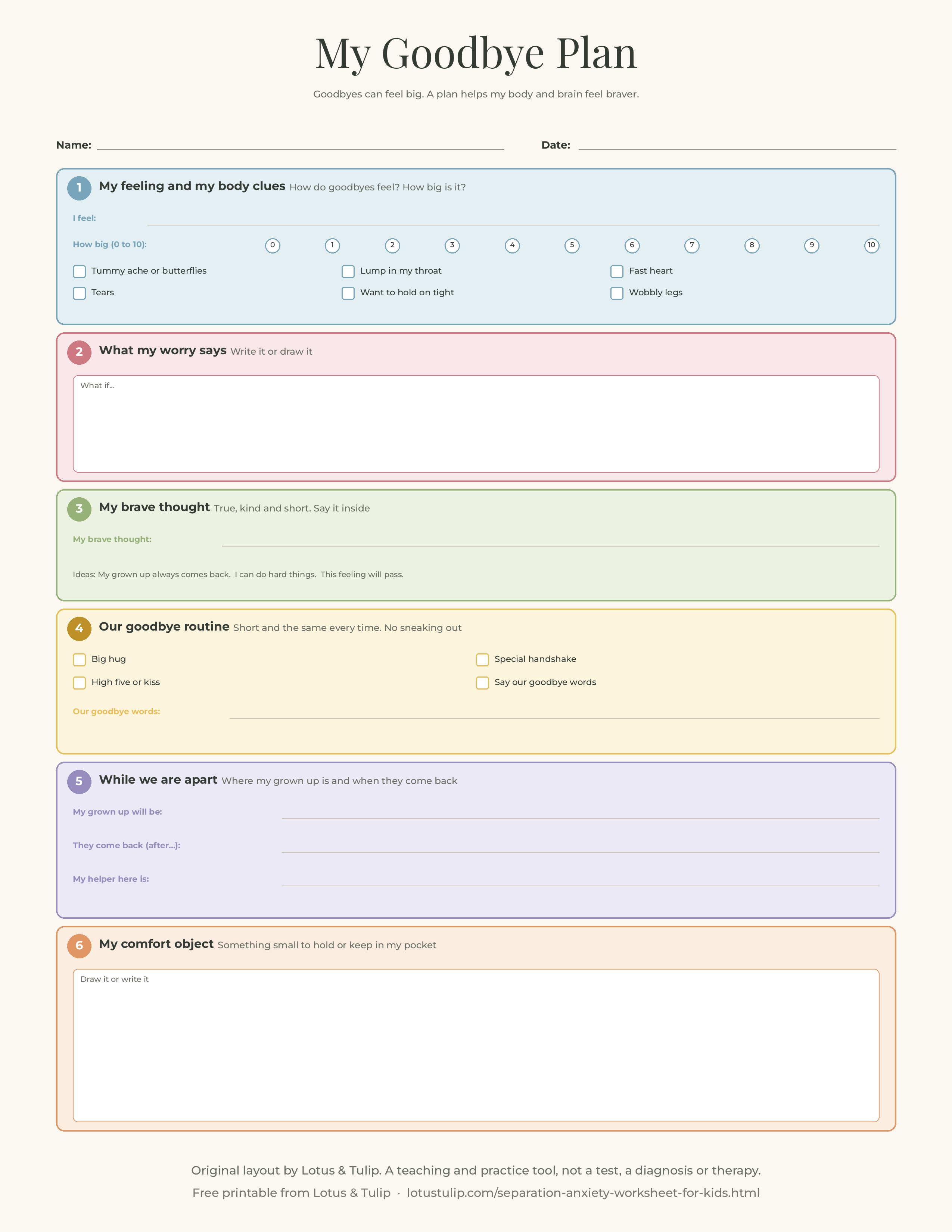
- Feelings and body clues. Young children often feel separation fear in the tummy, throat or legs before they can name a worry. Naming it and rating it from 0 to 10 makes it smaller and lets you track progress. See our feelings thermometer printable.
- The worry in the child's own words. "What if you don't come back?" "What if something happens to you?" Writing or drawing the worry makes it something to look at together.
- A goodbye routine. A short, predictable ritual, the same every time, such as a hug, a special handshake and one goodbye phrase. Long, drawn out goodbyes usually make distress worse.
- A plan for apart time. Where the grown up will be, when they will be back in words a child understands ("after lunch", not "at 1:30") and who the helper is while they are apart.
- A comfort object. A small item to hold or keep in a pocket, such as a photo, a bracelet or a note.
- A brave thought. A short, true, kind sentence to say inside: "Mom always comes back. I can do hard things."
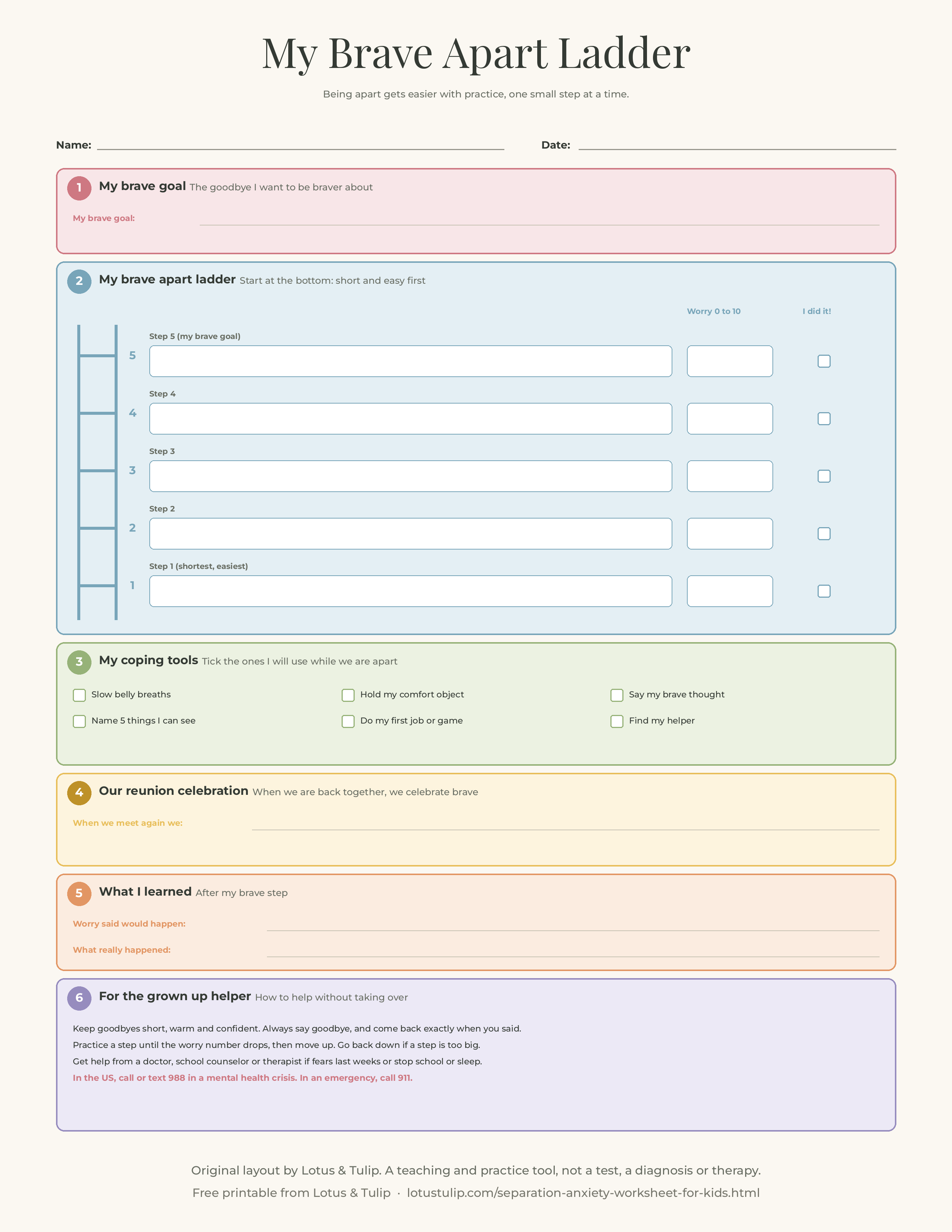
- A brave apart ladder. Steps from shortest and easiest to longest and hardest, practiced in order. This is the exposure part of treatment. See our exposure hierarchy worksheet for the full method.
- Coping tools and a reunion celebration. Calming skills for the hard moment and a small, happy reunion ritual that rewards the brave step, not the tears.
How to use a separation anxiety worksheet, step by step
- Pick a calm time to start. Fill in the worksheet together at a relaxed moment, not at the door in the middle of a goodbye. Tell the child you are making a plan to help their body and brain feel braver.
- Name the feeling and the body clues. Ask how goodbyes feel, where in the body and how big from 0 to 10. Drawing counts as an answer. Normalize it: "Lots of kids feel this way."
- Write down the worry. Ask what the worry says will happen. Listen without arguing. Then gently check it: "How many times have I picked you up? How many times did I come back?"
- Choose a brave thought. Help the child pick or write one short sentence that is true and helpful. Practice saying it out loud a few times before you need it.
- Build the goodbye routine. Agree on the same short ritual every time: for example a hug, a high five, "See you after snack, alligator." Keep it under a minute, then leave calmly. Never sneak out, which can make children more watchful and clingy.
- Make the apart plan. Write where the grown up will be, when they will be back in child friendly words and who the child can go to for help. Add the comfort object.
- Build the brave apart ladder. List five steps, from about 2 or 3 out of 10 up to the goal. For example: a parent in the next room for 5 minutes, a short walk to the mailbox, 30 minutes with a grandparent, a 2 hour playdate, a full school day without calling home. Each step should feel a little scary but doable.
- Practice often, then celebrate. Do the lowest step several times a week until the worry number drops, then move up. Come back exactly when you said you would. After each step, celebrate the bravery with the reunion ritual and ask, "What did worry say would happen, and what really happened?"
- Shrink accommodation and review weekly. Pick one accommodation to reduce slowly, such as answering calls only at a set time. Share the plan with the teacher or caregiver. If fears last more than a few weeks, keep a child from school, sleep or friendships, or come with talk of self harm, get professional help. In the US, call or text 988 in a mental health crisis, or call 911 in an emergency.
How to adapt it by age
- Ages 3 to 5: Keep it very concrete. Use pictures, a goodbye song or a picture book about a parent coming back, and short practice separations at home. Use routine words for time ("after nap"). Coach the parent more than the child.
- Ages 6 to 8: Most children can now name the worry, pick a brave thought and help choose ladder steps. Sticker charts for brave steps work well. School drop off is often the main goal, so involve the teacher.
- Ages 9 to 12: Children can weigh evidence ("What happened the last 20 times?") and take more charge of the ladder. Sleepovers, camps, school trips and being home alone briefly are common goals. Respect their privacy around friends.
- After a big change: Moves, a new sibling, illness in the family, divorce or a loss can make separation fears flare. Expect some regression, keep routines steady and start the ladder a step lower. Our divorce worksheets for kids help with family changes.
Separation anxiety and school
School mornings are where separation fears often show up most, as tummy aches, tears, slow dressing or refusing to get in the car. School staff can help a lot: a warm, predictable greeting at the door, a quick handover to a named adult, a small job to do right away (feeding the class fish, handing out folders) and a short check in later. Avoid letting a child call home whenever worry spikes; plan set times instead, and gradually space them out.
If a child misses school often or cannot get through the door at all, involve the school counselor early. The longer a child stays home, the harder going back usually feels. School counselors can see our small group counseling plan for attendance and the worry group curriculum for elementary students.
Common mistakes
- Sneaking out. It avoids tears today but teaches the child that a parent can vanish at any moment, which often makes clinging worse. Always say goodbye.
- Long, emotional goodbyes. Lingering, coming back for "one more hug" or looking worried tells the child the situation is dangerous. Short, warm and confident works better.
- Starting at the top of the ladder. A full day at camp as step one leads to escape, and escape strengthens the fear. Start low and climb.
- Coming back late. Early practice depends on trust. Return exactly when you said, especially in the first weeks.
- Removing all accommodation at once. Going from sleeping in the child's bed to leaving them alone overnight is too big a jump. Reduce in small steps, with warmth.
- Using a worksheet instead of help. If fears are severe, lasting or getting worse, a worksheet supports treatment from a pediatrician, school counselor or child therapist. It does not replace it.
Examples
- A kindergartner and drop off: A 5 year old cried and held on to his dad's leg every morning for the first month of school. With the counselor they set a goodbye routine (hug, secret handshake, "See you at pick up, crocodile"), a photo of his family in his pocket and a job feeding the class fish as soon as he arrived. The teacher greeted him at the door. By week three, the crying lasted under a minute, and by week five he walked in on his own most days.
- A second grader and bedtime: A 7 year old would only fall asleep with her mom lying next to her. Her ladder: mom sitting on the bed, then on a chair by the bed, then in the doorway, then checking in every 5 minutes, then every 10, then a goodnight and a check in the morning. She rated her worry each night and earned a sticker for each brave night. After five weeks she fell asleep on her own most nights.
- A fifth grader and a school trip: A 10 year old wanted to go on an overnight class trip but worried something would happen to his mom while he was away. He wrote down the worry, checked the evidence, chose the brave thought "Mom is safe at home and I'll see her Saturday," and practiced with a night at his grandparents' and then a sleepover at a friend's. He went on the trip with one planned phone call. For more on worry, see our worry worksheet for kids.
Free printable: separation anxiety worksheets for kids
This free printable is an original Lotus & Tulip design on US Letter, in our own wording. It is not a published questionnaire or a manualized treatment program and gives no score. Page 1, My Goodbye Plan, helps a child get ready for a goodbye: my feeling and how big from 0 to 10, body clues to tick, what the worry says, my brave thought, our goodbye routine, where my grown up will be and when they will be back, my helper and my comfort object. Page 2, My Brave Apart Ladder, turns the plan into practice: my brave goal, a five step ladder with a worry rating and an "I did it!" box for each step, my coping tools, our reunion celebration, what I learned (what worry said would happen and what really happened) and notes for the grown up helper with US crisis lines.
Download the free separation anxiety worksheets for kids (PDF, 2 pages, US Letter)
Prefer single images? Page 1: My Goodbye Plan (PNG) · Page 2: My Brave Apart Ladder (PNG)
Free to print for your own child, students, clients or groups. Please link to this page rather than re-uploading the file. A teaching and practice tool, not a test, a diagnosis or a substitute for therapy. In the US, call or text 988 in a mental health crisis. In immediate danger, call 911.
Buy the kids feelings worksheets on Etsy
Related resources
- Hospital stay worksheets for kids: for clinginess before and after surgery or a hospital stay, with a free coping plan
- Parent with cancer worksheets for kids: when goodbyes get harder because a parent is having cancer treatment
- Incarcerated parent worksheets for kids: for separation from a parent in jail or prison, with a free staying connected plan
- Military deployment worksheets for kids: for missing a parent who is deployed, with a free deployment plan
- New baby and big sibling worksheets for kids: for clinginess after a new baby arrives, with a free big sibling plan
- Moving worksheets for kids: helping children cope with moving to a new home, with a free moving plan
- Nightmare worksheets for kids: bad dreams and bedtime fears that keep a child from sleeping alone, free calm bedtime plan
- School refusal worksheets for teens: when an older child or teen avoids school, a free return plan
- Selective mutism worksheets for kids: when a child talks at home but cannot speak at school, a free talking map and brave talking ladder
- Anxiety worksheets for kids: signs of anxiety, what helps and a brave plan
- CBT worksheets for kids: thought detective and brave steps ladder
- Worry worksheet for kids: worry time, a worry box and brave steps
- Exposure hierarchy worksheet: how to build a fear ladder
- Breathing exercises for kids: calm the body before a goodbye
- Coping skills list for kids: ideas for the apart time
- Divorce worksheets for kids: help when family changes stir up separation fears
- All counseling resources for kids and teens
FAQ
At what age is separation anxiety normal?
Separation anxiety is a normal stage for babies and toddlers. It usually starts somewhere between 6 and 12 months, is strongest in the second year and fades by about age 2 to 3 as children learn that parents come back. Some upset at the start of preschool or kindergarten is also normal and should get smaller over the first weeks.
How do I know if it is separation anxiety disorder?
Signs that it may be more than a phase include fear that is much stronger than other children the same age, lasts at least 4 weeks and gets in the way of school, sleep, friendships or family life. Frequent worry that something will happen to a parent, refusing to sleep alone, nightmares about separation and stomach aches before goodbyes are common. A pediatrician or child mental health professional can assess it.
What is a separation anxiety worksheet for kids?
It is a printable page that helps a child prepare for and practice being apart from a parent or caregiver. Good ones include naming the feeling, the worry in the child's own words, a brave thought, a goodbye routine, a plan for the apart time and a step by step brave ladder, so the worksheet leads to practice, not just talk.
Should I sneak out to avoid tears?
No. Sneaking out may avoid tears in the moment, but it can teach a child that a parent might disappear without warning, which often makes clinging and watchfulness worse. A short, warm, predictable goodbye, followed by leaving calmly and coming back when you said, works better over time.
Does treatment for separation anxiety work?
For many children, yes. In a 2011 randomized trial with 43 children ages 5 to 7, about 76% of those in a separation anxiety program with parent training and CBT no longer met criteria at follow up, compared with about 14% on a waiting list. Follow up was short, and results vary, so progress should be checked and the plan adjusted.
How can school counselors help a child with separation anxiety?
Plan a predictable morning handover to a named adult, give the child a small job on arrival, schedule short check ins instead of open ended calls home and work with parents on a brave apart ladder. If attendance is slipping, act early, because time away from school usually makes returning harder.
When should a child see a professional?
Get help from a pediatrician, school counselor or licensed child therapist if separation fears last more than a few weeks, keep a child from school or sleep, keep getting worse, or come with talk of self harm or wanting to die. In the US, call or text 988 in a mental health crisis, or call 911 in an emergency.
Sources
- Feriante, J., Torrico, T. J., and Bernstein, B. Separation anxiety disorder (updated 2023). In StatPearls. Treasure Island (FL): StatPearls Publishing. ncbi.nlm.nih.gov/books/NBK560793.
- Kossowsky, J., Pfaltz, M. C., Schneider, S., Taeymans, J., Locher, C., and Gaab, J. (2013). The separation anxiety hypothesis of panic disorder revisited: A meta-analysis. American Journal of Psychiatry, 170(7), 768 to 781.
- Lebowitz, E. R., Woolston, J., Bar-Haim, Y., and others (2013). Family accommodation in pediatric anxiety disorders. Depression and Anxiety, 30(1), 47 to 54.
- Lebowitz, E. R., Marin, C., Martino, A., Shimshoni, Y., and Silverman, W. K. (2020). Parent-based treatment as efficacious as cognitive-behavioral therapy for childhood anxiety: A randomized noninferiority study. Journal of the American Academy of Child and Adolescent Psychiatry, 59(3), 362 to 372.
- Merikangas, K. R., He, J. P., Burstein, M., and others (2010). Lifetime prevalence of mental disorders in U.S. adolescents: Results from the National Comorbidity Survey Replication, Adolescent Supplement (NCS-A). Journal of the American Academy of Child and Adolescent Psychiatry, 49(10), 980 to 989.
- MSD Manual Professional Edition. Separation anxiety and stranger anxiety. msdmanuals.com.
- Schneider, S., Blatter-Meunier, J., Herren, C., Adornetto, C., In-Albon, T., and Lavallee, K. (2011). Disorder-specific cognitive-behavioral therapy for separation anxiety disorder in young children: A randomized waiting-list-controlled trial. Psychotherapy and Psychosomatics, 80(4), 206 to 215.
- Shear, K., Jin, R., Ruscio, A. M., Walters, E. E., and Kessler, R. C. (2006). Prevalence and correlates of estimated DSM-IV child and adult separation anxiety disorder in the National Comorbidity Survey Replication. American Journal of Psychiatry, 163(6), 1074 to 1083.
- Walkup, J. T., Albano, A. M., Piacentini, J., and others (2008). Cognitive behavioral therapy, sertraline, or a combination in childhood anxiety. New England Journal of Medicine, 359(26), 2753 to 2766.