
Kids and teens · Calm breathing · Updated 2026-11-04
Breathing exercises for kids: 12 calm breathing techniques with steps, age by age tips and a free printable
Ready-made printable: Mindfulness Worksheets for Kids and Teens Holiday 20% off: about $9.20, was $12 (EUR 10) · instant digital download
Buy on Etsy
"Just take a deep breath" is probably the most common calming advice adults give children, and one of the least taught. Told in the middle of a tantrum, it often turns into a big, fast gulp of air that does nothing, or makes a child feel worse. Taught on purpose, when a child is calm, slow breathing can become a tool they actually reach for before a test, after a fight at recess or at bedtime. This guide is for US teachers, school counselors, therapists who work with children and teens, and parents. It explains what slow breathing does and what the research really shows, how to adapt breathing exercises for preschoolers, elementary students and teens, 12 named kid friendly techniques with exact steps, when breathing does not help or can backfire, routines for the classroom, the counseling office and home, and common mistakes. It ends with a free three page printable: a set of 12 breathing cards, a one page calm breathing poster and a practice tracker.
Jump to the free breathing exercises printable
Why slow breathing helps kids calm down
Breathing is unusual: it runs on its own, but we can also take control of it. That makes it one of the few parts of the body's stress response a child can change on purpose. When a child is scared or angry, breathing tends to get faster and higher in the chest. Slowing it down, and especially making the out breath long and relaxed, works in the opposite direction.
A simple way to explain the physiology without overclaiming:
- Heart rate rises and falls with each breath. In most healthy people, the heart beats a little faster on the in breath and a little slower on the out breath. This normal rhythm is called respiratory sinus arrhythmia.
- Slow breathing makes those swings bigger. Heart rate variability (HRV), the beat to beat variation in heart rate, tends to rise during slow breathing. Higher HRV at rest is generally read as a sign of more parasympathetic, "rest and digest" activity, which is carried in large part by the vagus nerve.
- There is a sweet spot in adults. Researchers Paul Lehrer and Richard Gevirtz, writing in Frontiers in Psychology in 2014, described how breathing at around 6 breaths per minute in adults lines up heart rate and breathing so that these swings are largest, which is the basis of HRV biofeedback. Children do not need to hit any particular number; slower and smoother than their usual breathing is the goal.
Be careful with the popular shortcut "deep breathing activates the vagus nerve." It is a reasonable simplification of the HRV findings, but it is not something anyone can measure in a child at a calm down corner, and it is not proof that a particular exercise will work for a particular child. The honest version: slow breathing is linked to changes in the body that go along with feeling calmer, and many people, children included, report feeling calmer after doing it.
What the research says
Most breathing research has been done with adults, and much of it is small. Here is the picture, stated as carefully as the studies allow.
- A systematic review of slow breathing. In 2018, Andrea Zaccaro and colleagues published a systematic review in Frontiers in Human Neuroscience on slow breathing (under 10 breaths per minute) in healthy people. Out of 2,461 abstracts, only 15 studies met their criteria. Slow breathing was linked to increased HRV and respiratory sinus arrhythmia, changes in brain activity on EEG (more alpha, less theta), and reports of more comfort, relaxation, alertness and vigor, with fewer symptoms of arousal, anxiety, depression, anger and confusion. The authors themselves note that the evidence base is small and that study methods varied.
- An eight week training study. Xiao Ma and colleagues, in a 2017 study in Frontiers in Psychology, randomly assigned 40 healthy adults to diaphragmatic breathing training (20 sessions over 8 weeks, coached, with real time feedback) or no training. After training, the breathing group showed less negative mood and lower salivary cortisol. Sustained attention improved in both groups, more in the breathing group. It was a small pilot study in adults, so treat it as encouraging rather than conclusive.
- Children before a test. Kiat Hui Khng, in a 2017 study in Cognition and Emotion, tested 122 fifth grade students in Singapore. Children who took deep breaths before a timed math test reported less anxiety and did better on the test than a control group.
- Exhale focused breathing in adults. In a 2023 randomized study in Cell Reports Medicine, Melis Yilmaz Balban, David Spiegel, Andrew Huberman and colleagues compared three daily 5 minute breathing practices with 5 minutes of mindfulness meditation for a month. Breathing practices together, and cyclic sighing (two inhales, then a long exhale) in particular, increased positive mood more than meditation and lowered resting breathing rate. The study was remote and exploratory, and it found no significant differences in heart rate or HRV.
The practical takeaway: slow, exhale focused breathing is low cost, low risk for most children, and reasonably supported as a short term calming and focusing tool. It is not a treatment for an anxiety disorder on its own, and most of the research is in adults rather than children. That is why this guide puts as much weight on practice routines and on knowing when breathing is the wrong tool as on the techniques themselves.
Breathing exercises by age
| Age | What works | Keep in mind |
|---|---|---|
| Preschool (3 to 5) | Concrete pictures and props: blowing bubbles, a pinwheel or a feather, smelling a flower and blowing out a candle, a stuffed animal riding on the belly. One to three breaths at a time. | Young children cannot count to 4 while breathing. Skip breath holds. Make the out breath something they can see or hear. |
| Early elementary (5 to 8) | Stories and movement: balloon, bunny, snake, hot cocoa and five finger breathing. Three to five breaths. Practice daily at the same time. | Children this age love "silly" breaths. Use that for practice, then move to the quieter ones for real upset moments. |
| Upper elementary (8 to 11) | Counting and tracing: square breathing with counts of 3 or 4, figure eight breathing, breathing cards they can choose from. One to two minutes. | Explain the why in one sentence. Let them pick a favorite and notice what changes in their body. |
| Middle and high school (11 to 18) | Longer exhales (in for 4, out for 6), the double sigh, box breathing before tests or games, quiet breathing they can do without anyone noticing. | Teens drop anything that feels babyish. Link it to sports, music, test performance and sleep. Respect a no; offer it, do not force it. |
12 breathing exercises for kids, with steps
For all of these: sit or stand comfortably, let the shoulders drop, and breathe in gently through the nose if that is comfortable. The out breath should be slow and relaxed, never forced. Three to five rounds is plenty for younger children. Stop if a child feels dizzy or uncomfortable.
1. Balloon breathing (belly breathing)
- Put one hand on your belly.
- Breathe in slowly through your nose and imagine a balloon in your belly filling up. Feel your hand move out.
- Breathe out slowly through your mouth and let the balloon gently go down.
- Repeat 3 to 5 times.
This is the base skill for almost every other technique. If a child's shoulders shoot up when they breathe in, the balloon image helps move the breath lower.
2. Hot cocoa breathing
- Hold your hands like you are holding a warm mug of hot cocoa.
- Breathe in through your nose and smell the chocolate.
- Blow out slowly through your mouth to cool it down, gently, so it does not spill.
- Repeat 3 to 5 times.
The "do not spill it" detail is what slows the out breath. Swap in soup or tea if a child prefers.
3. Five finger breathing (starfish breathing)
- Spread one hand out like a starfish.
- Use the pointer finger of your other hand to trace up your thumb as you breathe in.
- Trace down the other side as you breathe out.
- Keep going up and down each finger until you have traced all five fingers, five slow breaths.
Tracing gives the eyes and hands a job, which helps children who find it hard to sit still. It can be done under a desk without anyone noticing.
4. Square breathing (box breathing)
- Look at a square, or trace one in the air or on your hand.
- Breathe in for 3 as you trace the first side.
- Hold gently for 3 along the top.
- Breathe out for 3 down the next side.
- Hold gently for 3 along the bottom. Repeat 3 to 4 times.
Older children and teens can use counts of 4. Keep the holds soft and short; if holding feels uncomfortable or makes a child anxious, skip the holds and just breathe in and out along the sides.
5. Bunny breathing
- Pretend you are a bunny sniffing for carrots.
- Take three quick little sniffs in through your nose.
- Let out one long, slow breath through your mouth.
- Repeat 3 times, then breathe normally.
Many children find bunny breathing helpful when they are crying, because it matches their jerky breathing and then lengthens the out breath. Keep it to a few rounds; quick sniffs repeated for a long time are not the goal.
6. Snake breathing
- Breathe in slowly through your nose.
- Breathe out slowly while making a long, quiet "sssss" sound like a snake.
- Try to make your hiss last a little longer each time.
- Repeat 3 to 5 times.
The hiss makes the out breath audible, so an adult can hear whether it is slowing down.
7. Flower and candle breathing
- Hold up one finger as a flower, or hold a real or paper flower.
- Breathe in slowly through your nose to smell the flower.
- Hold up another finger as a candle.
- Breathe out slowly to blow out the candle, gently enough to make the flame flicker before it goes out.
- Repeat 3 to 5 times.
This is a favorite for preschool and kindergarten. The "flicker, not blast" detail turns a big puff into a slow exhale.
8. Bumblebee breathing (humming breath)
- Breathe in slowly through your nose.
- Close your lips and breathe out with a long, low "mmmmm" hum, like a bumblebee.
- Notice the buzzing feeling in your face and head.
- Repeat 3 to 5 times.
Some children like to cover their ears gently while humming. Others find the sound too much; let them choose.
9. Bubble, pinwheel or feather breathing
- Hold a bubble wand, pinwheel or feather in front of your mouth.
- Breathe in through your nose.
- Breathe out slowly to make the biggest bubble you can, keep the pinwheel turning as long as you can, or keep the feather moving without blowing it away.
- Repeat 3 to 5 times.
Props show a child the difference between a fast puff and a slow, steady breath. A big bubble only happens with a slow exhale.
10. Belly buddy breathing (teddy bear breathing)
- Lie down on your back and put a small stuffed animal on your belly.
- Breathe in slowly and watch your buddy rise.
- Breathe out slowly and rock your buddy down, gently, so it does not fall off.
- Repeat for 5 to 10 breaths.
A good bedtime routine and a good way to teach belly breathing to children who cannot feel it with a hand. Sesame Street's "Belly Breathe" song is built on the same idea.
11. Figure eight breathing (lazy 8)
- Trace a sideways figure eight on paper, on the desk or in the air.
- Breathe in as you trace the left loop.
- Breathe out as you trace the right loop.
- Keep tracing for 4 to 6 loops.
Like five finger breathing, tracing gives restless hands something to do. Page 2 of the free printable has a lazy 8 to trace.
12. Double sigh (for older kids and teens)
- Breathe in through your nose until your lungs feel comfortably full.
- Take a second, shorter sip of air in through your nose on top of it.
- Let it all out with a long, slow breath through your mouth.
- Repeat 2 to 3 times, then breathe normally.
This is the "cyclic sighing" pattern from the 2023 Stanford study, which was done with adults. It is a good fit for teens who want something quick and discreet. Younger children can do one or two double sighs, but should not do it for minutes on end.
How to teach breathing exercises to kids, step by step
- Teach it when the child is calm. A breathing exercise is a skill, and skills are learned when the thinking brain is available. The first time a child tries balloon breathing should never be in the middle of a meltdown.
- Explain the why in one sentence. For example: "When we are upset our body speeds up, and slow breathing, especially a slow breath out, helps it slow down again." For teens, add a sentence about heart rate and breathing.
- Model it first. Do the exercise yourself, out loud and slowly, before asking the child to try. Children copy pace more than words.
- Start with one technique and a short practice. Three breaths is enough on day one. Choose a technique that fits the child's age from the table above.
- Make the out breath visible or audible. Use a prop, a hiss, a hum or a tracing finger so the child can see and hear a slow exhale.
- Ask what they noticed. "What changed in your body?" There is no right answer. Some children feel calmer, some feel nothing, a few feel silly. All of that is information.
- Practice daily at a set time. Morning meeting, after recess, before a test, in the car, at bedtime. One to two minutes a day builds the habit.
- Let the child pick a favorite. Use the breathing cards in the free printable. Children are more likely to use a breath they chose themselves.
- Use it early, before the big feeling. Once a breath is familiar, prompt it at the first sign of frustration ("Your shoulders are going up, want to do your snake breath?"), and track it on the practice tracker so you both can see whether it helps.
When breathing exercises do not help, or can backfire
Breathing is a good tool, not a universal one. Knowing its limits protects children and keeps the skill from becoming something they hate.
- Forcing breathing during a meltdown. A child who is in full fight or flight usually cannot follow multi step instructions, and being told "breathe!" can feel like being told to stop feeling. In that moment, keep everyone safe, lower your voice, reduce talking and simply breathe slowly yourself near the child. Children often settle by matching a calm adult. Offer the breathing card once they are coming down.
- Breathing too fast or too deep. Big, rapid "deep breaths" can lead to overbreathing (hyperventilation), which lowers carbon dioxide in the blood. MedlinePlus lists symptoms such as feeling lightheaded or dizzy, numbness or tingling around the mouth or in the arms, and muscle spasms in the hands and feet. The fix is slower and gentler, not bigger: a soft breath in, a long slow breath out through pursed lips. If a child gets dizzy, stop the exercise, have them sit down and breathe normally.
- Breath holds for young or anxious children. Holding the breath can feel scary for some children, especially those with anxiety, asthma or a history of trauma. Holds are optional in every technique here.
- Asthma and other breathing conditions. Calm breathing exercises are not a treatment for asthma and never replace a child's inhaler or asthma action plan. A 2016 Cochrane review of breathing exercises for children with asthma found too little reliable evidence to draw conclusions. If a child with asthma is wheezing, coughing or struggling to breathe, follow their asthma action plan and get medical help; do not ask them to do a breathing game. Talk with the child's family or doctor before using breathing exercises with a child who has asthma or another lung or heart condition.
- Trauma and focus on the body. For some children who have experienced trauma, closing their eyes or focusing on their breath can bring up distress. Let eyes stay open, offer a choice of activities, and stop if a child becomes more upset. A trauma informed therapist can help.
- When the problem is not the body. A child who is being bullied, is hungry, is in pain or needs a break from an impossible task needs that problem solved. Breathing helps a child get calm enough to deal with a problem; it does not make the problem go away.
- Using it as a punishment. "Go sit there and breathe" turns a coping skill into a consequence. Keep breathing practice positive and voluntary.
Breathing exercises are not a substitute for professional care. If a child has frequent panic, ongoing worry, outbursts that are getting worse, or physical symptoms you are unsure about, involve the school counselor, the family, the pediatrician or a mental health professional.
Breathing routines for the classroom, counseling office and home
In the classroom
- Morning breath. Start the day with three balloon breaths together, led by a different student each day.
- Transition breath. After recess or lunch, before starting work: one minute of five finger breathing with the lights dimmed.
- Before tests. Two minutes of slow breathing before a quiz, in line with the Khng study. Older students can use box breathing or longer exhales.
- Poster at eye level. Hang the calm breathing poster from the free printable in the calm down corner and point to it rather than lecturing.
In the counseling office or therapy room
- Breath of the week. In a small group, teach one technique per session, practice it, and have each student rate how calm they feel before and after on a 1 to 5 scale.
- Breath and feelings. Pair breathing with a feelings check: name the feeling, rate its size, pick a breath card, re-rate. This turns breathing into data a child can see.
- Build a menu. By the end of a group, each child should have two or three favorite breaths written on a card or added to their coping plan.
At home
- Bedtime belly buddy. Five belly buddy breaths with a favorite stuffed animal as part of the bedtime routine.
- Car breathing. Practice snake or bumblebee breathing at red lights. Low stakes, daily repetition.
- Parent goes first. When you feel frustrated, say it out loud: "I am getting frustrated, I am going to do three hot cocoa breaths." Children learn the skill by watching you use it.
Common mistakes
- Only teaching it in a crisis. A skill first used in a meltdown rarely works. Practice when calm, often.
- Saying "take a deep breath" without showing how. Children often take a big gasp. Teach "slow and low" and a long breath out instead.
- Too many rounds. Ten fast, deep breaths can make a child dizzy. Three to five slow ones are better.
- Long breath holds. Keep holds optional and short, especially for young children.
- Making it a performance. Do not ask a reluctant child to demonstrate in front of the class. Offer quiet options like five finger breathing.
- Promising too much. "This will make your anxiety go away" sets a child up to feel they failed. Try: "This might help your body feel a bit calmer. Let's see."
- Never checking if it helps. Use a simple before and after rating. If a technique does not help this child, try another one or another kind of coping skill.
Safety note: If a child, teen or adult is struggling or having thoughts of suicide, call or text the 988 Suicide and Crisis Lifeline at 988 or chat at 988lifeline.org. It is free, confidential and available 24 hours a day. In a life threatening emergency, including serious trouble breathing, blue or gray lips, or chest pain, call 911. This guide and printable are educational and are not a substitute for medical or mental health care.
Free breathing exercises printable (PDF)
This free printable is an original Lotus & Tulip design, sized for US Letter paper and suited to preschool through middle school, small groups and home. It has three pages:
- Page 1: Breathing cards. Twelve cut apart cards, one for each technique in this guide (balloon, hot cocoa, five finger, square, bunny, snake, flower and candle, bumblebee, bubble, belly buddy, figure eight and double sigh), each with a simple picture and short steps.
- Page 2: Calm breathing poster. A one page chart: notice, slow down, breathe, check in, with a square to trace for box breathing, a lazy 8 to trace, a five finger reminder and a "slow and low" tip.
- Page 3: Breathing practice tracker. Two weeks, Monday to Friday: when I practiced, which breath I used, how I felt before and after on a 1 to 5 scale, plus "my favorite breaths" and an adult notes box.
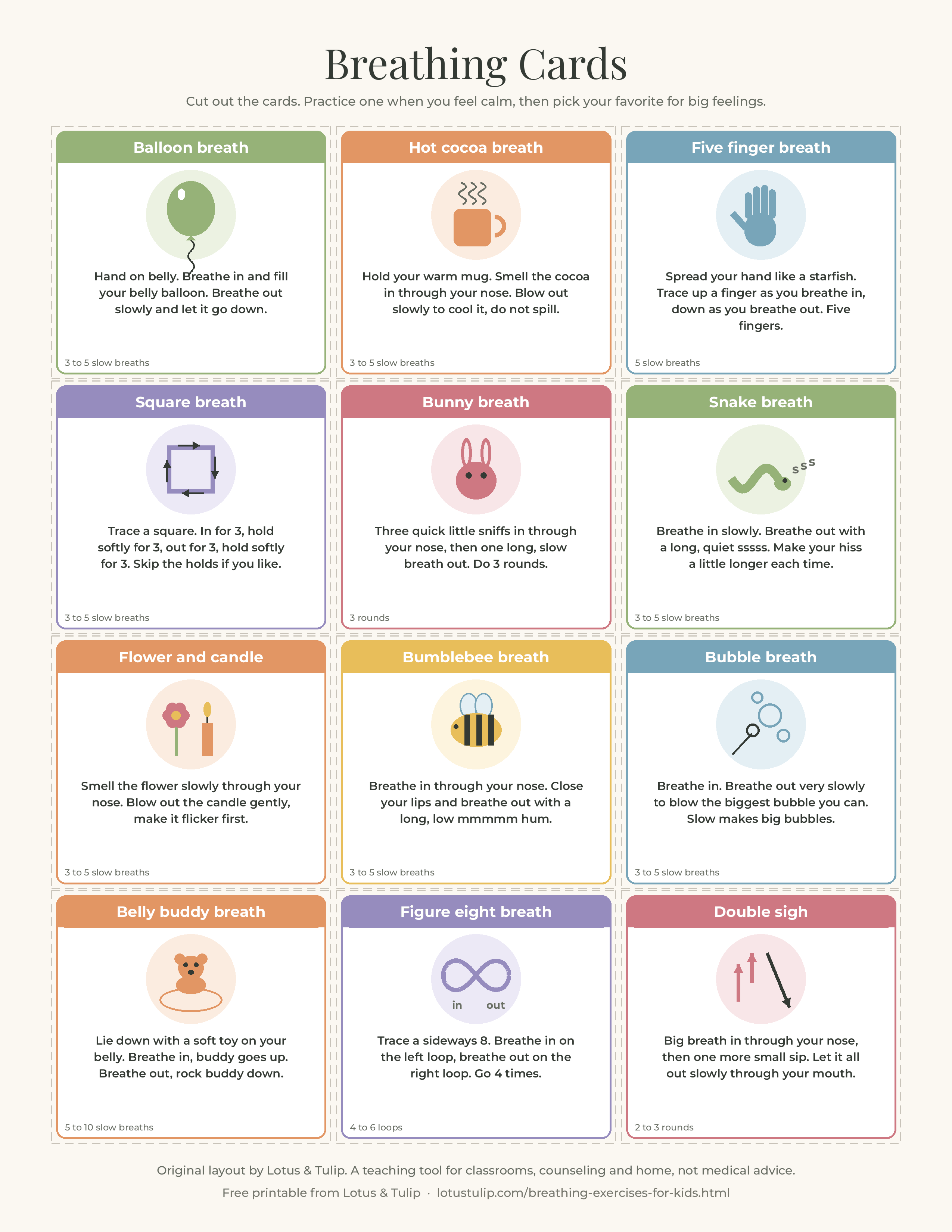
Download the free breathing exercises printable (PDF, 3 pages, US Letter)
Prefer single images? Page 1: Breathing cards (PNG) · Page 2: Calm breathing poster (PNG) · Page 3: Breathing practice tracker (PNG)
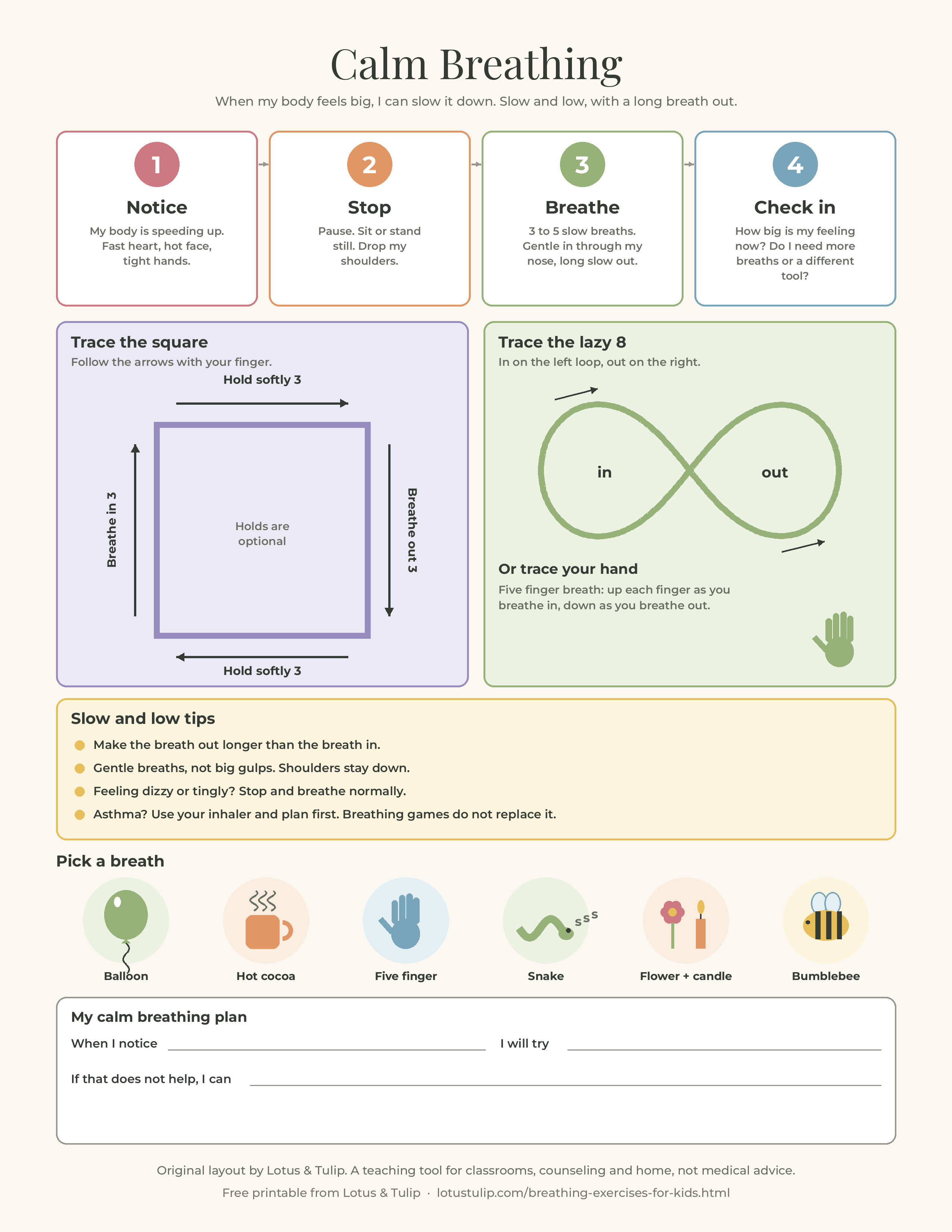
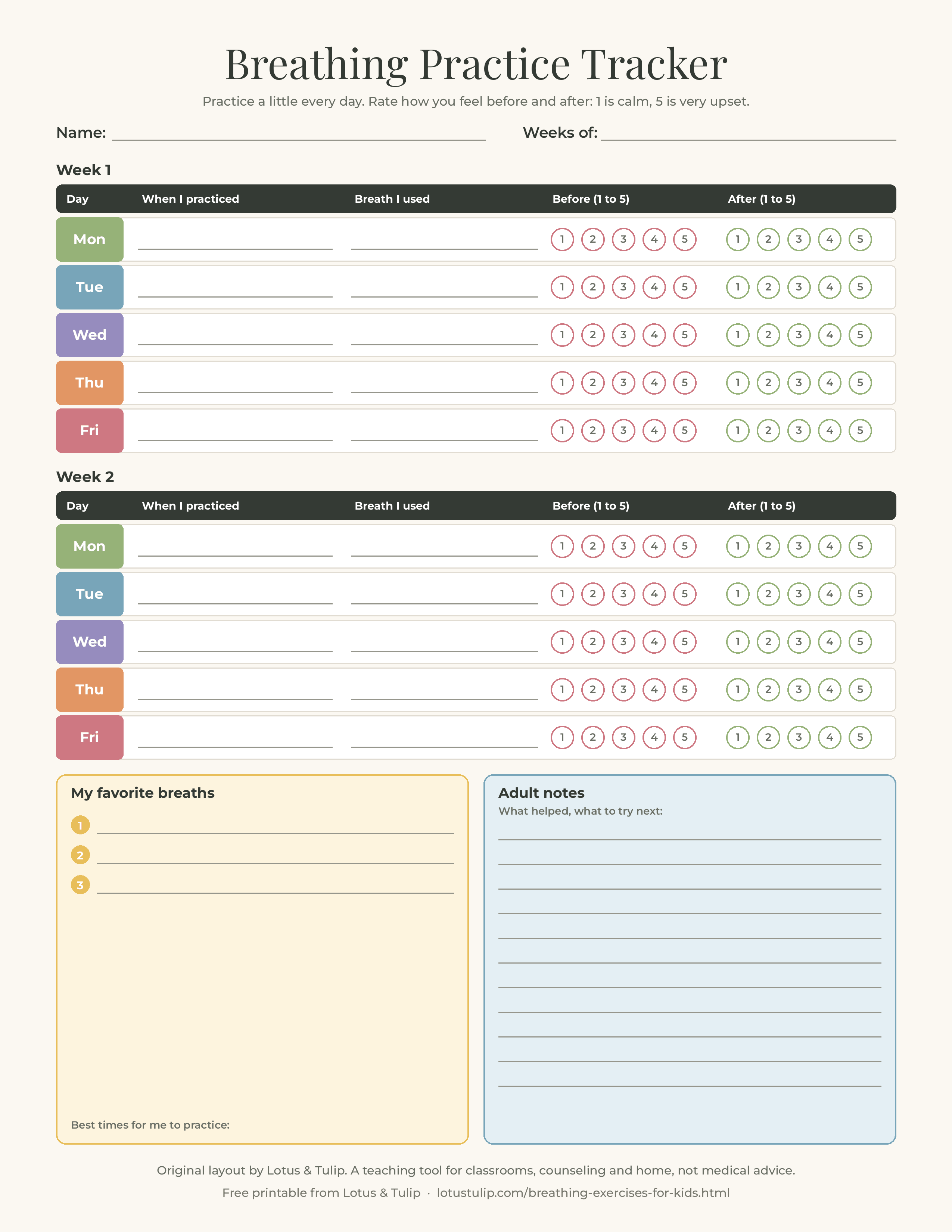
Free to print for your own use and for use with your own students, clients or children. Please link to this page rather than re-uploading the file.
Related resources
- Sensory processing activities for kids: too much, too little and seeking, with a free sensory map and day plan
- Coping skills list for kids, 60 ideas (free printable)
- Calm down corner ideas (free calm down steps printable)
- DBT TIPP skills worksheet, including paced breathing for teens (free printable)
- 5 4 3 2 1 grounding worksheet (free printable)
- Feelings thermometer printable (free)
- Window of tolerance worksheet (free printable)
Sources
- Zaccaro, A., Piarulli, A., Laurino, M., Garbella, E., Menicucci, D., Neri, B., and Gemignani, A. (2018). How breath-control can change your life: a systematic review on psycho-physiological correlates of slow breathing. Frontiers in Human Neuroscience, 12, 353.
- Ma, X., Yue, Z.-Q., Gong, Z.-Q., Zhang, H., Duan, N.-Y., Shi, Y.-T., Wei, G.-X., and Li, Y.-F. (2017). The effect of diaphragmatic breathing on attention, negative affect and stress in healthy adults. Frontiers in Psychology, 8, 874.
- Khng, K. H. (2017). A better state-of-mind: deep breathing reduces state anxiety and enhances test performance through regulating test cognitions in children. Cognition and Emotion, 31(7), 1502 to 1510.
- Balban, M. Y., Neri, E., Kogon, M. M., Weed, L., Nouriani, B., Jo, B., Holl, G., Zeitzer, J. M., Spiegel, D., and Huberman, A. D. (2023). Brief structured respiration practices enhance mood and reduce physiological arousal. Cell Reports Medicine, 4(1), 100895.
- Lehrer, P. M., and Gevirtz, R. (2014). Heart rate variability biofeedback: how and why does it work? Frontiers in Psychology, 5, 756.
- Macêdo, T. M. F., Freitas, D. A., Chaves, G. S. S., Holloway, E. A., and Mendonça, K. M. P. P. (2016). Breathing exercises for children with asthma. Cochrane Database of Systematic Reviews, CD011017.
- MedlinePlus Medical Encyclopedia. Hyperventilation. US National Library of Medicine.
- 988 Suicide and Crisis Lifeline, 988lifeline.org.
FAQ
What are good breathing exercises for kids?
Good breathing exercises for kids use a picture or prop to make the out breath slow and visible: balloon (belly) breathing, hot cocoa breathing, five finger breathing, flower and candle breathing, snake breathing, bubble breathing and belly buddy breathing for young children, and square breathing or a double sigh for older kids and teens. Three to five slow breaths is enough.
How do you teach a child to take a calm breath?
Teach it when the child is calm, not during a meltdown. Model it yourself, use one simple technique with a picture or prop, focus on a slow, gentle out breath rather than a big in breath, practice a few breaths every day at the same time, and let the child pick a favorite to use when feelings start to build.
Do breathing exercises really help kids with anxiety?
They can help in the moment. Research in adults links slow breathing to more relaxation and less anxiety, and a 2017 study of 122 fifth graders found that deep breathing before a math test reduced anxiety and improved scores. Breathing is a useful short term tool, but it is not a treatment for an anxiety disorder on its own. Children with ongoing anxiety should see a professional.
What is the 5 finger breathing technique?
Five finger breathing, sometimes called starfish breathing, means spreading one hand and tracing it with a finger of the other hand: breathe in as you trace up each finger and breathe out as you trace down. Tracing all five fingers gives five slow breaths and keeps hands and eyes busy.
Is box breathing safe for kids?
For most children, a gentle version is fine. Use short counts of 3 or 4 and keep the holds soft and optional. Skip the holds for young children or anyone who finds holding the breath uncomfortable, and stop if a child feels dizzy. Check with the child's doctor first if they have asthma or another lung or heart condition.
Why does my child get dizzy doing deep breathing?
Dizziness usually means they are breathing too fast or too deeply, which lowers carbon dioxide in the blood. Have them stop, sit down and breathe normally. Next time, teach smaller, slower breaths with a long, gentle out breath, and do only three to five rounds. If dizziness happens without fast breathing, or with chest pain or fainting, seek medical advice.
Is this breathing exercises printable free?
Yes. It is free to print for your own use and for use with your own students, clients or children. Please link to this page rather than re-uploading the file.