
Kids and teens · Sensory processing for kids 4 to 12 · Updated 2026-11-15
Sensory processing activities for kids: what sensory differences look like, what research shows and a free sensory day plan

Ages 5 to 11: Kids Feelings and Social Skills Worksheets, incl. feelings detective, body clues, a feelings thermometer, a coping skills menu and a calm down plan Holiday 20% off: about $11.04, was $14 (EUR 12) · fillable PDF, instant digital download
Buy on EtsyTry it free first: download a fillable sample (feelings thermometer and calm-down plan, PDF, 240 KB). Type into it on screen, then get the full pack. No email needed.
Calm and move tools: Coping Skills Cards for Kids and Teens, 96 printable cards plus a coping skills list, toolbox worksheet and tracker Holiday 20% off: about $5.52, was $7 (EUR 6) · instant digital download
Buy on EtsyMake the day predictable: Visual Schedule and Behavior Supports, 23 pages with token boards, a reward menu, first then boards and 136 picture cards Holiday 20% off: about $6.44, was $8 (EUR 7) · instant digital download
Buy on EtsyOne child screams when the hand dryer starts, refuses every shirt with a seam and eats five foods. Another climbs the bookshelf, crashes into the couch on purpose and chews through every pencil and hoodie string. A third seems not to notice when someone calls her name, or when her knee is bleeding. All three may be showing differences in how their bodies take in and respond to sensory information.
This guide is for parents, teachers, school counselors and therapists supporting children about 4 to 12. It explains the senses involved, the three common patterns (too much, too little and seeking), what pediatricians say about the label "sensory processing disorder", what research shows and does not show, eight kinds of sensory processing activities, nine steps to build a sensory day plan, age and need adaptations, the classroom side, common mistakes and three short examples. It ends with a free 2 page printable: My Sensory Map and My Sensory Day Plan.
When to talk with your child's doctor first: if sensory reactions limit what your child eats, how they sleep, or whether they can manage school, haircuts or friendships; if you also notice delays in speech, play or motor skills, or a loss of skills they had; if your child hurts themselves (head banging, biting) or seems not to feel pain; or if hearing or vision has not been checked. Sensory differences are a common part of autism, ADHD, developmental coordination disorder and anxiety, so a full evaluation matters more than any activity list. Never place weighted blankets or weighted sleep products on or near a sleeping baby. If a child talks about wanting to die or hurting themselves, call or text 988 (the 988 Suicide and Crisis Lifeline). If anyone is in immediate danger, call 911.
Download the free sensory processing worksheets for kids (PDF, 2 pages, US Letter)
Direct download, no email or sign up. See the pages first. Setting up a quiet space? See calm down corner ideas. Want to teach hunger, thirst and feelings clues? See interoception activities for kids.
What sensory processing means, in plain words
Sensory processing is how the brain notices, sorts and responds to information from the body and the world. Most of us learned five senses at school. Occupational therapists usually talk about eight:
- Touch (tactile): textures, clothing, temperature, pain, being touched.
- Hearing (auditory): sounds, volume, background noise.
- Sight (visual): light, movement, clutter, faces.
- Taste (gustatory): flavors and how food feels in the mouth.
- Smell (olfactory): food, soap, perfume, cleaning products and other scents.
- Movement and balance (vestibular): the inner ear sense that tells us when we spin, swing, tip or fall.
- Body position (proprioception): signals from muscles and joints that tell us where our body is and how hard we are pushing.
- Inside body signals (interoception): hunger, thirst, a full bladder, a racing heart. See interoception activities for kids for this one in depth.
Three common patterns
- Too much (over-responsive or sensory sensitive). Ordinary input feels loud, scratchy, bright or overwhelming. The child covers ears, avoids messy play, gags on textures, melts down in busy stores or refuses haircuts and tooth brushing.
- Too little (under-responsive). The child seems slow to notice: does not hear their name, does not notice a runny nose or a scrape, looks tired or "switched off" and needs extra input to get going.
- Seeking. The child goes looking for more: spinning, jumping, crashing, touching everything, chewing shirts, making noise and finding it very hard to sit still.
Most children show a mix, and the mix can change with tiredness, hunger, stress and setting. A child can avoid noise and seek movement at the same time. That is why the free sensory map below asks about each sense separately instead of putting a child in one box.
Is sensory processing disorder a diagnosis?
This is the question parents ask most, and the honest answer is: not officially. In 2012 the American Academy of Pediatrics said there is no universally accepted framework for diagnosing sensory processing disorder, so it generally should not be diagnosed on its own. It is unclear whether children with sensory problems have a separate disorder of the sensory pathways or whether these difficulties are features of other conditions. The AAP listed autism, ADHD, developmental coordination disorder and childhood anxiety disorders as conditions where difficulty tolerating or processing sensory information is often seen, and asked doctors to complete a thorough evaluation for these.
The DSM-5 criteria for autism do include sensory differences: "hyper- or hyporeactivity to sensory input or unusual interest in sensory aspects of the environment", for example indifference to pain or temperature, distress at specific sounds or textures, or fascination with lights or movement (as summarized by the CDC). So sensory differences are real and well documented. What is debated is whether they make up a stand alone disorder.
For families this matters in practice. The sensory differences you see are worth taking seriously, but they are a reason to get a broader evaluation, not an answer by themselves. You do not need a label to start helping your child feel more comfortable at home and school.
What the research shows, honestly
Sensory sensitivities are common in ordinary classrooms. In a US study that followed a representative sample of 925 children aged 7 to 11 from infancy, 16% of parents said at least four touch or sound sensations bothered their child. Children with higher sensory over-responsivity also had more worry, behavior and regulation problems and fewer adaptive social skills, according to their parents (Ben-Sasson, Carter and Briggs-Gowan, 2009).
Estimates of how many children have significant sensory problems vary. When parents of incoming kindergartners in one suburban US school district completed a sensory screening questionnaire, 13.7% of the 703 children whose parents responded met screening criteria. Assuming none of the non-responders did gives a cautious 5.3% of the 1,796 enrolled children. The authors called for rigorous epidemiological studies, and this remains a screening estimate based on parent perceptions, not a diagnosis count (Ahn and colleagues, 2004).
Sensory differences are very common in autism. In 281 autistic children aged 3 to 6, 95% showed some degree of sensory processing difference on a parent questionnaire compared with typically developing peers (Tomchek and Dunn, 2007). A meta-analysis of 14 studies found the largest differences in under-responsivity, followed by over-responsivity and sensation seeking, with the biggest gaps in children aged 6 to 9 (Ben-Sasson and colleagues, 2009).
Sensory over-responsivity and ADHD are related but separate. In a sample of 922 children followed from infancy to school age, groups emerged with high sensory over-responsivity only (35 children), high ADHD symptoms only (38), both (35) and neither (814). The authors concluded the two sets of symptoms occur independently (Ben-Sasson and colleagues, 2017). A child who cannot sit still might be seeking movement, might have ADHD, or both.
Anxiety and sensory sensitivity often travel together, and researchers do not yet know which causes which, or whether a shared risk factor drives both (Green and Ben-Sasson, 2010). In practice, a child who is anxious may react more strongly to noise, and a child who is overwhelmed by noise may become anxious about places that are loud.
Therapy evidence is mixed and depends on the type. A systematic review of 19 studies separated two approaches. Clinic based sensory integration therapy, delivered by occupational therapists using child directed, sensory rich play, showed positive effects on individual goals in two small randomized trials (effect sizes 0.72 to 1.62). Classroom sensory based strategies used on their own, such as weighted vests or therapy balls, showed few positive effects (Case-Smith, Weaver and Fristad, 2015). A separate review of seven weighted vest studies concluded that, on balance, they appear ineffective and cannot be recommended for clinical use (Stephenson and Carter, 2009).
Manualized occupational therapy using Ayres Sensory Integration has the strongest support, mostly in autism. In a randomized trial of 32 autistic children aged 4 to 8, those who received 30 sessions improved more on individual goals than a usual care group (effect size d = 1.2) and needed less caregiver help with self care (Schaaf and colleagues, 2014). A small Brazilian trial of 17 children aged 5 to 8 found similar gains (Omairi and colleagues, 2022). In a 2025 trial comparing this therapy, applied behavior analysis and no treatment, both therapies improved individual goals compared with no treatment, while gains in daily living skills over the no treatment group were not significant (Schaaf and colleagues, 2025).
What this means for you. No study has tested worksheets or home sensory activity lists like the ones on this page. They are supports, not treatment. Their value is practical: helping a child and the adults around them notice patterns, plan breaks before overload and choose activities the child actually likes. The AAP suggests that families who try sensory based therapy agree on a trial period and clear goals and check whether things are really improving. That advice works for home activities too.
What sensory activities can and cannot do
Sensory activities can make daily life more comfortable and predictable. They give a seeking child safe ways to move and push, give a sensitive child ways to reduce input and recover, and give everyone a shared language: "Your body seems to need a movement break" is easier to hear than "Stop running around." Planned breaks often prevent the meltdowns that happen when a child has been holding it together for too long.
They cannot diagnose anything, cure autism or ADHD, replace an occupational therapy, speech or developmental evaluation, or fix problems that come from pain, poor sleep, anxiety, hearing loss or something hard happening in a child's life. If activities are not making things easier after a few weeks, that is useful information to bring to your pediatrician.
8 kinds of sensory processing activities for kids
- Heavy work (body position). Activities that push, pull, lift or carry: wall pushes, carrying a stack of books to the library, pushing a laundry basket, helping move chairs, tug of war, wheelbarrow walks, animal walks (bear, crab, frog). Many children find heavy work both calming and focusing.
- Movement and balance. Swinging, rocking, slow spinning on a playground spinner, balance beam walks, hopscotch, dancing, trampoline jumping with supervision. Start slowly: fast spinning can overwhelm some children and make others sick.
- Touch play. For sensitive children, start at the edges with tools and choices: scooping dry rice or beans with a cup, using a paintbrush instead of fingers, playdough inside a zip bag. For seekers, offer textured fidgets, kinetic sand and finger painting. Never force a texture onto a child's skin.
- Mouth and chewing. Crunchy snacks (apple slices, carrots, pretzels), drinking through a straw, a water bottle with a bite valve, chewy foods. For children who chew clothing or pencils, an occupational therapist can suggest safe chew tools.
- Sound. Ear defenders or noise reducing headphones for loud places (fire drills, assemblies, hand dryers), a heads up before predictable noises, quiet music during work, and a calm voice instead of a louder one.
- Sight. Less clutter on walls and desks, softer lighting, sunglasses or a cap outdoors, a desk away from busy doorways, and a visual schedule so the day is predictable.
- A just right space. A small, quiet spot the child chooses to go to: a tent, a beanbag, a corner with a blanket and a few favorite calm items. See calm down corner ideas for how to set one up so it is a break, never a punishment.
- Body check ins. Short moments to notice: "Is my body too fast, too slow or just right?" Pair them with the activity that helps. This links sensory work to self regulation and to interoception.
Occupational therapists often call a personalized schedule of activities like these a "sensory diet". The idea is simple: short, planned doses through the day, matched to what this child needs, rather than one long session when things already feel out of control.
How to build a sensory day plan for kids, step by step
- Watch for a week. Note when and where hard moments happen (mornings, the cafeteria, after recess, bedtime) and what was going on just before. Patterns matter more than single bad days.
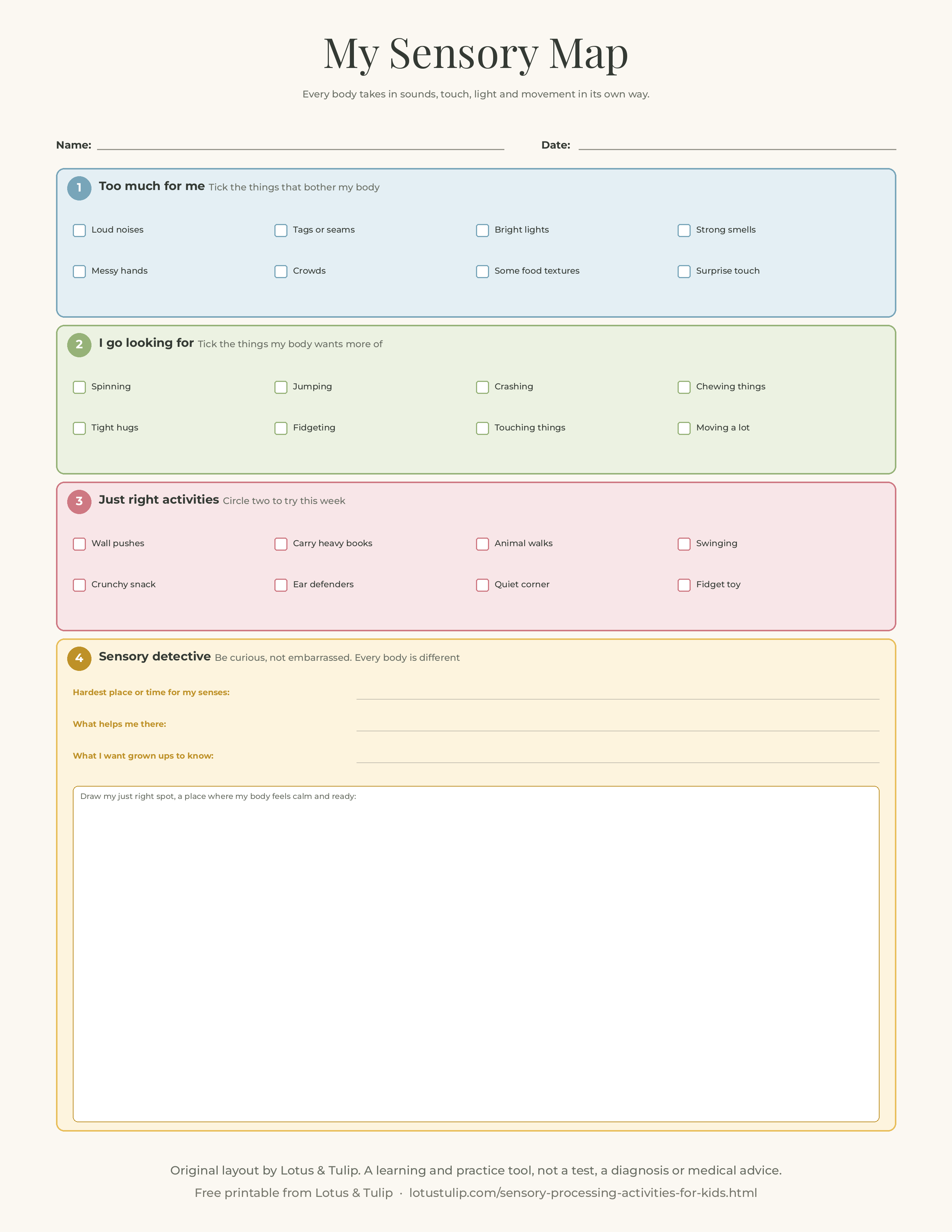
- Fill in the sensory map together. Ask the child, not just the adults, what feels too much and what their body goes looking for. Children aged 7 and up are often surprisingly clear about this. Younger children can point and color.
- Name it without shame. "Your ears are extra sensitive" or "Your body loves to move" is accurate and kind. Avoid "You are being dramatic" or "You are so wild."
- Pick two or three just right activities. Choose ones the child enjoys and that fit the setting. A seeker might pick wall pushes and carrying books; a sensitive child might pick ear defenders and the quiet corner.
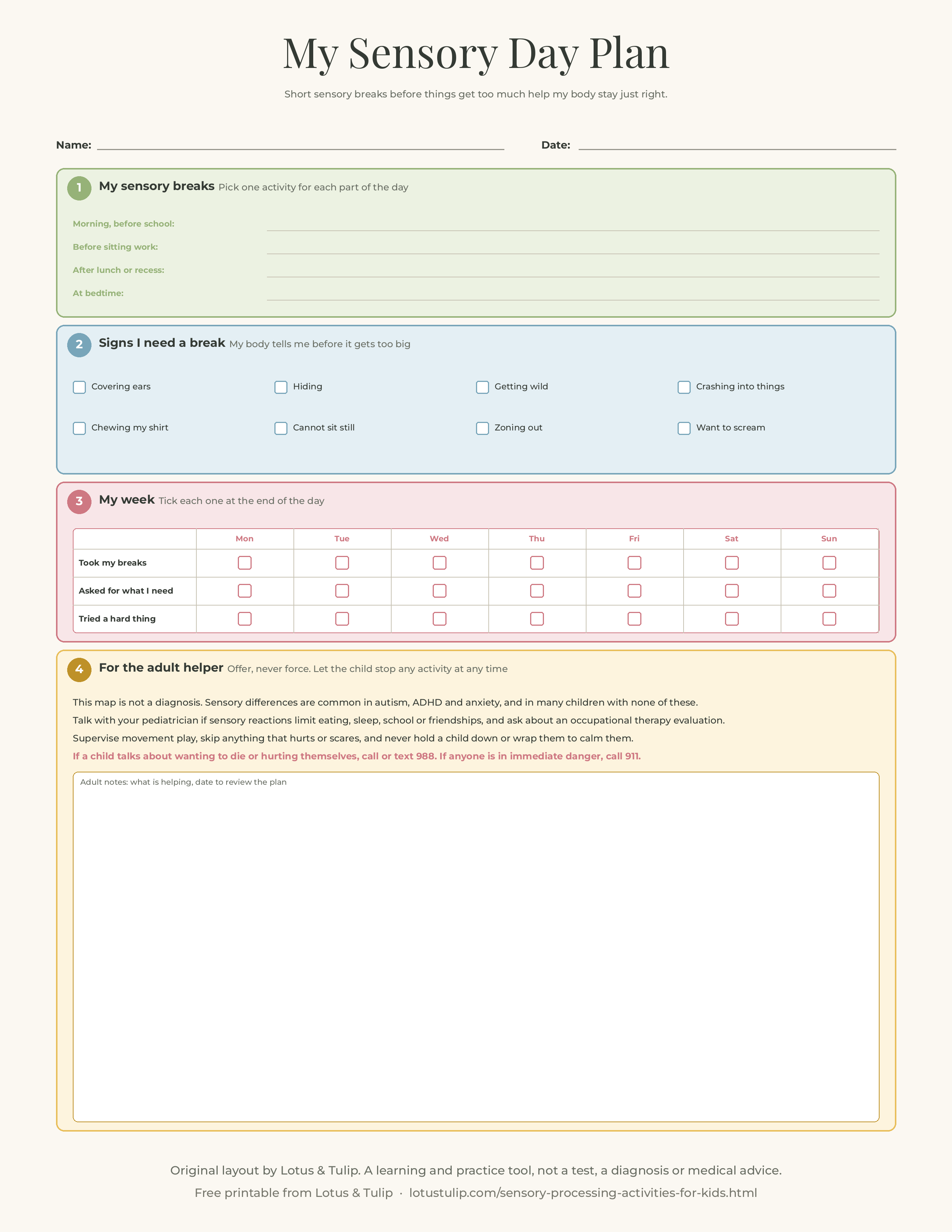
- Schedule breaks before the hard times. A few minutes of heavy work before sitting work, a movement break after lunch, a quiet break before a noisy assembly. Write them on the sensory day plan.
- Teach the warning signs. Help the child notice their early signs (covering ears, getting wild, zoning out) and practice asking for a break with words, a card or a signal.
- Change the environment, not only the child. Cut tags, offer seamless socks, dim lights, warn before loud noises, seat the child away from the door. These small changes often help more than any activity.
- Share the plan. Give a copy to teachers, grandparents and babysitters so everyone uses the same words and tools. Consistency helps the plan work.
- Review after two to four weeks. Use the weekly tracker. Keep what helps, drop what does not and bring the plan to your pediatrician or occupational therapist if hard moments are not getting easier.
How to adapt it by age and need
- Ages 4 to 6: keep it playful and physical. Use pictures, animal walks, songs and an adult reading the map aloud. Two choices are plenty. Expect the adult to notice warning signs for the child.
- Ages 7 to 9: children can fill in most of the map and start to spot their own patterns. Turn breaks into jobs (library helper, chair stacker) so they do not feel singled out.
- Ages 10 to 12: respect privacy and choice. Older children often prefer discreet tools: a stress ball in a pocket, music on headphones, a water bottle, a hall pass. Let them lead the plan.
- Autistic children: sensory needs are part of who they are, not a behavior problem to stamp out. Work with their occupational therapist, honor their preferences and never use sensory input as a reward to be earned or taken away.
- Children with ADHD: movement breaks and fidgets can sit alongside an ADHD plan. They are not a replacement for an ADHD evaluation or treatment.
- Anxious children: reducing overwhelming input helps, but avoiding every uncomfortable place can let fears grow. Pair comfort tools with gentle, gradual steps, and see anxiety worksheets for kids.
Sensory processing at school: notes for teachers and counselors
- Build movement into everyone's day. Class wide movement breaks help sensory seekers without singling anyone out.
- Offer a menu, not a prescription. Let students choose from a short list of break options and a quiet spot, and teach how to ask.
- Plan for predictable hard spots. Fire drills, assemblies, lunchrooms, gym class and substitute days are common trouble points. A heads up and a plan help.
- Refer for a proper look. When sensory needs interfere with learning, talk with the family and your school team about a school occupational therapy evaluation, and about whether a 504 plan or IEP accommodations (such as ear defenders, movement breaks or alternative seating) are appropriate.
- Do not use weighted vests or restraint as behavior tools. The evidence for weighted vests is weak, and holding, wrapping or confining a child to calm them is not a sensory activity.
- Notice the whole child. New sensory struggles alongside changes in mood, sleep or behavior can signal stress at home or school. If you suspect abuse or neglect, follow your district's mandated reporting procedures.
Common mistakes
- Treating every behavior as sensory. Sensory needs are one possible reason. Pain, tiredness, hunger, anxiety, learning difficulties and unmet needs for attention can look the same. Keep watching patterns.
- Forcing exposure. Making a child touch slime or stay in a loud gym "to get used to it" usually increases fear and distrust. Go at the child's pace with choices and an exit.
- Using sensory breaks as rewards or punishments. A movement break should not be taken away for misbehaving. That is exactly when the child may need it most.
- Buying gear instead of making a plan. Swings, weighted products and expensive kits are not required. Most helpful activities use books, walls, chairs and a quiet corner.
- Waiting for a meltdown. Breaks work best before overload. Once a child is in full meltdown, keep them safe, lower input and talk less.
- Skipping the evaluation. If sensory reactions are intense or come with other concerns, an activity list is not enough. Ask for a full evaluation.
Examples
- Leo, 5: melted down every morning over socks and shirts. His dad cut out tags, bought seamless socks, let Leo choose between two outfits the night before and added a minute of bear hugs and wall pushes before getting dressed. Mornings were not perfect, but the screaming stopped most days within two weeks.
- Ava, 8: could not stay in her seat and was always in trouble for crashing into classmates in line. With the school counselor she ticked jumping, crashing and moving a lot on her map. Her teacher made her the book cart pusher, added wall pushes before math and let her line up last. The crashing in line mostly stopped, and the team asked the family to raise attention concerns with her pediatrician as well.
- Noah, 11: avoided the cafeteria and hid in the bathroom during assemblies. His map showed loud noises, crowds and strong smells. With his parents and teacher he planned noise reducing earbuds, a lunch spot at the end of a table, and a few minutes' warning before assemblies with a seat near the exit. His counselor also helped him with worry about loud places, step by step.
Free printable: sensory processing worksheets for kids
This printable is an original Lotus & Tulip layout. It is not the Sensory Profile or any screening tool and gives no score. Page 1, My Sensory Map, has ticks for what feels too much, what my body goes looking for and just right activities to try, plus sensory detective lines (hardest place or time, what helps, what I want grown ups to know) and a box to draw a just right spot. Page 2, My Sensory Day Plan, has lines to plan a sensory break for each part of the day, ticks for signs I need a break, a 7 day tracker (took my breaks, asked for what I need, tried a hard thing) and adult helper notes on when to get help.
Download the free sensory processing worksheets for kids (PDF, 2 pages, US Letter)
Prefer single images? Page 1: My Sensory Map (PNG) · Page 2: My Sensory Day Plan (PNG)
Related resources
- Calm down corner ideas: how to set up a quiet space that is a break, not a punishment
- Interoception activities for kids: teaching hunger, thirst and feelings body clues
- Break card printable: teach a child to ask for a break before overload
- Coping skills list for kids: 60 ideas including senses and movement
- Breathing exercises for kids: calm body tools with exact steps
- Picky eating activities for kids: what is normal, what research shows and a free food explorer plan
- All counseling resources for kids and teens
FAQ
What are sensory processing activities for kids?
They are planned activities that give a child the kind and amount of sensory input their body needs: heavy work like carrying and pushing, movement like swinging, touch play, crunchy or chewy snacks, quiet spaces and noise reduction. The goal is to help a child feel calm, alert and comfortable enough to take part in daily life.
Is sensory processing disorder a real diagnosis?
Sensory differences are real and well documented, but sensory processing disorder is not in the DSM-5, and in 2012 the American Academy of Pediatrics advised that it generally should not be diagnosed on its own because there is no accepted diagnostic framework. Sensory differences are part of the autism criteria and are common in ADHD, developmental coordination disorder and anxiety, so a full evaluation is recommended.
What is heavy work for kids?
Heavy work means activities that make muscles push, pull, lift or carry, such as wall pushes, carrying books, pushing a laundry basket, wheelbarrow walks or animal walks. Occupational therapists often use heavy work because many children find it both calming and organizing.
Do weighted vests and weighted blankets help?
Reviews of weighted vest studies have found little evidence that they help, and one review concluded they cannot be recommended for clinical use. Weighted blankets and weighted sleep products must never be used on or near a sleeping baby. For older children, talk with your doctor or occupational therapist before trying any weighted product.
How do I know if my child needs an occupational therapy evaluation?
Ask your pediatrician about an evaluation if sensory reactions limit eating, sleep, dressing, hygiene, school or friendships, if they come with delays in speech, play or motor skills, or if home changes and activities have not helped after a few weeks. Schools can also evaluate when sensory needs affect learning.
Can sensory activities stop meltdowns?
They can make meltdowns less frequent by giving breaks before a child is overloaded, but they will not prevent every one. During a meltdown, keep the child safe, lower noise and light, talk less and wait. Plan new strategies afterward, when everyone is calm.
What age are these sensory worksheets for?
They are designed for children about 4 to 12. Younger children can point and color with an adult reading aloud. Children 7 to 12 can fill in most of the sensory map and day plan themselves. Teachers, school counselors and therapists can use them in individual sessions or to share a plan with the whole team.
Sources
- Ahn, R. R., Miller, L. J., Milberger, S., and McIntosh, D. N. (2004). Prevalence of parents' perceptions of sensory processing disorders among kindergarten children. American Journal of Occupational Therapy, 58(3), 287 to 293.
- American Academy of Pediatrics, Section on Complementary and Integrative Medicine and Council on Children with Disabilities; Zimmer, M., and Desch, L. (2012). Sensory integration therapies for children with developmental and behavioral disorders. Pediatrics, 129(6), 1186 to 1189.
- Ben-Sasson, A., Carter, A. S., and Briggs-Gowan, M. J. (2009). Sensory over-responsivity in elementary school: prevalence and social-emotional correlates. Journal of Abnormal Child Psychology, 37(5), 705 to 716.
- Ben-Sasson, A., Hen, L., Fluss, R., Cermak, S. A., Engel-Yeger, B., and Gal, E. (2009). A meta-analysis of sensory modulation symptoms in individuals with autism spectrum disorders. Journal of Autism and Developmental Disorders, 39(1), 1 to 11.
- Ben-Sasson, A., Soto, T. W., Heberle, A. E., Carter, A. S., and Briggs-Gowan, M. J. (2017). Early and concurrent features of ADHD and sensory over-responsivity symptom clusters. Journal of Attention Disorders, 21(10), 835 to 845.
- Case-Smith, J., Weaver, L. L., and Fristad, M. A. (2015). A systematic review of sensory processing interventions for children with autism spectrum disorders. Autism, 19(2), 133 to 148.
- Centers for Disease Control and Prevention. Clinical testing and diagnosis for autism spectrum disorder (DSM-5 criteria summary).
- Green, S. A., and Ben-Sasson, A. (2010). Anxiety disorders and sensory over-responsivity in children with autism spectrum disorders: is there a causal relationship? Journal of Autism and Developmental Disorders, 40(12), 1495 to 1504.
- Moon, R. Y., Carlin, R. F., Hand, I., Task Force on Sudden Infant Death Syndrome, and Committee on Fetus and Newborn (2022). Evidence base for 2022 updated recommendations for a safe infant sleeping environment to reduce the risk of sleep-related infant deaths. Pediatrics, 150(1), e2022057991.
- Omairi, C., Mailloux, Z., Antoniuk, S. A., and Schaaf, R. (2022). Occupational therapy using Ayres Sensory Integration: a randomized controlled trial in Brazil. American Journal of Occupational Therapy, 76(4), 7604205160.
- Schaaf, R. C., Benevides, T., Mailloux, Z., Faller, P., and colleagues (2014). An intervention for sensory difficulties in children with autism: a randomized trial. Journal of Autism and Developmental Disorders, 44(7), 1493 to 1506.
- Schaaf, R. C., Ridgway, E. M., Jones, E. A., Dumont, R. L., and colleagues (2025). A comparative trial of occupational therapy using Ayres Sensory Integration and applied behavior analysis interventions for autistic children. Autism Research, 18(10), 2120 to 2134.
- Stephenson, J., and Carter, M. (2009). The use of weighted vests with children with autism spectrum disorders and other disabilities. Journal of Autism and Developmental Disorders, 39(1), 105 to 114.
- Tomchek, S. D., and Dunn, W. (2007). Sensory processing in children with and without autism: a comparative study using the short sensory profile. American Journal of Occupational Therapy, 61(2), 190 to 200.
Lotus & Tulip is not affiliated with the researchers, programs, agencies or organizations named on this page. Names in the examples are invented. This page is educational and does not replace professional advice, diagnosis or treatment.