
Kids and teens · Helping a child live with diabetes, asthma, epilepsy or another chronic illness, ages 3 to 12 · Updated 2026-11-15
Chronic illness worksheets for kids: how to help a child cope with diabetes, asthma, epilepsy or another long term condition, what research shows and a free coping plan

Ages 5 to 11: Kids Feelings and Social Skills Worksheets, incl. feelings detective, body clues, a feelings thermometer, a coping skills menu and a calm down plan Holiday 20% off: about $11.04, was $14 (EUR 12) · fillable PDF, instant digital download
Buy on EtsyTry it free first: download a fillable sample (feelings thermometer and calm-down plan, PDF, 240 KB). Type into it on screen, then get the full pack. No email needed.
Calm tools for hard days: Coping Skills Cards for Kids and Teens, 96 printable cards plus a coping skills list, toolbox worksheet and tracker Holiday 20% off: about $5.52, was $7 (EUR 6) · instant digital download
Buy on EtsyBest value for families and counselors: Kids and Teens Worksheets Bundle (feelings, anger, self esteem, social anxiety) Holiday 20% off: about $22.08, was $28 (EUR 24) · 80 pages, instant digital download
Buy on EtsyLiving with a chronic illness is part of ordinary childhood for millions of American kids. HealthyChildren.org, from the American Academy of Pediatrics (AAP), estimates that 10 to 20 million US children and adolescents have some form of chronic illness or disability, meaning a condition that lasts from three months to a lifetime. The CDC reports that more than 40% of school aged children and adolescents have at least one chronic health condition. In 2023 about 4.8 million US children (6.7%) had asthma, and nearly half of them (47.1%) had an asthma attack in the past year. About 314,000 children and teens younger than 20 have diagnosed type 1 diabetes, and about 456,000 children 17 and younger have active epilepsy.
This guide is for parents, other caregivers, teachers, school nurses, school counselors, child life specialists and therapists supporting children about 3 to 12 who live with a long term condition such as type 1 diabetes, asthma, epilepsy, a food allergy, arthritis, inflammatory bowel disease, a heart condition or chronic pain. It covers what children worry about, what research shows (honestly, including its limits), what worksheets can and cannot do, eight kinds of activities, nine steps to help, flare ups and school, age and need adaptations, common mistakes and three short examples. It ends with a free 2 page printable: My Health Feelings Map and My Health Coping Plan.
Medical and professional care comes first: these pages support everyday conversations about feelings and coping. They are not medical instructions and never replace your child's doctor, care team, diabetes educator, asthma action plan, seizure action plan or emergency plan. HealthyChildren.org advises calling your pediatrician if you are concerned about your child's mood or behavior at home or school, such as sadness, anxiety, irritability or aggression. If a child talks about wanting to die or hurt themselves, call or text 988 (Suicide and Crisis Lifeline). If anyone is in immediate danger or your child has a medical emergency, call 911.
Download the free chronic illness worksheets for kids (PDF, 2 pages, US Letter)
Direct download, no email or sign up. See the pages first.
What children with a chronic illness worry about
HealthyChildren.org notes that children with chronic illnesses and disabilities often deal with more stress than other children: needles and procedures, hospital stays, a body that does not always cooperate and, for some, fear about the future. A child with epilepsy may worry about the next seizure; a child with diabetes lives with finger checks, insulin and food decisions every day. Common worries include:
- "Why me?" Children may feel it is unfair, or wonder if they did something to cause the condition. Young children especially can link illness to being bad.
- "I'm different." Taking medicine at school, carrying an inhaler, wearing a pump or sitting out of a game can make a child feel singled out. A meta-analysis of 621 studies found slightly lower self-esteem on average in children with a chronic illness than in healthy peers (Pinquart, 2013).
- "It hurts and it's scary." Shots, blood draws, scans and hospital visits are hard, especially when a child does not know what is coming.
- "What will my friends think?" Many children worry about being teased, missing parties or explaining their condition.
- "Will it ever go away?" Children may not understand that a condition is long term, or may fear what it means for growing up.
What the research shows, honestly
Most children with a chronic illness cope well, and many show real strength. Research also shows that, on average, emotional strain is a bit higher than for healthy peers, so it deserves attention. Here is what holds up, with its limits.
Emotional and behavior problems are somewhat more common. A meta-analysis of 569 studies using the Child Behavior Checklist and related forms found higher levels of internalizing problems (such as worry and sadness, g = .47), externalizing problems (such as acting out, g = .22) and total behavior problems (g = .42) in young people with a chronic physical illness compared with healthy peers. Differences were largest in parent ratings and smallest in adolescents' own ratings, and they varied by condition, for example externalizing problems were highest for epilepsy and migraine or tension headache (Pinquart and Shen, 2011a). The authors called for regular screening for distress and referral when needed.
Depressive symptoms are slightly higher on average. A meta-analysis of 340 studies found a small overall difference (d = .19), with larger differences for chronic fatigue syndrome, fibromyalgia, migraine or tension headache and epilepsy (d = .39) than for many other conditions (Pinquart and Shen, 2011b). Most children with asthma or diabetes will not become depressed, but adults should know the signs.
Self-esteem is a little lower, and success and friends help. The self-esteem meta-analysis of 621 studies found a small average gap (g = -.18), larger in adolescents than children. The author recommended that pediatricians, parents and teachers promote experiences of success and positive peer relationships (Pinquart, 2013).
Support for parents can help, though the evidence is limited. A Cochrane review of 44 randomized trials with 4,697 participants looked at psychological therapies for parents of children with asthma, cancer, chronic pain, diabetes, inflammatory bowel disease, skin disease and brain injury. Cognitive behavioral therapy and problem solving therapy may improve parenting behavior, and problem solving therapy may also improve parents' mental health, but the quality of evidence was generally low and data were too thin to judge many outcomes (Law and colleagues, 2019).
No study has tested worksheets like the ones on this page. They are a simple way to put what pediatric guidance points to, honest information, room for feelings, real choices, focus on strengths and growing independence, into a child's hands.
What chronic illness worksheets can and cannot do
They can help a child name feelings about their condition, collect questions for the doctor, notice what helps on hard days, take pride in health jobs they already do, plan small choices they control and give adults a calm, regular way to check in.
They cannot diagnose or treat anything, replace a medical action plan, tell anyone how to dose medicine or manage symptoms, or treat anxiety or depression. They should never be used to blame a child for symptoms, to grade how "good" a child is at managing their illness or to push a child to say they are fine.
8 kinds of chronic illness activities for kids
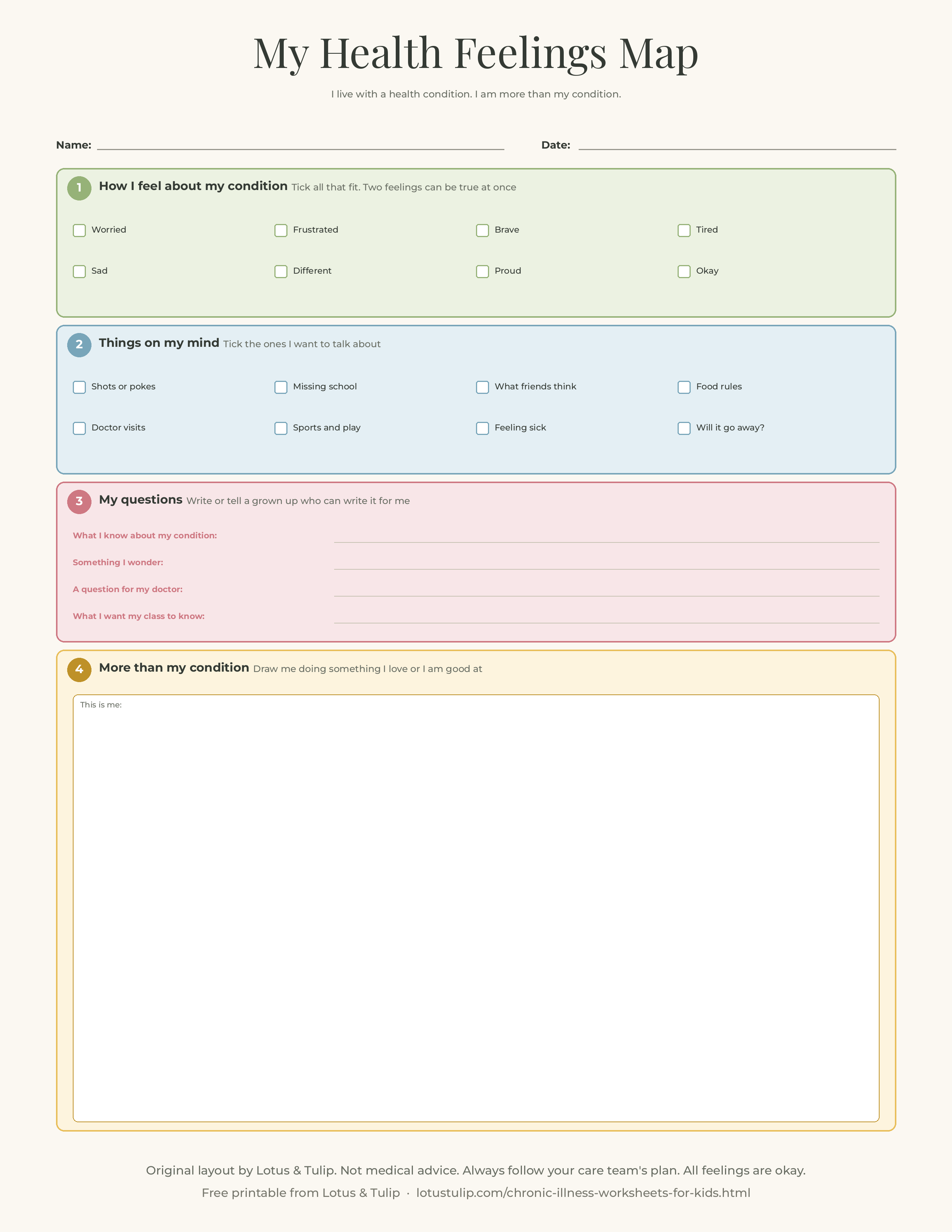
- Feelings check in: a list to tick or color, including worried, frustrated, brave, tired, sad and proud, because mixed feelings about a condition are normal.
- Things on my mind: a checklist of common worries, such as shots or finger pokes, missing school, what friends think, food rules, sports and play, and "will it go away?"
- My questions: sentence starters for what the child knows about their condition, what they wonder, a question for the doctor and what they want their class to know.
- More than my condition: a drawing box for the child's interests and strengths, so the illness is part of their story, not all of it. HealthyChildren.org suggests emphasizing what a child can do well.
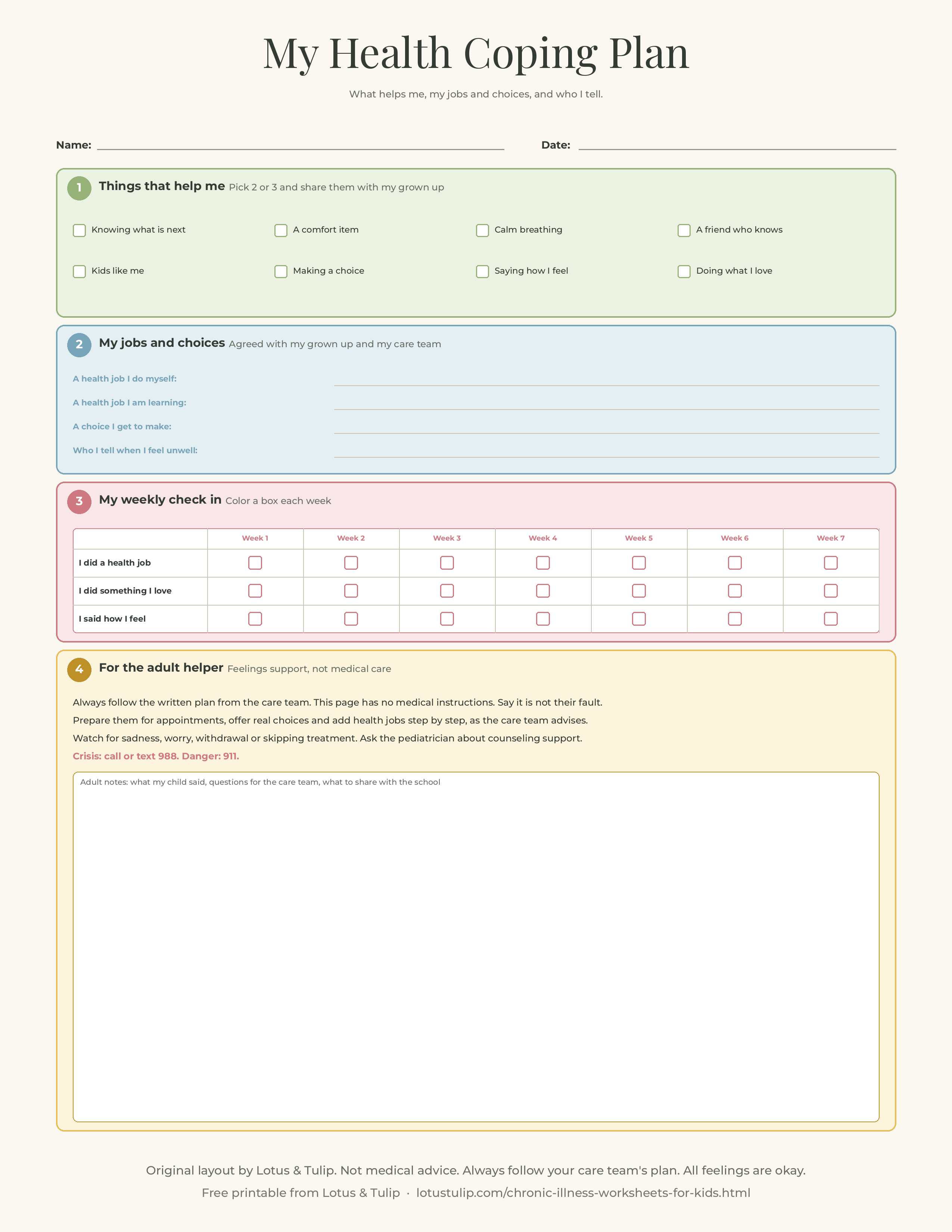
- Things that help me: choosing two or three supports, such as knowing what will happen, a comfort item at appointments, calm breathing, a friend who knows, or meeting kids with the same condition.
- My jobs and choices: a health job the child does now, one they are learning and a choice they get to make, such as which arm for a blood draw, as HealthyChildren.org suggests.
- Who I tell: naming the adults at home and at school a child tells when they feel unwell, which supports the plan the care team has already written.
- Weekly check in: a simple tracker for doing a health job, doing something I love and saying how I feel.
How to help a child cope with a chronic illness, step by step
- Learn about the condition together. HealthyChildren.org says that the more information parents and children have, the less frightening the present and future seem, and that knowledge helps both feel more in control. Use simple, true words and let the care team fill gaps.
- Say clearly that it is not their fault. Children may think they caused their illness or that it is a punishment. Tell them plainly that nothing they did, said or thought caused it, and repeat it over time.
- Listen to every feeling. HealthyChildren.org encourages parents to let a child express sadness, frustration or anger without overreacting, to ask how they feel when they say nothing and to listen for what is left unspoken. Page 1 of the printable can start the conversation.
- Prepare them for what is coming. Explain what will happen at an appointment or procedure ahead of time, and do not surprise a child with a frightening procedure. HealthyChildren.org notes that rehearsal, such as visiting the hospital ward before surgery, can help. See our hospital stay worksheets for kids for longer stays.
- Offer real choices. Let the child control what they safely can: which arm, which bandage, the order of tasks, the reward after a hard appointment. Choices give back some sense of control.
- Build skills little by little. HealthyChildren.org advises watching for signs a child is ready and helping them take on more of their own care gradually as they grow, always within the plan from the care team. Page 2 lists a job they do, a job they are learning and a choice they make.
- Protect strengths, friends and fun. Keep sports, hobbies and friendships going as much as the care team allows. Research links lower self-esteem with chronic illness on average, and success experiences and good peer relationships are important sources of self-esteem (Pinquart, 2013).
- Connect them with kids like them. HealthyChildren.org encourages time with other children who have the same or a similar condition. Ask the care team about support groups or camps for children with diabetes, asthma, epilepsy and other conditions.
- Watch mood and get help early. Because worry, sadness and behavior problems are somewhat more common, notice changes such as withdrawal, irritability, avoiding treatment, sleep changes or falling grades, and talk with your pediatrician about a psychologist, social worker or counselor.
Flare ups, hospital stays and the rest of the family
Flare ups and bad days. Asthma attacks, low or high blood sugar, seizures and pain flares can be frightening. Follow the written plan from the care team first. Afterwards, when the child is calm, a short talk about what happened and what helped can make the next time less scary.
Hospital stays and procedures. Child life specialists in many US children's hospitals help children understand and cope with medical care. Ask whether one can meet your child before a planned procedure.
Brothers and sisters. Siblings may feel jealous, worried or left out. HealthyChildren.org suggests time alone with each child and honest answers to their questions. See our sibling support worksheets for kids.
Parents need support too. Caring for a child with a chronic illness is demanding. The Cochrane review above suggests that some parent focused therapies can help. Ask the care team about social work, parent groups or counseling for yourself.
How to adapt it by age and need
- Ages 3 to 5: use very short, concrete words ("Your body needs medicine to help it make energy"), keep routines predictable, use a doll or stuffed animal to practice procedures and let the child color and point while an adult writes.
- Ages 6 to 8: children start asking why and comparing themselves with friends. Let them tick worries, dictate questions for the doctor and choose one small health job to be proud of.
- Ages 9 to 12: they understand more and may hide feelings, skip treatment to fit in or worry about the future. Offer privacy, let them fill in both pages alone and include them in talks with the care team.
- Preteens and teens: Got Transition's Six Core Elements, which build on AAP, AAFP and ACP guidance on moving from pediatric to adult care, suggest introducing a transition policy around ages 12 to 14 and checking self-care skills from about 14. Encourage your child to talk with the doctor alone for part of each visit.
- Autism and literal thinkers: a visual schedule for appointments, photos of the clinic and clear "first, then" language can help.
- ADHD and children who find waiting hard: bring busy kits to appointments, keep check ins short and active and use visual reminders for daily health jobs agreed with the care team.
Notes for teachers, school nurses and school counselors
- Know the written plan. HealthyChildren.org says a child with special health needs should have a written health care and emergency plan at school, including medicines or procedures, dietary needs, possible problems, precautions and whom to contact.
- Know the student's rights. The US Department of Education's Office for Civil Rights explains that diabetes will, in virtually all cases, substantially limit endocrine function, and that asthma can substantially limit breathing, so many of these students are protected under Section 504 and may need a 504 plan. The American Diabetes Association notes that a child does not need to struggle academically to be protected, and that some children also qualify for an IEP under IDEA if their condition affects learning.
- Common accommodations. The American Diabetes Association lists examples such as access to supplies, water, food and the bathroom, alternate test times when blood sugar is far out of range, making up missed work without penalty and trained staff on field trips. Capable students should be allowed to self-manage anywhere, anytime.
- Protect privacy and belonging. Ask the student and family what classmates should know. Some children like to explain their condition to the class; others do not.
- Use the printable in a counselor check in. With a caregiver's permission, the pages can help a student talk about feelings and what helps at school. Never use them in place of the student's health plan.
- Know when to refer and report. Refer to the school psychologist, social worker or outside care if a student is struggling over time or talks about suicide. If a student describes being hurt or not cared for, follow your school's procedure and your state's mandated reporting law.
Common mistakes
- Keeping it vague to protect them. Children fill silence with their own fears. Honest, simple words are kinder.
- Making it all about the illness. A child is a reader, a soccer player or an artist first. Keep their life and strengths in view.
- Blaming the child for symptoms. High blood sugar, an asthma flare or a seizure is not a moral failure. Talk about what to try next, not who is at fault.
- Handing over care too fast, or never. Independence grows step by step, with adult backup, as the care team advises.
- Missing quiet distress. A child who never complains may be struggling privately, especially as they get older.
- Using a worksheet instead of the medical plan. Feelings pages sit alongside the action plan from the care team, never in place of it.
Examples
- Leo, 5: he has asthma and cried before every nebulizer treatment. His mom let him choose a stuffed bear to "do breathing" first and a song to play during the treatment. On page 1 he colored "Worried" and "Brave," and on page 2 his choice was "which song."
- Amira, 8: she was diagnosed with type 1 diabetes in the summer and did not want her class to see her finger checks. With her school nurse and parents she filled in "What I want my class to know," and decided to tell two friends first. Her 504 plan already allowed her to check in the classroom.
- Noah, 11: he has epilepsy and stopped going to sleepovers after a seizure at a friend's house. With his counselor he ticked "What friends think" and wrote a question for his neurologist about sleepovers. His family and the care team made a plan with the friend's parents, and he went to the next one.
Free printable: chronic illness worksheets for kids
This printable is an original Lotus & Tulip layout. It is not an assessment, gives no score and does not contain medical instructions. Page 1, My Health Feelings Map, has a feelings checklist, things on my mind, my questions and a box to draw "more than my condition." Page 2, My Health Coping Plan, has things that help me, my jobs and choices, a weekly check in tracker and notes for the adult helper, including following the care team's written plan, building skills step by step, watching mood, 988 and 911.
Download the free chronic illness worksheets for kids (PDF, 2 pages, US Letter)
Prefer single images? Page 1: My Health Feelings Map (PNG) · Page 2: My Health Coping Plan (PNG)
Related resources
- Food allergy worksheets for kids: for food allergy worries, parties and teasing, with a free food allergy brave plan
- Hospital stay worksheets for kids: preparing for surgery or a hospital stay
- Sibling support worksheets for kids: for the brothers and sisters
- Anxiety worksheets for kids: when worry spills into everyday life
- Coping skills list for kids: 60 ideas for hard days
- Breathing exercises for kids: calm skills for waiting rooms and procedures
- All counseling resources for kids and teens
FAQ
How does a chronic illness affect a child emotionally?
It varies. Large meta-analyses find that, on average, children with a chronic physical illness have somewhat more worry, sadness and behavior problems and slightly lower self-esteem than healthy peers, with bigger differences for some conditions such as epilepsy and chronic pain. Many children cope well. Watching mood and offering support matters more than expecting problems.
How do I explain a chronic illness to my child?
Use true, simple words that fit their age: the name of the condition, what it does in the body, what treatment involves and that it is not their fault. HealthyChildren.org notes that information makes the future less frightening. Answer questions again later, and ask the care team to help with hard ones.
Can these worksheets be used for diabetes, asthma or epilepsy?
Yes. They focus on feelings, questions, strengths and small choices, which fit almost any long term condition, including type 1 diabetes, asthma, epilepsy, food allergies, arthritis and inflammatory bowel disease. They contain no medical instructions, so always follow the written plan from your child's care team.
When should a child start managing their own condition?
Gradually, as they show they are ready. HealthyChildren.org advises helping a child take on more of their own care little by little as they grow. Got Transition suggests introducing transition planning around ages 12 to 14. Always agree each new step with the care team.
Does a child with a chronic illness qualify for a 504 plan?
Often, yes. The US Department of Education's Office for Civil Rights explains that diabetes will in virtually all cases substantially limit endocrine function, and that asthma can substantially limit breathing, so many students are protected under Section 504. Eligibility is decided by the school team. Ask your school's 504 coordinator or principal.
What are signs a child with a chronic illness needs more help?
Ongoing sadness, worry, irritability, withdrawal from friends, refusing or skipping treatment, sleep changes or falling grades. HealthyChildren.org advises calling your pediatrician if you are concerned about mood or behavior. If a child talks about suicide, call or text 988; in an emergency, call 911.
What age are these chronic illness worksheets for?
They are designed for children about 3 to 12. Younger children can color, point and talk through the pages with an adult who writes for them, while children 8 to 12 can fill in most of the map and plan themselves. Parents, school nurses, counselors, child life specialists and therapists can all use them.
Sources
- American Diabetes Association. Safe at School: FAQs for schools; Your school and your rights.
- Centers for Disease Control and Prevention. Most recent national asthma data (2023 National Health Interview Survey).
- Centers for Disease Control and Prevention. Managing chronic health conditions in schools.
- Centers for Disease Control and Prevention. National Diabetes Statistics Report.
- Centers for Disease Control and Prevention. Epilepsy facts and stats.
- Got Transition. Six Core Elements of health care transition.
- HealthyChildren.org (American Academy of Pediatrics). Chronic conditions; Living with a chronic illness or disability; Chronic conditions and school.
- Law, E., Fisher, E., Eccleston, C., and Palermo, T. M. (2019). Psychological interventions for parents of children and adolescents with chronic illness. Cochrane Database of Systematic Reviews, 3, CD009660.
- Pinquart, M. (2013). Self-esteem of children and adolescents with chronic illness: a meta-analysis. Child: Care, Health and Development, 39(2), 153 to 161.
- Pinquart, M., and Shen, Y. (2011a). Behavior problems in children and adolescents with chronic physical illness: a meta-analysis. Journal of Pediatric Psychology, 36(9), 1003 to 1016.
- Pinquart, M., and Shen, Y. (2011b). Depressive symptoms in children and adolescents with chronic physical illness: an updated meta-analysis. Journal of Pediatric Psychology, 36(4), 375 to 384.
- US Department of Education, Office for Civil Rights (2024). Section 504 protections for students with diabetes; Section 504 protections for students with asthma.
- White, P. H., Cooley, W. C., and the Transitions Clinical Report Authoring Group, AAP, AAFP and ACP (2018). Supporting the health care transition from adolescence to adulthood in the medical home. Pediatrics, 142(5), e20182587.
Lotus & Tulip is not affiliated with the American Academy of Pediatrics, the CDC, the US Department of Education, the American Diabetes Association, Got Transition or the researchers or organizations named on this page. Names in the examples are invented. This page is educational and does not replace professional medical, mental health or legal advice.