
Kids and teens · Helping a child live with a food allergy, ages 3 to 12 · Updated 2026-11-15
Food allergy worksheets for kids: how to help a child cope with food allergy worries, lunch, parties and teasing, what research shows and a free food allergy plan

Ages 5 to 11: Kids Feelings and Social Skills Worksheets, incl. feelings detective, body clues, a feelings thermometer, a coping skills menu and a calm down plan Holiday 20% off: about $11.04, was $14 (EUR 12) · fillable PDF, instant digital download
Buy on EtsyTry it free first: download a fillable sample (feelings thermometer and calm-down plan, PDF, 240 KB). Type into it on screen, then get the full pack. No email needed.
Calm tools for hard days: Coping Skills Cards for Kids and Teens, 96 printable cards plus a coping skills list, toolbox worksheet and tracker Holiday 20% off: about $5.52, was $7 (EUR 6) · instant digital download
Buy on EtsyBest value for families and counselors: Kids and Teens Worksheets Bundle (feelings, anger, self esteem, social anxiety) Holiday 20% off: about $22.08, was $28 (EUR 24) · 80 pages, instant digital download
Buy on EtsyFood allergy is common in American classrooms. According to the CDC's National Center for Health Statistics, about 1 in 20 US children (5.8%) had a diagnosed food allergy in 2021, rising from 4.4% of children under 6 to 7.1% of children 12 to 17. A national survey of parents of 38,408 children estimated that 7.6% of US children have a current food allergy, most often to peanut (2.2%), milk (1.9%), shellfish (1.3%) and tree nuts (1.2%). Among those children, 42.3% had had at least one severe reaction, 39.9% were allergic to more than one food and 19.0% had visited an emergency department for a food reaction in the past year (Gupta and colleagues, 2018).
Living with that risk every day shapes how a child feels about lunch, birthday parties, sleepovers and friends. This guide is for parents, other caregivers, teachers, school nurses, school counselors and therapists supporting children about 3 to 12 with a food allergy. It covers what children worry about, what research shows (honestly, including its limits), what worksheets can and cannot do, eight kinds of activities, nine steps to help, parties and teasing, age and need adaptations, school notes, common mistakes and three short examples. It ends with a free 2 page printable: My Food Allergy Feelings Map and My Food Allergy Brave Plan.
Medical care comes first: these pages support conversations about feelings, confidence and speaking up. They are not medical instructions and never replace your child's allergist, pediatrician or their written allergy and anaphylaxis emergency plan. The American Academy of Pediatrics (AAP) recommends a written, personalized emergency plan for every child at risk of anaphylaxis. If your child has signs of a serious allergic reaction, follow that plan and call 911. If a child talks about wanting to die or hurt themselves, call or text 988 (Suicide and Crisis Lifeline). If anyone is in immediate danger, call 911.
Download the free food allergy worksheets for kids (PDF, 2 pages, US Letter)
Direct download, no email or sign up. See the pages first.
What children with a food allergy worry about
Lurie Children's Hospital of Chicago describes how everyday situations can bring up big worries for children with food allergies: eating something by mistake, being near a food that could cause a reaction, using an epinephrine auto-injector, going to the hospital, eating out, birthday parties and standing out or being teased. Common worries include:
- "What if I eat it by accident?" Some caution is useful and keeps a child safe. Too much can turn every snack into a threat.
- "What if I have a reaction and nobody helps?" Children often worry about who will notice, who has their medicine and whether adults know what to do.
- "I hate the medicine." Auto-injectors, past reactions and emergency visits can leave strong memories.
- "I'm the only one who can't have cake." Class parties, lunch tables and treats from other parents can make a child feel left out.
- "They'll tease me." For many children this is not imagined. Studies below show food allergy related bullying is common.
What the research shows, honestly
Many children with a food allergy are happy, confident and well supported. Research also shows some real pressure points worth knowing about. Here is what holds up, with its limits.
Bullying about food allergy is common. In 353 surveys completed mostly by parents of children with food allergy at a New York food allergy institute, 24% reported bullying, teasing or harassment because of a food allergy. Of those, 86% reported more than one episode, 82% of episodes happened at school, 80% came mainly from classmates and 21% involved teachers or school staff. More than half (57%) described physical events, such as being touched by the allergen or having it thrown or waved at them (Lieberman and colleagues, 2010). In a second study of 251 children and parents recruited at allergy clinic visits, 31.5% of children (and 24.7% of parents) reported bullying specifically because of the food allergy. Bullying was linked with lower quality of life and more distress, and parents knew about it in only 52.1% of the cases children reported. When parents did know, children's quality of life was better (Shemesh and colleagues, 2013). A 2024 systematic review of 26 studies found reported rates ranging from 17% to 60% (Nocerino and colleagues, 2024).
Worry is often about the allergy itself. A review of two decades of research concluded that the link between food allergy and anxiety mainly reflects fears specific to the allergy rather than a general anxious personality. Some short lived anxiety around key events is expected and may even help a child stay careful, but high levels of anxiety have been linked with less helpful coping, not better safety (Polloni and Muraro, 2020). A small study of 80 children aged 4 to 12 from mostly lower income, ethnic minority families found higher overall and social anxiety symptoms in children with a food allergy, but not more depression (Goodwin and colleagues, 2017).
Planning helps more than avoidance. A 2026 study developing food allergy coping scales with 151 children and young people aged 8 to 16 and 390 caregivers found that planning and preparation appeared to be the most helpful coping strategies, and avoidance and minimizing the least, with managing emotions also important (Knibb and colleagues, 2026).
Focused help for worry is promising but early. At Children's Hospital of Philadelphia, a six session group program called Food Allergy Bravery for children aged 8 to 12 with impairing food allergy anxiety was completed by every family offered it, and anxiety scores fell and stayed lower at follow up. It was a small, uncontrolled study, and the authors say randomized trials are needed (Dahlsgaard, Lewis and Spergel, 2023). In a randomized trial with 200 mothers of children with food allergy, a single session of cognitive behavioral therapy with accurate risk information did not lower anxiety overall at 6 weeks, but did help the 52% of mothers who started with moderate or high anxiety (Boyle and colleagues, 2017).
No study has tested worksheets like the ones on this page. They are a simple way to put what this research points to, naming fears, practicing what to say, planning ahead and telling an adult about teasing, into a child's hands.
What food allergy worksheets can and cannot do
They can help a child name feelings about their allergy, practice words for speaking up, plan for parties and lunch, notice their own brave moments, report teasing to a trusted adult and give adults a calm, regular way to check in.
They cannot diagnose an allergy, tell anyone what is safe to eat, replace label reading by an adult, an emergency plan or epinephrine, or treat anxiety. They should never be used to push a child to eat a feared food, to test an allergy at home or to blame a child after a reaction.
8 kinds of food allergy activities for kids
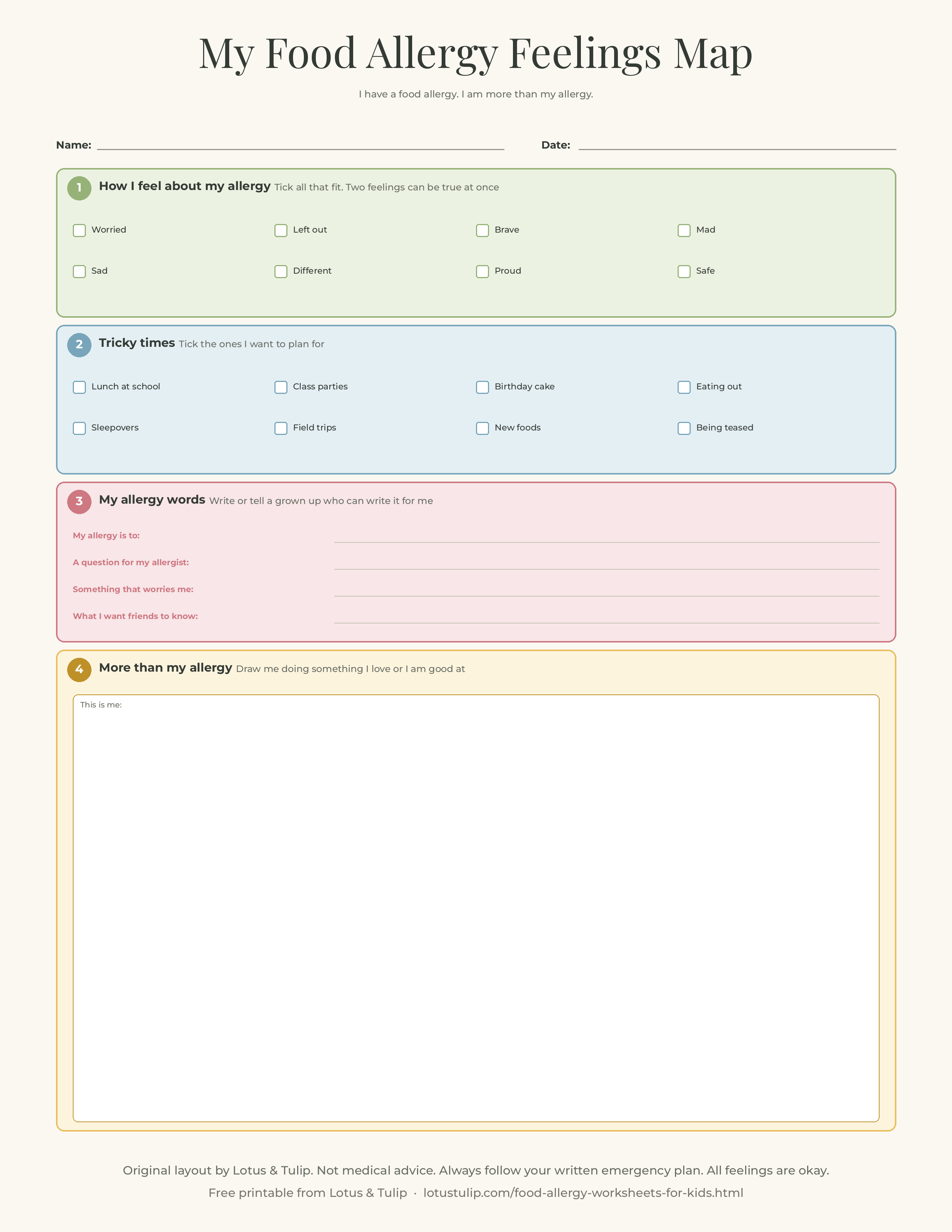
- Feelings check in: a list to tick or color, including worried, left out, brave, mad, proud and safe, because mixed feelings about an allergy are normal.
- Tricky times: a checklist of situations that feel hard, such as lunch, class parties, birthday cake, eating out, sleepovers, field trips and new foods.
- My allergy words: sentence starters for what the child is allergic to, what they say when offered food, what they say if they feel funny and what they want friends to know.
- More than my allergy: a drawing box for interests and strengths, so the allergy is part of the child's story, not all of it.
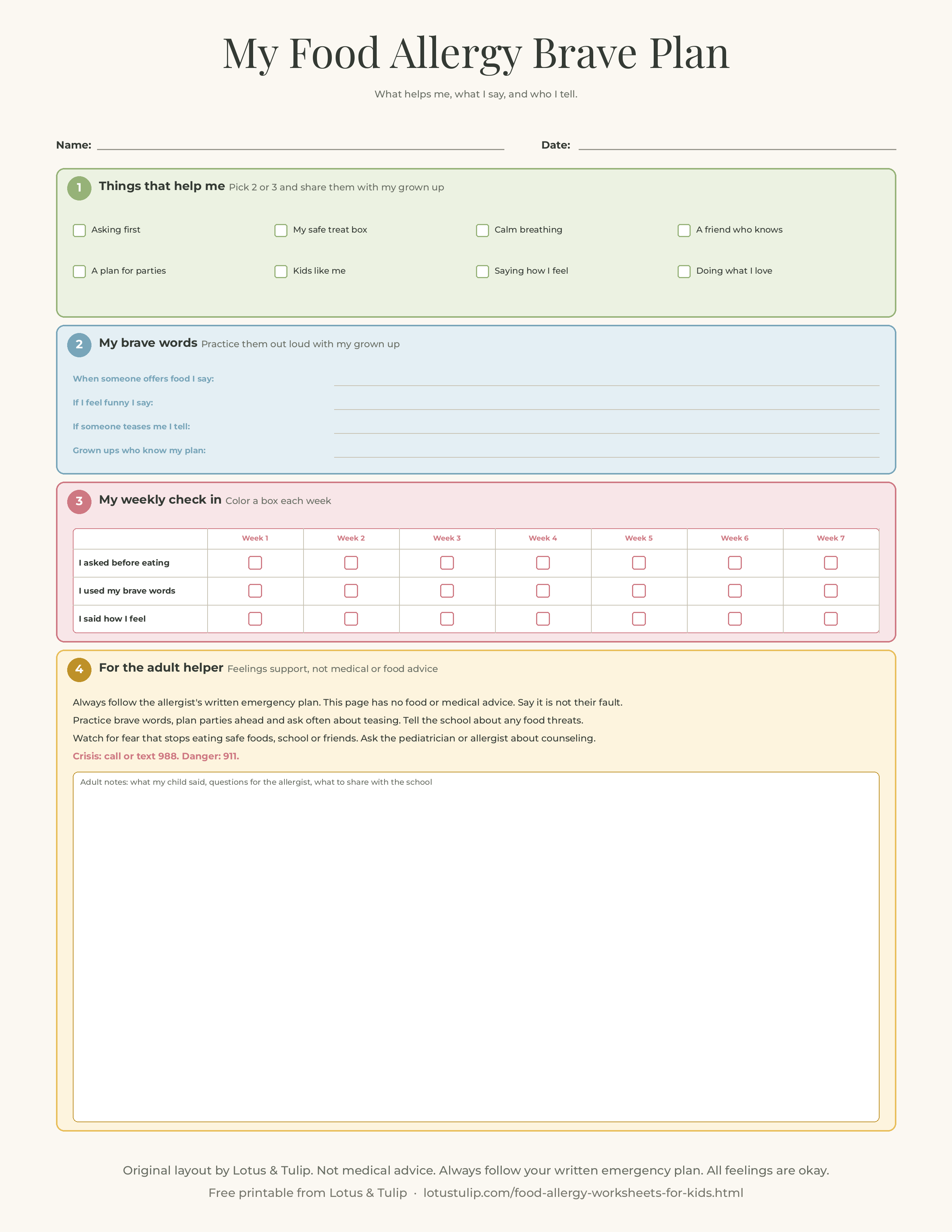
- Things that help me: choosing two or three supports, such as a safe treat box, asking before eating, a friend who knows, calm breathing and an adult who carries the plan.
- My brave words plan: practiced phrases such as "No thank you, I have a food allergy," "I need to ask my grown up first" and "I don't feel right," which matches the planning and preparation research.
- Who I tell: naming the adults at home and at school a child tells when they feel unwell or when someone teases them about food.
- Weekly check in: a simple tracker for asking before eating, using my brave words and saying how I feel.
How to help a child cope with a food allergy, step by step
- Learn the facts together. Use simple, true words: what the allergy is, what the body does and what the plan is. Lurie Children's notes that understanding allergies can help children feel more confident and less afraid. Let the allergist answer hard questions.
- Know the written plan and keep it close. The AAP recommends a written allergy and anaphylaxis emergency plan, and Food Allergy Research & Education (FARE) offers a physician signed Food Allergy & Anaphylaxis Emergency Care Plan. Share it with the school, caregivers and other families, and review it regularly.
- Say clearly that it is not their fault. Children can feel they are a burden or did something wrong. Tell them plainly that the allergy is not their fault and that keeping them safe is the adults' job.
- Listen to every feeling. Let a child be mad about missing the cake or scared after a reaction without rushing to fix it. Page 1 of the printable can start the conversation.
- Practice brave words. Role play turning down food, asking an adult first and saying "I don't feel right." Planning and preparation appear to be among the most helpful ways children cope (Knibb and colleagues, 2026).
- Plan the tricky times ahead. Before a party, field trip or sleepover, talk through who knows the plan, where the medicine is and what safe food the child will have, so the event is about fun, not fear.
- Ask about teasing, regularly. Parents knew about food allergy bullying in only about half of cases, and knowing was linked with better quality of life (Shemesh and colleagues, 2013). Ask open questions such as "Who did you sit with at lunch?" and take every report seriously.
- Keep life big. Avoid shrinking a child's world more than the allergy requires. Keep sports, friends, parties and trips going with a plan, and celebrate brave moments.
- Watch worry and get help early. Some caution is healthy. If fear stops a child eating safe foods, going to school or seeing friends, or brings panic and sleep problems, talk with your pediatrician or allergist about a psychologist or counselor who knows food allergy.
Parties, eating out, reactions and the rest of the family
Parties and treats. HealthyChildren.org lists ways school staff can help, including encouraging non-food items for classroom celebrations and enforcing no food sharing rules. At home, a small box of safe treats the child chose can make surprise cake moments easier.
After a reaction. Follow the emergency plan and the medical team first. Afterwards, when the child is calm, a short talk about what happened, who helped and what went right can make the memory less frightening. If fear stays high for weeks, ask for help.
Brothers and sisters. Siblings may feel worried after a reaction or frustrated by food rules at home. Give them honest information and their own time with you. See our sibling support worksheets for kids.
Parents need support too. Food allergy can be stressful for the whole family. The trial with mothers above suggests that accurate risk information and a brief psychological approach can help parents who feel very anxious. Ask your allergist about support groups or counseling for yourself.
How to adapt it by age and need
- Ages 3 to 5: keep words very short ("That food makes your body sick, so we always ask first"), practice "ask first" with toy food and let the child color and point while an adult writes. Adults stay fully in charge of food safety.
- Ages 6 to 8: children start noticing they are different. Let them tick tricky times, practice brave words and choose one small job, such as reminding an adult to bring their medicine bag.
- Ages 9 to 12: they understand more and may take risks to fit in or hide teasing. Offer privacy, let them fill in both pages alone and include them in talks with the allergist about carrying medicine, as the care team advises.
- Teens: independence, eating out with friends and dating raise new questions. Encourage your teen to talk with the allergist alone for part of each visit and to tell close friends what to do in an emergency.
- Autism and sensory differences: visual scripts for "ask first," photos of safe foods and clear routines can help. A child who is also a selective eater may need extra planning; see our picky eating activities for kids.
- Anxious children: keep the focus on what the child can do, not on every possible danger, and avoid repeated checking that keeps worry going. Our anxiety worksheets for kids include brave steps.
Notes for teachers, school nurses and school counselors
- Follow the CDC guidelines. The CDC's Voluntary Guidelines for Managing Food Allergies in Schools and Early Care and Education Programs name five priorities: daily management for each child, preparing for emergencies, staff training, educating children and families, and a safe environment, which includes a positive climate that reduces bullying and social isolation.
- Know the student's rights. The US Department of Education's Office for Civil Rights explains that students with food allergies may be protected under Section 504 even if they are not limited in learning. Modifications can include allergy free eating areas, allergen free food options, food rules in classrooms, clean surfaces, quick access to epinephrine with trained staff and making up work missed for appointments. Ask your school's 504 coordinator.
- Treat food threats as serious. OCR notes that Section 504 may require a school to respond to bullying or harassment based on a student's medical condition, including threats of exposure to a food a student is allergic to. Waving or hiding an allergen is not a joke.
- Include, don't isolate. Where an allergy table is used, let friends with safe lunches join, and plan non-food rewards and celebrations so the child is not singled out.
- Use the printable in a counselor check in. With a caregiver's permission, the pages can help a student talk about worries and practice brave words. Never use them in place of the student's health plan.
- Know when to refer and report. Refer to the school psychologist, social worker or outside care if a student is struggling over time or talks about suicide. If a student describes being hurt or not cared for, follow your school's procedure and your state's mandated reporting law.
Common mistakes
- Using fear to keep them safe. Scary stories can make a child more anxious without making them safer. Clear rules and practiced words work better.
- Making their world too small. Skipping every party protects in the short term but costs friendships. Plan instead.
- Brushing off teasing. Food allergy bullying can be physically dangerous. Treat it seriously and tell the school.
- Blaming the child after a reaction. Talk about what to do next time, not who is at fault.
- Handing over responsibility too fast, or never. Independence grows step by step, with adult backup, as the allergist advises.
- Using a worksheet instead of the emergency plan. Feelings pages sit alongside the written plan and epinephrine, never in place of them.
Examples
- Mia, 5: she is allergic to milk and cried at a cousin's birthday when everyone else had cake. Her dad made a safe treat box with her, and they practiced "I have my own treat" with toy food. On page 1 she colored "Left out" and "Brave."
- Jayden, 8: a classmate waved a peanut butter cracker at him at lunch. He had not told anyone until his mom asked who he sat with. He ticked "Being teased" on page 1, his parents met the teacher and principal, and the school addressed it under its bullying policy and his 504 plan.
- Sofia, 11: after a reaction to cashews at a restaurant, she refused to eat anywhere but home. With her counselor she filled in "My brave words" and, together with her allergist, made a step by step plan to eat out again with her family.
Free printable: food allergy worksheets for kids
This printable is an original Lotus & Tulip layout. It is not an assessment, gives no score and does not contain medical instructions or food safety advice. Page 1, My Food Allergy Feelings Map, has a feelings checklist, tricky times, my allergy words and a box to draw "more than my allergy." Page 2, My Food Allergy Brave Plan, has things that help me, my brave words, a weekly check in tracker and notes for the adult helper, including following the written emergency plan, asking about teasing, watching worry, 988 and 911.
Download the free food allergy worksheets for kids (PDF, 2 pages, US Letter)
Prefer single images? Page 1: My Food Allergy Feelings Map (PNG) · Page 2: My Food Allergy Brave Plan (PNG)
Related resources
- Chronic illness worksheets for kids: for diabetes, asthma, epilepsy and other long term conditions
- Anxiety worksheets for kids: when worry spills into everyday life
- Bullying worksheets for kids: rude vs mean vs bullying and what to do
- Picky eating activities for kids: when food worries are about taste and texture
- Hospital stay worksheets for kids: preparing for a hospital visit or stay
- Coping skills list for kids: 60 ideas for hard days
- All counseling resources for kids and teens
FAQ
How common are food allergies in children?
The CDC reports that about 1 in 20 US children (5.8%) had a diagnosed food allergy in 2021. A large national parent survey estimated 7.6% of children have a current food allergy, most often to peanut, milk, shellfish or tree nuts, and that about 4 in 10 of them have had a severe reaction.
How does a food allergy affect a child emotionally?
Many children cope well. Research shows that worry tends to be specific to the allergy, such as fear of eating something by mistake or of a reaction, and that some caution is normal. Very high anxiety is linked with less helpful coping, so watch for fear that shrinks a child's life.
Are kids with food allergies bullied?
Often. In one clinic study, 31.5% of children with food allergies reported bullying because of their allergy, frequently including threats with food, and parents knew in only about half of cases. Ask regularly and tell the school about any incident.
How do I help my child with food allergy anxiety?
Give simple facts, practice brave words, plan ahead for parties and trips, keep their life as full as the allergy safely allows and avoid using scary stories. If fear stops a child eating safe foods, going to school or seeing friends, ask your pediatrician or allergist about a psychologist who knows food allergy.
Does a child with a food allergy qualify for a 504 plan?
Often, yes. The US Department of Education's Office for Civil Rights explains that students with food allergies may be protected under Section 504 even if they are not limited in learning, and lists modifications such as allergy free eating areas and quick access to epinephrine. Eligibility is decided by the school team.
Can these worksheets tell me what my child can eat?
No. They contain no medical instructions or food safety advice. Always follow your child's allergist and written allergy and anaphylaxis emergency plan, and call 911 for a serious reaction.
What age are these food allergy worksheets for?
They are designed for children about 3 to 12. Younger children can color, point and talk through the pages with an adult who writes for them, while children 8 to 12 can fill in most of the map and plan themselves. Parents, school nurses, counselors and therapists can all use them.
Sources
- Boyle, R. J., Umasunthar, T., Smith, J. G., and colleagues (2017). A brief psychological intervention for mothers of children with food allergy can change risk perception and reduce anxiety: outcomes of a randomized controlled trial. Clinical and Experimental Allergy, 47(10), 1309 to 1317.
- Centers for Disease Control and Prevention (2013). Voluntary Guidelines for Managing Food Allergies in Schools and Early Care and Education Programs.
- Dahlsgaard, K. K., Lewis, M. O., and Spergel, J. M. (2023). Cognitive-behavioral intervention for anxiety associated with food allergy in a clinical sample of children: feasibility, acceptability, and proof-of-concept in children. Annals of Allergy, Asthma and Immunology, 130(1), 100 to 105.
- Food Allergy Research & Education (FARE). Food Allergy & Anaphylaxis Emergency Care Plan.
- Goodwin, R. D., and colleagues (2017). Food allergy and anxiety and depression among ethnic minority children and their caregivers. Journal of Pediatrics, 187, 258 to 264.
- Gupta, R. S., Warren, C. M., Smith, B. M., and colleagues (2018). The public health impact of parent-reported childhood food allergies in the United States. Pediatrics, 142(6), e20181235.
- HealthyChildren.org (American Academy of Pediatrics). Managing food allergies at school: information for families.
- Knibb, R. C., Purser, S. E. M., Hammond, J., and Ambridge, K. (2026). Development and validation of the Coping with Food Allergy Scales (CoFAS) for children and young people and parents. Journal of Allergy and Clinical Immunology: In Practice, 14(5), 1165 to 1174.
- Lieberman, J. A., Weiss, C., Furlong, T. J., Sicherer, M., and Sicherer, S. H. (2010). Bullying among pediatric patients with food allergy. Annals of Allergy, Asthma and Immunology, 105(4), 282 to 286.
- Lurie Children's Hospital of Chicago. Food allergy related anxiety.
- Nocerino, R., Mercuri, C., Bosco, V., and colleagues (2024). Food allergy-related bullying in pediatric patients: a systematic review. Children, 11(12), 1485.
- Polloni, L., and Muraro, A. (2020). Anxiety and food allergy: a review of the last two decades. Clinical and Experimental Allergy, 50(4), 420 to 441.
- Shemesh, E., Annunziato, R. A., Ambrose, M. A., and colleagues (2013). Child and parental reports of bullying in a consecutive sample of children with food allergy. Pediatrics, 131(1), e10 to e17.
- US Department of Education, Office for Civil Rights (2024). Section 504 protections for students with food allergies.
- Wang, J., Sicherer, S. H., and AAP Section on Allergy and Immunology (2017). Guidance on completing a written allergy and anaphylaxis emergency plan. Pediatrics, 139(3), e20164005.
- Zablotsky, B., Black, L. I., and Akinbami, L. J. (2023). Diagnosed allergic conditions in children aged 0 to 17 years: United States, 2021. NCHS Data Brief No. 459.
Lotus & Tulip is not affiliated with the American Academy of Pediatrics, the CDC, the US Department of Education, Food Allergy Research & Education, Lurie Children's Hospital, Children's Hospital of Philadelphia or the researchers or organizations named on this page. Names in the examples are invented. This page is educational and does not replace professional medical, mental health or legal advice.