
Kids and teens · Resilience in children ages 4 to 12 · Updated 2026-11-14
Resilience activities for kids: what actually builds bounce back, 12 activities, what research shows and a free printable

Ages 5 to 11: Kids Feelings and Social Skills Worksheets, incl. feelings detective, body clues, a coping skills menu and a calm down plan Holiday 20% off: about $11.04, was $14 (EUR 12) · fillable PDF, instant digital download
Buy on EtsyTry it free first: download a fillable sample (feelings thermometer and calm-down plan, PDF, 240 KB). Type into it on screen, then get the full pack. No email needed.
Strengths and inner coach: Self Esteem Worksheets for Kids and Teens, all 18 worksheets Holiday 20% off: about $9.20, was $12 (EUR 10) · instant digital download
Buy on EtsyKids and teens bundle: Kids and Teens Worksheets Bundle (feelings, anger, self esteem, social anxiety) Holiday 20% off: about $22.08, was $28 (EUR 24) · 80 pages, instant digital download
Buy on EtsyEvery child meets hard things: a lost game, a friend who says something mean, a bad grade, a move, a parent's divorce, a pet that dies. Resilience is not about never being upset by these. It is about having enough support, skills and experience to feel the hard feeling, get help, and slowly find a way forward. The encouraging part is that resilience is not a rare trait some children are born with. It is built, mostly through relationships and through small, everyday chances to cope.
This guide is for parents, teachers, school counselors and child therapists working with children about 4 to 12. It explains what resilience is and is not, what the research shows (including its limits), 12 resilience activities you can use at home or in class, nine steps to use a bounce back worksheet, how to adapt it by age, common mistakes and three short examples. It ends with a free 2 page printable: My Bounce Back Plan and My Resilience Builder.
Download the free resilience activities for kids (PDF, 2 pages, US Letter)
Direct download, no email or sign up. See the pages first. Working with older students? See our resilience activities for teens.
What resilience in kids is, and what it is not
Psychologists describe resilience as doing well, or recovering, despite real adversity. Developmental psychologist Ann Masten famously called it "ordinary magic" (2001): resilience is common and usually comes from ordinary human systems, such as close relationships with caring adults, a working brain that can learn to plan and calm down, and a school and community that give children chances to succeed. It is not a superpower, and it is not a fixed trait. A child can cope well with one kind of stress and struggle with another.
A few things resilience is not:
- Not "never crying." Resilient children feel sad, scared and angry. They also recover, often with help.
- Not "toughing it out alone." Asking for help is one of the most resilient things a child can do.
- Not the child's job alone. If a child is facing abuse, bullying, hunger or an unsafe home, the answer is adult protection and change, not more coping skills for the child.
- Not instant. Bouncing back after a big loss can take weeks or months, and that is normal.
What the research shows, honestly
- Many children at high risk still do well. The Kauai Longitudinal Study followed all 698 babies born in 1955 on the Hawaiian island of Kauai into adulthood. Emmy Werner and colleagues classed 201 of them as high risk (poverty, birth complications, family conflict, parental alcoholism or mental illness). Two out of three of those who faced four or more risk factors by age 2 developed serious learning or behavior problems by age 10, or mental health problems, delinquency records or teen pregnancies by 18. But one in three (72 children) grew into competent, caring young adults, and many of the others recovered by midlife. Common threads included a close bond with at least one caring person, often a grandparent, older sibling, teacher or mentor.
- One stable relationship matters most. The Center on the Developing Child at Harvard University concludes that "the single most common factor for children who develop resilience is at least one stable and committed relationship with a supportive parent, caregiver, or other adult." Those relationships protect children and help them build skills such as planning, monitoring and regulating their behavior.
- Positive experiences add up. In a 2015 Wisconsin survey of 6,188 adults (Bethell and colleagues, 2019, JAMA Pediatrics), people who recalled 6 or 7 positive childhood experiences, such as feeling able to talk with family about feelings, feeling a family stood by them in hard times, feeling safe with an adult at home, belonging at school and having at least two non-parent adults who cared, had 72% lower odds of depression or poor mental health as adults than those recalling 0 to 2. This held across levels of childhood adversity. The study was cross-sectional and relied on memory, so it shows an association, not proof of cause.
- School resilience programs help a little, especially in the short term. A systematic review by Jacinta Dray and colleagues (2017, Journal of the American Academy of Child and Adolescent Psychiatry) found 57 randomized trials of universal school programs that built at least three resilience skills. Across ages, they reduced depressive symptoms, internalizing and externalizing problems and general distress. In trials with children 5 to 10, they reduced anxiety symptoms and general distress. The authors cautioned that programs varied widely and study quality limited firm conclusions. Approaches based on cognitive behavioral therapy looked most promising.
- Effects of single programs are modest. A meta-analysis of 17 studies of one well known school resilience curriculum with 2,498 young people (Brunwasser, Gillham and Kim, 2009) found small reductions in depressive symptoms (effect sizes about 0.11 to 0.21) compared with no intervention, and no clear advantage over other active programs. Resilience is built over years, not in a six week unit.
- How we praise matters. In six studies with fifth graders, Claudia Mueller and Carol Dweck (1998) found that children praised for being smart ("You must be smart at this") persisted less, enjoyed tasks less and performed worse after a setback than children praised for effort ("You must have worked hard"). Later growth mindset school interventions have shown only small average effects on grades (Sisk and colleagues, 2018, d = 0.08), so treat mindset talk as one helpful habit, not a cure.
- Some struggle may help, too much hurts. In a US national sample of 2,398 adults, Mark Seery and colleagues (2010) found that people with some lifetime adversity reported better mental health than people with none or with a great deal. This was an adult study and does not mean children should be exposed to hardship on purpose. It does suggest that shielding children from every manageable difficulty may not help them.
The practical message: build connection first, then give children many small, supported chances to cope, solve problems and see that they can get through hard things. That is what the activities and the two printable pages below are built for.
The building blocks of resilience in children
- A caring adult. At least one steady person who listens, stays calm and believes in the child. It does not have to be a parent.
- Feelings skills. Naming feelings, knowing body clues and having ways to calm down. See our emotional regulation worksheets for kids.
- Problem solving. Breaking a problem down, thinking of options and trying one. See our problem solving worksheet for kids.
- A sense of control. Knowing what they can and cannot change, and acting on what they can.
- Helpful thinking. Realistic, kind self talk such as "This is hard, and I can try again," not forced positivity.
- Strengths and competence. Things the child is good at and proud of, at home, school or play.
- Belonging and purpose. Friends, team, faith or cultural community, and chances to help others.
12 resilience activities for kids
- "Hard things I have gotten through" list. Help the child list three times they got through something tough: the first day of school, learning to ride a bike, a scary shot at the doctor. Read it back on hard days as proof they can do it again.
- Can control / can't control sort. Write worries on slips of paper and sort them into two piles. Spend energy on the "can" pile. Our circle of control worksheet goes deeper.
- Helper hand. Trace the child's hand and write one trusted person on each finger: someone at home, at school, a relative, a coach, a neighbor. Keep it somewhere visible.
- Bounce back thought cards. Write three short, true thoughts on cards: "Mistakes help my brain grow." "I can ask for help." "This feeling will pass." Practice saying them on calm days.
- Try again tracker. Each day for a week, the child writes or draws one hard thing they tried and what helped them keep going. Celebrate the trying, not only the result.
- Strengths spotting. At dinner or circle time, each person names one strength they saw in someone else that day ("You were patient when the tower fell").
- Mistake of the week. Adults share a mistake they made and what they learned. This makes mistakes normal and safe to talk about.
- Problem solving steps. Use a simple sequence: What is the problem? What could I do? What might happen? Pick one and try it. Check how it went.
- Calm body first. Teach two or three calming skills before they are needed, such as slow belly breaths, squeeze and release, or counting things they can see. See our breathing exercises for kids.
- Story talk. Read picture books or chapter books where characters face setbacks. Ask: What was hard? How did they feel? Who helped? What did they do next?
- Helper job. Give the child a real job that helps others, like feeding a pet, helping a younger child or being a class helper. Feeling useful builds competence and belonging.
- Brave stretch goal. Pick something a little hard but doable, such as ordering at a restaurant, trying out for a team or asking a new child to play. Plan it, try it, and talk afterward about what happened.
How to use a resilience worksheet, step by step
- Connect before you correct. Start at a calm moment, not in the middle of a meltdown. Sit together, listen and show you understand: "That was really disappointing."
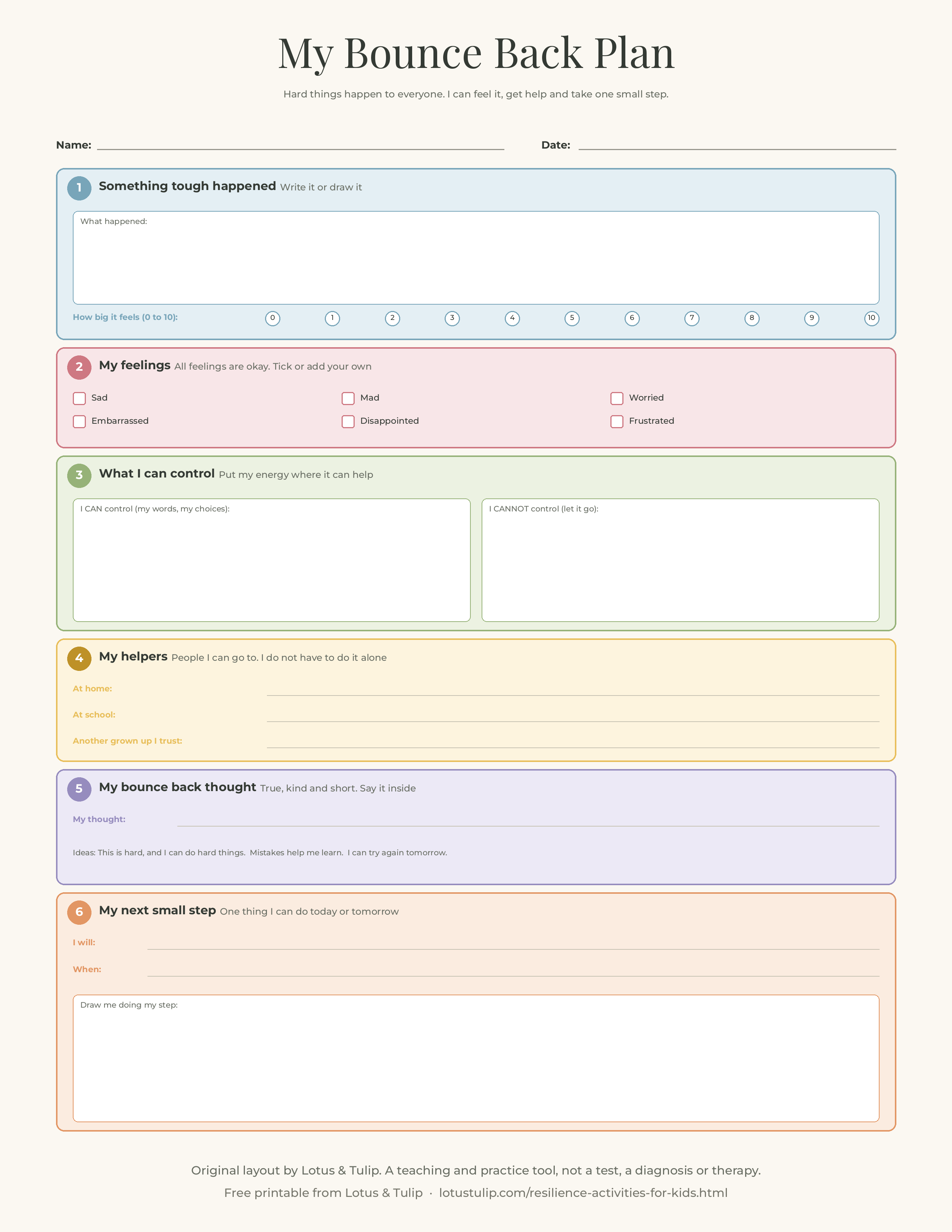
- Name what happened. Ask the child to write or draw the tough thing on My Bounce Back Plan and rate how big it feels from 0 to 10. Drawing counts as an answer.
- Name the feelings. Tick the feelings or add their own. All feelings are okay. Feeling two things at once, like sad and angry, is common.
- Sort control. Fill in what they can control (their words, choices, asking for help, trying again) and what they cannot (other people's choices, the weather, the past). Guide gently, without lecturing.
- List helpers. Write a helper at home, at school and one more trusted adult. If the child cannot name anyone at school, that is useful information for adults.
- Choose a bounce back thought. Help the child pick one short, true and kind sentence and practice saying it inside.
- Pick one small next step. Choose something they can do today or tomorrow, such as asking the teacher for help, practicing for 10 minutes or inviting a friend to play. Write when they will do it.
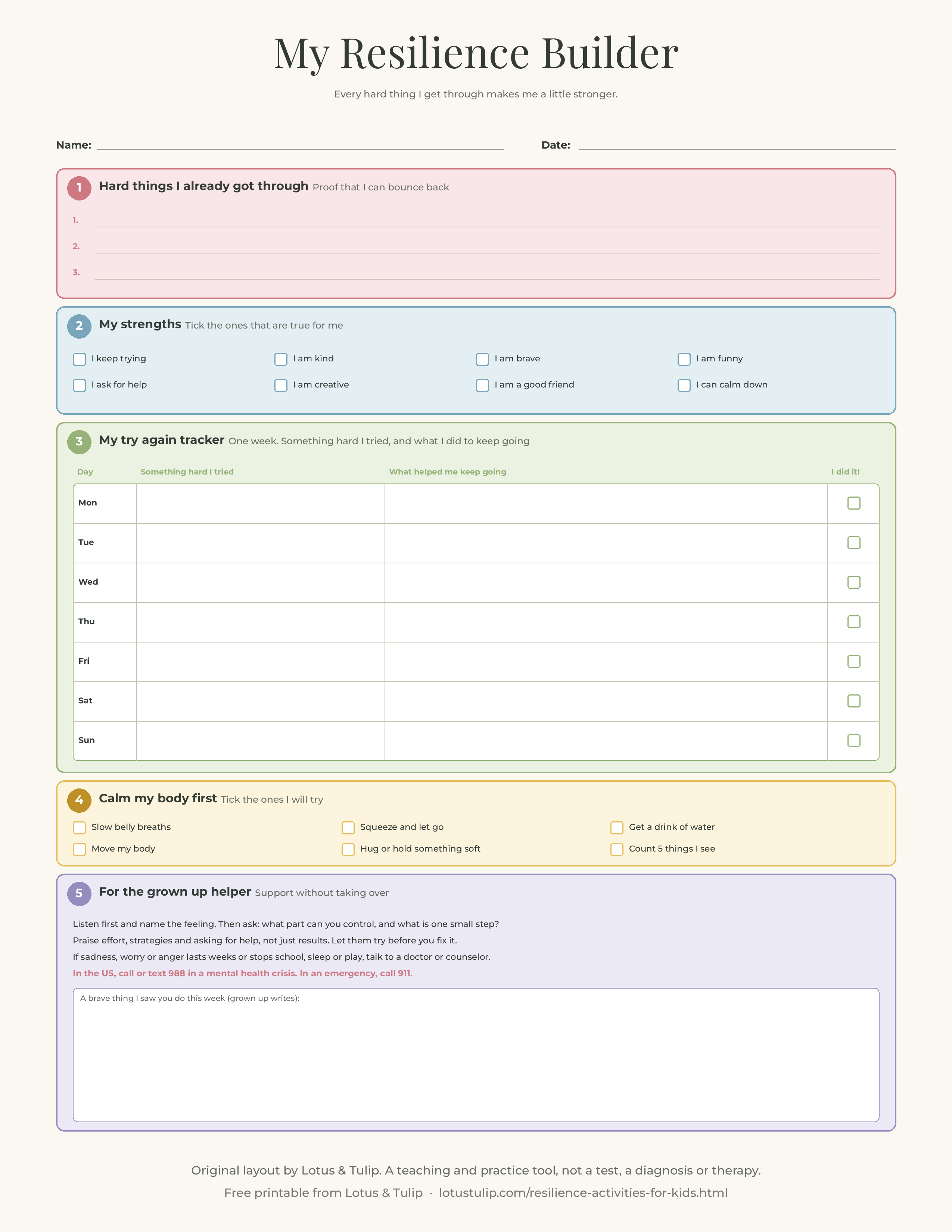
- Build the resilience habit. Use page 2, My Resilience Builder, over a week: hard things they already got through, their strengths, the daily try again tracker and calming tools. Write one brave thing you saw them do.
- Review and get help when needed. Look back at the end of the week and celebrate effort. If sadness, worry or anger lasts weeks, stops school, sleep, eating or play, or comes with talk of self harm, contact a pediatrician, school counselor or child therapist. In the US, call or text 988 in a mental health crisis, or call 911 in an emergency.
How to adapt it by age
- Ages 4 to 6: Keep it concrete and playful. Use drawing, puppets and stories. Do the control sort with pictures. One feeling, one helper and one small step is enough. Adults do the writing.
- Ages 7 to 9: Most children can fill in both pages with some help. The try again tracker and strengths ticks work well with stickers. Link activities to real school situations like tests, friendships and sports.
- Ages 10 to 12: Children can reflect more deeply on thoughts, plan their own stretch goals and track progress. Respect growing privacy, and let them decide what to share with peers.
- After a big loss or change: Death, divorce, a move or illness in the family need time and extra support, not quick bounce back. See our grief activities for kids and divorce worksheets for kids.
Resilience activities in the classroom and school counseling
Teachers and school counselors can weave resilience into the school day without a separate curriculum: a brief morning check in, a class "mistake of the week," strengths spotting at the end of the day, and problem solving steps posted on the wall. In small groups, the bounce back plan works well as a structured activity, with each child choosing one small step to report back on next session. Keep sharing optional and never require a child to describe a painful event in front of peers.
Watch for children who cannot name any adult at school as a helper. Pairing them with a staff mentor who checks in briefly each week is a simple way to add the most important protective factor the research describes.
Common mistakes
- Rushing to fix it. Solving every problem for a child removes the chance to practice. Ask "What do you think you could try?" first, and step in when the problem is too big or unsafe.
- Forced positivity. "Look on the bright side" can make children feel unheard. Acknowledge the feeling before moving to problem solving.
- Praising only results or "smartness." Praise effort, strategies, asking for help and trying again.
- Treating resilience as the child's job alone. If the problem is bullying, abuse or an unsafe environment, adults must act to change the situation.
- One worksheet and done. Resilience grows through many small, repeated experiences over months and years.
- Using a worksheet instead of help. If a child is struggling for weeks, a worksheet supports professional help. It does not replace it.
Examples
- A 6 year old and a lost game: After losing at a board game, a first grader threw the pieces and cried. Her dad waited until she was calm, then drew the game on her bounce back plan. She rated it 8 out of 10, ticked "mad" and "embarrassed," and picked the thought "Losing is part of playing." Her next step was to play one more round the next day. After a few weeks of practice, she could lose with a groan instead of a meltdown most of the time.
- An 8 year old and a hard spelling test: A third grader said he was "just bad at spelling" after a low score. His teacher helped him fill in what he could control (practicing 10 minutes a night, asking for help with tricky words) and what he could not (which words were on the test). Over two weeks his try again tracker filled up, and his next score improved. More importantly, he started saying "I haven't learned these yet."
- An 11 year old and a friendship change: A fifth grader's best friend started sitting with another group. With the school counselor she listed hard things she had already gotten through, noticed her strength as a kind and funny friend, and set a small brave goal of inviting a classmate from art club to sit with her. It took a few tries, but within a month she had two new friends. For more on friendship skills, see our friendship worksheets for kids.
Free printable: resilience activities for kids
This free printable is an original Lotus & Tulip design on US Letter, in our own wording. It is not a published questionnaire or a manualized program and gives no score. Page 1, My Bounce Back Plan, helps a child work through one tough moment: what happened and how big it feels from 0 to 10, feelings to tick, what I can control and what I cannot control, my helpers at home, at school and another trusted adult, my bounce back thought and my next small step with a space to draw it. Page 2, My Resilience Builder, turns coping into a habit: hard things I already got through, my strengths to tick, a 7 day try again tracker, calm my body tools and a section for the grown up helper with tips, US crisis lines and a space to write a brave thing they saw the child do.
Download the free resilience activities for kids (PDF, 2 pages, US Letter)
Prefer single images? Page 1: My Bounce Back Plan (PNG) · Page 2: My Resilience Builder (PNG)
Free to print for your own child, students, clients or groups. Please link to this page rather than re-uploading the file. A teaching and practice tool, not a test, a diagnosis or a substitute for therapy. In the US, call or text 988 in a mental health crisis. In immediate danger, call 911.
Buy the kids feelings worksheets on Etsy
Related resources
- Trauma worksheets for kids: a calm and safe plan and a reminders plan for ages 5 to 12
- Depression worksheets for kids: feelings weather check and little lifts plan for ages 5 to 12
- Resilience activities for teens: setback map and values based next steps
- Growth mindset worksheet: how to teach it honestly
- Problem solving worksheet for kids: steps and practice cards
- Coping skills list for kids: 60 ideas by category
- Circle of control worksheet: focus on what you can change
- Self esteem worksheets for kids: strengths and kind self talk
- Emotional regulation worksheets for kids: name it and calm it
- All counseling resources for kids and teens
FAQ
What is resilience for kids?
Resilience is a child's ability to cope with and recover from hard things, such as disappointment, change, loss or stress. It does not mean never being upset. It means feeling the feeling, getting support and finding a way forward. It is built over time, mostly through caring relationships and many small chances to practice coping.
What are good resilience activities for kids?
Simple, repeatable activities work best: listing hard things they have already gotten through, sorting what they can and cannot control, a helper hand of trusted people, bounce back thought cards, a try again tracker, strengths spotting, sharing mistakes, problem solving steps, calming skills, story talk, helper jobs and small brave stretch goals.
What is the most important factor in a child's resilience?
Research summarized by the Center on the Developing Child at Harvard University points to at least one stable, committed relationship with a supportive parent, caregiver or other adult as the single most common factor in children who develop resilience. That adult does not have to be a parent. A grandparent, teacher, coach or mentor can play this role.
Can resilience be taught?
The skills behind it can be practiced. School programs that build several resilience skills have shown short term reductions in anxiety, depressive symptoms and distress in reviews of randomized trials, though results vary. Resilience grows through repeated everyday experiences with support, not from one lesson.
How do I help my child bounce back from failure?
Stay calm and acknowledge the feeling first. Then help them think about what they can control and choose one small next step. Praise effort and strategies rather than only results or intelligence, and share your own mistakes and how you handled them. Let them try before you step in to fix it.
At what age can kids start resilience activities?
Even preschoolers can start with simple activities like naming feelings, calming breaths, stories about characters who face problems and picking one small step with an adult. Children 7 and up can usually fill in worksheets like the bounce back plan with some help, and 10 to 12 year olds can plan their own stretch goals.
When should a child see a professional?
Get help from a pediatrician, school counselor or licensed child therapist if sadness, worry or anger lasts more than a few weeks, keeps a child from school, sleep, eating or play, keeps getting worse, or comes with talk of self harm or wanting to die. In the US, call or text 988 in a mental health crisis, or call 911 in an emergency.
Sources
- Bethell, C., Jones, J., Gombojav, N., Linkenbach, J., and Sege, R. (2019). Positive childhood experiences and adult mental and relational health in a statewide sample: Associations across adverse childhood experiences levels. JAMA Pediatrics, 173(11), e193007.
- Brunwasser, S. M., Gillham, J. E., and Kim, E. S. (2009). A meta-analytic review of the Penn Resiliency Program's effect on depressive symptoms. Journal of Consulting and Clinical Psychology, 77(6), 1042 to 1054.
- Center on the Developing Child at Harvard University (2015). Supportive relationships and active skill-building strengthen the foundations of resilience: Working Paper 13. developingchild.harvard.edu.
- Dray, J., Bowman, J., Campbell, E., and others (2017). Systematic review of universal resilience-focused interventions targeting child and adolescent mental health in the school setting. Journal of the American Academy of Child and Adolescent Psychiatry, 56(10), 813 to 824.
- Masten, A. S. (2001). Ordinary magic: Resilience processes in development. American Psychologist, 56(3), 227 to 238.
- Mueller, C. M., and Dweck, C. S. (1998). Praise for intelligence can undermine children's motivation and performance. Journal of Personality and Social Psychology, 75(1), 33 to 52.
- Seery, M. D., Holman, E. A., and Silver, R. C. (2010). Whatever does not kill us: Cumulative lifetime adversity, vulnerability, and resilience. Journal of Personality and Social Psychology, 99(6), 1025 to 1041.
- Sisk, V. F., Burgoyne, A. P., Sun, J., Butler, J. L., and Macnamara, B. N. (2018). To what extent and under which circumstances are growth mind-sets important to academic achievement? Two meta-analyses. Psychological Science, 29(4), 549 to 571.
- Werner, E. E. (1993). Risk, resilience, and recovery: Perspectives from the Kauai Longitudinal Study. Development and Psychopathology, 5(4), 503 to 515.
Lotus & Tulip is not affiliated with the researchers, universities or programs named on this page. This page is educational and does not replace professional advice.