
Therapist worksheets · DBT distress tolerance · Updated 2026-11-12
DBT STOP skill worksheet: how to stop, step back, observe and proceed mindfully (free printable)
Full DBT set: DBT Worksheets for Therapists, 20 pages incl. a crisis survival plan, a diary card, check the facts, opposite action and chain analysis Holiday 20% off: about $11.04, was $14 (EUR 12) · fillable PDF, instant digital download
Buy on EtsyTry it free first: download a fillable sample (weekly diary card and checking the facts, PDF, 234 KB). Type into it on screen, then get the full pack. No email needed.
For teens: DBT Worksheets for Teens, 20 pages incl. wise mind, a distress tolerance toolkit, a body reset and school and social media triggers Holiday 20% off: about $11.04, was $14 (EUR 12) · instant digital download
Buy on EtsyMega bundle: Therapist Worksheets Mega Bundle (8 packs incl. DBT, CBT, ACT, anxiety, grief and ADHD) Holiday 20% off: about $35.88, was $45 (EUR 39) · fillable PDFs for all 8 packs plus 160 printable pages, instant digital download
Buy on EtsyMost damage in a crisis happens in a few seconds: the text that gets sent, the door that gets slammed, the thing said that cannot be unsaid, the urge to hurt yourself that gets acted on. STOP is the DBT skill built for exactly that gap between an urge and an action. It is short enough to remember when you are flooded, and it does one job: it buys time so that the next move comes from a calmer, wiser place. This guide is for therapists, counselors, DBT skills group leaders, school mental health staff and anyone practicing DBT skills with a clinician. It covers what each letter means, when to use STOP and when not to, how to teach and rehearse it, what changes for teens, examples, common mistakes and what the research does and does not show. It ends with a free 2 page printable: My STOP Skill Plan (with a cut out pocket card) and a STOP Skill Practice Log.
Download the free DBT STOP skill worksheet (PDF, 2 pages, US Letter)
Direct download, no email or sign up. See the pages first.
What the STOP skill is
STOP is one of the crisis survival skills in the distress tolerance module of dialectical behavior therapy. In the second edition of Marsha Linehan's skills materials (2015), the crisis survival skills are listed in Distress Tolerance Handout 2 as STOP, pros and cons, TIP skills, distracting with Wise Mind ACCEPTS, self-soothing and IMPROVE the moment. STOP has its own page, Distress Tolerance Handout 4, with two practice worksheets, Distress Tolerance Worksheets 2 and 2a. The handout notes that the skill was adapted from an unpublished worksheet by Francheska Perepletchikova and Seth Axelrod, who introduced STOP in their adaptation of DBT for children to increase awareness and reduce impulsive behavior (Perepletchikova et al., 2011).
The letters, in our own words:
- S: Stop. Do not react. Freeze, physically if you can: hands still, mouth closed, thumb off the send button. Emotions push for action right now; freezing keeps the choice in your hands.
- T: Take a step back. Put some distance between you and the situation. Leave the room, put the phone face down, take a break, let one slow breath out. You are not giving up; you are refusing to let the feeling make the decision.
- O: Observe. Notice what is going on inside you and around you. What are you feeling and thinking? What are the facts? What are other people actually saying or doing, as opposed to what you assume?
- P: Proceed mindfully. Act with awareness. Consider your thoughts and feelings, the situation and other people, and think about your goals. Ask wise mind: which action will make this better, and which will make it worse?
The skill borrows from other parts of DBT. Observe is the same mindfulness "what" skill taught in the core mindfulness module, and Proceed mindfully leans on wise mind and effectiveness. STOP packages them into four steps you can run in under a minute.
When to use STOP, and when not to
Distress Tolerance Handout 3 describes when crisis survival skills fit: when the pain is intense but likely to be short term, when there is strong pressure to act on emotion in a way that would make things worse, when you are so overwhelmed you cannot think, and when you need to keep functioning but cannot solve the problem right now. STOP is usually the first skill to reach for in those moments, because it comes before everything else.
Good moments for STOP:
- Right before an action you would regret: sending an angry message, quitting on the spot, yelling at a child or partner, driving off in a rage, breaking something.
- When an urge to self-harm, use substances, binge or purge shows up and the person has a plan to ride it out.
- In a tense conversation that is about to escalate.
- When a teen gets a hurtful message or post and wants to reply in kind.
STOP is not the right tool for everything:
- It is not a fix for ongoing problems. Crisis survival skills are for getting through the moment. If the same crisis comes back every week, the work is problem solving, emotion regulation and changing the situation.
- It is not for situations that need immediate action. If someone is in danger, act. STOP is about not acting on emotion, not about freezing in an emergency.
- It does not replace a safety plan. If there is suicide risk, STOP can be one line in the plan, but the plan needs warning signs, people to contact and crisis lines. See our safety plan worksheet.
What makes STOP work in practice
- Freezing is physical. Telling yourself to "calm down" rarely works. Taking your hand off the phone, sitting down or putting both feet on the floor is a concrete action the body can follow.
- Distance lowers the pull. Many urges are tied to a cue: the person, the screen, the room. Stepping back removes the cue for a few minutes, which is often enough for the peak to pass.
- Observing slows the story. Describing facts ("he said he'll call tomorrow") instead of interpretations ("he's leaving me") separates the event from the alarm about it. If the reaction does not fit the facts, check the facts is the next skill.
- Proceed mindfully keeps it from being avoidance. STOP does not end in "do nothing forever." It ends with choosing a next step on purpose, which might be sending a calmer message tomorrow, using TIPP to bring the body down, or asking for help.
- Rehearsal matters most. In a real crisis people fall back on what they have practiced. A skill that has only been read about is hard to reach when you are flooded.
What the research says
- DBT skills training has good support as a package. In a randomized component analysis of 99 women with borderline personality disorder and recent suicidal behavior (Linehan et al., 2015, JAMA Psychiatry), the conditions that included DBT skills training reduced nonsuicidal self-injury, depression and anxiety more than DBT individual therapy without skills training. Skills training covered all four modules, including distress tolerance.
- Using skills appears to matter. Neacsiu, Rizvi and Linehan (2010, Behaviour Research and Therapy) followed 108 women with borderline personality disorder across three randomized trials and found that increases in DBT skills use (measured across skills in general, not STOP specifically) mediated the decrease in suicide attempts and depression and the gain in anger control, and partly mediated the decrease in nonsuicidal self-injury.
- STOP comes from child DBT. Perepletchikova and colleagues (2011) introduced STOP in a 6 week DBT skills pilot with 11 children in regular education classes; the children reported more adaptive coping and fewer depressive symptoms afterward, without a control group. A later pilot randomized trial of DBT adapted for preadolescent children with disruptive mood dysregulation disorder (Perepletchikova et al., 2017, Journal of the American Academy of Child and Adolescent Psychiatry, 43 children ages 7 to 12) found a positive response rate of 90.4% with DBT-C compared with 45.5% with treatment as usual.
- What is not known. We know of no trial that tests STOP on its own against a control condition. It is a sensible skill inside a well supported treatment, but its separate effect has not been isolated. Track whether it helps a given person, for example with the before and after ratings on page 2 of the printable.
How to use the DBT STOP skill worksheet, step by step
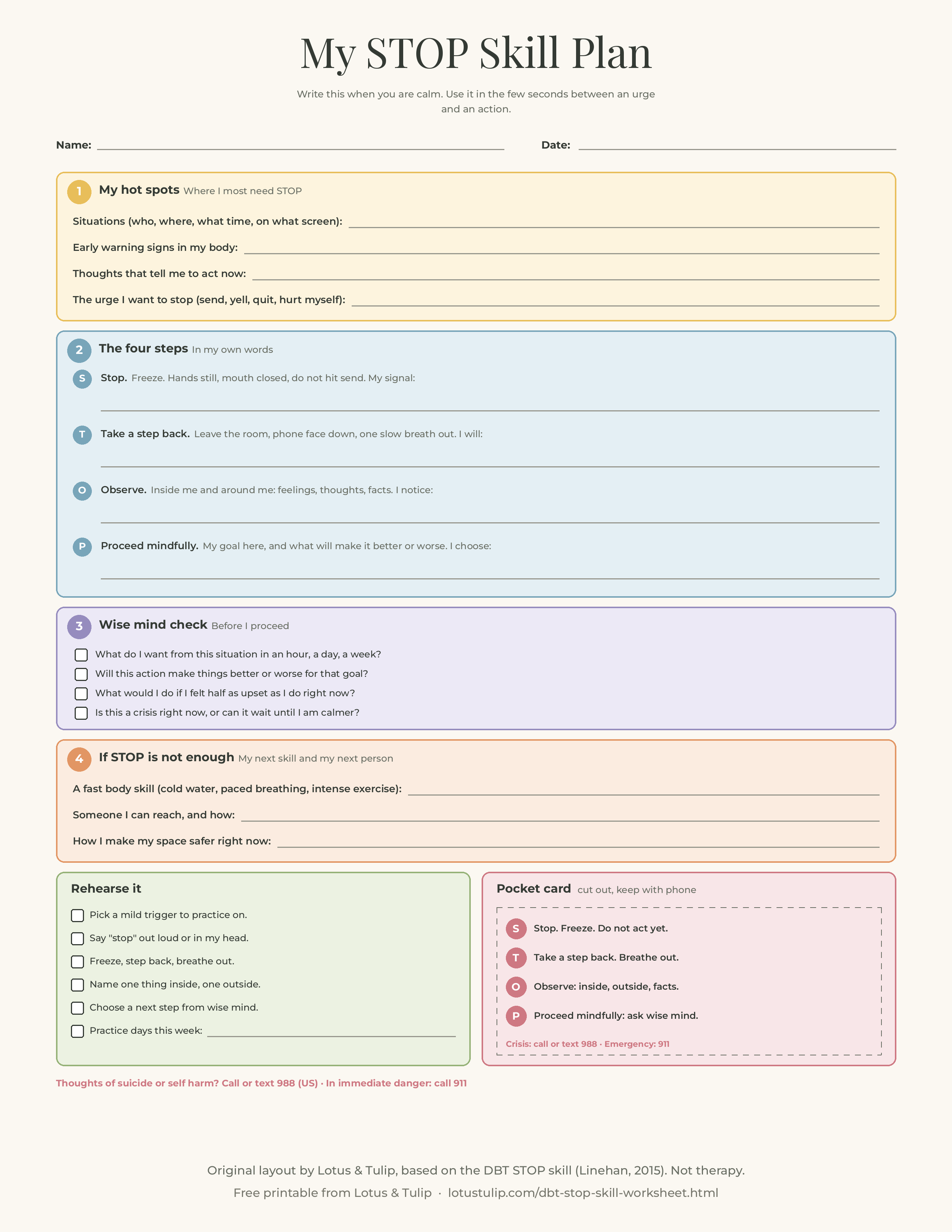
- Fill it in while calm. Page 1 is a plan, not an in the moment form. Complete it in session or on a calm day so the words are ready when they are needed.
- Name the hot spots. In box 1, list the situations where impulsive actions happen most, the early warning signs in the body (hot face, clenched jaw, racing heart), the thoughts that say "act now," and the specific urge to stop.
- Write each step in personal words. In box 2, choose a freeze signal (saying "stop" in your head, hands flat on the table), a step back action, what to observe, and a default mindful next step.
- Prepare the wise mind check. Box 3 lists four questions to ask before proceeding. Read them aloud in session so they feel familiar.
- Plan what comes after STOP. Box 4 names a fast body skill, a person to contact and a way to make the space safer, for moments when STOP alone is not enough.
- Rehearse with a mild trigger. In session, recall a small irritation, notice the urge, then practice freezing, stepping back, observing and choosing. Repeat a few times, and tick the rehearsal boxes.
- Cut out the pocket card. Keep it in a wallet, phone case or locker. Some clients photograph it and set it as a lock screen.
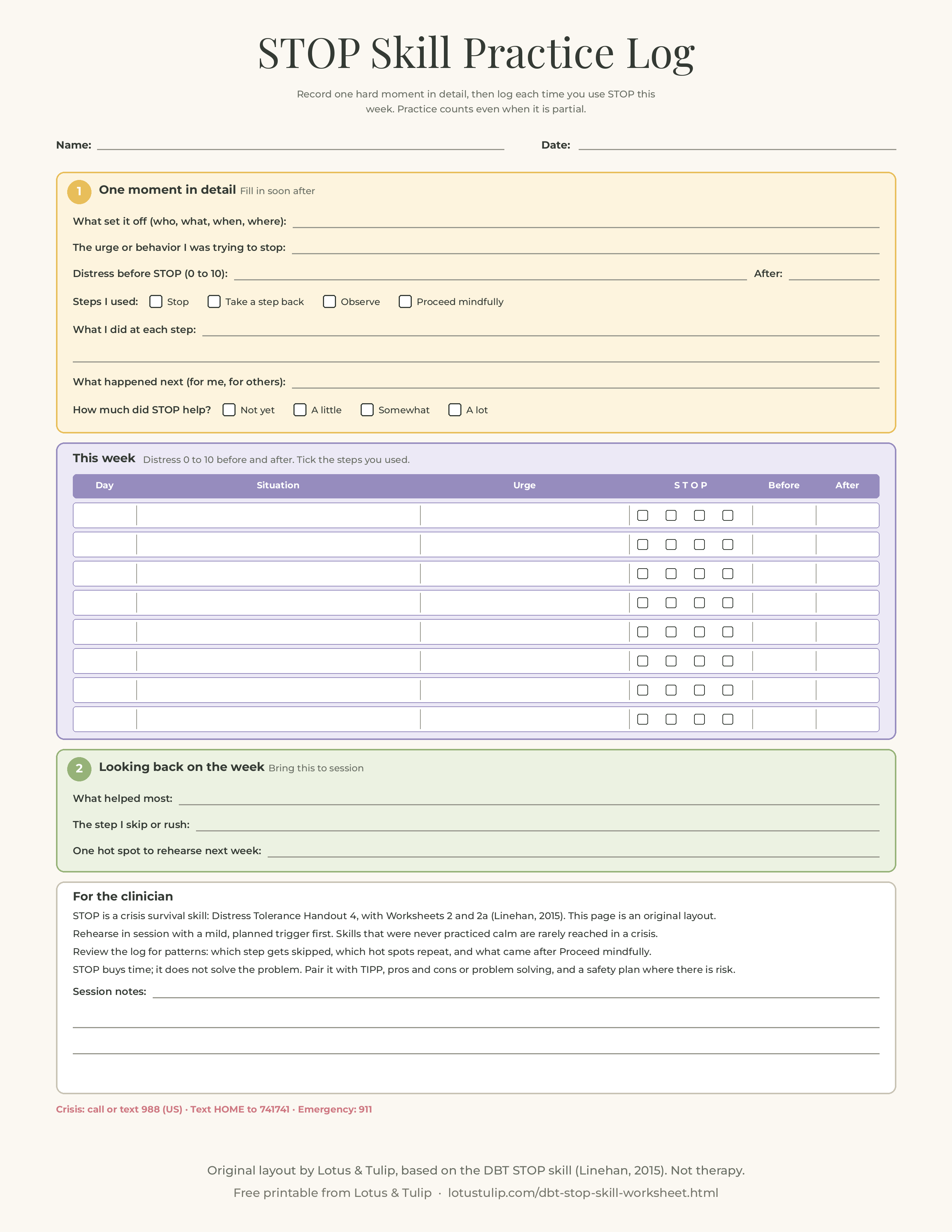
- Log real use. On page 2, record one hard moment in detail, with distress 0 to 10 before and after and the steps actually used. Log every other use in the weekly table, including partial attempts.
- Review in the next session. Look for the step that gets skipped, the hot spots that repeat and what happened after Proceed mindfully, and adjust the plan.
Teaching STOP to teens
STOP was designed with young people in mind, and it tends to land well with teens because it is short, physical and does not ask them to feel differently first.
- Make it about phones. Many teen crises happen through a screen. "Phone face down, step away, wait 10 minutes" is a concrete version of S and T that teens can practice on small things first.
- Use their examples. Ask for a time they reacted fast and regretted it, and walk through what STOP would have looked like. Avoid examples that sound like a lecture.
- Agree on a signal with caregivers. A word or gesture that means "I'm doing STOP" lets a teen step away from an argument without it being read as disrespect. Caregivers can practice the same skill.
- Celebrate partial use. Freezing for five seconds and then still sending the message is progress. The log on page 2 counts it.
Our DBT Worksheets for Teens include wise mind, a distress tolerance toolkit and school and social media trigger pages that pair well with this printable.
Three short examples
These are illustrative composites written for this guide, not real clients.
- A 15 year old and a group chat. He sees a screenshot of himself being mocked and starts typing an insult. S: he takes his thumb off the screen and says "stop" in his head. T: he puts the phone in his bag and goes to get water. O: "My face is hot, I want to hit back, I feel humiliated. Fact: three people saw it." P: wise mind says replying will make it spread further. He tells his older sister and decides to talk to the school counselor in the morning.
- A parent at bedtime. After the third trip out of bed, a mother feels the urge to shout. S: she stops in the doorway with her hands at her sides. T: she steps into the hallway and breathes out slowly twice. O: "I'm exhausted and frustrated. He's anxious about tomorrow's test." P: she goes back in, speaks quietly, sets one clear limit and offers to check on him in ten minutes.
- An adult with self-harm urges. After a painful phone call, a client notices a strong urge to self-harm. S: she freezes and sits on the floor. T: she leaves the bathroom and goes to the kitchen. O: distress is 9 out of 10, she feels rejected, and the urge is strong but not an emergency. P: following her plan, she uses cold water on her face, texts a friend from box 4 and writes the moment in her log to bring to session. If she had felt unable to stay safe, the plan says to call or text 988.
Common mistakes
- Only teaching it in a crisis. STOP learned for the first time during a meltdown rarely sticks. Teach and rehearse it when things are calm.
- Treating it as suppression. STOP does not mean pretending the feeling is not there. Observe asks you to notice it fully; the point is not acting on it blindly.
- Skipping the step back. Freezing in front of the trigger is hard. Physical distance is often what makes the freeze hold.
- Never getting to P. If STOP turns into walking away from every conflict, it has become avoidance. The last step is choosing an effective next action, which often means going back to the situation later.
- Expecting STOP to carry a full crisis. It is a first step. Plan the next skills, people and crisis lines, as in box 4.
- Not tracking. Without a log, it is hard to tell whether the skill is being used or what gets in the way.
Free DBT STOP skill worksheet
This free printable is an original Lotus & Tulip layout on US Letter. Page 1, My STOP Skill Plan, has my hot spots (situations, body warning signs, act now thoughts and the urge to stop), the four steps with a line for my own words at each, a wise mind check, an if STOP is not enough box, a rehearsal checklist and a cut out pocket card with 988 and 911. Page 2, STOP Skill Practice Log, has one moment in detail (what set it off, the urge, distress 0 to 10 before and after, steps used, outcome, how much it helped), an 8 row weekly log with S, T, O and P tick boxes, a looking back on the week box, notes for the clinician and US crisis lines.
Download the free DBT STOP skill worksheet (PDF, 2 pages, US Letter)
Prefer single images? Page 1: my STOP skill plan (PNG) · Page 2: STOP skill practice log (PNG)
Free to print for use with your own clients or for personal use. Please link to this page rather than re-uploading the file. An original layout based on the STOP skill as described in published DBT materials (Linehan, 2015); it does not reproduce the handouts or worksheets. A practice tool, not a substitute for therapy. If you are in crisis in the US, call or text 988, text HOME to 741741, or call 911 in an emergency.
Related resources
- Distress tolerance worksheets: all the crisis survival skills, with a crisis survival plan
- DBT TIPP skills worksheet: fast body skills for when STOP is not enough
- DBT pros and cons worksheet: the grid to read during Proceed mindfully, with a pocket card
- Wise mind worksheet: the state of mind Proceed mindfully asks you to consult
- Cope ahead worksheet: rehearse STOP for a situation you can see coming
- Check the facts worksheet: when Observe shows the reaction does not fit the facts
- Radical acceptance worksheet: the reality acceptance side of distress tolerance
- Urge surfing worksheet: riding out an urge without acting on it
- Safety plan worksheet: for suicide risk, alongside STOP
FAQ
What does STOP stand for in DBT?
Stop, Take a step back, Observe and Proceed mindfully. It is a crisis survival skill in the DBT distress tolerance module, used in the moment between an urge and an action.
Which DBT handout covers the STOP skill?
In Linehan's second edition skills materials (2015), STOP is Distress Tolerance Handout 4, with Distress Tolerance Worksheets 2 and 2a for practice. Distress Tolerance Handout 2 gives the overview of the crisis survival skills and Handout 3 explains when to use them.
Who created the STOP skill?
The handout says it was adapted from an unpublished worksheet by Francheska Perepletchikova and Seth Axelrod, who introduced STOP in their adaptation of DBT for children (Perepletchikova et al., 2011). Linehan included it in the 2015 adult skills materials.
Is the STOP skill evidence based?
STOP is part of DBT skills training, which has good support as a package, for example in Linehan and colleagues' 2015 component analysis. No published trial has tested STOP on its own, so its separate effect is not known. Tracking before and after distress for a given person is the best way to judge it.
Can kids and teens use the STOP skill?
Yes. STOP was first introduced in DBT for children, and its short, physical steps suit teens. Practicing on small, everyday triggers and on phone situations helps it transfer to bigger moments.
Is this DBT STOP skill worksheet free?
Yes. It is free to print for use with your own clients or for personal use. Please link to this page rather than re-uploading the file.
Sources
- Linehan, M. M. (2015). DBT Skills Training Handouts and Worksheets, second edition. Guilford Press. Distress Tolerance Handouts 2 to 4 and Worksheets 2 and 2a.
- Linehan, M. M., Korslund, K. E., Harned, M. S., Gallop, R. J., Lungu, A., Neacsiu, A. D., McDavid, J., Comtois, K. A., and Murray-Gregory, A. M. (2015). Dialectical behavior therapy for high suicide risk in individuals with borderline personality disorder: a randomized clinical trial and component analysis. JAMA Psychiatry, 72(5), 475 to 482.
- Neacsiu, A. D., Rizvi, S. L., and Linehan, M. M. (2010). Dialectical behavior therapy skills use as a mediator and outcome of treatment for borderline personality disorder. Behaviour Research and Therapy, 48(9), 832 to 839.
- Perepletchikova, F., Axelrod, S. R., Kaufman, J., Rounsaville, B. J., Douglas-Palumberi, H., and Miller, A. L. (2011). Adapting dialectical behaviour therapy for children: towards a new research agenda for paediatric suicidal and non-suicidal self-injurious behaviours. Child and Adolescent Mental Health, 16(2), 116 to 121.
- Perepletchikova, F., Nathanson, D., Axelrod, S. R., Merrill, C., Walker, A., Grossman, M., Rebeta, J., Scahill, L., Kaufman, J., Flye, B., Mauer, E., and Walkup, J. (2017). Randomized clinical trial of dialectical behavior therapy for preadolescent children with disruptive mood dysregulation disorder: feasibility and outcomes. Journal of the American Academy of Child and Adolescent Psychiatry, 56(10), 832 to 840.