
Therapist worksheets · DBT distress tolerance · Updated 2026-11-12
DBT pros and cons worksheet: how to weigh a crisis urge before it wins (free printable)
Full DBT set: DBT Worksheets for Therapists, 20 pages incl. a crisis survival plan, a diary card, check the facts, opposite action and chain analysis Holiday 20% off: about $11.04, was $14 (EUR 12) · fillable PDF, instant digital download
Buy on EtsyTry it free first: download a fillable sample (weekly diary card and checking the facts, PDF, 234 KB). Type into it on screen, then get the full pack. No email needed.
For teens: DBT Worksheets for Teens, 20 pages incl. wise mind, a distress tolerance toolkit, a body reset and school and social media triggers Holiday 20% off: about $11.04, was $14 (EUR 12) · instant digital download
Buy on EtsyMega bundle: Therapist Worksheets Mega Bundle (8 packs incl. DBT, CBT, ACT, anxiety, grief and ADHD) Holiday 20% off: about $35.88, was $45 (EUR 39) · fillable PDFs for all 8 packs plus 160 printable pages, instant digital download
Buy on EtsyWhen an urge is at full strength, it argues well. It promises relief right now and keeps quiet about tomorrow. The DBT pros and cons skill is a way to have the counterargument ready before the urge shows up: an honest, written comparison of acting on the urge and resisting it, made while you are calm and reread when you are not. This guide is for therapists, counselors, DBT skills group leaders, school mental health staff and anyone practicing DBT skills with a clinician. It covers what the skill is and where it comes from, the four box grid, how it differs from an ordinary pros and cons list, when to use it, a step by step method, what changes for teens, examples, common mistakes and what the research does and does not show. It ends with a free 2 page printable: My Pros and Cons Grid (with a wise mind conclusion and a cut out pocket card) and a Pros and Cons Practice Log.
Download the free DBT pros and cons worksheet (PDF, 2 pages, US Letter)
Direct download, no email or sign up. See the pages first.
What the DBT pros and cons skill is
Pros and cons is one of the crisis survival skills in the distress tolerance module of dialectical behavior therapy. It was already listed among the crisis survival strategies in Marsha Linehan's first skills training manual (1993). In the second edition of the skills materials (Linehan, 2015), Distress Tolerance Handout 2 lists the crisis survival skills as STOP, pros and cons, TIP skills, distracting with Wise Mind ACCEPTS, self-soothing and IMPROVE the moment. Pros and cons has its own page, Distress Tolerance Handout 5, with two practice worksheets: Distress Tolerance Worksheet 3, Pros and Cons of Acting on Crisis Urges, and Worksheet 3a, which uses a different grid layout. Worksheet 3 notes that it was adapted from an unpublished worksheet by Seth Axelrod.
The handout defines a crisis urge in a useful way: an urge is a crisis when it is very strong and when acting on it will make things worse in the long term. That covers the obvious dangerous behaviors (self-harm, using substances, bingeing, driving recklessly, lashing out) and also the quieter ones the handout names: giving in, giving up, or avoiding what you need to do to build the life you want. Quitting a job in a rage, skipping the exam, ending a relationship by text at 2 a.m. and staying in bed all day can all be crisis urges.
The four box grid
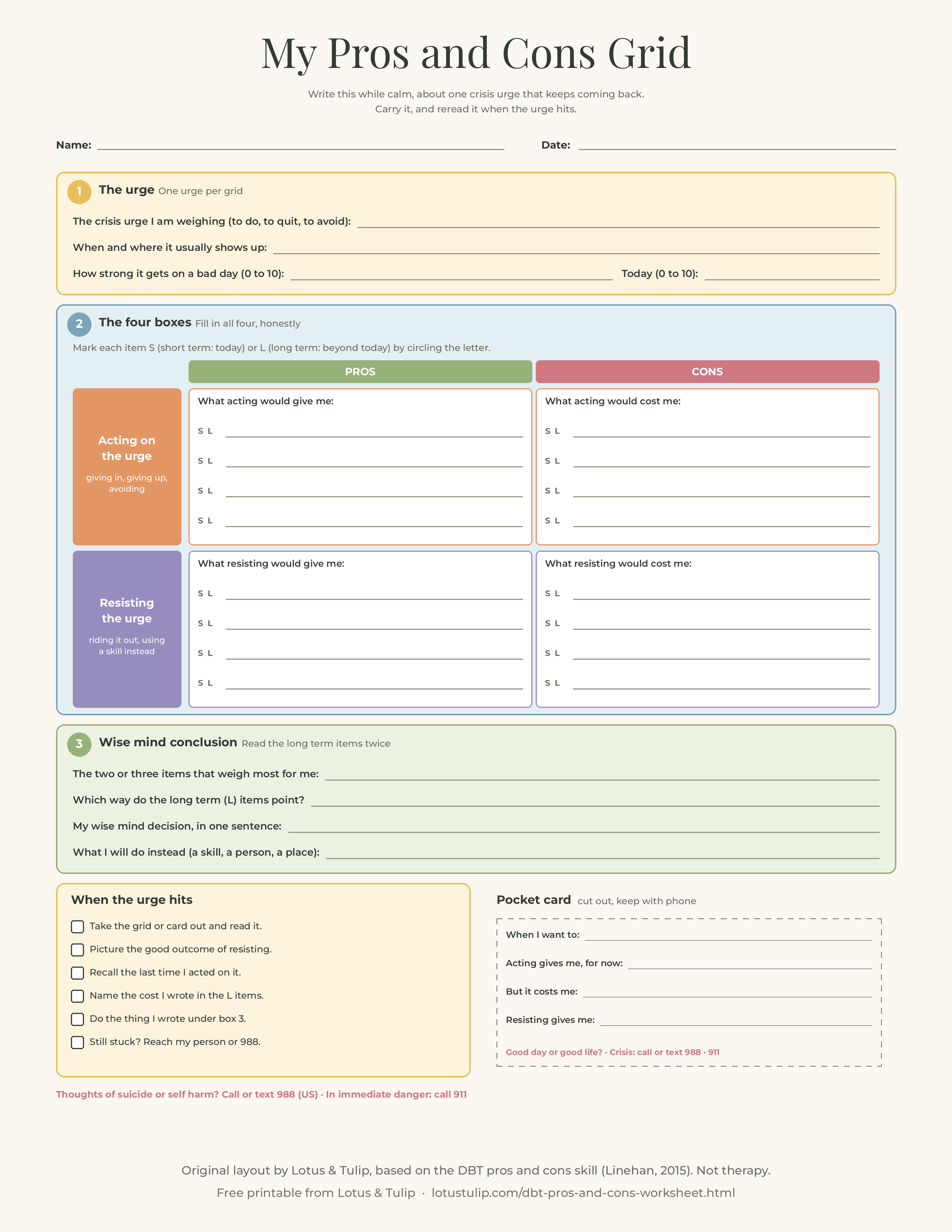
The DBT version compares two courses of action, not one. You weigh both sides of acting on the urge and both sides of resisting it:
- Pros of acting on the urge. What giving in would honestly give you. Usually relief, escape, a feeling of control or of getting even. Write these down; pretending they do not exist makes the whole exercise unbelievable.
- Cons of acting on the urge. What it would cost you, today and later: shame, injury, a damaged relationship, a relapse, a lost job, a broken promise to yourself.
- Pros of resisting. What riding it out gives you: keeping your word, staying out of the hospital, a day clean, waking up without regret, being someone people can trust.
- Cons of resisting. What resisting costs: the pain does not go away right now, it takes effort, the problem is still there. Being honest here is what makes the grid credible.
Linehan's Worksheet 3 then asks which items are short term (just for today) and which are long term (beyond today), and puts the question to wise mind in a memorable form: would you rather have a good day or a good life? The pattern that usually emerges is the core of the skill. Most of the pros of acting are short term, and most of its cons are long term. Resisting is usually the reverse: the costs come now and the benefits come later. Seeing that asymmetry on paper is what makes the next choice easier.
The handout's guidance for using the grid has two halves. Before an overwhelming urge hits, write the pros and cons, carry them with you and rehearse them. When the urge hits, get the list out and read it, imagine the positive consequences of resisting, think of the negative consequences of giving in, and remember what happened the last times you acted on the urge.
How it differs from an ordinary pros and cons list
Everyday pros and cons lists, and the decisional balance sheet that Irving Janis and Leon Mann described in 1977, are tools for thinking through a decision. The DBT skill shares the four box shape but does a different job:
- It is about an urge, not an open decision. The person has usually already decided, in calmer moments, that they want to stop the behavior. The grid exists to remind them why when emotion mind takes over.
- It is written in advance. Nobody builds a careful grid while flooded. The skill works by rereading a grid made earlier, which is why carrying it matters.
- Time horizon is built in. Marking items short term or long term is part of the method, not an extra.
- It is paired with other skills. Pros and cons tells you what you want to do; skills like STOP, TIPP and distraction help you actually do it.
The difference matters clinically. In a 2015 review in Behavioural and Cognitive Psychotherapy, William Miller and Gary Rose concluded that with people who are still ambivalent about change, an evenly weighted decisional balance exercise tends to lower commitment to change, while motivational interviewing style evocation tends to raise it. The DBT use case is closer to the situation they describe where the person has already decided. If a client is genuinely on the fence about whether to change at all, see our decisional balance worksheet guide for when a full grid helps and when to choose something else.
When to use pros and cons
Distress Tolerance Handout 3 describes when crisis survival skills fit: when you have intense pain that cannot be helped quickly, when you want to act on your emotions but it will only make things worse, when emotion mind threatens to overwhelm you and you need to stay skillful, when you are overwhelmed but demands must be met, and when arousal is extreme but the problem cannot be solved right away. It also says what they are not for: everyday problems, solving all your life problems, or making your life worth living.
Within that, pros and cons fits best:
- For urges that come back. Self-harm, substance use, bingeing or purging, rage, impulsive spending, quitting, isolating. A grid written once can be reread many times.
- When there is a little time between urge and action. Reading takes a minute or two. If you are too flooded to read, start with STOP or TIPP to bring the body down first, then read the grid.
- When the person is unsure whether resisting is worth it. The pros of resisting column is often the first time someone has written down what they are working toward.
It is not a substitute for safety planning. If there is suicide risk, the grid can be one line in a safety plan, but the plan also needs warning signs, people to contact, ways to make the environment safer and crisis lines.
What makes the skill work in practice
- Honest pros of the urge. Clients already know the cons of their urges; they hear them from everyone. Writing down what the urge actually does for them ("it stops the feeling for twenty minutes") shows the clinician takes the urge seriously and makes the rest of the grid believable.
- Their words, not yours. A con the client wrote in their own language ("my sister will stop letting me see the kids") carries more weight in a crisis than a general warning.
- Specific memories. "Last time I did this I spent the next two days unable to look at anyone" is stronger than "it makes things worse." The handout explicitly asks you to remember past consequences.
- Weight, not count. One long term con can outweigh five short term pros. Ask the client to circle the two or three items that matter most.
- Easy to reach. A grid in a drawer at home does nothing at a party. A wallet card or a photo on the phone does.
What the research says
- DBT skills training has good support as a package. In a randomized component analysis of 99 women with borderline personality disorder and recent suicidal behavior (Linehan et al., 2015, JAMA Psychiatry), the conditions that included DBT skills training reduced nonsuicidal self-injury, depression and anxiety more than DBT individual therapy without skills training. Skills training covered all four modules, including distress tolerance.
- Using skills appears to matter. Neacsiu, Rizvi and Linehan (2010, Behaviour Research and Therapy) followed 108 women with borderline personality disorder across three randomized trials and found that increases in DBT skills use (measured across skills in general, not pros and cons specifically) mediated the decrease in suicide attempts and depression and the gain in anger control, and partly mediated the decrease in nonsuicidal self-injury.
- Weighing pros and cons is not automatically helpful. Miller and Rose (2015) found that in people who are ambivalent about change, an even pros and cons exercise tended to reduce commitment. This is about decisional balance in motivational interviewing, not the DBT crisis skill, but it is a good reason to use the DBT grid when the person already wants to resist the urge.
- What is not known. We know of no trial that tests the DBT pros and cons skill on its own against a control condition, so its separate effect has not been isolated. It is a sensible skill inside a well supported treatment. Track whether it helps a given person, for example with the before and after urge ratings on page 2 of the printable.
How to use the DBT pros and cons worksheet, step by step
- Pick one urge. Choose a single, specific crisis urge that keeps coming back, such as "cutting when I feel rejected" or "texting my ex when I drink." One grid per urge keeps it concrete.
- Describe it in box 1. Write the urge, when and where it usually shows up, and how strong it gets on a bad day from 0 to 10.
- Fill in the pros of acting first. Start with the honest benefits of giving in. This lowers defensiveness and makes the rest of the grid credible.
- Fill in the other three boxes. Cons of acting, pros of resisting, cons of resisting. Aim for at least three items in each, in the client's own words, with specific memories where possible.
- Mark each item short or long term. Circle S for today and L for beyond today. Then look at where the L items fall.
- Write the wise mind conclusion. In box 3, name the two or three items that weigh most, which way the long term items point, a one sentence wise mind decision, and what to do instead: a skill, a person or a place.
- Make the pocket card. Copy the urge, the short term gain, the main cost and the main reason to resist onto the cut out card. Keep it with the phone, or photograph it.
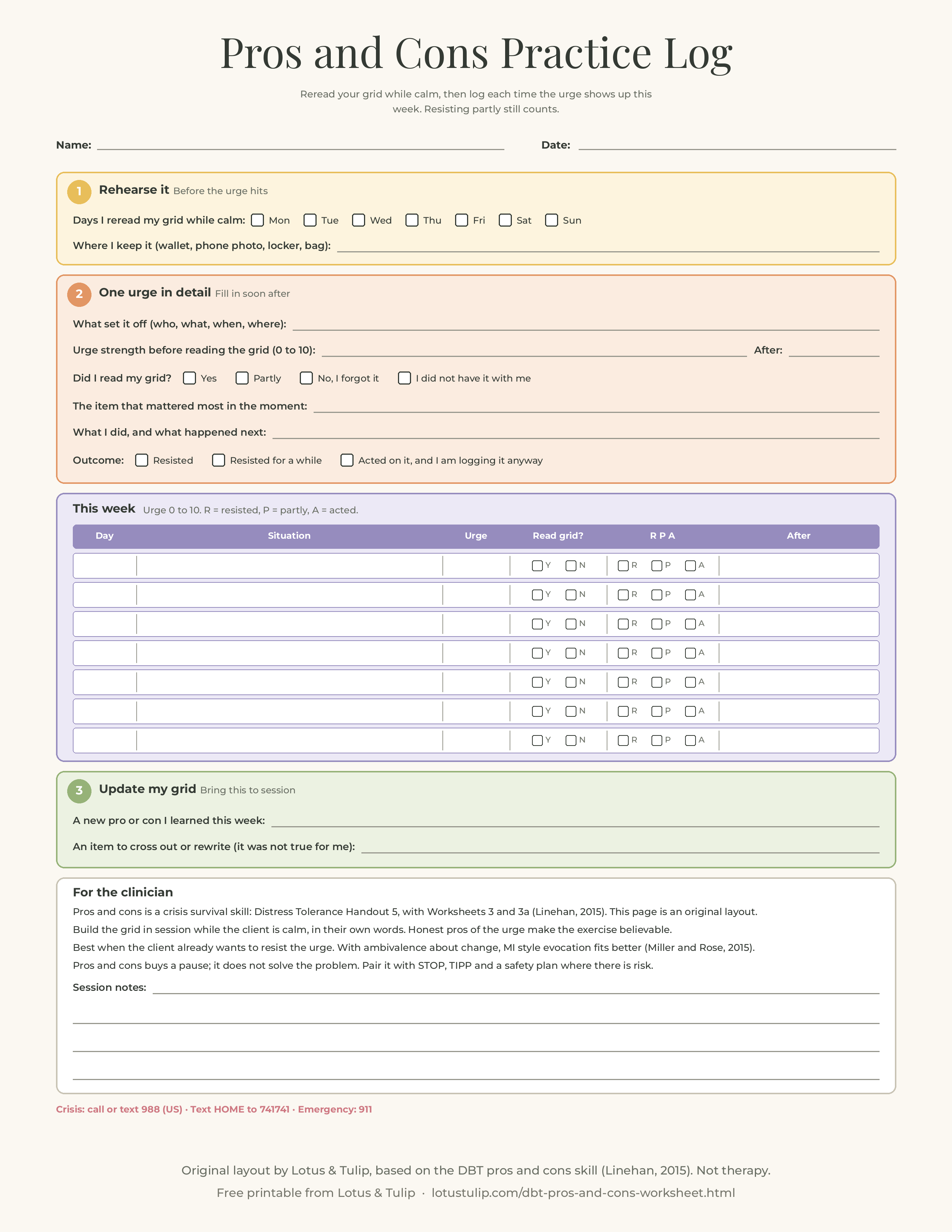
- Rehearse while calm. Reread the grid on several days during the week, before any urge hits, and tick the days on page 2. Rehearsal is what makes the list come to mind in a crisis.
- Log real use and update. When the urge shows up, read the grid, rate the urge before and after, and record what happened, including times the urge won. In session, add what was learned and rewrite items that turned out not to be true.
Teaching pros and cons to teens
The adolescent version of DBT skills keeps the same grid. In the DBT Skills Manual for Adolescents (Rathus and Miller, 2015), pros and cons is Distress Tolerance Handout 9, Crisis Survival Skills: Pros and Cons, followed by Handout 10, a practice exercise. It asks teens to consider short term and long term pros and cons, to write them out and carry them before an urge hits, and to review them and imagine the consequences when it does.
- Use their urges, not adult ones. Sending the screenshot, sneaking out, skipping school, vaping, posting something cruel, quitting the team. A grid about a real teen urge lands; a lecture about consequences does not.
- Take the pros seriously. If a teen writes "everyone would think I'm funny," that is a real pro. Arguing with it ends the conversation.
- Make it phone sized. A photo of the pocket card as a lock screen or a note in the phone is more likely to be there when needed than paper.
- Involve caregivers carefully. Some teens are happy to share their grid with a parent; others need it to stay private to be honest. Agree on this up front.
Our DBT Worksheets for Teens include wise mind, a distress tolerance toolkit and school and social media trigger pages that pair well with this printable.
Three short examples
These are illustrative composites written for this guide, not real clients.
- A 16 year old and a group chat. Urge: post an embarrassing photo of a former friend after a fight. Pros of acting: "she'd feel what I felt" (S), "people would be on my side for a day" (S). Cons of acting: suspension (L), "everyone would see me as the mean one" (L), "she might post something worse back" (S). Pros of resisting: "I keep my record clean for the program I'm applying to" (L), "I don't have to regret it" (L). Cons of resisting: "I stay angry tonight" (S). Her wise mind conclusion: "Not worth it. Talk to the counselor tomorrow." She photographs the card and sets it as her lock screen.
- An adult in recovery. Urge: drink after a hard family phone call. Pros of acting: "the knot in my chest goes away for a few hours" (S). Cons of acting: losing 90 days of sobriety (L), "last time I ended up saying things to my brother I can't take back" (L). Pros of resisting: "I wake up clear and keep my promise to my daughter" (L). Cons of resisting: "tonight will feel long" (S). When the urge hits, he reads the card in his car, calls his sponsor and drives home instead of to the bar. His log records the urge at 8 before reading and 5 after.
- A client with self-harm urges. Urge: cut after feeling rejected. In session she and her therapist fill in all four boxes, including the honest pro "it shuts off the feeling fast." The long term items (scars she hides, the shame afterward, a step back from her goal of a year without self-harm) all point the same way. Her box 3 plan: hold ice, text a friend, and if she cannot stay safe, call or text 988. Two weeks later her log shows one night she resisted fully, one night partly, and a list of new cons to add.
Common mistakes
- Only listing the cons of the urge. A one sided list feels like a lecture and collapses when the urge says "but it works." Fill in all four boxes.
- Doing it for the first time during a crisis. The skill depends on a grid written and rehearsed in advance.
- Vague items. "Bad for me" carries no weight at midnight. "My kids saw me last time" does.
- Ignoring time horizon. Without the short and long term marks, the pros of acting often look as big as the cons.
- Using it as a debate with an ambivalent client. If someone has not decided they want to change, a full grid can backfire. Use motivational interviewing style conversation first.
- Stopping at the decision. Knowing you want to resist is not the same as being able to. Plan what to do instead, and pair the grid with STOP, TIPP or distraction.
- Never updating it. Grids go stale. Add new consequences as they happen and rewrite items that turned out not to be true.
Free DBT pros and cons worksheet
This free printable is an original Lotus & Tulip layout on US Letter. Page 1, My Pros and Cons Grid, has the urge (what it is, when it shows up, how strong it gets), a four box grid for acting on versus resisting the urge with S and L markers to circle on every line, a wise mind conclusion, a when the urge hits checklist and a cut out pocket card with 988 and 911. Page 2, Pros and Cons Practice Log, has rehearsal days, one urge in detail (what set it off, urge strength before and after reading the grid, whether the grid was read, the item that mattered most, the outcome), a 7 row weekly log, an update my grid box, notes for the clinician and US crisis lines.
Download the free DBT pros and cons worksheet (PDF, 2 pages, US Letter)
Prefer single images? Page 1: my pros and cons grid (PNG) · Page 2: pros and cons practice log (PNG)
Free to print for use with your own clients or for personal use. Please link to this page rather than re-uploading the file. An original layout based on the pros and cons skill as described in published DBT materials (Linehan, 2015); it does not reproduce the handouts or worksheets. A practice tool, not a substitute for therapy. If you are in crisis in the US, call or text 988, text HOME to 741741, or call 911 in an emergency.
Related resources
- Distress tolerance worksheets: all the crisis survival skills, with a crisis survival plan
- DBT STOP skill worksheet: the pause that gives you time to read your grid
- DBT TIPP skills worksheet: fast body skills for when you are too flooded to read
- Wise mind worksheet: the state of mind the conclusion box asks you to consult
- Decisional balance worksheet: pros and cons for open decisions about change, and when to avoid it
- Urge surfing worksheet: riding out an urge without acting on it
- Behavior chain analysis worksheet: understanding what happened when the urge won
- Safety plan worksheet: for suicide risk, alongside pros and cons
- Motivational interviewing worksheet: a conversation style for the moment someone is unsure about change
FAQ
What is the pros and cons skill in DBT?
It is a crisis survival skill in the DBT distress tolerance module. You list the pros and cons of acting on a crisis urge and the pros and cons of resisting it, mark which are short term and long term, write it while calm, carry it, and reread it when the urge hits.
Which DBT handout covers pros and cons?
In Linehan's second edition skills materials (2015), pros and cons is Distress Tolerance Handout 5, with Distress Tolerance Worksheets 3 and 3a for practice. In the adolescent skills manual (Rathus and Miller, 2015), it is Distress Tolerance Handout 9, with a practice exercise in Handout 10.
Why does DBT use four boxes instead of two columns?
Because resisting an urge has costs and acting on it has real benefits. Weighing all four boxes, acting versus resisting and pros versus cons, makes the comparison honest, and the short and long term marks usually show that the benefits of acting are short lived while its costs last.
Is the DBT pros and cons skill evidence based?
It is part of DBT skills training, which has good support as a package, for example in Linehan and colleagues' 2015 component analysis. No published trial has tested pros and cons on its own, so its separate effect is not known. Tracking urge ratings before and after reading the grid is the best way to judge it for one person.
How is DBT pros and cons different from a decisional balance?
A decisional balance is for thinking through an open decision about change, and research reviewed by Miller and Rose (2015) suggests it can lower commitment in people who are ambivalent. DBT pros and cons is for a crisis urge the person has usually already decided to resist, and it is written in advance to be reread in the moment.
Is this DBT pros and cons worksheet free?
Yes. It is free to print for use with your own clients or for personal use. Please link to this page rather than re-uploading the file.
Sources
- Linehan, M. M. (1993). Skills Training Manual for Treating Borderline Personality Disorder. Guilford Press.
- Linehan, M. M. (2015). DBT Skills Training Handouts and Worksheets, second edition. Guilford Press. Distress Tolerance Handouts 2, 3 and 5 and Worksheets 3 and 3a.
- Linehan, M. M., Korslund, K. E., Harned, M. S., Gallop, R. J., Lungu, A., Neacsiu, A. D., McDavid, J., Comtois, K. A., and Murray-Gregory, A. M. (2015). Dialectical behavior therapy for high suicide risk in individuals with borderline personality disorder: a randomized clinical trial and component analysis. JAMA Psychiatry, 72(5), 475 to 482.
- Neacsiu, A. D., Rizvi, S. L., and Linehan, M. M. (2010). Dialectical behavior therapy skills use as a mediator and outcome of treatment for borderline personality disorder. Behaviour Research and Therapy, 48(9), 832 to 839.
- Rathus, J. H., and Miller, A. L. (2015). DBT Skills Manual for Adolescents. Guilford Press. Distress Tolerance Handouts 9 and 10.
- Janis, I. L., and Mann, L. (1977). Decision Making: A Psychological Analysis of Conflict, Choice, and Commitment. Free Press.
- Miller, W. R., and Rose, G. S. (2015). Motivational interviewing and decisional balance: contrasting responses to client ambivalence. Behavioural and Cognitive Psychotherapy, 43(2), 129 to 141.