
Special education and visual supports · Updated 2026-11-03
Free visual schedule printable: how to use a visual schedule for kids at home and in the classroom
Ready-made printable: Visual Schedule and Behavior Supports Holiday 20% off: about $6.44, was $8 (EUR 7) · instant digital download
Buy on Etsy
A visual schedule shows a child what is happening today, in order, with pictures or words they can point to. "Breakfast, then shoes, then car, then school." Instead of holding the plan in their head or asking "what's next?" over and over, the child can look. This guide is for parents, special education teachers, ABA therapists and RBTs, speech and occupational therapists and school counselors who work with autistic children, kids with ADHD, young children and anyone who finds transitions hard. It covers what a visual schedule is, the different types, what the research says, how to set one up and teach it step by step, examples for home and school, and the mistakes that make schedules stop working. It ends with a free printable: a "My Day" picture schedule, 24 picture cards with blanks, and a blank vertical schedule with an All done pocket.
Jump to the free visual schedule printable
What a visual schedule is
A visual schedule is a sequence of pictures, photos, objects or words that shows the steps of a day, a part of the day, or a single activity. The child checks the schedule before each change, does the step, and marks it as finished by moving the card to an All done pocket, turning it over, or ticking a box. Then they check what comes next.
That last part matters. A poster of the daily routine on the wall is useful, but a schedule the child actually uses is interactive: they look at it, touch it and change it as the day goes on. Finishing a step and putting the card away gives a clear end to one activity before the next one starts, which is often exactly where the trouble happens.
Types of visual schedules
There is no single right format. Pick the one that matches how the child understands symbols today, and change it as they grow.
- Object schedules. A real object stands for each activity: a spoon for lunch, a towel for bath. Good for very young children or learners who do not yet connect pictures with activities.
- Photo schedules. Photos of the real place, person or item. Easier to recognize than drawings for some children.
- Picture or symbol schedules. Simple line drawings like the cards in the free printable below. The most common format at home and in special education classrooms.
- Written schedules. Words only, or words with small pictures, for readers. Many older students and adults use a written checklist or a phone planner, which is the same idea.
- Full day, part day and mini schedules. A full day schedule shows the big blocks (morning, school, afternoon, bedtime). A part day schedule shows the next few activities. A mini schedule, sometimes called an activity schedule or task strip, breaks one activity into steps, such as the steps of washing hands.
- Vertical or horizontal. Top to bottom works well on a wall or door. Left to right matches reading order and fits on a desk or a binder. Both work. Keep the direction the same every day.
The smallest visual schedule is a first then board: one task, then one thing the child likes. If a full schedule is too much right now, start there, or with the Now and Next strip in the free printable.
What the research says about visual schedules
Visual supports are one of the evidence-based practices for autistic children and youth identified in the 2020 report from the National Clearinghouse on Autism Evidence and Practice (Steinbrenner et al., 2020), which reviewed intervention research published from 1990 to 2017 and identified 28 evidence-based practices. In that report, visual supports include visual schedules along with other visual cues that help a learner do a skill or behavior without extra prompts from an adult.
Schedules have also been studied on their own. Knight, Sartini and Spriggs (2015), writing in the Journal of Autism and Developmental Disorders, reviewed 31 studies of visual activity schedules for people with autism published between 1993 and 2013 and concluded that they can be considered an evidence-based practice, especially when they are taught with systematic instruction such as prompting and fading. Much of the practical teaching method comes from Lynn McClannahan and Patricia Krantz, whose book Activity Schedules for Children with Autism: Teaching Independent Behavior describes teaching a child to follow a picture schedule with physical guidance from behind and few or no spoken prompts, then fading that help so the child uses the schedule on their own.
Two honest caveats. Most of this research is with autistic learners, so for other children it is good practice rather than proven treatment, although many teachers use visual schedules for whole classes and young children because they make expectations clear for everyone. And a schedule is one support, not a full plan. If a child has frequent or dangerous behavior around transitions, a BCBA or the school team should look at the whole picture.
Who a visual schedule helps
- Autistic children who do better with predictability and visual information than with spoken instructions.
- Children with ADHD who lose track of the steps in a routine, especially mornings and bedtime.
- Preschoolers and young children who cannot tell time yet and ask "when is it my turn?" or "is it time to go home?"
- Children with language delays or who are learning English, for whom pictures carry the meaning that words do not yet.
- Any child going through change: a new school, a new sibling, a move, a trip, or a day with a substitute teacher.
How to use a visual schedule, step by step
- Pick one routine to start. Choose the part of the day that causes the most trouble, often the morning, the after school stretch or bedtime. A schedule that covers three to five steps is easier to teach than a full day on the first try.
- Choose a format the child understands. If the child does not yet connect pictures with real things, use objects or photos. If they recognize simple drawings, use picture cards. If they read, add words or use a written list.
- Put the steps in order and keep them concrete. One card per activity, in the order it really happens: "Wake up, get dressed, breakfast, brush teeth, shoes on." Avoid vague steps like "get ready" that hide five smaller steps.
- Place the schedule where the routine happens. On the bedroom door for mornings, on the bathroom mirror for bedtime, on the student's desk or a wall near the classroom door. Make it easy to see and reach.
- Teach it when things are calm. Walk through the schedule together: point, name the step, do it, and move the card. Use few words. Many ABA teams guide the child's hand from behind instead of talking, so the child links the movement with the schedule rather than with an adult's voice.
- Check the schedule before every transition. Say a short cue like "check your schedule" and let the child look, or hand them the next card to take to the activity. The schedule should become the answer to "what's next?"
- Mark each step as finished. Move the card to the All done pocket, flip it over, or tick it off. This gives a clear ending and shows how much is left. End on something the child enjoys when you can.
- Prepare for changes with a change card. When the plan changes, put the "?" or change card over the step, show what happens instead, and keep the rest the same. Practice this on good days so a real surprise is less of a shock.
- Fade your help, not the schedule. Step back a little at a time: fewer prompts, more distance, then let the child set up or check the schedule on their own. Many adults keep using a schedule for life, in a planner or on a phone. Independence is the goal.
Visual schedules at home
At home, the two routines that most often fall apart are mornings and bedtime, because they have many small steps and a deadline. Page 1 of the free printable is built around those blocks.
- Morning: wake up, toilet, get dressed, breakfast, brush teeth, shoes on, car or bus. Put the schedule where the child gets dressed, not in the kitchen.
- After school: snack, wash hands, homework, play, clean up. Kids often need a break before homework, so put snack and a short play first if that works better for your child.
- Bedtime: bath, pajamas, brush teeth, book, bed. Keep the order the same every night. A predictable bedtime routine is one of the easiest wins for a family.
- Outings: a mini schedule for the doctor, a store or a visit to family ("car, waiting room, doctor, sticker, car, home") can make a new place feel much more manageable.
For parents, a schedule works best alongside clear, calm directions and praise for following it. The Calm and Connected parenting worksheets cover those skills step by step.
Visual schedules in the classroom
Many classrooms use two levels of schedule. A whole class schedule on the board shows the big blocks of the day, such as morning meeting, reading, math, recess, lunch, specials and dismissal, and the teacher moves a marker or removes each block as it ends. An individual schedule on a student's desk or in a binder shows the same day in smaller steps for a child who needs more support.
- Review it at the start of the day. A minute at morning meeting to walk through the schedule, including anything unusual, prevents a lot of questions later.
- Flag changes early. Assemblies, fire drills, substitutes and indoor recess are exactly when students need the schedule most. Show the change card as soon as you know.
- Use a transition routine. A consistent signal (a song, a chime, a timer) followed by "check your schedule" makes transitions quicker for everyone.
- Pair with other visual supports. A first then board for a hard task inside a block, a token board for staying on task, and a calm down corner card on the schedule as a planned break.
Visual schedules for autism, ABA and special education
For autistic learners and students with IEPs, a few details make a big difference:
- Teach the schedule as a skill. Following a schedule is something the child learns, not something they will pick up just because it is on the wall. Plan teaching time and track progress, for example how many steps the child follows without a prompt.
- Prompt from behind and fade quickly. Physical or gestural prompts from behind, faded over time, help the child rely on the schedule rather than on an adult telling them what to do.
- Use "transition cards" if needed. Some children carry the next card to the activity and match it to a spot there. This makes the link between the picture and the place very concrete.
- Include preferred activities. A schedule that is only demands becomes something to avoid. Build in short breaks and favorite activities, and let the child choose where you can.
- Keep the team consistent. Use the same pictures and the same format at school, at therapy and at home when you can, so the child does not have to learn three systems.
Common visual schedule mistakes
- Too many steps too soon. A full day of 20 cards is overwhelming for a beginner. Start with a short routine and grow it.
- A schedule that is never checked. If it only hangs on the wall, it is decoration. Build "check your schedule" into every transition.
- No clear finish. Without an All done pocket or a tick, the child cannot see what is over and what is left.
- Hiding changes. Removing a card without warning teaches the child the schedule cannot be trusted. Show the change.
- Pictures the child does not understand. If the child does not recognize the symbol, use a photo or an object, and teach the picture by pairing it with the real thing.
- Too much talking. Point to the card instead of explaining. The schedule does the talking.
- Taking it away when things go well. Removing a schedule because the routine is going smoothly often makes the trouble come back. Fade your help first, and keep the schedule.
Visual schedule examples
| Situation | Type | Steps |
|---|---|---|
| School morning at home | Vertical picture schedule on the bedroom door | Wake up, get dressed, breakfast, brush teeth, shoes on, car ride |
| Bedtime | Picture strip on the bathroom mirror | Bath, pajamas, brush teeth, book, bedtime |
| After school | Picture schedule on the fridge | Snack, wash hands, work, play, clean up |
| Kindergarten classroom | Whole class schedule on the board | Morning meeting, reading, snack, outside, math, lunch, centers, home |
| Student with an IEP | Individual desk schedule with All done pocket | Same day in smaller steps, with a break card after each work block |
| Speech or OT session | Now and Next strip | Now: practice cards. Next: bubbles |
| Doctor visit | Mini schedule on a key ring | Car ride, waiting room, doctor, sticker, car ride, home |
Free visual schedule printable
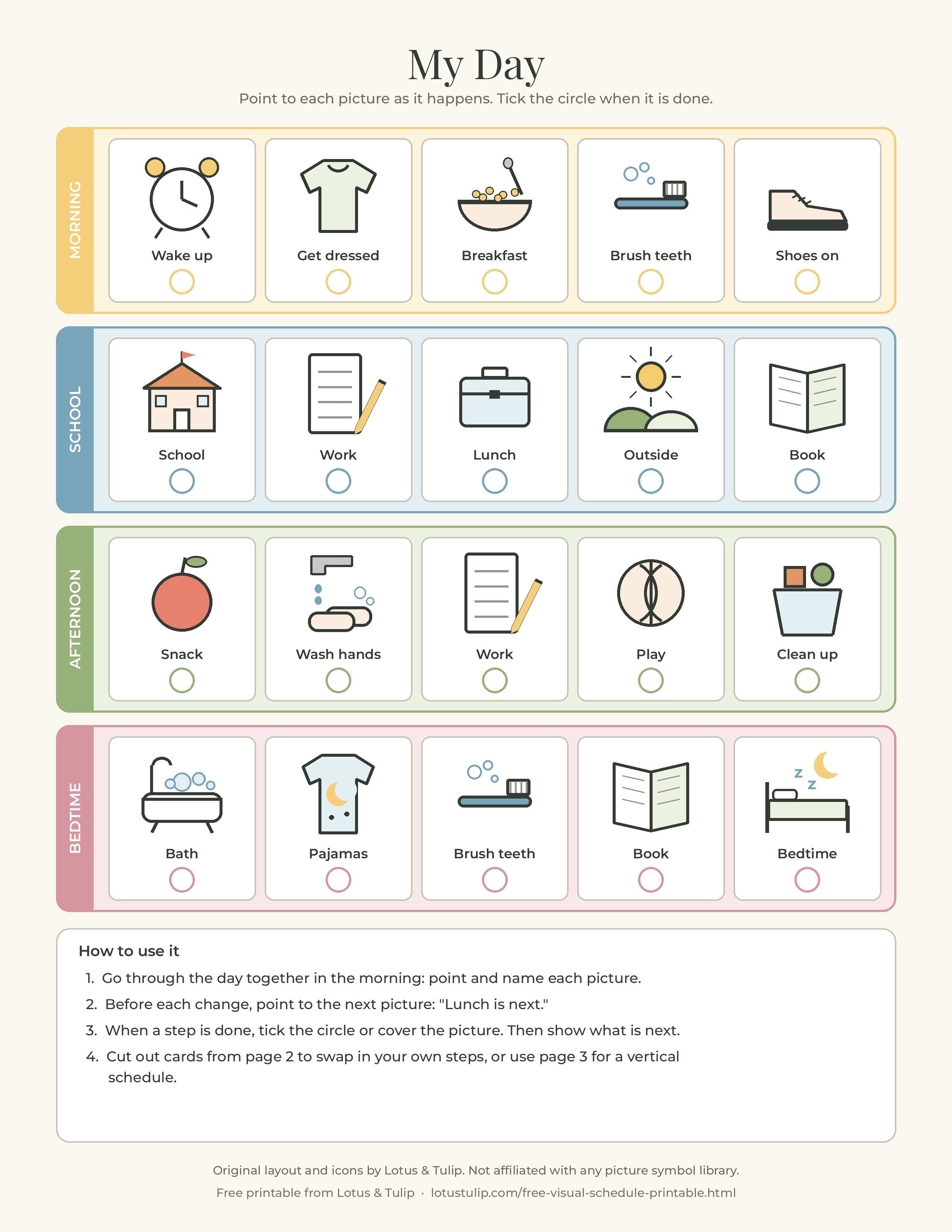
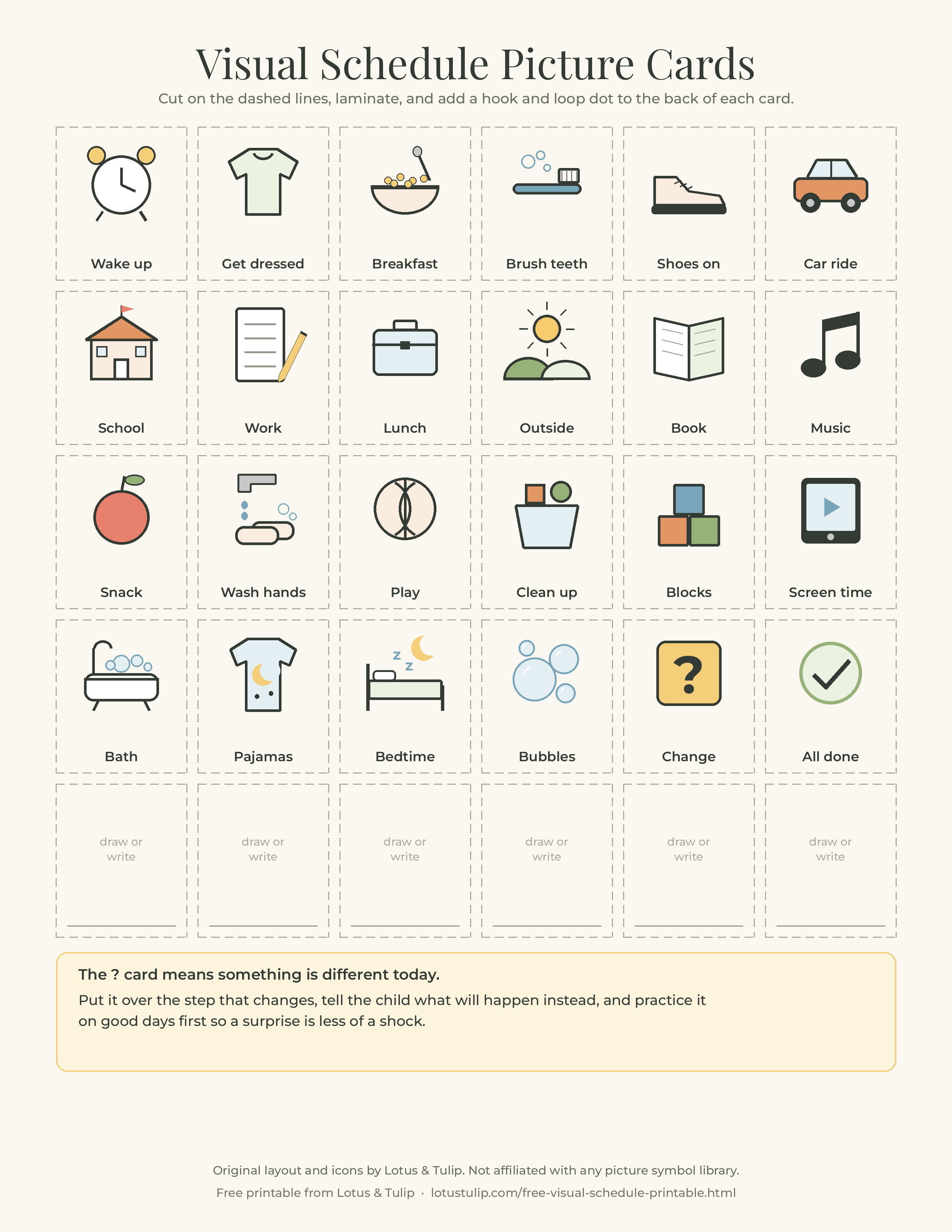
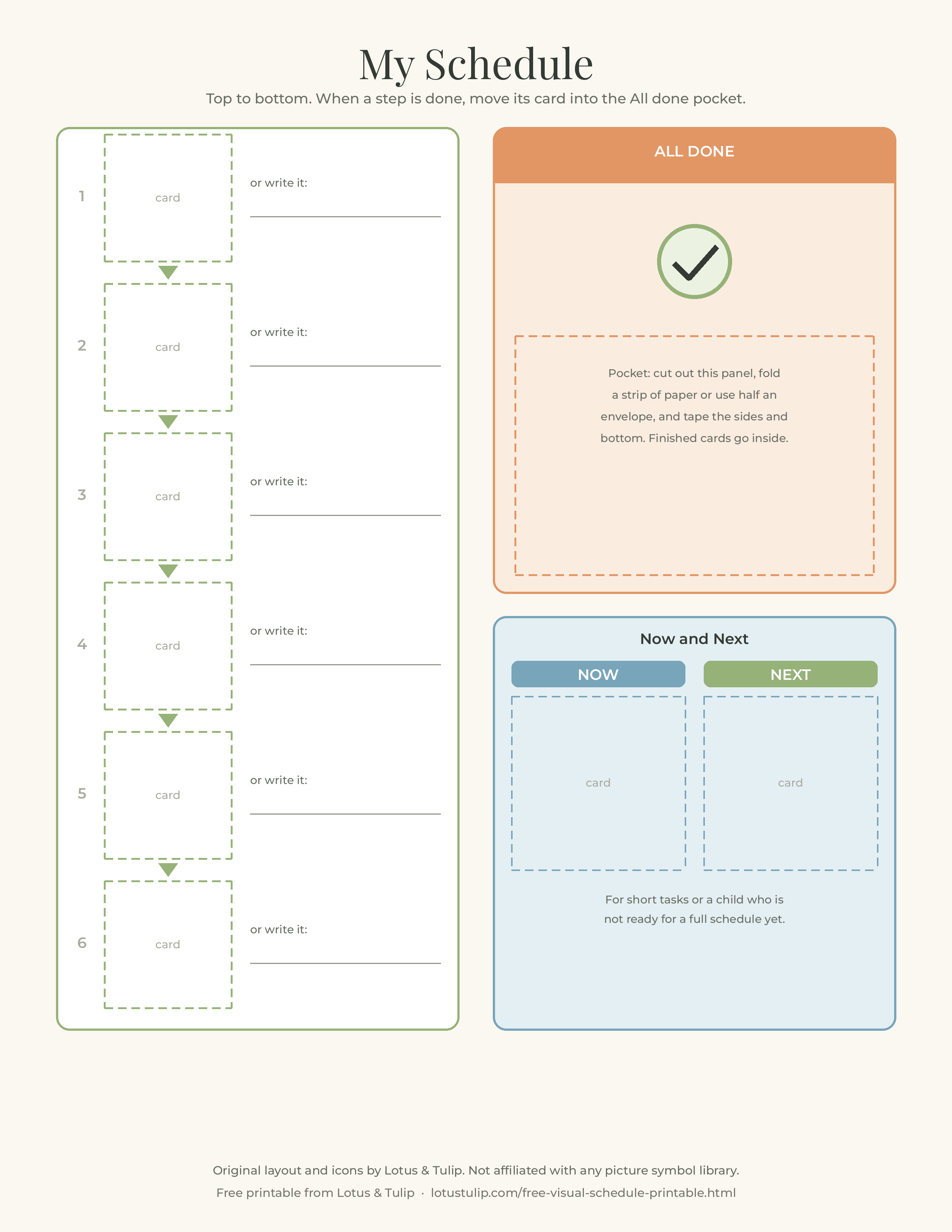
This free printable is an original Lotus & Tulip design with its own simple icons, on US Letter. Page 1 is a "My Day" picture schedule in four colored blocks (morning, school, afternoon and bedtime) with five pictures each and a circle to tick when a step is done, plus a short how to use it guide. Page 2 has 24 cut out picture cards for a vertical schedule (wake up, get dressed, breakfast, brush teeth, shoes on, car ride, school, work, lunch, outside, book, music, snack, wash hands, play, clean up, blocks, screen time, bath, pajamas, bedtime, bubbles, a "?" change card and an All done card) and six blank cards to draw or write on. Page 3 is a blank vertical schedule with six numbered slots, an All done pocket and a Now and Next strip. Print on card stock, laminate if you like, and add hook and loop dots.
Download the free visual schedule (PDF, 3 pages, US Letter)
Prefer single images? Page 1: My Day picture schedule (PNG) · Page 2: 24 picture cards and 6 blanks (PNG) · Page 3: vertical schedule with All done pocket (PNG)
Free to print for use with your own students, clients or children. Please link to this page rather than re-uploading the file. A general visual support, not a substitute for an individual plan from your child's team.
Related resources
- Break card printable: how to teach an I need a break card (free break cards and break plan)
- First then board printable (free picture cards)
- Token board printable (free 3, 5 and 10 token boards)
- Calm down corner ideas (free calm down steps printable)
- Coping skills list for kids (free printable)
- Daily check in for students (free printable)
FAQ
What is a visual schedule?
A visual schedule is a sequence of pictures, photos, objects or words that shows a child what will happen and in what order. The child checks it before each change, does the step, and marks it as finished, for example by moving the card to an All done pocket.
Who should use a visual schedule?
Visual schedules are widely used with autistic children, where visual supports are an evidence-based practice (NCAEP 2020). They are also helpful for children with ADHD, young children who cannot tell time yet, children with language delays, and any child facing change.
How many pictures should a visual schedule have?
Start small, usually three to five steps for one routine. Add more only when the child follows the short schedule easily. Some children do best with just a Now and Next strip or a first then board for a while.
Should a visual schedule be vertical or horizontal?
Both work. Vertical schedules fit doors and walls, and horizontal schedules match reading order and fit on a desk. What matters most is that the direction stays the same and the child can mark each step as done.
How do I make a visual schedule at home?
Pick one routine, choose pictures your child understands, put one card per step in the order it really happens, and place the schedule where the routine takes place. Teach it on a calm day, check it before each step and move finished cards to an All done pocket. The free printable on this page has the cards and boards to start.
How do you handle changes to a visual schedule?
Show the change instead of hiding it. Put a change card over the step that is different, show what happens instead, and keep the rest the same. Practicing small planned changes on good days makes unplanned ones easier.
Is this visual schedule printable free?
Yes. It is free to print for use with your own students, clients or children. Please link to this page rather than re-uploading the file.