
Special education and visual supports · Updated 2026-11-03
Token board printable: how to use a token board with kids (free 3, 5 and 10 token boards)
Ready-made printable: Visual Schedule and Behavior Supports Holiday 20% off: about $6.44, was $8 (EUR 7) · instant digital download
Buy on Etsy
A token board is a small visual chart where a child earns a token, such as a star or a sticker, for each step of a task, and trades a full board for something they chose at the start. "Five stars, then bubbles." It turns a long or hard task into short steps the child can see, and it keeps the reward in view the whole time. This guide is for special education teachers, ABA therapists and RBTs, speech and occupational therapists, school counselors and parents of autistic children or kids who find motivation and waiting hard. It explains what a token board is and why it works, how to set one up step by step, how to choose reinforcers, how to fade the board, the most common mistakes, and examples for home and the classroom. It ends with a free printable set: a 3 token board, a 5 token board, a 10 token board, star tokens, blank tokens and reward cards.
Jump to the free token board printable
What a token board is
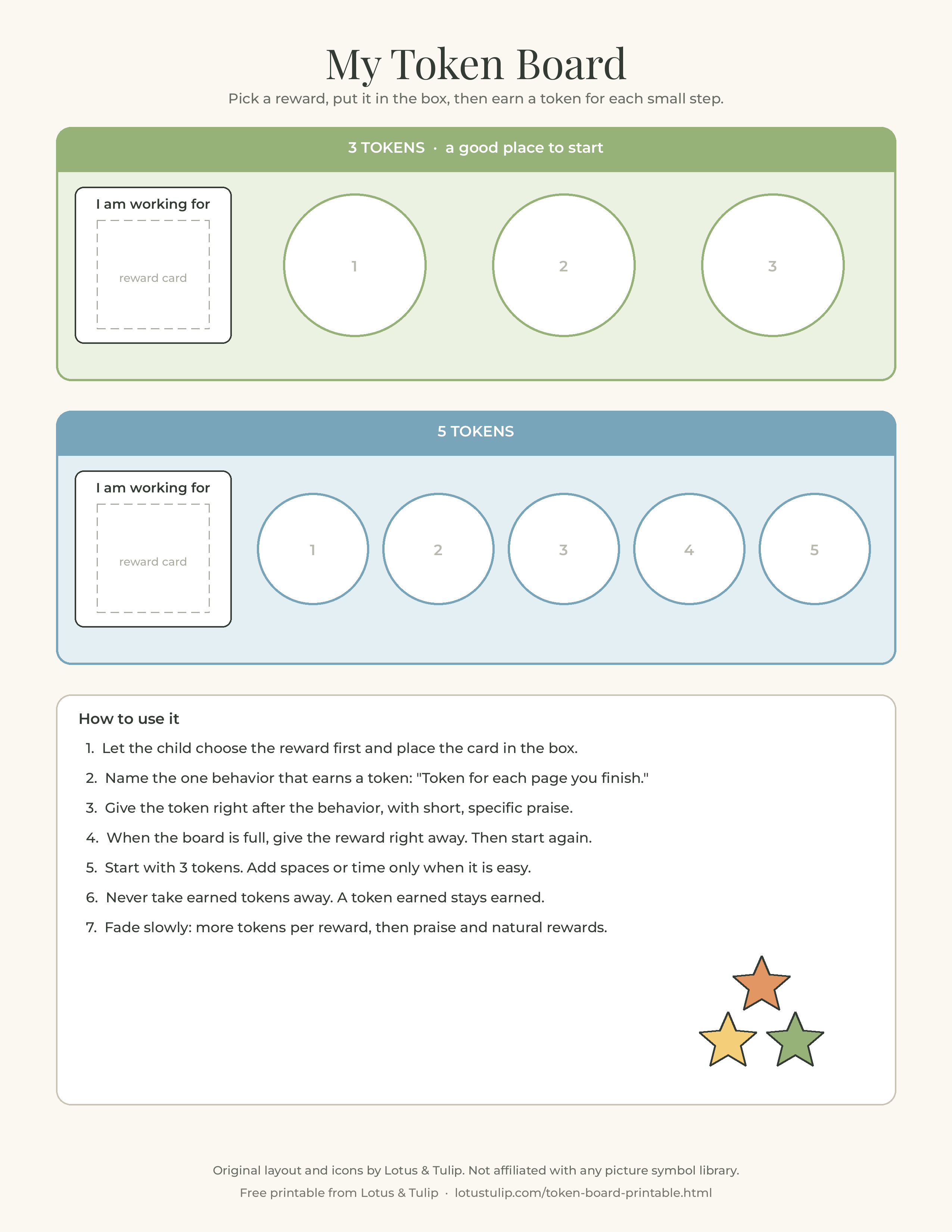
A token board has two parts. The first is an "I am working for" box that holds a picture or word card for the reward the child picked. The second is a row of empty spaces, usually 3, 5 or 10. Each time the child does the target behavior (finishes a math problem, says a word, takes a bite, stays in their seat for two minutes) an adult places a token in the next space. When every space is full, the child gets the reward right away, the tokens come off, and the board starts again.
The tokens themselves have no value at first. They work because they are paired with something the child wants. In behavior analysis they are called conditioned or generalized reinforcers: a promise the child can see and count. That is also what makes a token board different from a sticker chart that is reviewed at the end of the week. On a token board the reward is close, clear and earned within minutes, not days.
Why token boards work: what the research says
Token systems are one of the oldest tools in applied behavior analysis. Teodoro Ayllon and Nathan Azrin described a full token economy for a psychiatric hospital ward in their 1968 book The Token Economy: A Motivational System for Therapy and Rehabilitation, and the approach spread into classrooms and special education in the years after. Timothy Hackenberg's 2009 review, "Token reinforcement: A review and analysis" in the Journal of the Experimental Analysis of Behavior, describes decades of laboratory and applied work on how tokens gain their value and how the number of tokens and the timing of the exchange affect behavior.
For autistic children and youth, reinforcement is one of the evidence-based practices identified in the 2020 report from the National Clearinghouse on Autism Evidence and Practice (Steinbrenner et al., 2020), and visual supports are on the same list. A token board combines both: a visual that shows progress, and reinforcement that follows the behavior. That does not mean a token board fixes every behavior. It means it is a reasonable, well studied first tool, and it works best when it is set up carefully and adjusted for the individual child. If behavior is dangerous or very frequent, a BCBA or the child's school team should design an individual plan.
How to use a token board, step by step
- Pick one target behavior and name it in plain words. "Token for each page you finish" or "token for each time you raise your hand" is clear. "Token for being good" is not, because the child cannot tell what earns the next star.
- Let the child choose the reward before you start. Offer two or three real options and put the chosen picture in the "I am working for" box. Choosing builds buy in, and seeing the reward card keeps it in mind.
- Start small, usually with 3 tokens. The child should reach the reward fast the first few times, ideally within a few minutes. Early success teaches how the board works. Move to 5, then 10 only when the smaller board is easy.
- Teach the board when things are calm. Do a few quick practice rounds with very easy tasks so the child learns "do the thing, get a token, full board means reward" before you use it for something hard.
- Give each token right after the behavior. Place the token immediately and pair it with short, specific praise: "You finished the page. That is your third star." Delay weakens the link between the behavior and the token.
- Exchange as soon as the board is full. Give the reward right away, for the time you agreed, then clear the board. If the exchange is late or skipped, the tokens lose their meaning.
- Keep the board where the child can see it. On the desk, on the table or on a clipboard. Counting the spaces that are left is part of what helps the child wait.
- Fade the board over time. Once the routine is easy, slowly increase the number of tokens per reward, the amount of work per token, or the time between tokens, and lean more on praise and natural rewards. The goal is less adult support, not a token board forever.
Choosing reinforcers that actually work
The reward in the "I am working for" box carries the whole board. If the child does not care about it today, no number of stars will help. A few practical rules:
- Watch what the child chooses on their own. What they do in free time is a strong clue. Teams often do a quick preference check by offering a few items and noting which one the child takes first.
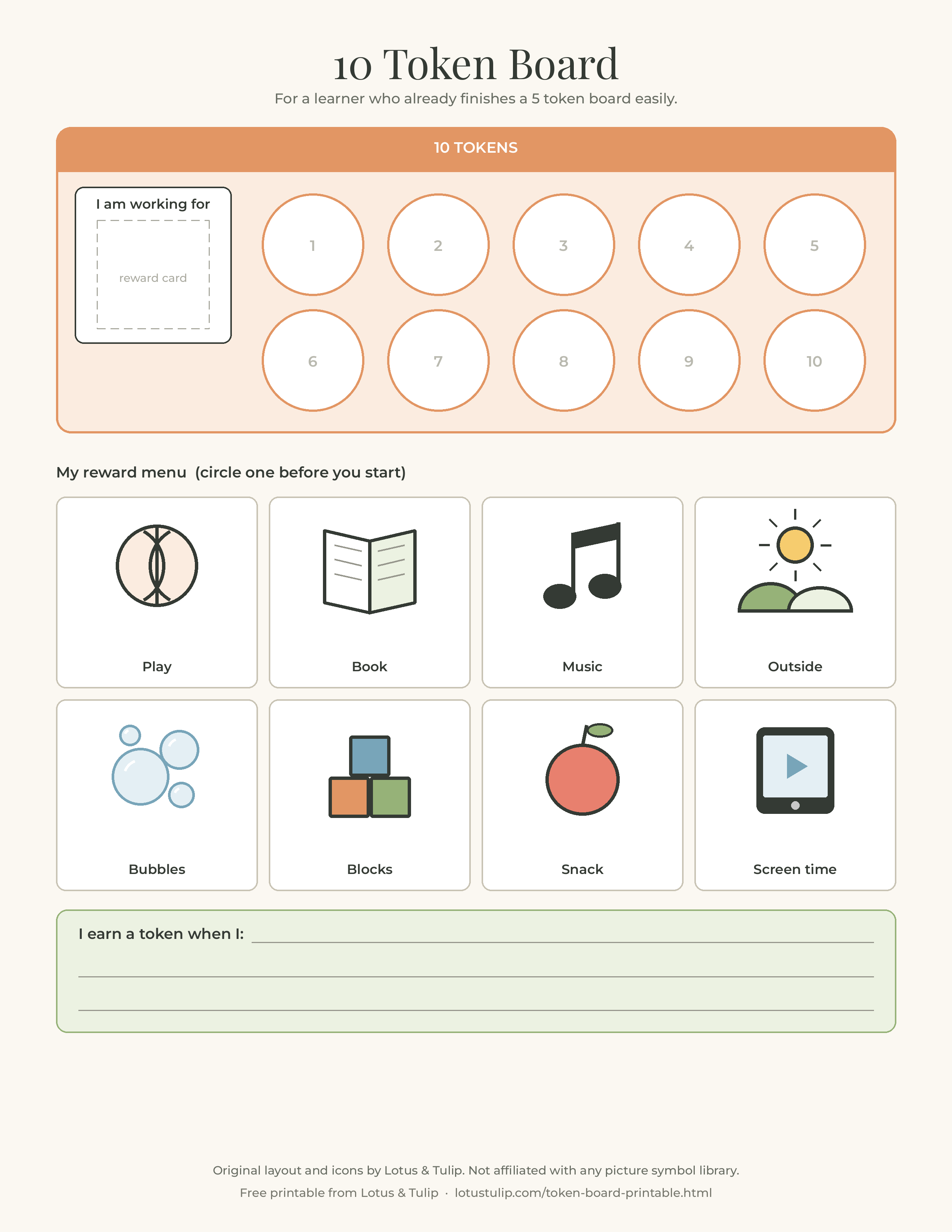
- Offer a choice every round. A small reward menu (like page 2 of the free printable) lets the child pick before each board. Preferences change during the day.
- Use rewards you can give right away and end cleanly. Two minutes of bubbles, one song, a short game, a turn with blocks, a small snack, a few minutes of screen time with a timer. A reward that is hard to stop leads to a fight at the end.
- Mix activities, items and social rewards. High fives, a silly dance, helping the teacher or choosing the class song are free and can be just as motivating for some children.
- Keep the strongest rewards special. If a favorite item is freely available all day, it will not work as well on the board. Save it for the board where you can.
- Match the reward to the effort. A short task earns a short reward. A long, hard task can earn a bigger one.
How to fade a token board
Fading means the child keeps the behavior while the board does less of the work. Go slowly, change one thing at a time, and step back if behavior drops.
- More tokens per reward. Move from the 3 token board to the 5, then to the 10.
- More work per token. One token for two problems instead of one, or for five minutes of reading instead of two.
- Thinner timing. Give tokens less often, for example at the end of each part of a lesson instead of after every response.
- Natural rewards. Shift the "I am working for" box toward things that happen anyway, like recess, lunch or free choice time, and keep the praise.
- Self-monitoring. Older students can place their own tokens or tick boxes, with an adult checking in, which builds independence.
Common token board mistakes
- Too many tokens too soon. Starting at 10 means the child waits too long for the first reward and gives up. Start at 3.
- Taking tokens away. Removing earned tokens for misbehavior (response cost) is a separate procedure that needs careful planning. On a basic token board, a token earned stays earned. Handle problem behavior separately.
- Vague target behavior. If adults give tokens for different things, the child cannot learn the rule. Agree on one clear behavior and say it out loud.
- A reward that is not motivating today. Check before each board and let the child choose.
- Late tokens or late exchanges. Tokens given minutes later, or a reward that comes "after lunch", break the link.
- Changing the deal halfway. "Actually you need two more stars" teaches the child the board cannot be trusted. Change the plan only between boards.
- Using it only for hard things. Run some easy boards too, so the board is not a signal that something bad is coming.
- Too much talking. Point, place the token, say a few words. Long explanations cancel out the visual.
Token board examples for home and the classroom
| Setting | Token for | Board | I am working for |
|---|---|---|---|
| Homework at home | Each finished problem | 5 tokens | Ten minutes of blocks |
| Morning routine | Each step: dressed, teeth, shoes | 3 tokens | Choosing the car music |
| Mealtime | Each bite of a new food | 3 tokens | Favorite snack |
| Classroom independent work | Each completed worksheet section | 5 tokens | Computer time with a timer |
| Small group or circle time | Each two minutes of sitting with the group | 10 tokens | Line leader or class helper |
| Speech or ABA session | Each target word or response | 10 tokens | Bubbles or a short game |
| Community outing | Each aisle with calm walking | 5 tokens | Playground on the way home |
Notice that the reward in each example is short and clearly ends. That keeps the next board possible.
Token board, first then board and visual schedule: which one when
These three visuals work together. A first then board shows one task and the reward right after it, and is often the first visual a child learns. A token board stretches that idea over several small steps, which helps with longer tasks and with waiting. A visual schedule shows the whole morning or day. Many teams use all three: the schedule for the day, a first then board for a single hard transition, and a token board for a longer work period. Our calm down corner guide covers what to do when a child is too upset for any of them, because a token board is a teaching tool, not a crisis tool.
Free token board printable
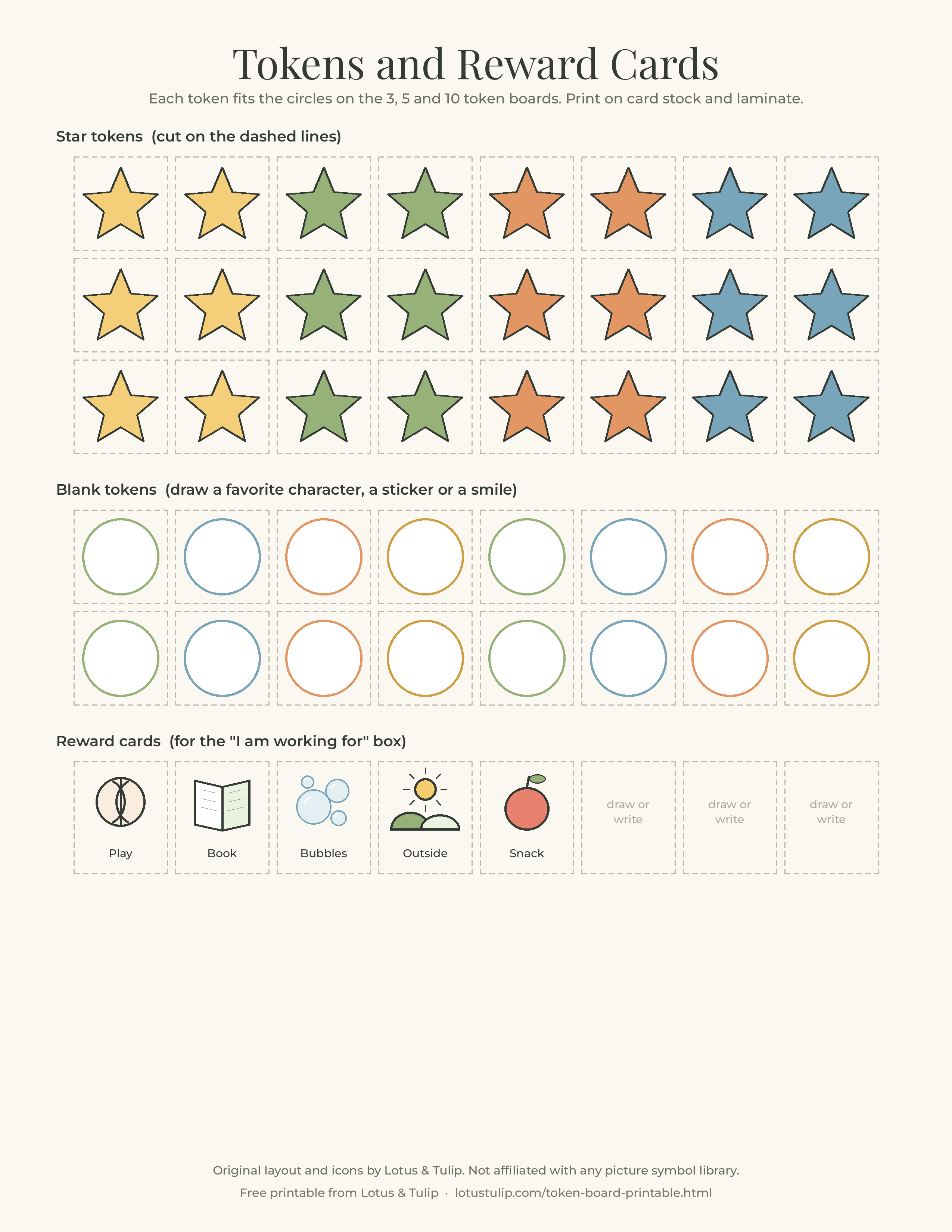
This free printable is an original Lotus & Tulip design with its own simple icons, on US Letter. Page 1 has a 3 token board and a 5 token board, each with an "I am working for" box, plus a short how to use it guide. Page 2 has a 10 token board, a reward menu with eight picture choices (play, book, music, outside, bubbles, blocks, snack, screen time) and an "I earn a token when I" line. Page 3 has 24 star tokens in four colors, 16 blank tokens to draw on or add stickers, and reward cards with five pictures and three blanks. Each token fits the circles on all three boards. Print on card stock, laminate if you like, and add hook and loop dots to the circles and the back of each token.
Download the free token boards (PDF, 3 pages, US Letter)
Prefer single images? Page 1: 3 and 5 token boards (PNG) · Page 2: 10 token board and reward menu (PNG) · Page 3: star tokens, blank tokens and reward cards (PNG)
Free to print for use with your own students, clients or children. Please link to this page rather than re-uploading the file. A general visual support, not a substitute for an individual behavior plan from your child's team.
Related resources
- Behavior contract for students: the written next step once a student outgrows a token board, with a free template and tracker
- Self-monitoring checklist for students: the next step toward independence, a free self-check sheet with a weekly graph
- Break card printable: how to teach an I need a break card (free break cards and break plan)
- First then board printable (free picture cards)
- Calm down corner ideas (free calm down steps printable)
- Coping skills list for kids (free printable)
- Daily check in for students (free printable)
FAQ
What is a token board?
A token board is a visual chart with a reward box and a row of spaces. A child earns a token, such as a star or sticker, for each step of a task or each time they show a target behavior, and gets the chosen reward as soon as the board is full.
How many tokens should a token board have?
Start with 3 tokens so the child reaches the reward quickly. Move to 5 and then 10 only when the smaller board is easy and behavior stays steady. Many children work on a 5 token board for a long time, and that is fine.
Is a token board ABA?
Token boards come from applied behavior analysis and are used in many ABA programs, but they are not limited to ABA. Special education teachers, speech and occupational therapists, school counselors and parents use them too.
Should you take tokens away for bad behavior?
On a basic token board, no. A token earned stays earned. Taking tokens away is a separate procedure called response cost, which needs careful planning and is best set up with a BCBA or the child's team. Handle problem behavior separately from the board.
How do you fade a token board?
Change one thing at a time: more tokens per reward, more work per token, or more time between tokens, while keeping specific praise. Shift the reward toward natural ones like recess or free choice. If behavior drops, go back a step.
What is the difference between a token board and a first then board?
A first then board shows one task and the reward right after it. A token board breaks a longer task into several small steps, each earning a token, before the reward. Many children learn a first then board first and move to a token board next.
Is this token board printable free?
Yes. It is free to print for use with your own students, clients or children. Please link to this page rather than re-uploading the file.