
Therapist marketing · Updated 2026-11-08
Instagram Post Ideas for Physical Therapists (with Free Printable)
Ready-made template kit: Physical Therapist Instagram Templates Holiday 20% off: about $22.08, was $28 (EUR 24) · instant digital download
Buy on Etsy
Instagram posts for physical therapists sit at an awkward crossroads. Prospective patients arrive with a sore back, a new knee replacement date, a parent who fell last month, or a screenshot of an exercise they found at midnight. Referral sources arrive wanting to know whether you take their patients and how you talk about care. Algorithms reward confident claims, before and after photos and "fix your back in three days" reels. Your license, HIPAA and the people who trust you reward the opposite: honest credentials, no guaranteed outcomes, no identifiable patients, and a clear line between public education and an individual plan of care.
This guide is written for US physical therapists who run or contribute to a professional Instagram account: outpatient orthopedic and sports clinics, private practices, solo PTs, pelvic health and neurologic specialists, home health and mobile PTs, and clinics that employ physical therapist assistants. It also helps PTAs who post under a practice account, as long as roles stay accurate. It covers what to post on Instagram as a physical therapist: why the job is different from generic wellness or counselor posting, the parts of the current APTA Code of Ethics for the Physical Therapy Profession that touch social media, how to show PT, DPT, PTA and specialist credentials honestly, patient privacy, scope next to occupational therapy, speech-language pathology, athletic training, chiropractic and personal training, direct access without inventing a state list, safety red flags, home safety education, cash-pay and insurance language without billing advice, ten content pillars, 34 post ideas with original caption angles, six fuller captions, DM scripts that refuse diagnosis by message, a two or three posts a week rhythm and a 12 week overview, the dates that suit a PT feed, a nine step HowTo, mistakes, myths, three fictional examples, a comparison table, when not to post, research notes and a free three page US Letter printable: PT Posting Steps, a PT Content Planner and a PT Post Care Check with pocket cards.
If you are newer to posting as a clinician, our general ethics checklist for therapist social media and Instagram post ideas for therapists cover basics written mainly for mental health practices. Neighboring clinical feeds have their own pages: Instagram post ideas for occupational therapists, Instagram post ideas for speech therapists and Instagram post ideas for couples therapists. Seasonal logistics for any clinical feed are in holiday social media posts for therapists. General therapist bio, caption, story, reel, feed, calendar, highlight, link-in-bio, pinned and carousel pages remain useful for layout, not for PT-specific ethics. This page stays with the questions physical therapists tend to face: movement without turning a caption into a home exercise program, red flags that belong in an emergency department rather than a comment thread, honest talk about referrals and direct access, and a respectful line between physical therapy and personal training.
We relied on primary sources and opened each one while writing: the APTA Code of Ethics for the Physical Therapy Profession (effective January 1, 2026), the earlier 2020 Code of Ethics for the Physical Therapist (HOD S06-20-28-25) that many state boards still reprint, APTA pages on National Physical Therapy Month, the World Physiotherapy page for World PT Day, the CDC Signs and Symptoms of Stroke page, the CDC STEADI Check for Safety brochure and patient resources page, the American Association of Neurological Surgeons page on cauda equina syndrome, the CMS page on good faith estimates for people who are not using insurance, 45 CFR 149.610, Telehealth.HHS.gov on licensing across state lines, FSBPT material on the National Physical Therapy Examination, ABPTS pages on specialist certification, 988lifeline.org, and the FTC Guides Concerning Use of Endorsements and Testimonials in Advertising (16 CFR Part 255, 88 FR 48102, July 26, 2023). Notes are at the end. The printable is an original Lotus and Tulip layout.
This guide is general marketing information, not legal, ethical, billing or clinical advice. Your state licensing board and practice act, the APTA Code of Ethics if it applies to you as a member or because your board adopted similar language, HIPAA if you are a covered entity, payer contracts and your employer policy all come first. A social media post is public education. It is not a physical therapy examination, it is not a home exercise program, and it is not treatment by Instagram or DM. If someone is in danger or has a medical emergency, call 911. For a mental health or suicidal crisis, call or text 988. Chest pain, sudden weakness, sudden trouble speaking or seeing, loss of bowel or bladder control, saddle anesthesia (numbness in the groin, buttocks or inner thighs), new unexplained weight loss with night pain, or signs of a post-operative infection belong with emergency or physician care, not with an Instagram tip. Physical therapy is not emergency care. Every safety post you publish should repeat that message and say that your account and inbox are not monitored for emergencies.
What this guide is and is not
It is a planning guide for public, educational Instagram content from a physical therapy practice or an individual PT or PTA who posts professionally. It helps you choose themes, write captions that stay inside your license and your competence, describe how your practice works, and keep privacy and safety information in plain view.
It is not legal advice. Physical therapy practice acts, title protection, advertising rules, direct access rules and telehealth rules vary from state to state. Some boards say specific things about testimonials, specialty claims, fee advertising or the use of the words "physical therapist" and "physiotherapist." Hospitals, health systems and home health agencies usually have their own social media policies, and those are often stricter than anything here. When in doubt, read the rules or ask the risk management line that comes with your liability insurance.
It is not clinical advice. Nothing here tells you how to examine a lumbar spine, how to progress a post-operative protocol, how to perform or teach dry needling, how to manipulate a joint or how to treat pelvic floor dysfunction. Those decisions belong in your training, your supervision and the examination room. Public education is not a home exercise program, and a comment thread is not a telehealth visit.
It is not a promise that Instagram will fill a schedule. Many PT referrals still come from surgeons, primary care clinicians, other therapists, case managers, insurance networks and word of mouth. A good feed helps someone understand what you do before they call and helps a referral source feel comfortable sending people your way. That is a real benefit, and it is smaller than the growth claims you may see elsewhere.
And it is not physical therapy for your followers. A feed can teach general ideas about how care works, when to seek help and how to prepare for a first visit. It cannot watch a stranger's gait in a story reply and decide what is going on, and it cannot prescribe exercises from a DM that includes an MRI.
Why posting as a PT is different from generic therapy-practice posting
Most therapist Instagram advice is written for counselors and psychologists. Their posts talk about feelings, boundaries and what a session is like. A physical therapist feed shares some of that ground, especially around first visits, fees and privacy, but it has its own traps and its own opportunities.
- The work is visibly physical. Unlike talk therapy, PT happens with movement, tables, gait belts, stairs and clinic floors. That makes it tempting to film patients. A clip of someone standing for the first time after surgery can look inspiring and still identify a person, imply a typical result and turn a private recovery into an advertisement.
- People want a program, not an explanation. Followers often ask for "the three stretches for sciatica" or "what I should do for this MRI." A caption that answers them with exercises is treating someone you have never examined. Keep movement posts at the level of general education: what a first visit involves, how effort can feel, why rest and movement are both part of many recoveries, and when to seek care.
- Miracle claims travel faster than careful ones. "Fix your back in three days," "pain-free in two weeks" and "the only exercise you will ever need" are common on wellness accounts. They are not compatible with honest physical therapy marketing. Recoveries vary. You cannot know a stranger's medical history from a comment.
- Red flags sit next to ordinary aches. Back pain education is useful until the reader has saddle anesthesia or cannot pass urine. Shoulder education is useful until the reader has chest pain. A PT feed that never mentions emergencies teaches people to treat the account like a clinic.
- Several nearby professions share the word "movement." Occupational therapists, speech-language pathologists, athletic trainers, chiropractors and personal trainers all help people move or feel better in different ways. A respectful comparison post builds trust. A dismissive one makes you look insecure and can confuse patients who need more than one professional.
- Direct access is widely misunderstood. Some followers think they must always have a physician referral. Some think they can start PT in any state without checking the rules. Your captions can explain that US rules vary by state, without pretending to be a lawyer or listing provisions you have not verified for every jurisdiction.
The good news is that PT content does not need drama. People respond to clear, practical, kind explanations of how care works, and that is exactly what a measured feed can offer week after week.
The ethics that shape a PT feed
As of January 1, 2026, APTA members are governed by a single Code of Ethics for the Physical Therapy Profession. APTA's own ethics pages and the 2026 Code PDF state that the House of Delegates adopted this new Code in 2025 and that it combines the former Code of Ethics for the Physical Therapist and the Standards of Ethical Conduct for the Physical Therapist Assistant. Complaints about later conduct are assessed under the new Code. The document is not a statute by itself, but many state boards have long incorporated APTA ethics language, so it is worth reading even if you are not a member.
The 2026 Code names six ethical principles that members "shall abide by": autonomy, beneficence, nonmaleficence, justice, veracity and fidelity. Veracity is defined as "Be honest and truthful in all professional decisions and actions, with all internal and external parties." Autonomy includes "the imperative to always respect another's privacy, maintain confidentiality, and obtain informed and ongoing consent." The Code then sets out nine Ethical Commitments: Respect, Integrity, Accountability, Maintaining Professional Relationships, Compassion and Trust, Responsible Business and Organizational Practices, Direction and Supervision, Professional Expertise, and Societal Responsibility. Enforceable Standards of Conduct sit under those commitments. A handful of them do most of the work on Instagram.
Standard 1.2: confidential information stays confidential
Standard 1.2 says physical therapists and physical therapist assistants "shall protect patients' and clients' confidential information and not disclose that confidential information except as authorized by the patient or client or as permitted or required by law." A clinic reel, a story reply and a screenshot of a thank-you text are all disclosures. Authorization for marketing use, when HIPAA applies, is not the same as a casual "sure, you can post that" in the hallway. Even with written permission, ask whether the post identifies the person to their community and whether it functions as an outcome claim.
Standard 2.2 and Standard 5.1: honest information and informed decisions
Standard 2.2 requires ongoing informed consent after providing information that is "understandable, honest, and necessary" so a patient or surrogate can decide about care or research. Standard 5.1 asks you to provide the information necessary for informed decisions, "including ensuring that information regarding the authorship of clinical documentation, patient education materials, publications, and presentations is truthful, accurate, and relevant." A public caption is a presentation to the public. If a fact comes from CDC or CMS, say so. If a slide was drafted with help from a template kit or an editing tool, you remain responsible for every word that goes out under your name.
Standard 3.1 and Standard 8.1: stay inside scope and competence
Standard 3.1 says PTs and PTAs "shall not exceed their professional, jurisdictional, and personal scopes of practice and shall communicate with, collaborate with, or refer to a peer or other health care professionals when necessary." Standard 8.1 says physical therapists "shall recognize and practice within the limits of their skills and competence and refer a patient or client to another health care professional when it is in the best interests of the patient or client." On Instagram, that means you do not diagnose from a DM, you do not give exercise progressions to strangers, and you do not imply expertise in dry needling, spinal manipulation or pelvic health unless that work is inside your legal scope, your training and the way you actually practice.
Aspirational examples 3.D, 5.B and 5.C: social media is named
The 2026 Code's aspirational examples are not the enforceable Standards, and the Code itself says so. They still show what APTA expects members to strive toward. Example 3.D asks PTs and PTAs to "strive to be accountable for the accuracy and truthfulness of information they disseminate, including in the use of emerging technologies, such as social media and artificial intelligence." Example 5.B asks them to strive to be "responsible and accountable for the use of respectful, accurate, and truthful written, verbal, and nonverbal communication in all forms, including social media." Example 5.C asks them to "strive to recognize the public trust placed in them as health care professionals and maintain professional responsibility when information is disseminated using current and emerging technologies, including but not limited to social media and artificial intelligence." In plain language: if it goes on your professional account, it is your professional speech.
Standard 6.1, 6.5 and 6.6: truthful business information
Standard 6.1 says PTs and PTAs "shall provide information about their services that is truthful and accurate and shall not make misleading representations in any forms of communication, including billing." That reaches your bio, your highlight named Rates, your "new patient openings" post and any caption about how quickly someone will feel better. Standard 6.5 requires full disclosure of any financial interest in products or services you recommend to patients or to the public, so an affiliate link or a branded supplement needs a clear connection disclosure. Standard 6.6 says physical therapists "shall ensure that patients and clients are informed of their financial obligations prior to incurring charges so that shared decision-making can be incorporated into the treatment plan." A fees post and a self-pay estimate post are ethics work, not just marketing.
The 2020 Code, still widely reprinted
Many state board websites still host the 2020 Code of Ethics for the Physical Therapist (HOD S06-20-28-25, last updated August 12, 2020 on the APTA PDF we opened). Two lines from that earlier Code remain useful teaching quotes because they are short and familiar. Principle 4A said: "Physical therapists shall provide truthful, accurate, and relevant information and shall not make misleading representations." Principle 2E said physical therapists "shall protect confidential patient and client information and may disclose confidential information to appropriate authorities only when allowed or as required by law." Principle 8D asked physical therapists to "educate members of the public about the benefits of physical therapy and the unique role of the physical therapist," which is a fair description of an ethical feed. If your board still cites the 2020 numbering, follow your board. If you are an APTA member posting after January 1, 2026, use the current combined Code as your first reference.
Testimonials and the FTC
The FTC Guides Concerning Use of Endorsements and Testimonials in Advertising (16 CFR Part 255, source note 88 FR 48102, July 26, 2023) apply to health care practices that post reviews. Section 255.1 says endorsements must reflect the honest opinions, findings, beliefs or experience of the endorser, and may not convey any representation that would be deceptive if the advertiser made it directly. Section 255.2 says an advertisement that uses consumer endorsements about a key attribute will likely be read as saying the endorser's experience is what people can generally expect, and that you need substantiation for that impression. Consumer endorsements themselves are not scientific evidence. Section 255.2 also says you should not take actions that distort what consumers think of your services, such as publishing only glowing reviews. Section 255.5 requires a clear, conspicuous disclosure of unexpected material connections, including payment, a free or discounted visit or a family relationship. Many PTs decide not to request public reviews from current patients at all, because the treating relationship makes a request hard to refuse. Before and after photos of patients raise the same typicality problem as a glowing review, and they raise a privacy problem as well.
Credentials: PT, DPT, PTA and specialist letters, shown honestly
The public mixes up degrees, licenses and specialty certifications. That makes credentials a good education post and a common source of quiet overstatement.
- PT is a license, not a vibe. In the United States, "physical therapist" is a licensed title. FSBPT administers the National Physical Therapy Examination (NPTE) as the entry-level exam used toward licensure; state boards issue the actual license. If you write PT after your name, you should hold a current license in the jurisdiction you are claiming.
- DPT is a degree. Many newer graduates hold a Doctor of Physical Therapy degree. It is not a medical doctor credential, and it is not the same thing as a license. A person can hold a DPT and not yet be licensed, and a licensed PT may hold an older master's or bachelor's degree. If you write DPT, the degree should be real. Do not let a caption imply that every PT is a physician or that a DPT replaces a medical evaluation when one is needed.
- PTA is a distinct licensed or certified role. Physical therapist assistants have their own education and, in US jurisdictions, their own path to authorization to practice, including the NPTE for PTAs. The 2026 Code is explicit about direction and supervision. Standard 7.2 says PTAs "shall provide physical therapist services under the direction and supervision of a physical therapist and shall communicate with the physical therapist when the patient's or client's status requires modification to the established plan of care." Standard 7.3 says physical therapists "shall exercise primary responsibility for the supervision of physical therapist assistants and support personnel." A practice account should not suggest that a PTA independently evaluates or signs a plan of care.
- Specialist board certification is voluntary. The American Board of Physical Therapy Specialties (ABPTS) governs voluntary, post-licensure specialist certification for physical therapists. Those credentials are earned after licensure, not instead of it. Only list a specialty certification you currently hold. A weekend course, a residency in progress or an interest in a population is not the same claim. "I often work with people after knee replacement" is honest. Initials you have not earned are not.
- Students and aides are not PTs. If students or aides appear in staff posts (without patients), name their roles accurately. Do not let a caption suggest that an aide is "one of our therapists."
A strong credentials post explains, in plain language, how to look up a PT or PTA license on a state board website, what DPT means, what a PTA does, and what a specialist certification is, then lists only the credentials you hold. That post builds more trust than a crowded bio.
Patient privacy: HIPAA, consent and what never belongs on a grid
If you are a covered entity or a business associate under HIPAA, protected health information does not belong on Instagram without a valid authorization that covers that specific marketing use. A general consent-to-treat form is usually not enough. "Written specific consent" here means a document that names the platform, the kind of photo or story, the time period and the patient's right to refuse without it affecting care. Even then, the kindest standard, and the one we recommend, is that patients do not appear on the practice account at all.
Identifiable does not only mean a face. A voice, a gait, a scar, a tattoo, a unique brace color, a hospital gown sticker, a parked car outside your clinic, a child's backpack or a caption that says "my Tuesday total knee finally climbed the clinic stairs" can identify someone in a small town. Cropping a head out of a photo does not automatically de-identify it. Stories that vanish in 24 hours are still disclosures. So are duets, stitches and reposts of a patient's own video.
Never invite clinical material into your inbox. "DM me your MRI," "send a video of your walk" and "tell me your diagnosis and I will tell you what to do" turn your account into an unplanned telehealth intake, usually without an examination, a record or a license check for the sender's location. They also collect health information through a platform you do not control. A better caption says: "We cannot review images or symptoms here. If you want care, use the booking link. If this is an emergency, call 911."
Education is not a home exercise program. A carousel about what a first visit is like, how to dress for an evaluation or why a therapist might ask about sleep and work is education. A numbered list of exercises "for your herniated disc" is a program written for a person you have never met. Keep the first. Decline the second.
PT, PTA, OT, speech, athletic training, chiropractic and personal training
Patients often do not know who does what. A respectful comparison post is one of the most useful things a PT account can publish, especially if you share a building with other disciplines. Write it as a plain map, not a ranking.
- Physical therapists examine and treat people so they can move and function with less limitation. The work can include exercise, hands-on care, education, equipment recommendations and referrals when something sits outside PT scope. PTs are responsible for the evaluation and the plan of care.
- Physical therapist assistants provide selected interventions under the direction and supervision of a PT and communicate back when a patient's status suggests the plan needs to change. They are licensed clinicians in their own right, not aides.
- Occupational therapists help people participate in the everyday activities they need and want to do, often called occupations: dressing, bathing, schoolwork, job tasks, caregiving and rest. There is real overlap with PT around mobility and upper limb function, and many patients benefit from both. Our occupational therapist Instagram guide stays with OT-specific questions such as children, splints and school services.
- Speech-language pathologists evaluate and treat speech, language, voice, fluency, cognitive-communication and swallowing. Their safety posts look different from yours, especially around sudden speech or swallowing changes. See Instagram posts for speech therapists.
- Athletic trainers are health care professionals with their own education, certification and, in many states, licensure. They often work with athletes on prevention, emergency care on the field and rehabilitation in sport settings. A PT who also holds athletic training credentials should say so plainly. A PT who does not should not borrow the title.
- Chiropractors are licensed clinicians with a different education and a different practice act. Some patients see both a PT and a chiropractor. Explain your own services without disparaging theirs.
- Personal trainers coach exercise and fitness for people who are appropriate for community or studio training. They are not licensed to examine or treat medical conditions as physical therapists are. Many trainers do careful, thoughtful work, and many PTs refer to trainers when a patient is ready for general fitness. The difference is not "trainers are unsafe." The difference is role, examination, clinical diagnosis within scope and legal responsibility. If you want a neighboring fitness-business kit written in the same calm style, The Patient Rep: Personal Trainer Instagram Templates is built for trainers rather than clinics.
Some PT techniques sit in a gray zone that captions should handle with extra care. Dry needling, spinal manipulation and pelvic health services are legal in some jurisdictions, restricted in others, and always dependent on training and competence. Mention that scope and training requirements vary. Do not post how-to instructions, needle placements, manipulation setups or internal examination details. Pelvic health content also needs a higher privacy bar: no patient stories, no exam-room photos and no jokes that would embarrass someone reading at work.
Direct access and referrals, without a homemade state list
People search "do I need a referral for physical therapy" every week. It is a good post topic and a bad place to invent the law. APTA maintains a Direct Access by State overview for advocates and members, and FSBPT publishes a jurisdiction licensure reference on the same theme. Provisions differ. Some jurisdictions allow a patient to see a physical therapist without a physician referral. Others allow it with visit limits, time limits or extra rules for certain procedures. Payer rules can be stricter than the practice act: a state may allow you to evaluate someone directly while their insurance still requires a referral for payment. Medicare and other federal programs have their own documentation and certification rules that are not the same as a state's direct access statute.
A careful caption says: "Whether you need a physician referral depends on the state where you will receive care and on your insurance plan. Contact the clinic and we will help you check both. This is general information, not legal or benefits advice." Then describe how your own clinic handles new patients. If you require a referral even when the state does not, say so. If you can evaluate without one, say what happens next if the person needs imaging, a medical workup or a referral out.
Do not publish a list of states from memory. Do not tell a follower in another state that they "definitely do not need a referral." Do not use direct access as a slogan that implies PT replaces a physician.
Safety posts: red flags, 911, 988 and "not emergency care"
A physical therapist feed that never mentions emergencies quietly trains people to treat comments as triage. One pinned safety post, repeated in your Safety highlight and at the end of higher-risk education posts, does the opposite.
Call 911, or seek emergency care right away, rather than waiting for an Instagram reply, if someone has:
- Chest pain or pressure, especially with shortness of breath, nausea, sweating or pain spreading to the arm, neck or jaw. This is not a posture problem to stretch out.
- Sudden weakness, trouble speaking, trouble seeing, a drooping face, sudden confusion, sudden severe headache, or sudden dizziness and loss of balance. The CDC page on signs and symptoms of stroke (cdc.gov/stroke/signs-symptoms/) describes these as sudden warning signs and tells people to call 9-1-1 immediately, note when symptoms began, and not drive themselves. An ambulance can begin care on the way.
- Loss of bowel or bladder control, or numbness in the groin, buttocks, inner thighs or around the genitals (often called saddle anesthesia), especially with back pain or leg weakness. The American Association of Neurological Surgeons describes these among the warning signs of cauda equina syndrome and treats the condition as a medical emergency. A caption can name the concern and send the reader to emergency care. It should not diagnose the reader or describe surgical treatment.
- New unexplained weight loss with night pain that does not fit an ordinary training sore. That pattern belongs with a physician, not with a mobility reel.
- Possible infection after surgery or a recent procedure: spreading redness, increasing swelling, drainage, fever or feeling suddenly much worse. Direct the person to their surgeon, physician or emergency care, depending on severity. Do not adjust their protocol in a comment.
Physical therapy is not emergency care. Your account is not monitored for emergencies. Say both sentences out loud in the post. After hours, medical emergencies still go to 911. If someone is in a mental health or suicidal crisis, they can call or text 988 to reach the 988 Suicide and Crisis Lifeline. You can mention 988 without turning your PT account into a counseling page. Counselors and psychologists who want a feed written for mental health practice can use our Calm Practice therapist Instagram templates and the general therapist posting guides.
A good safety post also tells people what to do when something is urgent but not a 911 moment: call the treating clinic, call the surgeon's line, or use an after-hours nurse line. "DM me, I always answer" is not a safety plan.
Home safety education, kept general
Falls and home hazards are natural PT topics, especially for clinics that see older adults. Keep this content as public education, not as a home safety evaluation of someone you have never visited.
CDC's STEADI program (Stopping Elderly Accidents, Deaths and Injuries) publishes a brochure called Check for Safety: A Home Fall Prevention Checklist for Older Adults. We opened the official PDF. It asks readers to look at stairs and steps (objects on the stairs, broken or uneven steps, lighting and switches at the top and bottom, loose carpet, handrails on both sides and as long as the stairs), floors (clear paths, throw rugs, objects, cords), the kitchen (frequently used items about waist high, a sturdy step stool with a bar rather than a chair), bedrooms (a lamp within reach, a lit path from bed to bathroom) and bathrooms (a non-slip mat or strips in the tub or shower, grab bars next to and inside the tub and next to the toilet). You may point people to that checklist and quote its themes. You should not invent fall percentages, and you should not claim that a caption prevents falls.
Each home safety post should end with: "General education, not individual advice. If someone has fallen and is hurt or cannot get up, call 911. This account is not monitored for emergencies."
Fees, insurance, estimates and telehealth, without legal or billing advice
People decide whether to call you based on money and logistics as much as on clinical skill. Honest operations posts prevent angry first visits. They are not a substitute for a billing department or an attorney.
Cash-pay and insurance can coexist in one caption if you stay descriptive. Explain whether you are in network with any plans, whether you provide superbills, what a first-visit deposit is and how cancellation works. Do not promise that a plan will cover a specific number of visits. Coverage depends on the person's plan, diagnosis and authorization rules.
Good Faith Estimates are a patient right for many self-pay visits. The No Surprises Act took effect on January 1, 2022. CMS's consumer page, "Know your medical bill rights when not using insurance," says that people who do not have health insurance or are not using it usually must receive a good faith estimate of expected charges when they schedule care at least three business days in advance or if they ask for one. The estimate is not a bill. CMS notes that you will not get this estimate during emergency care, and that a person may be able to dispute a bill that is at least $400 more than the estimate. The detailed provider requirements live in 45 CFR 149.610. Your caption can say that self-pay patients may request a written good faith estimate and that your clinic will explain how to do that. It should not interpret a particular patient's dispute rights. Check current CMS materials and your own counsel or billing advisor before you publish numbers or deadlines beyond what you have verified.
Telehealth follows the patient, not the app. Telehealth.HHS.gov's page on licensing across state lines (last updated April 30, 2025) says the ability to deliver care across state lines varies by state. Pathways can include a full license, temporary practice laws, reciprocity, joining a licensure compact and telehealth registration where it exists. The same page advises providers to verify patient location and obtain consent before an appointment. A Physical Therapy Compact exists for participating jurisdictions; do not invent which states are issuing privileges today. Tell people to check the official compact and board sources, and list only the places you are actually authorized to treat. "Serving clients nationwide" is almost never an accurate sentence.
If you offer video visits, say which states you can see patients in, that you confirm location each visit, and that a video session is still physical therapy, not a comment-section consult.
Ten content pillars for a physical therapist Instagram
Pillars keep you from inventing a new personality every Monday. Five or six would be enough. Ten gives you room to rotate without repeating the same "three stretches" temptation.
- Who we are. Names, roles, licenses, languages spoken, the populations you actually see, and a photo of staff that includes no patients.
- What physical therapy is (and is not). Evaluation, a plan of care, education, and the difference between PT, PTA, OT and personal training.
- Safety and red flags. 911, 988, stroke signs, cauda equina concerns, post-operative warning signs, and "this account is not monitored."
- Privacy and consent. Why you do not post patients, why you will not review an MRI in a DM, and how to ask questions without sending health details.
- The first visit. What to wear, what to bring, how long it lasts, who you will meet, and how goals are set together.
- Time, money and paperwork. Hours, cancellation, self-pay, insurance as a description rather than a promise, and how to request a good faith estimate.
- Movement education without a program. Why graded activity often matters, how effort can feel, myths about rest versus movement, always labeled as general information.
- Home and community safety. CDC Check for Safety themes, lighting, stairs, bathrooms, and when a fall is an emergency.
- Access and logistics. Referrals, direct access in plain language, parking, late policies, telehealth states and how to reschedule.
- Dates and community. National Physical Therapy Month, World PT Day, local clinic hours around holidays, and thank-you posts that do not display patients.
Pin at least three posts: the safety post, a privacy post, and a booking or first-visit post. Keep matching highlights so a new visitor can find Safety, Book, Fees and FAQ without scrolling a year of content.
34 Instagram post ideas for physical therapists, with caption angles
These are original planning ideas, not captions copied from any template kit. Adapt the wording to your clinic, your states and your competence. Add "General information, not medical advice. Talk with your PT or physician about your own situation" whenever a post teaches a health idea.
About you and the profession
- What a physical therapist does in one visit. Caption angle: walk through interview, examination, shared goals and a plan, without promising a result.
- PT, DPT and PTA, explained. Caption angle: license versus degree versus assistant role, plus a link to your state board lookup.
- How to check a physical therapist's license. Caption angle: name the board website you recommend and what "active" should mean.
- Who we see, and who we refer out. Caption angle: your actual populations, plus examples of when you call a physician, an OT or another PT.
- A day in the clinic with no patients on camera. Caption angle: empty treatment space, the front desk rhythm, how long notes take. No charts in the frame.
- Meet the team, titles only as held. Caption angle: first names, roles and languages. No stacked initials that are really course names.
- What "doctor" means when your degree is a DPT. Caption angle: honest explanation so nobody thinks you are their physician.
Safety, privacy and first visits
- Pinned safety post. Caption angle: 911, 988, stroke signs, bowel or bladder changes with back pain, chest pain, and "we do not monitor this account for emergencies."
- Why we do not post patients. Caption angle: privacy is care, not secrecy. Invite people to keep their own recovery photos private if they wish.
- We cannot review your MRI in a DM. Caption angle: images without an examination are not a plan, and inboxes are not clinics.
- What to wear to a first visit. Caption angle: clothes you can move in, shoes you usually walk in, and why shorts or a tank may help an examination of that area.
- What to bring. Caption angle: medication list, surgical notes if you have them, a list of questions, and your insurance card if you will use insurance.
- How long a first visit lasts, at your clinic. Caption angle: your real time range, who the patient will meet, and that plans can change after the examination.
- Questions worth asking any PT before you book. Caption angle: licenses, experience with your kind of problem, expected costs, and who covers vacations.
Access, money and operations
- Do you need a referral? Caption angle: rules vary by state and by insurance. Describe your clinic's process. No homemade state chart.
- Self-pay, insurance, or both. Caption angle: what you actually offer, without promising a plan will pay.
- Good faith estimates for self-pay visits. Caption angle: people who are not using insurance can often request a written estimate. Point them to your front desk and to CMS consumer information.
- Cancellation and late policies, said kindly. Caption angle: the rule, the reason, and how to reschedule.
- Telehealth states we can serve. Caption angle: list jurisdictions, mention that you confirm location each visit, and say you cannot treat someone in a state where you are not authorized.
- New patient openings this month. Caption angle: days and times that are real today, plus how waitlists work.
- Holiday hours and after-hours expectations. Caption angle: when you are closed and where emergencies go. Pair with the holiday social media posts for therapists page if you also treat December as a planning season.
Movement education, without turning the caption into treatment
- Why an examination comes before a program. Caption angle: two people with "knee pain" can need completely different plans.
- Soreness versus warning signs. Caption angle: ordinary muscle soreness after new work versus chest pain, sudden weakness or a wound that looks infected.
- Rest and movement can both belong in a recovery. Caption angle: avoid "never rest" and "never move" slogans.
- Effort levels in plain language. Caption angle: how a session can feel challenging without being unsafe, and why a stranger should not copy your patient's effort.
- What a home program is, and what a reel is not. Caption angle: a home program is written after an examination, for one person, and is updated. A reel is public education.
- Myth versus fact: "I have to wait for a referral no matter what." Caption angle: sometimes yes for insurance, not always for the practice act. Check both.
- Myth versus fact: "PT is only for after surgery." Caption angle: many people also come with sprains, balance trouble, pelvic health needs or a wish to move more comfortably. No outcome promise.
- Myth versus fact: "a personal trainer and a PT do the same job." Caption angle: respectful role difference, and when people might see both.
Falls, home life and awareness dates
- After a fall: clinic versus 911. Caption angle: if someone is hurt or cannot get up, call 911. The clinic is not an emergency department.
- A home safety series using CDC Check for Safety themes. Caption angle: one room each week (stairs, floors, bathroom, path from bed). Cite CDC. Invite readers to download the official checklist rather than treating your carousel as an inspection.
- National Physical Therapy Month (October). Caption angle: thank the profession, explain one misunderstood part of the work, and avoid using patients as proof.
- World PT Day (8 September). Caption angle: the 2026 World Physiotherapy theme is the role of physiotherapy and physical activity in the prevention, management and rehabilitation of cardiovascular disease and stroke. Keep claims general, cite World Physiotherapy, and include stroke warning signs that point to 911.
- Thank you, without a testimonial slideshow. Caption angle: thank referral sources and families in general language. Do not display reviews that you cannot support as typical results.
Six fuller caption examples you can adapt
These are original drafts. Replace bracketed details. Do not paste a patient's story into any of them.
- Welcome. "Hello, we are [clinic name] in [city, state]. Our physical therapists are licensed in [states]. Some of us hold a DPT degree, which is a physical therapy doctorate, not a medical degree. If a PTA treats you here, it is under a physical therapist's direction and plan of care. We see [populations you actually serve]. We do not post patients, and we cannot give personal advice in comments or DMs. To book, use the link in our bio. General information, not medical advice."
- Safety. "Please read this before you send a message. This account is not monitored for emergencies, and physical therapy is not emergency care. Call 911 for chest pain, sudden weakness, sudden trouble speaking or seeing, a drooping face, loss of bowel or bladder control, numbness in the groin or buttocks, or a fall when someone is hurt or cannot get up. CDC describes sudden stroke signs and says to call 9-1-1 right away and not drive yourself. If you are in a mental health crisis, call or text 988. For clinic questions, call our office during [hours]."
- Referral. "People ask, do I need a referral for physical therapy? It depends on two different things: the rules in the state where you will receive care, and the rules of your insurance plan if you will use insurance. Those answers are not always the same. Contact us and we will help you check both for your situation. We are not your lawyer or your benefits department. General information, not legal advice."
- Privacy. "We are glad you trust us with hard days. We will not post your photo, your progress or your kind words on this account. Please do not send MRI files, incision photos or diagnosis lists here. If you want care, use the booking link or call the clinic. If you are looking at this because something feels suddenly wrong, start with 911 or your physician rather than a comment."
- First visit. "Your first visit at our clinic usually lasts about [time]. Wear clothes you can move in. Bring a list of your questions, your medications and any surgical notes you already have. We will talk, examine the areas that matter for your goals and discuss a plan you can agree to. We cannot tell you today, before we meet, how many visits you will need. If you are paying without using insurance, ask us about a written good faith estimate when you schedule."
- World PT Day. "8 September is World PT Day. World Physiotherapy, which founded the day on the date the organization began in 1951, designated 8 September in 1996. The 2026 theme focuses on the role of physiotherapy and physical activity in the prevention, management and rehabilitation of cardiovascular disease and stroke. We are not affiliated with World Physiotherapy. If you or someone near you has sudden trouble speaking, seeing, smiling evenly, lifting an arm, or keeping balance, call 911. That is not a content theme. That is an emergency."
DM and comment replies that refuse clinical advice kindly
Save these somewhere your whole team can find them. Edit for your voice. The point is to be warm and boringly consistent.
- When someone sends a symptom list or an MRI. "Thank you for trusting us. We cannot review symptoms, images or diagnoses by message, because that would not be a real examination and this inbox is not a clinic. If you would like to be seen, here is how to book: [link]. If you feel suddenly worse, have chest pain, sudden weakness or trouble speaking, or cannot control your bowel or bladder, call 911 now rather than waiting for us."
- When someone asks for "the exercises for sciatica" (or any named condition). "I do not give exercise programs to people I have not examined, because two people with the same word on an MRI can need different plans. If you want an evaluation, we can help you book. If your pain came with numbness in the groin, new bowel or bladder changes, or rapidly worsening weakness, please seek emergency care."
- When someone asks you to confirm a diagnosis. "I cannot diagnose anyone from a message or a video. A diagnosis, if one is appropriate, happens after an examination and, when needed, conversation with your physician. I am happy to help you schedule or to suggest you start with your doctor if that is the safer first step."
- When a current patient asks to change their home program in a comment. "Please call the clinic or use our patient portal so we can look at your chart. I will not change a program in a public comment, and I will not change one here without seeing you."
- When someone is in crisis or sounds unsafe. "If you are in danger right now, call 911. If you are in a mental health crisis, call or text 988. I am a physical therapist, this account is not monitored for emergencies, and I cannot keep you safe through Instagram."
- When a friend asks you to post their recovery photos. "I am honored you offered. Our practice does not post patients, even with permission, because it can identify you and it can look like a promised result. Thank you for understanding."
A sustainable rhythm and a 12 week overview
Two or three feed posts a week is enough for most solo PTs and small clinics. Daily posting usually leads to thinner captions, leftover patient stories and leftover promises. Stories can be lighter: a closed sign, a reminder that the inbox is not for emergencies, a poll about whether people knew they might not need a referral in your state (with the usual "rules vary" line).
Here is a 12 week overview you can repeat or rearrange. It is an original planning sketch, not a copy of any paid calendar.
- Weeks 1 and 2. Who you are, credentials, how to check a license, and the pinned safety post.
- Weeks 3 and 4. First visit, what to wear, questions to ask, and a privacy post about DMs and MRIs.
- Weeks 5 and 6. Referral versus insurance, self-pay language, and a good faith estimate reminder for people who will not use insurance.
- Weeks 7 and 8. PT versus PTA versus OT versus trainer, written respectfully, plus one movement-education post that is clearly not a program.
- Weeks 9 and 10. Home safety series from CDC Check for Safety themes, and an after-a-fall post that points to 911 when needed.
- Weeks 11 and 12. An awareness-date post if one falls in the window, a telehealth-states post, openings, and a review of highlights. Then look back: delete anything that overclaimed, update hours, and run live posts through the care check.
If National Physical Therapy Month or World PT Day lands inside a block, swap those weeks rather than doubling your posting rate. Consistency beats a burst of ten posts in October and silence in November.
September and October: the dates that fit a PT feed
World PT Day is 8 September every year. World Physiotherapy's World PT Day page, which we opened, says the day takes place every year on 8 September, that 8 September was designated in 1996, and that this is the date World Physiotherapy was founded in 1951. For 2026, the same official page says the theme will be cardiovascular disease and stroke, and that the toolkit materials "promote the role of physiotherapy and physical activity in the prevention, management, and rehabilitation of cardiovascular disease and stroke." Use that wording, cite World Physiotherapy, and do not invent extra statistics. Different public pages disagree about worldwide cardiovascular death counts, so this guide does not repeat those numbers. Pair any 2026 theme post with CDC stroke warning signs and a 911 line. You are not required to use World Physiotherapy's artwork, and you should not imply that APTA, World Physiotherapy or CDC endorse your clinic.
October is National Physical Therapy Month. APTA's National Physical Therapy Month page states that plainly. The same page says APTA and participating components began celebrating Physical Therapy Week in the early 1980s and that the first National Physical Therapy Month was celebrated in October 1992. For 2026, APTA writes that it is continuing the consumer awareness campaign "PT For Future Me" as the theme, highlighting physical therapy in promoting resilience and supporting strength, mobility and wellness across the lifespan. APTA articles dated September 9, 2026 and September 30, 2026 repeat that October is National Physical Therapy Month and that the 2026 campaign continues PT For Future Me. If you use the phrase, treat it as APTA's campaign language, not as your clinic's slogan, and do not present it as a clinical outcome claim.
Other dates (local races, school sports nights, your town's older-adult fair) are fine when they match the people you actually serve. Do not invent official themes for holidays you have not checked.
How to plan Instagram posts as a physical therapist, step by step
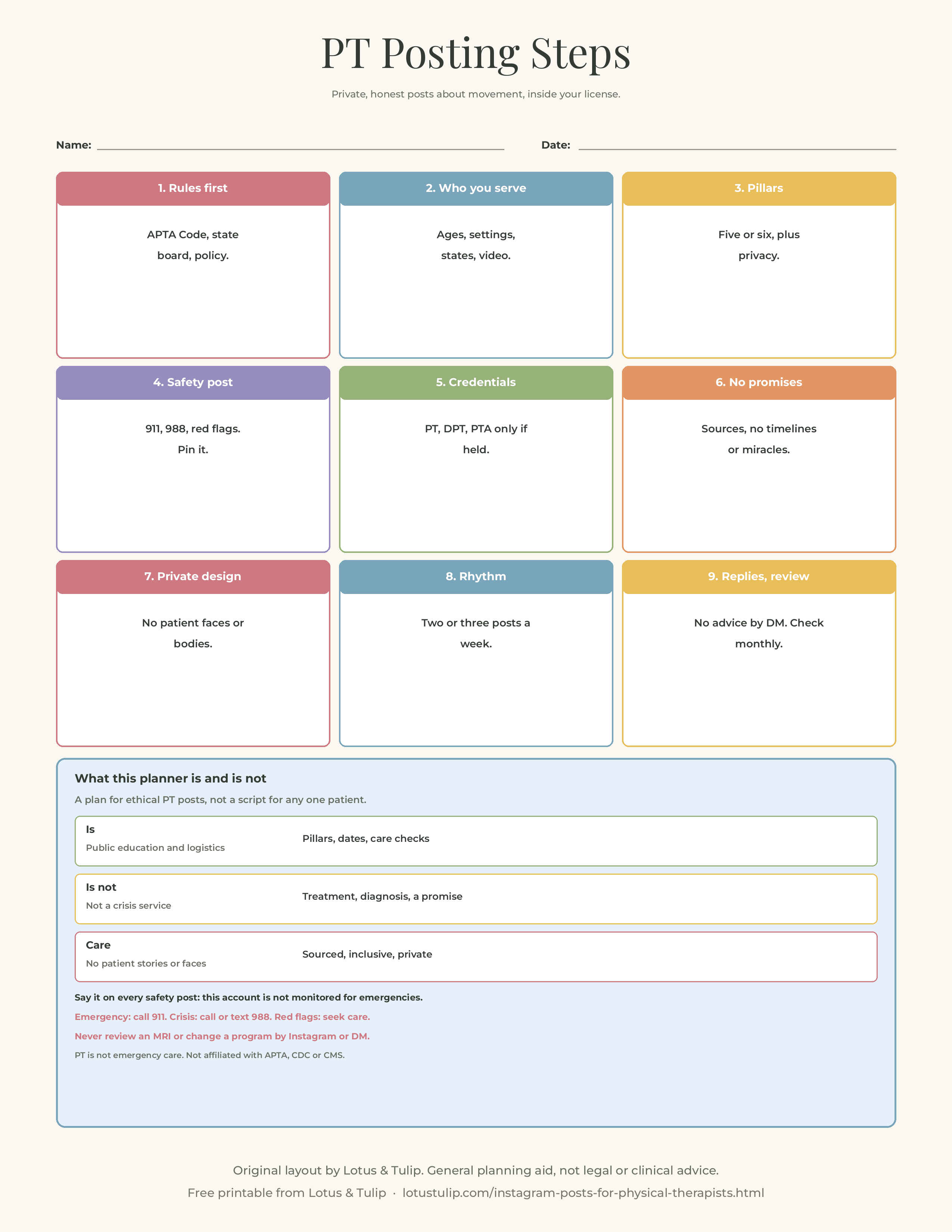
- Read your rules first. Open the current APTA Code of Ethics if it applies to you, your state practice act and board advertising rules, your employer's social media policy, and HIPAA guidance if you are a covered entity. Write down anything that forbids testimonials, specialty claims or patient photos.
- Name who you serve and where. List ages, settings, the states on your licenses, and whether you offer video visits. This becomes the edge of every caption about booking and telehealth.
- Choose five or six pillars, plus privacy and safety. Use the ten pillars above as a menu. If you cannot say something true under a pillar this month, skip it.
- Write and pin a safety post. Include 911, call or text 988, stroke and cauda equina warning signs in plain language, chest pain, post-operative infection concerns, and the sentence that your account is not monitored for emergencies. Put a copy in a Safety highlight.
- Audit your credentials in the bio and on every graphic. Keep PT, DPT, PTA and specialist initials only when they are current. Remove course names that look like board certifications.
- Ban promises, programs and patient images from the draft stage. If a caption needs a timeline, a guaranteed result, a numbered exercise list or a recognizable body to work, rewrite it or delete it.
- Design for privacy. Use original graphics, empty spaces and objects with no names. No faces, no gait videos of patients, no wound photos, no charts and no waiting-room cameos.
- Set a two or three posts a week rhythm. Batch captions on a quiet morning. Schedule only what has already passed the care check. Leave room for a story if hours change.
- Prepare replies and review monthly. Save DM replies that refuse diagnosis and route people to booking, their own clinician or emergency services. Once a month, update hours, remove outdated openings, and run every live post through the care check on page 3 of the free printable.
Mistakes and myths
Common mistakes
- Patient transformation videos. Even with a proud "you can post this," a first-steps-after-surgery clip identifies a person and acts as an outcome advertisement. FTC Section 255.2 treats consumer endorsements about a key attribute as if they represent typical results unless you can support a different reading.
- Before and after photos. The comparison itself promises a result. Cropping a head does not solve privacy or typicality.
- "Fix your back in three days" and other timelines. Standard 6.1 of the 2026 Code forbids misleading representations about your services. No one can promise that timeline to a stranger.
- Exercise prescriptions in public. "Do these three movements for your disc" is a home program written without an examination.
- Inviting MRIs and symptom videos into DMs. You collect health information on a third-party app and you appear to be evaluating someone.
- Letters you do not hold. Specialist initials before certification, "PT" after a license lapses, or calling a PTA a physical therapist.
- A homemade direct access map. State provisions change, and insurance rules sit on top of them. Point people to a check, not to your memory.
- "Serving clients nationwide" for telehealth. Telehealth.HHS.gov says cross-state practice depends on state rules. List the places you are authorized, or say nothing.
- Asking current patients for public reviews, especially in exchange for a discount. The treating relationship makes refusal hard, Section 255.5 would require a material-connection disclosure, and Section 255.2 warns against distorting what patients think.
- Posting from a hard session. If the caption only works because of one person's morning, wait and write something general, or write nothing.
Myths about physical therapist Instagram
- "PT content only works if people see real patients move." Empty stairs, a pair of shoes, a simple diagram and clear words explain a first visit and a safety message without using anyone's body.
- "Viewers will know a reel is not medical advice if you hide a disclaimer at the end." The whole caption and the first frame set the impression. Put the limit in plain language near the start, and do not give a program that the disclaimer then tries to unsay.
- "Personal trainers are the enemy." Many people need both clinical care and later fitness coaching. A respectful comparison helps patients choose. A mocking one helps no one.
- "Direct access means I can say anyone can walk in tomorrow." The practice act, the payer and your own clinic policy may each give a different answer.
- "You need to post daily to be taken seriously." Two or three careful posts a week, with current highlights, serve a clinic better than daily filler.
- "Instagram replaces a website." People still need a page with your licenses, fees, location, telehealth states and contact details that they can read without an app.
Three fictional examples
These people and practices are invented. They show decisions, not real clinics.
- Yasmin, an outpatient orthopedic PT. A follower comments "fix my back in 3 days like that account I saw" under her posture carousel. Yasmin does not joke along. She replies that no ethical PT can promise that, that recoveries vary, and that sudden back pain with numbness in the groin or new bladder changes is an emergency, not a reel. That week she publishes a caption about why examinations come before programs. She leaves the miracle-claim account unmentioned by name.
- Luis, a pelvic health PT. A patient texts a thank-you note and says he can share "as much as you want, this work changed my life." Luis thanks him privately and does not post the note. Pelvic health stories are easy to recognize even without a name. Instead Luis writes a general post about what pelvic health physical therapy can involve at a high level, says internal examination details will never appear on the account, lists the licenses he holds, and reminds readers that scope and training requirements vary by state. He adds that the inbox cannot triage symptoms.
- Abena, a home health and outpatient PT who sees many older adults. After a visit where a client tripped on a throw rug, Abena starts drafting "One of my patients almost fell today." She deletes it, because the client's daughter follows the practice. Over four weeks she posts CDC Check for Safety themes: clear floors, lighting on stairs, the path from bed to bathroom, grab bars. Each slide names CDC STEADI, says "General education, not individual advice," and ends with "If someone has fallen and is hurt or cannot get up, call 911." She does not claim the series prevented any falls.
How this guide compares with neighboring Instagram articles
| Guide | Written for | What it covers that this page leaves aside |
|---|---|---|
| This page: Instagram posts for physical therapists | PTs and PTAs | Movement education without home programs, medical red flags, direct access language, PT versus trainer, World PT Day and National Physical Therapy Month |
| Instagram posts for occupational therapists | OTs and OTAs | What occupation means, children and sensory differences, splints, school OT under IDEA, World OT Day and OT Month |
| Instagram posts for speech therapists | SLPs | Child language and communication, swallowing as a referral theme, sudden speech-change safety in more depth |
| Instagram posts for couples therapists | Couple and family therapists | Relationship ethics, session privacy between partners, and mental health advertising norms for that specialty |
| Holiday social media posts for therapists | Any clinical feed in December and January | A week by week seasonal calendar, grief at the holidays and clinic-hour posts for the winter close |
| Instagram post ideas for therapists and what therapists can post on social media | Mental health clinicians | Counseling and psychotherapy themes, crisis language for therapy practices, and general bio or caption craft |
Use the general therapist pages for layout ideas (bios, highlights, pinned posts, carousels). Come back here when the question is uniquely physical therapy.
Ethical PT post versus overclaiming post
| Topic | Ethical PT post | Overclaiming post |
|---|---|---|
| Back pain | "Here is what a first examination can include, and when back pain plus saddle numbness is an emergency." | "Fix your back in three days with this morning routine." |
| Exercises | "A home program is written after we examine you. This reel is general education, not your program." | "Screenshot these five moves for your herniated disc." |
| Credentials | "PT, licensed in [states]. DPT is my degree. Specialist letters only if certified." | "Spine specialist, board eligible, miracle results." |
| Results | "Here is how we set goals together and how we know when to refer out." | "Week one versus week eight: watch this patient run again." |
| Direct access | "State rules and insurance rules can differ. Call us and we will help you check both." | "No referral needed anywhere in the US. Walk in tomorrow." |
| Telehealth | "Video visits for patients located in [states]. We confirm your location each time." | "Online PT for anyone, anywhere." |
| Reviews | "Feedback is welcome privately. We do not request public reviews from current patients." | "Five stars and a photo earn 10 percent off." |
| Safety | "911 for emergencies, call or text 988 for a mental health crisis, this account is not monitored." | "DM me any time, I always answer." |
When not to post
- When the post only works with a specific patient in it. If you cannot write it without that person, do not write it.
- When someone is asking you to diagnose or to write them a program. Reply privately with a booking path or an emergency path, and keep the grid clean.
- When the idea needs a guarantee to be interesting. Choose another angle.
- When a technique is in a legal or training gray zone. Dry needling, spinal manipulation and pelvic health details are easy to overshare. If you cannot describe the service at a high level without giving instructions, wait.
- When something is unfolding in your clinic or family. A fall, a complication or an angry review is not content.
- When you are exhausted or comparing yourself with louder accounts. A quiet week with current highlights is fine.
- When your employer or health system policy says no. Follow it, even on a personal-looking account that names your workplace.
Free 3 page physical therapist Instagram printable (US Letter)
Print it, fill it in once a month, and keep it next to your scheduling tool. It works with any design app or template set.
- Page 1: PT Posting Steps. Nine step cards that match the HowTo above, what the planner is and is not, and safety lines for 911, 988, red flags and "not emergency care."
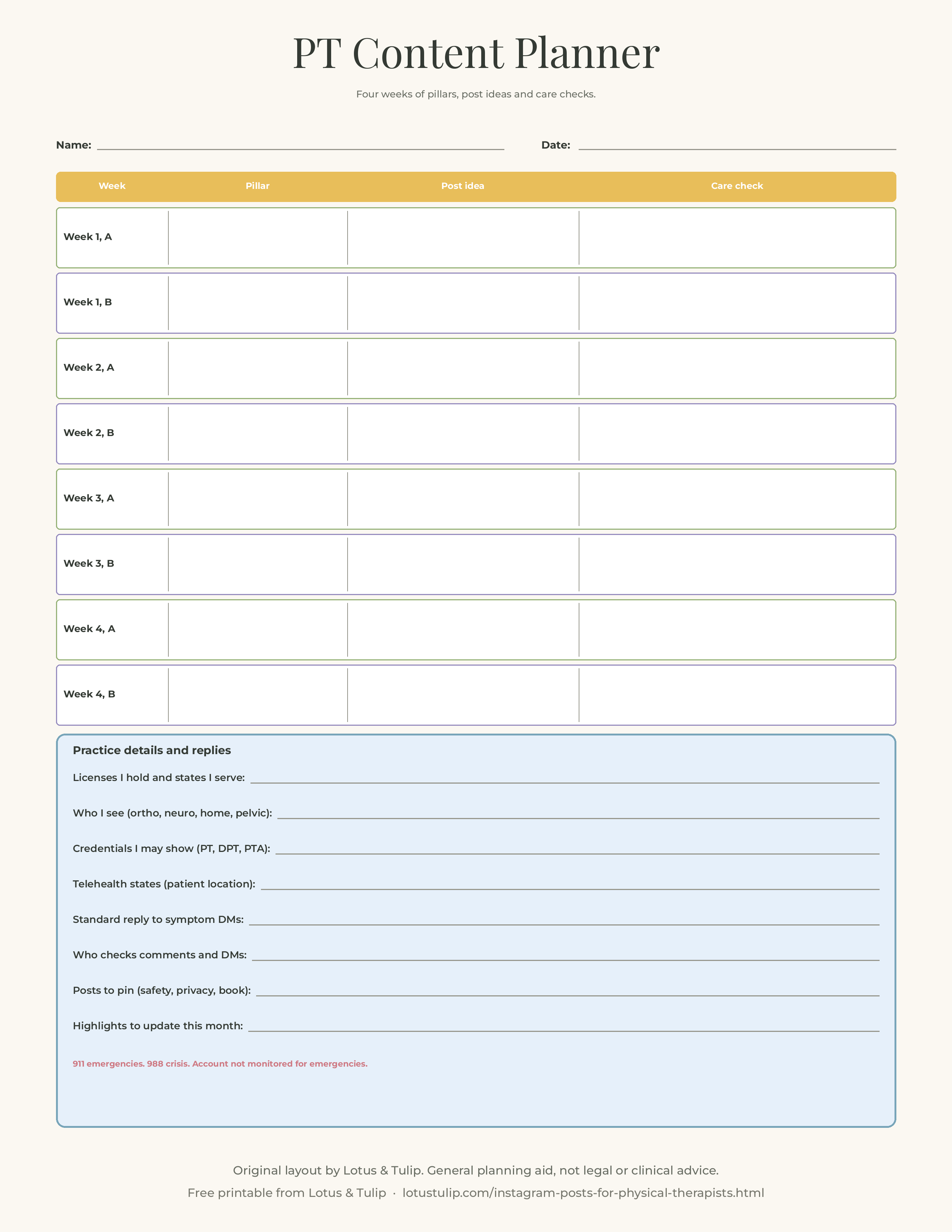
- Page 2: PT Content Planner. Four weeks of posts (two per week) with columns for pillar, post idea and care check, plus fields for licenses and states, who you see, credentials you may show, telehealth states, your standard reply to symptom DMs, who checks messages, posts to pin and highlights to update.
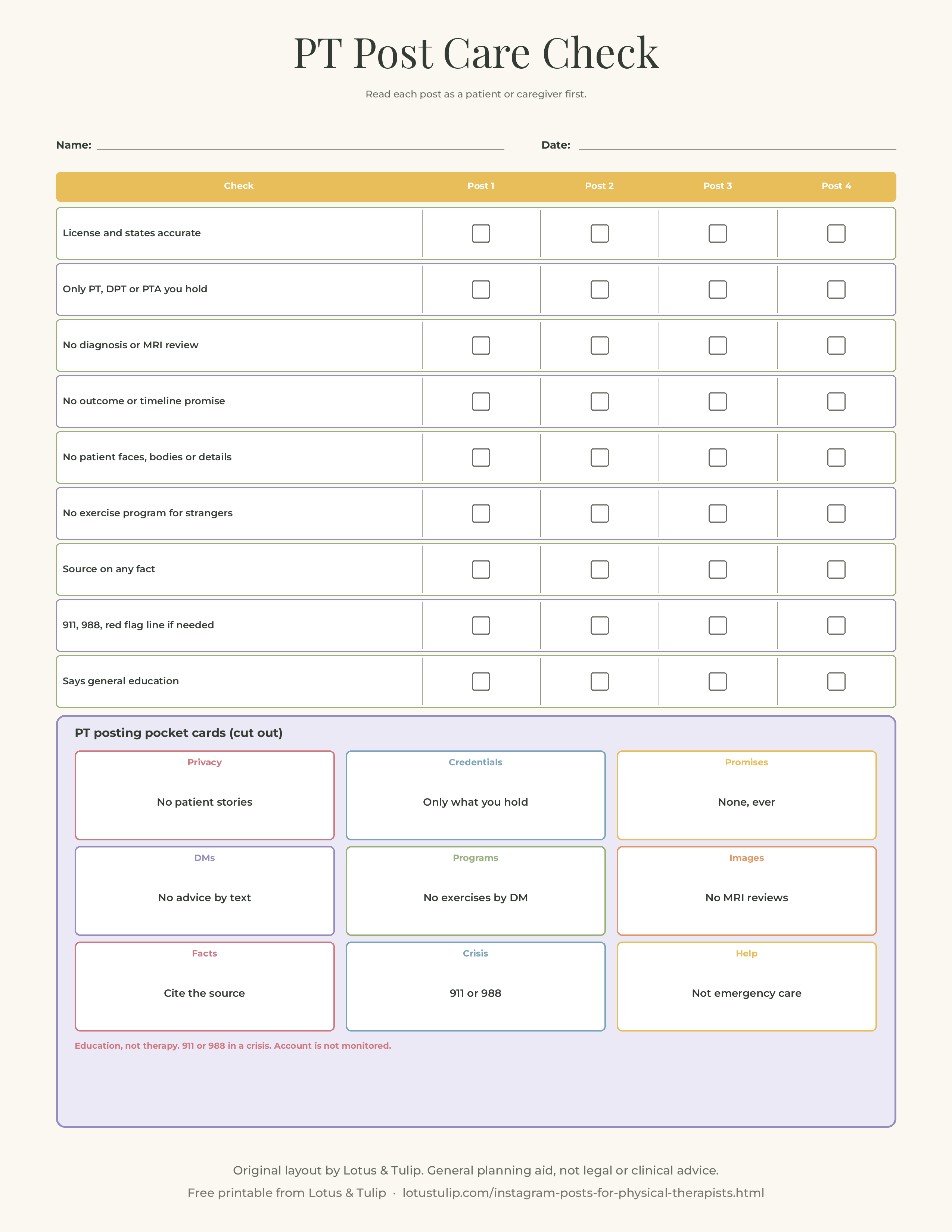
- Page 3: PT Post Care Check. A yes or no check for up to four posts (license and states accurate, only credentials held, no diagnosis, no outcome or timeline promise, no patient images or details, no exercise program for strangers, source on any fact, 911 and 988 lines if needed, says general education), plus nine PT posting pocket cards to cut out.
Download free PDF · Page 1 PNG · Page 2 PNG · Page 3 PNG
Research notes (verified, with caveats)
- American Physical Therapy Association. Code of Ethics for the Physical Therapy Profession, official PDF at apta.org/siteassets/pdfs/policies/apta-code-ethics-physical-therapy-profession.pdf, opened this session. Effective January 1, 2026; adopted by the House of Delegates in 2025; combines the former Code of Ethics for the Physical Therapist and the Standards of Ethical Conduct for the Physical Therapist Assistant. Ethical principles members shall abide by: autonomy (including privacy, confidentiality and informed and ongoing consent), beneficence, nonmaleficence, justice, veracity ("Be honest and truthful in all professional decisions and actions, with all internal and external parties"), and fidelity. Nine Ethical Commitments: Respect, Integrity, Accountability, Maintaining Professional Relationships, Compassion and Trust, Responsible Business and Organizational Practices, Direction and Supervision, Professional Expertise, and Societal Responsibility. Standards quoted or closely paraphrased: 1.2 (protect confidential information), 2.2 (ongoing informed consent after understandable, honest, necessary information), 3.1 (do not exceed professional, jurisdictional and personal scopes), 5.1 (information for informed decisions; authorship of materials truthful, accurate and relevant), 6.1 (information about services truthful and accurate; no misleading representations, including billing), 6.5 (disclose financial interests in recommended products or services), 6.6 (inform patients of financial obligations before they incur charges), 7.2 and 7.3 (PTA direction and supervision; PT primary responsibility for supervision), 8.1 (practice within limits of skills and competence; refer when in the patient's best interests). Aspirational examples 3.D, 5.B and 5.C name social media and, in 3.D and 5.C, artificial intelligence. APTA ethics pages (apta.org/your-practice/ethics-and-professionalism and the Standards of Ethical Conduct for the PTA policy page) confirm the new Code's effective date.
- American Physical Therapy Association. Code of Ethics for the Physical Therapist, HOD S06-20-28-25, PDF last updated August 12, 2020, opened this session at apta.org/siteassets/pdfs/policies/code-of-ethics-for-the-physical-therapist.pdf. Cited as the previous document that many boards still reprint. Principle 4A: "Physical therapists shall provide truthful, accurate, and relevant information and shall not make misleading representations." Principle 2E: protect confidential patient and client information. Principle 8D: educate the public about the benefits of physical therapy and the unique role of the physical therapist.
- American Physical Therapy Association. National Physical Therapy Month: October, apta.org/national-physical-therapy-month, opened via search this session. "October is National Physical Therapy Month." History: Physical Therapy Week in the early 1980s; first NPTM celebrated in October 1992. 2026 campaign language on that page: continuing "PT For Future Me." Supporting APTA articles dated September 9, 2026 and September 30, 2026 repeat the month and the continuing campaign.
- World Physiotherapy. World PT Day page, world.physio/wptday, opened this session. "World PT Day takes place every year on 8 September. In 2026 the theme will be cardiovascular disease and stroke." The 2026 toolkit "promote[s] the role of physiotherapy and physical activity in the prevention, management, and rehabilitation of cardiovascular disease and stroke." The page states that 8 September was designated as World PT Day in 1996 and that this is the date World Physiotherapy was founded in 1951. We did not repeat worldwide cardiovascular death counts because public pages we saw did not agree on a single figure.
- Centers for Disease Control and Prevention. Signs and Symptoms of Stroke, cdc.gov/stroke/signs-symptoms/. Sudden warning signs include sudden numbness or weakness, confusion, trouble speaking or understanding, vision change, trouble walking, dizziness or loss of balance, and a sudden severe headache. CDC tells people to call 9-1-1 immediately, note when symptoms began, and not drive themselves.
- American Association of Neurological Surgeons. Cauda Equina Syndrome patient page, aans.org. Warning signs discussed there include saddle anesthesia and bladder or bowel problems. The condition is presented as a medical emergency. This guide names those warning signs only so a caption can send readers to emergency care. It is not a diagnostic tool.
- Centers for Disease Control and Prevention, STEADI. Check for Safety: A Home Fall Prevention Checklist for Older Adults, cdc.gov/steadi/pdf/STEADI-Brochure-CheckForSafety-508.pdf, and the STEADI Patient and Caregiver Resources page. Themes used above come from the brochure's stairs, floors, kitchen, bedroom and bathroom sections. We did not invent or repeat fall prevalence percentages in the body of this guide.
- 988 Suicide and Crisis Lifeline, 988lifeline.org. People can call or text 988. This guide uses that public instruction and does not treat a PT account as a crisis service.
- Centers for Medicare and Medicaid Services. Know your medical bill rights when not using insurance, cms.gov/initiatives/your-patient-rights/medical-bill-rights/know-your-rights/without-insurance, opened this session. The No Surprises Act took effect January 1, 2022. People who do not have or are not using health insurance usually must receive a good faith estimate when they schedule care at least three business days in advance or if they ask for one. The estimate is not a bill and is not provided during emergency care. A person may be able to dispute a bill that is at least $400 more than the estimate. Provider requirements are also set out in 45 CFR 149.610.
- Telehealth.HHS.gov. Licensing across state lines, last updated April 30, 2025, opened this session. Cross-state practice varies by state; pathways include a full license, temporary practice laws, reciprocity, licensure compacts and telehealth registration. Providers should verify patient location and obtain consent before an appointment. We mention that a Physical Therapy Compact exists but we do not list participating states, because compact status changes and we did not rely on a secondary count.
- Federation of State Boards of Physical Therapy. National Exam (NPTE) pages and candidate materials, fsbpt.org. The NPTE is the entry-level examination used toward PT and PTA licensure; state boards issue licenses. American Board of Physical Therapy Specialties (specialization.apta.org) governs voluntary post-licensure specialist certification for physical therapists. We did not list every specialty area, to avoid an incomplete roster.
- Federal Trade Commission. Guides Concerning Use of Endorsements and Testimonials in Advertising, 16 CFR Part 255 (revised July 26, 2023, 88 FR 48102), via eCFR, opened this session. Section 255.1 (endorsements must reflect honest opinions and may not convey a representation that would be deceptive if made by the advertiser); Section 255.2 (consumer endorsements about a key attribute likely communicate typical results and need substantiation; consumer endorsements are not scientific evidence; do not distort reviews); Section 255.5 (clear, conspicuous disclosure of unexpected material connections).
This page is not affiliated with or endorsed by APTA, World Physiotherapy, CDC, CMS, HHS, FSBPT, ABPTS, AANS, the Physical Therapy Compact, the FTC or any licensing board. Our paid template kits are marketing tools for clinicians. They are not clinical interventions and have not been tested in any trial. You stay responsible for what you post.
Instagram posts for physical therapists: FAQ
What should a physical therapist post on Instagram?
Focus on what prospective patients and referral sources need: who you are and how to check a license, what a first visit involves, how privacy works, whether a referral may be needed in your clinic, fees and good faith estimates for self-pay care, telehealth states, respectful comparisons with OT, speech and personal training, general movement education that is not a home program, home safety themes from CDC Check for Safety, and a pinned safety post with 911 and 988.
How often should a PT post on Instagram?
Two or three feed posts a week is enough for most solo practitioners and small clinics, plus occasional stories. Once a week is fine if you keep your Safety, Book and Fees highlights current.
Can I post photos or videos of patients if they give permission?
HIPAA, if it applies to you, requires a valid authorization for marketing uses, and APTA Standard 1.2 asks you to protect confidential information except as authorized or required by law. Even with written authorization, consider whether the post identifies the person and whether it acts as an outcome promise under FTC Section 255.2. Most practices are safer not posting patients at all.
Can I write DPT or specialist initials in my Instagram bio?
Write DPT only if you hold that degree, and remember it is a degree rather than a medical license. Write PT or PTA only with a current authorization to practice. Add specialist board-certification initials only if you currently hold them through ABPTS or another body that actually issued them. The 2026 Code's Standard 6.1 requires truthful, accurate information about your services, and Standard 8.1 asks you to practice within the limits of your competence.
Is it okay to post exercise videos for common injuries?
General education about what an examination looks like, how effort can feel or why rest and movement may both matter can be useful. A numbered exercise list "for sciatica" or "for your disc" is a home program written for a stranger. Keep public movement content broad, label it as general information, and refuse to prescribe in comments or DMs.
Should I answer diagnosis or MRI questions in DMs?
No. Kindly explain that you cannot examine someone by message, offer a booking path, and point to 911 when red flags are present. Do not invite people to send images or diagnosis lists.
Can I offer telehealth PT to followers in other states?
Only where you are licensed or otherwise legally allowed to practice in the jurisdiction where the patient is located. Telehealth.HHS.gov notes that rules vary and that providers should verify patient location before each appointment. A compact privilege, where it exists, is not something to invent in a caption. List the places you can actually treat.
Is the free printable a copy of the paid kit?
No. The free three page set is an original planning aid: posting steps, a four week content planner and a post care check with pocket cards. The paid Measured Step kit contains designed posts, stories, highlight covers, captions and a 12 week calendar. The printable is not a preview of that kit.