
Therapists and couples · Updated 2026-11-07
Communication Exercises for Couples: 12 Structured Exercises (with Free Printable)
Ready-made printable: Couples Therapy Worksheets Holiday 20% off: about $9.20, was $12 (EUR 10) · instant digital download
Buy on Etsy
Communication exercises for couples are short, structured conversations that give two partners a safer way to talk about what matters: one person speaks while the other listens, complaints start gently instead of with blame, breaks happen before an argument boils over, and small daily moments of attention get noticed and returned. This guide gives you twelve exercises you can use in a couples session or at home, a clear order to teach them in, the research behind them (with its limits), worked fictional examples, a six week practice plan and a free three page printable.
It is written for couples therapists, marriage and family therapists, counselors and social workers who see couples, premarital and relationship educators, and for couples who want a calmer way to talk at home. Most exercises take 10 to 20 minutes and need nothing more than two chairs, a timer and the printable.
This page is distinct from our I statements worksheet, healthy boundaries worksheet, DEAR MAN worksheet, assertiveness worksheet and conflict resolution worksheet. Those pages each teach one skill for any relationship. This one is about the couple as a system: how two people take turns, start hard talks, take breaks, repair and stay connected between arguments.
We credit the research and programs this approach draws on, without claiming any affiliation or endorsement: the newlywed interaction studies of Gottman, Coan, Carrere and Swanson (1998) and Driver and Gottman (2004); the speaker listener technique from the Prevention and Relationship Education Program (PREP) described by Markman and colleagues; the relationship education meta analysis by Hawkins and colleagues (2008); the couple therapy meta analysis by Shadish and Baldwin (2003); and the guidance on intimate partner violence and couples work by Keilholtz and Spencer (2022). The printable is an original Lotus and Tulip layout, not a copy of any program's materials.
This guide is educational. It is not couples therapy and does not replace it. Communication exercises are for conflict between two people who are both safe. If there is physical violence, threats, coercive control, or one partner is afraid of the other, these exercises are not the right tool and can make things more dangerous. Contact the National Domestic Violence Hotline (call 1-800-799-7233 or text START to 88788). If anyone is thinking about suicide or self harm, call or text 988 (Suicide and Crisis Lifeline) or text HOME to 741741 (Crisis Text Line). For immediate danger, call 911.
What couples communication exercises are (and are not)
A communication exercise is a conversation with rules. The rules slow things down, decide who talks and who listens, and keep the focus on understanding before solving. Without rules, a couple who already argues will usually repeat the same pattern: one partner raises a problem with an attack, the other defends or counterattacks, voices rise, someone walks away, and nothing is settled. A good exercise interrupts that loop at a specific point.
Most exercises in this guide target one of five moments:
- Before the talk: deciding when and whether to have it (a planned time, a calm check).
- The opening: how the first sentence is said (gentle start, I statements).
- The middle: taking turns and making sure each person feels heard (speaker and listener, summarize before you respond).
- When it heats up: pausing and calming down (timeout, repair attempts).
- Between talks: the everyday connection that makes hard talks easier (bids, appreciation, curiosity questions).
What these exercises are not.
- Not a fix for abuse or control. If one partner uses violence, threats, intimidation, monitoring or control, the problem is not communication. Better wording will not make that partner safe, and a structured talk can expose the person at risk to retaliation afterwards.
- Not a script to win arguments. If one partner uses "I statements" as a polite wrapper for blame ("I feel that you are selfish"), the exercise has turned into a weapon.
- Not a promise that every problem can be solved. Some differences between partners are lasting (more on that below). The goal for those is understanding and a workable way to live with them, not a final answer.
- Not a replacement for couples therapy. Exercises are tools. Persistent distress, affairs, addiction, depression or trauma usually need a trained couples therapist.
Why structure helps couples talk
The start of a conversation predicts a lot. In a study of 130 newlywed couples, Gottman, Coan, Carrere and Swanson (1998) found that a harsh, negative start to a conflict discussion was one of the patterns that predicted later divorce, along with a husband's rejection of his wife's influence and a lack of de-escalation and soothing during conflict. The same study did not find that classic active listening (paraphrasing and validating during conflict) predicted better outcomes; the happy, stable couples in that sample rarely used it. That finding is one reason this guide treats paraphrasing as a tool for specific moments, not as the whole answer.
Structured turn taking still has a strong place. The speaker listener technique is a central part of PREP, a relationship education program that teaches communication and conflict management. Markman, Renick, Floyd, Stanley and Clements (1993) reported that at a five year follow up, couples who took the five session PREP program showed more positive and less negative communication than control couples, and lower levels of physical aggression. The structure works less like natural conversation and more like a guard rail: it is useful precisely when natural conversation keeps going off the road.
Small daily moments matter. Driver and Gottman (2004) observed 49 newlywed couples at dinner and in a conflict discussion. They coded everyday "bids" for attention and whether a partner turned toward, away from or against them, and found that playfulness and enthusiastic responses in daily life were linked with more humor and affection during later conflict. The authors are clear that this was observational and correlational, so it does not prove that changing bids changes arguments. It does suggest that connection between arguments is worth practicing too.
Skills can be taught. A meta analysis by Hawkins, Blanchard, Baldwin and Fawcett (2008) pooled 117 studies of marriage and relationship education and found modest but significant improvements in relationship quality and communication skills in experimental studies. Effects were larger for moderate dosage programs than for very short ones, a good argument for practicing an exercise over several weeks rather than trying it once.
Before you start: a safety check
For therapists, this is the most important section of the page. Keilholtz and Spencer (2022), writing in Practice Innovations, describe how assessment for intimate partner violence should be done with each partner separately and privately, so that both can disclose safely. Conjoint couples work is not suitable for every couple experiencing violence, and the safety of the person at risk comes first.
- Screen each partner alone before assigning joint exercises, and again if anything changes.
- Ask about fear, not only about hitting. "Are you ever afraid of what your partner might do?" "Does your partner check your phone, control money or stop you from seeing people?"
- Do not assign homework that requires a hard talk at home if one partner may be punished for what they say in session.
- Have resources ready: the National Domestic Violence Hotline (1-800-799-7233, text START to 88788, or chat at thehotline.org), 988 for suicidal thoughts, and 911 for immediate danger.
For couples using this page at home: if you are afraid of your partner, or a past argument led to pushing, hitting, breaking things or threats, please skip the exercises and contact the hotline instead. You deserve support that keeps you safe.
12 communication exercises for couples
Each exercise lists time, when to use it, how it works and a short debrief. Start with the connection exercises (1 to 3) before the conflict exercises; it is easier to learn a new way of talking when the topic is low stakes.
1. The daily check in (stress reducing talk)
Time: 10 to 20 minutes a day. When: any time; a good first exercise.
Each partner takes a turn talking about their day or a stress outside the relationship (work, family, health, a friend). The other partner's job is to be on their side: ask questions, show interest, say "that sounds exhausting" and avoid giving advice unless asked. The rule is simple: this is not the time to raise problems about each other. Couples who practice this often find it is the first time in months they have felt like a team.
Debrief: "What did your partner do that made you feel listened to?"
2. Bids: notice, turn toward, return
Time: one week of noticing, 10 minutes to review. When: early in the work, or when partners feel distant.
A bid is any small attempt to connect: "Look at this," a sigh, a touch, a joke, a question about the news. The other partner can turn toward it (respond with interest), turn away (miss or ignore it) or turn against it (respond with irritation). For one week, each partner notices a few bids they made and a few they received, and writes down how they responded. The aim is noticing, not keeping score.
Debrief: "What kind of bid do you make most? Which bids from your partner do you tend to miss?"
3. Appreciation and fondness log
Time: 2 minutes a day. When: throughout; especially helpful when resentment is high.
Each day, each partner writes one specific thing they appreciated about the other and says it out loud: "Thank you for taking the car in. I know you hate that place." Specific beats general ("you're great"). If a partner cannot think of anything, that is important information for the therapist, not a failure.
Debrief: "Which appreciation from your partner surprised you?"
4. Gentle start rewrite
Time: 10 to 15 minutes. When: before any hard conversation.
Take a complaint that usually starts a fight and rewrite the opening sentence. A harsh start blames the person and often uses "you always" or "you never": "You never help with anything around here." A gentle start describes the situation, the feeling and a positive need: "I'm overwhelmed with the kitchen tonight. Could you do the dishes while I put the kids to bed?" Practice turning three real complaints into gentle starts, then say one aloud. Our free printable has a rewrite box on page two.
Debrief: "How did it feel to hear the gentle version? What made it easier to say yes?"
5. I statements for couples
Time: 10 minutes. When: alongside the gentle start.
The frame is "I feel (feeling) when (specific situation) and I would like (request)." For example: "I feel lonely when we both scroll our phones at dinner, and I'd like us to keep phones off the table." The feeling word must be a feeling, not a disguised accusation; "I feel that you don't care" is a judgment, not a feeling. See our I statements worksheet for a full builder and practice cards.
Debrief: "Was your feeling word a real feeling? Was your request something your partner could actually do?"
6. Speaker and listener
Time: 15 to 20 minutes. When: for topics that keep turning into arguments.
Use an object (a card, a pen, the printable) as "the floor". Whoever holds it is the speaker. The speaker talks in short chunks, speaks only for themselves and uses I statements. The listener does not argue, defend or fix; they summarize what they heard in their own words ("So it sounds like when I'm late without texting, you start to worry something happened, and then you feel ignored"). The speaker confirms or corrects, then continues. After a few rounds, hand over the floor and switch roles. No problem solving until both partners feel understood.
This is the structured listening exercise used in PREP. It feels unnatural, which is the point: it slows a fast, hot exchange down enough for both people to hear each other.
Debrief: "What did you hear that you had not heard before? What was hardest about not responding right away?"
7. Summarize before you respond
Time: built into any conversation. When: once speaker and listener feels familiar.
A lighter version of exercise 6 for everyday talks. Before giving your view, briefly summarize your partner's view until they say "yes, that's it." Then say your side. One sentence is often enough. It prevents the classic pattern of two people arguing against things the other never said.
Debrief: "How many tries did it take to get the summary right?"
8. Map your conflict cycle
Time: 20 to 30 minutes, best in session. When: when the same fight keeps repeating.
Together, draw the loop: the trigger ("we're late again"), what partner A does on the outside (criticizes, raises voice), what A feels on the inside (anxious, unimportant), what partner B does on the outside (goes quiet, leaves the room), what B feels on the inside (attacked, like nothing they do is enough), and how each reaction feeds the other. Naming the cycle as the problem, rather than each other, often lowers blame quickly: "It's the cycle again" is easier to say than "It's you again."
Debrief: "Where in the loop could one of you do something different next time?"
9. Timeout and self soothing plan
Time: 10 minutes to plan; used as needed. When: before the next big argument.
When a partner is flooded (heart racing, can't think, wants to yell or escape), the conversation stops being useful. Agree in advance on a signal ("I need a break"), a promise to come back, and what each person will do to calm down. The Gottman Institute suggests a break of at least 20 minutes and no longer than 24 hours, spent actually soothing (breathing, walking, music, reading) rather than replaying the argument. The partner who calls the break names a return time: "I need a break. Let's talk again at 8." Leaving without a return time feels like abandonment to many people; coming back is what makes the timeout safe.
Debrief: "What calms your body fastest? What does your partner need to hear so the break does not feel like walking out?"
10. Repair attempts
Time: 10 minutes to build a list. When: any time; use during arguments.
A repair attempt is anything that slows an argument or reconnects: "I'm sorry, that came out wrong," "Can we start over?", "I see your point," "Can I have a hug?", a shared joke. Each partner writes three repair phrases they could say and three they would like to hear. The second list matters: a repair only works if the other person can receive it. Practice saying one repair phrase out loud in session.
Debrief: "Which repair would actually work on you in the middle of a fight?"
11. Solvable or lasting?
Time: 15 to 20 minutes. When: after the basics are in place.
List the issues you argue about and sort them. Solvable problems have a practical answer (who drives the kids on Tuesdays). Lasting problems come from deeper differences in personality, values or needs (one partner is social and the other needs quiet; one is a saver and the other a spender). For solvable problems, use a simple problem solving plan: brainstorm, pick one, try it for a week, review. For lasting problems, the aim is a calm, ongoing conversation: what each person's position means to them, and one small way to make room for both.
Debrief: "Which problem have you been trying to solve that might be a lasting difference?"
12. Curiosity questions and shared meaning
Time: 15 minutes, once a week. When: as a weekly ritual.
Take turns asking open questions you do not know the answer to: "What's something you're looking forward to this month?", "What's a worry you haven't told me about?", "What did a good weekend look like in your family growing up?", "What do you want our home to feel like?" Partners often discover they stopped asking questions years ago. Add one question about the future together: rituals, values or plans.
Debrief: "What did you learn about your partner this week?"
In what order should couples learn these exercises?
| Stage | Exercises | Why this order |
|---|---|---|
| 1. Connect | Daily check in, bids, appreciation log | Builds goodwill and practice with low stakes topics first |
| 2. Start gently | Gentle start rewrite, I statements | Changes the first sentence, which shapes the rest of the talk |
| 3. Listen | Speaker and listener, summarize before you respond | Gives each partner the experience of being heard |
| 4. Calm | Timeout plan, repair attempts | Prepares for the moments when things still heat up |
| 5. Understand the pattern | Conflict cycle map, solvable or lasting | Moves from single fights to the recurring loop |
| 6. Build together | Curiosity questions and shared meaning | Keeps the relationship about more than conflict |
A six week practice plan
This plan works for couples in therapy (one session a week plus home practice) or for a couple working through this page on their own. Keep a regular time each week and use the Weekly Practice Log on page three of the printable.
| Week | In session or weekly talk | Daily home practice |
|---|---|---|
| 1 | Safety check, goals, daily check in explained | Daily check in, appreciation log |
| 2 | Bids review, gentle start rewrite | Notice bids, one gentle start a day |
| 3 | I statements, first speaker and listener on a small topic | Daily check in, appreciation |
| 4 | Timeout plan and repair list | Use the timeout signal if needed, one repair phrase |
| 5 | Conflict cycle map, speaker and listener on a medium topic | Summarize before you respond |
| 6 | Solvable or lasting, curiosity questions, review progress | Weekly curiosity talk, keep what works |
Keep the topics small at first. A couple who tries speaker and listener on their biggest fight in week one usually gives up on the exercise. Start with something like weekend plans, then work up.
Adaptations
- Premarital and new couples. Focus on connection, gentle start and speaker and listener while things are going well; skills learned before distress are easier to use later.
- High conflict couples. Do the timeout plan in the first or second session, keep most hard talks inside the therapy room at first, and use speaker and listener with a therapist coaching every turn.
- Withdrawn or "we never fight" couples. Start with curiosity questions and bids. The task is often to bring hidden disagreements into the open gently.
- Co-parents. Keep topics focused on the children and logistics, and use gentle start and summarize before you respond. Separated co-parents with high conflict may need structured parallel parenting rather than shared conversation. Our Calm and Connected parenting worksheets help parents agree on routines and responses.
- Neurodivergent partners. Make rules visual, agree on literal signals ("pause" rather than a look), allow written exchanges for hard topics and plan for sensory overload during timeouts.
- Different communication cultures. Families and cultures differ in how directly people express disagreement and emotion. Ask each partner what respectful conflict looked like where they grew up, and adapt the scripts so they sound like the couple, not like a textbook.
- Telehealth. Ask partners to sit side by side or in separate rooms with separate devices if one tends to talk over the other. Use the printable on screen and type summaries in chat.
- Same sex and gender diverse couples. The exercises work the same way. Stay alert to outside stressors such as family rejection or discrimination, which can show up in the conflict cycle.
How to use communication exercises for couples, step by step
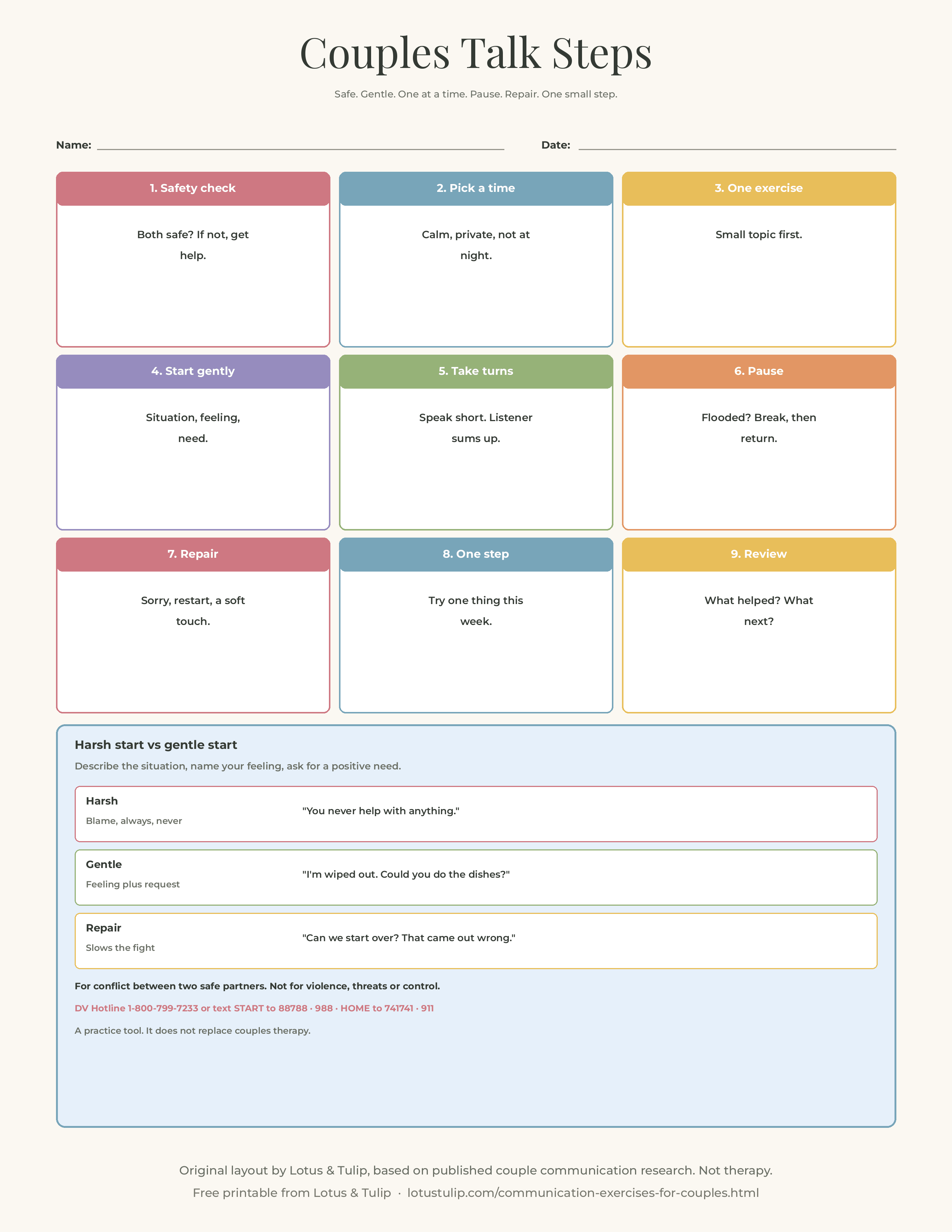
- Safety check. Confirm both partners are safe with each other. Screen each partner separately for violence, threats and control. If there is danger, stop and use the hotline (1-800-799-7233, text START to 88788), 988 or 911 instead of joint exercises.
- Pick a time. Agree on a calm time and place for the exercise, not in the middle of an argument, late at night or in front of the children.
- Choose one exercise. Start with a connection exercise or the one that targets your hardest moment, and only one at a time.
- Start gently. Open with a gentle start: the situation, your feeling and a positive need, not a criticism of your partner.
- Take turns. Use the speaker and listener rules: one person holds the floor, speaks in short chunks and the other summarizes before responding.
- Pause when flooded. Use your agreed signal, take a break of at least 20 minutes to soothe, and name a time to come back.
- Repair. Offer and accept small repair attempts: an apology, a softer restart, a touch or a shared joke.
- Agree on one small step. For solvable problems, pick one thing to try this week. For lasting problems, agree on one small way to make room for both of you.
- Review weekly. Use the practice log to note what you tried, what helped and what to try next.
A first round of these steps can take a whole session. That is normal. The skill grows with repetition, which matches the finding that moderate dosage relationship education tends to show larger effects than very short programs (Hawkins et al., 2008).
Tips for therapists, counselors and couples
Couples therapists. Coach in the moment. When a partner starts harshly, pause and ask them to try the opening again. When a listener rebuts, gently return the floor. Your role early on is part referee, part translator. Keep individual sessions available for safety screening and for work that cannot happen with the partner present.
Individual therapists. Many clients bring relationship conflict to individual therapy. You can teach gentle start, I statements, a timeout plan and repair phrases to one partner, which can still change the cycle. Pair with CBT or DBT pages for the individual's own patterns.
Relationship educators and premarital counselors. Run exercises 1, 4, 5, 6, 9 and 10 as group practice with couples in pairs. Normalize that the structure feels awkward at first.
Couples at home. Practice when things are calm. Keep sessions short. If the exercise turns into the same old fight, stop, take a break and try a smaller topic next time. If you keep getting stuck, a couples therapist can coach you live, which is often faster than trying alone.
Worked fictional examples
Dana and Chris, together nine years, two children. Their fights always started at 6 pm: Dana arrived home to a messy kitchen and said, "You never do anything." Chris went silent and left the room. In session they mapped the cycle and saw that Dana's harsh start covered feeling alone with the load, and Chris's silence covered feeling like nothing he did counted. They rewrote the opening ("I'm wiped out and the kitchen feels like too much. Can you take the dishes tonight?") and agreed that Chris would say "I need ten minutes, then I'll help" instead of leaving silently. Three weeks later, they reported the same trigger with a much shorter, calmer conversation.
Sam and Jordan, engaged. They rarely fought but felt more like roommates. They started with the daily check in and curiosity questions. During one curiosity talk, Jordan shared that holidays at Sam's family felt lonely. Using speaker and listener, Sam summarized until Jordan said "yes, that's it," and they agreed to plan one quiet evening alone during every family holiday.
A couple who should not do these exercises at home. During individual screening, one partner disclosed that past arguments ended with the other partner blocking the door and taking her phone. The therapist did not assign joint communication homework, made a safety plan with her individually, shared the National Domestic Violence Hotline, and referred the other partner to specialized services. Communication exercises were not the right tool for that couple.
These examples are fictional composites for teaching purposes, not real clients.
Common mistakes
- Starting with the biggest fight. Learn the skill on small topics first.
- Using the rules as weapons. "You're not doing the exercise right!" mid argument is another criticism. Gently restart instead.
- Disguised blame. "I feel like you're lazy" is not an I statement.
- Timeouts with no return. A break without a return time can feel like stonewalling or abandonment.
- Problem solving too early. Most people cannot accept a solution until they feel understood.
- Keeping score. Bids and appreciation logs are for noticing, not for proving who tries harder.
- Skipping the safety screen. The single most serious mistake a professional can make with these tools.
Communication exercises vs related guides
| Guide | Best when the main need is | Overlap |
|---|---|---|
| Communication exercises for couples (this page) | Two partners changing how they talk, fight and reconnect | All twelve exercises, six week plan |
| I statements worksheet | Learning one way to say a hard thing | Exercise 5 |
| Healthy boundaries worksheet | One person setting and holding limits | Needs and requests |
| DEAR MAN worksheet | Asking for something clearly (DBT) | Gentle start, requests |
| Conflict resolution worksheet | Solving a specific disagreement step by step | Solvable problems |
| Anger iceberg worksheet | Understanding feelings under anger | Conflict cycle, inside feelings |
When these exercises are not the right tool
- Violence, threats or control. Use the National Domestic Violence Hotline (1-800-799-7233, text START to 88788) and individual support, not joint exercises.
- A crisis. If a partner talks about suicide or self harm, stop the exercise. Call or text 988, text HOME to 741741, or call 911 for immediate danger, and consider a safety plan with a professional.
- Active addiction or untreated severe mental illness. These often need their own treatment first or alongside couples work.
- Right after discovering an affair. Rebuilding trust is a specific process, best done with a trained couples therapist.
- When one partner has already decided to leave. Discernment or separation counseling may fit better than communication practice.
What the research says (honestly)
Communication patterns predict relationship outcomes. Gottman, Coan, Carrere and Swanson (1998) followed 130 newlywed couples and found that negative start up, rejecting a partner's influence and a lack of de-escalation and soothing during conflict predicted divorce, while a balance of positive to negative affect predicted satisfaction among stable couples. They reported predicting divorce and stability with 83 percent accuracy in that sample. This is one study of newlyweds, mostly from one region; prediction in a research sample is not the same as a guarantee for any single couple.
Active listening is useful but not magic. The same 1998 study found that classic active listening during conflict was rare among happy, stable couples and did not predict outcomes. Programs such as PREP still teach structured listening, and Markman and colleagues (1993) found better communication and lower physical aggression in PREP couples at five years. A reasonable reading of both: structured listening is a helpful tool for hard topics, while gentleness, soothing and accepting influence are just as important.
Relationship education helps modestly. Hawkins and colleagues (2008) found modest but significant effects of marriage and relationship education on relationship quality and communication skills across 117 studies, with larger effects for moderate dosage programs. They also noted that samples lacked racial, ethnic and economic diversity, which limits what can be said for many couples.
Couple therapy works for many distressed couples. Shadish and Baldwin (2003), in a meta analysis of marriage and family therapy interventions in the Journal of Marital and Family Therapy, found that couple therapy outperformed no treatment, with little evidence that one approach was clearly better than another. Exercises on this page draw on themes common to several approaches; they are not a full therapy model.
Daily connection is linked to calmer conflict. Driver and Gottman (2004) found that playful bids and enthusiastic responses in daily life were associated with humor and affection in later conflict among 49 newlywed couples. The study was correlational; it supports practicing connection but does not prove it causes better conflict.
Safety comes first. Keilholtz and Spencer (2022) review assessment and treatment when intimate partner violence is present and stress separate, private assessment of each partner and that conjoint treatment is not suitable for all couples experiencing violence.
Bottom line. These exercises are reasonable, research informed ways to practice better communication. They work best with repetition, with a skilled coach for high conflict couples, and only when both partners are safe.
Free couples communication exercises printable (PDF)
The free printable has three pages in US Letter size:
- Page 1: Couples Talk Steps. Nine steps that match the HowTo above (safety check, pick a time, one exercise, start gently, take turns, pause when flooded, repair, one small step, review), plus a harsh start vs gentle start example and safety resources.
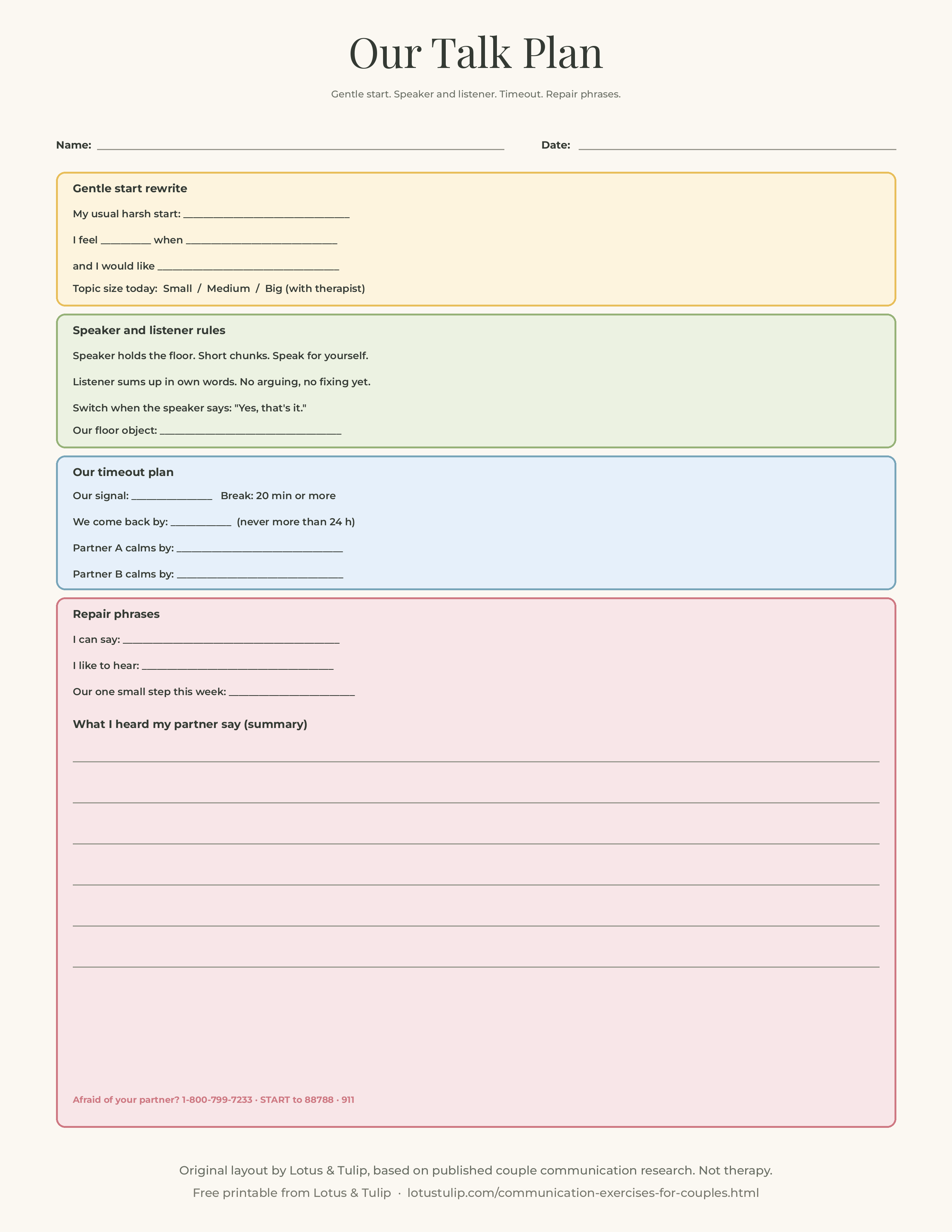
- Page 2: Our Talk Plan. A gentle start rewrite box, speaker and listener rules, our timeout signal and return time, calming plans for each partner, and repair phrases I can say and like to hear.
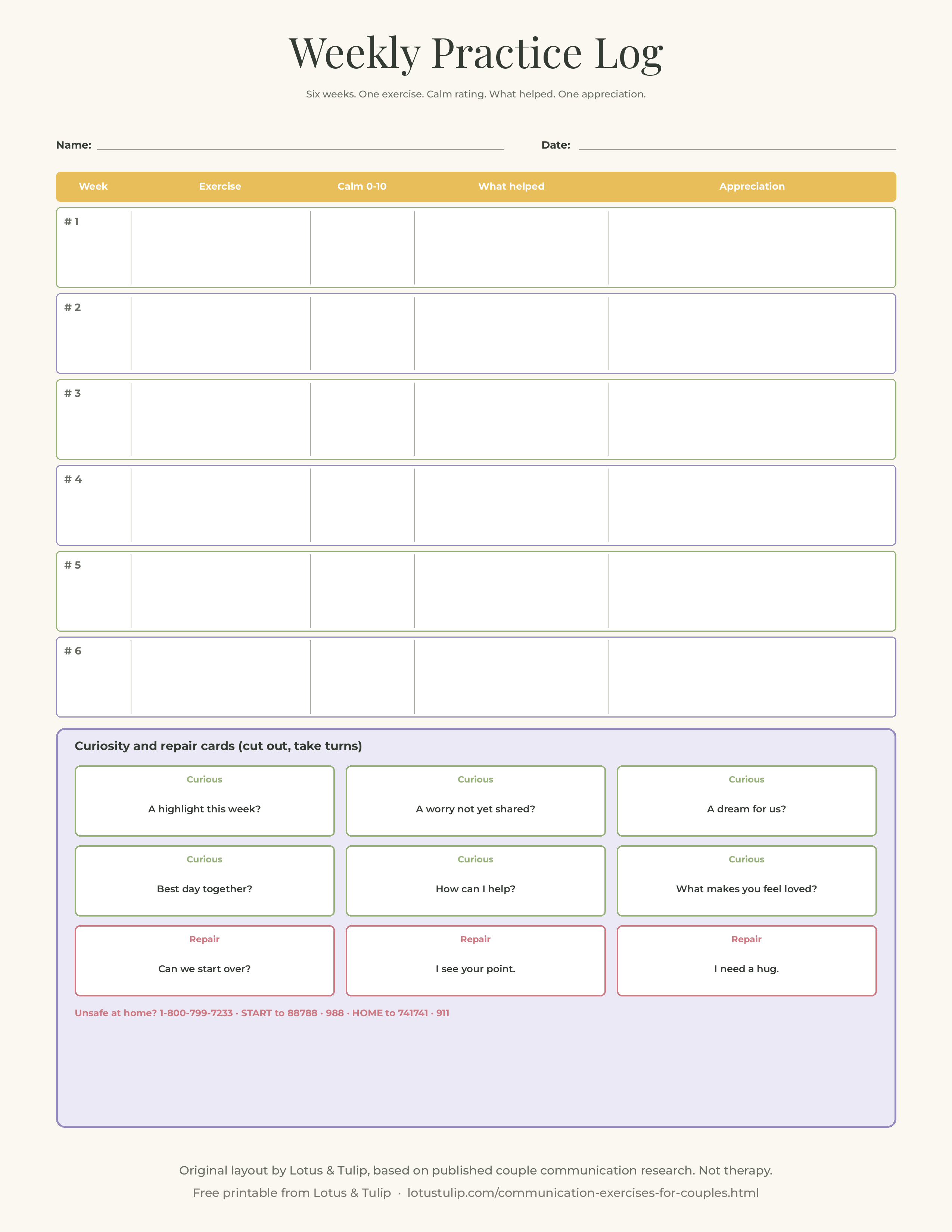
- Page 3: Weekly Practice Log + talk cards. Six weeks of exercise, who started, calm rating, what helped and one appreciation, plus nine cut out curiosity and repair cards.
Download the free couples communication printable (PDF, 3 pages, US Letter)
Prefer single images? Page 1: Couples Talk Steps (PNG) · Page 2: Our Talk Plan (PNG) · Page 3: Weekly Practice Log (PNG)
Free to print for your own use and for use with your own clients or groups. This is an original layout by Lotus & Tulip, drawing on published research on couple communication (Gottman et al. 1998; Driver and Gottman 2004; Markman et al. 1993; Hawkins et al. 2008). It is not affiliated with or endorsed by any author, institute, program or organization named on this page, does not diagnose or treat any condition, and is not a substitute for couples therapy. Please link to this page rather than re-uploading the file.
Related resources
- Attachment styles worksheet: a pattern map of worry and distance and a secure moves plan
- DBT validation worksheet: six levels of validation between partners, plus self-validation.
- Couples therapy informed consent form: no secrets policy, individual sessions, records and safety screening, with a free printable.
- Therapist worksheets: CBT, DBT, ACT and more: all worksheet sets in one place.
- I statements worksheet: a full builder with practice cards.
- Healthy boundaries worksheet: limits and scripts for one partner.
- GIVE and FAST worksheet: keeping the relationship and self respect while asking.
- Anger iceberg worksheet: feelings under the surface of a fight.
- Window of tolerance worksheet: understanding flooding and calming down.
- Safety plan worksheet: when the moment is about staying safe.
Sources
- Driver, J. L., and Gottman, J. M. (2004). Daily marital interactions and positive affect during marital conflict among newlywed couples. Family Process, 43(3), 301 to 314.
- Gottman, J. M., Coan, J., Carrere, S., and Swanson, C. (1998). Predicting marital happiness and stability from newlywed interactions. Journal of Marriage and the Family, 60(1), 5 to 22.
- Hawkins, A. J., Blanchard, V. L., Baldwin, S. A., and Fawcett, E. B. (2008). Does marriage and relationship education work? A meta analytic study. Journal of Consulting and Clinical Psychology, 76(5), 723 to 734.
- Keilholtz, B. M., and Spencer, C. M. (2022). Couples therapy and intimate partner violence: Considerations, assessment, and treatment modalities. Practice Innovations, 7(2), 124 to 137.
- Markman, H. J., Renick, M. J., Floyd, F. J., Stanley, S. M., and Clements, M. (1993). Preventing marital distress through communication and conflict management training: A 4 and 5 year follow up. Journal of Consulting and Clinical Psychology, 61(1), 70 to 77.
- Shadish, W. R., and Baldwin, S. A. (2003). Meta analysis of MFT interventions. Journal of Marital and Family Therapy, 29(4), 547 to 570.
- The Gottman Institute. Guidance on flooding and self soothing breaks. gottman.com.
- National Domestic Violence Hotline. thehotline.org.
Communication exercises for couples: FAQ
What are the best communication exercises for couples?
A good starting set is a daily check in about outside stress, noticing and turning toward bids, an appreciation log, a gentle start rewrite, I statements, the speaker and listener technique, a timeout plan with a return time and a list of repair phrases. Learn them in that order, on small topics first.
How does the speaker and listener technique work?
One partner holds an object that represents the floor and speaks in short chunks about their own experience. The other partner does not argue or fix, but summarizes what they heard until the speaker agrees it is right. Then they switch. Problem solving waits until both feel understood.
What is a gentle start up?
It is a way to raise a complaint that describes the situation, your feeling and a positive need, instead of criticizing your partner. For example, "I'm overwhelmed with the kitchen tonight, could you do the dishes?" instead of "You never help." Research with newlywed couples found a harsh start to conflict was one of the patterns that predicted later divorce (Gottman et al. 1998).
How long should a timeout be during an argument?
Long enough for your body to calm down. The Gottman Institute suggests at least 20 minutes and no more than 24 hours, spent soothing rather than replaying the fight. Always agree on a time to come back.
Can we do couples communication exercises without a therapist?
Many couples can practice connection and gentle start exercises on their own, and relationship education research shows modest benefits. If the same fight keeps escalating, if there is an affair, addiction or depression, or if exercises keep turning into arguments, a couples therapist can coach you live.
When should couples not use communication exercises?
When there is physical violence, threats, intimidation or controlling behavior, or when one partner is afraid of the other. In that case, contact the National Domestic Violence Hotline (call 1-800-799-7233 or text START to 88788), or call 911 in an emergency. Therapists should screen each partner separately before assigning joint exercises.
Do communication exercises actually work?
Relationship education that teaches communication skills shows modest but significant effects on communication and relationship quality across more than 100 studies (Hawkins et al. 2008), and couple therapy outperforms no treatment (Shadish and Baldwin 2003). Results depend on practice, dosage and whether both partners are safe and willing.