
Therapist practice · Updated 2026-11-10
Couples Therapy Informed Consent Form: No Secrets Policy, Individual Sessions, Records Access, Safety Screening and a Filled Example (Free Printable)
Ready-made printable: Therapy Progress Notes and Intake Templates Fillable PDF: includes an informed consent outline to adapt, plus intake, notes and safety plan pages (20 pages)
Holiday 20% off: about $7.36, was $9 (EUR 8) · instant digital download
Try it free first: download the fillable couples therapy consent form (both partners, editable no secrets policy, PDF, 2 pages). Type into it on screen. The pack above adds informed consent and telehealth consent outlines plus intake pages. No email needed.

Two people sit down in your office, or appear side by side on a video call, with different ideas of why they are there. One hopes you will help save the relationship; the other is quietly deciding whether to leave. One assumes anything said to you on the phone stays private; the other assumes you will tell them everything. Neither has thought about who can get a copy of the record if they divorce, or whether you might be asked who is the better parent. Your individual consent form answers none of these questions, because it was written for one client.
This guide is for marriage and family therapists, counselors, clinical social workers and psychologists in the US who see couples. It explains what a couples consent needs that an individual consent does not: who the client is, a secrets policy (no secrets, limited secrets or individual confidences kept), individual sessions, each partner's access to the record, divorce and custody limits, intimate partner violence screening and when you will not offer couples work, and fees when there are two people and one bill. It includes sample wording, a full fictional couples consent, short scenarios and a free three page printable: a blank form, the same form filled for a fictional couple, and a checklist with an individual contact log.
Jump to the free couples therapy consent form
This is educational information for licensed clinicians and trainees in the US. It is not legal advice and does not create any professional relationship. The federal rules quoted here were checked against the current eCFR text of 45 CFR part 164 (up to date as of November 5, 2026). The ethics standards were checked against the published codes: the AAMFT Code of Ethics (revised code effective January 1, 2026), the ACA Code of Ethics (2014), the APA Ethical Principles of Psychologists and Code of Conduct (2002, amended 2010 and 2016) and the NASW Code of Ethics. State laws on privilege, records, minors, mandated reporting, duty to warn and divorce proceedings vary and are often stricter. Have an attorney, your professional association or your licensing board review your form. Every practice, clinician, couple and detail in the examples on this page is fictional.
The short answer
A couples therapy informed consent form is the written agreement both partners sign before conjoint therapy begins. It covers everything in an individual consent (approach, risks and benefits, fees, confidentiality limits, emergencies, records) plus the questions that only exist when the client is more than one person.
- Say who the client is. The couple as a unit, or each partner as an individual client with joint sessions. The ACA code treats the couple as the client unless you agree otherwise (B.4.b), and the APA and NASW codes ask you to clarify this at the outset (APA 10.02(a), NASW 1.06(d)).
- Choose a secrets policy and get it in writing. No secrets, limited secrets, or individual confidences kept. Under the AAMFT code you may not reveal one partner's confidences to the other without that partner's prior written permission (2.2), so a no secrets policy only works if both partners agreed to it in writing before anything was shared.
- Explain individual sessions: whether you hold them, why, how often, and how information from them is handled under the policy you chose.
- Explain records. Whether you keep one joint record, what each partner can see, and that releasing joint records outside therapy needs written authorization from each partner (AAMFT 2.2 and 2.3), while HIPAA gives each partner a federal right of access to information about them (45 CFR 164.524).
- Set limits on court involvement. No custody evaluations or expert opinions for current or former therapy clients (AAMFT 7.5 and 7.6), how you respond to subpoenas, and fees for legal work.
- Screen each partner for intimate partner violence, separately, and say in the form that couples therapy may be paused, changed or not offered when one partner is unsafe.
- Put fees, cancellations and who pays in writing before therapy begins (AAMFT 8.2, APA 6.04(a)), including what happens when only one partner arrives.
- Both partners sign, each initials the secrets policy, and you review the agreement when anything changes.
Why couples therapy needs its own consent form
An individual consent rests on one assumption: there is one client, one set of confidences, one record and one person who can authorize a release. Couples work breaks every part of that. The AAMFT code opens its confidentiality standard with exactly this point: marriage and family therapists "have unique confidentiality concerns because the client in a therapeutic relationship may be more than one person," and they respect and guard the confidences "of each individual client in the client system." A form that does not deal with this leaves you improvising the first time one partner calls you alone.
| Question | Individual consent | Couples consent |
|---|---|---|
| Who is the client? | The person signing | The couple, or each partner; must be stated (ACA B.4.b, APA 10.02(a), NASW 1.06(d)) |
| Confidentiality | Private, with legal and safety limits | The same limits, plus what is shared between partners: the secrets policy (AAMFT 2.2, NASW 1.07(f) and (g)) |
| Individual contact | All sessions are individual | Whether and when you see each partner alone, and what happens to what they tell you |
| Records | One person's record | Joint or separate records; each partner's access; releases need each partner's authorization (AAMFT 2.3, ACA B.6.e) |
| Court | Subpoena handling | Divorce and custody: no custody evaluations, no taking sides (AAMFT 7.5 and 7.6, APA 10.02(b)) |
| Safety | Suicide and harm to others | The same, plus intimate partner violence screening and when couples therapy is not offered |
| Fees | One payer | Who pays, what happens if one partner cancels or does not show, insurance limits for couples work |
| Signatures | Client and clinician | Both partners and clinician, with each partner's initials on the secrets policy |
None of the codes requires a specific form. They require the conversation and, for some points, written agreement: the ACA code asks counselors to "seek agreement and document in writing such agreement among all involved parties regarding the confidentiality of information" (B.4.b), and the NASW code asks social workers to tell participants that they "cannot guarantee that all participants will honor such agreements" (1.07(f)). The form is how you do this once, properly, for every couple.
If you already use an informed consent for therapy template for individual clients, you do not need to rewrite it. Most practices keep their general consent and add a couples addendum that both partners sign. The free printable on this page is built that way: it sits on top of your general consent and covers only the couples specific clauses.
Who is the client? Decide before the first session
Everything else depends on this, and the codes agree on when to answer it: at the start. The APA code asks psychologists who serve "several persons who have a relationship (such as spouses, significant others, or parents and children)" to clarify at the outset "which of the individuals are clients/patients" and "the relationship the psychologist will have with each person," including "the probable uses of the services provided or the information obtained" (10.02(a)). The ACA code asks counselors to "clearly define who is considered 'the client'" and adds that "in the absence of an agreement to the contrary, the couple or family is considered to be the client" (B.4.b; see also A.8). The NASW code says the same for social workers (1.06(d)).
| Model | What it means | Works well when | Watch for |
|---|---|---|---|
| The couple is the client | You treat the relationship. Goals are shared; the record is usually one joint record. | Relationship focused work with no plan for individual therapy | Individual sessions still produce individual confidences; your secrets policy must cover them |
| Each partner is a client, seen jointly | Each partner is an individual client; most sessions are conjoint. Records may be kept per partner. | Insurance billing with an identified client, or when one partner's diagnosis drives the work | Each partner has their own rights to their own record; joint session notes mention the other partner |
| One partner is the client, the other is a collateral | You treat one person; the partner attends some sessions to help that person's treatment. | Individual therapy where a partner joins occasionally | The collateral is not your client; say so in writing, with what you will and will not share with them |
For insurance, conjoint sessions are usually billed as 90847 (family psychotherapy with the client present), which needs an identified client with a diagnosis. If you bill insurance, say in the form which partner is the identified client and that their diagnosis will appear on claims; relationship problems alone are often not covered. See our superbill template for therapists for coding couples sessions.
Whichever model you choose, state it in one plain sentence near the top of the form, such as: "In our work together, the client is your relationship. You are both my clients, and I do not take sides."
The no secrets policy, and the alternatives
Sooner or later one partner tells you something the other does not know. It might come in an individual session, a phone call to reschedule, an email, a text, or a moment in the parking lot. An ongoing affair. A decision to leave once the children finish school. Hidden debt. A health diagnosis. The secrets policy in your consent form decides, in advance, what you do with it. There are three common approaches, and each has a real cost.
| Policy | What you agree to | Strengths | Costs |
|---|---|---|---|
| No secrets | Information either partner shares with you alone may be brought into joint sessions if you judge it relevant to the couple's work. You will usually help the partner share it first. | Protects the couple as the client; you are never holding one partner's secret against the other; clear and easy to explain | Partners may stop telling you things; can be unsafe when one partner is afraid of the other; needs a firm safety exception |
| Limited secrets (sometimes called discretion or "accountability") | You may keep some individual information private, but you will not hold information that undermines the couple's work. You may ask the partner to share it within a set time, or end or change the couples work if they will not. | Flexible; lets a partner speak freely about many things; you can still stop being part of a hidden affair | Less predictable; partners must trust your judgment; you need to explain how you decide |
| Individual confidences kept | Anything a partner tells you alone stays between you and that partner unless they give permission or the law requires disclosure. | Familiar to clients from individual therapy; matches the default rule in the AAMFT code | You may end up holding a secret that makes honest couples work impossible, and the other partner may later feel betrayed |
Why the policy must be written and signed before anything is shared
The AAMFT code sets the default for marriage and family therapists clearly: "In the context of couple, family, or group treatment, the marriage and family therapist must not reveal any individual's confidences to others in the client unit without the prior written permission of that individual" (2.2). Read that carefully. Without written permission given in advance, the rule is individual confidences kept. A no secrets or limited secrets policy is that prior written permission. If a partner tells you something before they have signed the policy, the policy does not reach it, and an MFT who then shares it is outside the code.
The NASW code asks social workers to tell couples their "policy concerning the social worker's disclosure of confidential information among the parties involved in the counseling" (1.07(g)), and the APA code asks psychologists to discuss confidentiality at the outset "and thereafter as new circumstances may warrant" (4.02(b)). The practical answer is the same for every license: choose the policy, explain it in plain language, and have each partner initial it before the first individual contact, including a first phone call.
Sample wording for each policy
No secrets. "I work with your relationship as my client. If either of you shares something with me outside our joint sessions (in an individual session, by phone, email or text), I may bring it into our joint work if I believe it is relevant to the goals we agreed on. If that happens, I will usually give you the chance to share it yourself first, and I will help you do that. The exception: I will not share anything that I believe could put either of you at risk of harm. If one of you tells me you are afraid of the other, I will talk with you about safety first, and we may change or pause the couples work."
Limited secrets. "You may each share things with me privately, and I will use judgment about what, if anything, needs to come into our joint work. I will not keep a secret that I believe makes our couples work dishonest or unworkable, such as an ongoing affair or a decision to end the relationship that your partner does not know about. If that happens, I will ask you to share it within a time we agree, usually two to three sessions, and I will help you do so. If you choose not to, I may end or change the couples work without explaining why to your partner. I will not share information that I believe could put either of you at risk of harm."
Individual confidences kept. "What either of you tells me privately stays private unless you give me written permission to share it or the law requires disclosure. If something shared privately makes honest couples work impossible, I may need to end our couples work and refer you on, without being able to explain why."
Whichever you choose, add a line saying that the policy applies to all contact outside joint sessions: individual sessions, calls, voicemails, emails, texts, portal messages and conversations in the waiting room. Many therapists forget this, and the most common secret arrives by text at 11 at night.
The safety exception is not optional
A no secrets policy must never be used to tell one partner what the other has disclosed about abuse, fear or plans to leave an unsafe relationship. Sharing that can raise the danger sharply. Every version of the policy in your form should carve this out in plain words, and your own practice should treat any disclosure of fear, violence, threats or coercion as a safety issue first and a couples issue second. The section on screening below explains what to do instead.
What a "secret" usually is in practice
Name examples in the conversation so partners know what you mean: an ongoing affair, a decision to separate, hidden debt or gambling, substance use, a sexually transmitted infection, a pregnancy decision, plans to move. A partner's private history with no bearing on the relationship, or feelings they are still working out, usually are not "secrets" in this sense.
When a partner discloses something under the policy
Have a plan you can describe in two sentences: acknowledge, remind them of the policy they signed, explore how it could be shared, agree a timeline (for a limited secrets policy) and help them prepare; if they will not share it and the policy calls for it, bring it in, change the format, or end the couples work with referrals. Document each step with dates in that partner's record. If you end the work, the AAMFT code still expects reasonable efforts to arrange continuation of care (1.10) and referrals (1.9).
Individual sessions in couples therapy
Many couples therapists see each partner alone at least once near the start, for history taking and safety screening, and some build in individual sessions throughout. Others never see partners alone, to avoid alliances and secrets. Both are legitimate. What matters is that the form says which you do.
A good individual sessions clause answers six questions: whether you hold them (at intake only, as needed, or never); why (history, safety screening, a stuck point); how information from them is handled, by pointing to the secrets policy; balance (if you see one partner alone, you offer the other a similar session); the fee; and the limit that you will not become one partner's individual therapist without discussing it with both.
That last point matters more than it looks. The APA code tells psychologists that if "it becomes apparent that psychologists may be called on to perform potentially conflicting roles (such as family therapist and then witness for one party in divorce proceedings)," they "take reasonable steps to clarify and modify, or withdraw from, roles appropriately" (10.02(b)). The NASW code says the same (1.06(d)), and the AAMFT code asks MFTs not to "knowingly provide services that create a conflict of interest that may impair work performance, compromise clinical judgment, or cause harm to a client" (3.4). Switching from couples therapist to one partner's individual therapist, especially during a separation, is a classic way to end up in that position.
Sample clause: "I usually meet with each of you once on your own during the first three sessions, and I may suggest individual sessions later if they would help our joint work. If I meet with one of you, I will offer the other a similar session. Individual sessions are part of our couples work and follow the confidentiality agreement you each initialed above. I do not become the individual therapist of either partner during or after our couples work, because it can be unfair to the other partner and can create conflicts for me. If one of you would like individual therapy, I will help you find a therapist."
Records: what each partner can see, and who can release them
Records are where couples consent forms are most often wrong, usually because they promise something that federal law or the ethics code does not allow. There are three separate questions: how you keep the record, what each partner can see, and who can authorize a release to anyone else.
One joint record or separate records
Some therapists keep one record for the couple, with notes of joint sessions and of individual sessions in the same file. Others keep a record for each partner, put joint session notes in both, and keep individual session notes only in that partner's record. Federal law does not dictate either approach, but the choice decides what each partner can later see. If confidences from individual sessions are in a joint record, they are in a record the other partner may ask for. Say in the form which approach you use, in one sentence.
Each partner's right of access under HIPAA
If you are a HIPAA covered entity, each partner is an "individual" with a federal right "to inspect and obtain a copy of protected health information about the individual in a designated record set" (45 CFR 164.524(a)(1)). The designated record set includes the medical and billing records about individuals that you maintain and records you use to make decisions about them (164.501). Psychotherapy notes, the separately kept process notes defined in 164.501, are excluded from the right of access (164.524(a)(1)(i)). You must act on a request within 30 days, with one 30 day extension if you tell the person in writing why and when you will act (164.524(b)(2)).
Joint session notes are about both partners. HIPAA has no special rule for couples records, and nothing in it gives one partner a veto over the other's access to information about themselves. What HIPAA does provide is a reviewable ground for denying access in part: when the information "makes reference to another person (unless such other person is a health care provider) and a licensed health care professional has determined, in the exercise of professional judgment, that the access requested is reasonably likely to cause substantial harm to such other person" (164.524(a)(3)(ii)). Access may also be denied, with review, when it is reasonably likely to endanger the life or physical safety of the individual or another person (164.524(a)(3)(i)). These are case by case professional judgments with a right to review by another licensed professional (164.524(a)(4)), not a blanket policy you can write into a form.
A spouse is not automatically the other spouse's personal representative under HIPAA. A person is treated as an adult's personal representative only if, "under applicable law," they have authority to act on the individual's behalf in making health care decisions (164.502(g)(2)), for example under a health care power of attorney that is in effect. Being married, or paying the bill, is not enough.
What the ethics codes add
The ethics codes are stricter about joint records than HIPAA's default. The AAMFT code: "When providing couple, family, or group treatment, the marriage and family therapist does not provide access to records without a written authorization from each individual competent to provide written authorization" (2.3). The ACA code: "In situations involving multiple clients, counselors provide individual clients with only those parts of records that relate directly to them and do not include confidential information related to any other client" (B.6.e). The NASW code asks social workers, when giving access to records, to "take steps to protect the confidentiality of other individuals identified or discussed in such records" (1.08(c)).
This creates a real tension: an ethics code cannot remove a right that federal law gives the client, and HIPAA's denial grounds are narrow. Most practices handle it in three steps. Tell both partners at the start, in the form, how records work and what each may be able to see. Ask each to agree in writing that copies of the joint record go out only with both signatures, while acknowledging that each keeps their legal rights. And when one partner asks alone, slow down: talk with them, offer a summary or the parts that relate to them, consider the HIPAA denial grounds case by case, and get advice before releasing or refusing. State mental health records law may be stricter. Our treatment summary and right of access guide explains the 30 day clock and the summary option.
Releases to anyone else
Sending couples records outside the therapy, to an attorney, a new therapist, a mediator or a court, is different from a partner's own access. The AAMFT code says MFTs providing couple, family or group treatment do "not disclose information outside the treatment context without a written authorization from each individual competent to provide written authorization" (2.2). Under HIPAA, disclosures that are not for treatment, payment or operations or otherwise permitted generally need a valid authorization (164.508). For joint records the safest rule is simple and worth putting in the form: we release joint records only with the written authorization of each partner, or when the law requires it. Our release of information form for therapists covers the elements of a valid authorization.
Contact preferences and safety
Ask each partner, separately, how they want to be contacted. HIPAA requires a covered health care provider to "accommodate reasonable requests by individuals to receive communications of protected health information from the covered health care provider by alternative means or at alternative locations" (164.522(b)(1)(i)), and the provider may not require an explanation for the request (164.522(b)(2)(iii)). A partner who wants appointment reminders to a separate email, or no voicemails at home, should not have to explain why in front of the other partner. Build the question into each partner's individual intake, not the joint form.
Divorce, custody and court: set the limits in advance
Some couples you see will separate. Some will end up in court. The consent form is your best chance to tell both partners, while they are still cooperating, what you will and will not do if that happens.
The AAMFT code is direct. MFTs "must not provide forensic services or act as an expert witness for current or former therapy clients, unless otherwise mandated by legal systems" (7.5), and "must not provide custody evaluations for current or former therapy clients unless mandated by law or judicial order" (7.6). They may provide the court or the evaluator "with information about the minor, so long as appropriate authorization to disclose information is obtained" (7.6). The code also says MFTs "clearly advise clients that clients have the responsibility to make decisions regarding relationships such as cohabitation, marriage, divorce, separation, reconciliation, custody, and visitation or parenting time" (1.7). The APA code gives "family therapist and then witness for one party in divorce proceedings" as its example of a conflicting role (10.02(b)), and the NASW code names being "asked to testify in a child custody dispute or divorce proceedings involving clients" (1.06(d)).
When a court orders disclosure, the ACA code asks counselors to seek the client's written consent or to have the disclosure "limited as narrowly as possible" (B.2.d), and the NASW code asks social workers to request that the court withdraw or narrow the order or keep records under seal (1.07(j)). Whether joint session communications are privileged, and whether one partner can waive privilege for both, is state law. Do not promise privilege in the form. Promise a process.
Sample clause: "I am your couples therapist, not an evaluator. I do not make recommendations about custody, parenting time, or which of you is the better parent, and I do not write letters or testify for one of you against the other. If either of you or your attorneys asks me to take part in a legal case, I will need written authorization from both of you before releasing anything, unless a court orders me to. If I receive a subpoena, I will tell you both, ask for advice, and respond only as the law requires. Time I spend on legal matters (reading documents, preparing, travel, attending) is charged at [rate] per hour, payable by the person or attorney requesting it."
If children are involved, add a line that parenting focused sessions with children present follow your parental consent process for minors, and that you will need copies of any custody order that affects who may consent for the child.
Safety screening for intimate partner violence
Couples therapy assumes two people who can speak freely in the same room without fear of what happens afterward. When one partner is afraid of the other, or is being controlled, threatened or hurt, that assumption fails, and joint sessions can make things more dangerous: what is said in session can be punished at home. This is why many couples therapists screen each partner for intimate partner violence before committing to conjoint work, and why the consent form should say so.
How to screen
- Screen each partner alone. Never ask about violence, fear or control with both partners present. An individual session, a separate phone call or a private intake questionnaire completed alone are common ways to do it.
- Ask about behavior, not labels. "Has your partner ever pushed, grabbed, hit or choked you?" "Are you ever afraid of your partner?" "Does your partner check your phone, control your money or stop you seeing friends or family?" "Has your partner threatened you, your children, your pets or themselves?" Many people who answer yes to these would not say they are being abused.
- Ask about both directions, and about the most recent and the most frightening incidents, injuries, weapons in the home, threats to kill, strangulation, stalking and recent separation.
- Tell each partner before you start what you will do with their answers: you will not share them with the other partner, and if there is a safety concern you will talk with them about it first.
- Keep screening going. Ask again in later individual contact; situations change, and some people only disclose once they trust you.
- Think about where you write it down. If you keep a joint record that the other partner may later see, a detailed note of one partner's disclosure of abuse could reach the person they are afraid of. Many therapists record individual screening in each partner's own record for this reason. HIPAA also lets you deny access, with review, where access is reasonably likely to endanger someone's life or physical safety (164.524(a)(3)(i)).
Use a validated screening tool if your training or setting calls for one, and follow your agency's protocol. This guide does not recommend a particular instrument.
When couples therapy is not offered, or is paused
The form should say, plainly, that you may decide couples therapy is not the right service, now or later. Common reasons:
- one partner is afraid of the other, or says they cannot speak freely in joint sessions;
- there is recent or ongoing physical violence, sexual violence, strangulation, threats with a weapon or threats to kill;
- there is a pattern of coercive control: monitoring, isolation, financial control, intimidation;
- a partner is in active crisis (suicidal or homicidal risk, psychosis, intoxication in session) that needs individual care first;
- a partner is being pressured to attend, or is only attending to satisfy a court or the other partner;
- there is an active protective order between the partners, or a court order that prevents contact.
When you decide not to start or to pause couples work for safety reasons, do it without revealing the disclosure: explain the decision to each partner separately, framed around fit ("I think individual work would help each of you more right now"), and offer each referrals. Give the partner who disclosed safety information privately: the National Domestic Violence Hotline (call 1-800-799-7233 or text START to 88788), 911 in an emergency and 988 for a suicidal crisis. Document the decision and the referrals (AAMFT 1.9 and 1.10).
Sample clause: "Before we begin, I meet with each of you on your own to ask about your relationship, your safety and your health. What you tell me about safety in those meetings is kept private and is not shared with your partner. Couples therapy is not the right service for every couple. If I believe joint sessions could put either of you at risk, or that one of you cannot speak freely, I may recommend individual services instead, pause our joint sessions, or end them, and I will help each of you with referrals."
Fees, cancellations and insurance with two people and one bill
The AAMFT code requires MFTs to "clearly disclose and explain to clients and supervisees in writing" before the relationship begins "all financial arrangements and fees related to professional services, including charges for canceled or missed appointments," the use of collection agencies or legal measures, and the policy if a third party payer denies payment (8.2). The APA code asks psychologists and clients to "reach an agreement specifying compensation and billing arrangements" as early as feasible (6.04(a)). Couples add four questions that individual fee clauses do not answer.
- Who pays? Name the responsible person or say that both partners are responsible. If one partner pays and the couple separates, the other partner should not be surprised by a bill.
- What if only one partner arrives? Decide in advance: you hold an individual session under the secrets policy, you use the time for a shorter check in, or you reschedule and charge the late cancellation fee. Write it down.
- Who can cancel? Either partner, usually, with the same notice period. Say what happens when one partner cancels without the other knowing.
- Insurance. If you bill insurance, name the identified client and say that their diagnosis will appear on claims, and that couples work focused only on the relationship may not be covered. Our therapy cancellation policy template and Good Faith Estimate template cover the rest of the fee paperwork for self pay clients.
Sample clause: "Joint sessions are [50] minutes and cost $[fee]; individual sessions within our couples work cost $[fee]. [Name] / both of you are responsible for payment at each session. Either of you may cancel with at least [48] hours' notice; late cancellations and missed sessions are charged in full. If only one of you arrives, we will [use the time as an individual session under the agreement above / reschedule] at the full fee."
Telehealth, recording and ending couples therapy
Telehealth. The AAMFT code requires informed consent before technology assisted treatment, with the risks explained in writing (6.3), and compliance with the laws on where you may practice (6.6). For couples, add that both partners join from a private place, that you need to know where each is located for every session because your license must cover them, and that video from a home where one partner is unsafe may not be private enough for safety conversations.
Recording. The AAMFT code requires "informed consent and written authorization" before recording, using transcription services or permitting observation (1.11), and the APA code requires permission "from all such persons" (4.03). In couples work that means both partners, and it includes AI note tools. Add that neither partner may record sessions without the other's and your written agreement.
Ending. Say what happens if one partner wants to stop and the other wants to continue: couples work usually ends or changes, and you will discuss options with each of them, including referrals for individual therapy. Say what happens if you have not heard from either partner for a set time, and how you will close the file.
What to include in a couples therapy informed consent form
| Section | What it covers | Basis or reason |
|---|---|---|
| 1. Practice and clinician | Name, license type and number, state, contact, and a reference to your general consent | Identification; your general consent covers approach, risks and benefits |
| 2. Partners | Both names and contact details, and how each prefers to be contacted (asked separately) | 164.522(b) confidential communications |
| 3. Who the client is | The couple, each partner, or one partner with a collateral; identified client for insurance if any | ACA B.4.b and A.8, APA 10.02(a), NASW 1.06(d) |
| 4. Goals and format | Relationship focus, joint sessions, frequency, the therapist does not take sides | APA 10.01(a), AAMFT 1.2 |
| 5. Secrets policy | No secrets, limited secrets or individual confidences kept, initialed by each partner | AAMFT 2.2 prior written permission; NASW 1.07(f) and (g); ACA B.4.b |
| 6. Individual sessions | Whether, why, balance, fee, no switching to individual therapist | APA 10.02(b), AAMFT 3.4, NASW 1.06(d) |
| 7. Limits of confidentiality | Danger to self or others, child and elder abuse reporting, court orders, other legal duties under your state's law | AAMFT 2.1, APA 4.02, NASW 1.07(e) |
| 8. Records | Joint or separate records; what each may see; releases only with each partner's written authorization | 164.524, AAMFT 2.2 and 2.3, ACA B.6.e, NASW 1.08(c) |
| 9. Court involvement | No custody evaluations or expert opinions; subpoenas; legal fees | AAMFT 7.5 and 7.6, APA 10.02(b), ACA B.2.d, NASW 1.07(j) |
| 10. Safety screening | Individual screening, privacy of answers, when couples work is not offered | Clinical safety; AAMFT 1.8 to 1.10 |
| 11. Fees and cancellation | Fees, who pays, one partner arrives, cancellations, insurance and the identified client | AAMFT 8.2, APA 6.04 |
| 12. Telehealth and recording | Location, privacy, no recording without all parties' written consent | AAMFT 6.3, 6.6 and 1.11, APA 4.03 |
| 13. Ending | One partner withdraws; inactivity; referrals | AAMFT 1.9 and 1.10, APA 10.10 |
| 14. Emergencies | 988, 911, the National Domestic Violence Hotline, your availability | Safety |
| 15. Signatures | Both partners and the clinician, dated; copies given to each partner | AAMFT 1.2(e) documentation; APA 3.10(d) |
How to set up couples therapy informed consent, step by step
- Decide your model and policies once, for the practice. Who the client is, your secrets policy, whether you hold individual sessions, joint or separate records, fees when one partner arrives, and your court limits.
- Send the consent to both partners before the first session, separately if you can, so each has time to read it without the other watching.
- Ask about safety and contact preferences individually, by private questionnaire or phone call, before or at the start of the work.
- Walk through the form together in the first session. Explain who the client is, the secrets policy with examples, individual sessions, records and court limits in plain language, and invite questions.
- Have each partner initial the secrets policy and sign the form, and sign it yourself. Do this before any individual contact beyond scheduling.
- Hold individual screening sessions and decide whether conjoint therapy is appropriate. If not, change the plan without revealing what either partner disclosed.
- Give each partner a copy and file the signed form, the screening notes and the contact preferences in the right records.
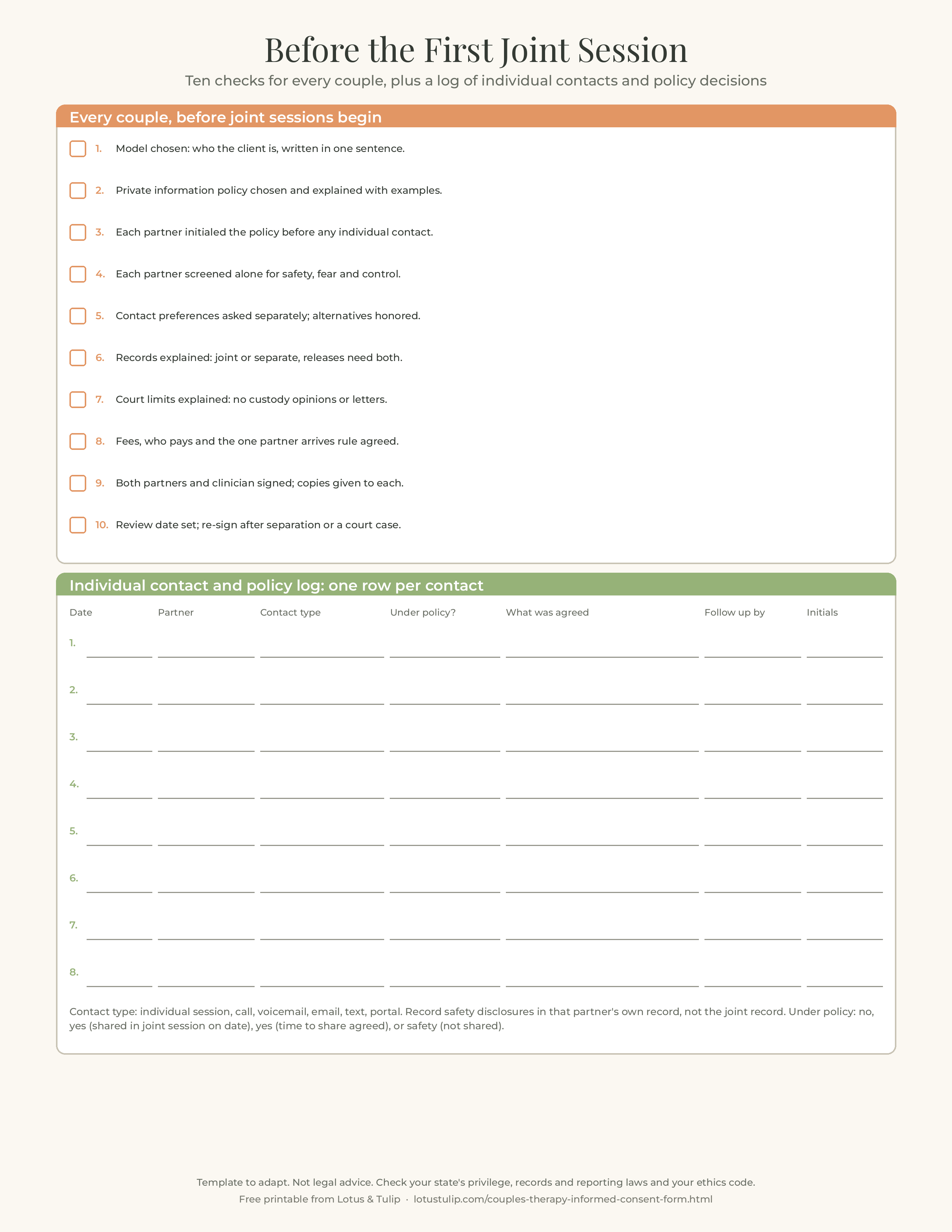
- Log individual contacts and policy decisions: date, partner, type of contact, whether anything fell under the secrets policy and what was agreed.
- Review the agreement when anything changes: separation, a court case, a new safety concern, a move to telehealth, or a change in who pays. Both partners initial the change.
Couples therapy informed consent example (fictional, full)
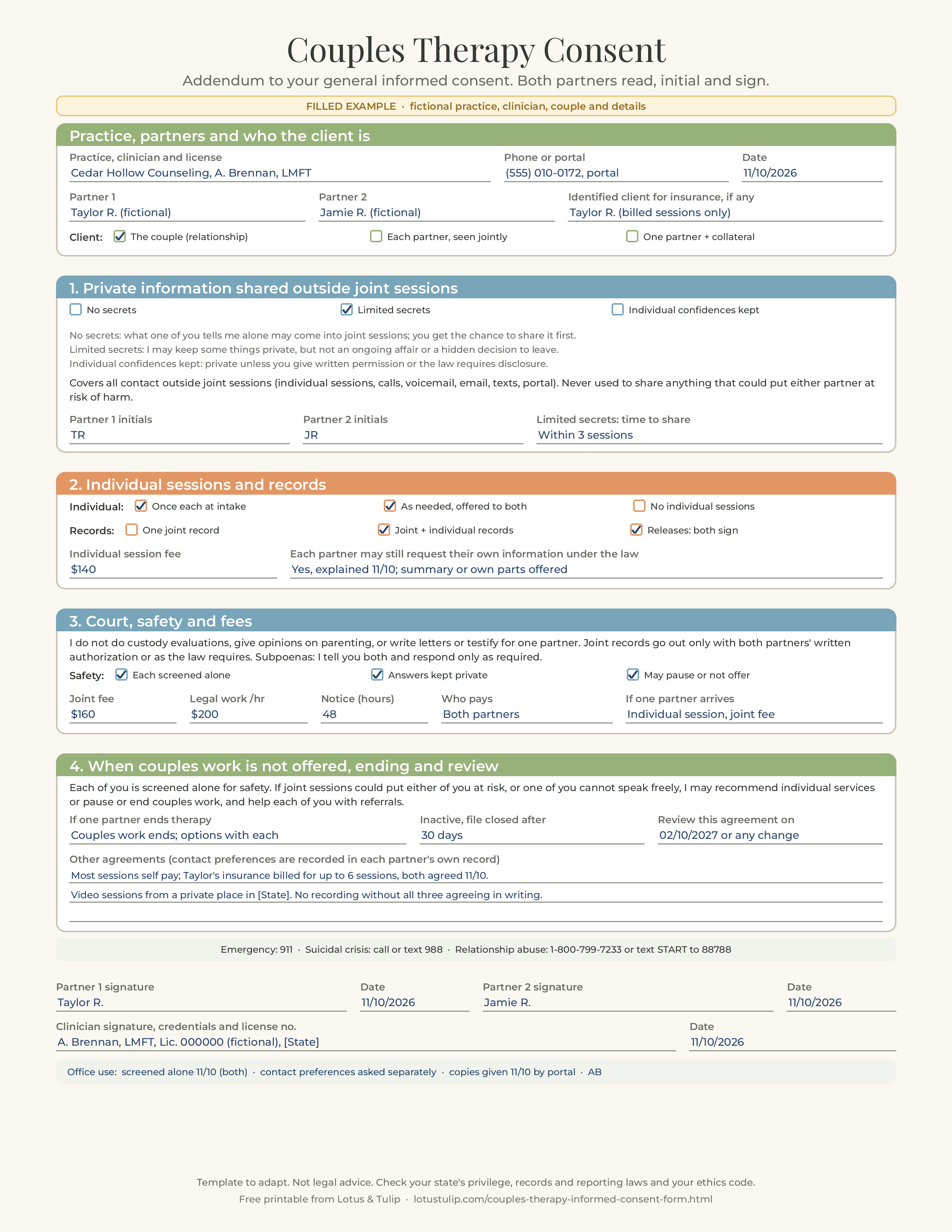
This is a complete sample of the couples addendum for a fictional solo practice, written to sit on top of the practice's general informed consent. It uses a limited secrets policy. Adapt every bracketed choice and every sentence to your license, your state and your way of working.
Cedar Hollow Counseling · A. Brennan, LMFT, License no. 000000 (fictional), [State] · (555) 010-0172 · secure client portal
Couples Therapy Agreement (addendum to the Cedar Hollow Counseling Informed Consent for Therapy)
Partners: Taylor R. and Jamie R. (fictional). Each of you has told me separately how you would like to be contacted.
1. Who my client is. In our work together, my client is your relationship. You are both my clients and I do not take sides. For insurance purposes, Taylor is the identified client for the sessions we bill; Taylor's diagnosis will appear on those claims. Relationship work on its own is often not covered, and we have agreed that most sessions will be self pay.
2. What we will do. We meet together for 50 minute sessions, weekly at first, then every two weeks, focusing on communication, repair after conflict and the patterns that keep you stuck. Therapy can help, and it can also bring up painful feelings. Some couples stay together and some separate; decisions about your relationship are yours.
3. Our agreement about private information (limited secrets). You may each share things with me privately. I will use judgment about what, if anything, needs to come into our joint work. I will not keep a secret that I believe makes our couples work dishonest or unworkable, such as an ongoing affair or a decision to end the relationship that your partner does not know about. If that happens, I will ask you to share it within a time we agree, usually within three sessions, and I will help you do it. If you choose not to, I may end or change our couples work without telling your partner why. I will never share anything that I believe could put either of you at risk of harm. This agreement covers every contact outside our joint sessions: individual sessions, phone calls, voicemails, emails, texts and portal messages. Initials: Taylor ____ Jamie ____
4. Individual sessions. I meet with each of you once on your own during the first three sessions, and I may suggest more individual sessions later. If I meet with one of you, I will offer the other a similar session. Individual sessions are part of our couples work and follow the agreement in section 3. I will not become the individual therapist of either of you during or after our couples work; if one of you would like individual therapy, I will help you find someone.
5. Limits of confidentiality. The limits in my general consent apply to both of you, including risk of serious harm, required reports of abuse or neglect, and court orders. Where possible, I will talk with you first.
6. Records. I keep one record of our joint sessions and a separate record for each of you for individual sessions and individual screening. I release copies of the joint record to anyone, including an attorney, only with the written authorization of both of you, unless the law requires otherwise. Each of you keeps your rights under federal and state law to ask for information about you; if one of you asks, I will talk with you about what I can provide, and I may provide a summary or only the parts that relate to you. Process notes I keep separately, if any, are not part of the record.
7. If there is a legal case. I am your couples therapist, not an evaluator. I do not make recommendations about custody, parenting time or which of you is the better parent, and I do not write letters or testify for one of you against the other. If I receive a subpoena or a request from an attorney, I will tell you both, seek advice and respond only as the law requires. Time I spend on legal matters is charged at $200 per hour to the person or attorney who requests it.
8. Safety. What each of you told me about safety in your individual meetings stays private. If I believe joint sessions could put either of you at risk, or that one of you cannot speak freely, I may recommend individual services instead, or pause or end our joint sessions, and I will help each of you with referrals. In an emergency call 911. For a suicidal crisis call or text 988. For relationship abuse, the National Domestic Violence Hotline is available at 1-800-799-7233 (or text START to 88788).
9. Fees and cancellations. Joint sessions are $160 and individual sessions within our couples work are $140, due at each session by card on file or portal payment. You are both responsible for payment. Either of you may cancel with at least 48 hours' notice; sessions canceled with less notice or missed are charged at the full fee. If only one of you arrives, we will use the time as an individual session under section 3, charged at the joint session fee.
10. Video sessions and recording. Please join video sessions from a private place in [State]. No one records any session without the written agreement of all three of us.
11. Ending. Either of you may end couples therapy at any time; if one of you stops, our couples work ends or changes and I will talk with each of you about next steps.
Signatures. We have each read this agreement, had the chance to ask questions, and agree to begin couples therapy on these terms.
Taylor R. ____________________ Date 11/10/2026 · Jamie R. ____________________ Date 11/10/2026 · A. Brennan, LMFT ____________________ Date 11/10/2026
Copies given to each partner on 11/10/2026 by portal.
Three short couples consent scenarios
1. An affair disclosed in an individual session (limited secrets). One partner says they are in contact with a former partner and are not sure they want to stop. The therapist reminds them of the agreement they initialed and agrees a plan to bring it into joint work within three sessions, with a rehearsal session first. The note goes in that partner's individual record: the disclosure in brief, the reminder, the timeline and the plan.
2. One partner asks for "the whole file" after separating. The therapist logs the request and the 30 day due date, calls the partner and explains the agreement about joint records. The partner needs proof of attendance for mediation, so the therapist offers a letter confirming that partner's dates of attendance, which they accept. Had they insisted on copies, the therapist would have reviewed the joint notes against the HIPAA denial grounds and sought advice before deciding.
3. Fear disclosed in screening. In an individual screening call, one partner says they are frightened of the other's temper and that the other has grabbed them twice in the last month. The therapist thanks them, assesses immediate safety, shares the hotline and 988 privately, and talks with them about a safety plan. The therapist decides joint sessions are not appropriate now and tells each partner separately that individual work is the recommended next step, without mentioning the disclosure. Referrals are offered to both. The note goes in the disclosing partner's individual record only.
Common couples consent mistakes
- Using the individual consent form and adding a second signature line, with no secrets policy at all.
- Explaining the secrets policy after the first individual phone call or session, when the AAMFT rule needed prior written permission.
- A no secrets policy with no safety exception.
- Not saying who the client is, then billing insurance under one partner's diagnosis without telling either of them.
- Promising that neither partner can see the records without the other's consent, which federal law may not allow.
- Putting one partner's private disclosure of abuse into a joint record the other partner can request.
- Asking about violence or control with both partners in the room.
- Writing a letter for one partner's divorce attorney, or offering a view on custody.
- No plan for the day only one partner arrives, or one partner cancels without telling the other.
- Never revisiting the agreement after separation, a new safety concern or a court case begins.
Free printable: couples therapy consent form, filled example and log
The free printable has three US Letter pages. Page 1 is a blank couples therapy consent and agreement, designed as an addendum to your general consent: both partners and how each prefers to be contacted, who the client is, the secrets policy choice (no secrets, limited secrets or individual confidences kept) with each partner's initials and the safety exception printed in, individual sessions, records access and releases, court involvement limits, safety screening and when couples work is not offered, fees and cancellations, and signature lines for both partners and the clinician. Page 2 is the same page filled for the fictional Cedar Hollow Counseling example. Page 3 is a ten point before the first joint session checklist and an eight row log of individual contacts and policy decisions.
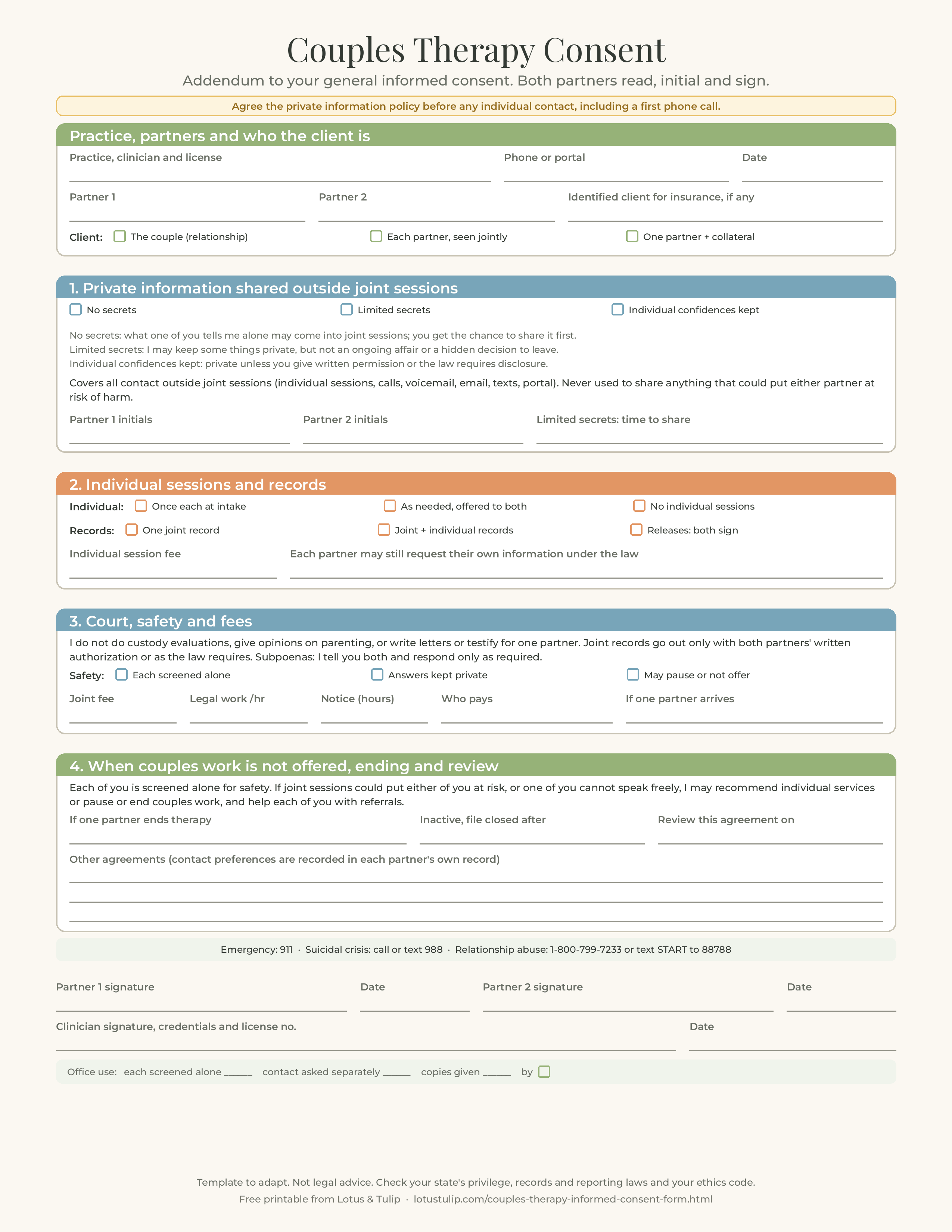
Download the free couples therapy consent form (PDF, 3 pages)
Rather type than handwrite? The free PDF above is for printing. Therapy Progress Notes and Intake Templates comes as a fillable PDF you type straight into (604 fields in Adobe Acrobat Reader), plus the printable version: SOAP, DAP and BIRP notes, intake, treatment plan and safety plan, 20 pages. Now with a bonus couples file (consent, intake for each partner, session note): try the fillable couples consent free first (PDF). Holiday 20% off: about $7.36, was $9 (EUR 8) · instant digital download
Buy on EtsyPrefer single images? Page 1: blank couples consent form (PNG) · Page 2: filled fictional example (PNG) · Page 3: checklist and individual contact log (PNG)
Free to print and use in your own practice. Please link to this page rather than re-uploading the file. The form helps you plan and document informed consent for couples therapy; it is not legal advice. Check your state's laws on privilege, mental health records, mandated reporting and duty to warn, and your licensing board's rules.
Related resources
- Family therapy informed consent form: who the client is, secrets policy, minors and custody, records and court, with a free printable
- Duty to warn for therapists: Tarasoff, state laws, HIPAA and a free documentation worksheet
- Closing a therapy private practice: checklist, timeline, client letters, records plan and free printable
- HIPAA risk assessment for therapists: security risk analysis, filled example and free worksheet
- Business associate agreement for therapists: which vendors need a BAA, breach duties, filled vendor log and free printable
- Professional will for therapists, with a clinical executor template and free printable
- Informed consent for therapy template, with a sample consent and free printable
- Release of information form for therapists, with a filled example
- Treatment summary template for therapists and the HIPAA right of access
- Parental consent form for therapy of a minor, custody orders and HIPAA
- Notice of privacy practices for therapists
- Therapy cancellation policy template
- Communication exercises for couples, with a free printable
- Instagram post ideas for couples therapists
- Couples therapy worksheets
Sources: 45 CFR 164.501 (designated record set, psychotherapy notes), 164.502(g)(2) (personal representatives of adults), 164.508 (authorizations), 164.522(b) (confidential communications), 164.524(a)(1), (a)(3), (a)(4) and (b)(2) (right of access, reviewable denial grounds, review, timing), eCFR text up to date as of November 5, 2026; AAMFT Code of Ethics (revised, effective January 1, 2026), standards 1.2, 1.7, 1.9, 1.10, 1.11, 2.1, 2.2, 2.3, 3.4, 6.3, 6.6, 7.5, 7.6 and 8.2; ACA Code of Ethics (2014), standards A.8, B.2.d, B.4.b and B.6.e; APA Ethical Principles of Psychologists and Code of Conduct (2002, amended 2010 and 2016), standards 3.10(d), 4.02, 4.03, 6.04(a), 10.01(a), 10.02 and 10.10; NASW Code of Ethics, standards 1.06(d), 1.07(e), (f), (g) and (j) and 1.08(c); National Domestic Violence Hotline contact details from thehotline.org. Rules and codes change; check the current versions.
FAQ
What is a no secrets policy in couples therapy?
A no secrets policy is a written agreement, signed by both partners at the start of couples therapy, that information either partner shares with the therapist alone may be brought into joint sessions if the therapist judges it relevant to the couple's work, usually after giving that partner the chance to share it first. It should always exclude information that could put either partner at risk of harm.
Can a couples therapist keep one partner's secret?
Yes, if that is the agreement. Under the AAMFT code, a marriage and family therapist must not reveal one partner's confidences to the other without that partner's prior written permission (standard 2.2), so the default is that individual confidences are kept. A no secrets or limited secrets policy changes that only if each partner agreed to it in writing in advance.
Can one partner get a copy of the couples therapy records?
Under HIPAA, each partner has a right of access to information about them in the designated record set (45 CFR 164.524), with narrow grounds for denial, such as information about another person that is reasonably likely to cause that person substantial harm. Ethics codes add limits: the AAMFT code asks for written authorization from each partner before giving access to couple records (2.3), and the ACA code limits each client to the parts that relate directly to them (B.6.e). Explain this in the consent form and get legal advice when a request arrives.
Will a couples therapist testify in a divorce or custody case?
A couples therapist should not act as an expert witness or custody evaluator for current or former therapy clients unless a court or the law requires it (AAMFT 7.5 and 7.6). A good consent form says the therapist will not write letters or testify for one partner against the other, explains how subpoenas are handled, and sets a fee for any legal work.
Is this couples therapy consent form free?
Yes. The three page printable (a blank couples therapy consent and agreement, a filled fictional example, and a checklist with an individual contact and policy log) is free to print and use in your own practice. Please link to this page rather than re-uploading it.