
Therapist marketing · Updated 2026-11-09
Instagram Post Ideas for Doulas (with Free Printable)
Ready-made template kit: Doula Instagram Templates Holiday 20% off: about $22.08, was $28 (EUR 24) · instant digital download
Buy on Etsy
Instagram posts for doulas carry more weight than most small business content. The person who finds your profile is often pregnant for the first time, or pregnant again after a hard birth, or a partner trying to work out how to help. They are scrolling at 2 a.m. with a due date in mind and a dozen questions: What does a doula actually do? Is it the same as a midwife? Will the hospital let you in? What does it cost, and does insurance or Medicaid pay? Who covers you if you are at another birth? At the same time, the algorithm rewards the posts that create problems: dramatic birth photos shared without real consent, "my clients don't need epidurals" reels, testimonials that promise a shorter labor, and "trust your body" captions that quietly drift into medical advice. Your clients, the hospitals you walk into, the certifying bodies you belong to and the FTC reward the opposite: a clear, non-clinical description of your role, no promises about birth outcomes, consent for every photo, real prices, an honest on-call policy, a visible list of urgent warning signs and a calm, steady feed.
This guide is written for US doulas and the small businesses around them: birth doulas, postpartum doulas, full spectrum and community-based doulas, doula collectives and agencies, doulas who are enrolled as Medicaid providers, nurses, childbirth educators and lactation professionals who also work as doulas, and the virtual assistants and social media managers who post for them. It covers what to post on Instagram as a doula: why doula marketing is different from parenting influencer content, the fact that doula certification is generally voluntary and what that means for your credibility, DONA International, CAPPA and other certifying bodies and how to show them honestly, the line between support and medical care, the words that cross it, Medicaid doula coverage and how to post about it accurately, the FTC's rules on testimonials, reviews and outcome claims, privacy and consent for birth photos, safety posts built around urgent maternal warning signs, 911, 988, the National Maternal Mental Health Hotline and the Postpartum Support International HelpLine, packages, on-call and backup policies, sourced education you can stand behind, ten content pillars, 36 post ideas with original caption angles, six fuller captions, DM scripts that keep your scope clear, a two or three posts a week rhythm and a 12 week overview, awareness dates that suit a doula feed, a nine step HowTo, mistakes, myths, three fictional examples, comparison tables, when not to post, research notes and a free three page US Letter printable: Doula Posting Steps, a Doula Content Planner and a Doula Post Care Check with pocket cards.
If your work overlaps with other practitioners, neighboring pages may help: what therapists can post on social media covers the licensed side of perinatal mental health, Instagram post ideas for dietitians suits prenatal nutrition colleagues, and Instagram post ideas for life coaches covers another unlicensed field with similar credential questions. This page stays with the questions doulas tend to face: how to look credible when anyone can use the title, how to talk about birth without giving medical advice, how to share the work without sharing a client's body or story, and how to keep a feed that families, nurses and midwives all trust.
What this guide is and is not
This is a practical content guide for doulas who market to families in the United States. It is not legal advice, it is not medical advice and it does not replace the standards of practice of your certifying body, your state's Medicaid doula rules if you are enrolled, the policies of the hospitals and birth centers you work in, the FTC Act or the advice of a lawyer who knows your business. Doula work sits in an unusual place: there is generally no license to check, but the families you serve are making health decisions, and everything you post is read in that light. Treat every example below as a starting point you check against your own situation.
Every factual statement here was checked against a primary or official source: DONA International's standards of practice, position paper and certification pages, CAPPA's certification pages, the National Health Law Program and the National Academy for State Health Policy on Medicaid doula coverage, the CDC's Hear Her campaign, the Health Resources and Services Administration (HRSA) National Maternal Mental Health Hotline, Postpartum Support International, the National Institute of Mental Health (NIMH), ACOG's Committee Opinion on postpartum care, NICHD's Safe to Sleep campaign, HHS guidance on HIPAA covered entities, the FTC's Endorsement Guides and consumer review rule, the 988 Suicide and Crisis Lifeline and Instagram's Community Guidelines. Where a source was only seen through search results rather than opened in full, or was checked for our previous articles, the research notes at the end say so. We used no doula industry survey figures and we do not quote any outcome percentages.
The post ideas, captions and fictional doulas are original to this page. They are examples of tone and structure, not scripts to copy word for word. Your families, your community and your voice should change them.
Why posting as a doula is different from parenting influencer content
A parenting creator can post a birth vlog and a hot take. A doula posting the same way runs into problems other creators rarely face, for five reasons.
First, anyone can call themselves a doula. Doula certification through a private body such as DONA International or CAPPA is a professional choice, not a state license, and in most places no credential is needed to practice. Some states now run their own doula certification or registry, mostly tied to Medicaid billing (more below). That openness lets doulas come from many backgrounds, and it is also why careful families look harder at your feed. Your training, your honesty about scope and the consistency of what you post are the credibility signals people have.
Second, your work sits right next to medical care. You are in the room with nurses, midwives and physicians, and families ask you medical questions all the time. DONA International's birth doula position paper says doulas do not perform clinical tasks such as vaginal exams or fetal heart rate or blood pressure monitoring, do not diagnose medical conditions, offer second opinions or give medical advice, and do not make decisions for their clients. A caption that tells followers whether to accept an induction, how to read a blood pressure number or which herbs "bring on labor" is the online version of stepping outside that line.
Third, birth outcomes are not yours to promise. There is real research on continuous labor support (more below), and it is tempting to turn it into "hire a doula and avoid a cesarean." But a review of trials describes averages across many people. It does not tell one family what will happen at their birth, and the FTC treats a testimonial about results as a claim about what clients generally achieve.
Fourth, your content involves bodies, babies and other people. Birth photos show a client at the most exposed moment of their life, often alongside a partner, a newborn and hospital staff who never agreed to be on your feed. Postpartum posts touch on bleeding, feeding, sleep and mood. Every one of those posts needs consent and care that a lifestyle account never thinks about.
Fifth, some of your followers are in danger and do not know it. The CDC's Hear Her campaign points out that some pregnancy related problems can happen up to a year after delivery. A follower who messages "is this headache normal?" at midnight, or who writes that they feel hopeless a few weeks after birth, needs a fast route to medical care or a crisis line, not a supportive emoji. A doula feed that keeps the warning signs and the right numbers visible is not only kind; it is part of the job.
Doula credentials and how to show them honestly
Because there is generally no license, credentials do a lot of work on a doula's profile, and they are easy to overstate. Here is the landscape, and how to present it accurately.
Certification is generally voluntary, so say what you actually have
Private certifying bodies set their own standards, and many skilled doulas are trained but not certified, or certified by a body a family has never heard of. Arizona, for example, offers a voluntary state doula certification: it is not required to practice, but it matters for Medicaid reimbursement there. "Certified doula" can mean a full certification packet with attended births and evaluations, a weekend workshop certificate or nothing at all. On Instagram, the honest move is specific: name the organization, the credential and its letters, and do not let a training certificate read like a license.
DONA International: CD(DONA) and postpartum certification
DONA International's birth doula certification page lists, as of this writing:
- Required education: a DONA approved birth doula workshop (16 to 24 hours), a childbirth education course (8 hours) and a lactation support education course (3 hours), which some trainers include in the workshop, plus required reading (The Birth Partner by Penny Simkin, three more books from the reading list and two DONA position papers).
- Practical experience: continuous in-person labor support for three births, each with a different client, with at least 15 total hours of labor support (one may be a cesarean birth), parent evaluations and self-reflection for all three births, a community resource and referral list, and signed scope of practice and code of ethics agreements.
- Submission: the certification packet within three years of completing the workshop, with DONA International membership required for packet submission.
Certified birth doulas use the letters CD(DONA). DONA also certifies postpartum doulas and describes a community-centered doula role that continues up to one year after birth. Being a DONA member, or having attended a DONA approved workshop, is not the same as being certified. "Trained through a DONA approved workshop, working toward certification" is accurate. "DONA certified" is not, until the certificate is issued. Check DONA's recertification rules too, so the credential in your bio is current.
CAPPA: CLD and CPD
CAPPA lists five core certifications, including Certified Labor Doula (CLD) and Certified Postpartum Doula (CPD), along with childbirth educator, lactation educator and infant and family educator credentials. Its labor doula pathway, as described on CAPPA's pages, includes CAPPA membership, a CAPPA labor doula training, a scope of practice pretest that requires a 100 percent passing grade, attendance at a minimum of three labors or births as a doula with parent and provider evaluations, a local resource list, signed policies (including a code of conduct and a social media policy) and a multiple choice exam plus an essay exam. The postpartum doula pathway adds proof of current infant and child CPR and support for three families with evaluations and letters of recommendation. CAPPA lists recertification every three years. Exact steps and time limits differ between CAPPA's pathways, so link to your certifier's page rather than paraphrasing requirements from memory.
Other certifying bodies and state programs
Other organizations train and certify doulas too, among them the International Childbirth Education Association (ICEA), ProDoula, Childbirth International, Birth Arts International and several community-based programs. All of them are legitimate to mention, as long as you name the issuer and do not imply a government license.
A growing number of states run their own doula certification or registry, mostly to decide who can bill Medicaid. Connecticut, for instance, began enrolling certified doulas in its Medicaid program for dates of service from January 1, 2025, and Arkansas requires doulas to be certified by its Department of Health before they enroll as Medicaid providers. The rules, names and training requirements vary by state and change often. If you hold a state certification or registry listing, say which state issued it. If you do not, avoid "state certified" altogether.
How to show credentials on your profile
- Name, role and real credential. "[Name], CD(DONA), birth and postpartum doula" or "[Name], birth doula, trained with [Organization]" is clear and checkable.
- Name the issuer. Letters without an issuer read like marketing. "Certified by [Organization]" lets a careful family look you up.
- Link a way to check. If your certifier has a public directory and you are listed, link it. A pinned "How to check your doula" post earns more trust than any testimonial.
- Keep other roles separate and disclosed. DONA's standards say that if a doula has qualifications in complementary modalities (such as massage, aromatherapy, childbirth education or placenta encapsulation) or in a medical field (such as nursing), they must make it clear those are additional services. A nurse who works as a doula is acting as a doula at a birth, not as the client's nurse.
- No borrowed authority. No clinical aesthetic, no scrubs, no "as seen in" logos and no hospital names that suggest an affiliation you do not have.
Support, not medical care: where the line sits, and how to post about it
This is the single most important boundary on a doula feed, and the one most often blurred by "birth worker" content online.
What a doula does
DONA International's 2025 birth doula standards of practice describe the role as emotional, physical and informational support, advocacy and partner support during pregnancy, labor, delivery and, whenever possible, immediately postpartum. That support is non-medical and shall not be construed as medical advice, and the client retains all autonomy in decision making. Postpartum doulas, in DONA's description, offer emotional, physical and educational support, and practical help with newborn care, household tasks and meal preparation. That is a lot of value, and none of it requires a clinical claim.
What a doula does not do
DONA's standards say its doulas do not perform clinical or medical tasks and will not diagnose or treat in any modality. Its earlier limits to practice give examples: taking blood pressure or temperature, fetal heart tone checks, vaginal examinations and postpartum clinical care for birth doulas, and examining the parent or baby, taking temperatures or blood pressure checks for postpartum doulas. DONA's standards also say advocacy does not include the doula speaking instead of the client or making decisions for the client. On Instagram, the safe line is simple: you can explain what your support looks like and help families prepare questions for their provider; you cannot tell followers what medical choice to make, interpret symptoms or test results, or suggest treatments.
Advocacy without overreach
Many doulas describe themselves as advocates, and DONA's 2025 standards include speaking up when it is safe and in the client's best interests. The way you describe that online matters. "I help you prepare questions, I make sure you have time to ask them, and I support the decisions you make" describes advocacy within scope. "I'll fight the hospital for you" or "I won't let them push you into a C-section" promises conflict and implies medical judgment you do not hold, and it can make staff wary of you before you walk in.
Words to watch in captions
| Usually a doula support description | Often reads as medical advice or a clinical claim |
|---|---|
| Comfort measures, positions to ask your team about, breathing, reassurance | "Avoid an epidural," "you don't need pain medication" |
| Preparing questions for your provider about induction | "Say no to induction," "inductions cause cesareans" |
| Birth preferences you discuss with your care team | "Refuse monitoring," "decline the IV, you don't need it" |
| Help finding an IBCLC, feeding support, a calm setup at home | "Fix low supply," diagnosing tongue tie, dosing herbs |
| Rest, meals, newborn care help, emotional support after birth | "Heal your postpartum depression," "balance your hormones" |
| Warning signs to call your provider or 911 about | "That's normal, wait and see," reading blood pressure numbers |
| Supporting your decisions | "Trust birth, your body knows," offered as a reason to skip care |
This table is a starting point, not a legal opinion. Context matters: a family reads your profile, your services page and your consult together. If a caption only works because of a clinical word or a medical instruction, rewrite it.
Additional services need their own label
Placenta encapsulation, massage, childbirth classes, lactation counseling and belly binding are popular add-ons. DONA's standards ask that such modalities be clearly presented as additional services, outside the doula's scope of practice. On Instagram, put them in a separate post or highlight, state the training or credential behind each one, and do not attach health claims to them. If you also hold a license, such as nursing or massage therapy, follow that board's advertising rules for that service.
Medicaid doula coverage: how to post about it accurately
Medicaid coverage for doula care is one of the biggest changes in the field, and one of the most misreported on Instagram. Families want to know whether they can get a doula at no cost, and a clear, accurate post helps them more than any other.
The current picture
- More than half of states. The National Health Law Program, which tracks Medicaid doula coverage, says 28 states, Guam and Washington, DC have implemented Medicaid coverage for doula care. The National Academy for State Health Policy (NASHP) counted 26 states and DC as of March 2026, an increase of 14 states since its April 2024 analysis. Counts differ by date and by how "implemented" is defined, so use a dated source on any slide.
- Coverage varies. NASHP reports that all states with a Medicaid doula benefit cover the prenatal, labor and delivery and postpartum periods, that at least 17 states cover doula services through 12 months postpartum, and that scope, number of visits and reimbursement rates vary significantly between states.
- Enrollment rules differ. Each state sets its own requirements for doulas who want to bill Medicaid, such as approved training, a state certification or registry listing, and enrollment with the state or its managed care plans. Some states are still building their programs.
What to say, and what not to say
- Say whether you are enrolled. "I'm an enrolled Medicaid doula in [State] and accept [plans]" is useful and checkable. If you are not enrolled, say "I don't bill Medicaid yet; here's how to find doulas who do in [State]."
- Do not promise "free" care. Eligibility, covered visits and plan participation vary. "If you have [State] Medicaid, doula care may be covered. Check with your plan" is honest.
- Date your post. Coverage changes year to year. A post that says "as of [month, year]" ages well; one that says "every state covers doulas now" does not.
- Link the state source. Your state Medicaid agency or health department page is a better link than a third party list.
Outcome claims, testimonials and reviews: what the FTC expects
The most common way a doula feed drifts into trouble is not a photo. It is a sentence about what doula support will do for a birth.
The research is real, and it is not a promise
A 2017 Cochrane review by Bohren and colleagues pooled trials of continuous one-to-one support during labor, with usable data from 26 trials and 15,858 women, and reported that continuous support was associated with several better outcomes on average. It is fair to tell followers that research on continuous labor support exists and to link the review. It is not fair to turn an average across thousands of people into a promise to one family. "Doulas mean no C-section" and "my clients have shorter labors" are claims about a specific result that no doula controls, and they can leave a client who needed a cesarean feeling they failed.
Testimonials are typicality claims
The FTC's Endorsement Guides (16 CFR 255.2) say an ad featuring a consumer's experience on a key attribute will likely be read as representing what consumers will generally achieve, and that testimonials about how well something works are claims the advertiser needs to substantiate. "She had a two hour labor with me by her side!" reads as "this is what my support does." If that is not what most clients experience, the post misleads even if the story is true. The FTC's Health Products Compliance Guidance adds that testimonials showing results more dramatic than people can generally expect are likely deceptive, and that "results not typical" style disclaimers do not cure the problem.
Reviews: invite everyone, reward no one for sentiment
The FTC's Rule on the Use of Consumer Reviews and Testimonials (16 CFR Part 465, 2024) makes several practices violations outright:
- Writing, creating or selling fake reviews or testimonials, including ones that misrepresent the reviewer's experience (465.2).
- Giving compensation or incentives in exchange for, or conditioned on, reviews expressing a particular sentiment (465.4). "A free postpartum visit for a five star review" is exactly this.
- Reviews by officers or managers of a business without a clear disclosure of their relationship, and soliciting undisclosed reviews from employees or relatives in certain situations (465.5). A doula collective asking its own members to review each other falls in this territory.
- Using unfounded legal threats, intimidation or knowingly false public accusations to suppress reviews (465.7).
- Buying or selling fake followers, likes or views to misrepresent influence for a commercial purpose (465.8).
The Endorsement Guides add that inviting only happy clients to post reviews can be deceptive, while inviting every client is fine. The simple habit: send every family the same short "I'd value an honest review" message a few weeks after your last visit, or none.
Affiliate links, partner products and referral fees
Doulas recommend birth balls, nursing pillows, carriers, classes and other professionals. Under 16 CFR 255.5, a material connection such as payment, free products, commissions or a referral fee must be disclosed clearly and conspicuously when your audience would not expect it. Part 465 describes clear and conspicuous on social media as unavoidable: not hidden behind "more," not only in your bio. "Affiliate link: I earn a commission" in the first line works. If you receive anything for referring a family to a photographer, a class or another provider, tell the family too.
Product posts are health claims too
When a doula recommends a product "for an easier labor" or "to boost supply," that is a health claim about the product. Under 255.3, an endorsement presented as expert advice must reflect a real exercise of that expertise, and health claims need competent and reliable evidence. "I bring a peanut ball to births because many clients find it comfortable" describes your practice. "This tea will start labor" is a claim you cannot support.
Privacy, consent and birth photos
Doulas see families at their most private. Clients assume discretion even when no law requires it, and birth content is where that trust is most easily broken.
HIPAA usually does not apply, until you bill electronically
HHS explains that a health care provider is a HIPAA covered entity only if it transmits health information electronically in connection with a transaction for which HHS has adopted a standard, such as electronic claims. A doula paid privately by families is usually not a covered entity. A doula who submits electronic Medicaid or insurance claims may well be one, and then the HIPAA Privacy and Security Rules apply to the health information they handle. If you enroll with Medicaid, ask your state program and a qualified advisor what that means for your records, texts and photos. Either way, state privacy and consumer protection laws may apply, and certifying bodies expect confidentiality. Do not claim to be "HIPAA compliant" unless you have actually done the work, and do not claim HIPAA protects a family's information if it does not apply to you.
Birth photos need real, specific consent
- Written consent for each use. A signed release for "photos on Instagram" at the consult is not the same as consent for one specific image, posted on a specific date, with a specific caption. Show the client the exact post before it goes live, and accept "no" at any point, including after the birth.
- Everyone in the frame. Partners, older children, other family members, nurses, midwives and physicians are in many birth photos. Their consent matters too, and many facilities set their own rules about photography and video during birth. Ask the facility before you plan to shoot.
- The baby has no say. Close-ups of a newborn's face, name, birth weight, time of birth and hospital wristband together tell strangers a lot. Many careful doulas never post identifiable newborns at all.
- Platform rules are not consent. Instagram's Community Guidelines allow some nudity in the context of breastfeeding, birth giving and after-birth moments. That means a post may be allowed on the platform. It does not mean your client agreed to it.
- Loss and hard births. Never post about a loss, an emergency or a NICU stay connected to a client, even anonymously, unless the family asks you to and approves every word.
Practical rules for a doula feed
- No "birth announcement" posts for clients unless the family wrote or approved them.
- No "on call, a client is in labor!" stories that reveal timing or location. Someone who knows the family can work out who it is.
- No screenshots of client texts, even blurred, without written permission for that exact use.
- No tagging clients, and no confirming in comments that someone is a client.
- Reply to every review, good or bad, in the same neutral style: "Thank you for taking the time to share this. I'd welcome a conversation by email."
Safety posts: warning signs, 911, 988 and maternal mental health lines
A doula account will, sooner or later, receive a message from someone who needs medical care or crisis support right now. Plan for that day, and put the information where anyone can find it.
Urgent maternal warning signs
The CDC's Hear Her campaign lists urgent maternal warning signs during pregnancy and in the year after delivery, including a headache that won't go away or gets worse over time, dizziness or fainting, changes in vision, a fever of 100.4°F or higher, extreme swelling of the hands or face, thoughts about harming yourself or your baby, trouble breathing, chest pain or a fast-beating heart, severe nausea and throwing up, severe belly pain that doesn't go away, the baby's movement stopping or slowing during pregnancy, vaginal bleeding or fluid leaking during pregnancy, heavy bleeding or bad-smelling discharge after pregnancy, severe swelling, redness or pain of a leg or arm, and overwhelming tiredness. The CDC says to seek medical care immediately for any of these, and to tell the provider about a pregnancy within the last year. A pinned carousel built from that list, with the CDC named as the source and "call your provider, or 911 in an emergency," is one of the most valuable posts a doula can make.
911, 988 and the maternal mental health lines
- Immediate danger or a medical emergency: call 911.
- 988 Suicide and Crisis Lifeline: call or text 988, or chat at 988lifeline.org, free, confidential and available 24/7. Spanish speakers can call 988 and press 2 or text AYUDA to 988.
- National Maternal Mental Health Hotline (HRSA): call or text 1-833-TLC-MAMA (1-833-852-6262), free, confidential and available 24/7 in English and Spanish, with interpreters for many other languages. HRSA's FAQ says it is not a crisis line, and that people in suicidal crisis should call or text 988 and people in imminent danger should call 911.
- Postpartum Support International (PSI) HelpLine: call 1-800-944-4773 (press 1 for Spanish or 2 for English), text "Help" to 800-944-4773 in English, or text 971-203-7773 in Spanish. PSI says the HelpLine is not a crisis hotline and does not handle emergencies; volunteers return messages with information, support and local resources.
Be precise about which line is which. A post that calls the PSI HelpLine a crisis line, or says the maternal mental health hotline replaces 911, sends someone to the wrong place at the worst moment.
Baby blues or more
NIMH describes the baby blues as mild mood changes and feelings of worry, unhappiness and exhaustion that many people have in the first two weeks after giving birth, and that usually resolve on their own. Perinatal depression is more serious, lasts longer and needs care. That gives you an honest, sourced post: what the baby blues usually look like, why "it's been more than two weeks" or "it's getting worse" is a reason to call the provider, and the numbers above. You are not screening anyone; you are pointing the way.
"This account is not monitored for emergencies"
Every doula account should have one pinned line: "I'm a doula, not a medical provider, and this account isn't monitored for emergencies. For warning signs, call your provider or 911. In crisis, call or text 988. For maternal mental health support, call or text 1-833-TLC-MAMA." Your clients will have your phone number and your on-call plan; your followers need the public version.
Packages, on-call, backup doulas, gift cards and cancellations
Money and logistics posts are among the most saved on any doula feed, because families are budgeting for a baby and hate guessing.
- Post real prices, or a real range. Birth package price and what it includes (prenatal visits, on-call period, labor support, postpartum visits), postpartum hourly rate or package minimums, and whether the consult is free. "DM me for pricing" makes careful families leave.
- Explain on-call plainly. When your on-call period starts and ends, how to reach you, how quickly you will come, and what happens if two clients go into labor at once. A clear backup doula policy, with the backup's name and credentials if they agree, builds more trust than "I've never missed a birth."
- Medicaid and insurance. If you are an enrolled Medicaid doula, say which plans. If families sometimes get reimbursed by private insurance or use health savings accounts, say "check with your plan" rather than promising coverage.
- Refunds and changes of plan. Say what happens if the birth is very fast, if a planned cesarean changes your role, if the family moves or if there is a loss. Write the kind version into your agreement and say it publicly.
- No fake scarcity. "I take three births a month and have one spot for April" is fine if it is true and still true when people read it.
- Gift cards and registry options. Doula support is a popular registry gift. Under the federal gift card rule (12 CFR 1005.20, part of Regulation E), funds on gift certificates and store gift cards generally cannot expire sooner than five years after issue or last load, and some states give more time. A gift card with no expiry date at all is the simplest policy.
Public education you can source and stand behind
Education posts are the backbone of a trustworthy doula feed. Each of these topics has a source you can name on the slide, and each ends with "General information, not medical advice. Talk to your provider about your own care."
What a doula is, in DONA's words
Use DONA International's description of non-medical emotional, physical and informational support, and add one sentence about how you work. It answers the first question most followers have.
The fourth trimester and postpartum care
ACOG's Committee Opinion 736, Optimizing Postpartum Care, recommends that postpartum care be an ongoing process rather than a single visit, with contact with an obstetric care provider within the first three weeks after birth and a comprehensive postpartum visit no later than 12 weeks after birth. "Your postpartum care isn't one appointment at six weeks" is a useful, sourced post that sends families back to their provider.
Urgent warning signs
The CDC Hear Her list above, word for word where possible, with the CDC named and the one year window stated.
Safe sleep basics
NICHD's Safe to Sleep campaign says to place babies on their back for every sleep, on a firm, flat, level surface covered only by a fitted sheet, and to share a room, but not a bed, for at least the first six months. Keep the post to those basics, name the source and refer detailed questions to the baby's doctor.
Feeding support and who to ask
Feeding questions are where doulas are most often asked for clinical help. A post that explains who an International Board Certified Lactation Consultant (IBCLC) is, when to call the baby's doctor, and how to find local feeding support is more useful, and safer, than any tip.
How to check your doula, and questions to ask at a consult
Training and who certified them, whether the certification is current, what their scope of practice is, their on-call and backup plan, what is included, how they handle photos and privacy, and what happens if plans change. Turn that into a carousel and it helps even families who never hire you.
Doula, midwife, OB, nurse, IBCLC and therapist
Followers mix these roles up constantly, and a clear "who does what" post is one of the most useful things a doula can share. Keep it factual and generous to the other professions, because you work beside them.
| Professional | What they typically do | What to say on your feed |
|---|---|---|
| Birth or postpartum doula | Non-medical emotional, physical and informational support; credential is generally voluntary (DONA, CAPPA, others, or a state program) | "I support you and your family. I don't give medical care or make medical decisions." |
| Midwife | Provides clinical maternity care; types and licensing (such as certified nurse-midwife or certified professional midwife) vary by state | "Your midwife provides your medical care and can answer clinical questions." |
| OB-GYN or family physician | Licensed physician providing prenatal, birth and postpartum medical care, including surgery | "Questions about induction, medication or a cesarean belong with your doctor." |
| Labor and delivery nurse | Licensed nurse providing clinical care and monitoring during labor and birth | "Your nurse monitors you and your baby. I'm there for comfort and continuity." |
| IBCLC | Board certified lactation consultant for feeding assessment and support | "For feeding problems, an IBCLC or your baby's doctor is the right call." |
| Licensed therapist or psychiatrist | Assessment and treatment of perinatal mental health conditions | "If you're struggling after birth, a licensed professional can help. Here's how to find one." |
If you collaborate with any of these colleagues, agree on how each of you describes the others, and disclose any referral arrangement.
Ten content pillars for a doula's Instagram
Pick five or six of these for any month, plus safety. If you cannot say something true and useful under a pillar this month, skip it.
- Who you are and your training. Your name, the families you serve, your real credential and issuer, and why you do this work.
- How you support families. Prenatal visits, labor support, postpartum visits, virtual support, what a typical week looks like.
- Your service area and on-call plan. Where you travel, which birth settings you attend, how on-call and backup work.
- Packages, fees and policies. Prices, what is included, Medicaid enrollment if any, refunds, gift cards.
- Who does what. Doula, midwife, OB, nurse, IBCLC and therapist, explained kindly and often.
- Sourced education. The fourth trimester, warning signs, safe sleep basics, baby blues or more, with the source on the slide.
- Myth vs fact. "Doulas are only for home births," "a doula replaces your partner," "doulas are against epidurals," "doulas give medical advice."
- Safety and privacy. Warning signs, 911, 988, the maternal mental health lines, how you handle photos and confidentiality.
- Preparation and partner support. Hospital bag lists, birth preferences to discuss with the care team, ideas for partners, meal trains.
- Community and gratitude. Colleagues you refer to, local support groups, World Doula Week, holiday hours and thank-you posts.
36 Instagram post ideas for doulas, with caption angles
Each idea has a short caption angle you can rewrite in your own voice. None of them needs a client photo, a testimonial, an outcome promise or a medical instruction.
About you and how you support families
- Welcome and your approach. "I'm [name], a [credential] birth and postpartum doula serving [area]. You make the decisions. I make sure you feel supported while you do."
- Why I became a doula. One honest paragraph about what drew you to this work, without implying you rescue families from their providers.
- My training, plainly. Organization, workshop, births attended for certification, credential and issuer, and what you are still learning.
- What a doula does. Emotional, physical and informational support, in three short slides, with DONA named.
- What I don't do. "I don't do medical checks, give medical advice or make decisions for you. Your provider handles medical care; I handle comfort and continuity."
- Births I attend. Hospital, birth center, home, planned cesarean, VBAC; whichever settings you support, stated plainly.
From consult to birth to postpartum
- From free consult to birth. Consult, agreement, prenatal visits, on-call, labor, postpartum visit, in six steps.
- Questions to ask at a consult. Training, certification, on-call, backup, fees, photos and privacy, what happens if plans change.
- What happens at a prenatal visit. Getting to know each other, preferences, comfort measures to practice, questions for your provider.
- How on-call works. When it starts, how to reach you, when you come, what happens if two clients labor at once.
- Meet my backup doula. With their consent: who they are, their training and how handoffs work.
- Birth preferences, not a script. How to write preferences to discuss with your care team, and why flexibility matters.
- Your first postpartum visit. What you help with: rest, meals, newborn care questions, feeding support referrals, emotional check-in.
Fees, booking and logistics
- Packages and fees. Real prices, what is included, no countdowns.
- Medicaid and payment options. Whether you are an enrolled Medicaid doula, which plans, and "check with your plan" for everything else.
- Service area and travel. A simple map or list of areas, with any travel fee.
- Booking ahead. "I take [number] births a month. If your due date is in [month], here's my availability." True and dated.
- Doula support as a gift. Gift cards with no expiry date, and how registry gifts work.
- Refunds and changes of plan. Fast births, planned cesareans, moves and loss, written kindly.
- Holiday office hours. A plain, pinned story, plus how on-call clients reach you.
Education, sourced
- Doula, midwife or OB? Three short columns, generous to each.
- Who does what on your support team. Doula, provider, nurse, IBCLC, therapist.
- Urgent maternal warning signs. The CDC Hear Her list, the one year window, 911 and your provider.
- Baby blues or more. NIMH: the first two weeks, what to watch for, who to call.
- Postpartum care isn't one visit. ACOG 736: contact within three weeks, comprehensive visit by 12 weeks.
- Safe sleep basics. Back to sleep, firm flat surface, room sharing without bed sharing, from Safe to Sleep.
- Who to ask about feeding. What an IBCLC is, when to call the baby's doctor, local feeding support.
- Packing a hospital bag. A practical list for the birthing person, the partner and the baby, with "check your hospital's list" added.
Partners, safety, community and gratitude
- Partner support ideas. Small, practical things partners can do, and why a doula supports partners rather than replacing them.
- Starting a meal train. How friends can help in the first weeks, and what to ask them for.
- How I handle photos and privacy. Written consent, no posting without approval, never identifiable newborns without permission.
- Not an emergency line. Warning signs to your provider or 911, 988 for crisis, 1-833-TLC-MAMA for maternal mental health support.
- A colleague shout-out. An IBCLC, a perinatal therapist, a support group you genuinely refer to; disclose any referral arrangement.
- World Doula Week. A post between March 22 and 28 about what doulas do and how to find one, rather than a sale.
- Thank you, quietly. A general thank-you to the families you served this year that names no one.
- Ask me anything. A stories question sticker, answered with general information only and a referral to the provider for anything medical.
Six fuller caption examples you can adapt
1. Welcome post.
"Hi, I'm [Name], a [credential, issuer] birth and postpartum doula serving families in [area]. I became a doula because I kept meeting parents who had great medical care and still felt alone in the room. My job is the part around the medical care: comfort, information, reassurance and support for your partner. I don't give medical advice or make decisions for you; your provider and you do that together. Consults are free and there's no obligation. Link in bio."
2. Doula, midwife or OB?
"Three roles, three different jobs. A midwife or OB provides your medical care: checks, monitoring, decisions about induction or surgery, and your baby's safe arrival. A labor nurse monitors you and your baby in the hospital. A doula provides non-medical support: comfort measures, information, encouragement and continuity from pregnancy to the weeks after birth. A doula doesn't replace any of them, or your partner. Many families have all of us on their team."
3. Urgent warning signs, save this.
"Some pregnancy related problems can happen up to a year after birth. The CDC's Hear Her campaign lists urgent warning signs, including a headache that won't go away, changes in vision, a fever of 100.4°F or higher, trouble breathing, chest pain, heavy bleeding and thoughts of harming yourself or your baby. If you notice any of them, get medical care right away and say you've been pregnant in the last year. In an emergency, call 911. Swipe for the full list. General information, not medical advice."
4. Baby blues or more?
"In the first two weeks after birth, many people feel weepy, worried and exhausted. NIMH calls this the baby blues, and it usually passes on its own. If it lasts longer than two weeks, gets worse, or you're struggling to care for yourself or your baby, call your provider. You can also call or text the National Maternal Mental Health Hotline at 1-833-TLC-MAMA, 24/7. If you're in crisis, call or text 988. If you're in danger, call 911. You deserve support, and asking for it is part of caring for your baby."
5. How I handle photos.
"You'll see very few birth photos on this account, and that's on purpose. I only post a photo if the family asks me to, approves the exact image and caption in writing, and everyone in it has agreed. I never post identifiable newborns, birth times or hospital names. Your birth is yours. If you'd like photos of your birth, I'm happy to recommend birth photographers, and I'll always follow your hospital's rules."
6. Fees, plainly.
"Here's exactly what birth doula support with me costs. The birth package is $[amount] and includes [number] prenatal visits, on-call support from [week] weeks, continuous support during labor and birth, and [number] postpartum visits. Postpartum support is $[rate] an hour, with a [number] hour minimum. I'm [an enrolled / not an enrolled] Medicaid doula in [State]. My backup doula is [name, credential]. Refund and change of plan policy: [link]. No countdowns, no pressure."
DM and comment replies that keep your scope kind and clear
Save these as quick replies. Each one stays in scope, protects privacy and routes people to the right place.
- "I have a bad headache and my vision is blurry. Is that normal?" "Please don't wait on me. Those can be urgent warning signs, so call your provider now, or 911 if it's severe or you feel unsafe. Tell them if you're pregnant or gave birth in the last year. I'm a doula, not a medical provider, and this account isn't monitored for emergencies."
- A message that mentions suicide, self-harm or harming the baby. "I'm really glad you told me. Please call or text 988 now, or chat at 988lifeline.org. They're there 24/7. If you or your baby are in immediate danger, call 911. You can also call or text 1-833-TLC-MAMA for maternal mental health support. This account isn't monitored for emergencies, so please reach out to them right away."
- "Should I agree to an induction?" "That's a decision for you and your provider, and it depends on your health and your baby's. What I can do is help you write down your questions so you get clear answers, and support whatever you decide."
- "Can you guarantee I won't need a C-section?" "No one can guarantee that, and I'd be wary of any doula who does. What I can promise is how I'll support you: [your process]. Happy to talk it through on a free consult."
- "My baby isn't latching. What should I do?" "Feeding struggles are so common and so hard. Please reach out to an IBCLC or your baby's doctor; if your baby seems unwell, isn't feeding or has fewer wet diapers, call the doctor today. Here's how to find local feeding support: [link]."
- A past client comments with birth details. Do not reply with details. "Thank you so much for your kind words. I'll send you a message." Then move to private.
- A negative review. "I take every concern seriously and would welcome a conversation by email at [address]." No confirmation they were a client, no birth details.
- "Are you a midwife?" "No, I'm a [credential] doula. I provide non-medical support during pregnancy, birth and postpartum. Your midwife or doctor provides your medical care."
A sustainable rhythm and a 12 week overview
Doulas are on call, and births do not respect posting schedules. Two or three feed posts a week, batched in one quiet hour and scheduled ahead, is enough to keep a profile current. Stories can carry availability, classes and question stickers. If a birth eats your week, nothing is lost.
| Weeks | Focus | Example posts |
|---|---|---|
| 1 to 2 | Foundations | Welcome and approach, what a doula does, pinned safety post with warning signs and hotlines |
| 3 to 4 | How you work | From free consult to birth, how on-call works, meet my backup doula, how I handle photos |
| 5 to 6 | Fees and access | Packages and fees, Medicaid and payment options, service area, booking ahead |
| 7 to 8 | Trust and credentials | How to check your doula, questions to ask at a consult, doula, midwife or OB |
| 9 to 10 | Sourced education | Urgent warning signs, baby blues or more, postpartum care isn't one visit, safe sleep basics |
| 11 to 12 | Family and community | Partner support ideas, meal trains, who to ask about feeding, colleague shout-out, thank-you post |
Repeat the cycle with fresh wording. Your best evergreen posts (what a doula does, warning signs, fees, safety lines) can be reshared every few months, with a note if anything has changed, especially phone numbers and Medicaid details.
Awareness dates for a doula feed
- March 22 to 28: World Doula Week. Observed every year on these dates. Use it for "what doulas do and how to find one," not a sale.
- April 11 to 17: Black Maternal Health Week. A week of awareness and advocacy around Black maternal health. If you post, center the organizers' own resources and voices rather than your services.
- May: Maternal Mental Health Awareness Month, and World Maternal Mental Health Day. World Maternal Mental Health Day falls on the first Wednesday in May (May 5 in 2027). A natural time for your baby blues or more carousel and the hotline numbers.
- August: National Breastfeeding Month (US) and World Breastfeeding Week (August 1 to 7). Good for "who to ask about feeding" and a shout-out to IBCLCs you refer to. Keep it inclusive of every way families feed their babies.
- October 15: Pregnancy and Infant Loss Remembrance Day. Many families light a candle at 7 p.m. local time for the International Wave of Light. A quiet post with support resources fits; a promotion does not.
- November and December. Holiday office hours, on-call plans over the holidays, gift cards for registries and a kind post about the first holidays with a newborn.
- Your own anniversaries. Certification date, practice anniversary, a new class. These are true, personal and never trend-dependent.
How to plan Instagram posts as a doula, step by step
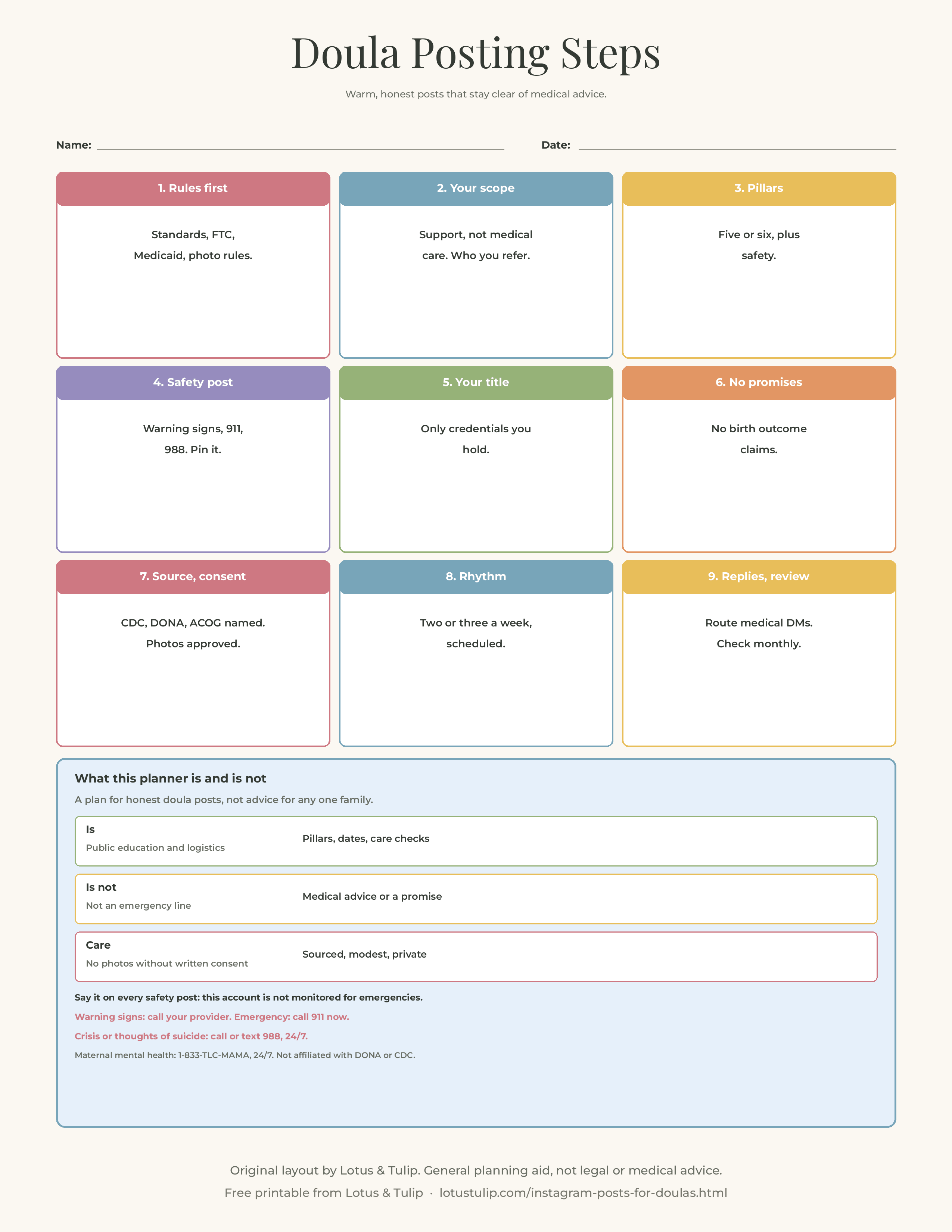
- Read your rules first. Read your certifying body's standards of practice and code of ethics, your state's Medicaid doula rules if you are enrolled, the photography policies of facilities you attend, and the FTC Endorsement Guides and consumer review rule. Note anything about scope, titles, claims, reviews, photos and confidentiality.
- Write your scope in one paragraph. Write down who you serve, what support you give, what you do not do (no clinical tasks, no medical advice, no decisions for clients), your additional services and who you refer to, including providers, IBCLCs, therapists, 911, 988 and the maternal mental health lines.
- Choose five or six pillars, plus safety. Use the ten pillars above as a menu. If you cannot say something true and useful under a pillar this month, skip it.
- Write and pin a safety post. Include the CDC urgent maternal warning signs, "call your provider, or 911 in an emergency," 988, 1-833-TLC-MAMA, the PSI HelpLine as a non-crisis resource, and a line that your account is not monitored for emergencies.
- Audit your title and credentials. Use only credentials you hold, with the issuer named and current; no "certified" without a certificate; no implied hospital affiliation; additional services and any license clearly separated.
- Ban outcome promises and medical advice from the draft stage. If a post needs a guarantee, a client's birth story, a medical instruction or a clinical word to work, rewrite it or delete it.
- Source every fact and get consent for every face. Name the source on the slide (DONA, CDC, ACOG, NIMH, Safe to Sleep), add "General information, not medical advice," and use no client photo or story without written approval of the exact post.
- Set a two or three posts a week rhythm. Batch captions in one quiet hour and schedule ahead, so on-call weeks do not stop the feed. Schedule only what has passed the care check.
- Prepare replies and review monthly. Save DM replies that route medical questions to providers and emergencies to 911 or 988, never confirm who is a client, and keep numbers current. Once a month, update prices, availability and Medicaid details, check disclosures on any affiliate posts, and run every live post through the care check on page 3 of the free printable.
Mistakes and myths
Common mistakes
- Medical advice in captions. Telling followers to decline an induction, skip monitoring or treat symptoms at home.
- "Certified" without a certificate. Workshop attendance or membership is not certification.
- Outcome promises. "Hire a doula, avoid a C-section," "my clients have shorter labors."
- Birth photos without specific consent. A blanket release at the consult is not consent for a particular image, and staff and family in the frame count too.
- "A client is in labor!" stories. Timing and location details can identify a family.
- Bonuses for five star reviews. An incentive conditioned on sentiment is prohibited by 16 CFR 465.4.
- Hidden affiliate links. Disclose material connections in the post, not only in your bio.
- Calling the PSI HelpLine a crisis line. PSI says it is not; send crisis messages to 988 and emergencies to 911.
- "Medicaid covers doulas everywhere." It does not, and coverage varies where it exists.
- Hostility toward hospitals and providers. It frightens families and makes your working relationships harder.
- "DM me for pricing." Careful families leave.
- Posting every day while on call. Births are the work. Batch and schedule.
Myths about doula Instagram
- "You need birth photos to grow." You need clarity and trust. A carousel that answers "what does a doula actually do?" can do more for bookings than any birth photo.
- "Doulas aren't licensed, so anything goes." Certification is generally voluntary, but consumer protection law, the FTC's rules on endorsements and reviews, privacy law where it applies and your certifier's standards all still apply.
- "The research proves doulas prevent cesareans." Reviews describe average associations across many people. They do not promise anything to one family.
- "Instagram allows birth photos, so I can post them." The platform's rules are about what is allowed on Instagram. Your client's written consent is a separate question.
- "Doulas are only for home births." Doulas support families in hospitals, birth centers and at home, and after planned and unplanned cesareans.
- "A doula replaces the partner." Good doulas support partners and help them take part in the way that suits them.
Three fictional examples
These doulas are invented. They show how the same principles fit different practices.
Rosa, solo birth doula (fictional). Rosa supports hospital births in a mid-sized city. Her bio says "CD(DONA), birth doula" with a link to DONA's directory. She pins three posts: "What a doula does (and doesn't)," "How on-call and backup work" and a safety post with the CDC warning signs, 911, 988 and 1-833-TLC-MAMA. Twice a week she posts one education carousel and one practical post (fees, availability, a prenatal class). She used to post "she did it without an epidural!" captions and stopped when a client told her it made her feel she had failed, so her feed now celebrates support, not outcomes.
Jordan, postpartum doula and former labor nurse (fictional). Jordan is a registered nurse who now works only as a postpartum doula. Their bio says "Postpartum doula (CAPPA CPD). Doula services only, not nursing care." Feeding posts send families to an IBCLC or the baby's doctor, and sleep posts quote Safe to Sleep and stop there. When followers ask clinical questions because Jordan mentions nursing experience, Jordan replies that they are working as a doula and points to the family's provider.
Amara, community doula in a Medicaid program (fictional). Amara is an enrolled Medicaid doula with a community organization. Her fees post explains which plans she accepts and links the state Medicaid page, dated "as of" the current month. Because she bills Medicaid electronically, she asked her organization about HIPAA and now keeps client texts and photos off her personal phone. She never posts client photos, and for Black Maternal Health Week she shares the organizers' resources rather than a promotion.
How this guide compares with neighboring articles
| Guide | Written for | What it covers that this page leaves aside |
|---|---|---|
| This page: Instagram posts for doulas | Birth, postpartum and community doulas, doula collectives | Voluntary certification, DONA and CAPPA credentials, the support and medical care line, Medicaid doula coverage, birth photo consent, maternal warning signs and hotlines |
| What therapists can post on social media | Licensed therapists and counselors | Licensed clinicians' ethics codes and therapy specific advertising |
| Instagram posts for dietitians | Dietitians and nutrition professionals | Nutrition titles and licensure, food and supplement claims |
| Instagram posts for life coaches | Life, career and wellness coaches | Coaching credentials, earnings claims, the coaching and therapy line |
| Instagram posts for massage therapists | Massage therapists and bodyworkers | Massage licensing, draping and touch boundaries, prenatal massage posts |
| Holiday social media posts for therapists | Any wellness feed in December and January | A week by week seasonal calendar and winter hours posts |
Use the neighboring pages for layout ideas (bios, highlights, pinned posts, carousels). Come back here when the question is about doula credentials, scope, birth photos or safety lines.
Honest doula post versus overclaiming post
| Topic | Honest doula post | Overclaiming post |
|---|---|---|
| Outcomes | "Here's how I'll support you, whatever kind of birth you have." | "Hire me and skip the C-section." |
| Medical choices | "Bring these questions about induction to your provider." | "Just say no to induction." |
| Title | "[Name], CAPPA CLD, labor doula." | "Certified birth expert," no certifier named. |
| Photos | "I post a birth photo only when the family approves the exact image." | A newborn's face, name, weight and hospital, posted the same day. |
| Medicaid | "I'm an enrolled Medicaid doula in [State], as of [month, year]." | "Doulas are free with Medicaid!" |
| Reviews | "I invite every family to leave an honest review." | "Free postpartum visit for every five star review." |
| Safety | "Warning signs: call your provider or 911. Crisis: call or text 988." | "Message me any time, I'll tell you if it's normal." |
| Providers | "Your care team and I work side by side." | "I'll protect you from the hospital." |
When not to post
- While you are at a birth or on a postpartum visit. Your client deserves your full attention, and real-time posts can identify them.
- Right after a hard or sad birth. Vague posts about "a tough night" can identify a family and read as unprofessional. Talk to a colleague or mentor instead.
- When a trend relies on outcome claims, scare stories or provider bashing. Skip it, however many views it gets.
- When you cannot find a source. If DONA, the CDC, ACOG, NIMH or another official source does not say it, leave it out or label it as your opinion.
- When a family has not approved a photo or story. No approval, no post. That includes "anonymous" stories.
- When a brand wants a post before you've used their product. Endorsements must reflect real use and honest opinion.
- When you're exhausted after a long birth. A missed week does no harm. A careless post can.
Free 3 page doula Instagram printable (US Letter)
Print it, fill it in once a month, and keep it next to your on-call calendar. It works with any design app or template set.
- Page 1: Doula Posting Steps. Nine step cards that match the HowTo above, what the planner is and is not, and safety lines for warning signs, 911, 988 and the National Maternal Mental Health Hotline.
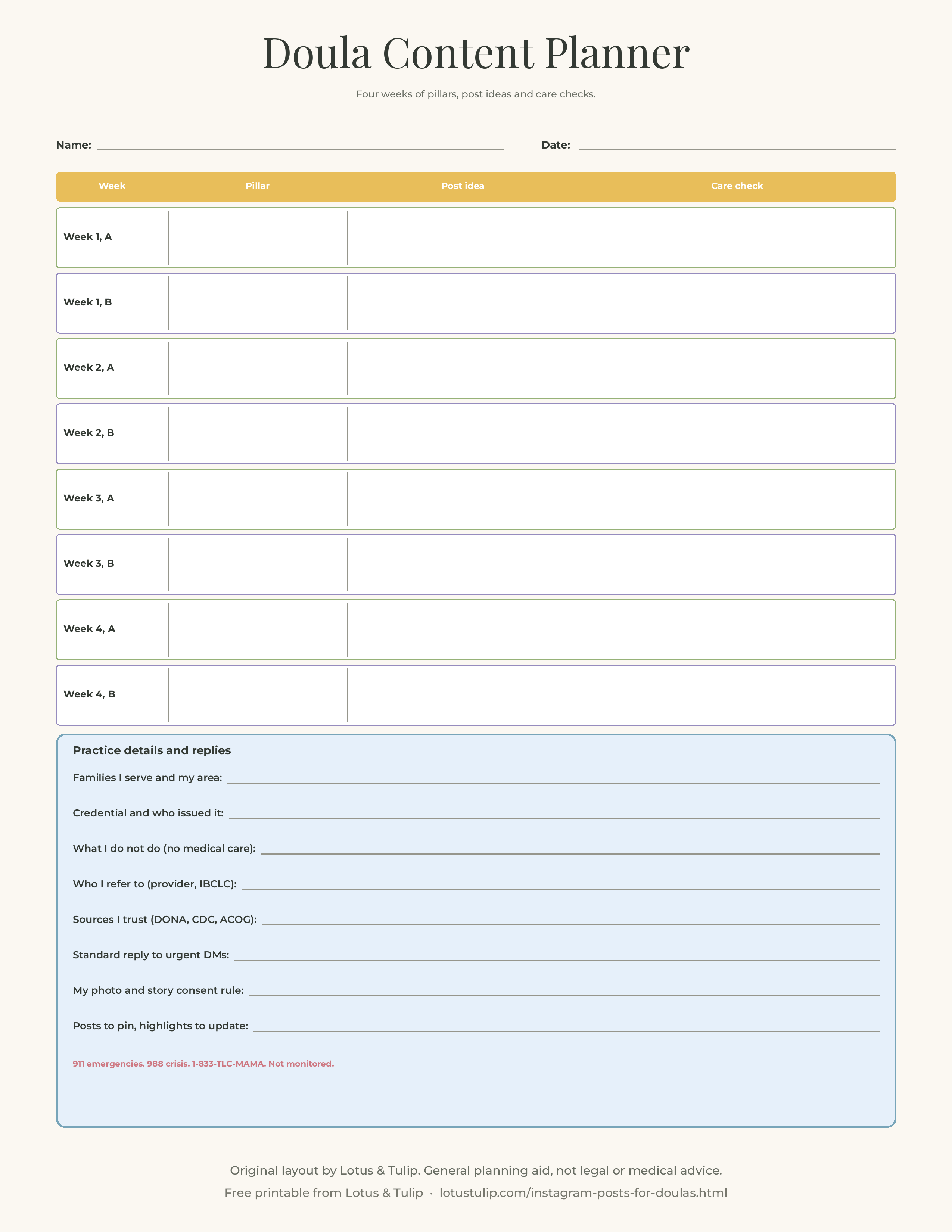
- Page 2: Doula Content Planner. Four weeks of posts (two per week) with columns for pillar, post idea and care check, plus fields for the families you serve and your area, your credential and its issuer, what you do not do, who you refer to, sources you trust, your standard reply to urgent DMs, your photo and story consent rule, and posts to pin and highlights to update.
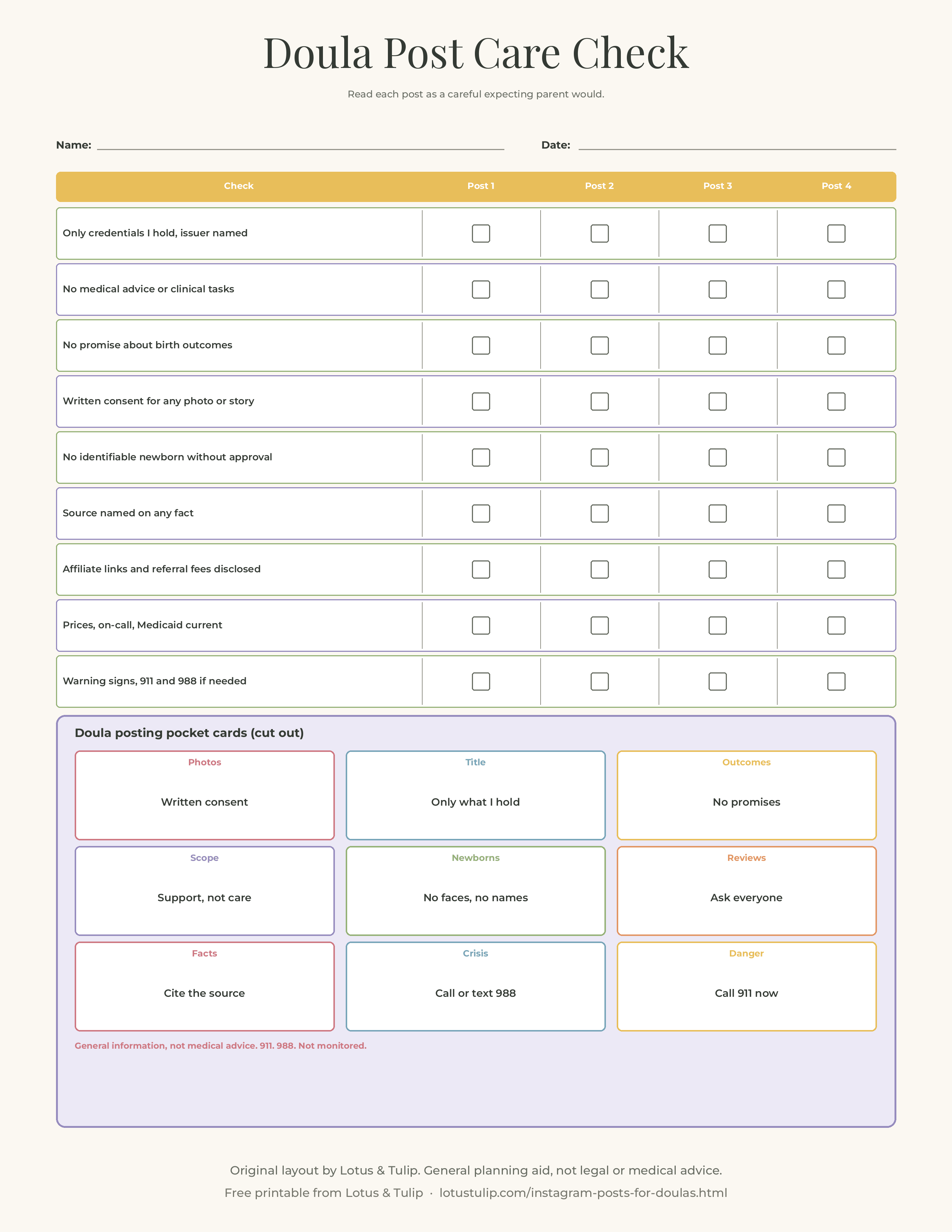
- Page 3: Doula Post Care Check. A yes or no check for up to four posts (only credentials I hold, issuer named; no medical advice or clinical tasks; no promise about birth outcomes; written consent for any photo or story; no identifiable newborn without approval; source named on any fact; affiliate links and referral fees disclosed; prices, on-call and Medicaid details current; warning signs, 911 and 988 if needed), plus nine doula posting pocket cards to cut out.
Download free PDF · Page 1 PNG · Page 2 PNG · Page 3 PNG
Research notes (verified, with caveats)
Sources below were opened or checked through search during this writing session on November 9, 2026, unless marked as checked on November 8, 2026 or in an earlier session on November 9, 2026 for our previous articles. Where we relied on search results rather than the full page, we say so.
- DONA International. Birth Doula Certification page, dona.org, opened this session (required education, practical experience, three year submission window, membership requirement; community-centered doula description). Birth Doula Standards of Practice (September 2025), via search extract this session (scope of work, non-medical support, no clinical or medical tasks, will not diagnose or treat, additional services, advocacy). "Updated Standards of Practice" page and Credentialing White Paper, via search this session (examples of clinical tasks, earlier limits to practice for birth and postpartum doulas, advocacy does not include speaking or deciding for the client). Position Paper: The Birth Doula's Role in Perinatal Care, via search this session. We did not use certification fees.
- CAPPA. Labor Doula (CLD) and Postpartum Doula (CPD) certification pages and FAQs, cappa.net, via search this session (five core certifications, requirements, recertification every three years). CAPPA's pages describe more than one pathway with different time limits, so we did not state a single deadline.
- ICEA (Get Certified page), ProDoula and third party lists of US doula training organizations, via search this session, used only to name other certifying bodies.
- Arizona voluntary doula certification, via search this session (not required to practice; relevant to Medicaid reimbursement). Connecticut Department of Social Services provider bulletin PB25-05, via search this session (enrollment of certified doulas in Medicaid for dates of service from January 1, 2025). Arkansas requirement for Department of Health certification before Medicaid enrollment, via a third party summary (Bornbir, 2026) found through search; check the Arkansas Department of Health and DHS for current rules.
- National Health Law Program. "Over Half the States and Counting," healthlaw.org, via search this session (28 states, Guam and Washington, DC have implemented Medicaid coverage for doula care). Wyoming Public Media, October 30, 2026, via search, quoting the program's figure of 28 states. NASHP, State Trends in Medicaid Coverage of Doula Services and state tracker, via search this session (26 states and DC as of March 2026; increase of 14 since April 2024; at least 17 states through 12 months postpartum; scope and rates vary). We did not use reimbursement rates on this page.
- Bohren MA, Hofmeyr GJ, Sakala C, Fukuzawa RK, Cuthbert A. Continuous support for women during childbirth. Cochrane Database of Systematic Reviews 2017, CD003766.pub6, via PubMed and Cochrane listings found through search this session (usable data from 26 trials, 15,858 women). We deliberately quote no effect sizes.
- CDC Hear Her campaign, Urgent Maternal Warning Signs and Symptoms (page dated May 15, 2024), opened this session. List developed by the Alliance for Innovation on Maternal Health.
- HRSA Maternal and Child Health Bureau, National Maternal Mental Health Hotline page and FAQ, via search this session (1-833-TLC-MAMA, 1-833-852-6262; call or text; 24/7; English and Spanish; interpreters; not a crisis line, 988 for suicidal crisis and 911 for imminent danger). CDC depression resources page, via search, confirms the number.
- Postpartum Support International, PSI HelpLine page, postpartum.net, via search this session (1-800-944-4773, press 1 Spanish or 2 English; text "Help" to 800-944-4773 in English; text 971-203-7773 in Spanish; not a crisis hotline and does not handle emergencies; messages returned daily).
- 988 Suicide and Crisis Lifeline, 988lifeline.org, checked in an earlier session on November 9, 2026 (call, text or chat 988, 24/7; Spanish: press 2 or text AYUDA to 988).
- NIMH. Perinatal Depression, via search this session (baby blues: mild mood changes in the first two weeks after birth that usually resolve on their own; perinatal depression is more serious and needs care).
- ACOG Committee Opinion No. 736, Optimizing Postpartum Care (2018), via search this session (ongoing process; contact within the first three weeks; comprehensive visit no later than 12 weeks after birth).
- NICHD Safe to Sleep, Ways to Reduce Baby's Risk, via search this session (back to sleep, firm flat level surface with a fitted sheet, room sharing without bed sharing for at least the first six months).
- HHS Office for Civil Rights. Covered Entities and Business Associates, checked November 8, 2026 and confirmed via search this session (covered health care providers transmit health information electronically in connection with a standard transaction). Electronic Medicaid claims use HIPAA standard transactions, per state Medicaid doula billing guidance found via search (New York eMedNY doula billing guidelines).
- Instagram Community Guidelines, help.instagram.com, via search this session (some nudity allowed in the context of breastfeeding, birth giving and after-birth moments).
- Awareness dates, via search this session: World Doula Week March 22 to 28 (worlddoulaweek.com); Black Maternal Health Week April 11 to 17 (blkmaternalhealthweek.com); World Maternal Mental Health Day first Wednesday in May (wmmhday.org; May 5, 2027 per third party calendars); National Breastfeeding Month in August (US Breastfeeding Committee) and World Breastfeeding Week August 1 to 7 (WHO); Pregnancy and Infant Loss Remembrance Day October 15 with the International Wave of Light at 7 p.m. local time.
- Federal Trade Commission. Guides Concerning Use of Endorsements and Testimonials in Advertising, 16 CFR Part 255 (2023): section 255.2 checked in an earlier session on November 9, 2026 via eCFR; sections 255.3 and 255.5 checked November 8, 2026. Health Products Compliance Guidance (2022), checked in an earlier session on November 9, 2026 via search. Rule on the Use of Consumer Reviews and Testimonials, 16 CFR Part 465 (2024), opened in an earlier session on November 9, 2026; sections 465.2, 465.4, 465.5, 465.7 and 465.8.
- Federal gift card rule, 12 CFR 1005.20 (Regulation E), checked November 8, 2026.
This page is not affiliated with or endorsed by DONA International, CAPPA, ICEA, ProDoula, any state Medicaid program, the National Health Law Program, NASHP, the CDC, HRSA, NIMH, NICHD, ACOG, Postpartum Support International, the 988 Lifeline, the FTC, HHS or Instagram. We used no doula industry survey statistics and quote no outcome percentages. Our paid template kits are marketing tools for doula and wellness businesses. They are not legal or medical tools. You stay responsible for what you post.
Instagram posts for doulas: FAQ
What should a doula post on Instagram?
Focus on what a careful family needs: who you are, the families you serve, your real credential and its issuer, what a doula does and does not do, how consults, on-call and backup work, your fees and Medicaid status, sourced education (such as the CDC urgent maternal warning signs, ACOG's postpartum care guidance and Safe to Sleep basics), and a pinned safety post with 911, 988 and the National Maternal Mental Health Hotline. Leave out medical advice, outcome promises and client photos without written approval.
How often should a doula post on Instagram?
Two or three feed posts a week is enough for most solo doulas, plus stories for availability and classes. Once a week is fine if your fees, consult, FAQ and safety posts are current. Batch and schedule your posts ahead so on-call weeks and long births do not stop your feed.
Do doulas need a license or certification in the US?
Generally no license is required, and certification through a private body such as DONA International or CAPPA is voluntary. Some states run their own doula certification or registry, mostly for doulas who want to bill Medicaid, and Arizona's state certification, for example, is voluntary but relevant to Medicaid reimbursement. Check your own state's rules, and only claim a certification you actually hold.
Can I say I'm DONA certified if I took a DONA workshop?
No. DONA's birth doula certification requires an approved workshop plus childbirth and lactation education, required reading, continuous labor support for three births with evaluations, a resource list, signed agreements and an approved packet. Until your certification is issued, say "trained through a DONA approved workshop" or "working toward certification."
Can a doula post birth photos on Instagram?
Only with written consent from the client for that specific image and caption, consent from anyone else identifiable in the photo, and respect for the facility's photography rules. Instagram's guidelines allow some birth and after-birth images, but that is not the same as your client's consent. Many doulas post no client photos at all and never show identifiable newborns.
Can I say doulas reduce cesareans or shorten labor?
Avoid promising it. Research reviews, such as the 2017 Cochrane review on continuous labor support, report average associations across many people, not outcomes for one family. The FTC treats testimonials and results claims as statements about what clients generally achieve, which you must be able to support. Describe how you support families instead.
Does Medicaid cover doulas?
In many states, yes, but not everywhere. The National Health Law Program counts 28 states, Guam and Washington, DC with Medicaid doula coverage, and NASHP counted 26 states and DC as of March 2026. Covered visits, rates and doula requirements vary by state and plan. Say whether you are enrolled, date your post and link your state's Medicaid page.
Is the free printable a copy of the paid kit?
No. The free three page set is an original planning aid: posting steps, a four week content planner and a post care check with pocket cards. The paid Tender Watch kit contains designed posts, stories, highlight covers, captions and a 12 week calendar. The printable is not a preview of that kit.