
Kids and teens · Lying and honesty for kids 4 to 12 · Updated 2026-11-15
Lying and honesty worksheets for kids: why kids lie, what research shows and a free honesty plan

Ages 5 to 11: Kids Feelings and Social Skills Worksheets, incl. feelings detective, body clues, a feelings thermometer, a coping skills menu and a calm down plan Holiday 20% off: about $11.04, was $14 (EUR 12) · fillable PDF, instant digital download
Buy on EtsyTry it free first: download a fillable sample (feelings thermometer and calm-down plan, PDF, 240 KB). Type into it on screen, then get the full pack. No email needed.
For parents: Parenting Worksheets: Calm and Connected, 30 pages on labeled praise, clear directions, calm consequences and routine charts Holiday 20% off: about $9.20, was $12 (EUR 10) · instant digital download
Buy on EtsyKids and teens bundle: Kids and Teens Worksheets Bundle (feelings, anger, self esteem, social anxiety) Holiday 20% off: about $22.08, was $28 (EUR 24) · 80 pages, instant digital download
Buy on EtsyThe cookie jar is empty, there are crumbs on the couch, and your child looks you in the eye and says, "It wasn't me." Or a teacher calls because the reading log was signed by "Mom" in suspiciously wobbly handwriting. Catching a child in a lie can feel personal, worrying and a little scary: is this a phase, or the start of something bigger?
This guide is for parents, caregivers, teachers, school counselors and therapists supporting children about 4 to 12. It explains why children lie at different ages, what research shows about punishment, praise, stories and promises, eight kinds of honesty activities, nine steps for what to do when your child lies, age and need adaptations, safe and unsafe secrets, notes for school, common mistakes and three short examples. It ends with a free 2 page printable: My Honesty Map and My Honesty Plan.
When to talk with a professional first: occasional lying is part of normal development. Talk with your child's pediatrician, school counselor or a child therapist if lying is frequent and getting worse after age 6 or 7; if it comes with stealing, cruelty, aggression, fire setting or running away; if it hides a problem such as being bullied, struggling with schoolwork, self harm, alcohol or drugs; if your child seems unable to tell what really happened from what they imagine; or if lying started with a big change, a loss or a frightening event. If a child tells you an adult asked them to keep a secret about touching, photos or being hurt, believe them, keep them safe and contact your local child protective services or police. If a child talks about wanting to die or hurting themselves, call or text 988 (the 988 Suicide and Crisis Lifeline). If anyone is in immediate danger, call 911.
Download the free lying and honesty worksheets for kids (PDF, 2 pages, US Letter)
Direct download, no email or sign up. See the pages first. Not sure when kids should tell an adult? See the tattling vs telling worksheet. Fibs mostly about a brother or sister? See sibling rivalry worksheets for kids.
Why kids lie: it is usually development, not a character flaw
To tell a lie on purpose, a child has to understand that other people cannot see inside their head, hold the true story in mind while saying a different one, and stop themselves from blurting out the truth. These are the same thinking skills (theory of mind and executive functioning) that help children plan, share and make friends. Researchers who study children's lying describe early lying as normal and linked to this cognitive growth, while warning that lying can become a problem when it is frequent or used over time to get through every difficulty (Talwar and Crossman, 2011).
Not every untrue sentence is a lie, either. Children say untrue things for many reasons:
- Pretend play and tall tales. "A dragon ate my sandwich." The American Academy of Child and Adolescent Psychiatry notes that children around 4 to 5 often make up stories and may blur fantasy and reality, and the American Academy of Pediatrics says children younger than about 6 can find the line between truth and fiction uncertain.
- Mistakes and memory gaps. "I brushed my teeth" may be yesterday's memory, not a plan to deceive.
- Self protective lies. The most common kind: denying a mistake to avoid trouble or disappointing someone.
- Wishful thinking and bragging. "My dad has a race car." Often a sign a child wants to fit in or feel important.
- Polite or white lies. "I love the sweater." Children learn these from the adults around them.
- Lies that cover a bigger problem. A child who says homework is done every night may be struggling to do it, which AACAP points to as one reason for a repeated pattern of lying.
What the research shows, honestly
Most lab studies of children's lying use a simple game: a child is asked not to peek at a toy while the adult leaves the room, then is asked whether they peeked. A hidden camera shows what really happened. This tells us a lot about how lying develops, but it is a short, low stakes situation, so keep that in mind when reading the numbers.
Lying starts early and grows with age. In a study of 65 children aged 2 to 3, 80% peeked at the toy. Most 2 year old peekers confessed, with only about a quarter lying, while most 3 year old peekers denied it; overall 40% of peekers lied. Most of the young liars then gave themselves away by naming the toy they had supposedly not seen (Evans and Lee, 2013). In a related study of children 3 to 8, most peeked and then lied, and children's ability to keep a lie going matched their growing understanding of what other people think (Talwar and Lee, 2008).
Lying at home is very common. A study that recorded everyday life in 40 families found that 96% of children told at least one lie during the observations. Children lied most often to avoid responsibility for something they had done, to falsely accuse a sibling and to control what someone else did. About 35% of 2 year olds were not observed lying, compared with 5% of 6 year olds. Parents rarely talked about the lie itself; they mostly questioned it or dealt with the misbehavior (Wilson, Smith and Ross, 2003).
A first lie can be a sign of a thinking milestone. In an experiment with 3 year olds who did not yet lie in the peeking game, a few weeks of training in understanding other people's thoughts and beliefs led them to start deceiving consistently, an effect that lasted more than a month (Ding and colleagues, 2015). This does not make lying good, but it means a preschooler's first fib is not a sign of a bad child.
Harsh punishment makes children better liars, not more honest ones. In a natural experiment with 84 children aged 3 and 4 in two West African schools, 94% of the peekers in a school that used harsh physical punishment lied about it, compared with 56% in a school that used time outs and scolding, and the children in the punitive school were also much better at keeping their lie consistent (Talwar and Lee, 2011).
Making the truth feel safe works better than threats. In a study of 372 children aged 4 to 8, hearing that an adult would be happy if they told the truth led to more truth telling than hearing nothing. Telling children they would feel good about themselves for telling the truth worked only when no punishment was expected; when punishment was on the table, that appeal lost its effect (Talwar, Arruda and Yachison, 2015).
Stories that praise honesty work better than stories that punish lying. Researchers read 268 children aged 3 to 7 one of four stories before the peeking game. "Pinocchio" and "The Boy Who Cried Wolf" did not reduce lying compared with a control story. "George Washington and the Cherry Tree," in which the young Washington is praised for admitting he cut down the tree, made children more than three times less likely to lie. When the story was rewritten to focus on punishment instead of praise, the effect disappeared (Lee and colleagues, 2014). The Washington story itself is a legend, not history, which can be a fun point to share with older children.
Asking for a promise helps, even for teens. In studies used to shape how courts question children, asking 3 to 11 year olds to promise to tell the truth made more of them tell the truth about something a parent had done (Talwar and colleagues, 2004). With 108 young people aged 8 to 16, those who had lied about cheating on a test were eight times more likely to switch to the truth after promising to tell the truth, while a talk about the morality of lying did not help (Evans and Lee, 2010).
Children copy the honesty they see. Most children aged 3 to 11 told a white lie when given a gift they did not like, more so with age, and parents' coaching shaped how they did it (Talwar, Murphy and Lee, 2007). In surveys, parents report lying to their children to get them to behave while teaching that lying is wrong, which researchers call "parenting by lying" (Heyman, Luu and Lee, 2009). Young adults who remembered more parenting by lying reported lying more to their own parents and more adjustment problems, though that study relied on memories and cannot prove cause (Setoh and colleagues, 2020).
Frequent lying in older children deserves a closer look. In parent and teacher reports on boys in grades 4, 7 and 10, lying was linked to stealing, fighting and delinquency, more strongly in older boys, and was more common in families with poor supervision, rejection or conflict between parents (Stouthamer-Loeber and Loeber, 1986). Repeated serious lying is also one of the possible signs of conduct problems that a professional would look at alongside many other behaviors.
What this means for you. No study has tested worksheets like the ones on this page, and most experiments are short lab games, not life at home. Still, the findings point the same way: expect some lying, stay calm, make the truth the easier choice, praise honesty more than you punish lies, model the honesty you want and look for the reason behind repeated lies.
What honesty worksheets can and cannot do
Honesty worksheets give children words for why they fib and how it feels, a script for fixing a lie, and a plan that both child and adult agree on before the next hard moment. They move the conversation from "Why did you lie to me?" to "What made the truth feel hard, and what would help next time?" For adults, the tracker turns attention toward brave truths, which are easy to miss.
They cannot fix a lie that is protecting a child from something frightening, replace an evaluation for learning, attention or behavior problems, or treat conduct disorder, anxiety or trauma. If lying stays frequent after four to six weeks of calm practice, or the doctor first box above applies, bring your notes to your pediatrician, school counselor or a child therapist.
8 kinds of honesty activities for kids
- Truth, pretend or fib sorting. Read short statements ("I saw a purple elephant at school," "I ate the last cookie and said the dog did") and sort them into true, pretend and fib piles. Young children learn that pretending is fine when everyone knows it is a story.
- Honesty stories with a happy ending. Choose books and stories in which a character tells a hard truth and is thanked or forgiven, then talk about how the character felt. Research suggests praise focused stories teach more than stories about liars being punished.
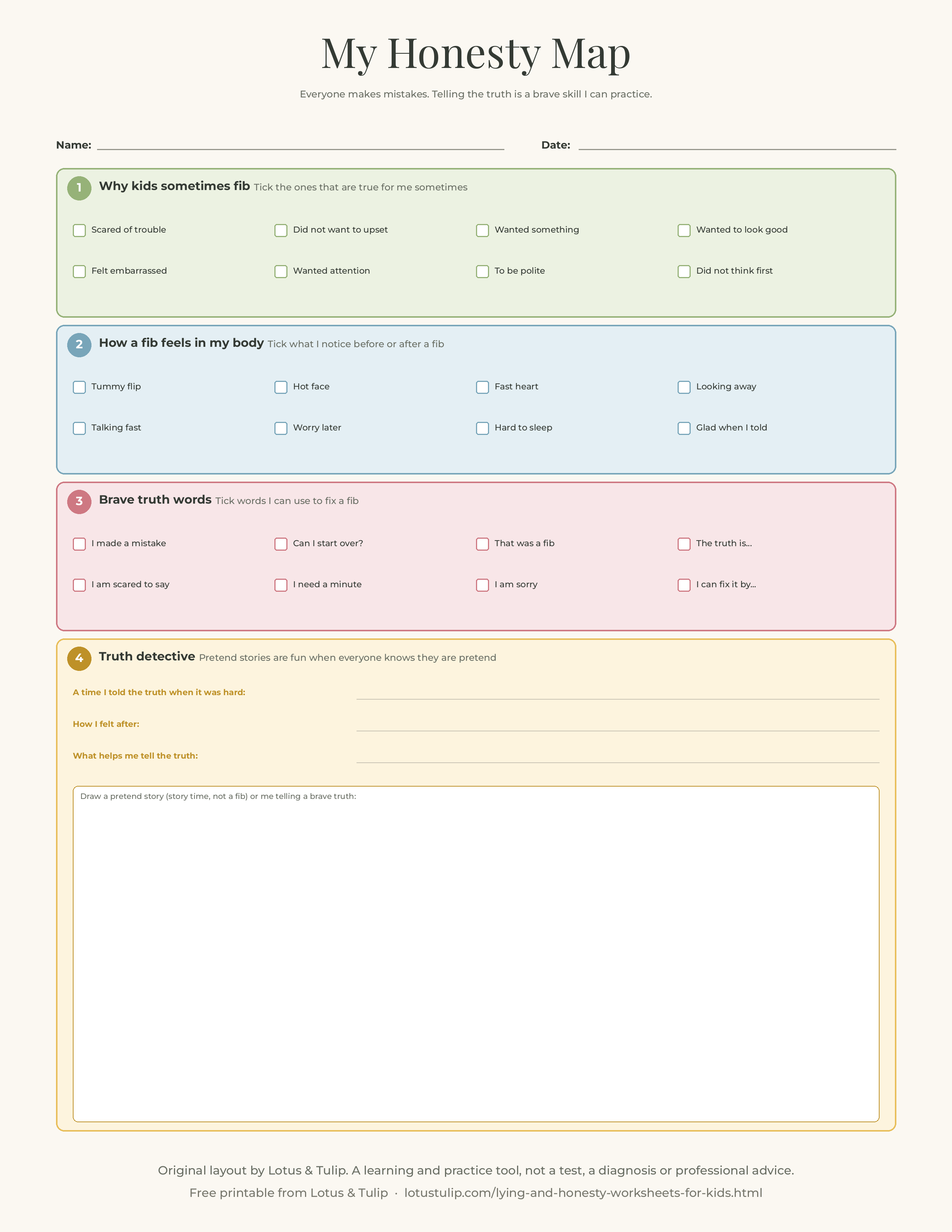
- Body clues. Many children feel a tummy flip, a hot face or a fast heart before or after a fib. Naming these feelings helps them notice the moment they could choose the truth instead. Page 1 of the free printable has a body clues checklist.
- Brave truth words. Practice short scripts: "I made a mistake," "That was a fib, the truth is...," "I am scared to tell you," "Can I start over?" A child who has the words ready is more likely to use them when nervous.
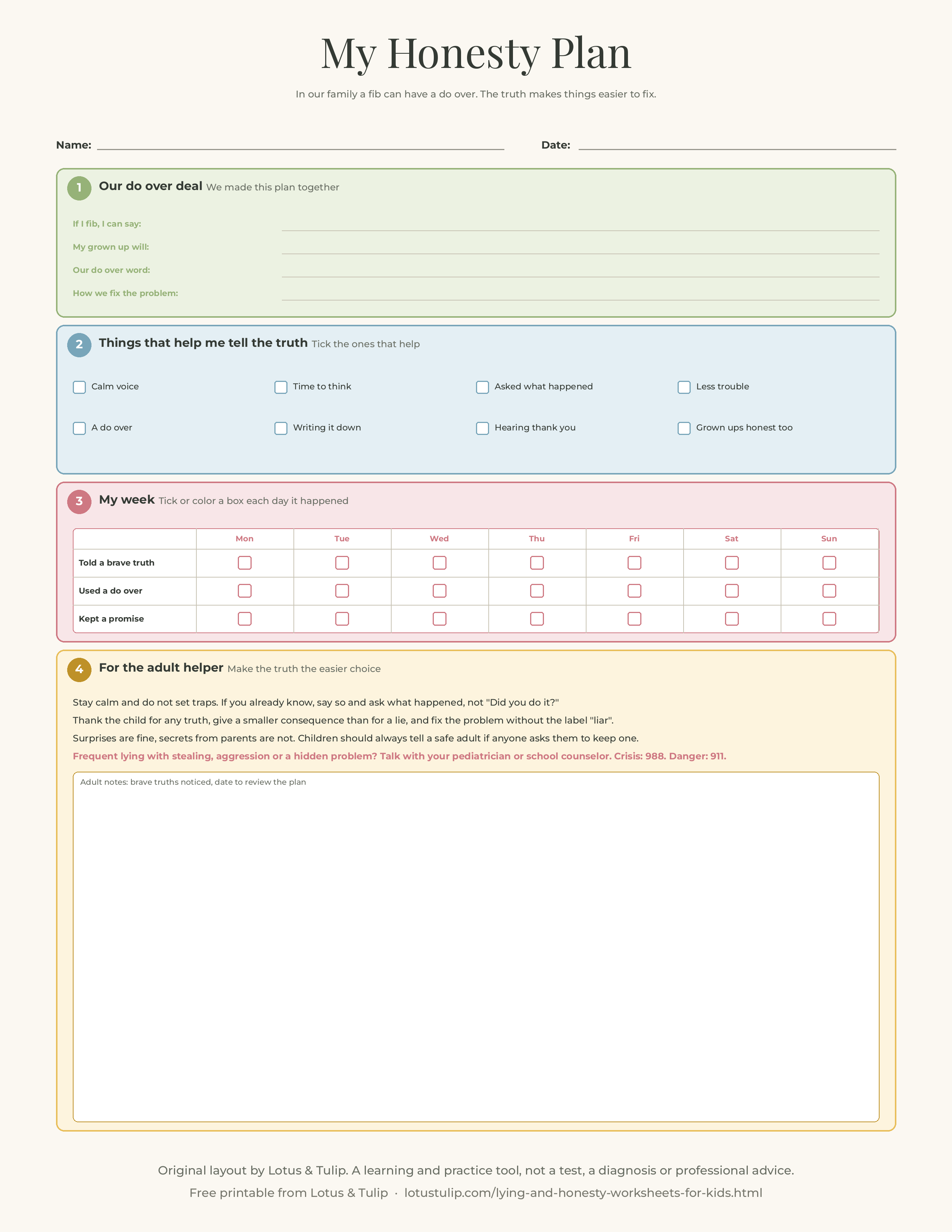
- The do over deal. Agree as a family that a child who corrects a fib quickly gets a smaller consequence, or none for small things. Page 2 of the printable lets you write your own do over word and plan.
- Truth promises. For school age children, ask calmly, "Will you promise to tell me the truth?" before asking what happened. Studies with children and teens suggest a promise can tip the balance toward honesty.
- Kind honesty role plays. Act out tricky moments: an unwanted gift, a friend's drawing you do not like, being asked if you are ready to go. Practice answers that are both true and kind ("Thank you for thinking of me," "I like the colors you used").
- Noticing brave truths. Keep a jar, chart or the weekly tracker on page 2 for every time your child told the truth when it was hard. Say specifically what you saw: "You told me you broke the cup even though you were worried. Thank you."
What to do when your child lies, step by step
- Pause and stay calm. Take a breath before you respond. A child who sees a big reaction learns that the truth is dangerous, which is what the punitive school study found.
- Do not set traps. If you already know what happened, say so: "I see the crayon on the wall. Let's talk about it." Asking "Did you draw on the wall?" when you know the answer invites a lie.
- Make the truth feel safe. The AAP suggests telling children you want only the truth, that you will tell them the truth too, and that they will be in much less trouble for telling the truth than for lying. Then keep that promise.
- Ask what happened, then wait. Open questions ("What happened here?") and a few seconds of quiet give an impulsive or nervous child time to choose the truth. For school age children, you can ask for a truth promise first.
- Thank them for any truth. Even if it came after a fib, notice it: "I'm not happy about the window, but I'm really glad you told me the truth."
- Deal with the behavior, not the label. Use a calm, related consequence and a chance to repair (cleaning the wall, apologizing to a sibling, redoing the homework). Avoid calling the child a liar, which can become part of how they see themselves.
- Look for the reason. Ask yourself what the lie was for: avoiding punishment, a skill the child does not have yet, wanting attention or fitting in, protecting someone, or hiding a bigger problem. Page 1 of the printable helps children name their own reasons.
- Model honesty. Avoid lies to get compliance ("The playground is closed today," "The police will come if you don't behave"). When you make a mistake, say so. Children notice the double standard the AAP warns about.
- Make a plan and review it. Fill in the honesty plan together, track brave truths for four weeks and talk about what is working. If nothing changes, or lying is getting more serious, talk with your pediatrician or school counselor.
How to adapt it by age and need
- Ages 4 to 5: keep it playful. Use pretend versus true games, short stories and simple words ("a fib," "a true thing"). Expect many tall tales and respond to the feeling behind them ("You wish you had a puppy"). Keep consequences tiny and immediate.
- Ages 6 to 8: children now know a lie is a lie, so the do over deal, truth promises and the body clues checklist work well. Sticker charts for brave truths and role plays of kind honesty fit this age.
- Ages 9 to 12: respect privacy and pride. Talk privately, not in front of siblings. Older children may lie to keep some privacy or to avoid looking foolish; discuss what is private and what parents need to know for safety. Ask about school, friends and online life with curiosity, not interrogation.
- Children with ADHD or impulsivity: a quick "No!" may come out before they think. Build in a pause ("Take a minute, then tell me what happened"), and offer a do over without extra penalty if they correct it quickly.
- Autistic children: some children are very literal and find white lies confusing or upsetting. Teach kind honesty explicitly with scripts, and do not assume a blunt truth is rude on purpose.
- Anxious children or children who people please: lies may come from fear of disappointing you. Lots of reassurance, low key responses and noticing brave truths help more than consequences.
- After trauma, loss or a big change: a sudden rise in lying can be a stress signal. Focus on safety and connection first and consider talking with a counselor.
Safe secrets and unsafe secrets
Honesty talks are a good time to teach the difference between surprises and secrets. A surprise, like a birthday gift, is fun and ends soon. A secret that an adult or older child asks a child to keep from parents, especially about touching, photos, gifts or being hurt, is never okay to keep. Tell your child clearly: "You will never be in trouble for telling me about a secret like that, even if you promised not to tell." The tattling vs telling worksheet linked below covers when to get a grown up's help.
Lying at school: notes for teachers and counselors
- Skip public interrogations. "Who did this?" in front of the class invites lies and blame. Talk privately, state what you saw and ask what happened.
- Use repair, not shame. Restorative questions (what happened, who was affected, how can it be made right) keep the focus on fixing harm.
- Prevent cheating with clear expectations. Explain what counts as copying, reduce the pressure behind it where you can and consider asking students to sign a simple honesty pledge before tests, in line with research on promises.
- Look behind repeated lies. Missing homework hidden by lies can point to learning, attention or emotional difficulties. Share concerns with the family and the school team; an evaluation may be needed.
- Notice the whole child. Lies about injuries, being afraid to go home or stories about secrets can signal abuse or neglect. If you suspect abuse or neglect, follow your district policy and your duties as a mandated reporter.
- Partner with families. Use the same do over language at school and at home, and share brave truths with parents, not only problems.
Common mistakes
- Setting traps. Asking questions you already know the answer to tests a child's honesty at the moment it is weakest.
- Harsh or bigger punishment for the truth. If confessing leads to the same or worse outcome, children learn to lie better. Make the truth clearly cheaper than a lie.
- Labeling the child. "You're such a liar" can stick. Try "That was a fib. Let's try again with the truth."
- Relying on scary stories. Research suggests stories about liars being punished do little; praise for honesty does more.
- The double standard. Lying to children for convenience while demanding total honesty sends a confusing message.
- Treating every lie the same. A 4 year old's dragon story, a 7 year old's cookie denial and a 12 year old hiding bullying need very different responses.
Examples
- Ava, 4: told her preschool teacher that she had a pet tiger and that her baby brother had spilled the paint. Her parents played true or pretend games at dinner, praised her stories as "story time" and used a simple do over: "Want to try that again with a true thing?" Within a few weeks she started saying, "That's a pretend story."
- Marcus, 7: denied eating cookies with crumbs on his shirt, and evenings were turning into arguments. His dad stopped asking questions he knew the answers to and started saying what he saw. They filled in the honesty plan together, with a smaller consequence for telling the truth right away and a sticker for each brave truth. Marcus began admitting small things on his own.
- Lily, 11: had been saying her reading homework was done for weeks. When her mom calmly asked what made reading hard, Lily cried and said the words "jumped around." Her parents talked with her teacher and pediatrician and asked the school about an evaluation. The lying stopped once the real problem was being addressed.
Free printable: lying and honesty worksheets for kids
This printable is an original Lotus & Tulip layout. It is not an assessment and gives no score. Page 1, My Honesty Map, has checklists for why kids sometimes fib and how a fib feels in my body, brave truth words to tick, truth detective prompts (a time I told the truth when it was hard, how I felt after, what helps me) and a box to draw a pretend story or a brave truth. Page 2, My Honesty Plan, has our do over deal (what I can say, what my grown up will do, our do over word, how we fix the problem), things that help me tell the truth, a 7 day tracker for brave truths, do overs and kept promises, and notes for the adult helper, including safe and unsafe secrets and when to get help.
Download the free lying and honesty worksheets for kids (PDF, 2 pages, US Letter)
Prefer single images? Page 1: My Honesty Map (PNG) · Page 2: My Honesty Plan (PNG)
Related resources
- Tattling vs telling worksheet: when to handle it and when to get a grown up
- Sibling rivalry worksheets for kids: when fibs and blame are mostly about a brother or sister
- Empathy worksheets for kids: seeing how a lie affects someone else
- Self esteem worksheets for kids: for children who lie to look good or fit in
- Parenting worksheets: tools for calmer family routines
- All counseling resources for kids and teens
FAQ
Is it normal for kids to lie?
Yes. Lying usually starts between about 2 and 4 years old and becomes more common through the early school years. In one home observation study, 96% of children told at least one lie. Early lying is linked to normal growth in thinking skills, and most children learn to value honesty when adults respond calmly and praise the truth.
Why does my child lie when they know they will get caught?
Young children often lie on impulse to avoid trouble or disappointing you, before thinking ahead. Their lies are easy to spot because they are still learning to hold a story together. A calm response, no traps and a do over for correcting a fib help more than bigger punishments.
Should I punish my child for lying?
Use calm, related consequences for the behavior, and make telling the truth clearly lead to less trouble than lying. Research found that children in a school with harsh punishment lied more and became better at it, and that appeals for honesty worked better when no punishment was expected.
How do I teach my child to tell the truth?
Model honesty, read stories in which characters are praised for telling the truth, practice brave truth words, ask school age children to promise to tell the truth, and thank them every time they tell you a hard truth. The free honesty map and honesty plan on this page put these steps on paper.
When is lying a sign of a bigger problem?
Talk with your pediatrician, school counselor or a child therapist if lying is frequent and getting worse after age 6 or 7, comes with stealing, aggression or cruelty, or covers a problem such as bullying, schoolwork struggles, self harm or substance use. AACAP notes that a repeated pattern of serious lying may call for professional help.
Are white lies okay to teach kids?
Many families teach children to be kind as well as honest. In one study, most children aged 3 to 11 told a polite white lie about a gift they did not like, and more often with age. You can teach kind honesty instead, such as "Thank you for thinking of me" for a gift they do not like, so children do not have to choose between truth and kindness.
What age are these lying and honesty worksheets for?
They are designed for children about 4 to 12. Younger children can point, color and talk through the pages with an adult reading aloud. Children 7 to 12 can fill in most of the honesty map and honesty plan themselves. Parents, teachers, school counselors and therapists can use them at home, in class or in sessions.
Sources
- American Academy of Child and Adolescent Psychiatry (2017). Lying and children. Facts for Families No. 44.
- American Academy of Pediatrics. When children lie: what parents can do (HealthyChildren.org).
- Ding, X. P., Wellman, H. M., Wang, Y., Fu, G., and Lee, K. (2015). Theory-of-mind training causes honest young children to lie. Psychological Science, 26(11), 1812 to 1821.
- Evans, A. D., and Lee, K. (2010). Promising to tell the truth makes 8- to 16-year-olds more honest. Behavioral Sciences and the Law, 28(6), 801 to 811.
- Evans, A. D., and Lee, K. (2013). Emergence of lying in very young children. Developmental Psychology, 49(10), 1958 to 1963.
- Heyman, G. D., Luu, D. H., and Lee, K. (2009). Parenting by lying. Journal of Moral Education, 38(3), 353 to 369.
- Lee, K., Talwar, V., McCarthy, A., Ross, I., Evans, A., and Arruda, C. (2014). Can classic moral stories promote honesty in children? Psychological Science, 25(8), 1630 to 1636.
- Setoh, P., Zhao, S., Santos, R., Heyman, G. D., and Lee, K. (2020). Parenting by lying in childhood is associated with negative developmental outcomes in adulthood. Journal of Experimental Child Psychology, 189, 104680.
- Stouthamer-Loeber, M., and Loeber, R. (1986). Boys who lie. Journal of Abnormal Child Psychology, 14(4), 551 to 564.
- Talwar, V., Arruda, C., and Yachison, S. (2015). The effects of punishment and appeals for honesty on children's truth-telling behavior. Journal of Experimental Child Psychology, 130, 209 to 217.
- Talwar, V., and Crossman, A. (2011). From little white lies to filthy liars: the evolution of honesty and deception in young children. Advances in Child Development and Behavior, 40, 139 to 179.
- Talwar, V., and Lee, K. (2008). Social and cognitive correlates of children's lying behavior. Child Development, 79(4), 866 to 881.
- Talwar, V., and Lee, K. (2011). A punitive environment fosters children's dishonesty: a natural experiment. Child Development, 82(6), 1751 to 1758.
- Talwar, V., Lee, K., Bala, N., and Lindsay, R. C. L. (2004). Children's lie-telling to conceal a parent's transgression: legal implications. Law and Human Behavior, 28(4), 411 to 435.
- Talwar, V., Murphy, S. M., and Lee, K. (2007). White lie-telling in children for politeness purposes. International Journal of Behavioral Development, 31(1), 1 to 11.
- Wilson, A. E., Smith, M. D., and Ross, H. S. (2003). The nature and effects of young children's lies. Social Development, 12(1), 21 to 45.
Lotus & Tulip is not affiliated with the researchers, programs, agencies or organizations named on this page. Names in the examples are invented. This page is educational and does not replace professional advice, diagnosis or treatment.