
Kids and teens · Empathy, perspective taking and caring for others · Updated 2026-11-04
Empathy worksheets for kids: how to teach empathy, activities that work, and a free printable
Ready-made printable: Social Skills Small Group Curriculum for School Counselors, Grades 2 to 5 Holiday 20% off: about $11.04, was $14 (EUR 12) · instant digital download
Buy on Etsy
Most adults agree that empathy matters, and most children are capable of it. Yet the same child who comforts a crying toddler can laugh when a classmate trips, ignore the new kid at lunch, or insist that a friend "shouldn't be upset" about something that clearly hurt. That gap is normal. Empathy is not one switch that turns on at a certain age. It is a set of skills: noticing how someone feels, imagining their point of view, caring about it, and then knowing what to do. Each of those parts can be taught and practiced.
This guide is for school counselors, teachers, child therapists and parents in the US who want practical, honest help with teaching empathy to kids. It covers what empathy actually is (including the difference between cognitive and affective empathy), what to expect at each age, what research does and does not show about empathy programs, empathy activities for kids at school, in counseling and at home, a step by step teaching plan, common mistakes, and a free three page set of empathy worksheets for kids: Feelings Detective, Walk in Their Shoes, and an Empathy in Action tracker with kind response cards.
Jump to the free empathy worksheets for kids
What is empathy? A plain language definition for kids and adults
For kids, a simple definition works best: empathy is understanding how someone else feels and caring about it. Many teachers add a third part, because understanding alone is not the goal: and then doing something kind about it.
Researchers break empathy into a few related parts. The labels vary between books, but most describe something like this:
- Affective empathy (feeling with). Picking up on another person's emotion and feeling some of it yourself. A child who tears up when a friend is sad, or gets giggly when everyone else is laughing, is showing affective empathy.
- Cognitive empathy (understanding). Working out what someone else is thinking or feeling, even when you do not feel it yourself. This draws on perspective taking: imagining a situation from where the other person stands, with what they know and what they want.
- Empathic concern (caring). Feeling warmth and concern for the other person and wanting things to be better for them. This is the part most closely linked to helping.
Developmental psychologists such as Nancy Eisenberg have long drawn an important distinction between sympathy, which is concern focused on the other person, and personal distress, which is a self focused upset reaction to someone else's pain. A child who is flooded by a friend's distress may cover their ears or walk away, not because they do not care but because the feeling is too big. That is why emotional regulation and empathy belong together. A child has to be calm enough to stay with someone else's feelings before they can help. Our emotional regulation worksheets for kids cover that side.
Empathy is also not the same thing as agreeing, giving in, or taking on someone else's problem as your own. You can understand why a classmate is angry and still say no to what they want. That distinction is worth teaching directly, especially to children who are anxious people pleasers.
Why empathy matters, and where it fits in SEL
In the CASEL framework, which many US schools use to organize social and emotional learning, empathy sits inside social awareness. CASEL defines social awareness as the abilities to understand the perspectives of and empathize with others, including those from diverse backgrounds, cultures and contexts. Its listed examples include taking others' perspectives, recognizing strengths in others, demonstrating empathy and compassion, and showing concern for the feelings of others. If your school uses CASEL language, empathy lessons fit neatly under that competency, and they connect to relationship skills and responsible decision making.
Harvard's Making Caring Common project makes a useful point here. Its educator guide on building empathy notes that there is more to developing empathy than simply asking students to "walk in someone else's shoes." It highlights two things adults often miss. First, people tend to feel more empathy for those who are similar to them or close to them, so adults need to help children widen their circle of concern to include classmates who are different or overlooked. Second, there is an empathy action gap: children (and adults) often care about someone but do nothing. Teaching what to say and do is part of teaching empathy.
That same project's 2014 report, The Children We Mean to Raise, surveyed about 10,000 middle and high school students. Roughly 80 percent ranked achievement or happiness above caring for others as what mattered most to them, and many believed their parents and teachers felt the same. It was a survey, not an experiment, but it is a reminder that children read our priorities from what we praise and check on, not from what we say.
What the research says about teaching empathy (with honest caveats)
Empathy is a popular word in education marketing, and claims often run ahead of the evidence. Here is a careful summary of what well known studies actually found.
Social and emotional learning in general helps, modestly. Joseph Durlak and colleagues' 2011 meta-analysis in Child Development pooled 213 school based universal SEL programs involving about 270,000 students from kindergarten through high school. Compared with controls, students in SEL programs showed better social and emotional skills, attitudes and behavior, and an 11 percentile point gain in academic achievement. Many of those programs include perspective taking and empathy, but this was a review of SEL broadly, not empathy alone.
Empathy focused school programs show small positive effects. Tina Malti and colleagues (2016, Journal of Clinical Child and Adolescent Psychology) reviewed 19 school based programs with strong empirical support that target empathy related responding. They found positive but small effects on social and emotional skills, conduct problems and academic functioning. Programs that started earlier and targeted more parts of empathy (for example, emotion recognition plus perspective taking plus caring) tended to show larger effects. Small effects are still worth having across a whole class, but nobody should expect a few lessons to transform a child.
Roots of Empathy: better behavior, less clear change in measured empathy. Roots of Empathy is a well known classroom program built around monthly visits from a baby and parent. In a quasi-experimental study by Kimberly Schonert-Reichl and colleagues (2012, School Mental Health) with 585 fourth to seventh graders in 28 classrooms, children in the program showed more peer nominated prosocial behavior and less teacher rated proactive and relational aggression than controls. Interestingly, their self reported empathy and perspective taking did not change significantly. A larger cluster randomized trial in Northern Ireland led by Paul Connolly (74 schools, children aged 8 to 9) found similar results: small immediate improvements in teacher rated prosocial behavior (an effect size of about 0.2) and a borderline reduction in difficult behavior, but no evidence of change in empathy or other measured social and emotional skills. The prosocial gains were not sustained at later follow ups. The researchers suggested the program may work partly by shifting class norms toward caring.
What that means for worksheets. Two lessons stand out. First, behavior can improve even when questionnaires show little change in "empathy scores," so look at what children actually do. Second, short programs fade, so empathy practice works best as a regular, ongoing part of classroom and family life rather than a one time unit. A worksheet will not create empathy on its own. What it can do is give children a structured way to slow down, read a situation, consider another point of view and plan a response, with an adult guiding the conversation. That is how the free printable below is designed to be used.
A useful caution. Psychologist Paul Bloom, in his 2016 book Against Empathy, argues that emotional empathy can be biased toward people who are like us and can act like a spotlight, focusing on one vivid person while ignoring others. You do not have to accept his whole argument to take the practical point: pair "feeling with" others with fairness, reasoning and compassion, and deliberately widen who children notice. This is the same idea as Making Caring Common's circle of concern.
Empathy by age: what to expect
Children develop at different rates, and autistic children, children with ADHD, children with language delays and children who have experienced trauma may show empathy differently or need more explicit teaching. These are rough guides, not checklists.
| Age | What is typical | How adults can help |
|---|---|---|
| Toddlers (1 to 3) | Notice when others are upset. In the second year many begin comforting, patting or bringing a toy, often offering what would comfort themselves. Research by Carolyn Zahn-Waxler and colleagues (1992) documented this rise in concern and helping between about 13 and 20 months. | Name feelings out loud ("Your friend is sad. Her tower fell."), model comforting, praise gentle touches. |
| Preschool (3 to 5) | Growing feelings vocabulary. Around age 4 most children begin to understand that other people can believe things that are not true, a milestone researchers call false belief understanding (Wellman, Cross and Watson's 2001 meta-analysis of many studies found this shift fairly consistent across countries). | Feelings books and picture talk, pretend play with dolls or puppets, simple "how would you feel?" questions. |
| Early elementary (5 to 8) | Can read basic emotions from faces and situations, starting to understand that two people can feel differently about the same event. Still quite self focused under stress. | Feelings detective games, read alouds with pauses for "what is this character feeling?", scripts for kind responses. |
| Upper elementary (8 to 11) | More complex perspective taking: mixed feelings, hidden feelings, how someone's past affects their reaction. Peer groups and fairness matter a lot. | Walk in Their Shoes worksheets on real conflicts, class discussions about exclusion, service projects with reflection. |
| Middle school (11 to 14) | Can think about groups, social issues and people far away. Also a peak time for exclusion, online cruelty and conformity pressure. | Discussions of group chats and bystander choices, literature and history from several viewpoints, widening the circle of concern. |
The four step empathy skill: Notice, Imagine, Check, Act
Breaking empathy into steps makes it teachable. The free printable follows this sequence, and it works as a classroom anchor chart too.
- Notice. Look for clues: faces, body language, tone of voice and what just happened. "Her shoulders are down and she's sitting alone."
- Imagine. Think about how the situation looks from their side. What do they know? What do they want? How might they feel?
- Check. Guesses can be wrong. Ask kindly: "Are you okay?" or "How are you feeling about it?" Then listen without fixing or arguing.
- Act. Do or say something that helps: sit with them, invite them in, say "That sounds hard," get an adult, or simply give space if that is what they want.
The "Check" step is the one most often skipped. Children who are good at guessing feelings can still guess wrong, and children who struggle to read cues (including many autistic children) benefit from learning that asking is a perfectly good strategy. It is also more respectful than assuming.
Empathy activities for kids in the classroom
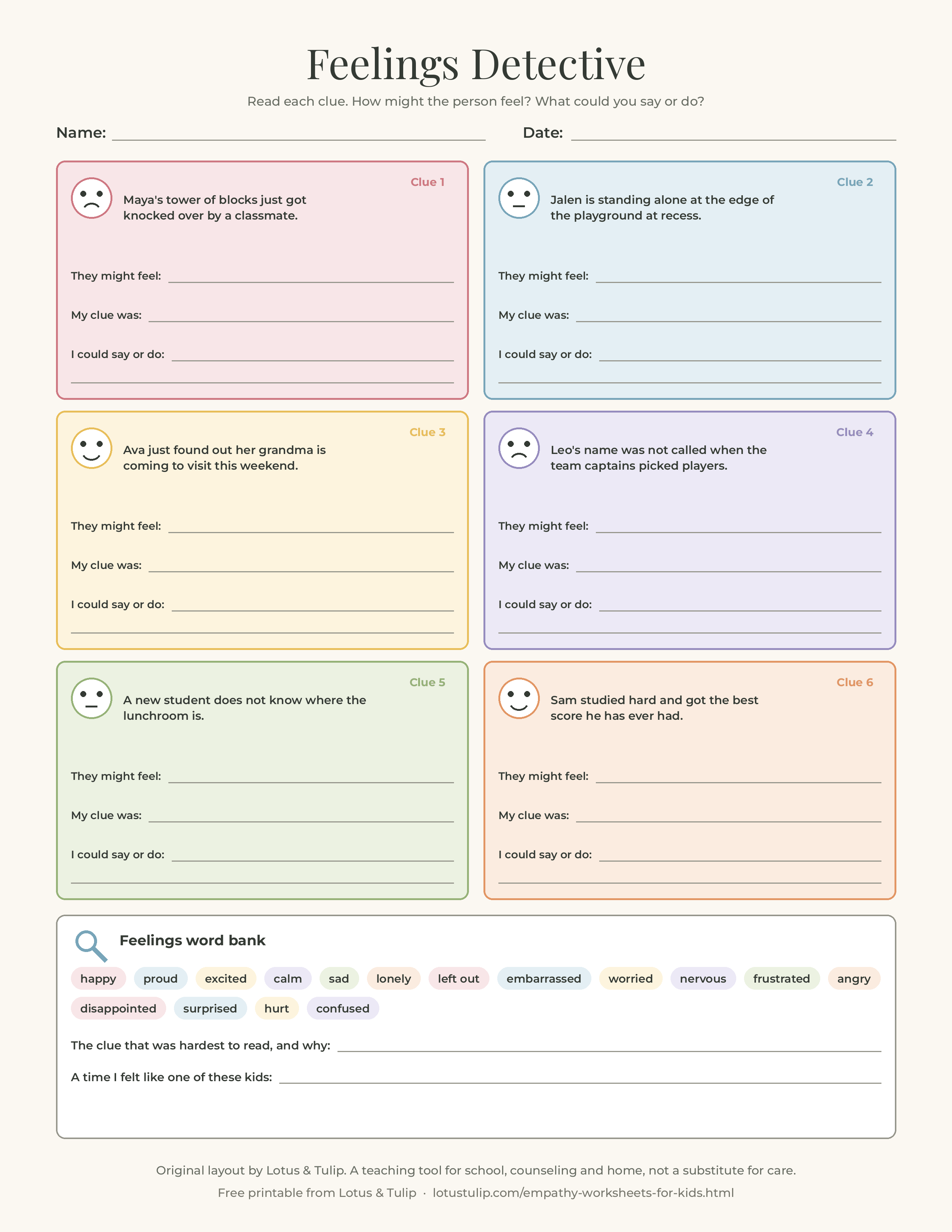
- Feelings detective. Show a photo, a short scenario or a picture book illustration. Students name the feeling and, crucially, the clue that told them. Page 1 of the free printable has six ready made clue cards and a feelings word bank.
- Read aloud pauses. Stop at key moments in a story and ask: "What is this character feeling? What do they want? What would you say to them?" Picture books and chapter books with characters who are left out, new, or misunderstood work especially well.
- Two sides of the story. Retell a familiar story (a fairy tale, a historical event, a playground disagreement written as a scenario) from another character's point of view. This builds cognitive empathy without putting any real child on the spot.
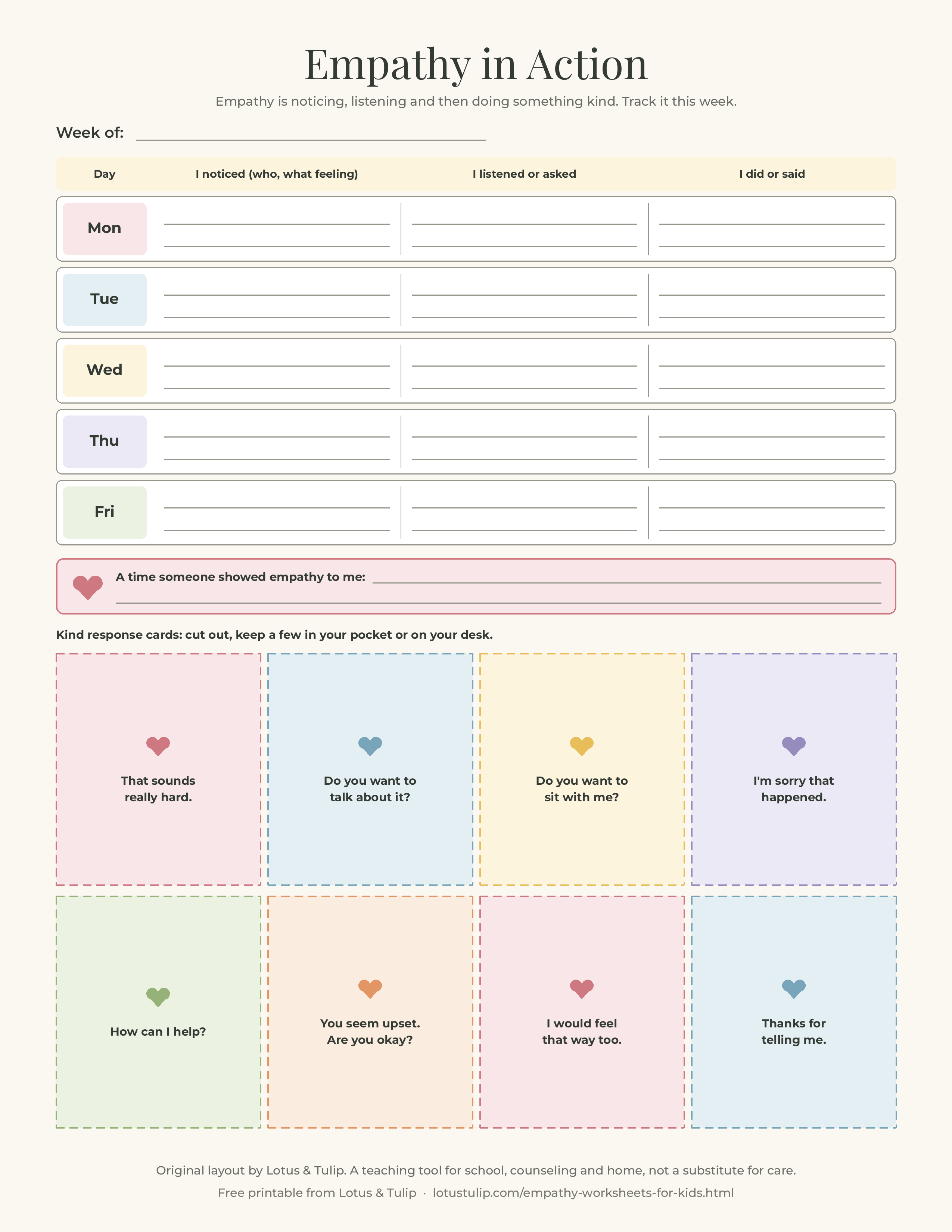
- Role play kind responses. Practice what to actually say. Students take turns playing someone who is upset while a partner tries "That sounds hard," "Do you want to sit with me?" or "How can I help?" Use the cut out kind response cards on page 3.
- Active listening partners. One student talks for a minute about something that matters to them while the partner listens without interrupting, then reflects back what they heard. Making Caring Common recommends similar listening practice.
- Circle of concern mapping. Students draw circles: people they care about most in the center, then classmates, school staff and the wider community. Ask who is often missed (a new student, a custodian, a quiet classmate) and plan one small action for someone in an outer circle.
- Morning meeting check ins. A quick feelings check in each morning gives students daily practice reading and naming feelings and shows that the class notices each other. Our daily check in sheet for students works well for this.
- Kindness in action. Empathy and kindness are closely linked. Our kindness activities for kids guide has a Kindness Bingo card and a school week plan that pair well with empathy lessons.
Empathy activities for school counselors and therapists
In small groups and individual sessions, you can go deeper and use children's real situations.
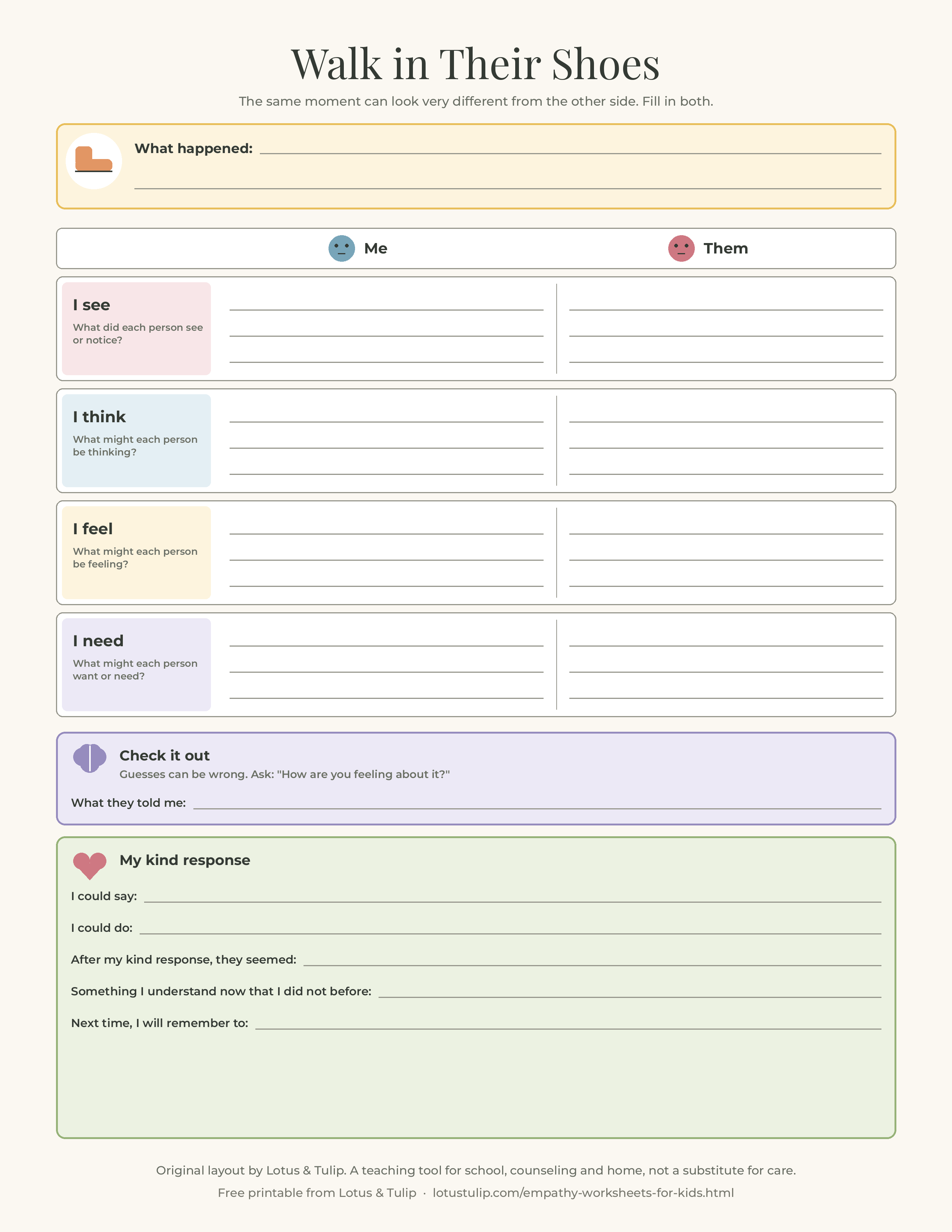
- Walk in Their Shoes on a real conflict. After a disagreement has cooled down, use page 2 of the printable to fill in what each person saw, thought, felt and needed. Children are often genuinely surprised to discover that the other child's behavior made sense from their side.
- Feelings charades and emotion cards. Act out feelings with face and body only while others guess. Then discuss: which feelings were easy to read and which were hard? This is useful practice for children who miss social cues.
- Puppets and play. For younger children, puppets or figures allow empathy practice at a safe distance. "The bunny wasn't invited to the party. What might the bunny feel? What could the bear do?" Our play therapy prompts are useful here.
- Repair after harm. When a child has hurt someone, empathy questions are more effective than lectures: "What happened? Who was affected? How do you think they felt? What could make it right?" This mirrors restorative approaches many schools use.
- Combine with problem solving. Once a child understands the other person's view, the next question is "So what could we do?" Our problem solving worksheet for kids and conflict resolution worksheet build on this step.
- Self empathy. Children who are harsh with themselves often struggle to be gentle with others, and vice versa. Practicing kind self talk ("This is hard, and I can keep trying") is a related skill. See our positive self talk worksheet.
How to teach empathy at home
- Name feelings in everyday life. "Grandpa seems tired today." "Your sister looks frustrated with that puzzle." Children learn the language of feelings by hearing it used about real people.
- Ask "how do you think they felt?" more than "say sorry." A forced apology teaches a script. A genuine question teaches perspective taking. After the conversation, an apology often comes more naturally.
- Show empathy to your child. Children learn empathy partly by receiving it. "You're really disappointed that the playdate got canceled. That makes sense." Acknowledging a feeling is not the same as giving in to a demand.
- Talk about characters in books, shows and movies. Fiction is a low pressure way to practice imagining other people's thoughts and feelings.
- Make caring a family expectation. Making Caring Common suggests that adults make caring for others a clear priority, for example by asking about kindness as often as about grades or scores.
- Widen the circle. Notice people your family usually overlooks: a neighbor who lives alone, a new family at school, the bus driver. Talk about what their day might be like and what small thing might help.
- Use the Empathy in Action tracker. Once a week, look at page 3 together and talk about who your child noticed and what they did. Keep it light and curious, not a performance chart.
How to teach empathy to kids, step by step
- Build a feelings vocabulary first. Children cannot understand others' feelings without words for them. Start with basic feelings and add more subtle ones such as disappointed, embarrassed, left out and frustrated. A feelings wheel helps.
- Teach the four steps: Notice, Imagine, Check, Act. Introduce them as a simple sequence and post them where children can see them.
- Practice reading clues. Use the Feelings Detective page with scenarios, photos or book pictures. Always ask for the clue as well as the feeling, so children learn to look for evidence.
- Practice perspective taking at a safe distance. Start with stories, characters and made up scenarios before moving to real conflicts. It is easier to imagine another view when you are not upset yourself.
- Teach checking and listening. Model asking "Are you okay?" and listening without fixing. Role play it until it feels natural.
- Give children words and actions. Teach specific kind responses and helpful actions so the empathy action gap gets smaller. The kind response cards on page 3 are a starting point.
- Apply it to real situations. When a conflict or hurt happens, once everyone is calm, use the Walk in Their Shoes page to explore both sides.
- Notice and name empathy when it happens. "I saw you check on Mia when she fell. That was empathy in action." Specific acknowledgment works better than prizes, which can shift children's attention from the other person to the reward.
- Keep it going all year. Because short programs tend to fade, revisit the steps regularly through morning meetings, read alouds, group sessions and family conversations.
Tips that make empathy worksheets work
- Talk more than write. The worksheet is a structure for a conversation. With younger children, an adult can read and scribe while the child talks.
- Accept more than one right answer. Different people can feel different things in the same situation. If a child says the boy whose tower was knocked over might feel "angry" rather than "sad," ask for their clue. Both can be right.
- Do not use worksheets as punishment. Handing a Walk in Their Shoes page to a child as a consequence turns empathy into a chore. Use it as a calm, supported reflection.
- Include the child's own feelings. Children who feel unheard rarely have room for others. Start by understanding their side, then move to the other person's.
- Adapt for different learners. Children who find faces hard to read may do better with situation clues and explicit rules ("If someone is crying, they might be sad or hurt. You can ask."). That is a valid path to empathy, not a lesser one.
Common mistakes when teaching empathy
- Treating a lack of empathy as a character flaw. Many children who seem unkind are overwhelmed, lacking skills or missing cues. Teach the skill before judging the child.
- Forcing apologies. "Say sorry" teaches compliance, not empathy. Help children understand the impact first.
- Telling children how they should feel. "Don't be sad, it's just a game" teaches children that feelings are wrong. Acknowledge, then help.
- Expecting empathy from a dysregulated child. A child in the middle of a meltdown cannot take another's perspective. Calm first, talk later.
- Stopping at feelings. Understanding without action leaves children unsure what to do. Always end with "What could you say or do?"
- Running one empathy unit and moving on. As the research above shows, effects of short programs fade. Small, regular practice beats one big unit.
- Using empathy lessons as a bullying policy. Empathy lessons support a caring school climate, but they do not replace clear rules, adult supervision and a proper response to bullying. Our friendship worksheets for kids cover the difference between friendship problems and bullying.
Free empathy worksheets for kids (PDF)
This free printable is an original Lotus & Tulip design, sized for US Letter paper and suited to about ages 5 to 12 (kindergarten to grade 6) in classrooms, counseling sessions, small groups and at home. Younger children can use it with an adult reading and writing for them. It has three pages:
- Page 1: Feelings Detective. Six situation clue cards (a knocked over tower, a child alone at recess, a grandparent visit, not being picked for a team, a lost new student and a proud test score). For each, children write how the person might feel, the clue that told them, and what they could say or do, with a 16 word feelings word bank and two reflection prompts.
- Page 2: Walk in Their Shoes. A perspective taking worksheet: what happened, then side by side "Me" and "Them" columns for what each person sees, thinks, feels and needs, a "Check it out" box for asking the other person, and a kind response plan.
- Page 3: Empathy in Action. A Monday to Friday tracker (I noticed, I listened or asked, I did or said), a prompt about a time someone showed empathy to me, and eight cut out kind response cards such as "That sounds really hard," "Do you want to sit with me?" and "How can I help?"
Download the free empathy worksheets for kids (PDF, 3 pages, US Letter)
Prefer single images? Page 1: Feelings Detective (PNG) · Page 2: Walk in Their Shoes (PNG) · Page 3: Empathy in Action and Kind Response Cards (PNG)
Free to print for your own use and for use with your own students, clients or children. Please link to this page rather than re-uploading the file.
Related resources
- Lying and honesty worksheets for kids: why kids lie, what research shows and a free honesty plan
- Sibling rivalry worksheets for kids: seeing a sibling's side and making a fair deal, free printable
- Kindness activities for kids (free printable)
- Friendship worksheets for kids (free printable)
- Emotional regulation worksheets for kids (free printable)
- Feelings wheel for kids
- Conflict resolution worksheet (free printable)
- Problem solving worksheet for kids (free printable)
- I statements worksheet (free printable)
- Self esteem worksheets for kids (free printable)
- Daily check in sheet for students
Sources
- Bloom, P. (2016). Against Empathy: The Case for Rational Compassion. Ecco.
- CASEL. The CASEL 5: social awareness. casel.org (What Is SEL? and CASEL's SEL Framework, 2020).
- Connolly, P., Miller, S., Kee, F., et al. (2018). A cluster randomised controlled trial and evaluation and cost-effectiveness analysis of the Roots of Empathy schools-based programme for improving social and emotional well-being outcomes among 8- to 9-year-olds in Northern Ireland. Public Health Research, 6(4). NIHR Journals Library.
- Durlak, J. A., Weissberg, R. P., Dymnicki, A. B., Taylor, R. D., and Schellinger, K. B. (2011). The impact of enhancing students' social and emotional learning: a meta-analysis of school-based universal interventions. Child Development, 82(1), 405 to 432.
- Making Caring Common, Harvard Graduate School of Education. How to Build Empathy and Strengthen Your School Community; Circle of Concern Strategy. mcc.gse.harvard.edu.
- Making Caring Common (2014). The Children We Mean to Raise: The Real Messages Adults Are Sending About Values. Harvard Graduate School of Education.
- Malti, T., Chaparro, M. P., Zuffianò, A., and Colasante, T. (2016). School-based interventions to promote empathy-related responding in children and adolescents: a developmental analysis. Journal of Clinical Child and Adolescent Psychology, 45(6), 718 to 731.
- Schonert-Reichl, K. A., Smith, V., Zaidman-Zait, A., and Hertzman, C. (2012). Promoting children's prosocial behaviors in school: impact of the "Roots of Empathy" program on the social and emotional competence of school-aged children. School Mental Health, 4(1), 1 to 21.
- Wellman, H. M., Cross, D., and Watson, J. (2001). Meta-analysis of theory-of-mind development: the truth about false belief. Child Development, 72(3), 655 to 684.
- Zahn-Waxler, C., Radke-Yarrow, M., Wagner, E., and Chapman, M. (1992). Development of concern for others. Developmental Psychology, 28(1), 126 to 136.
Empathy worksheets for kids: FAQ
What is empathy for kids?
For kids, empathy means understanding how someone else feels and caring about it, and then doing something kind. It has a feeling part (sharing some of another person's emotion), a thinking part (imagining their point of view) and a caring part (wanting things to be better for them).
What is the difference between cognitive and affective empathy?
Affective empathy is feeling some of what another person feels, like getting sad when a friend is sad. Cognitive empathy is understanding what someone thinks or feels, even if you do not feel it yourself, which relies on perspective taking. Children need both, plus the calm and the words to act on them.
At what age do children develop empathy?
Early signs appear in toddlers, who often begin comforting others in their second year. Understanding that other people can think differently grows around age 4, and more complex perspective taking (mixed feelings, other people's backgrounds, groups) keeps developing through elementary and middle school and beyond.
How do you teach empathy to kids?
Build a feelings vocabulary, teach a simple sequence such as Notice, Imagine, Check, Act, practice reading clues and taking perspectives with stories and scenarios, teach specific kind words and actions, apply the steps to real situations once everyone is calm, and keep practicing regularly rather than in one unit.
What are some good empathy activities for kids?
Feelings detective games with photos or scenarios, read aloud pauses to discuss characters' feelings, retelling stories from another character's view, role playing kind responses, active listening partners, circle of concern mapping and service projects followed by reflection all give children practice.
Do empathy programs actually work?
Research shows small but real benefits. A 2016 review of 19 school based empathy programs found small positive effects on social skills, behavior and academics. Roots of Empathy studies found improvements in prosocial behavior and reductions in aggression, though measured empathy did not clearly change and some gains faded. Ongoing practice seems to matter more than a short unit.
Are these empathy worksheets free?
Yes. The three page empathy worksheets for kids are free to print for your own use and for use with your own students, clients or children. Please link to this page rather than re-uploading the file.