
Kids and teens · Sibling rivalry for kids 4 to 12 · Updated 2026-11-15
Sibling rivalry worksheets for kids: why siblings fight, what research shows and a free sibling feelings map and fair play plan

Ages 5 to 11: Kids Feelings and Social Skills Worksheets, incl. feelings detective, body clues, a feelings thermometer, a coping skills menu and a calm down plan Holiday 20% off: about $11.04, was $14 (EUR 12) · fillable PDF, instant digital download
Buy on EtsyTry it free first: download a fillable sample (feelings thermometer and calm-down plan, PDF, 240 KB). Type into it on screen, then get the full pack. No email needed.
For big blow ups: Anger Management Worksheets for Kids and Teens, all 18 worksheets Holiday 20% off: about $9.20, was $12 (EUR 10) · instant digital download
Buy on EtsyKids and teens bundle: Kids and Teens Worksheets Bundle (feelings, anger, self esteem, social anxiety) Holiday 20% off: about $22.08, was $28 (EUR 24) · 80 pages, instant digital download
Buy on Etsy"He took my Lego!" "She's looking at me!" "That's not fair, you always let him go first!" If your home sounds like this some days, you are in good company. Brothers and sisters are often a child's first friends and first rivals at the same time, and the fights can wear down even the calmest parent. The goal is not a home with no conflict. It is a home where children slowly learn to name their feelings, say what they need and work out a deal, with less refereeing from you.
This guide is for parents, school counselors, teachers and therapists supporting children about 4 to 12. It explains why siblings fight, what research shows about sibling conflict and sibling aggression, why the most common responses often backfire, what worksheets can and cannot do, eight kinds of sibling rivalry worksheets, nine steps to use them, age adaptations, the school side, common mistakes and three short examples. It ends with a free 2 page printable: My Sibling Feelings Map and Our Fair Play Plan.
When sibling fighting is not ordinary rivalry: rivalry goes both ways and is mixed with good times. It is time to get help if the hurting is one sided (the same child is always the target), happens over and over, is meant to humiliate or frighten, causes injuries, involves threats or weapons, makes a child afraid to be home or alone with a sibling, or involves any sexual touching. Talk with your child's doctor or a licensed therapist. For advice about possible abuse, call or text the Childhelp National Child Abuse Hotline at 1-800-422-4453. If a child talks about wanting to die or hurting themselves, call or text 988 (the 988 Suicide and Crisis Lifeline). If anyone is in immediate danger, call 911.
Download the free sibling rivalry worksheets for kids (PDF, 2 pages, US Letter)
Direct download, no email or sign up. See the pages first. Fights turning into big blow ups? See anger management activities for kids. Want a simple deal making script? See the conflict resolution worksheet.
What sibling rivalry is, in plain words
Sibling rivalry is the competition, jealousy and fighting between brothers and sisters. It shows up as arguments over toys, turns, space and screens, teasing, tattling, keeping score and the constant question of who gets more: more attention, more time, more stuff or more praise. Most of it is a normal part of growing up together. Children who share a home, a parent's attention and a lot of hours practice their social skills on each other first, the good ones and the rough ones.
The same relationship is also a source of warmth. Siblings play, comfort, teach and stick up for each other. Researchers usually describe sibling relationships along two separate lines, warmth and conflict, and many brothers and sisters are high on both. That matters for the goal: you are not only trying to cut the fighting, you are also trying to grow the good moments.
Why siblings fight
- Competition for a parent's attention. Attention is the thing children want most, and a sibling is the most obvious competitor for it.
- Feeling that things are unfair. Different bedtimes, privileges and rules can feel like proof that a parent loves the other child more, even when there are good reasons.
- Age and stage. A 3 year old who grabs and a 7 year old who wants their creation left alone will clash. Children close in age often compete more directly.
- Temperament and needs. An intense or impulsive child, or a child with ADHD, autism, anxiety or a medical condition, may need more support, and siblings notice.
- Missing skills. Young children do not yet have the words, patience or problem solving skills to settle a disagreement, so they shout, grab or hit.
- Stress at home. A new baby, a move, divorce, money worries or a tired, stretched parent all raise the temperature.
- Boredom and closeness. Long car rides, rainy days and shared rooms simply give more chances for friction.
What the research shows, honestly
Sibling aggression is very common, especially in young children. In the US National Survey of Children's Exposure to Violence, Tucker and colleagues (2013) found that 37.6% of children and teens up to age 17 had been victimized by a brother or sister living with them in the past year, including physical, property and psychological aggression. Rates peaked at 45% for children aged 2 to 5 and 46% for those aged 6 to 9, and were higher for boys, for siblings closer in age and for brother and brother pairs. A UK study of 4,237 adolescents (Tippett and Wolke, 2015) found that 46% had been victimized by a sibling and 36% had been aggressive toward one, using a broad definition that included teasing.
It is not always harmless. In a national US sample of 3,599 children and teens, those who experienced sibling aggression in the past year, from psychological aggression to mild or severe physical assault, reported more mental health distress, and sibling and peer aggression each predicted worse mental health on their own (Tucker and colleagues, 2013, Pediatrics). In the same survey, about 15% of children and of teens had been victimized by both a sibling and a peer, and those children reported the most distress (Tucker and colleagues, 2014). In a UK birth cohort of more than 6,900 young people, children who said at age 12 that they were frequently bullied by a sibling were about twice as likely to have depression (odds ratio 2.16) and self harm (2.56) at 18, and more likely to have anxiety (1.83), even after accounting for other family and peer factors (Bowes and colleagues, 2014). A review in The Lancet Psychiatry estimated that up to 40% of children are exposed to sibling bullying every week and urged health professionals to ask about it (Wolke, Tippett and Dantchev, 2015). These are associations, not proof that sibling fights cause later problems, but they are a good reason not to brush off repeated, one sided bullying as "just kids being kids."
Parenting is the factor most strongly linked to sibling aggression. In the UK study, harsh parenting was linked to more sibling aggression and positive parenting protected against it (Tippett and Wolke, 2015). Larger families, male siblings and financial difficulties were also linked to higher rates.
Ignoring fights does not reliably make them go away, especially with young children. Kramer, Perozynski and Chung (1999) recorded 88 two child families at home with a younger child aged 3 to 5. Passive nonintervention was strongly associated with more conflict afterward, and younger sibling pairs were more antagonistic when parents did not step in. With older pairs the picture was different: they were less involved and less close when mothers intervened in any way. In a Canadian study of 40 families with 2 and 4 year olds, parents tended to step into the most intense fights, and after parent intervention children used fewer power moves and more mature negotiation (Perlman and Ross, 1997).
Coaching children to solve it themselves helps. When mothers were trained to mediate disputes between children aged 5 to 8, children reasoned, talked about feelings and understood each other's motives more often, and younger siblings in particular gained a voice (Siddiqui and Ross, 2004). In a randomized study of 48 families with children aged 5 to 10, children whose parents were trained in mediation used more constructive strategies, compromised more often, showed less negativity when settling repeated conflicts alone and understood their sibling's point of view better (Smith and Ross, 2007).
"Fair" matters more than "equal." In a study of 135 children (average age about 12) and their older siblings, children who were treated differently by their parents had fewer emotional problems and higher self esteem when they saw that different treatment as fair (Kowal, Kramer, Krull and Crick, 2002). In 74 families with teens, differences in treatment were linked to poorer parent and child relationships only when the teen judged them unfair (Kowal, Krull and Kramer, 2004). The authors suggest families talk openly about why each child gets what they get.
Programs that teach siblings skills can help. In the More Fun with Sisters and Brothers program, siblings aged 4 to 8 from 95 families learned emotional and social skills. Compared with a wait list group, sibling relationship quality and children's emotion regulation improved, and children needed less parent direction to manage negative feelings (Kennedy and Kramer, 2008). A follow up analysis found mothers in the program also reported better emotion regulation of their own (Ravindran and colleagues, 2015). In Siblings Are Special, a randomized trial with 174 families, fifth graders and a younger sibling in grades 2 to 4 joined 12 weekly after school sessions and three family nights. The program improved positive sibling relationships, parents' strategies, children's self control, social competence and school performance, but it did not reduce sibling conflict itself in the short term (Feinberg and colleagues, 2013). That is an honest reminder that building warmth and skills is a slower, steadier route than trying to stamp out every fight.
What we do not know. Most studies are modest in size, many come from the UK or Canada, and much of the evidence is correlational. No study has tested sibling rivalry worksheets on their own. Worksheets are best seen as a practical way to put the tested ideas (naming feelings, coached problem solving, fairness talks and warm time together) into everyday family life.
Why the usual responses backfire
- "Who started it?" Trials rarely find the truth, the child who is better at arguing usually wins, and the other child learns that sneaky provocation pays. Focus on what each child needs now.
- Always ignoring it. Leaving young children to "work it out" can teach that the bigger or louder child wins. Research with preschool age siblings links nonintervention to more conflict later.
- Always taking over. Deciding every dispute for them keeps you the referee forever and, with older children, can make siblings less close. Coach instead of judge.
- Comparing. "Why can't you be more like your sister?" feeds the exact competition you are trying to calm, and it can stick for years.
- Making everything exactly equal. Counting chips and minutes teaches children to keep score. Children cope better with differences they understand as fair.
- Harsh punishment and yelling. Harsh parenting is linked to more sibling aggression. It also models the very behavior you want to stop.
- Forced apologies. A grumbled "sorry" on command teaches little. A short repair, such as fixing the tower or offering a turn, teaches more.
What sibling rivalry worksheets can and cannot do
Worksheets can slow things down. They give a child words for jealous, left out and mad, turn a shouting match into a turn taking conversation, make family rules visible and give you a calm script to follow when you are tired. They also give school counselors and therapists a quick, concrete way to talk about home life without blaming anyone.
Worksheets cannot fix a home where a child is being hurt, replace your attention or warmth, or treat ADHD, anxiety, depression or trauma. They will not work in the middle of a meltdown. Use them when everyone is calm, and get professional help when the safety signs above apply.
8 kinds of sibling rivalry worksheets for kids
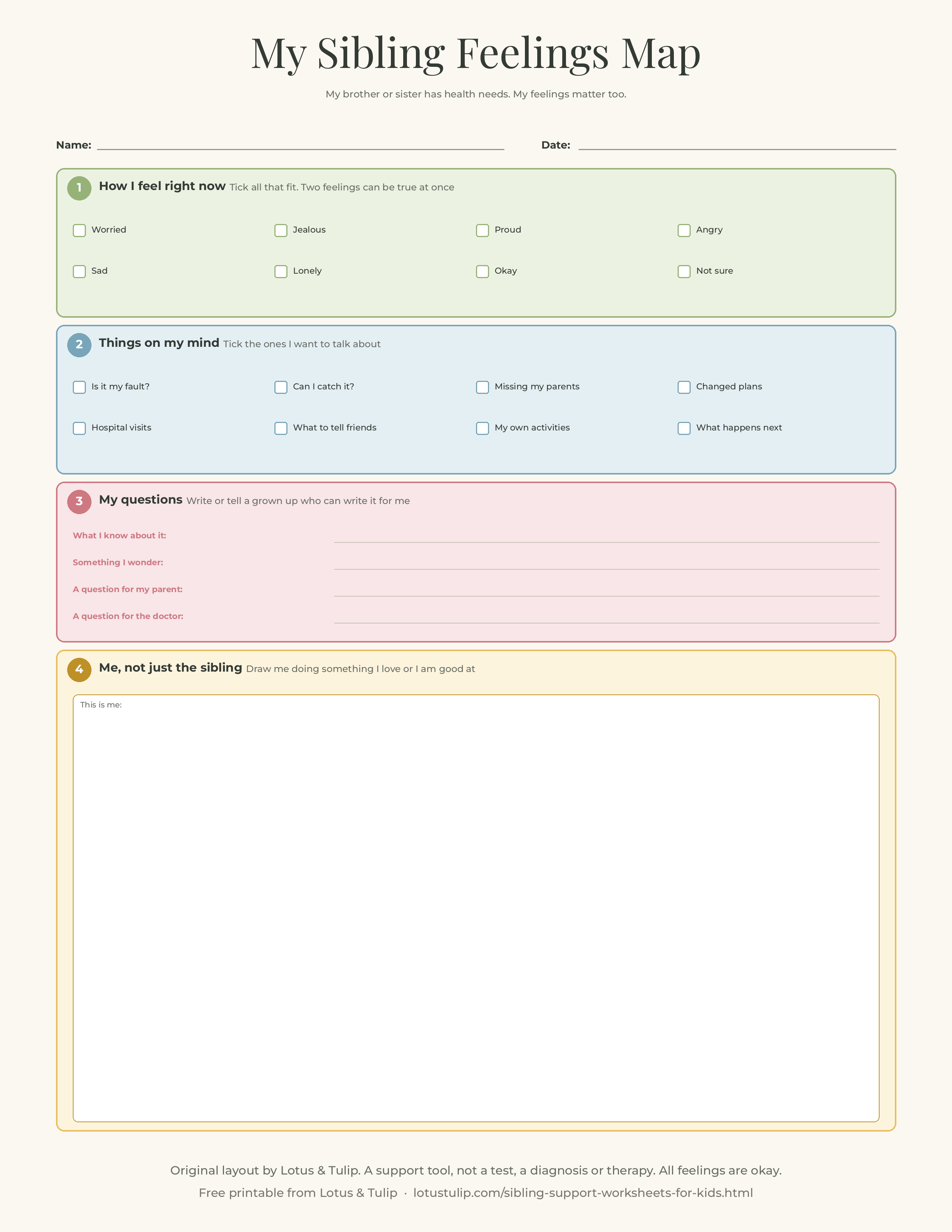
- Sibling feelings map. What a brother or sister does that bothers me most and how I feel about it: mad, jealous, left out, hurt or worried.
- Trigger tracker. When, where and over what the fights happen, such as screens after school or the back seat of the car, so you can change the setup.
- Calm down choices. A short menu of what I can do instead of hitting or yelling: walk away, take a break, use my words, ask a grown up.
- Two sides, one deal. A mediation page where each child says what happened, how they feel and what they want, then both build a deal that is fair to both.
- Fair is not always equal. A page that explains why a baby, a teen and a 7 year old get different things, and helps children name what they each need.
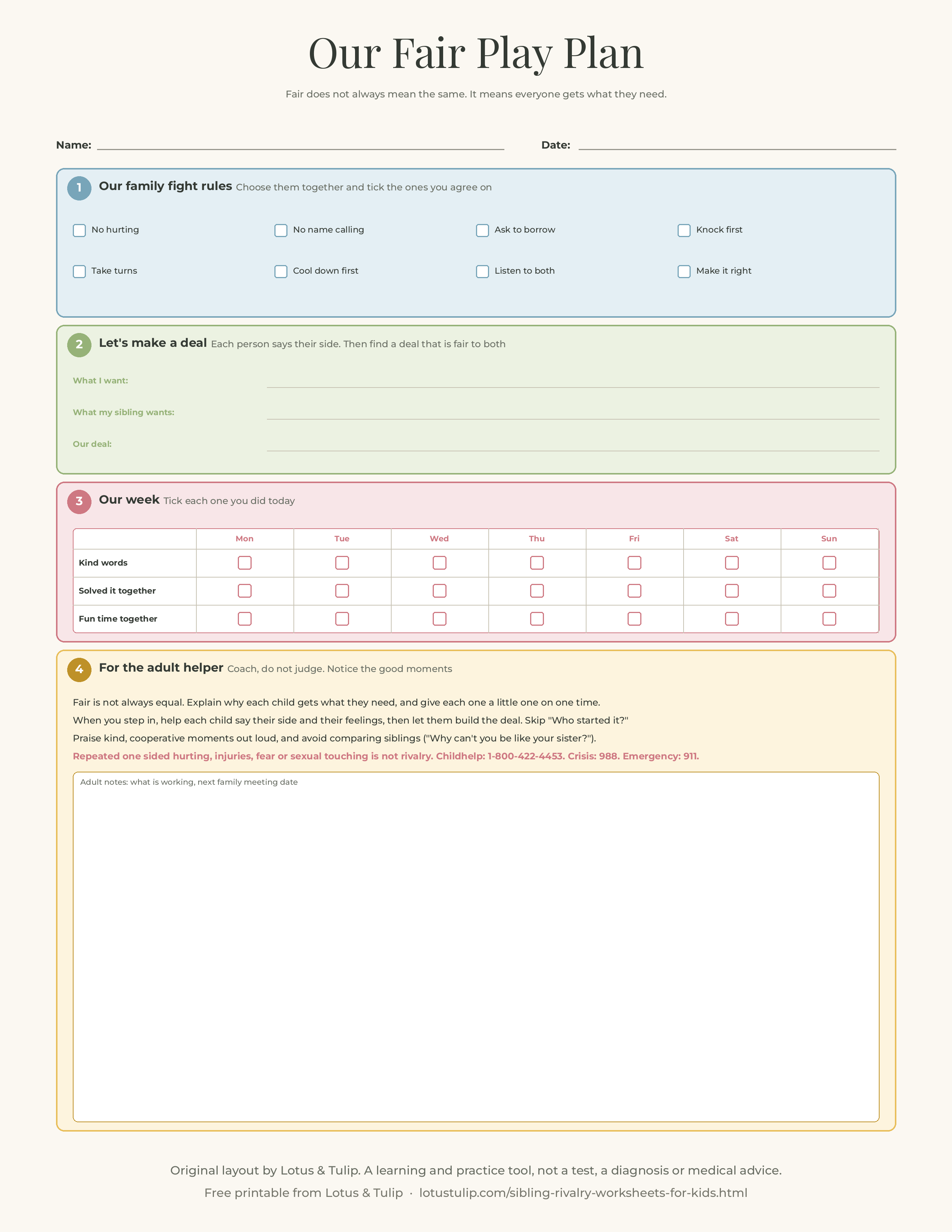
- Family fight rules. A short list of rules the family agrees on together, such as no hurting, no name calling, ask before borrowing and knock first.
- Good things about my sibling. Strengths, shared interests and fun memories, which grow the warm side of the relationship.
- Kindness and teamwork tracker. A weekly chart for kind words, solving a problem together and fun time together, noticed and praised by an adult.
How to use sibling rivalry worksheets for kids, step by step
- Choose a calm time. Never introduce a worksheet in the middle of a fight. Pick a quiet moment, ideally with each child alone first, and say: "Having a brother or sister can be fun and hard. I want to hear how it is for you."
- Fill in the Sibling Feelings Map with each child. Let them tick what bothers them and how they feel. Do not argue, defend the sibling or correct the feelings. Simply say: "That sounds really frustrating."
- Look for patterns. Compare what each child ticked and when fights happen. Many families find a few hot spots, such as screens, the car or the hour before dinner, that a simple change can cool down.
- Agree on family fight rules together. Hold a short family meeting and use Our Fair Play Plan to pick four to six rules everyone can live with. Rules children help write are easier for them to remember and follow.
- Practice calm down choices before you need them. Have each child circle two things to try next time, then role play a pretend fight and practice walking away, taking a break or asking for help.
- Coach the deal, do not judge it. When a real dispute comes up and nobody is getting hurt, step in as a coach: each child says their side and how they feel, you repeat back what you hear, and they suggest ideas until there is a deal that is fair to both. Write it in the Let's Make a Deal box.
- Step in fast when anyone is getting hurt. Separate the children, check for injuries and give everyone time to calm down. Talk it through later. Physical hurting, threats and humiliation are always a stop, not something to mediate.
- Talk about fair versus equal. Explain, without apology, why each child gets what they need: "Your brother goes to bed later because he is older. When you are 9, you will too." Give each child a little one on one time that is theirs.
- Notice and celebrate the good moments. Use the weekly tracker to tick kind words, problems solved together and fun time together. Praise specific cooperation out loud, and review the plan every week or two.
How to adapt it by age
- Ages 4 to 6: keep it very short and visual. Read the feeling words aloud, let children point or color, and act out the calm down choices with toys. Stay close during play and step in early, since young children need more help settling fights. A sand timer makes turn taking concrete.
- Ages 7 to 9: children can fill in most of the map on their own and take part in deal making. This is a good age for family meetings, written fight rules and the fair versus equal talk. Expect lots of "That's not fair!" and answer it calmly and consistently.
- Ages 10 to 12: respect privacy and growing independence. Let preteens write their own rules for their space and belongings, and lead their own deals while you check in afterward. Older siblings may resent being the "babysitter" or being expected to always give in, so name that and share responsibilities fairly.
- New baby in the family: keep the older child's routines steady, give them a real helper job if they want one, protect daily one on one time and accept mixed feelings ("You love her and sometimes you wish she would go back!"). In a small study, firstborns who got along well with friends before the baby came had warmer sibling relationships years later (Kramer and Kowal, 2005), so playdates and friendship skills are worth supporting.
- A sibling with a disability or extra needs: explain the needs in simple words, make room for the typically developing child's own feelings and time, and look for local sibling support groups. Avoid making one child the permanent caregiver.
Sibling rivalry and school: notes for counselors and teachers
Sibling trouble does not stay at home. Being bullied by a sibling is linked to being bullied by peers (Tucker and colleagues, 2014; Tippett and Wolke, 2015), and children bullied in both places report the most distress, perhaps because they have no safe place to escape. When a student is involved in bullying at school, it is worth asking gently about home.
- Use the feelings map in individual sessions or a small group. A short "brothers and sisters" group lets children see that others feel jealous or left out too, and gives them practice with the deal making steps.
- Avoid comparisons between siblings at school. "Your sister was such a strong reader" can sting. Treat each child as their own person.
- Think carefully about placing siblings together. Siblings in the same class or group can thrive or compete. Ask families and the children what works for them.
- Share calm, practical tips with families. Send home the free printable with a short note rather than a long list of what parents should do differently.
- Know when to refer and report. Refer to a school psychologist, social worker or outside therapist when fighting is severe or a child seems afraid, anxious or depressed. If you suspect abuse, including sibling sexual abuse, follow your district's mandated reporting procedures.
Buy the kids feelings worksheets on Etsy
Common mistakes
- Using worksheets as punishment. "Go fill in your sibling sheet" after a fight turns a tool into a penalty. Use them in calm times, together.
- Only working with the "problem" child. Both children are part of the pattern. Each one needs a turn to be heard.
- Expecting no fights at all. The goal is fewer, shorter and safer fights, and more good moments. Some conflict helps children learn to negotiate.
- Treating repeated one sided bullying as rivalry. If one child is always the target, is afraid or gets hurt, protect them first and get help.
- Labeling children. "The difficult one" and "the easy one" become roles children live up to.
- Forgetting to refill your own tank. Refereeing all day is exhausting. A calm parent is the most powerful tool in this whole guide, so take your own breaks too.
Examples
- Liam, 6, and Noah, 9: fought most afternoons over the tablet. Their dad filled in the feelings map with each boy separately and found the fights clustered right after school when both were hungry and tired. They added a snack first rule, a 20 minute timer and "Knock first" for Noah's room. Within two weeks the afternoon fights were down to a couple a week.
- Ava, 8, and Mia, 5: Ava often said "Mom loves Mia more" because Mia got help getting dressed. Their mom used the fair versus equal talk and gave Ava ten minutes of reading time alone with her each night. Ava wrote "Our deal: I help Mia with her shoes, Mom reads with me" in the deal box, and ticked kind words on the tracker.
- Carlos, 11: was referred to the school counselor for pushing peers. In session he ticked "Hits or pushes" and "Gets more attention" on the map and said his older brother hit him at home most days. The counselor talked with his parents, who had not realized how often it happened, and connected the family with a therapist. Both boys later worked on the Fair Play Plan with their parents.
Free printable: sibling rivalry worksheets for kids
This printable is an original Lotus & Tulip layout. It is not a test or a clinical tool and gives no score. Page 1, My Sibling Feelings Map, has ticks for what my brother or sister does that bothers me, how I feel and what I can do instead, plus lines and a drawing box for good things about my sibling. Page 2, Our Fair Play Plan, has family fight rules to choose together, a Let's Make a Deal box, a 7 day tracker for kind words, solving it together and fun time together, and notes for the adult helper, including when fighting is not rivalry, the Childhelp hotline and the 988 and 911 numbers.
Download the free sibling rivalry worksheets for kids (PDF, 2 pages, US Letter)
Prefer single images? Page 1: My Sibling Feelings Map (PNG) · Page 2: Our Fair Play Plan (PNG)
Related resources
- Sibling support worksheets for kids: when a brother or sister has a chronic illness, cancer or disability, with a free sibling support plan
- Blended family worksheets for kids: for new stepsiblings and half siblings, with a free blended family plan
- New baby and big sibling worksheets for kids: preparing an older child for a new baby, with a free big sibling plan
- Lying and honesty worksheets for kids: why kids lie, what research shows and a free honesty plan
- Conflict resolution worksheet: a step by step script for working out disagreements
- Anger management activities for kids: calm down ideas for big blow ups
- Tattling vs telling worksheet: when to handle it and when to get a grown up
- Empathy worksheets for kids: seeing a brother's or sister's point of view
- Parenting worksheets: tools for calmer family routines
- All counseling resources for kids and teens
FAQ
Is sibling rivalry normal?
Yes. Arguments, jealousy and teasing between brothers and sisters are very common, especially in young children. In a large US survey, more than a third of children had experienced some aggression from a sibling in the past year, peaking at about 45% in children aged 2 to 9. Most rivalry is mixed with plenty of play and warmth, and it can be a chance to learn to negotiate.
When is sibling rivalry a problem?
Watch for fighting that is constant, one sided, physically harmful or humiliating, or that leaves a child anxious, sad or afraid to be home. Frequent sibling bullying has been linked to more depression, anxiety and self harm later on, so repeated bullying deserves the same attention as bullying at school. Talk with your child's doctor or a therapist if you are worried.
Should I step in or let my kids work it out?
It depends on age and safety. Always step in when someone is getting hurt. With young children, research suggests ignoring fights tends to lead to more conflict, so coach them through it. As children grow, shift from deciding for them to mediating: help each child say their side and feelings, then let them build the deal. Trained parent mediation has been shown to improve children's negotiation and understanding of each other.
What do I say when my child says "It's not fair"?
Acknowledge the feeling, then explain your reasons simply: "You wish you could stay up as late as your sister. She's older, and when you're her age you will too." Studies find that different treatment is far less harmful when children understand it as fair, so open talk about why each child gets what they need helps more than making everything exactly equal.
How can I reduce sibling rivalry with a new baby?
Prepare the older child before the birth, keep their routines steady, offer a helper job if they want one, protect daily one on one time and accept mixed feelings without scolding. Expect some regression, such as baby talk or toileting accidents, for a while. Supporting the older child's friendships also helps, as early friendship skills have been linked to warmer sibling relationships later.
What age are these sibling rivalry worksheets for?
They are designed for children about 4 to 12. Children 4 to 6 can point, color and act out choices with an adult reading aloud. Children 7 to 12 can fill in most of the pages and take part in deal making and family meetings. School counselors and therapists can use them in individual sessions or small groups.
When is sibling fighting abuse?
Sibling fighting becomes abuse when one child repeatedly hurts, threatens, humiliates or controls another, when there are injuries or fear, or when there is any sexual touching. If you are concerned, protect the child who is being hurt, increase supervision and contact a doctor or therapist. You can call or text the Childhelp National Child Abuse Hotline at 1-800-422-4453 for advice. In a crisis call or text 988, and in an emergency call 911.
Sources
- Bowes, L., Wolke, D., Joinson, C., Lereya, S. T., and Lewis, G. (2014). Sibling bullying and risk of depression, anxiety, and self-harm: a prospective cohort study. Pediatrics, 134(4), e1032 to e1039.
- Childhelp National Child Abuse Hotline. 1-800-422-4453. childhelphotline.org.
- Feinberg, M. E., Solmeyer, A. R., Hostetler, M. L., Sakuma, K. L., Jones, D., and McHale, S. M. (2013). Siblings are special: initial test of a new approach for preventing youth behavior problems. Journal of Adolescent Health, 53(2), 166 to 173.
- Kennedy, D. E., and Kramer, L. (2008). Improving emotion regulation and sibling relationship quality: the More Fun With Sisters and Brothers program. Family Relations, 57(5), 567 to 578.
- Kowal, A., Kramer, L., Krull, J. L., and Crick, N. R. (2002). Children's perceptions of the fairness of parental preferential treatment and their socioemotional well-being. Journal of Family Psychology, 16(3), 297 to 306.
- Kowal, A. K., Krull, J. L., and Kramer, L. (2004). How the differential treatment of siblings is linked with parent-child relationship quality. Journal of Family Psychology, 18(4), 658 to 665.
- Kramer, L., and Kowal, A. K. (2005). Sibling relationship quality from birth to adolescence: the enduring contributions of friends. Journal of Family Psychology, 19(4), 503 to 511.
- Kramer, L., Perozynski, L. A., and Chung, T. Y. (1999). Parental responses to sibling conflict: the effects of development and parent gender. Child Development, 70(6), 1401 to 1414.
- Perlman, M., and Ross, H. S. (1997). The benefits of parent intervention in children's disputes: an examination of concurrent changes in children's fighting styles. Child Development, 68(4), 690 to 700.
- Ravindran, N., Engle, J. M., McElwain, N. L., and Kramer, L. (2015). Fostering parents' emotion regulation through a sibling-focused experimental intervention. Journal of Family Psychology, 29(3), 458 to 468.
- Siddiqui, A., and Ross, H. (2004). Mediation as a method of parent intervention in children's disputes. Journal of Family Psychology, 18(1), 147 to 159.
- Smith, J., and Ross, H. (2007). Training parents to mediate sibling disputes affects children's negotiation and conflict understanding. Child Development, 78(3), 790 to 805.
- Tippett, N., and Wolke, D. (2015). Aggression between siblings: associations with the home environment and peer bullying. Aggressive Behavior, 41(1), 14 to 24.
- Tucker, C. J., Finkelhor, D., Shattuck, A. M., and Turner, H. (2013). Prevalence and correlates of sibling victimization types. Child Abuse and Neglect, 37(4), 213 to 223.
- Tucker, C. J., Finkelhor, D., Turner, H., and Shattuck, A. (2013). Association of sibling aggression with child and adolescent mental health. Pediatrics, 132(1), 79 to 84.
- Tucker, C. J., Finkelhor, D., Turner, H., and Shattuck, A. M. (2014). Sibling and peer victimization in childhood and adolescence. Child Abuse and Neglect, 38(10), 1599 to 1606.
- Wolke, D., Tippett, N., and Dantchev, S. (2015). Bullying in the family: sibling bullying. The Lancet Psychiatry, 2(10), 917 to 929.
Lotus & Tulip is not affiliated with the researchers, programs, agencies or organizations named on this page. Names in the examples are invented. This page is educational and does not replace professional advice, diagnosis or treatment.