
Kids and teens · School counseling and classroom SEL · Updated 2026-11-12
Tattling vs telling worksheet: how to teach kids when to tell an adult (free printable)
Bullying group: Stand Strong Bullying Small Group Curriculum, 8 lesson plans and 8 student pages on spotting bullying, speaking up and finding adults Holiday 20% off: about $11.04, was $14 (EUR 12) · instant digital download
Buy on EtsyTry it free first: download session 1 free (group at a glance, lesson plan and student page, PDF, 74 KB). Run it with your group, then get all 8 sessions. No email needed.
Ages 5 to 11: Kids Feelings and Social Skills Worksheets, incl. conflict solving steps, I-statements and stop, think, choose, try Holiday 20% off: about $11.04, was $14 (EUR 12) · fillable PDF, instant digital download
Buy on EtsyTry it free first: download a fillable sample (feelings thermometer and calm-down plan, PDF, 240 KB). Type into it on screen, then get the full pack. No email needed.
Social skills group: Social Skills Small Group Curriculum, Grades 2 to 5, 8 sessions with lesson plans and student pages Holiday 20% off: about $11.04, was $14 (EUR 12) · instant digital download
Buy on Etsy"He's looking at me." "She took my eraser." "They won't let me play." Most adults who work with young children hear reports like these all day, and it is tempting to answer with "don't be a tattletale". The trouble is that the same child who reports a borrowed eraser also needs to report the kid who is shoved off the bus step every morning, the scary secret an older child asked them to keep, or the classmate who said they want to hurt themselves. A rule that discourages telling can silence the reports that matter most.
This guide is for school counselors, teachers, social workers, child therapists and parents of children about 5 to 11. It explains what tattling and telling mean, what research on children's reporting actually shows, a simple three question test kids can use, how to teach it step by step, how adults should respond, and the mistakes to avoid. It ends with a free 2 page printable: a Tattle or Tell? sort with 12 scenarios and a small problem toolbox, and a My Telling Plan page with trusted adults, a how to tell script, surprise vs unsafe secret, a practice log and a response guide for adults.
Download the free tattling vs telling worksheet (PDF, 2 pages, US Letter)
Direct download, no email or sign up. See the pages first.
Tattling vs telling: the difference in one sentence
The classroom version most counselors use is simple: telling (or reporting) is to keep someone safe or get them help; tattling is to get someone in trouble over something small. A child who says "Sam fell off the climber and he isn't getting up" is telling. A child who says "Sam is using the blue crayon and it's my turn next" is usually tattling, and the problem is one they could try to solve themselves.
Two points keep this from turning into a rule that backfires. First, the difference is about the problem, not the child. No child should be labeled a tattletale. Second, the line is not always sharp. A small problem that keeps happening after a child has tried to solve it, or one that involves a power imbalance, can become something to tell. That is why the printable says "Some cards can go either way" and asks children to talk about why.
Many teachers and counselors now prefer the word reporting instead of telling, because it is the same word schools use for bullying and safety concerns. Either works, as long as the whole class hears the same words from every adult.
What research says about tattling
Tattling is very common, mostly truthful, and changes with age. Researchers define it broadly as reporting another person's rule breaking to a third party, often an adult.
- Young children tattle a lot, and they are usually accurate. Gordon Ingram and Jesse Bering (2010, Child Development) observed 40 preschoolers with an average age of about 4 in two preschools. Tattling made up the majority of the children's talk to others about peers' behavior, it was usually truthful, and adults rarely ignored it. Children who tattled more were also more socially dominant and were rated by teachers as more relationally aggressive, a reminder that some tattling is about power in the group.
- At home, it starts with siblings. Irene den Bak and Hildy Ross (1996, Social Development) observed 40 families with 2 and 4 year old siblings. Younger children tattled mainly to recruit a parent's help in a conflict, older ones also tattled simply to inform the parent. A follow up (Ross and den Bak-Lammers, 1998) found that tattling increased with age and was largely truthful.
- Children's own view of tattling shifts in elementary school. Ivy Loke, Gail Heyman and colleagues (2011, Developmental Psychology) showed 60 children aged 6 to 11 short stories about a peer who broke a minor rule (such as not finishing vegetables) or a major one (such as stealing from a classmate). All ages thought reporting the major transgression to a teacher was right. Younger children also approved of reporting the minor ones; older children did not. The authors link this to a peer culture in which reporting carries a growing social cost.
That last finding matters for school counselors. By upper elementary, kids already feel the pressure not to "snitch". If adults add to it with "stop tattling", children may hold back the major reports too.
Why teaching the difference matters: bullying and safety
Many bullied students never tell an adult. In the federal School Crime Supplement for school year 2021 to 22, only about 44 percent of students ages 12 to 18 who were bullied at school said an adult at school was notified. Notification was higher in 6th and 7th grade (62 and 57 percent) than in grades 8 to 12 (32 to 41 percent), and lower for students bullied only online or by text (about 31 percent) (NCES, Condition of Education indicator on student bullying and Digest table 230.60).
StopBullying.gov advises adults to encourage kids to speak to a trusted adult if they are bullied or see others being bullied, and to make sure kids know how to get help. A tattling vs telling lesson is one of the most concrete ways to do that in the early grades: it gives children words, a test and a list of named adults before they need them.
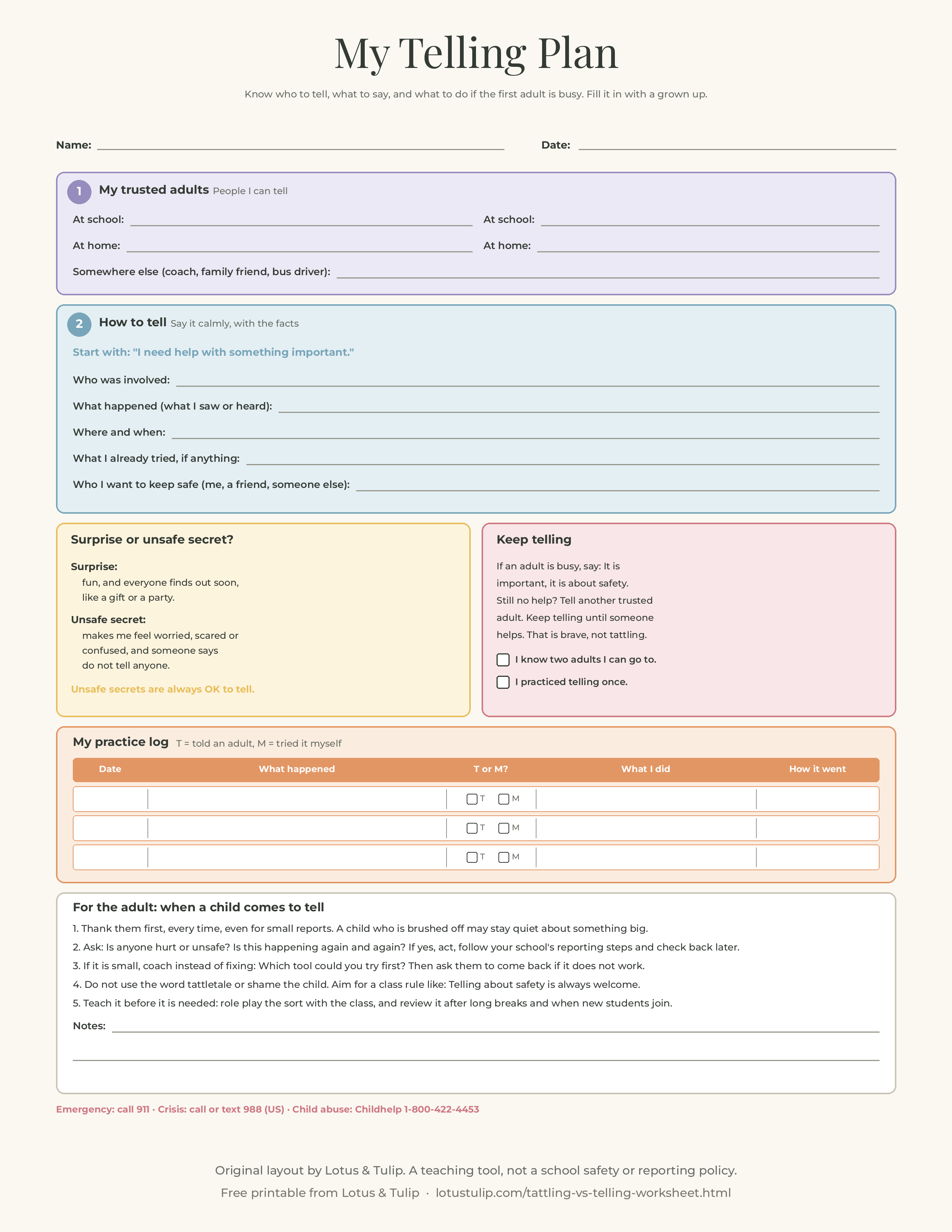
The same skills protect children in situations that are not bullying. Body safety programs commonly teach the difference between a surprise (fun, and everyone finds out soon) and an unsafe secret (it makes you feel worried, scared or confused, and someone says not to tell). The printable includes that box because children should hear, clearly, that unsafe secrets are always OK to tell.
The three question test kids can use
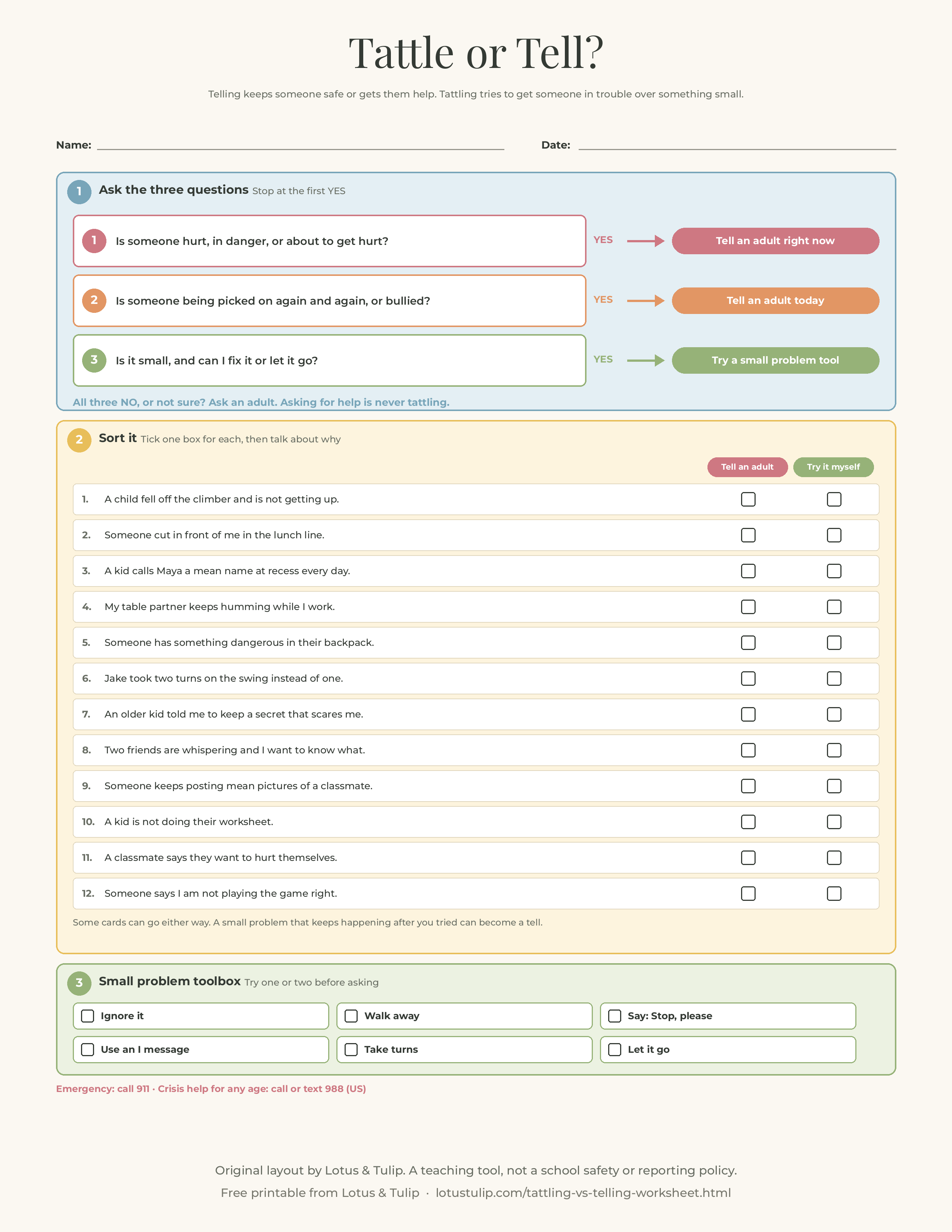
Page 1 of the free printable turns the idea into three questions in order. Children stop at the first yes.
| Question | If yes | Examples |
|---|---|---|
| 1. Is someone hurt, in danger, or about to get hurt? | Tell an adult right now | A fall where a child does not get up, something dangerous in a backpack, a classmate who says they want to hurt themselves |
| 2. Is someone being picked on again and again, or bullied? | Tell an adult today | Daily name calling, being shut out of every game on purpose, mean pictures posted in a group chat |
| 3. Is it small, and can I fix it or let it go? | Try a small problem tool | Line cutting, humming, an extra turn on the swing, someone not doing their own work |
If all three answers are no, or the child is not sure, the answer is still simple: ask an adult. Asking for help is never tattling. The goal is not fewer conversations with adults. It is that small problems come with "I tried walking away and saying stop, and it's still happening" instead of nothing but a complaint.
The small problem toolbox on the same page gives six options children can tick: ignore it, walk away, say "Stop, please", use an I message, take turns and let it go. These link directly to other skills in this collection, such as the size of the problem scale, I statements and the conflict resolution steps.
How to teach tattling vs telling, step by step
- Agree on the words as a staff. Decide whether your school says telling or reporting, and drop the word tattletale from adult vocabulary. Children believe what every adult says, not what one adult says once.
- Explain the purpose before the rule. Start with: "Telling is how we keep people safe and get help. Some problems are small, and you can try to solve those yourself first." Read the one sentence definition at the top of page 1 together.
- Teach the three questions. Walk through them in order with one example each. Have students repeat them with you: hurt or in danger, again and again, small.
- Sort the scenarios together. Use the 12 scenarios on the printable as a whole class or small group sort. Read each one, let children tick a box, then discuss. Spend the most time on the cards that could go either way.
- Practice the small problem tools. Role play two or three small problems and have children try a tool from the toolbox: walk away, say "Stop, please" in a calm, firm voice, or use an I message. Praise the attempt, not only the result.
- Name trusted adults. On page 2, each child writes adults they could tell at school, at home and somewhere else. Help younger children with names and photos. Make sure every child has at least two.
- Rehearse how to tell. Practice the script: "I need help with something important", then who, what happened, where and when, and what they already tried. Include what to do if an adult is busy: "It's important, it's about safety." Then, if needed, tell another adult.
- Respond the same way every time. When a child comes to tell, thank them, ask whether anyone is hurt or unsafe or whether it keeps happening, and either act or coach a small problem tool. See the adult guide below.
- Review and keep it alive. Revisit the sort after long breaks, when new students join and when reports pile up. Use the practice log on page 2 for children who are learning to try a tool first, or who rarely tell anything at all.
How adults should respond when a child comes to tell
How adults react teaches more than any worksheet. The bottom of page 2 has a short guide:
- Thank them first, every time. Even for small reports. A child who is brushed off for the eraser may decide not to come back about something big.
- Ask two questions. "Is anyone hurt or unsafe?" and "Is this happening again and again?" If the answer to either is yes, act, follow your school's reporting procedures, and check back with the child later so they know telling worked.
- If it is small, coach instead of fixing. "Which tool could you try first?" Then invite them back if it does not work. Over time this moves the child from reporting to problem solving.
- Never shame. Avoid "tattletale" and sighing at the child. A class rule like "Telling about safety is always welcome" says what you want.
School staff are mandated reporters of suspected child abuse or neglect under state law. A tattling lesson does not change those duties, and any disclosure of abuse goes straight to your school's procedure, not to a worksheet.
Adapting it by age and need
Pre-K to grade 1. Use pictures and act out the scenarios with puppets. Keep to two categories, "tell now" and "try first", and expect a lot of small reports; at this age that is normal and often accurate. Celebrate any attempt at a tool.
Grades 2 to 5. Use the full sort and the three questions. Add the idea that a small problem can become a tell when it keeps happening, and talk directly about the worry of being called a snitch. Pair it with a lesson on what bullying is (unwanted, a power imbalance, repeated), such as the sorting page in our bullying worksheets for kids.
Students with disabilities or language needs. Visual supports help: a picture card for "I need help", the scenario cards with simple drawings, and the trusted adults written with photos. Some children over-report everything and need practice with the small problem tools; others under-report and need repeated, low pressure practice in telling. Coordinate with the child's IEP team where relevant.
Common mistakes
- "Don't tattle" as a blanket rule. It teaches children to stay quiet, including about bullying and safety.
- Only teaching the small problems. Children need as much practice with "tell now" scenarios as with "try it myself" ones.
- No named adults. "Tell a trusted adult" means little to a six year old until the adults have names and faces.
- Forgetting online problems. Mean posts and group chats are among the reports students make least often. Include at least one in the sort.
- Not following up. If a child tells and nothing seems to happen, they learn that telling does not work. Check back, even briefly.
- One lesson and done. The skill needs review across the year, especially after long breaks.
Free tattling vs telling worksheet
This free printable is an original Lotus & Tulip layout on US Letter. Page 1, Tattle or Tell?, has the three questions as a stop at the first yes flow (hurt or in danger, picked on again and again, small and fixable), 12 scenarios to sort with tick boxes for "Tell an adult" and "Try it myself", and a small problem toolbox with six tools. Page 2, My Telling Plan, has trusted adults at school, at home and elsewhere, a how to tell script (who, what, where and when, what I tried, who I want to keep safe), surprise or unsafe secret, a keep telling box with two self checks, a 3 row practice log and a short guide for the adult, with 911, 988 and the Childhelp hotline.
Download the free tattling vs telling worksheet (PDF, 2 pages, US Letter)
Prefer single images? Page 1: tattle or tell sort (PNG) · Page 2: my telling plan (PNG)
Free to print for use with your own students, clients or children. Please link to this page rather than re-uploading the file. A teaching tool, not a school safety, bullying or child abuse reporting policy. In an emergency in the US, call 911. For crisis support for any age, call or text 988. The Childhelp National Child Abuse Hotline (1-800-422-4453) offers support and guidance; it is not a reporting line.
Related resources
- Lying and honesty worksheets for kids: why kids lie, what research shows and a free honesty plan
- Sibling rivalry worksheets for kids: when most of the telling is about a brother or sister, free sibling feelings map
- Expected vs unexpected behavior worksheet (free printable): reading the situation before acting
- Whole body listening worksheet (free printable): teach listening without forcing eye contact or stillness
- Personal space worksheet (free printable): the space bubble, the arm's length check and three zones
- Bullying worksheets for kids: is it bullying, upstander plans and reporting
- Size of the problem worksheet: big problem vs little problem, with matching reactions
- Conflict resolution worksheet for kids: the steps for solving small problems
- I statements worksheet: one of the small problem tools
- Social skills worksheets for kids
- Girls friendship group activities: rude vs mean vs bullying for grades 3 to 5
FAQ
What is the difference between tattling and telling?
Telling, or reporting, is going to an adult to keep someone safe or get help. Tattling is going to an adult to get someone in trouble over something small that a child could try to solve or let go. If someone is hurt, in danger, or being picked on again and again, it is always telling.
How do you teach tattling vs telling to kids?
Teach the purpose first, then three questions in order: is someone hurt or in danger, is someone being picked on again and again, and is it small enough to fix or let go. Sort real scenarios together, practice small problem tools, name trusted adults and rehearse how to tell.
Should I tell kids not to tattle?
It is better not to. A blanket "don't tattle" rule can stop children from reporting bullying and safety concerns. Research shows older children already see reporting minor things as socially costly, so adults should make it clear that telling about safety is always welcome.
What age do kids understand tattling vs telling?
Preschoolers tattle often and mostly accurately. In one study of 6 to 11 year olds, all ages thought reporting a serious wrong to a teacher was right, while only the younger children also approved of reporting minor ones. Most children can learn the three question test from kindergarten, with pictures and practice.
Is tattling vs telling the same as snitching?
Older students often use "snitching" for any report to an adult. It helps to talk about it directly: reporting that someone is hurt, in danger or being bullied is about safety, not about getting someone in trouble.
Is this tattling vs telling worksheet free?
Yes. It is free to print for use with your own students, clients or children. Please link to this page rather than re-uploading the file.
Sources
- Ingram, G. P. D., and Bering, J. M. (2010). Children's tattling: the reporting of everyday norm violations in preschool settings. Child Development, 81(3), 945 to 957.
- den Bak, I. M., and Ross, H. S. (1996). I'm telling! The content, context, and consequences of children's tattling on their siblings. Social Development, 5(3).
- Ross, H. S., and den Bak-Lammers, I. M. (1998). Consistency and change in children's tattling on their siblings: children's perspectives on the moral rules and procedures of family life. Social Development, 7(3).
- Loke, I. C., Heyman, G. D., Forgie, J., McCarthy, A., and Lee, K. (2011). Children's moral evaluations of reporting the transgressions of peers: age differences in evaluations of tattling. Developmental Psychology, 47(6), 1757 to 1762.
- National Center for Education Statistics. Condition of Education: Student Bullying, and Digest of Education Statistics table 230.60 (School Crime Supplement, school year 2021 to 22).
- StopBullying.gov. How to Prevent Bullying (US Department of Health and Human Services).
- Childhelp National Child Abuse Hotline, 1-800-422-4453.