
Parenting · Therapists and parent coaches · Updated 2026-11-08
Parenting Worksheets: Calm Connection, Limits, and a Free Printable
Ready-made printable: Parenting Worksheets Holiday 20% off: about $9.20, was $12 (EUR 10) · instant digital download
Buy on Etsy
Parenting worksheets help a parent slow down a hard moment long enough to do two things that often pull in opposite directions: stay connected to the child and keep a clear limit. They are short, fill-in pages for a stress check, a connection ritual, an emotion coaching script, a calm direction and a repair after things go sideways. This guide is written for US parents and for the therapists, parent coaches, school counselors and parent educators who sit with them.
You will get a plain language model of what these pages can and cannot do, twelve worksheet backed practices, a six session starter plan, a nine step HowTo, adaptations, tips, mistakes, myths, three fictional examples, when-not guidance, verified research notes, eight FAQs and a free three page US Letter printable: Parenting Care Steps, My Calm and Connected Plan and a Practice Log with nine pocket cards.
This page sits beside, and is not a substitute for, our communication exercises for couples, the healthy boundaries worksheet and boundaries activities for teens, emotional regulation worksheets for kids, a coping skills list for kids, divorce worksheets for kids and anger management activities for kids. For visual routines, see the free visual schedule printable, the first then board and the token board printable.
We draw on published research and public guidance without claiming any affiliation or endorsement, including the AAP policy statement by Sege and Siegel (2018), CDC Essentials for Parenting, Kaminski, Valle, Filene and Boyle (2008), Patterson's coercive family process (described carefully, without blaming parents), neighboring programs such as PCIT (Eyberg), Incredible Years (Webster-Stratton), Triple P (Sanders) and Kazdin Parent Management Training, Gottman's emotion coaching ideas in Raising an Emotionally Intelligent Child, and parental burnout research by Mikolajczak, Gross and Roskam (2019). Full citations are below. The printable is an original Lotus and Tulip layout.
This guide is educational. Parenting worksheets do not diagnose a child or a parent, do not treat oppositional defiant disorder, ADHD, autism, trauma or any other condition, and do not replace a parenting program, therapy or medical care. They are skill practice aids, not a standalone trial and not a manualized parent-training protocol. They are not advice to stay in an unsafe home. If a child is in danger or you suspect abuse or neglect, call 911 for immediate danger, contact your local child protective services and reach Childhelp at 1-800-422-4453 (1-800-4-A-CHILD). If you or someone in the home is being hurt or controlled by a partner, call the National Domestic Violence Hotline at 1-800-799-7233 or text START to 88788. If you or your child is thinking about suicide, call or text 988 (Suicide and Crisis Lifeline) or text HOME to 741741 (Crisis Text Line). For immediate danger, call 911.
What parenting worksheets are (and are not)
Most parents already know, in a general way, what they want: warmth, cooperation and fewer explosions at bedtime, homework or sibling fights. The gap is rarely information alone. It is doing the skill when the parent's body is already loud: heart racing, jaw tight, a story running ("I cannot do this," "they are doing this on purpose"). A good worksheet gives that moment a shape and leaves lines for a script the parent can actually say.
Parents use these pages after a hard evening, in a parent group, in a coaching session or between telehealth visits. Therapists and parent coaches use them to make practice visible. School counselors sometimes share a single page after a conference, with a clear note that a worksheet is not a behavior plan or a diagnosis.
Parenting worksheets are:
- Structured practice pages for connection, emotion coaching, clear limits, routines and repair.
- A way for a parent to notice their own stress and triggers before they try to teach a child anything.
- Collaborative tools for a therapist, parent coach or school counselor and a parent, and for parents who want a calmer script at home.
- Useful across many family structures: one parent, two parents, grandparents raising children, blended families and two-home families.
They are not:
- A diagnosis of the child or of the parent. A worksheet cannot tell you whether a child has ADHD, autism, anxiety, trauma or oppositional defiant disorder.
- A substitute for a parenting program, therapy or medical care. Evidence based parent training is a structured treatment delivered by trained clinicians. These pages are not that treatment.
- Shame or perfect-parent theater. The goal is not a child who never cries or a parent who never raises their voice. The goal is a repairable relationship and limits the child can understand.
- A promise of calm kids. Children will still have big feelings. Skills change how often hard moments spiral and how quickly a family finds its way back.
- One script for every family. Culture, language, faith, disability, housing and who lives in the home all shape what these pages should sound like.
- Advice to stay in an unsafe home. If a partner is controlling, threatening or violent, safety planning and outside help come first.
Core ideas that shape good parenting worksheets
Good parenting pages rest on ideas that show up again and again in parent-training research and in public guidance from groups such as the AAP and the CDC. You do not need the full theory. You do need these ideas when you choose which page to use.
- Regulate yourself first. A flooded parent cannot coach a flooded child. Heart rate, tone and the story in your head leak into the room before any clever phrase does. A stress check-in is the first parenting skill, not self indulgence.
- Connection before correction. Children cooperate more, and recover faster, when they feel seen. Connection does not mean dropping the limit. It means the child is not alone with the feeling while the limit stays in place.
- Emotion coaching. John Gottman and Joan DeClaire, in Raising an Emotionally Intelligent Child, described a five step sequence: notice the feeling, treat it as a chance to connect and teach, listen and validate, help the child name it, and then keep the limit while you problem-solve. Validation is not agreement and not permission to hit, break things or refuse every request.
- Clear directions and calm limits. Children do better with short, specific directions ("Please put your shoes by the door") than with questions that are not really questions ("Why are your shoes still on the floor?"). When-then statements and two acceptable choices reduce power struggles. Follow-through matters more than volume.
- Repair after rupture. Repair is the parent coming back, naming what happened without unloading shame onto the child, and trying again. A child who sees repair learns that conflict does not end the relationship.
- Special time, or child-led connection. A short daily stretch in which the child leads and the parent follows with attention and labeled praise is one of the most reliable ways to refill the relationship. Many parent-training programs include a version of this. This page does not teach any one program's protocol.
- Routines and transitions. Predictable mornings, arrivals, meals and bedtimes prevent many clashes. Visual supports help younger children and many neurodivergent children see what comes next.
- Age-appropriate expectations. A three year old cannot sit still through a long restaurant meal because you explained the rule once. A thirteen year old needs more say in the plan than a six year old.
- The coercive cycle, described carefully. Gerald Patterson and later researchers such as Thomas Dishion described a pattern that can grow in any family: a child protests, the parent escalates, the child escalates, and someone eventually gives in or both people explode. The protest is strengthened because it "worked," and the parent feels more helpless next time. This is a loop, not a verdict on a bad parent or a bad child. The way out is more warmth and play, clearer directions, consistent follow-through and fewer empty threats.
Twelve worksheet backed parenting practices
Pick one to three practices at a time. Each one lists a goal, what to do and a tip. Use the free printable for the core plan and log, and the full Etsy set when you want separate pages for each skill plus a parent group outline.
1. Parent stress check-in
Goal: notice your own state before you try to teach or correct.
How: once a day, and again after a hard moment, rate stress from 0 to 10. Write where you feel it, the story your mind is telling ("I am failing," "they never listen") and whether you have eaten, slept or had any adult support. Pick one two-minute reset: water, stepping into another room, slower breaths or putting the phone down.
Tip: if the number is 8 or above, the next move is regulation, not a longer lecture.
2. Values as a parent
Goal: remember the parent you want to be when the moment is loud.
How: finish a few lines: "When my child is grown, I hope they remember me as..." "In hard moments I want to stand for..." Circle three words (patient, playful, honest, firm, kind, curious, safe) and write one behavior that would show each word this week.
Tip: values are not goals. "Get out the door on time" is a goal. "Be firm and kind in the morning" is a value you can practice even on a late day.
3. Connection rituals menu
Goal: build small, repeatable moments of warmth that do not depend on perfect behavior.
How: list five to eight tiny rituals you could offer most days: a six second hug at pickup, sitting on the bed for two songs, a shared snack, a walk to the corner or a one-sentence "best and hardest part" at dinner. Mark which already happen and which one you will add this week.
Tip: a two minute greeting every day beats a long "special day" once a month.
4. Emotion coaching steps
Goal: walk through notice, name, validate, keep the limit and problem-solve.
How: pick one recent moment. Write what you noticed in the child's body, a feeling word, one validating sentence ("You are really disappointed we have to leave"), the limit you still need ("We are still leaving in two minutes") and one small problem-solve if the child is calm enough. Practice the sentences out loud so they sound like you.
Tip: in a full meltdown, skip the problem-solve. Safety and presence come first.
5. Parent trigger and button map
Goal: find the moments that hook you so they are less surprising.
How: list situations that reliably light you up: back talk, public embarrassment, being ignored, sibling teasing, a mess after you just cleaned or feeling rushed. For each, write what it touches in you and your usual move (raise your voice, lecture, give in, withdraw). Pick one trigger to watch this week and a replacement move from your calm-body menu.
Tip: the map is about your pattern, not about blaming the child for "pushing buttons."
6. Parent calm-body menu
Goal: have three regulation skills ready before you need them.
How: write a short menu: in the moment (longer exhales, feel your feet, unclench your jaw, lower your voice), if you can step away (cold water, a window, a stretch) and after (a walk, a text to a friend). Keep the three you are most likely to use on a card or your phone.
Tip: pick skills you can do with a child still in the room.
7. Clear limit and when-then or choice scripts
Goal: replace vague nagging with a short direction the child can follow.
How: rewrite three recent requests. Start with the fuzzy version ("Can you please get ready?"), then a one-step direction ("Please put on your socks"), then a when-then ("When your socks and shoes are on, then we can pick a song") or two choices. Note how you will follow through without a threat you will not keep.
Tip: get close, use the child's name, give one direction, wait. Repeating yourself from another room teaches the child that the first tries do not count.
8. Repair after a hard moment
Goal: come back after a rupture without making the child take care of your guilt.
How: write a repair in four lines: what happened, how it may have landed for the child, what you wish you had done and what you will try next time. Invite the child to say how it felt, if they want to. Then return to the original limit if it still matters.
Tip: a long speech about what a bad parent you are asks the child to comfort you. Keep repair short, specific and forward looking.
9. Special time planner
Goal: schedule a short, child-led stretch of attention.
How: pick a time you can protect most days, even 10 to 15 minutes. Let the child choose the activity. Follow, describe what you see and offer labeled praise ("You stacked those carefully"). Write the day, time, activity and one moment of connection. Phones go in another room.
Tip: special time is not a reward and should not be taken away as a punishment. If you have more than one child, plan separate turns.
10. Routines and transitions plan
Goal: make the predictable parts of the day easier to see and easier to start.
How: choose one sticky routine (morning, after school or bedtime). List the steps, note where the day usually derails, add a warning ("five more minutes"), a visual sequence if that helps and one when-then at the hardest step. Practice once when nobody is rushing.
Tip: pair this page with a visual schedule or a first then board when a child does better seeing the next step than hearing it.
11. Family meeting notes
Goal: give the family a short, regular place to solve ordinary problems without doing it mid-fight.
How: set a weekly meeting of 10 to 20 minutes. Agenda: one appreciation each, one problem (chores, sibling teasing, screens, weekend plans), ideas from everyone, one small experiment and a fun closer. Write what you decided and the review date. The meeting is not a trial.
Tip: start with something easy, such as who feeds the fish, before you take on a hotter topic.
12. Weekly what-worked review
Goal: notice change instead of only noticing the next crisis.
How: at the end of the week, answer: What is one moment I am glad I handled well? What skill did I practice? What still felt hard? What did I learn about my child's need underneath the behavior? What is one small experiment for next week? Bring the page to coaching if you have it.
Tip: "I repaired after dinner" or "I gave one clear direction instead of five" counts as a win.
A six session starter plan (skills practice, not a certified protocol)
This outline is a practical sequence for a parent, a parent group or a coaching block. It is not a certified protocol, not PCIT, not Incredible Years, not Triple P, not Kazdin Parent Management Training and not a claim that six sessions have been tested as a package. Families with severe aggression or safety risks usually need a trained clinician and a full evidence based program, not a printable sequence alone.
| Session | Focus | Practices | Between sessions |
|---|---|---|---|
| 1 | Safety, stress and the parent you want to be | Parent stress check-in, values as a parent | One daily stress rating and one value written on a card |
| 2 | Connection before correction | Connection rituals menu, special time planner | Special time most days, even 10 minutes |
| 3 | Feelings and your own hooks | Emotion coaching steps, parent trigger map | Coach one feeling this week; notice one trigger |
| 4 | Your body and clearer limits | Calm-body menu, clear limit and when-then scripts | Practice one rewritten direction and one calm skill |
| 5 | Repair and smoother days | Repair after a hard moment, routines and transitions plan | One planned repair; try the new routine once without rushing |
| 6 | Family voice and review | Family meeting notes, weekly what-worked review | Hold one short family meeting; choose the next skill to keep |
A parent who repairs more quickly, gives fewer repeated directions and protects special time has made real progress even if bedtime is not peaceful every night.
How to use parenting worksheets, step by step
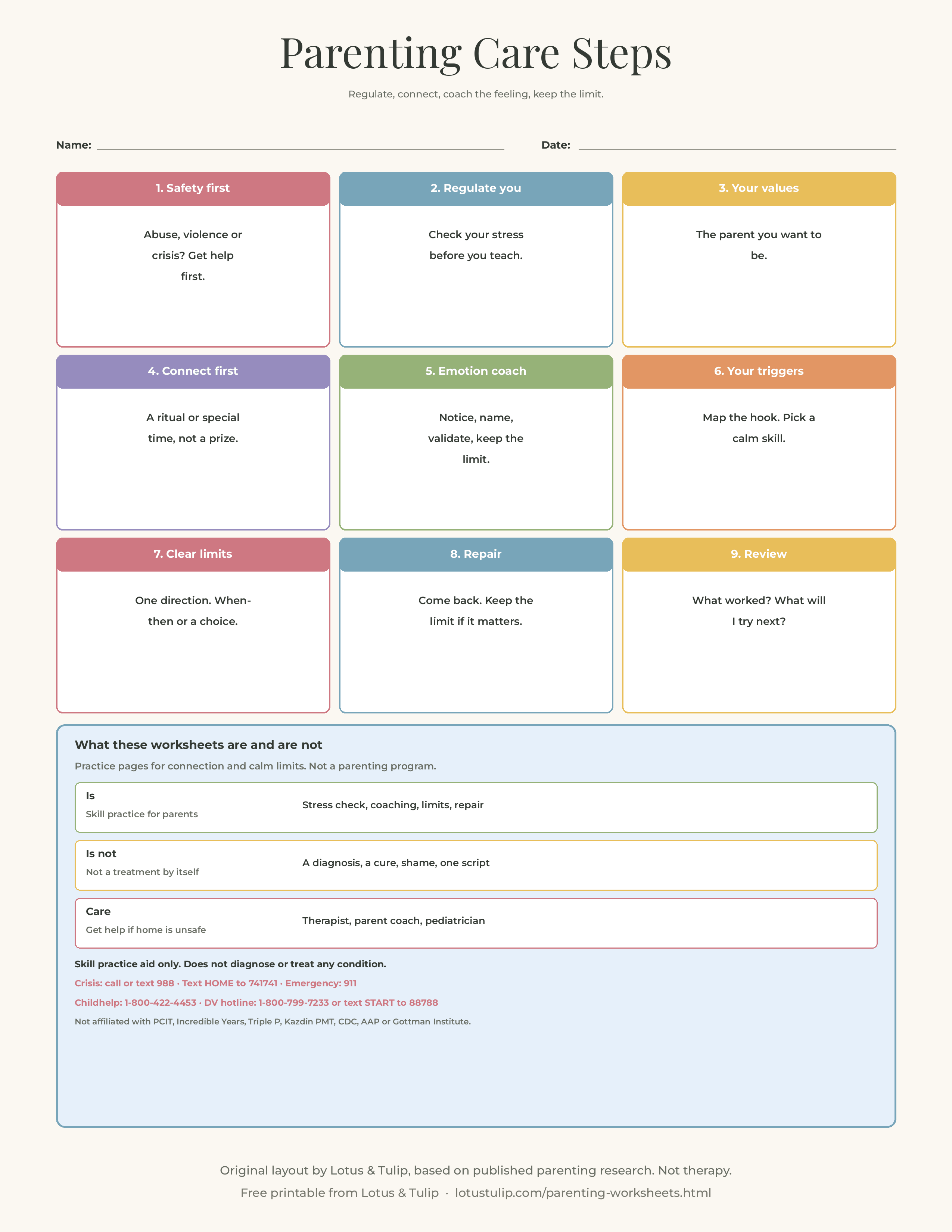
- Check safety first. Ask, privately, whether anyone in the home is being hurt, threatened or controlled and whether the parent or child is in crisis. If yes, stop the skill pages and use Childhelp at 1-800-422-4453, the Domestic Violence Hotline at 1-800-799-7233 (or text START to 88788), 988, HOME to 741741, 911 and a written safety plan.
- Regulate yourself first. Do a stress check-in. If your number is high, pick one calm-body skill before you pick a limit to teach.
- Clarify the parent you want to be. Write one or two values and one behavior that would show them this week.
- Add connection before correction. Choose one ritual and protect a short stretch of special time. Connection is not a prize. It is the ground the limit stands on.
- Practice emotion coaching on one real moment. Notice, name, validate, keep the limit and problem-solve only if the child is ready. Use the child's words.
- Map your triggers and pick a calm skill. Choose the hook that shows up most often and decide in advance what you will do with your body when it appears.
- Give one clear direction and a calm limit. Rewrite a fuzzy request into a when-then or a choice. Follow through once, calmly, instead of repeating yourself from another room.
- Repair after rupture. When (not if) a hard moment goes badly, come back with a short repair and then return to the original limit if it still matters.
- Review what worked and adapt. Use the weekly review, adjust for age and family structure, and get more help if safety, severe aggression or your own distress is growing. Print the free three page set or share the PDF for telehealth.
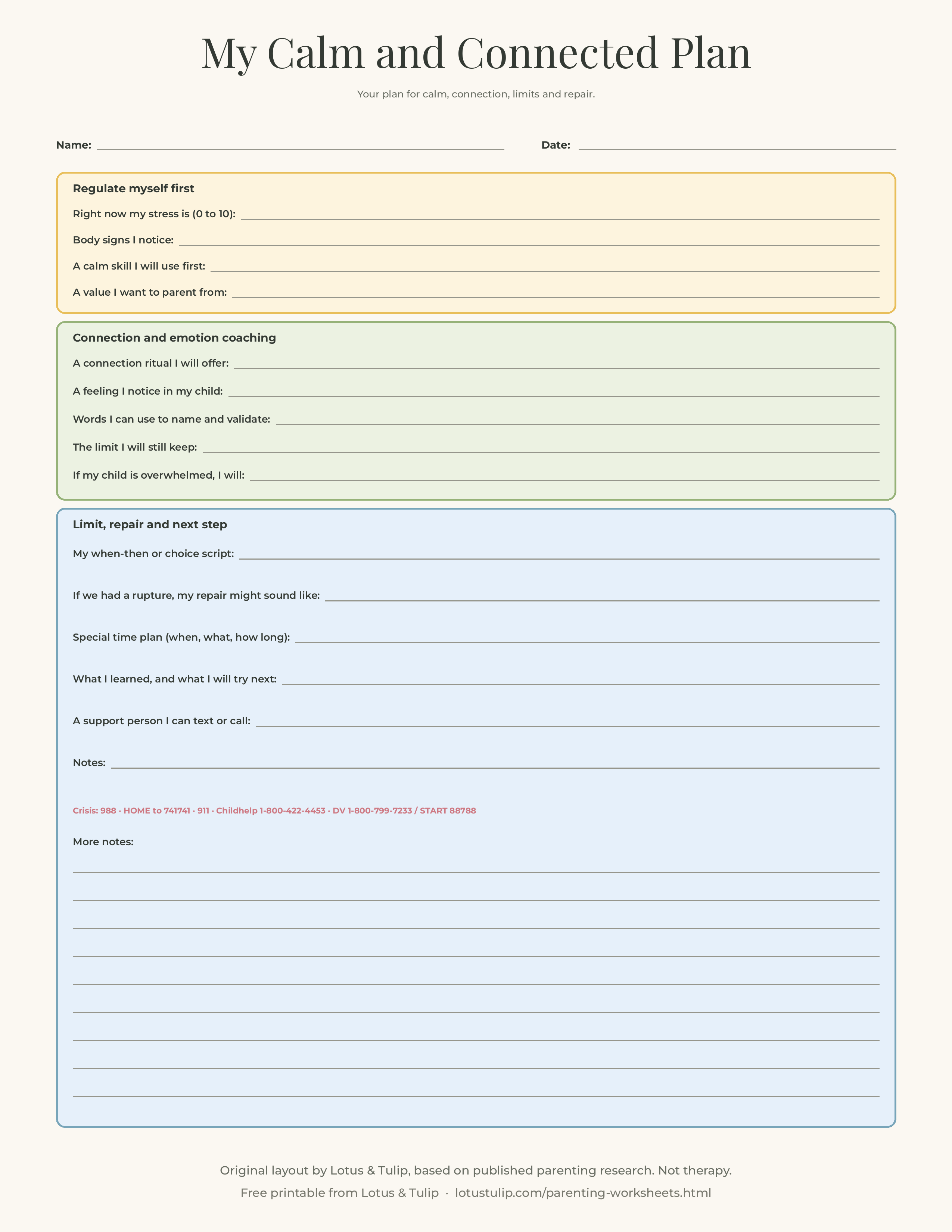
Page two works well as a phone photo, so a parent has the plan at pickup or bedtime.
Adaptations
- Ages about 3 to 5. Keep directions to one step. Use play, pictures and routines more than long talks. Special time is sitting on the floor and following the child's lead. Do not expect a preschooler to "use their words" in the middle of a meltdown. Visual schedules and first-then boards help transitions.
- Ages about 6 to 12. Children this age can help write a when-then and take a real role in a short family meeting. Homework, siblings and friendship slights become common triggers. Pair these pages with emotional regulation worksheets for kids and anger management activities for kids when the child also needs language for their side of the moment.
- Teens. Collaboration matters more than a parent-written script. Special time may be a drive, cooking or watching something the teen chose, with phones down. Limits still exist, but the teen should help shape the plan. See boundaries activities for teens, communication skills activities for teens and anger management activities for teens.
- ADHD or autistic children (supports, not a treatment). Worksheets do not treat ADHD or autism. They can still help a parent offer fewer words, one step at a time, extra transition warnings, visuals, sensory breaks and praise for effort. See ADHD worksheets, executive functioning worksheets for kids and the visual supports linked above. Seek evaluation when attention, language, sensory load or social communication are significant concerns.
- Anxious children. Avoidance can look like "defiance" (refusing school, bedtime or new places). Pushing harder without understanding the fear often makes things worse. Combine calm limits with support for small, chosen steps. See anxiety worksheets for kids, the worry worksheet for kids and anxiety activities for teens.
- Two-home or divorce families. Keep worksheets focused on the home you can influence. Do not use them to collect evidence against the other parent or to make a child carry messages. See divorce worksheets for kids and divorce activities for teens.
- Trauma. Do not force a child to disclose what happened, and do not use a parenting worksheet as trauma treatment. Prioritize safety, predictability and choice. See trauma worksheets and the safety plan worksheet. A family living with violence needs safety resources first, not a clearer when-then script.
- Cultural differences, without stereotypes. Families differ in how they show warmth, talk about feelings and set limits. Adapt the wording to the family's language. Do not assume a family that values obedience is harsh, or that a family that talks a lot about feelings is permissive. Ask what a good day looks like in their home.
- Therapists running parent support versus parents at home. In a group or coaching session, model the skill, have the parent practice out loud and assign one experiment, not five. At home, start with the stress check-in and special time. Teachers and relatives can support routines. They should not diagnose a child from a worksheet.
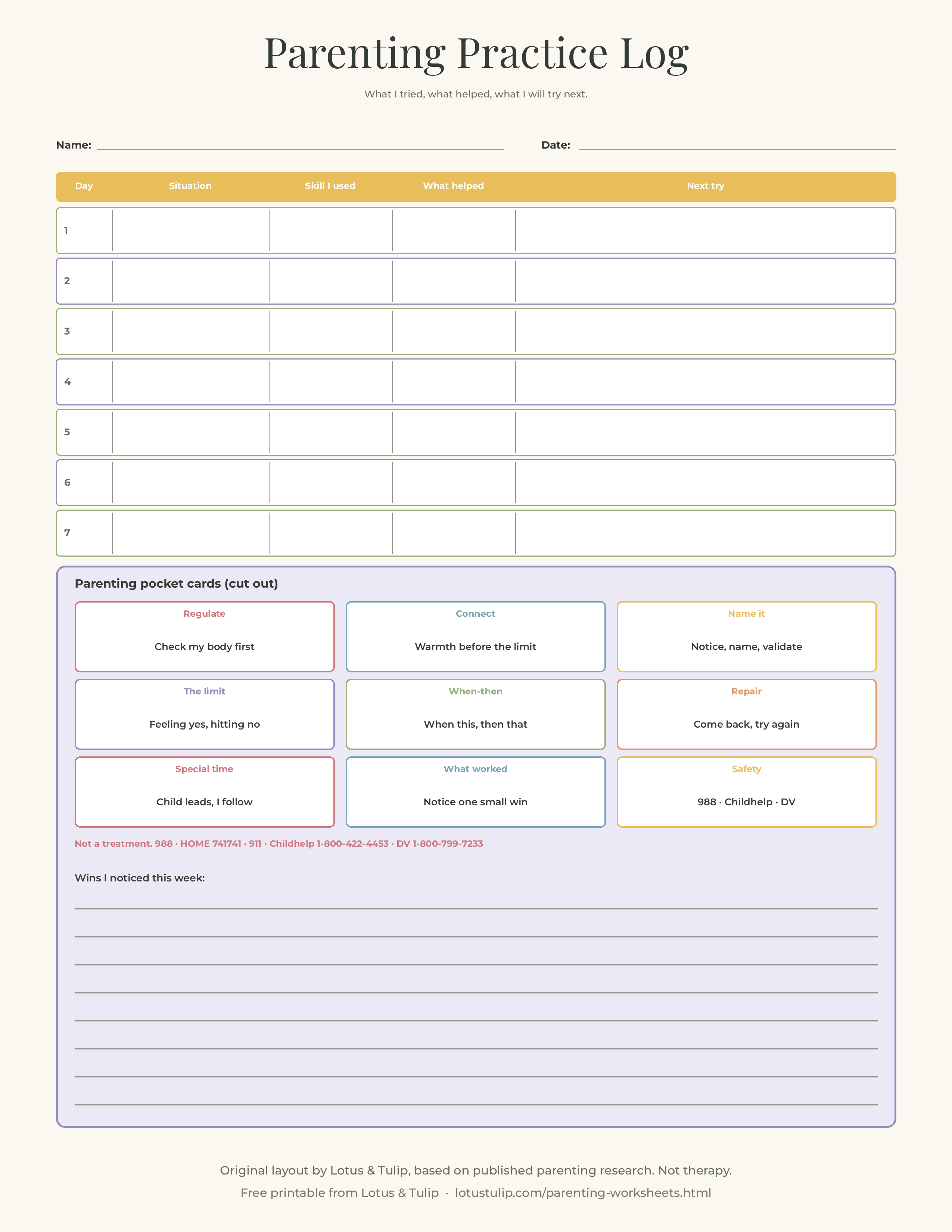
- Telehealth parent coaching. Screen share page two, role-play the script and review the log next time. Check privacy: who else is in the home, and can the parent speak freely about safety?
Tips for parents, therapists and parent coaches
- Practice the wording out loud until it sounds like the parent, not like a manual.
- Change one thing at a time. Special time plus one rewritten morning direction is plenty for a first week.
- Praise specifically. "You started your homework after one reminder" teaches more than "good job." CDC materials call this labeled praise.
- Catch what you want more of. If most comments are corrections, attention starts to arrive only when things go wrong.
- Do skills in session. Role-play the script or watch a two minute special time clip. Live practice beats another handout.
- Watch for parent burnout. Exhaustion, distance from the child and a sense of being a failed parent deserve adult support, not another productivity tip.
- Coordinate caregivers. A child who hears two completely different sets of rules is not being "manipulative." The adults need a shared, simple plan.
- Keep notes short. Three lines after a hard evening beat a page the parent will never fill in again.
Common mistakes
- Skipping the parent's own regulation. A flooded parent cannot deliver even a perfect script well.
- Validating and then dropping the limit. "I hear that you are mad, so fine, keep the tablet" teaches the child that big feelings cancel the rule.
- Keeping the limit and skipping the feeling. "Because I said so" may end the moment and still leave the child alone with the emotion.
- Using special time as a reward or taking it away as a punishment. That turns connection into a prize.
- Threats you will not keep. "No birthday party ever again" teaches the child that your words cannot be trusted.
- Talking from another room, five times. Move close, say it once, wait, follow through.
- Making the child manage your guilt. A long apology about what a terrible parent you are asks the child to take care of you.
- Treating worksheets as the treatment. Pages support practice. They do not replace care when a family is stuck or unsafe.
Myths about parenting worksheets and discipline
- "Spanking works if you do it right." The AAP policy statement by Sege and Siegel (2018, reaffirmed in 2024) recommends that caregivers not use corporal punishment, including hitting and spanking, and not use verbal strategies that shame or humiliate. Aversive strategies are described as minimally effective in the short term and not effective in the long term. Warmth plus clear limits is the direction public guidance has taken. Details are in the research notes below.
- "Just ignore it." Planned ignoring can help with small bids for attention (whining for a snack you already addressed). It is the wrong tool for aggression, bullying, safety risks or a child who is scared or hurt.
- "Time-out versus time-in is a war you have to pick a side in." The useful question is not the brand name. It is whether the child is safe, the parent stays regulated, the child is not being shamed and connection returns after the pause. Some children calm with a parent nearby (a "time-in"). Some families use a brief, boring, pre-taught break from attention after a clear limit, which is how many parent-training programs teach time-out. Kaminski and colleagues (2008) found teaching time-out, alongside positive interaction and consistency, among the components linked with larger effects in programs for young children. That is about taught programs, not sending a child away in anger. If a "time-out" becomes yelling, shame or a long exile, it has left the skill.
- "A worksheet will fix the behavior." Paper does not change a pattern. Practice does, slowly, with repair when it goes badly. Families facing violence, untreated parental mental health needs or a child's significant clinical needs need more than a PDF.
- "If I validate feelings I will raise a child with no limits." Emotion coaching includes the limit. The feeling is welcome. Hitting, running into the street and breaking things are not.
- "Good parents do not need scripts." Many warm, competent parents use scripts when they are tired. Writing a sentence in advance is a kindness to your future self.
Three fictional examples
Maya and five year old Jonah at bedtime. Jonah melted down when the tablet turned off, and Maya usually bargained for "five more minutes" until she exploded. She wrote a feeling word (disappointed), a validating sentence ("You really wanted one more show"), the limit ("The tablet is off for tonight") and a when-then ("When your pajamas are on, then we can read two books"). She used longer exhales first. Bedtime was still noisy, but she stopped adding extra shows and repaired the night she yelled.
Luis and siblings age 8 and 10. After-school fights over the same chair had taken over the evening. Luis started ten minutes of special time with each child on alternating days and used a family meeting to try a rotating chair schedule. When he snapped at them, he came back later with a short repair. The fights did not vanish. The evenings got shorter, and both children started coming to him with the problem instead of only with accusations.
A parent coach pauses the worksheets. Dana came to coaching to "get my kids to listen." Midway through a session on calm limits, she mentioned that her partner "gets in my face" when the children cry and that she is "not supposed to leave the house" after an argument. The coach stopped the parenting pages and spoke with Dana alone. A when-then script does not belong in a home where one adult is being controlled or threatened. The coach named the safety concern and offered the National Domestic Violence Hotline (1-800-799-7233, or text START to 88788). If a child is being hurt, that is also a report to child protective services; Childhelp (1-800-422-4453) can help an adult figure out next steps. Parenting skills can wait until safety is addressed. This example is fictional.
How this page compares to nearby Lotus and Tulip guides
| Guide | Best for | How it differs |
|---|---|---|
| Communication exercises for couples | Two partners practicing speaking, listening and repair | Adult-to-adult communication; this page is about the parent and child relationship (they often support each other) |
| Healthy boundaries worksheet and boundaries activities for teens | Naming limits and asking for what you need | Personal boundaries with other adults or for teens; this page focuses on parenting limits with care |
| Emotional regulation worksheets for kids | Helping a child notice and ride out feelings | Child facing; this page is parent facing, even when the same moment is in view |
| Coping skills list for kids | A menu of calming strategies a child can pick | Skills for the child's body; this page also builds the parent's regulation and the relationship |
| Divorce worksheets for kids | Children navigating two homes or a family change | The child's experience of separation; this page can support the adults without using the child as a messenger |
| Anger management activities for kids | A child's anger triggers, body cues and calm plans | Child anger skills; this page includes the parent's side of the same heat |
When not to use these worksheets
- Suspected child abuse or neglect. Do not try to "worksheet" a child out of an unsafe situation. Report concerns to local child protective services. Childhelp at 1-800-422-4453 (1-800-4-A-CHILD) can help you find local resources. If a child is in immediate danger, call 911.
- Domestic violence or coercive control. Parenting practice is not a safety plan. Call 1-800-799-7233 or text START to 88788. Speak with each adult separately if you are a professional. Do not assign couples communication exercises when one partner is unsafe.
- A parent or child in acute crisis. Suicidal thoughts, self harm or a psychiatric emergency come first. Call or text 988, text HOME to 741741, call 911 for immediate danger and complete a written safety plan.
- Severe aggression or a safety risk at home. A child who is seriously hurting people, using weapons or destroying property in a way that puts others at risk needs a qualified clinician and, often, an evidence based parent-training program. A printable is not enough.
- A medical or developmental question that needs assessment. Sudden behavior change, possible hearing or language problems, or signs of ADHD, autism or a mood disorder deserve evaluation. Worksheets can support the family while they wait. They do not answer those questions.
- Outside your scope. Teachers and relatives can share a calm idea. Moderate or severe family distress should be guided by a licensed clinician.
Free 3 page parenting worksheets printable (US Letter)
Download the free printable and use it at home, in a parent session or in a parent group.
- Page 1: Parenting Care Steps. Nine steps that match the HowTo, what these worksheets are and are not, and crisis resources including 988, the Crisis Text Line, 911, Childhelp and the domestic violence hotline.
- Page 2: My Calm and Connected Plan. Space to regulate yourself, choose a connection ritual, coach a feeling, write a limit script and plan a repair.
- Page 3: Practice Log. Seven rows for what you tried and what helped, plus nine pocket cards.
Download free PDF · Page 1 PNG · Page 2 PNG · Page 3 PNG
Research notes (verified, with caveats)
- Sege RD, Siegel BS; Council on Child Abuse and Neglect; Committee on Psychosocial Aspects of Child and Family Health. Effective Discipline to Raise Healthy Children. Pediatrics. 2018;142(6):e20183112. This AAP policy statement (reaffirmed June 2024) advises caregivers not to use corporal punishment, including hitting and spanking, or verbal strategies that cause shame or humiliation. It describes aversive strategies as minimally effective in the short term and not effective in the long term, and notes links to increased risk of negative behavioral, cognitive, psychosocial and emotional outcomes. It recommends reinforcing appropriate behavior, setting limits, redirecting and setting future expectations. We are not affiliated with the AAP.
- Centers for Disease Control and Prevention. Essentials for Parenting Toddlers and Preschoolers. A free public resource for caregivers of children about ages 2 to 4, emphasizing a positive relationship, labeled praise, consistent routines and clear follow-through. We are not affiliated with the CDC and this printable is not a CDC product.
- Kaminski JW, Valle LA, Filene JH, Boyle CL. A meta-analytic review of components associated with parent training program effectiveness. J Abnorm Child Psychol. 2008;36(4):567-589. The authors synthesized 77 published evaluations of parent-training programs for children aged 0 to 7. Components associated with larger effects included increasing positive parent-child interactions and emotional communication skills, teaching time-out and consistency, and requiring parents to practice new skills with their children during sessions. Components associated with smaller effects included teaching parents problem solving, promoting children's cognitive, academic or social skills, and providing extra ancillary services. A quality-assessed summary reported an overall weighted effect size of 0.34 (95 percent CI 0.29 to 0.39), with substantial heterogeneity.
- Patterson GR. Coercive Family Process. Eugene, OR: Castalia; 1982, and later work by Patterson, Dishion and colleagues. The model describes a reciprocal loop in which parent and child escalate and someone eventually gives in, which strengthens the protest next time. We describe the loop so parents can notice it, not to blame them, and we are not teaching an Oregon model protocol.
- Neighboring clinical programs, named so readers can recognize them. We do not teach their protocols and we are not affiliated with them: Sheila Eyberg's Parent-Child Interaction Therapy (PCIT); Carolyn Webster-Stratton's Incredible Years programs; Matthew Sanders' Triple P (Positive Parenting Program); and Alan Kazdin's Parent Management Training. If a clinician recommends one of these, that is about a trained program, not about this printable.
- Gottman J, DeClaire J. Raising an Emotionally Intelligent Child. New York, NY: Simon and Schuster; 1997 (earlier issued as The Heart of Parenting). Gottman described emotion coaching as: notice the child's emotion; treat it as a chance for closeness and teaching; listen and validate; help the child find words; and set limits while you handle the situation. He contrasted this with dismissing, disapproving and laissez-faire styles. Gottman Institute materials describe studies of more than 120 families behind the book. We are not affiliated with the Gottman Institute and we do not teach or claim the Gottman Method.
- Mikolajczak M, Gross JJ, Roskam I. Parental burnout: what is it, and why does it matter? Clin Psychol Sci. 2019;7(6). Parental burnout is described as overwhelming exhaustion related to the parental role, emotional distancing from one's children and a sense of parental ineffectiveness. In two cross-lagged longitudinal studies (N = 918 and N = 822) with surveys three times over a year, parental burnout predicted later increases in escape ideation and in neglectful and violent behaviors toward children. That is one reason this guide starts with the parent's own stress.
We do not invent effect sizes beyond what we could verify. The sources above describe structured programs, policy statements and longitudinal studies, not a three page printable. The free pages are a skill practice aid. They have not been tested in a randomized trial and they are not a manualized parent-training protocol.
Parenting worksheets: FAQ
What are parenting worksheets?
They are short, structured pages that help a parent practice noticing their own stress, offering connection, coaching a child's feeling, giving a clear limit and repairing after a hard moment. Parents use them at home. Therapists, parent coaches and school counselors use them in sessions and groups.
Do parenting worksheets replace a parenting class or therapy?
No. They are skill practice aids. They do not replace an evidence based parenting program, therapy or medical care, and they do not treat ADHD, autism, trauma or any diagnosis. If behavior is dangerous or getting worse, work with a qualified clinician.
What is emotion coaching?
It means noticing a child's feeling, naming it, validating it, keeping the limit and problem-solving if the child is calm enough. Validation means "I get that this is hard," not "you can do whatever you want." The idea is widely associated with John Gottman's writing for parents. This page is not affiliated with the Gottman Institute.
What is special time?
A short, regular stretch (often 10 to 15 minutes) when the child leads and the parent follows with attention and specific praise. It is not a reward and should not be taken away as a punishment. Many parent-training programs include a version of child-led connection under different names.
Is time-out better than time-in?
There is no single winner for every child. What matters is safety, a regulated parent, a clear limit and a return to connection. Some children calm with a parent nearby. Some families use a brief, boring, pre-taught break from attention, which is how several programs teach time-out. A time-out that becomes yelling, shame or a long exile has left the skill.
Can I use these pages if my child has ADHD or is autistic?
You can use them as supports (shorter directions, visuals, extra transition time, sensory breaks, praise for effort), not as a treatment. They do not diagnose or treat ADHD or autism. Ask a clinician for evaluation and tailored care when those questions are on the table.
What if I am worried about my own anger or my partner's behavior?
Start with the stress check-in, the calm-body menu and, if needed, your own therapist. If a partner is threatening, controlling or violent, skip the worksheets and call 1-800-799-7233 or text START to 88788. If a child may be abused or neglected, contact child protective services and Childhelp at 1-800-422-4453. For suicidal thoughts, call or text 988, text HOME to 741741 or call 911.
Can therapists use these in parent groups or on telehealth?
Yes. The six session table is a starter sequence, not a certified protocol. On telehealth, screen share page two, role-play the wording and review the log next time. Always check safety privately before you assign home practice.