
Kids and teens · Self esteem and confidence · Updated 2026-11-04
Self esteem worksheets for kids: how to build real self esteem, with activities that work (free printable)
Ready-made printable: Self Esteem Worksheets for Kids and Teens Holiday 20% off: about $9.20, was $12 (EUR 10) · instant digital download
Buy on Etsy
Most adults who search for self esteem worksheets for kids have a specific child in mind. The eight year old who crumples a drawing and says "I'm bad at everything." The fifth grader who will not raise a hand. The seventh grader who scrolls, compares and goes quiet. The instinct is to pour in reassurance: you're amazing, you're so smart, don't say that about yourself. It comes from love, and some of it helps. But fifty years of research on self esteem has a few surprises in it, and one of them is that the most common way adults try to boost a child's self esteem can make things worse for exactly the children who need it most. This guide is for US school counselors, teachers, child and teen therapists and parents. It covers what self esteem is and is not, what the research honestly shows (including what it does not show), signs of low self esteem by age, a nine step plan for building it, which kinds of praise help and which backfire, self esteem activities for kids and for teens, ideas for counselors and parents, the most common mistakes, and when low self esteem is a sign of something that needs more help. It ends with a free three page printable: a "My Strengths" page, a "Kind Self Talk" inner coach page and a "My Proud Moments" weekly log.
Jump to the free self esteem worksheets printable
What self esteem is (and what it is not)
Self esteem is how a person evaluates their own worth: the overall sense of "I am basically okay" or "I am not good enough." The sociologist Morris Rosenberg, whose 1965 ten item scale is still the most widely used measure, described high self esteem as feeling that you are "good enough," a person of worth, without needing to feel superior to anyone. That last part matters, and it is often lost in classroom posters.
Researchers also separate global self esteem from how children see themselves in specific areas. Psychologist Susan Harter's work on children's self perceptions, including her Self-Perception Profile for Children, looks at domains such as schoolwork, friendships, sports, appearance and behavior, alongside overall self worth. A child can feel capable at soccer and hopeless at reading at the same time. This is one of the most useful ideas for anyone working with kids, because it means you do not have to fix "self esteem" in the abstract. You can work on one domain at a time, starting with the one that hurts most.
It helps to keep four related ideas apart:
- Self esteem: how much I value myself overall. "I am a person who matters."
- Self confidence or self efficacy: belief that I can do a specific thing. "I can learn long division." This is domain specific and grows mostly through real experiences of success after effort.
- Narcissism: feeling superior to others and entitled to special treatment. "I am better than other kids." This is not too much healthy self esteem. It is a different thing, and as you will see below, it seems to grow from different parenting.
- Self compassion: treating yourself with the kindness you would show a friend when things go wrong. It does not depend on being good at anything, which makes it sturdier on bad days.
Healthy self esteem in a child looks less like constant pride and more like resilience: "I messed that up, and I am still okay, and I can try again."
What the research says about self esteem in kids
Self esteem became a national project in the US in the 1980s. California even created a state task force to promote self esteem in 1986, on the hope that raising it would reduce problems from school failure to drug use. In 2003, psychologist Roy Baumeister and colleagues published a major review of the evidence in Psychological Science in the Public Interest, and the findings are worth knowing before you plan any self esteem group.
- Self esteem and grades: there is a modest link, but it does not show that self esteem causes good grades. If anything, doing well in school seems to raise self esteem more than the reverse. The review found that efforts to boost students' self esteem had not been shown to improve academic performance, and could sometimes be counterproductive.
- Risky behavior: high self esteem did not prevent children from smoking, drinking, using drugs or starting sex early.
- Where it does matter: high self esteem was linked to greater persistence after failure, and it is strongly related to happiness. Low self esteem was more likely than high self esteem to lead to depression under some circumstances.
- Inflated self views: people whose high self regard is fragile or inflated (closer to narcissism) can become aggressive when their pride is wounded.
The conclusion many people took from this was "self esteem doesn't matter." That goes too far. Later research makes a stronger case that low self esteem is a real risk factor, especially for depression:
- A 2013 meta-analysis by Julia Sowislo and Ulrich Orth pooled 77 longitudinal studies on depression. Low self esteem predicted later depression more strongly (average effect about β = −.16) than depression predicted later self esteem (about −.08). For anxiety, the effects ran about equally in both directions.
- A study of about 1,000 people followed from childhood in Dunedin, New Zealand (Trzesniewski and colleagues, 2006) found that teens with low self esteem had worse mental and physical health, poorer economic prospects and more criminal behavior as adults, even after accounting for adolescent depression, gender and family income. This is a correlational study, so it cannot prove low self esteem caused those outcomes, but it suggests it is worth taking seriously.
So the honest summary is: self esteem is not a magic lever for grades or behavior, but persistently low self esteem is a genuine vulnerability, especially for mood. The goal is not to inflate it. The goal is a realistic, stable sense of worth.
Do self esteem interventions work?
Yes, modestly, and some kinds work better than others. A 1998 meta-analysis by Haney and Durlak of 116 studies found an overall average effect of 0.27. Programs that targeted self esteem directly did better (0.57) than programs that hoped it would improve as a side effect of something else (0.10), and programs for children who already had difficulties did better (0.47) than broad prevention programs for everyone (0.09). Few studies checked whether gains lasted.
A larger 2006 meta-analysis by O'Mara, Marsh, Craven and Debus looked at 145 studies and found an average effect of about d = .51. The biggest effects (about 1.16) came when an intervention targeted a specific domain, such as academic self concept, and was measured in that same domain. Programs that used praise and feedback tied to actual performance, rather than general praise, also tended to do better. Both findings point the same way: be specific, and be honest.
How self esteem changes with age
A 2018 meta-analysis by Orth, Erol and Luciano, pooling 331 samples and about 165,000 people, found that average self esteem rises from age 4 to 11, stays roughly flat from 11 to 15, and then rises strongly through the late teens and twenties. The popular idea of a steep self esteem crash in middle school did not show up in the averages. Individual kids can still struggle a lot in those years, and the flat stretch from 11 to 15 is a good reason to put extra support into middle school.
Signs of low self esteem in kids
Low self esteem rarely announces itself. These signs are worth noticing when they show up often and across settings, not on one bad day:
- Frequent harsh self talk: "I'm stupid," "I'm the worst," "Nobody likes me."
- Avoiding new or hard tasks, giving up quickly, or refusing to try in case they fail.
- Strong reactions to small mistakes: tears, ripping up work, "I ruin everything."
- Brushing off compliments or not believing them.
- Constant comparison with siblings, classmates or people online.
- Needing a lot of reassurance, or seeming to need to win every game.
- Letting others decide for them, or going along with peers to fit in.
- Quitting activities they used to enjoy.
Some of these overlap with anxiety, depression, learning differences and ADHD. A child who says "I'm dumb" after months of struggling to read may be giving you accurate information about an unmet need, not only a self esteem problem. Fixing the reading support often does more for that child's self esteem than any worksheet. Inflated self esteem has signs too: bragging, putting others down, and anger or blame when criticized. It is worth noticing, because the fix is different.
Self esteem by age: what to expect and what helps
| Age | What self esteem often looks like | What helps most |
|---|---|---|
| 5 to 7 (K to 2nd grade) | Often very positive and all or nothing: "I'm the best runner!" Easily hurt by a bad day but quick to recover. | Warm attention, small jobs they can really do, naming effort and specific actions, drawing and talking instead of writing. |
| 8 to 10 (3rd to 5th grade) | Kids start comparing themselves with classmates and become more realistic, and sometimes more self critical, especially about school. | Strengths lists, domain by domain talk ("you find spelling hard and you're a great problem solver"), tracking progress over time. |
| 11 to 14 (middle school) | Appearance, friendships and social status feel huge. Comparison and an inner critic often get louder. | Small groups, inner critic and inner coach work, conversations about social media and comparison, adults who stay warm when kids pull away. |
| 15 to 18 (high school) | On average self esteem rises in these years, but some teens get stuck in harsh self judgment, perfectionism or low mood. | Values and identity work, self compassion, real responsibility, watching for signs of depression. |
How to build self esteem in kids, step by step
- Start with warmth, not praise. A 2015 study in PNAS by Eddie Brummelman and colleagues followed 565 children aged 7 to 11 over 18 months. Parental warmth (showing affection, enjoying time together) predicted higher self esteem. Overvaluing the child ("my child is more special than other children") predicted narcissism instead. The effects were small, but the message is clear: children learn they are worth something from being enjoyed and loved, not from being told they are better than others.
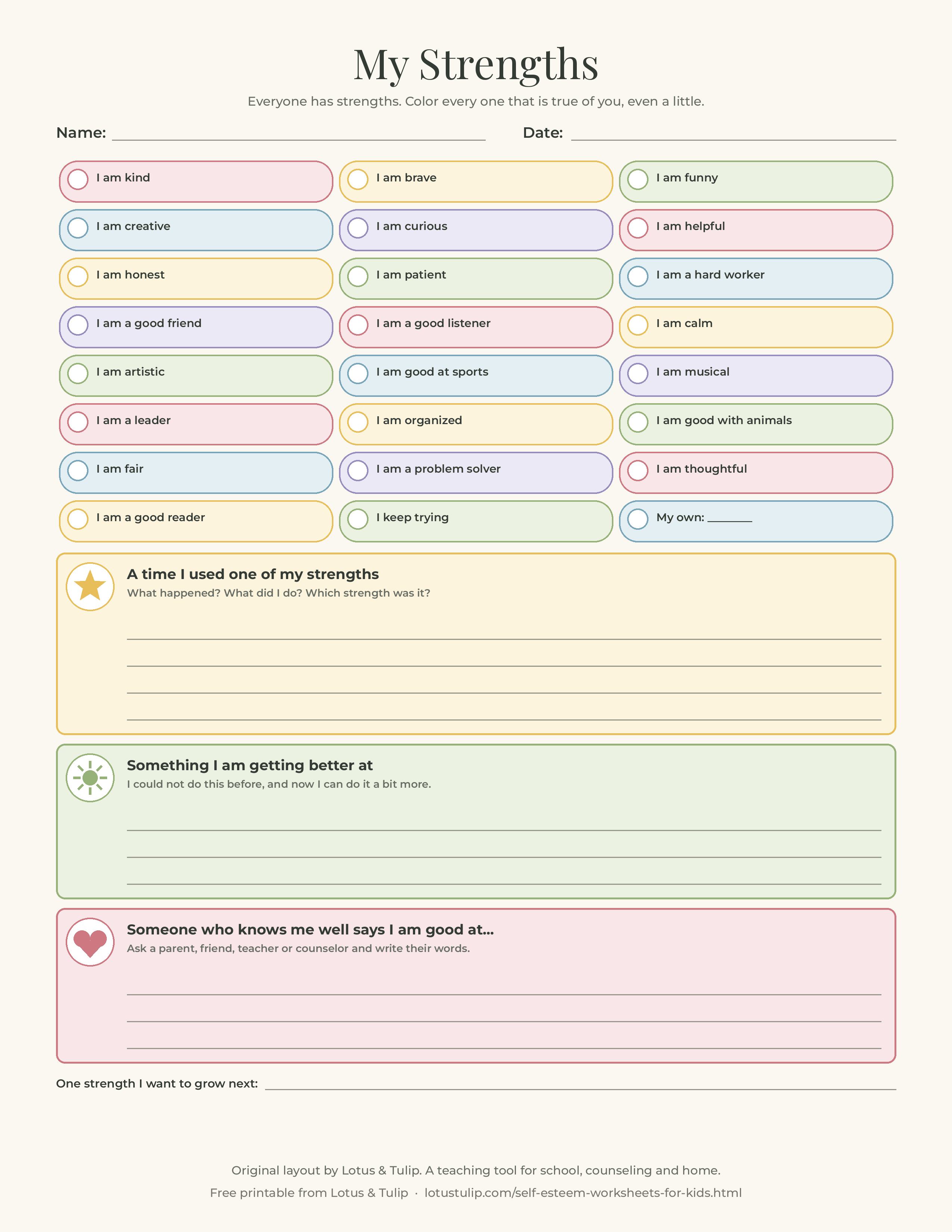
- Find real strengths together. Use a strengths list like page 1 of the free printable. Ask the child to color every strength that is true, even a little, then ask for an example of each. Strengths backed by a real memory are much more believable than a compliment.
- Work one domain at a time. Ask where the child feels worst: schoolwork, friends, sports, looks or behavior. Pick one area and build a small, honest win there. Research suggests targeted, domain specific work has the largest effects.
- Create chances to be genuinely capable. Give real jobs with real responsibility: feeding a pet, being the classroom tech helper, teaching a younger child a game. Competence that the child can see is the most durable base for self esteem.
- Praise specifically and honestly. Describe what the child did ("You kept going on that problem after it went wrong twice") rather than who they are ("You're a genius"). Keep it believable. More on this in the next section.
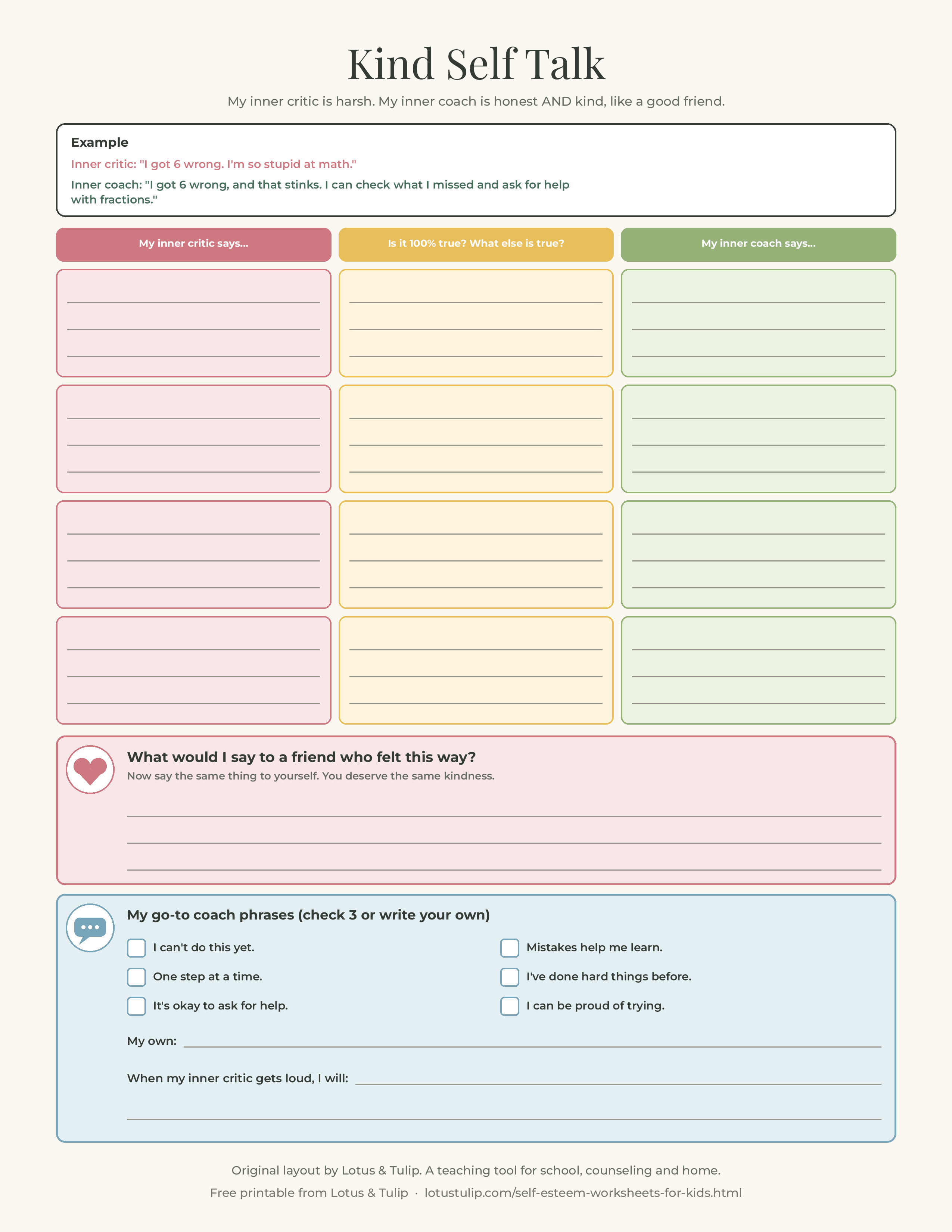
- Teach the inner critic and the inner coach. Name the harsh voice, check whether what it says is fully true, then write what a kind, honest coach would say instead. Page 2 of the printable walks through this.
- Normalize mistakes. Talk about your own mistakes and what you did next. Treat errors as information, not verdicts. A child who learns "mistakes are part of learning" has a self esteem that survives a bad test.
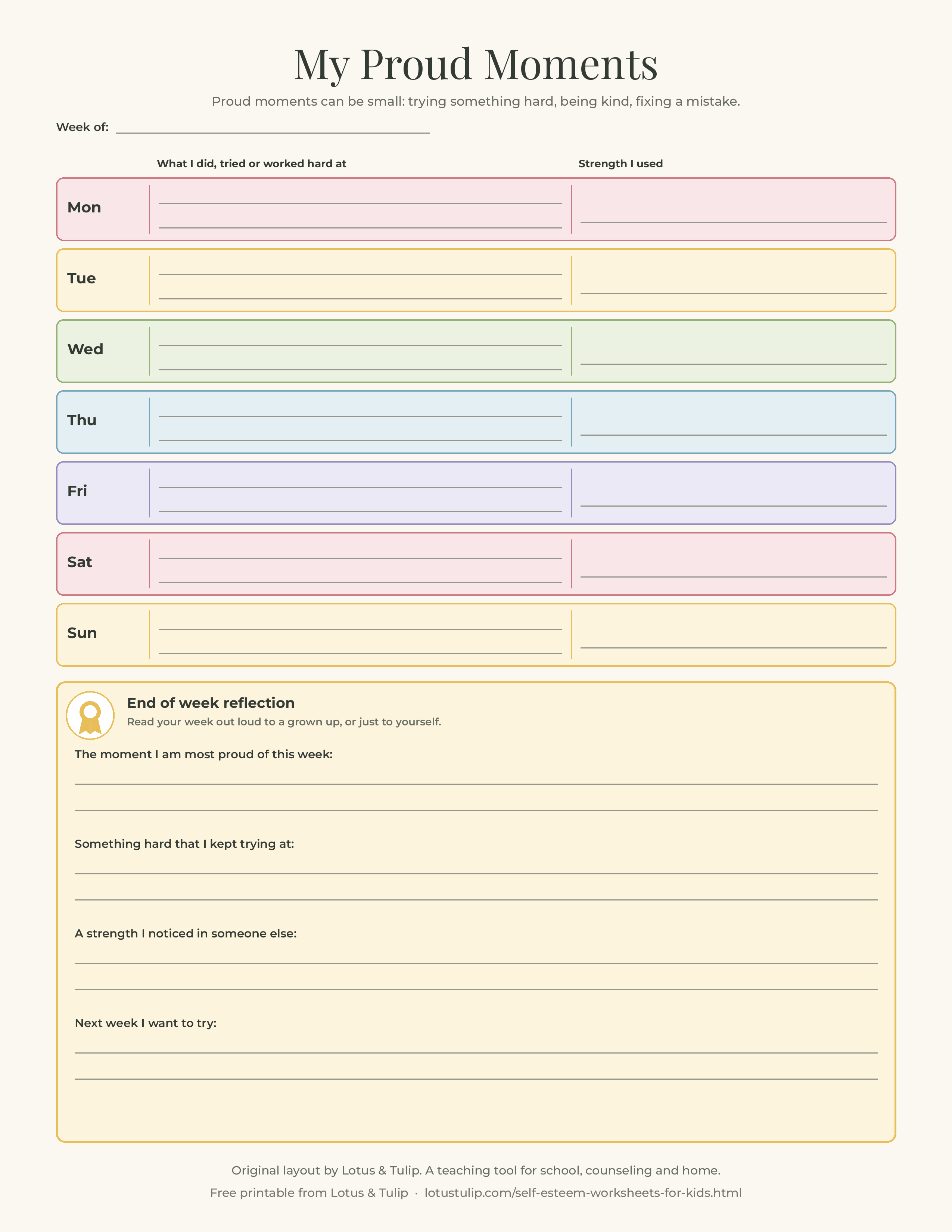
- Notice and record proud moments. Each day, write one thing the child did, tried or worked hard at, and the strength they used. Over a week, this builds a record of evidence the inner critic cannot easily argue with. Page 3 is a weekly log for exactly this.
- Review, repeat and widen the circle. Look back at the log weekly, ask a trusted adult to add what they notice, and choose the next strength or domain. Short, regular practice beats one big session.
Praise that builds self esteem, and praise that backfires
This is where the research gets most practical, and most counterintuitive.
Inflated praise can backfire for kids with low self esteem. In a 2014 series of studies in Psychological Science, Brummelman and colleagues found that adults were more likely to give inflated praise ("that's incredibly beautiful!") to children with low self esteem. In an experiment with about 240 children, those with low self esteem who received inflated praise for a drawing were later less likely to choose a challenging drawing task, while children with high self esteem who got the same praise sought more challenge. The only difference between the conditions was the word "incredibly." The likely explanation is that inflated praise sets a standard a self doubting child is afraid of failing to meet, though the study did not measure that directly, and the effect was small.
Praising the person can increase shame after failure. In another 2014 study in the Journal of Experimental Psychology: General, the same team found that adults tend to give children with low self esteem more praise for who they are ("you're a great artist") and less for what they did ("you worked hard on that drawing"). With 313 children around age 10, person praise, but not process praise, made children more likely to feel ashamed after a later failure, especially the children with low self esteem. When praise is about who you are, failure can feel like it is about who you are too.
You may have heard the related claim that praising intelligence harms motivation, from Mueller and Dweck's well known 1998 studies. That work is covered in our growth mindset worksheet guide, so we will not repeat it here, except to note that a 2019 replication with 624 children in China (Li and Bates) found little or no effect of ability versus effort praise. Treat the "never say smart" rule as a reasonable habit, not a proven law. The Brummelman findings on low self esteem children are from a smaller set of studies and are best treated the same way: promising, consistent with each other, and worth acting on gently.
| Instead of | Try |
|---|---|
| "That's the most amazing picture ever!" | "You used three kinds of blue in the sky. How did you decide that?" |
| "You're so smart." | "You tried two ways before that one worked. That's how hard problems get solved." |
| "You're the best player on the team." | "I saw you pass to Maya when you could have shot. That was good teamwork." |
| "Don't say that, you're not stupid!" | "That felt really frustrating. What part was hardest? What could help?" |
| "You're perfect just the way you are." | "I love being with you, on good days and hard days." |
The last row is important. Unconditional love is not the same as unconditional praise. Children need to know they are loved regardless of performance, and they need feedback about performance that is honest. Mixing the two ("you're wonderful because you got an A") is where self worth starts to feel conditional.
Self esteem activities for kids
These work in a counseling office, a classroom or at a kitchen table. Most take 10 to 20 minutes.
- Strengths hunt: color the strengths on page 1 of the printable, then find one real example for three of them. Ask, "When did you show that one?"
- Evidence jar: each time the child does something kind, brave or hard, write it on a slip and add it to a jar. Read them on a hard day.
- Strengths interview: the child interviews a parent, teacher or friend: "What do you think I'm good at? When did you notice?" They write the answer in their own words.
- "Not yet" list: list three things the child could not do last year and can do now. Then one thing they cannot do yet. Progress is the best evidence that effort pays off.
- Inner critic puppet: younger kids draw or make a puppet of the inner critic, give it a silly name, and practice answering it with a coach voice.
- Friend test: "If your best friend said 'I'm stupid,' what would you say to them?" Then say it to yourself. This is the core of self compassion.
- Teach a skill: the child teaches you or a younger child something they are good at, from a card trick to a video game level. Being the expert is powerful.
- Helper job: give a real, regular responsibility with a visible result, like watering plants or handing out materials.
- Mistake of the week: at dinner or in group, everyone shares a mistake and what they learned or did next. Adults go first.
- Compliment circle with a rule: compliments must be about something someone did, not looks. "You helped me find my pencil" beats "you have nice shoes."
- Proud moments log: one line a day on page 3 of the printable, reviewed on Friday.
- Me map: draw yourself in the middle, with branches for people who care about you, things you like, things you're good at and things you're learning.
Self esteem activities for teens
Teens tend to roll their eyes at activities that feel babyish, so lean on choice, honesty and real stakes.
- Critic to coach rewrite: use page 2 of the printable with real thoughts from the week. Teens often find the middle column ("Is it 100% true? What else is true?") the most useful.
- Values sort: pick the five values that matter most (honesty, loyalty, creativity, fairness, courage) and name one action this week that fits each. Self worth built on values is less fragile than self worth built on approval.
- Comparison audit: for one day, notice every time you compare yourself with someone. Where were you? What were you looking at? How did you feel after?
- Social media check in: research by Patti Valkenburg and colleagues (2021) tracked 387 Dutch teens aged 13 to 15 six times a day for three weeks. For 88% of them, social media use had no or very small effects on self esteem in the moment. About 4% felt better and 8% felt worse. In other words, it depends on the teen. Help each teen find out which group they are in, rather than lecturing all of them.
- Self compassion letter: write to yourself about something you feel bad about, in the voice of a kind friend who knows everything and still likes you. A 2018 meta-analysis (Marsh, Chan and MacBeth) found self compassion was strongly linked with less depression, anxiety and stress in adolescents (r = −0.55 across 19 studies). That is a correlation, not proof that teaching it reduces distress, but it is one of the stronger links in this field.
- Competence project: pick one skill to build over four weeks, track practice, and look back at the start and end. Pair it with our goal setting worksheet.
Ideas for school counselors
Self esteem is one of the most common referral reasons for elementary and middle school small groups. A few tips from the research and from practice:
- Target the kids who need it. Haney and Durlak found much larger effects for children already struggling than for universal programs. A Tier 2 small group of four to six students is a better fit than a whole grade assembly.
- Focus each session on one skill. Strengths, kind self talk, handling mistakes, friendship, comparison and asking for help work well as separate sessions.
- Measure something. A short pre and post rating ("How do you feel about yourself? 1 to 5"), plus teacher observations, gives you data for your annual results report and helps you spot kids who need more.
- Involve home. Send the Proud Moments log home and ask a parent to add one line each week.
- Keep it honest. Avoid mirrors that say "I am perfect." Aim for "I am learning, and I am worth caring about."
Affirmations deserve a short warning. A 2009 study by Wood, Perunovic and Lee found that repeating "I'm a lovable person" made adults with low self esteem feel worse. We cover this in more detail in our positive self talk worksheet guide. The short version: kind, believable self talk works better than big, unbelievable statements.
Tips for parents
- Spend enjoyable time together without an agenda. Warmth predicts self esteem better than praise does.
- Let them struggle a little. Rescuing too fast sends the message "you can't handle this." Wait, encourage, then help with the smallest useful hint.
- Watch your own self talk. Kids hear "I look terrible" and "I'm so stupid" from adults and learn the language.
- Do not compare siblings. Even positive comparisons ("you're the sporty one") can box a child in.
- Listen before reassuring. When your child says "I'm bad at everything," try "That sounds like a hard day. What happened?" before "That's not true."
- Celebrate effort and kindness at least as much as results, and name the specific thing you saw.
For more ideas at home, see our gratitude worksheet for kids, friendship worksheets and worry worksheet, which pair well with self esteem work.
Common mistakes when building self esteem
- Over the top praise for a child who doubts themselves. It can feel like pressure, and they may not believe it.
- Arguing with the inner critic. "You're not stupid!" invites "Yes I am." Ask questions instead.
- Removing every challenge. Self esteem grows from real accomplishments, which require real difficulty.
- Treating it as a one time lesson. One session of positive statements rarely changes much. Short, regular practice does.
- Ignoring the real problem. Bullying, a learning disability, family stress or depression may be driving the low self esteem. Those need direct help.
- Making it about being special. Telling children they are better than others is associated with narcissism, not healthy self esteem.
When low self esteem is a sign of something more
Low self esteem is common and often responds well to the ideas in this guide. But talk to a pediatrician, school counselor or licensed mental health professional if a child or teen:
- Has low mood, irritability, sleep or appetite changes, or loss of interest lasting two weeks or more.
- Says things like "everyone would be better off without me" or talks about wanting to die or disappear.
- Avoids school, friends or activities because of how they feel about themselves.
- Is being bullied, or shows signs of self harm or disordered eating.
In the US, call or text 988 (the Suicide and Crisis Lifeline) any time for support, or call 911 if someone is in immediate danger. A worksheet is a teaching tool, not a substitute for assessment or treatment.
Free self esteem worksheets printable (PDF)
This free printable is an original Lotus & Tulip design, sized for US Letter paper and suited to about ages 6 to 14 (elementary and middle school), counseling sessions, small groups, classrooms and home. Younger children can use it with an adult writing for them. It has three pages:
- Page 1: My Strengths. Twenty three strengths to color (from "I am kind" to "I keep trying") plus a space for your own, then boxes for a time I used one of my strengths, something I am getting better at, what someone who knows me well says I am good at, and one strength to grow next.
- Page 2: Kind Self Talk. A worked example, a three column chart (my inner critic says, is it 100% true and what else is true, my inner coach says) with four rows, a "what would I say to a friend" box, six coach phrases to choose from and a plan for when the inner critic gets loud.
- Page 3: My Proud Moments. A Monday to Sunday log of what I did, tried or worked hard at and the strength I used, plus an end of week reflection: my proudest moment, something hard I kept trying at, a strength I noticed in someone else, and what I want to try next week.
Download the free self esteem worksheets printable (PDF, 3 pages, US Letter)
Prefer single images? Page 1: My Strengths (PNG) · Page 2: Kind Self Talk, inner critic and inner coach (PNG) · Page 3: My Proud Moments weekly log (PNG)
Free self esteem starter pack: Want more real worksheets? The free self esteem worksheets starter pack adds a strengths finder, inner critic and inner coach, thinking traps about me, believable affirmations, a brave steps ladder and a support and safety page from our paid self esteem set for kids and teens.
Free to print for your own use and for use with your own students, clients or children. Please link to this page rather than re-uploading the file.
Related resources
- Bedwetting worksheets for kids: when wet nights start to dent a child's confidence, with a free dry night plan
- New baby and big sibling worksheets for kids: helping an older child feel valued when a new baby arrives, free big sibling plan
- Lying and honesty worksheets for kids: why kids lie, what research shows and a free honesty plan
- Growth mindset worksheet (free printable)
- Positive self talk worksheet for kids and teens (free printable)
- Goal setting worksheet for students (free printable)
- Gratitude worksheet for kids (free printable)
- Friendship worksheets for kids (free printable)
- Worry worksheet for kids (free printable)
- Body image worksheets for kids (free printable)
- Puberty worksheets for kids (free printable)
Sources
- Baumeister, R. F., Campbell, J. D., Krueger, J. I., and Vohs, K. D. (2003). Does high self-esteem cause better performance, interpersonal success, happiness, or healthier lifestyles? Psychological Science in the Public Interest, 4(1), 1 to 44.
- Brummelman, E., Thomaes, S., Orobio de Castro, B., Overbeek, G., and Bushman, B. J. (2014). "That's not just beautiful, that's incredibly beautiful!": the adverse impact of inflated praise on children with low self-esteem. Psychological Science, 25(3), 728 to 735.
- Brummelman, E., Thomaes, S., Overbeek, G., Orobio de Castro, B., van den Hout, M. A., and Bushman, B. J. (2014). On feeding those hungry for praise: person praise backfires in children with low self-esteem. Journal of Experimental Psychology: General, 143(1), 9 to 14.
- Brummelman, E., Thomaes, S., Nelemans, S. A., Orobio de Castro, B., Overbeek, G., and Bushman, B. J. (2015). Origins of narcissism in children. Proceedings of the National Academy of Sciences, 112(12), 3659 to 3662.
- Haney, P., and Durlak, J. A. (1998). Changing self-esteem in children and adolescents: a meta-analytic review. Journal of Clinical Child Psychology, 27(4), 423 to 433.
- O'Mara, A. J., Marsh, H. W., Craven, R. G., and Debus, R. L. (2006). Do self-concept interventions make a difference? A synergistic blend of construct validation and meta-analysis. Educational Psychologist, 41(3), 181 to 206.
- Sowislo, J. F., and Orth, U. (2013). Does low self-esteem predict depression and anxiety? A meta-analysis of longitudinal studies. Psychological Bulletin, 139(1), 213 to 240.
- Orth, U., Erol, R. Y., and Luciano, E. C. (2018). Development of self-esteem from age 4 to 94 years: a meta-analysis of longitudinal studies. Psychological Bulletin, 144(10), 1045 to 1080.
- Trzesniewski, K. H., Donnellan, M. B., Moffitt, T. E., Robins, R. W., Poulton, R., and Caspi, A. (2006). Low self-esteem during adolescence predicts poor health, criminal behavior, and limited economic prospects during adulthood. Developmental Psychology, 42(2), 381 to 390.
- Valkenburg, P., Beyens, I., Pouwels, J. L., van Driel, I. I., and Keijsers, L. (2021). Social media use and adolescents' self-esteem: heading for a person-specific media effects paradigm. Journal of Communication, 71(1), 56 to 78.
- Marsh, I. C., Chan, S. W. Y., and MacBeth, A. (2018). Self-compassion and psychological distress in adolescents: a meta-analysis. Mindfulness, 9(4), 1011 to 1027.
- Li, Y., and Bates, T. C. (2019). You can't change your basic ability, but you work at things, and that's how we get hard things done: testing the role of growth mindset on response to setbacks, educational attainment, and cognitive ability. Journal of Experimental Psychology: General, 148(9), 1640 to 1655.
- Wood, J. V., Perunovic, W. Q. E., and Lee, J. W. (2009). Positive self-statements: power for some, peril for others. Psychological Science, 20(7), 860 to 866.
- Rosenberg, M. (1965). Society and the Adolescent Self-Image. Princeton University Press. Harter, S. (1985). Manual for the Self-Perception Profile for Children. University of Denver.
Self esteem worksheets FAQ
What are good self esteem activities for kids?
The most useful ones are concrete and honest: coloring a strengths list and finding a real example of each strength, keeping a daily proud moments log, interviewing a trusted adult about what they notice, rewriting harsh self talk with an inner coach voice, and giving the child real jobs they can succeed at. Short, regular practice works better than a single big lesson.
How can I build my child's self esteem?
Spend warm, enjoyable time together, give specific and believable feedback about what your child did rather than who they are, let them face manageable challenges, talk openly about your own mistakes and help them notice real evidence of their strengths. Research suggests parental warmth predicts healthy self esteem, while telling a child they are better than others is linked with narcissism instead.
What are the signs of low self esteem in a child?
Common signs include frequent harsh self talk ("I'm stupid"), avoiding new or hard tasks, giving up quickly, strong reactions to small mistakes, brushing off compliments, constant comparison with others and needing a lot of reassurance. If these come with lasting low mood, sleep or appetite changes, or talk of not wanting to be alive, contact a professional.
Can too much praise lower self esteem?
It can backfire for some children. Studies by Eddie Brummelman and colleagues found that inflated praise ("incredibly beautiful") made children with low self esteem less likely to take on a challenge, and praise for who a child is, rather than what they did, made low self esteem children more likely to feel ashamed after failure. The studies are small, but they support specific, honest praise about effort and actions.
Do self esteem programs in schools work?
Modestly, and some work better than others. Meta-analyses have found the largest effects when programs target self esteem directly, focus on a specific area such as schoolwork, use honest feedback tied to real performance, and serve children who are already struggling. Broad programs for everyone and programs that only hope self esteem improves as a side effect show much smaller effects.
At what age does self esteem drop?
A 2018 meta-analysis of 331 samples found that average self esteem rises from age 4 to 11, stays roughly flat from 11 to 15 and then rises again through the late teens and twenties. There was no steep average drop in early adolescence, but individual children, especially in middle school, can still struggle a lot.
What age are these self esteem worksheets for?
The free printable suits about ages 6 to 14, from first grade through middle school. Younger children can do it with an adult writing their words, and older teens can use the Kind Self Talk page on its own with real thoughts from their week.