
Kids and teens · Military deployment for kids 3 to 12 · Updated 2026-11-15
Military deployment worksheets for kids: how to help children cope when a parent deploys, what research shows and a free deployment plan

Ages 5 to 11: Kids Feelings and Social Skills Worksheets, incl. feelings detective, body clues, a feelings thermometer, a coping skills menu and a calm down plan Holiday 20% off: about $11.04, was $14 (EUR 12) · fillable PDF, instant digital download
Buy on EtsyTry it free first: download a fillable sample (feelings thermometer and calm-down plan, PDF, 240 KB). Type into it on screen, then get the full pack. No email needed.
Routines while a parent is away: Visual Schedule and Behavior Supports, 23 pages with token boards, a reward menu, first then boards and 136 picture cards Holiday 20% off: about $6.44, was $8 (EUR 7) · instant digital download
Buy on EtsyKids and teens bundle: Kids and Teens Worksheets Bundle (feelings, anger, self esteem, social anxiety) Holiday 20% off: about $22.08, was $28 (EUR 24) · 80 pages, instant digital download
Buy on EtsyThe orders came in, the date is on the calendar, and your child has started asking the same questions every night at bedtime: "How long is a deployment? Where will Dad sleep? What if something happens to him?" A parent's deployment is one of the defining experiences of growing up in a military family. Children have to say goodbye, live with an empty chair at the table for months, cope with worry they may not have words for, and then adjust all over again when their parent comes home.
This guide is for parents, caregivers, teachers, school counselors and therapists supporting military connected children about 3 to 12 through a parent's deployment. It explains how children react at different ages and stages of the deployment, what research shows (honestly, including its limits), what deployment worksheets can and cannot do, eight kinds of deployment activities, nine steps to help your child before, during and after a deployment, age and need adaptations, notes for schools, common mistakes and three short examples. It ends with a free 2 page printable: My Deployment Map and My Deployment Plan.
When to talk with a professional: worry, tears, clinginess and some acting out are common during a deployment. Talk with your child's pediatrician, the school counselor, a military and family life counselor or a child therapist if your child's distress is extreme, lasts for weeks, keeps getting worse, or gets in the way of school, sleep, eating or friendships; if a child is constantly afraid for the deployed parent's safety and cannot separate from you; or if you, the parent at home, are struggling to cope. Military OneSource offers free, confidential help 24/7 at 800-342-9647. If a child or adult talks about wanting to die or hurting themselves, call or text 988 (the 988 Suicide and Crisis Lifeline); service members, veterans and their families can dial 988 and press 1 for the Military Crisis Line, or text 838255. If anyone is in immediate danger, call 911.
Download the free military deployment worksheets for kids (PDF, 2 pages, US Letter)
Direct download, no email or sign up. See the pages first. Moving to a new duty station? See moving worksheets for kids. Hard goodbyes at drop off? See the separation anxiety worksheet for kids.
How deployment affects children
Deployment is not one event but a cycle: the weeks of preparation before a parent leaves, the long stretch of the deployment itself, and the return home and reintegration afterward. Each stage brings its own feelings. Before the parent leaves, children may be moody, irritable or test limits, and Military OneSource notes that this is normal. During the deployment, children miss their parent, worry about their safety and adjust to a household run by one parent or another caregiver. After the return, there is joy, but also a period of getting used to each other again, new routines and sometimes a parent who comes home changed.
Age shapes how children show stress. According to the American Academy of Pediatrics (AAP) and the VA's National Center for PTSD:
- Babies may react to changes in routine and to the caregiver's mood, with feeding or sleep trouble and more irritability.
- Toddlers and preschoolers may cry more, cling, have tantrums, or sleep and eat differently. Preschoolers may believe the parent left because "I was bad," and may go back to thumb sucking, toileting accidents or separation anxiety.
- School age children often worry that the deployed parent will be hurt, and may become moody or aggressive, complain of stomachaches or headaches, regress or do worse in school.
- Teens may feel angry that the parent had to leave, take on new household responsibilities, withdraw, act like they do not care or take risks.
The AAP also notes that stress may not disappear when the parent comes home. It can even increase, for example if the parent returns with physical or mental health problems, or if a child holds back from getting close to avoid the pain of another goodbye.
What the research shows, honestly
Most research on military children was done during the long wars in Iraq and Afghanistan, with families who faced repeated combat deployments. Many studies use parent reports or medical records, and families who join studies or programs may differ from others. Keep that in mind when reading the numbers.
Many children live through deployments. The 2023 Demographics Profile of the Military Community counted 888,892 children of active duty service members, 40.5% of them 5 or younger and 32.9% aged 6 to 11, plus many more children in National Guard and Reserve families.
Young children show it in behavior. In a study at child care centers on a large Marine base, 169 families of children aged 1 and a half to 5 took part, and 55 children had a deployed parent. After accounting for the at home caregiver's stress and depressive symptoms, children 3 and older with a deployed parent had higher behavior problem scores, as rated by both parents and child care providers, than same aged peers without a deployed parent (Chartrand and colleagues, 2008). Looking at records of 642,397 children aged 3 to 8 in military families, outpatient mental and behavioral health visits rose by 11% when a parent was deployed; visits for behavioral disorders rose 19% and for stress disorders 18%, with larger increases in older children (Gorman, Eide and Hisle-Gorman, 2010).
School age children are mostly resilient, but anxiety runs higher. In a study of 272 children aged 6 to 12 with an active duty Army or Marine Corps parent who was either deployed or recently home, behavior and depression levels were comparable to community norms, but anxiety was elevated: 24.7% of children with a currently deployed parent and 31.9% of those whose parent had recently returned had clinically significant anxiety symptoms. The longer the total months of combat deployment in the child's lifetime, and the more distressed either parent was, the more depression and behavior problems children showed, and these effects did not simply end when the parent came home (Lester and colleagues, 2010). In a study of children aged 5 to 12 in Army families with a deployed parent, about one in three were rated at high risk for psychosocial problems; parenting stress was the strongest predictor, while families who used military support services reported fewer problems (Flake and colleagues, 2009).
Length of deployment and the at home parent's wellbeing matter. In a telephone study of 1,507 children aged 11 to 17 and their at home caregivers, children had more emotional difficulties than national samples. Older youth and girls reported more school, family and peer difficulties during deployment, and more total months of deployment and poorer caregiver mental health were linked to more difficulties both during the deployment and when the parent returned (Chandra and colleagues, 2010). In medical records of 307,520 children aged 5 to 17 of active duty Army parents, mental health diagnoses, especially stress and adjustment, depressive and behavioral disorders, rose with the total months a parent was deployed (Mansfield and colleagues, 2011).
Support helps. FOCUS (Families OverComing Under Stress), a family centered resilience program for military families, was evaluated with 2,615 families (3,499 parents and 3,810 children) across 15 installations. Children's emotional and behavioral symptoms and anxiety went down and their prosocial behavior went up, and parents' anxiety and depression fell and stayed lower at follow up (Lester and colleagues, 2016). This was a program evaluation without a comparison group, so it shows promise rather than proof.
What this means for you. No study has tested worksheets like the ones on this page. The research does not say that deployment harms every child; most children cope, and many grow in independence and pride. What it does show is that longer and repeated deployments add up, that the at home parent's stress spills over to children, and that support for the whole family makes a difference. So the most powerful steps are honest preparation, steady routines, regular contact, looking after the parent at home, using the free military support that exists, and watching for children who need more.
What deployment worksheets can and cannot do
Deployment worksheets give children words for feelings that are hard to say out loud, a place to write their questions, and a plan they helped make for staying close and getting through hard days. They turn the time apart into something children can see and count, and they give the deployed parent concrete things to respond to in letters and calls.
They cannot make a deployment painless, replace an evaluation for anxiety, depression or behavior problems, or address a parent's injury, combat stress or a family crisis. If your child is still very upset after several weeks, or the professional box above applies, bring the pages to your pediatrician, the school counselor, a military and family life counselor or a child therapist.
8 kinds of deployment activities for kids
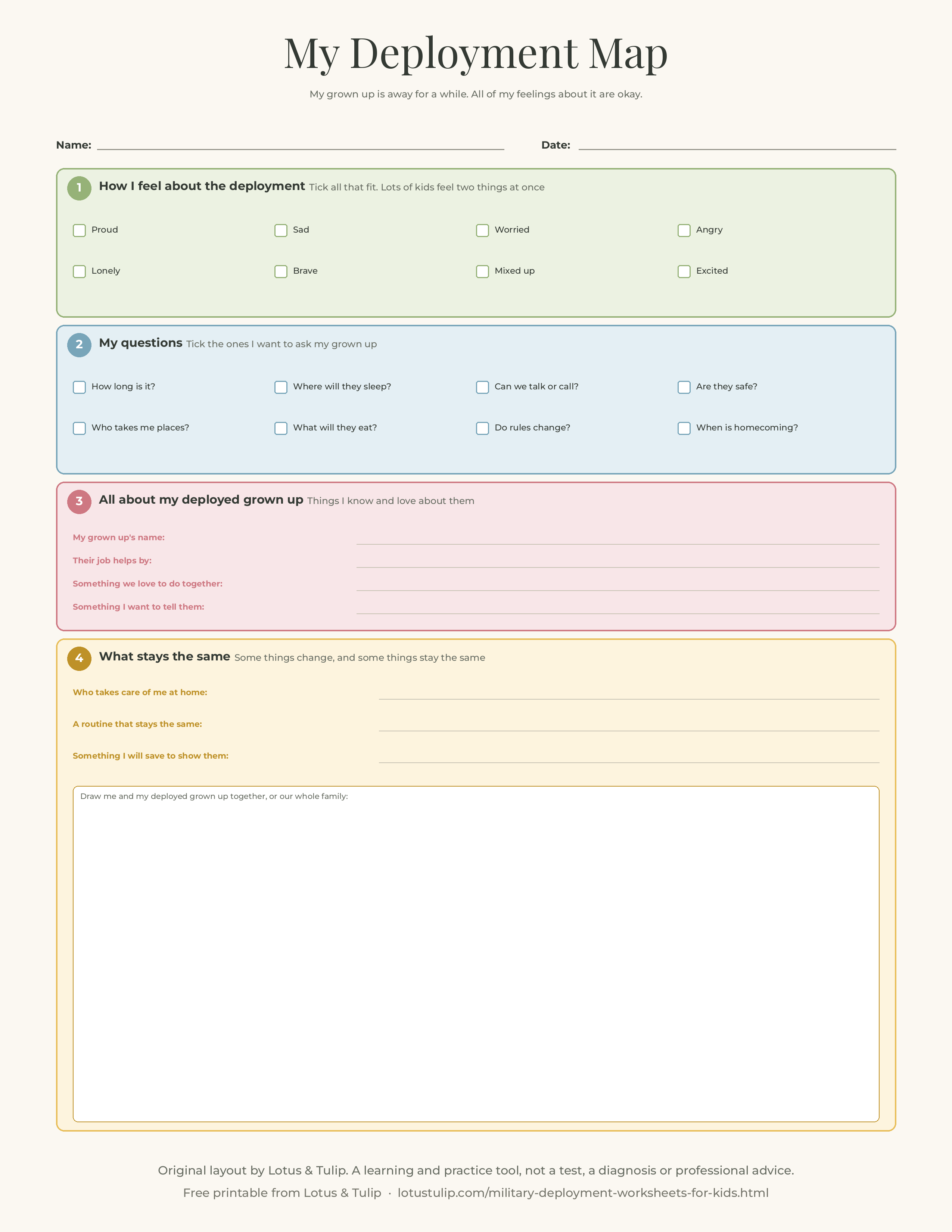
- Feelings check in. Children often feel proud, sad, worried and angry all at once. A simple checklist of feelings (page 1 of the free printable) shows that mixed feelings are normal and gives quieter children a way to say how they feel.
- Question list. Children worry about practical things: how long, where the parent will sleep, whether they can call, who will drive them to practice. Writing the questions down, then answering them simply and honestly, lowers worry.
- Countdown that fits the child. For young children, months mean little. A paper chain, a jar of treats or a calendar marked with "sleeps" or holidays makes the time visible. Keep it flexible, because return dates can change.
- Map and where in the world. The AAP suggests pointing out on a map where the deployed parent is. When the location cannot be shared, mark a time zone or simply "far away, working with their team."
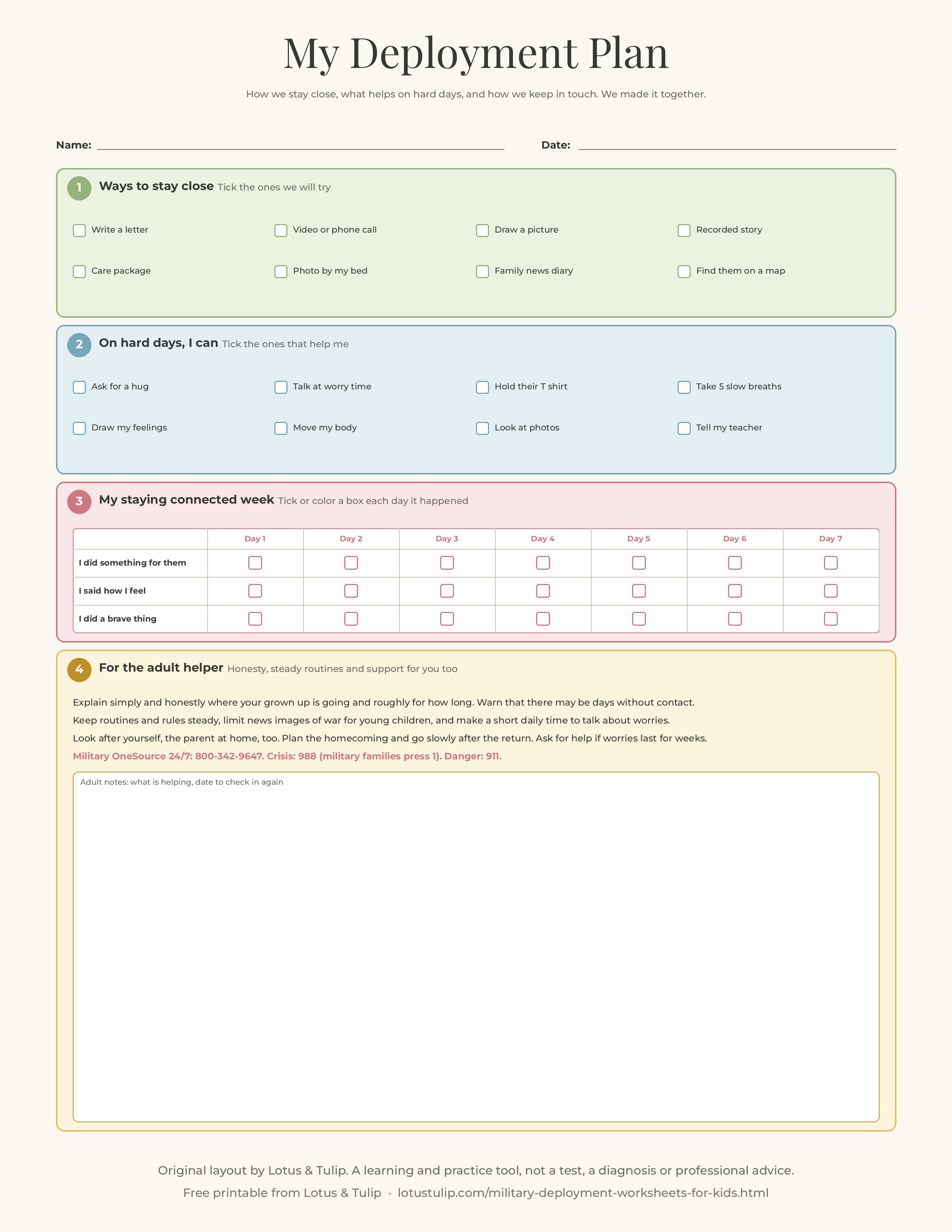
- Staying close tools. Recorded bedtime stories, a photo of the parent by the bed, a T shirt or stuffed animal, letters, care packages and a journal of family news to share later. The AAP and the National Center for PTSD both recommend keeping the absent parent present in daily life.
- Helper jobs. Giving children real jobs, like feeding the dog or packing part of a care package, builds pride. Keep jobs age appropriate; children should not take on the absent parent's role.
- Worry time and calm tools. A short daily time to talk about worries, plus a menu of calm tools (breathing, a hug, drawing, moving their body) helps children manage fear without carrying it all day.
- Homecoming plan. Making a welcome sign, a list of things to show the parent and a few things to do together gives children something to look forward to and prepares them for the adjustment after the return.
How to help your child through a deployment, step by step
- Prepare yourself first. The AAP recommends learning what to expect and identifying your circle of support before the deployment begins. Ask your installation's Military and Family Support Center about briefings and programs, and save Military OneSource (800-342-9647) in your phone.
- Tell them simply and honestly. Explain what a deployment is, why the parent is going and roughly how long, in words that fit your child's age. Let them ask questions and answer as simply and truthfully as you can. If you do not know, say so.
- Spend one on one time before the goodbye. Military OneSource suggests that the deploying parent spend one on one time with each child, let school age children help pack, and keep the goodbye itself loving but brief.
- Plan how you will stay in touch. Agree on letters, emails, video calls or recorded messages, and warn children that there may be days or weeks without contact, so silence does not automatically mean something is wrong. If you have more than one child, a personal note for each helps.
- Keep routines and rules steady. Bedtimes, meals, activities and household rules stay the same as much as possible. Kids thrive on routines; at the same time, the AAP warns against overscheduling children to keep feelings away.
- Listen to every feeling. Make regular time to talk, name feelings without rushing to fix them, and tell children many times that their feelings are normal. Page 1 of the printable helps children check off feelings and questions.
- Manage the news. Ask what your child has already heard, share basic facts rather than graphic details, and keep young children away from repeated news images of war or violence, as the AAP recommends.
- Look after the parent at home. Research consistently links the at home parent's stress to children's adjustment. Accept help, keep your own support network, and use free confidential counseling through Military OneSource or a military and family life counselor if you are struggling.
- Plan the homecoming and go slowly. Prepare children for the excitement and for a period of getting used to each other again. After the return, avoid big changes right away, let the returning parent ease back into routines and discipline over time, and accept that children (and adults) may need some alone time. If stress stays high or grows, ask for individual or family counseling.
How to adapt it by age and need
- Ages 3 to 5: keep it concrete and short. Use a photo of the parent, a recorded bedtime story, a simple countdown with pictures, and play. Reassure often that the parent did not leave because of anything the child did, and expect some regression, responding with closeness and patience.
- Ages 6 to 8: children can use the feelings checklist and question list with help. Give them a helper job, a special box for letters and drawings, and a regular time to talk about worries.
- Ages 9 to 12: children understand more and may follow the news. Give honest information, invite their ideas for staying in touch, and respect their opinions. Watch for withdrawal, irritability, falling grades or "I don't care," which can hide worry.
- Autistic children and children who need predictability: use visual schedules, a picture countdown, a social story about deployment and about the homecoming, and keep the household routine as predictable as possible. Prepare for the change in routine when the parent returns, too.
- Children with ADHD, learning differences or an IEP or 504 plan: tell the school team before the deployment begins, because changes at home can show up as trouble with attention, behavior or homework.
- Anxious children: more calm information usually helps more than less. Limit news, create a short daily worry time, and practice calm tools. If fear for the parent's safety becomes constant, talk with a professional.
- National Guard and Reserve families: your child may be the only military connected student in class, far from an installation. Tell the school, look for support through Military OneSource, which serves Guard and Reserve families, and help your child connect with other military kids if possible.
- When the parent returns injured, with combat stress or does not return: children need extra support and honest, age appropriate explanations. Involve your child's pediatrician, a counselor or a child therapist, and see the grief activities for kids for loss.
Deployment and school: notes for teachers and counselors
- Know your military connected students. Under the federal Every Student Succeeds Act, states report results for military connected students, and many schools collect a military student identifier at enrollment. Ask families to let you know when a deployment is coming; Military OneSource also encourages parents to alert teachers and coaches.
- Know the Interstate Compact. All 50 states and the District of Columbia have joined the Interstate Compact on Educational Opportunity for Military Children, which covers enrollment, placement, attendance, eligibility and graduation for students who move. Among other things, it lets students request excused absences before, during and after a parent's deployment to spend time with that parent. Your district's compact contact or the installation school liaison can help.
- Use the counselors who are already there. Child and youth behavioral military and family life counselors (CYB-MFLCs) offer free, confidential, non-medical support in many schools, child development centers and youth centers. Children under 18 need written parental consent.
- Be flexible and watchful. Attention, homework and behavior can slip during a deployment and in the weeks after a return. Small check ins, a trusted adult at school and flexibility around key dates (departure, return, holidays) help.
- Be thoughtful in class. Avoid putting a child on the spot during discussions about war or current events. Activities like letters or drawings for the deployed parent can be offered as a choice.
- Mandated reporting. Deployment stress can strain families. Confidential military counseling has exceptions for suspected child abuse, neglect, domestic violence and harm to self or others, and so do you. If you suspect abuse or neglect, follow your district policy and your duties as a mandated reporter. Military installations also have a Family Advocacy Program that works to prevent and respond to child abuse and domestic abuse in military families.
Common mistakes
- Saying too little. Children notice when something is being hidden, and silence leaves room for scarier ideas. Share simple, honest facts.
- Promising what you cannot control. "Daddy will be home for your birthday" or "Nothing bad will happen" can backfire. Promise what you can: love, contact when possible and care at home.
- Making the child the "man" or "woman" of the house. Helper jobs are good; carrying an adult's role is not. Children need to stay children.
- Letting rules slide. Loosening every rule out of sympathy can make children feel less safe. Keep limits warm and consistent.
- Expecting the homecoming to fix everything. Reintegration takes time. Expect some bumps and go slowly.
- Forgetting the parent at home. Your stress matters to your child. Asking for help is part of caring for them.
Examples
- Mia, 4: began waking at night and asking if her mom left "because I was naughty." Her dad explained again, in simple words, that Mom's job sent her far away and that it was not because of anything Mia did. Mom recorded bedtime stories before she left, and Mia and her dad made a paper chain to tear one link each night. After a few weeks her sleep settled.
- Elijah, 8: got stomachaches every school morning after his dad deployed. With his mom he filled in My Deployment Map, ticking "worried" and the question "What if Dad gets hurt?" They talked about what Dad's team does to stay safe, set a short worry time after dinner, and asked the school counselor for a weekly check in. He started a letter box for his dad and the stomachaches eased.
- Ava, 11: her mom's third deployment. She said she did not care, but she stopped seeing friends and argued constantly at home. Her dad, feeling stretched thin himself, called Military OneSource and arranged family counseling. Ava joined a group for military connected students at school and helped plan her mom's homecoming.
Free printable: military deployment worksheets for kids
This printable is an original Lotus & Tulip layout. It is not an assessment and gives no score. Page 1, My Deployment Map, has a checklist of feelings about the deployment, questions to ask a grown up, an all about my deployed grown up section and a box to draw us together. Page 2, My Deployment Plan, has ways to stay close, things I can do on hard days, a weekly tracker for staying connected and notes for the adult helper, including when to get help and Military OneSource, 988 and 911.
Download the free military deployment worksheets for kids (PDF, 2 pages, US Letter)
Prefer single images? Page 1: My Deployment Map (PNG) · Page 2: My Deployment Plan (PNG)
Related resources
- Incarcerated parent worksheets for kids: when a parent is away in jail or prison, with a free staying connected plan
- Moving worksheets for kids: for a move to a new duty station, with a free moving plan
- Separation anxiety worksheet for kids: for clinginess and hard goodbyes
- Grief activities for kids: when a family faces a loss
- Divorce worksheets for kids: when a family is living in two homes
- New baby and big sibling worksheets for kids: when a new baby arrives during or after a deployment
- All counseling resources for kids and teens
FAQ
How do I explain military deployment to a child?
Use simple, honest words that fit their age: the parent's job is sending them far away to work with their team for a while, roughly how long, and how you will stay in touch. Let them ask questions, answer as truthfully as you can, and tell young children clearly that the deployment is not because of anything they did. Expect to repeat the conversation many times.
How does deployment affect children?
Most children cope, but many show stress: young children may cling, cry, regress or act out, school age children often worry about the parent's safety and may have stomachaches or school trouble, and teens may feel angry or withdraw. Research links longer total deployments and a stressed parent at home with more difficulties, and some effects continue after the parent returns.
How can I help my child stay connected to a deployed parent?
Plan contact ahead of time: letters, emails, video calls or recorded messages, plus personal notes for each child. Keep the parent present at home with photos, a recorded bedtime story, a special object, a map and a journal of family news. Warn children that there may be gaps in contact.
Should I use a countdown for a deployment?
A countdown can make a long time feel manageable for young children, such as a paper chain or a calendar of sleeps. Because return dates often change, many families count down to smaller milestones like holidays or the next care package instead of the exact return day.
What help is available for military kids during a deployment?
Military OneSource (800-342-9647) offers free, confidential help 24/7, including counseling. Child and youth behavioral military and family life counselors work in many schools, child development centers and youth centers, with written parental consent. Installation Military and Family Support Centers, school liaisons, chaplains and your child's pediatrician can also help.
Why is my child struggling after the deployed parent came home?
Reintegration is its own adjustment. Routines, rules and roles shift again, the child may hold back to avoid the pain of another goodbye, or the parent may come home changed. Go slowly, avoid big changes right away and let the returning parent ease back in. If stress stays high or grows, consider individual or family counseling.
What age are these deployment worksheets for?
They are designed for children about 3 to 12. Younger children can point, color and talk through the pages with an adult reading aloud. Children 7 to 12 can fill in most of the deployment map and deployment plan themselves. Parents, teachers, school counselors and therapists can use them at home, in class or in sessions.
Sources
- American Academy of Pediatrics, HealthyChildren.org. Effects of deployment on children and families.
- Chandra, A., Lara-Cinisomo, S., Jaycox, L. H., Tanielian, T., Burns, R. M., Ruder, T., and Han, B. (2010). Children on the homefront: the experience of children from military families. Pediatrics, 125(1), 16 to 25.
- Chartrand, M. M., Frank, D. A., White, L. F., and Shope, T. R. (2008). Effect of parents' wartime deployment on the behavior of young children in military families. Archives of Pediatrics and Adolescent Medicine, 162(11), 1009 to 1014.
- Department of Defense, Military Community and Family Policy (2023). 2023 Demographics: Profile of the Military Community.
- Flake, E. M., Davis, B. E., Johnson, P. L., and Middleton, L. S. (2009). The psychosocial effects of deployment on military children. Journal of Developmental and Behavioral Pediatrics, 30(4), 271 to 278.
- Gorman, G. H., Eide, M., and Hisle-Gorman, E. (2010). Wartime military deployment and increased pediatric mental and behavioral health complaints. Pediatrics, 126(6), 1058 to 1066.
- Lester, P., Peterson, K., Reeves, J., Knauss, L., Glover, D., Mogil, C., Duan, N., Saltzman, W., Pynoos, R., Wilt, K., and Beardslee, W. (2010). The long war and parental combat deployment: effects on military children and at-home spouses. Journal of the American Academy of Child and Adolescent Psychiatry, 49(4), 310 to 320.
- Lester, P., Liang, L. J., Milburn, N., and colleagues (2016). Evaluation of a family-centered preventive intervention for military families: parent and child longitudinal outcomes. Journal of the American Academy of Child and Adolescent Psychiatry, 55(1), 14 to 24.
- Mansfield, A. J., Kaufman, J. S., Engel, C. C., and Gaynes, B. N. (2011). Deployment and mental health diagnoses among children of US Army personnel. Archives of Pediatrics and Adolescent Medicine, 165(11), 999 to 1005.
- Military Interstate Children's Compact Commission (MIC3). Frequently asked questions and compact rules.
- Military OneSource. Supporting your children through the deployment cycle; Interstate Compact for military children; Military and Family Life Counseling; Military Crisis Line (988, press 1).
- National Center for PTSD, U.S. Department of Veterans Affairs. Children coping with deployment.
Lotus & Tulip is not affiliated with the U.S. military, Military OneSource, the Department of Veterans Affairs, the researchers, programs, agencies or organizations named on this page. Names in the examples are invented. This page is educational and does not replace professional advice, diagnosis or treatment.