
Kids and teens · Support for children with a parent in jail or prison, ages 4 to 12 · Updated 2026-11-15
Incarcerated parent worksheets for kids: how to help a child when a parent is in jail or prison, what research shows and a free staying connected plan

For school counselors: Changing Families Divorce Small Group Curriculum, 8 sessions on big feelings, kid jobs and grown up jobs, routines and finding adults to lean on, for students whose family is changing Holiday 20% off: about $11.04, was $14 (EUR 12) · instant digital download
Buy on EtsyAges 5 to 11: Kids Feelings and Social Skills Worksheets, incl. feelings detective, body clues, a feelings thermometer, a coping skills menu and a calm down plan Holiday 20% off: about $11.04, was $14 (EUR 12) · fillable PDF, instant digital download
Buy on EtsyTry it free first: download a fillable sample (feelings thermometer and calm-down plan, PDF, 240 KB). Type into it on screen, then get the full pack. No email needed.
Kids and teens bundle: Kids and Teens Worksheets Bundle (feelings, anger, self esteem, social anxiety) Holiday 20% off: about $22.08, was $28 (EUR 24) · 80 pages, instant digital download
Buy on EtsyWhen a mom or dad goes to jail or prison, a child loses more than daily time with a parent. Routines change, money can get tight, a child may move in with a grandparent or another relative, and many children carry a secret they are afraid to share at school. The Annie E. Casey Foundation's report A Shared Sentence estimated that more than 5 million children in the United States, about 7% of all US children, have had a parent in jail or prison at some point in their childhood. In almost every classroom, someone is living this.
This guide is for caregivers, grandparents, parents, teachers, school counselors and therapists supporting children about 4 to 12 whose parent is in jail or prison, or who recently came home. It explains what children commonly feel, what research shows (honestly, including its limits), what worksheets can and cannot do, eight kinds of activities, nine steps to help, age and need adaptations, notes for schools, common mistakes and three short examples. It ends with a free 2 page printable: My Missing You Map and My Staying Connected Plan.
Professional help first when it is needed: these pages support children and do not replace a pediatrician, school counselor or child therapist. Ask for help if, after the first weeks, a child has ongoing trouble sleeping, eating, going to school or playing, shows big changes in behavior, keeps reliving a frightening arrest, or seems withdrawn and hopeless. If a child is not safe at home, or contact with a parent is restricted by a court, follow that order and the advice of the child's caseworker or attorney. If a child or adult talks about wanting to die or hurting themselves, call or text 988 (the 988 Suicide and Crisis Lifeline) right away. If anyone is in immediate danger, call 911.
Download the free incarcerated parent worksheets for kids (PDF, 2 pages, US Letter)
Direct download, no email or sign up. See the pages first.
What children often feel when a parent is in jail or prison
There is no single reaction. In a study of 54 children aged 2.5 to 7.5 whose mothers were in prison, Poehlmann (2005) found that common reactions to the first separation included sadness, worry, confusion, anger, loneliness, sleep problems and developmental regressions, such as a child who had been dry at night starting to wet the bed again. Older children may also feel embarrassed, protective of their parent, angry at the parent, or relieved if home life had been chaotic, and they may feel guilty for that relief. Many children feel all of these on the same day.
Youth.gov, the federal youth programs site, notes that the emotional pain and the practical upheaval of a disrupted family life can be made worse by stigma, that families often lose income, and that some children went through trauma around the arrest itself or the events before it. The CDC counts living with a household member who is in jail or prison as one of the adverse childhood experiences (ACEs) that can undermine a child's sense of safety, stability and bonding. That does not mean a child is damaged. It means the child deserves steady, caring support.
Children also hear confusing words. Jail is usually a local facility where people wait for a court decision or serve short sentences, and stays can change at short notice. Prison is a state or federal facility for longer sentences, often far from home. Knowing which one applies helps you explain how long, how far and what visits look like.
What the research shows, honestly
Research on children of incarcerated parents has grown, but many studies are small, and it is hard to separate the effect of incarceration from the poverty, stress and other hard experiences that often come before it. Here is what holds up, with its limits.
It affects a very large number of children. In the Bureau of Justice Statistics (BJS) 2016 Survey of Prison Inmates, an estimated 684,500 people in state and federal prisons were parents of at least one minor child: 47% of state prisoners and 57% of federal prisoners. Together they reported about 1,473,700 children under 18 (Maruschak, Bronson and Alper, 2021). Among children of parents in state prison, about 19% were age 4 or younger and 48% were 10 or older. These counts do not include parents in local jails or stepchildren, so the real number of affected children is higher.
It is not evenly shared. A Shared Sentence reports that the share of children who have experienced parental incarceration ranges from 3% in New Jersey to 13% in Kentucky, that Black and Latino children are over seven and two times more likely than white children to have had a parent incarcerated, and that family income can drop by an average of 22% when a father is incarcerated.
The link with later problems is real but smaller and narrower than many people assume. A meta-analysis by Murray, Farrington and Sekol (2012) pooled 40 studies including 7,374 children with incarcerated parents and 37,325 comparison children. In the most rigorous studies, parental incarceration was linked to a higher risk of antisocial behavior, about 10% more than peers, but not to mental health problems, drug use or poor school performance. The authors also note that the quality of many studies was poor. Most children with a parent in prison do not go on to serious problems, and stable care makes a difference.
It shows up in health and learning. Using the 2011 to 2012 National Survey of Children's Health, Turney (2014) found that, after accounting for family background, parental incarceration was linked to learning disabilities, ADD and ADHD, behavioral or conduct problems, developmental delays and speech or language problems. This is a survey that shows a link, not proof of cause, but it is one reason a school check in is worth doing.
Stable care and honest words help. In Poehlmann's 2005 study, 63% of children had insecure relationships with their mothers and caregivers, but secure relationships were more likely when children lived in a stable caregiving situation. In a randomized trial with 71 children aged 3 to 8 whose fathers were in jail, Poehlmann-Tynan and colleagues (2020) tested Sesame Street's Little Children, Big Challenges: Incarceration materials. Children who had been told the simple, honest truth about where their parent was showed more positive emotion during the jail visit, with a medium effect size, and caregivers who received the materials reported more positive change in how they talked with children about the incarceration. It was a small trial, but it is rare direct evidence that honest, age appropriate explanations help.
Witnessing the arrest matters. In a study of 76 families recruited through four jails in two states, young children who had witnessed their parent's arrest and had high emotional symptoms showed poorer health and more intense reactions to the parent leaving, and witnessing the parent's crime was linked to missed social and adaptive milestones (Poehlmann-Tynan and colleagues, 2021). Children who saw an arrest may need extra comfort and a trauma informed check in.
Contact usually helps, but the setting matters. Among 315 fathers in four Midwest jails, phone calls were the most common contact and 22% reported daily phone contact with their children (Shlafer and colleagues, 2020). In a study of 157 jailed parents of children aged 2 to 6, more frequent visits were linked to fewer child behavior problems at a jail with child friendly on site video visits, but to more behavior problems at a jail that offered mainly visits through Plexiglas (Pritzl and colleagues, 2022). The lesson is not "avoid visits." It is to prepare children well, follow their reactions and push for the most child friendly options available.
No study has tested worksheets like the ones on this page. They are a structured way to put the honest talk, the feelings work and the connection ideas above into a child's hands.
What incarcerated parent worksheets can and cannot do
They can give a child words for mixed feelings, make it clear the child did not cause the arrest, give a younger child a concrete picture of what is happening, plan letters, drawings, calls and visits, help a child decide who to tell and what to say, and give the adults a calm, shared way to check in over weeks and months.
They cannot replace a caring, stable adult, therapy for a child with trauma symptoms, legal advice about custody or contact, or practical help with housing, food and money. They should never be used to pressure a child into contact they do not want, to question a child about the crime, or to send messages between adults in conflict.
8 kinds of incarcerated parent activities for kids
- Feelings check in: a list of feelings to tick or color, including mixed ones such as "angry and missing them" and "relieved," so no feeling is off limits.
- True things cards: short facts a child can return to, such as "it is not my fault," "I can love my parent and not like what they did" and "I can ask questions."
- Where my grown up is: a simple drawing or description of jail or prison and how the child can stay in touch, using the words the family has chosen.
- Countdown or calendar: for a known release date, a concrete marker such as "three birthdays from now" or "next winter," which Sesame Street suggests for young children. Skip it when dates are uncertain.
- Letters and drawings: pictures, letters dictated to an adult, copies of schoolwork or a report card to send, all within the facility's mail rules.
- Visit and call preparation: what to expect, three things I want to tell, and a goodbye plan for the end of the visit.
- Who I tell, and what I say: choosing safe people to tell and practicing a short private answer, such as "my dad is away for a while and I don't want to talk about it."
- Hard days plan and feelings tracker: calm choices for birthdays, holidays, court dates and after visits, plus a simple weekly tracker for adults to notice patterns.
How to help a child when a parent is in jail or prison, step by step
- Take care of safety and stability first. Make sure the child knows who is taking care of them, where they will sleep and that their daily life will go on. Keep school, meals and bedtime as steady as you can. In research, stable care was linked to more secure relationships.
- Tell the truth simply and soon. Children often invent their own reasons for a parent's absence. Sesame Street suggests words such as "Daddy is in a place called prison for a while. Grown ups sometimes go to prison when they break a rule called a law." Avoid "Mom is away at school" or "Dad is working far away"; children usually find out, and in the Sesame trial children told the honest truth coped better during visits.
- Say clearly that it is not the child's fault. Sesame Street advises telling children early that the incarceration is not their fault and nothing for them to be ashamed of. Repeat it often, especially if the child saw the arrest or was asked questions by police.
- Answer questions honestly, at the child's level. Give the details a child can handle, and say "I don't know yet, I will tell you when I find out" when that is true. You do not have to describe the crime. "Your mom made a choice that broke a law" is enough for many young children.
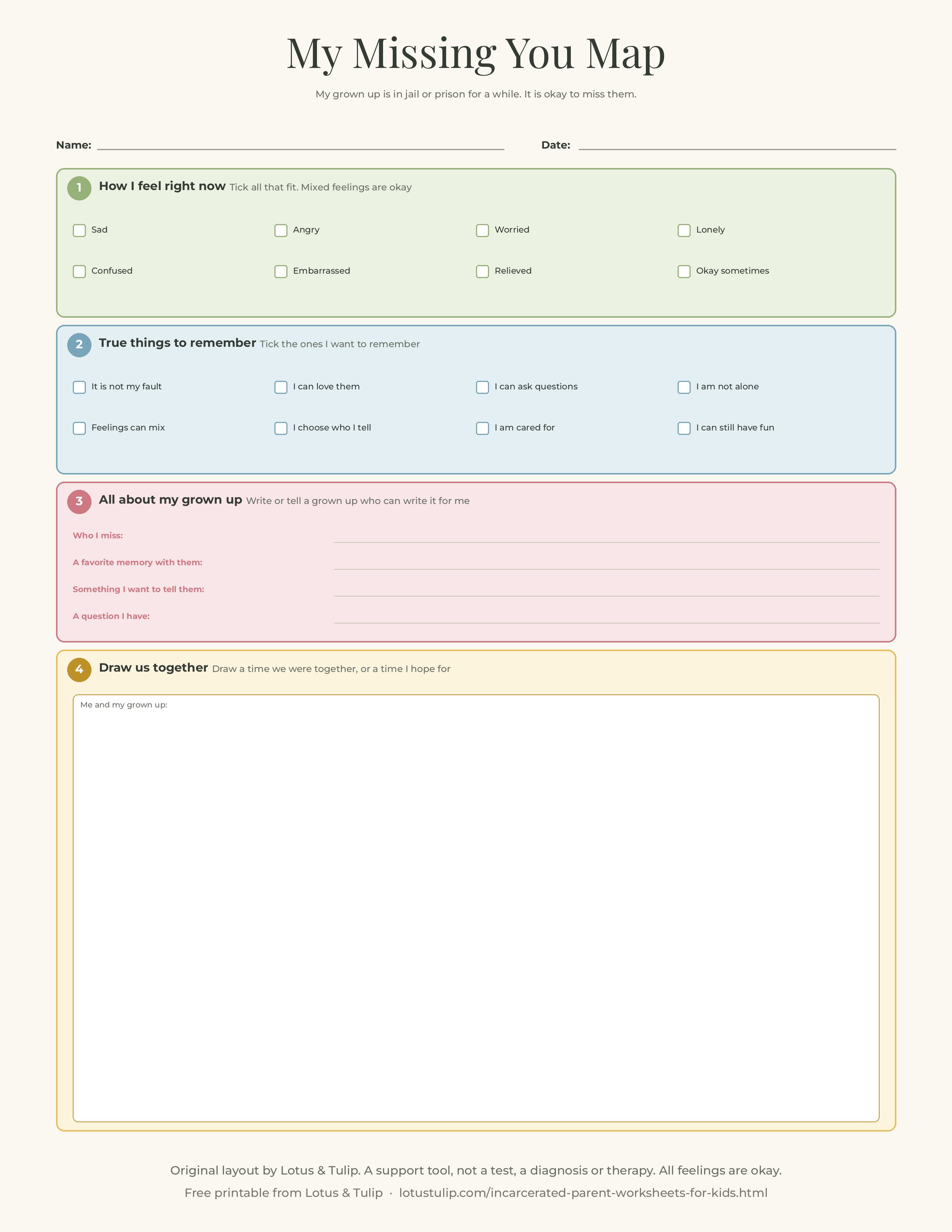
- Welcome every feeling, including anger and relief. Use page 1 of the printable to let a child show what they feel without having to explain it. Let them love their parent, miss them, be angry at them, or all three. Do not criticize the parent in front of the child.
- Help the child stay connected, when it is safe and allowed. Phone calls, letters, drawings, video visits and in person visits can all help. If contact is not allowed for legal or safety reasons, follow that advice and help the child express feelings in a letter they keep or a memory box instead.
- Prepare for each visit. Sesame Street suggests telling children ahead of time how they will get there and what they may see and do: waiting in line, a parent in a uniform, "no touching" rules, and saying goodbye at the end and leaving without their parent. Plan a few ice breakers and a calm activity for afterward.
- Help the child decide who to tell. A child has the right to privacy. Together, choose one or two safe adults at school, such as the counselor or a trusted teacher, and practice a short answer for peers. Let the child lead.
- Watch over time, care for yourself, and plan for coming home. Use the feelings tracker to notice sleep, school or behavior changes and ask for help early. Caregivers carry a lot; Sesame Street has a whole workshop on taking care of yourself. When release is coming, talk about what will change, keep expectations gentle, and know that reunions can bring joy and stress at the same time.
How to adapt it by age and need
- Ages 3 to 5: use short, concrete words, the same ones every time. Expect repeated questions and some regression in sleep, toileting or separation. Use drawing, coloring and a photo of the parent more than writing. Young children may think the parent left because of them, so repeat "not your fault" often.
- Ages 6 to 8: children understand rules and consequences and may worry about whether their parent is safe, has food or is lonely. Answer those worries honestly and simply. Children this age can dictate letters and help plan visits.
- Ages 9 to 12: children may know more than adults think, including from the internet or other kids. Ask what they have heard. They may feel embarrassed or protective, and they may want to decide for themselves about calls and visits. Let them fill in the map and plan on their own.
- Teens: anger, withdrawal, taking on adult roles at home and fear of being judged are common. Respect privacy, offer real choices and see our divorce and family change activities for teens for ideas you can adapt.
- Children who saw the arrest: give extra comfort and predictability, expect bad dreams or fear of police for a while, and talk with a counselor or therapist if images, fear or startle reactions do not fade. Our trauma worksheets for kids can help.
- Autism and literal thinkers: plain, consistent words matter even more. A short social story about where the parent is, a picture schedule for visit days and a clear goodbye routine can make visits easier.
- ADHD and children who act out: behavior may be how grief and stress come out. Keep activities short and active, catch good moments, and avoid punishments that remove contact with the parent.
- Children in kinship or foster care: work with the caseworker on visits and on what the child can be told, and keep sibling contact where possible. Grandparents raising grandchildren deserve support too.
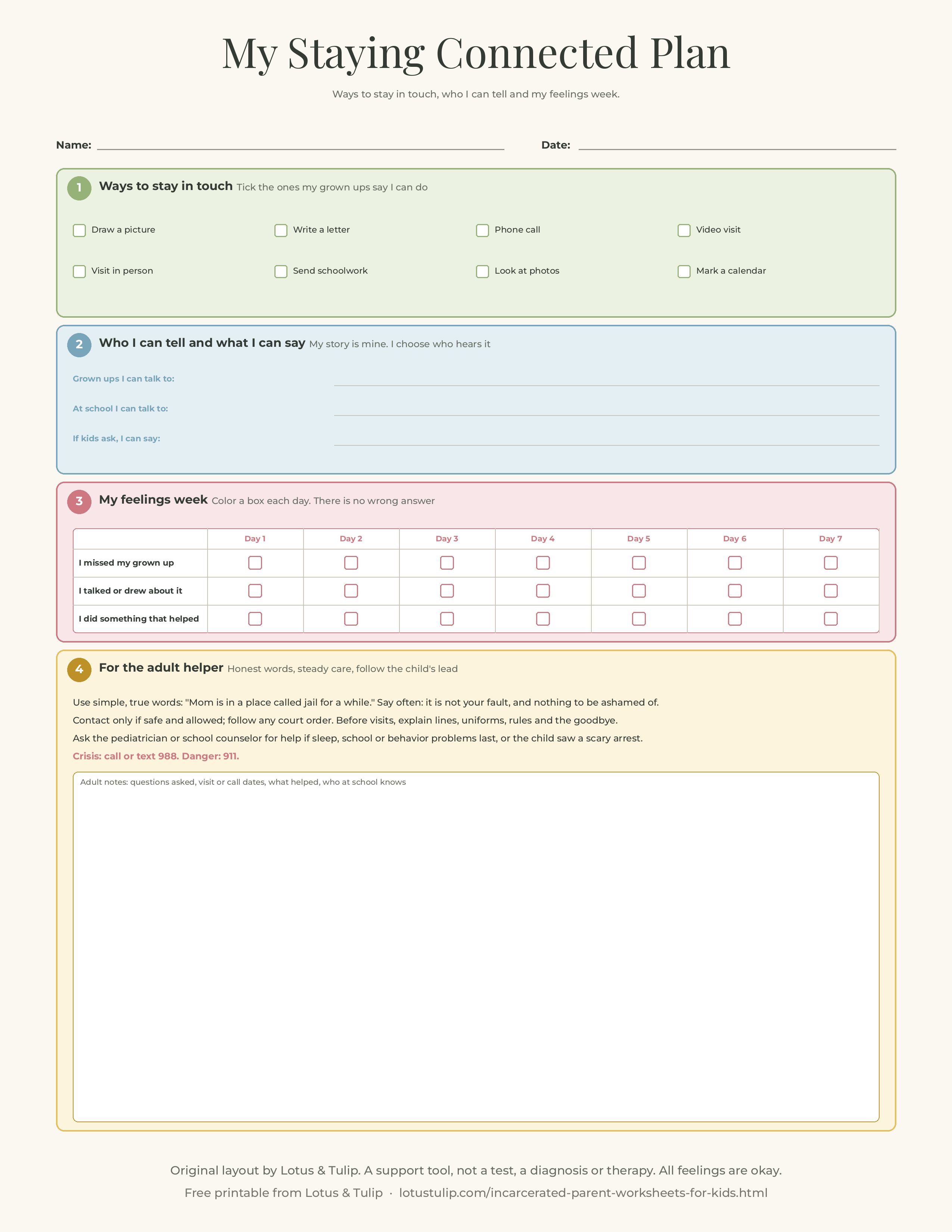
- When a parent comes home: expect mixed feelings. A child may cling, test limits or keep their distance. Keep routines steady, go slowly and revisit page 2 of the printable together.
When a parent is in jail or prison: notes for teachers and school counselors
- Do not assume, and do not ask for details. Families decide what to share. If a caregiver tells you, ask what words the child uses and who else at school may know. Never discuss it in front of classmates.
- Make the classroom safe for every family. Use inclusive language for family events ("bring a grown up who cares about you"), offer choices for Father's Day and Mother's Day projects and remember that some children cannot send or share a card.
- Work with the caregiver. The Annie E. Casey Foundation encourages educators to work hand in hand with the child's caregiver, stay aware of social and emotional concerns and build on the child's talents and interests.
- Offer a counselor check in. With a caregiver's permission, a few sessions using the free printable can help a child sort out feelings, plan who to tell and prepare for visits. A small group for students whose families are changing may also fit, with the sessions on routines and finding adults to lean on.
- Help with practical school links. Where allowed, schoolwork, report cards or art can be copied for the child to send. Some incarcerated parents keep legal rights to school information; check your district's policy and any court orders.
- Mandated reporting: parental incarceration on its own is not abuse or neglect. But if a child describes being hurt, being left without care, or you see other signs of abuse or neglect, follow your school's reporting procedure and your state's mandated reporting law.
Common mistakes
- Hiding the truth. "Dad is working far away" can leave a child confused, waiting and later feeling betrayed. Simple, honest words help more.
- Badmouthing the parent. Children often feel that criticism of a parent is criticism of them. You can be honest about the choice without attacking the person.
- Making the child keep a heavy secret. Privacy is fine; shame is not. Give the child at least one safe adult they are allowed to talk to.
- Using contact as a reward or punishment. Calls and visits are about the child's relationship, not about behavior.
- Visiting without preparation. Security checks, uniforms, glass or no touching rules can frighten a child who does not know what to expect.
- Assuming the child will have problems. Most children cope with steady care. Low expectations can hurt as much as stigma.
Examples
- Jayden, 5: saw police take his dad from the apartment and started waking at night. His grandma used the same words every time: "Daddy is in a place called jail. You did not do anything wrong. The police were doing their job, and you are safe with me." Jayden colored the feelings on page 1 and drew a picture for his dad each week. His grandma told his teacher, and the night waking eased over a few weeks.
- Sofia, 8: told friends her mom was on a work trip and became anxious when a classmate asked questions. With the school counselor, she chose two people she could tell and practiced "my mom is away for a while, I don't want to talk about it." Before her first video visit, she wrote three things she wanted to tell her mom on page 2.
- Marcus, 11: was angry at his father and did not want to visit. His aunt let him decide, kept the door open and suggested a letter he could keep or send. After two months he chose to write. He used the hard days list around his birthday and the court date, and checked in monthly with the counselor.
Free printable: incarcerated parent worksheets for kids
This printable is an original Lotus & Tulip layout. It is not an assessment, gives no score and does not replace professional help. Page 1, My Missing You Map, has a feelings checklist with mixed feelings included, true things to remember, all about my grown up and a box to draw us together. Page 2, My Staying Connected Plan, has ways to stay in touch, who I can tell and what I can say, a feelings week tracker and notes for the adult helper, including honest words to use, what to do when contact is not allowed, when to get help and 988 and 911.
Download the free incarcerated parent worksheets for kids (PDF, 2 pages, US Letter)
Prefer single images? Page 1: My Missing You Map (PNG) · Page 2: My Staying Connected Plan (PNG)
Related resources
- Divorce worksheets for kids: when family changes bring two homes or one parent away
- Divorce small group activities: a changing families group that adapts for students with a parent away
- Military deployment worksheets for kids: another kind of parent absence, with a free deployment plan
- Separation anxiety worksheet for kids: when goodbyes get hard after a big change
- Trauma worksheets for kids: for children who saw a frightening arrest
- Adoption and foster care worksheets for kids: when a child lives with relatives or foster parents while a parent is away, with a free belonging plan
- All counseling resources for kids and teens
FAQ
What should I tell a child when their parent goes to jail?
Tell the truth in simple words, soon, and say clearly that it is not their fault. Sesame Street suggests words such as "Mommy is in a place called jail. She is there because she may have broken a grown up rule called a law." In a randomized trial, young children who were told the simple, honest truth showed more positive emotion during jail visits.
Should children visit a parent in jail or prison?
Often yes, if it is safe, allowed and the child wants to. Research suggests the setting matters: visits in child friendly settings went with fewer behavior problems, while visits mainly through glass went with more. Prepare the child for security, uniforms, rules and the goodbye, and follow any court orders.
How many children have a parent in prison?
The Annie E. Casey Foundation estimated that more than 5 million US children, about 7%, have had a parent in jail or prison at some point. In 2016, parents in state and federal prisons reported about 1.47 million minor children, a count that does not include local jails.
Will my child have problems because their parent is incarcerated?
Not necessarily. A large meta-analysis found that in the most rigorous studies, parental incarceration was linked to a modestly higher risk of antisocial behavior but not to mental health problems, drug use or poor school performance. Stable, caring adults and honest communication make a real difference.
Should I tell my child's school?
It usually helps to tell at least one trusted person, such as the school counselor, so the child has support and teachers understand changes in behavior. Ask the child who they are comfortable with, and ask the school to keep it private.
What if contact with the parent is not allowed?
Follow the court order or the advice of the caseworker or attorney. Sesame Street notes that when there are legal reasons contact is not allowed, it is important to follow that advice. A child can still draw, write letters they keep, and talk about their feelings with a caring adult.
What age are these incarcerated parent worksheets for?
They are designed for children about 4 to 12. Younger children can color, point and talk through the pages with an adult who writes for them. Children 8 to 12 can fill in most of the map and plan themselves. Caregivers, teachers, school counselors and therapists can all use them.
Sources
- Annie E. Casey Foundation (2016). A Shared Sentence: The devastating toll of parental incarceration on kids, families and communities; and Parental incarceration and its impact on children (resource page).
- Centers for Disease Control and Prevention. About adverse childhood experiences.
- Maruschak, L. M., Bronson, J., and Alper, M. (2021). Parents in prison and their minor children: Survey of Prison Inmates, 2016 (NCJ 252645). Bureau of Justice Statistics.
- Murray, J., Farrington, D. P., and Sekol, I. (2012). Children's antisocial behavior, mental health, drug use, and educational performance after parental incarceration: a systematic review and meta-analysis. Psychological Bulletin, 138(2), 175 to 210.
- Poehlmann, J. (2005). Representations of attachment relationships in children of incarcerated mothers. Child Development, 76(3), 679 to 696.
- Poehlmann-Tynan, J., Cuthrell, H., Weymouth, L., Burnson, C., Frerks, L., Muentner, L., and colleagues (2020). Multisite randomized efficacy trial of educational materials for young children with incarcerated parents. Development and Psychopathology, 33(1), 323 to 339.
- Poehlmann-Tynan, J., Muentner, L., Pritzl, K., Cuthrell, H., Hindt, L. A., Davis, L., and Shlafer, R. (2021). The health and development of young children who witnessed their parent's arrest prior to parental jail incarceration. International Journal of Environmental Research and Public Health, 18(9), 4512.
- Pritzl, K., Milavetz, Z., Cuthrell, H., Muentner, L., and Poehlmann-Tynan, J. (2022). Young children's contact with their parents in jail and child behavior problems. Journal of Offender Rehabilitation, 61(2), 88 to 105.
- Sesame Workshop. Sesame Street in Communities: Incarceration resources, including Ask Me Anything, Staying Connected and Caregiver Workshop: Taking Care of Yourself.
- Shlafer, R. J., Davis, L., Hindt, L., Weymouth, L., Cuthrell, H., Burnson, C., and Poehlmann-Tynan, J. (2020). Fathers in jail and their minor children: paternal characteristics and associations with father child contact. Journal of Child and Family Studies, 29(3), 791 to 801.
- Turney, K. (2014). Stress proliferation across generations? Examining the relationship between parental incarceration and childhood health. Journal of Health and Social Behavior, 55(3), 302 to 319.
- Youth.gov. Children of incarcerated parents.
Lotus & Tulip is not affiliated with Sesame Workshop, the Annie E. Casey Foundation, the Bureau of Justice Statistics, the CDC, Youth.gov, the researchers, programs, agencies or organizations named on this page. Names in the examples are invented. This page is educational and does not replace professional medical, mental health or legal advice.