
Kids and teens · Divorce, separation and family change · Updated 2026-11-04
Divorce worksheets for kids: how to help children cope with divorce or separation (free printable)
Ready-made printable: Changing Families Divorce Small Group Curriculum for School Counselors Holiday 20% off: about $11.04, was $14 (EUR 12) · instant digital download
Buy on Etsy
When parents separate, children rarely ask for help in words. A first grader starts asking every night whether Dad is coming back. A nine year old who used to love school becomes the kid who "forgets" homework at one house and never at the other. A twelve year old shrugs and says "it's fine," then snaps at a younger sibling for nothing. Underneath these very different reactions are some very common questions: Is this my fault? Will I still see both of them? What happens to me? Do I have to pick a side? Divorce worksheets for kids are not magic, but a good one gives a child a safe, concrete way to put those questions on paper, so the adults around them can answer them.
This guide is for school counselors, therapists, teachers and parents in the US who want to support a child through divorce or separation. It covers what research actually says about children and divorce (more hopeful, and more nuanced, than many people assume), the factors that seem to protect children, how to talk to kids about divorce at different ages, a step by step way to use worksheets in counseling or at home, mistakes to avoid and when to get more help. You can also download a free three page printable: My Family Is Changing, My Two Homes and My Support Plan, an original Lotus & Tulip design sized for US Letter paper.
Jump to the free divorce worksheets for kids printable
What the research says about children and divorce
If you are a parent going through a separation, you may have heard frightening claims about what divorce "does" to children. The research picture is more balanced, and it is worth knowing, because it changes what you focus on.
On average, the differences are real but small. Paul Amato and Bruce Keith's 1991 meta-analysis in Psychological Bulletin combined dozens of studies and found that children of divorced parents scored somewhat lower, on average, than children in continuously married families on measures such as school achievement, conduct, psychological adjustment, self-concept and social relations. The differences were small. Amato updated the analysis in 2001 in the Journal of Family Psychology, pooling 67 studies from the 1990s. Children with divorced parents still scored lower on average across those same areas, with effect sizes mostly in the range of about one tenth to about one fifth of a standard deviation. In everyday terms, that means a lot of overlap: many children from divorced families do better than many children from married families.
Most children are resilient. E. Mavis Hetherington followed about 1,400 families and more than 2,500 children over several decades, and summarized the work in the 2002 book For Better or For Worse: Divorce Reconsidered with John Kelly. She reported that about 25 percent of youth from divorced families had serious social, emotional or psychological problems, compared with about 10 percent from families that stayed together. Read the other way, that means around three quarters of children from divorced families were functioning within the normal range. Hetherington also described the first year or two after a separation as the hardest period for most families, with many children adapting reasonably well after that. A 2003 review by Joan Kelly and Robert Emery in Family Relations reached a similar conclusion: divorce raises the risk of problems, but most children do not develop lasting difficulties, and what happens around the divorce matters a great deal.
It is not only "the divorce." These studies cannot fully separate the effects of divorce itself from things that came before or with it, such as conflict between parents, a drop in income, moving house, changing schools, a parent's depression or a new partner arriving. That is not a weakness to hide; it is useful. Many of these surrounding stresses are things adults can influence.
What helps children cope with divorce: protective factors
Across the research, a handful of factors come up again and again as making children's adjustment better or worse. These are the things worth putting your energy into.
| Factor | What research suggests | What it looks like in practice |
|---|---|---|
| Parental conflict | Ongoing, intense conflict is one of the strongest predictors of children's problems, whether parents are married or divorced. Amato, Loomis and Booth (1995) found that in high conflict marriages, children tended to do better after a divorce, while in low conflict marriages they tended to do worse. | Keep arguments away from children, never use the child as a messenger and avoid criticizing the other parent in front of them. |
| Feeling caught in the middle | In a study of 522 adolescents about four and a half years after their parents separated, Buchanan, Maccoby and Dornbusch (1991) found that teens who felt caught between parents had poorer adjustment, and feeling caught was linked to hostile, conflicted co-parenting. | Do not ask the child to report on the other home, carry messages, keep secrets or choose a side. |
| Warm, consistent parenting | Kelly and Emery (2003) and others point to competent, warm parenting with clear routines and reasonable rules as a key protective factor. | Predictable routines, regular one to one time, praise for effort and calm, consistent limits. |
| Relationship with both parents | When it is safe, a close relationship with both parents is generally linked with better adjustment. The quality of contact tends to matter more than the amount alone. | Reliable visits and calls, shown up for on time, focused on the child rather than on adult issues. |
| Stability | Each extra change (a new home, school, caregiver or partner) can add stress, especially when several pile up at once. | Keep school, friends, activities and pets the same where possible, and space out other changes. |
| Understanding and coping skills | Children who believe they caused the divorce or that they should fix it tend to struggle more. Learning coping skills and getting accurate information helps. | Clear, honest explanations, repeated often, plus simple coping tools the child can use. |
Notice something about this list: almost every factor is about what the adults do, not about the child. That is why divorce worksheets for kids work best as part of a bigger plan that includes the adults.
Does counseling for children of divorce work?
Two well known US programs show what structured support can do, and they also show its limits.
- Children of Divorce Intervention Program (CODIP). Developed by JoAnne Pedro-Carroll and colleagues at the University of Rochester, CODIP is a school based small group program for children of divorce. Versions have been tested with different ages, including a 12 session program for kindergarten and first grade and a longer version for fourth to sixth graders. Studies from the 1980s and 1990s, including a two year follow up of the K to 1 program published in School Psychology Review in 1999, reported benefits such as less anxiety, fewer classroom problems and fewer visits to the school health office compared with children who did not take part. The samples were small, so treat these as encouraging rather than definitive results.
- New Beginnings Program. Developed by Sharlene Wolchik, Irwin Sandler and colleagues at Arizona State University, New Beginnings focuses mainly on parenting after divorce. In a randomized trial of 240 divorced families with children aged 9 to 12, reported in JAMA in 2002, families were assigned to a mother program, a mother plus child program or a comparison condition in which families received books about divorce. At the six year follow up, when the young people were 15 to 19, about 11 percent in the mother plus child program had a diagnosed mental disorder, compared with about 23.5 percent in the comparison group. The mother only program did not show a significant difference on diagnosis.
The common thread is useful for anyone using worksheets. Effective programs combine accurate information ("it is not your fault"), feelings work, practical coping and problem solving skills, peer support (in groups) and work with parents. A single worksheet will not replicate a program, but a set of well chosen worksheets used regularly with a caring adult can carry the same core messages.
How to talk to kids about divorce
The American Academy of Child and Adolescent Psychiatry (AACAP), in its Facts for Families guide "Children and Divorce," gives practical advice that matches the research above. Paraphrased, it includes: do not keep the divorce a secret or wait until the last minute; tell the child together if you can; keep the explanation simple and honest; make it clear the child did not cause it; admit that it will be sad and upsetting; reassure the child that both parents still love them and will keep being their parents; and do not discuss each other's faults with the child. AACAP also notes that children often believe they caused the divorce, and that adults should avoid putting pressure on children to choose sides.
A short script many families adapt:
"We have something important to tell you. Mom and Dad have decided to live in different homes. This is a grown up decision, and it is not because of anything you said or did. We both love you, and that will never change. You will still see both of us, and here is what will happen next. It is okay to feel sad, mad, worried or anything else. You can ask us any question, any time, even the same question many times."
Adjust the words to your family. Not every family has a mom and a dad, and in some families one parent is not safe or not available. The core messages still apply: it is not your fault, you are loved, here is what happens next, and your feelings are okay.
Common reactions to divorce by age
Every child is different, and these are general patterns rather than rules, but knowing what is typical helps adults respond calmly.
| Age | Common reactions | What tends to help |
|---|---|---|
| Preschool (3 to 5) | Clinginess, sleep problems, regression (toileting, baby talk), fear of being left, magical thinking that they caused it. | Very simple explanations, predictable routines, a picture calendar of where they will sleep, comfort items that travel between homes. |
| Early elementary (6 to 8) | Sadness, missing the absent parent, fantasies of parents getting back together, worry about being replaced. | Repeated reassurance, a "two homes" calendar, chances to play out feelings, permission to love both parents. |
| Older elementary (9 to 12) | Anger, a sense of unfairness, taking sides, somatic complaints such as stomachaches, changes in school performance. | Honest age appropriate information, ways to express anger safely, protection from adult conflict, a trusted adult at school. |
| Teens (13 and up) | Withdrawal, worry about their own future relationships, taking on adult roles, acting out or "pseudo maturity." | Respect for their views on schedules, privacy, not using them as a confidant for adult problems, keeping expectations and limits steady. |
How to use divorce worksheets with kids, step by step
- Start with the adults. Before you hand a child a worksheet, make sure the adults are giving the same basic messages: it is not your fault, both parents love you, and here is what will happen. A worksheet cannot fix mixed messages.
- Choose a calm, private moment. Avoid switch days, bedtime arguments or the hour after a hard phone call. In schools, use a counseling session or small group, never in front of the whole class.
- Explain that all feelings are okay. Tell the child there are no right or wrong answers, and that they can have more than one feeling at the same time, such as sad and relieved.
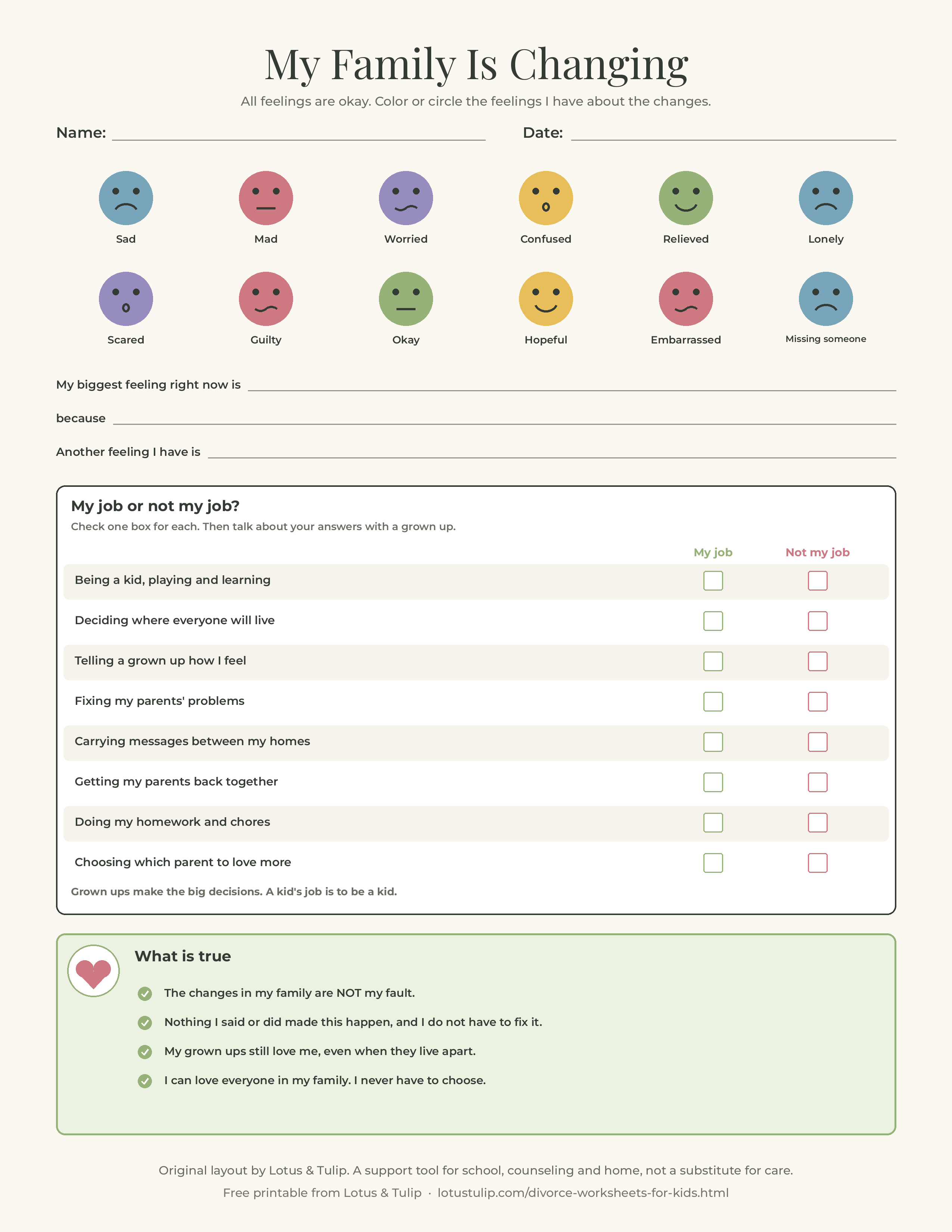
- Do the feelings check together. Use the My Family Is Changing page to color or circle feelings, then ask about the biggest one. Listen more than you talk, and reflect back what you hear.
- Sort "my job" and "not my job." Go through the list and talk about each answer. This is often where children reveal a hidden belief, such as thinking they should get their parents back together.
- Read "what is true" out loud. Have the child read the four truths, or read them together. Repeat these messages often, because one conversation is rarely enough.
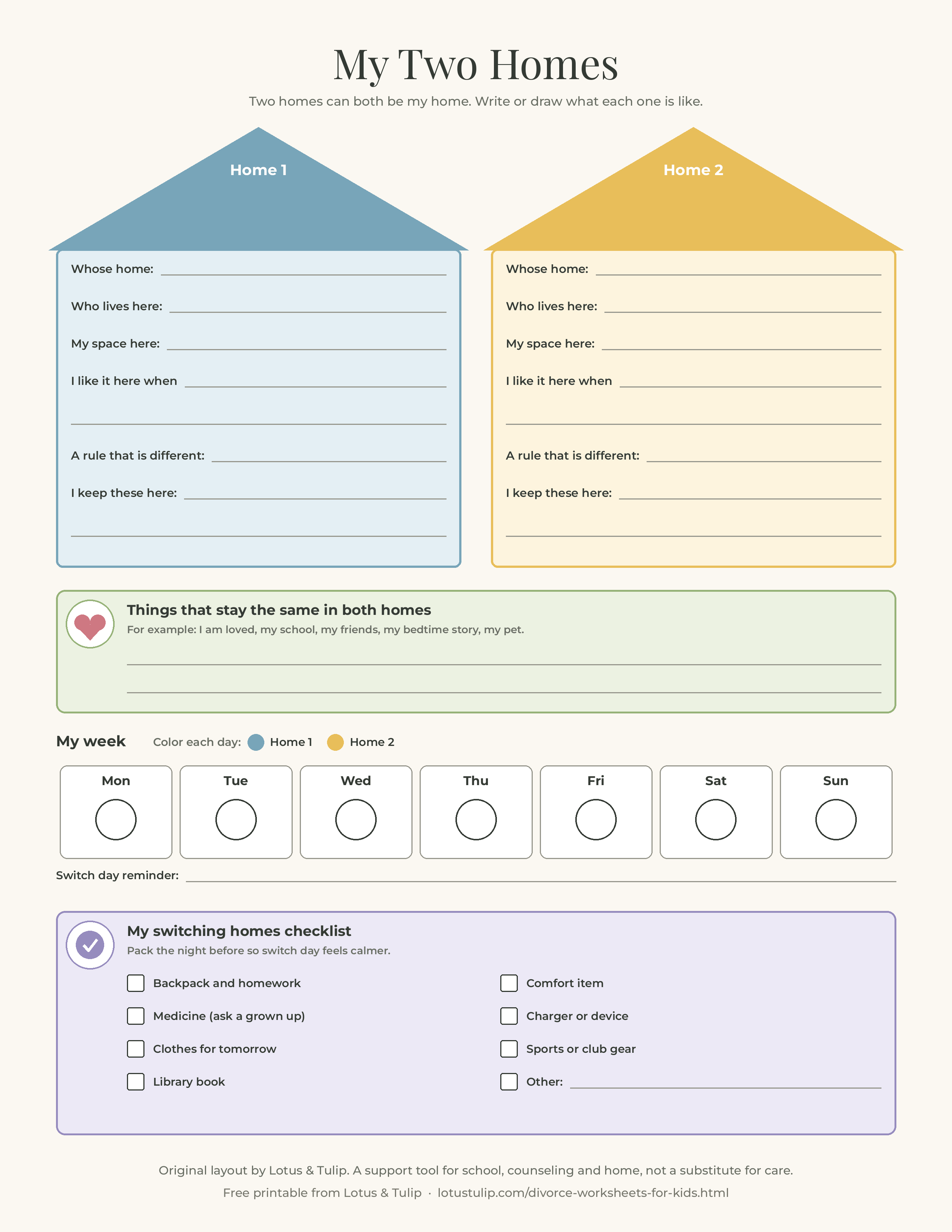
- Map the two homes. Use My Two Homes to name each home, list what is there and color the week. For many children, seeing the schedule on paper makes the change feel less random.
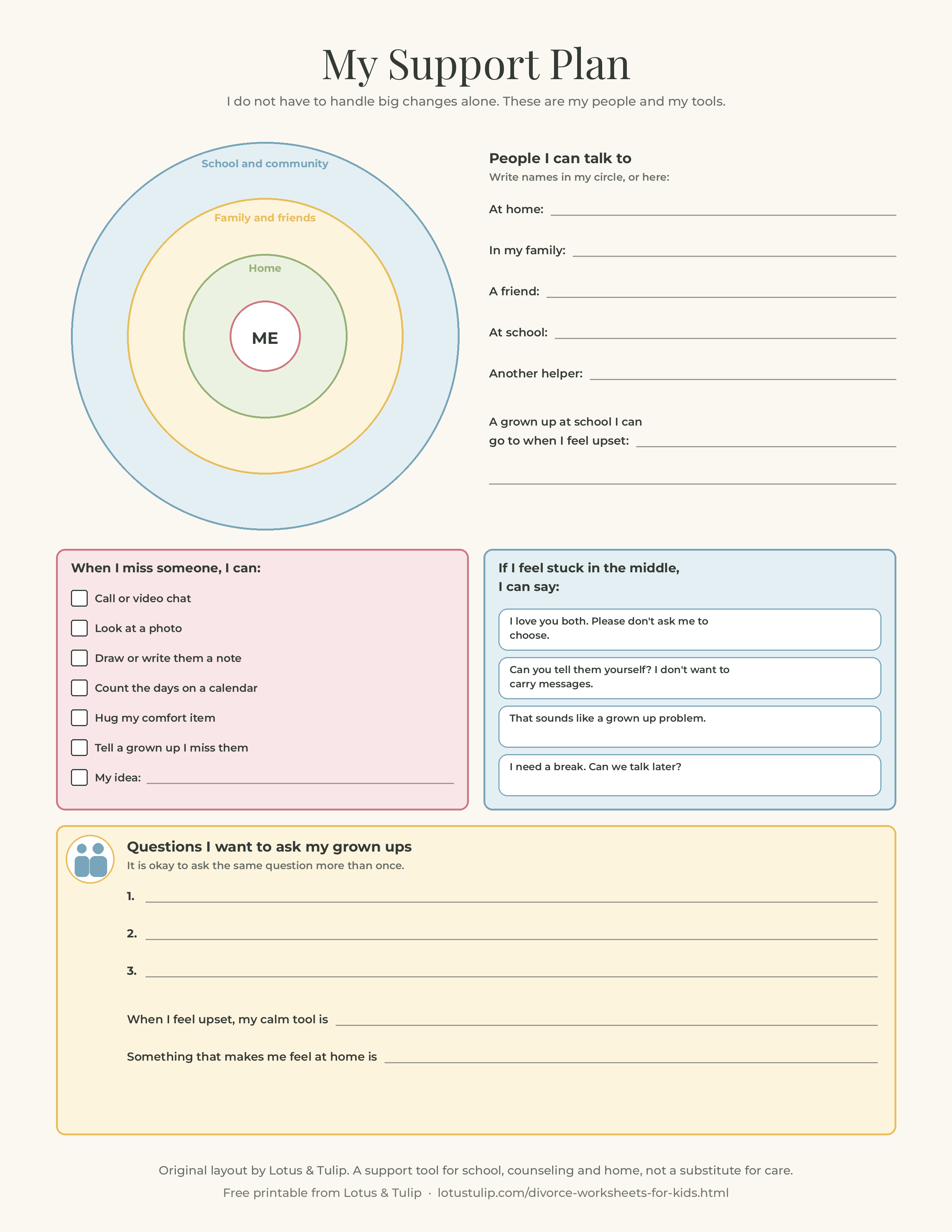
- Build the support plan. Fill in My Support Plan: people in their circle, what to do when they miss someone, words to use if they feel stuck in the middle and questions they want to ask.
- Follow up and share, with permission. Check in again in a week or two. Ask the child before sharing anything with a parent, and pass on questions the adults need to answer. Revisit the pages as the family's situation changes.
Divorce activities for kids beyond worksheets
Worksheets are a starting point. Pair them with activities that let children process the change in other ways.
- Two homes calendar. A color coded wall calendar in each home, matching the week plan on the worksheet. Younger children can move a magnet or sticker each morning.
- Feelings in a bag. Write feelings on slips, pull one out and share a time you felt it. Adults go first to model.
- Books about divorce. Picture books and middle grade novels about family change give children language and the comfort of knowing other kids have been through it. Read together and ask, "How is that like your family? How is it different?"
- Play and art. Drawing both homes, building them with blocks or acting out a switch day with figures helps younger children who cannot yet explain feelings in words. Our play therapy games and activities include ideas for this.
- Coping cards. A small set of calm down strategies the child carries between homes, so the same tools are available in both places. See our coping skills list for kids.
- Memory box. A box for photos, notes and small objects from both homes, especially helpful when a parent lives far away.
- Question jar. A jar where children can drop questions any time. Adults answer them together, honestly and briefly, at a set time each week.
Tips for school counselors and teachers
- Offer a small group. Groups for children of divorce let children see that they are not the only one, which many find hugely relieving. Programs like CODIP use small groups with structured sessions on feelings, misconceptions, coping and family changes.
- Know the custody basics. Find out which adults can pick the child up and receive information, and keep records current. Unless a court order says otherwise, both parents generally have the right to see school records under federal FERPA rules.
- Send information to both homes. Duplicate newsletters, conference invitations and report cards when appropriate, so the child is not the courier.
- Be sensitive with family assignments. Family trees, Mother's Day and Father's Day crafts and "my house" projects can be painful. Offer flexible options such as "someone special" or "my homes."
- Watch switch days. Many children are tired, distracted or emotional on days they move between homes. A quiet check in or a lighter load can help.
- Stay neutral. Never take a side or comment on either parent, even if a child or parent invites it.
- Know when to refer. If a child shows signs of depression, anxiety, self harm, abuse or neglect, follow your school's procedures, including mandated reporting where required.
Tips for parents and co-parents
- Protect your child from conflict. If you need to argue, do it away from the child, by email or with a mediator. Your child should never hear the details of the legal case or finances.
- Never use your child as a messenger or spy. Talk to the other parent directly, or use a co-parenting app. Do not quiz your child about the other home.
- Speak respectfully about the other parent. Children often see themselves as half of each parent. Criticizing one parent can feel like criticizing them.
- Keep routines as similar as you can. Similar bedtimes, homework rules and screen limits in both homes make switching easier, even if every detail is not identical.
- Make room for both relationships. When it is safe, let your child call, text or keep photos of the other parent without guilt.
- Look after yourself. Children notice parental stress. Support from friends, a therapist or a parenting program helps you stay the steady adult your child needs. Our calm and connected parenting worksheets include pages on staying calm and reconnecting.
- Introduce new partners slowly. Give children time to adjust to the separation before adding new relationships, and keep early introductions low pressure.
Common mistakes to avoid
- Saying nothing. Silence lets children fill the gaps with their own, often scarier, explanations, including that it is their fault.
- Too much information. Children need to know what will happen to them, not the adult reasons, affairs, money disputes or legal details.
- Making the child a confidant. Leaning on a child, especially an older child, for emotional support about the divorce puts them in an adult role.
- Asking the child to choose. Questions like "Who do you want to live with?" put enormous pressure on a child. Teens' views matter, but adults should make the decisions.
- Promising what you cannot control. Do not promise that nothing will change or that parents might get back together.
- Expecting a worksheet to do it all. Worksheets give structure. Listening, stability and low conflict between adults do most of the work.
When to get more help
Sadness, anger and worry are normal reactions to divorce, and many children feel better as routines settle. Talk to your child's pediatrician, school counselor or a licensed mental health professional if strong reactions last more than a few months or get worse; if the child seems persistently sad, hopeless, anxious or irritable; if school performance or friendships drop sharply; if there are big changes in sleep or eating; if the child withdraws from activities they used to enjoy; or if there has been family violence or abuse. A family therapist or a structured program such as a children of divorce group can make a real difference. If a child talks about wanting to die or about harming themselves, take it seriously and get help right away. In the US, call or text 988 (the Suicide and Crisis Lifeline) any time, or call 911 if someone is in immediate danger. A worksheet is a support tool, not a substitute for assessment or treatment.
Free divorce worksheets for kids printable (PDF)
This free printable is an original Lotus & Tulip design, sized for US Letter paper and suited to about ages 6 to 12 (elementary and early middle school), counseling sessions, small groups and home. Younger children can use it with an adult writing for them, and older students can adapt it. The wording uses "Home 1" and "Home 2" so it fits many kinds of families. It has three pages:
- Page 1: My Family Is Changing. A feelings check with twelve faces to color or circle (including relieved, guilty, confused and missing someone), lines for "my biggest feeling right now is" and "because," a "my job or not my job?" sort with eight items, and a "what is true" box: the changes are not my fault, I do not have to fix it, my grown ups still love me, and I never have to choose.
- Page 2: My Two Homes. Two houses to fill in (whose home, who lives here, my space, what I like, a rule that is different, things I keep there), a "things that stay the same in both homes" box, a Monday to Sunday week to color by home, a switch day reminder and a switching homes packing checklist.
- Page 3: My Support Plan. A support circle (home, family and friends, school and community), people I can talk to including a grown up at school, a "when I miss someone, I can" checklist, four "if I feel stuck in the middle, I can say" scripts, questions I want to ask my grown ups and my calm tool.
Download the free divorce worksheets for kids printable (PDF, 3 pages, US Letter)
Prefer single images? Page 1: My Family Is Changing (PNG) · Page 2: My Two Homes (PNG) · Page 3: My Support Plan (PNG)
Free to print for your own use and for use with your own students, clients or children. Please link to this page rather than re-uploading the file.
Related resources
- Blended family worksheets for kids: when a parent remarries or a new partner moves in, with a free blended family plan
- Incarcerated parent worksheets for kids: when a parent is in jail or prison, with honest words to use and a free staying connected plan
- Military deployment worksheets for kids: when a parent is away on military deployment, with a free deployment plan
- Moving worksheets for kids: helping children cope with moving to a new home, with a free moving plan
- Separation anxiety worksheet for kids (free printable): a goodbye plan and a brave apart ladder
- Grief activities for kids (free printable)
- Worry worksheet for kids (free printable)
- Emotional regulation worksheets for kids (free printable)
- Coping skills list for kids (free printable)
- Calm down corner ideas (free printable)
- Feelings wheel printable
- Self esteem worksheets for kids (free printable)
- I statements worksheet (free printable)
Sources
- American Academy of Child and Adolescent Psychiatry. Children and Divorce. Facts for Families No. 1. aacap.org.
- Amato, P. R. (2001). Children of divorce in the 1990s: an update of the Amato and Keith (1991) meta-analysis. Journal of Family Psychology, 15(3), 355 to 370.
- Amato, P. R., and Keith, B. (1991). Parental divorce and the well-being of children: a meta-analysis. Psychological Bulletin, 110(1), 26 to 46.
- Amato, P. R., Loomis, L. S., and Booth, A. (1995). Parental divorce, marital conflict, and offspring well-being during early adulthood. Social Forces, 73(3), 895 to 915.
- Buchanan, C. M., Maccoby, E. E., and Dornbusch, S. M. (1991). Caught between parents: adolescents' experience in divorced homes. Child Development, 62(5), 1008 to 1029.
- Hetherington, E. M., and Kelly, J. (2002). For Better or For Worse: Divorce Reconsidered. New York: W. W. Norton.
- Kelly, J. B., and Emery, R. E. (2003). Children's adjustment following divorce: risk and resilience perspectives. Family Relations, 52(4), 352 to 362.
- Pedro-Carroll, J. L., Sutton, S. E., and Wyman, P. A. (1999). A two-year follow-up evaluation of a preventive intervention for young children of divorce. School Psychology Review, 28(3), 467 to 476.
- Wolchik, S. A., Sandler, I. N., Millsap, R. E., et al. (2002). Six-year follow-up of preventive interventions for children of divorce: a randomized controlled trial. JAMA, 288(15), 1874 to 1881.
Divorce worksheets for kids: FAQ
How do I help my child cope with divorce?
Tell your child together if you can, keep the explanation simple and honest, and make it clear the divorce is not their fault and that both parents still love them. Keep routines and school as stable as possible, protect your child from adult conflict, never use them as a messenger and give them chances to talk about feelings. Worksheets and activities can help structure those conversations.
Does divorce harm children?
On average, children of divorced parents score somewhat lower on measures like school achievement and emotional adjustment, but the differences are small and most children are resilient. Research by Hetherington suggests around three quarters of children from divorced families function within the normal range. Ongoing conflict, feeling caught in the middle and multiple changes tend to matter more than the divorce itself.
What age is hardest for children when parents divorce?
There is no single hardest age. Young children may struggle with routines and believe they caused it, school age children often feel sad, angry or hope parents will reunite, and teens may withdraw or take on adult roles. What helps most at every age is low conflict, stable routines and warm, consistent care.
What should you not say to a child during a divorce?
Avoid blaming or criticizing the other parent, sharing adult details about the reasons, legal case or money, asking the child to choose a side or who they want to live with, asking them to carry messages or report on the other home, and promising things you cannot control, such as that parents will get back together.
How do school counselors help children of divorce?
School counselors offer individual check ins and small groups where children learn that the divorce is not their fault, name their feelings, practice coping skills and see that other children share their experience. Programs such as the Children of Divorce Intervention Program have reported benefits like reduced anxiety and fewer classroom problems. Counselors also help teachers adjust family assignments and share information with both homes.
What age is this free divorce worksheet for?
The free printable suits about ages 6 to 12, in counseling sessions, small groups or at home. Younger children can use it with an adult writing for them, and older students can adapt it. It uses "Home 1" and "Home 2" so it works for many family structures.
When should a child see a therapist after divorce?
Consider professional help if strong sadness, anger or worry lasts more than a few months or worsens, if school or friendships suffer badly, if sleep or eating change a lot, if the child withdraws or talks about self harm, or if there has been family violence. In the US, call or text 988 for crisis support, or 911 in an emergency.