
Kids and teens · Moving to a new home for kids 4 to 12 · Updated 2026-11-15
Moving worksheets for kids: how to help children cope with moving to a new home, what research shows and a free moving plan

Ages 5 to 11: Kids Feelings and Social Skills Worksheets, incl. feelings detective, body clues, a feelings thermometer, a coping skills menu and a calm down plan Holiday 20% off: about $11.04, was $14 (EUR 12) · fillable PDF, instant digital download
Buy on EtsyTry it free first: download a fillable sample (feelings thermometer and calm-down plan, PDF, 240 KB). Type into it on screen, then get the full pack. No email needed.
Routines in a new home: Visual Schedule and Behavior Supports, 23 pages with token boards, a reward menu, first then boards and 136 picture cards Holiday 20% off: about $6.44, was $8 (EUR 7) · instant digital download
Buy on EtsyKids and teens bundle: Kids and Teens Worksheets Bundle (feelings, anger, self esteem, social anxiety) Holiday 20% off: about $22.08, was $28 (EUR 24) · 80 pages, instant digital download
Buy on EtsyThe boxes are stacked in the hallway, the walls are bare, and your child asks for the third time tonight, "But why do we have to move?" Maybe it is a new job, a bigger place, a divorce, a military assignment, rising rent or being closer to family. Whatever the reason, moving to a new home turns a child's whole world upside down at once: their room, their street, their school, their friends and their routines.
This guide is for parents, caregivers, teachers, school counselors and therapists supporting children about 4 to 12 through a move. It explains how moving affects children at different ages, what research shows (honestly, including its limits), what moving worksheets can and cannot do, eight kinds of moving activities, nine steps to help your child before, during and after the move, age and need adaptations, notes for the new school, common mistakes and three short examples. It ends with a free 2 page printable: My Moving Map and My Moving Plan.
When to talk with a professional: most children settle within weeks to a few months. Talk with your child's pediatrician, school counselor or a child therapist if sadness, worry, anger, sleep or appetite changes, school refusal or withdrawal from friends last more than a few weeks or keep getting worse; if grades drop sharply; or if the move came with other big losses, such as a divorce, a death, losing a home, a disaster or a parent's deployment. If your family has lost housing or is staying with others because you have nowhere else to go, ask the school for its homeless education liaison (see the school section below). If a child talks about wanting to die or hurting themselves, call or text 988 (the 988 Suicide and Crisis Lifeline). If anyone is in immediate danger, call 911.
Download the free moving worksheets for kids (PDF, 2 pages, US Letter)
Direct download, no email or sign up. See the pages first. Moving because parents are separating? See divorce worksheets for kids. Hard goodbyes at drop off? See the separation anxiety worksheet for kids.
How moving affects children
For adults a move is usually a decision with reasons. For children it is mostly something that happens to them. The American Academy of Child and Adolescent Psychiatry (AACAP) describes moving to a new community as one of the most stressful experiences a family can face, and notes that frequent moves, or even a single move, can be especially hard on children and teens. Moves interrupt friendships, and a new child at school can feel that everyone else already has a best friend or a group. The new school may be ahead in some subjects and behind in others, which can leave a child stressed, anxious or bored.
Age matters. AACAP notes that children in kindergarten and first grade can be particularly vulnerable because they are just learning to separate from parents and adjust to new adults, so a move may push them back toward being more dependent for a while. In general, the older the child, the harder the move tends to be, because friends matter more and more. Preteens may protest the move again and again or ask to stay behind with a friend's family.
A move also rarely comes alone. Families often move because of a new job, a separation, money problems or a change in who lives in the home. AACAP points out that moves are harder when they come with a death, a divorce, a loss of income or a change of schools, and that children can sense and react to tension when one parent did not want the move.
What the research shows, honestly
Most research on moving and children looks at large surveys and follows families over time. These studies can show links between moving and later problems, but they cannot easily separate the move itself from the reasons families move. Keep that in mind when reading the numbers.
Moving is common, though less than it used to be. The U.S. Census Bureau's Current Population Survey found that 8.4% of Americans lived somewhere else a year earlier in 2021, the lowest rate it had documented in over 70 years, and 8.7% in 2022. Over a whole childhood, moves add up: in a national survey of 10,362 U.S. children aged 6 to 17, 24% had never moved, 35% had moved once or twice and 39% had moved three or more times (Simpson and Fowler, 1994). Military connected children move even more often; the Military Child Education Coalition reports that they move and change schools about six to nine times between kindergarten and graduation, about three times as often as civilian classmates.
Frequent moves are linked to school and behavior problems. In the same national survey, after accounting for family background, children who had moved three or more times were 2.3 times more likely to have received psychological help, 1.7 times more likely to have repeated a grade and 1.9 times more likely to have been suspended or expelled than children who had never moved (Simpson and Fowler, 1994). In another analysis of 9,915 children aged 6 to 17 from that survey, 23% of children who moved frequently had repeated a grade, compared with 12% of other children, and 18% had four or more frequent behavior problems, compared with 7%. After adjusting for other factors, frequent movers were 77% more likely to have four or more behavior problems and 35% more likely to have failed a grade, but no more likely to have a learning disorder or developmental delay (Wood and colleagues, 1993).
Friendships take a hit at first. A small study of 36 young adolescents who had recently moved and 37 who had not found that the movers had fewer contacts with friends and felt less close to their best friend during the school year, and boys who had moved met more rejection from peers (Vernberg, 1990). This is why friendship building deserves a real place in a moving plan.
Timing and frequency matter more than a single move. In a study following 19,162 U.S. children from kindergarten through eighth grade, moving in middle childhood and early adolescence was linked to lower cognitive skills, but those effects were short term and faded over time; links with social and emotional skills showed up for moves in early and middle childhood (Coley and Kull, 2016). A Danish national study of almost 1.5 million people found that childhood moves were linked to higher risks of later problems such as attempted suicide, violent offending and substance misuse, with risks rising with the number of moves in a year and the age at moving, and particularly marked for several moves in a single year in early and mid adolescence (Webb, Pedersen and Mok, 2016). A systematic review of 22 studies found that residential mobility was associated with more behavioral and emotional problems and adolescent depression, and that frequent moving can be a useful marker for children who may need extra support (Jelleyman and Spencer, 2008).
Often it is not the move itself, but what comes with it. In a study of 8,116 adults, people who had moved eight or more times as children were more likely to have had adverse childhood experiences such as abuse, neglect or household dysfunction. When researchers accounted for those experiences, the link between frequent moves and later health problems was greatly reduced (Dong and colleagues, 2005). In other words, frequent moving is often a sign of a family under stress, and the support around a child matters a great deal.
What this means for you. No study has tested worksheets like the ones on this page, and most of this research looks at frequent moves, not one planned move. A single, well prepared move is something most children manage well, and AACAP notes that with attention from parents, a move can even become a positive growth experience that builds confidence and social skills. The findings point the same way: prepare children early, keep routines steady, protect old friendships while building new ones, work closely with the new school, try to limit repeated moves where you have a choice, and watch for children who are carrying other losses at the same time.
What moving worksheets can and cannot do
Moving worksheets give children words for mixed feelings, a place to write down their questions, and a plan they helped make. They move the conversation from "You'll love it there" to "What will you miss, what are you curious about, and what would help?" For adults, a first week tracker turns attention toward small steps, like saying hi to a neighbor or trying a new park, which are easy to overlook in the chaos of unpacking.
They cannot make a hard move painless, replace an evaluation for anxiety, depression or learning problems, or fix the stress of losing a home, a parent's job or a family breakup. If your child is still very upset after a few weeks, or the professional box above applies, bring your notes to your pediatrician, the school counselor or a child therapist.
8 kinds of moving activities for kids
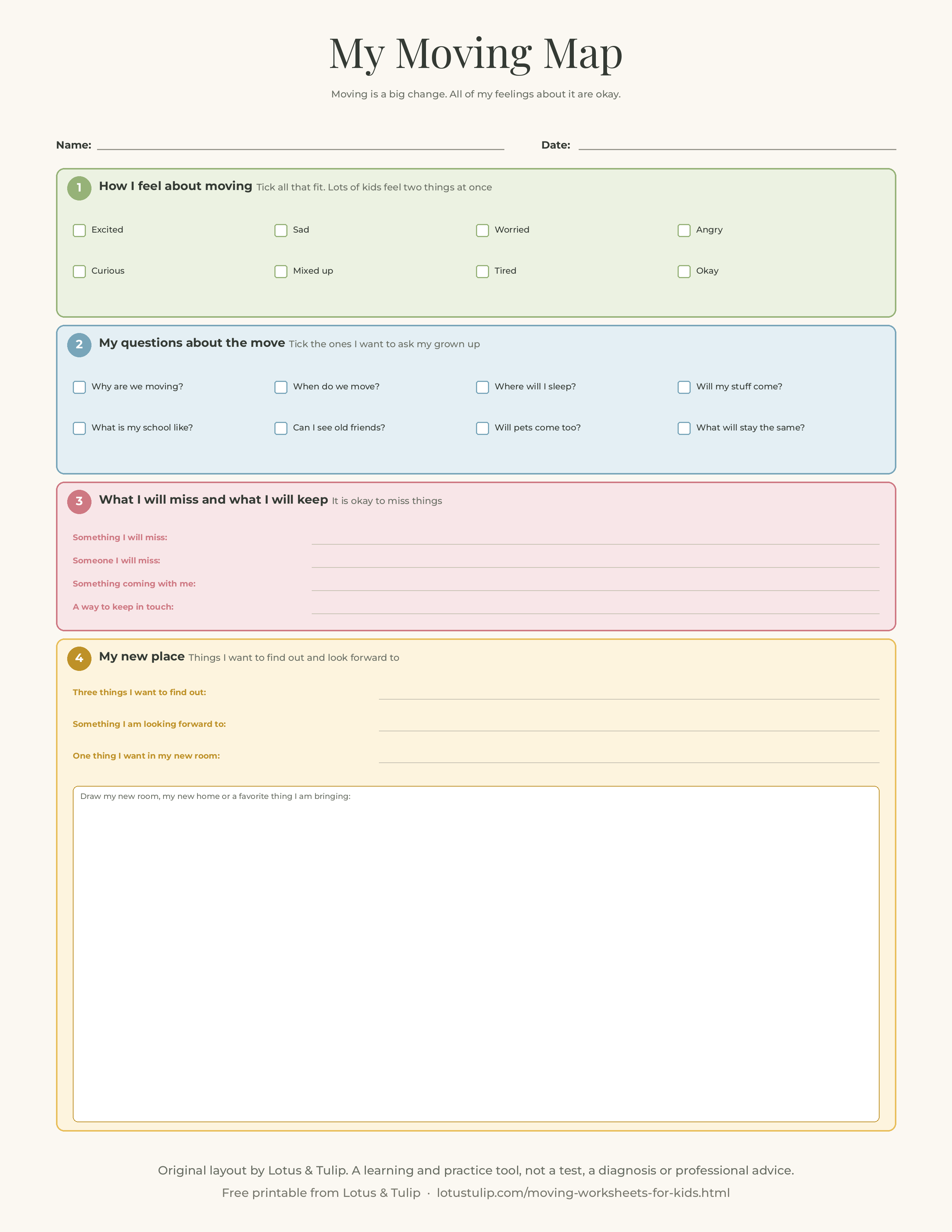
- Feelings check in. Many children feel excited and sad at the same time. A simple checklist of feelings (page 1 of the free printable) shows that mixed feelings are normal and gives quieter children a way to say how they feel without having to find the words.
- Question list. Children often worry about practical things adults forget to explain: where they will sleep, whether their toys and pets are coming, what the new school is like. Writing questions down, then answering them honestly, lowers worry.
- Miss and keep list. Name what your child will miss (a friend, a tree, the corner store) and what is coming with them (people, pets, favorite things, family traditions). This honors the loss without dwelling on it.
- Get to know the new place. AACAP suggests helping children learn about the new area with maps and photos. Look at the new street, school, parks and library online, and pick three things to find out together.
- Design my room. Letting children help plan or decorate their room, another AACAP suggestion, gives them some control. Even small choices, like where the bed goes or which poster goes up first, help.
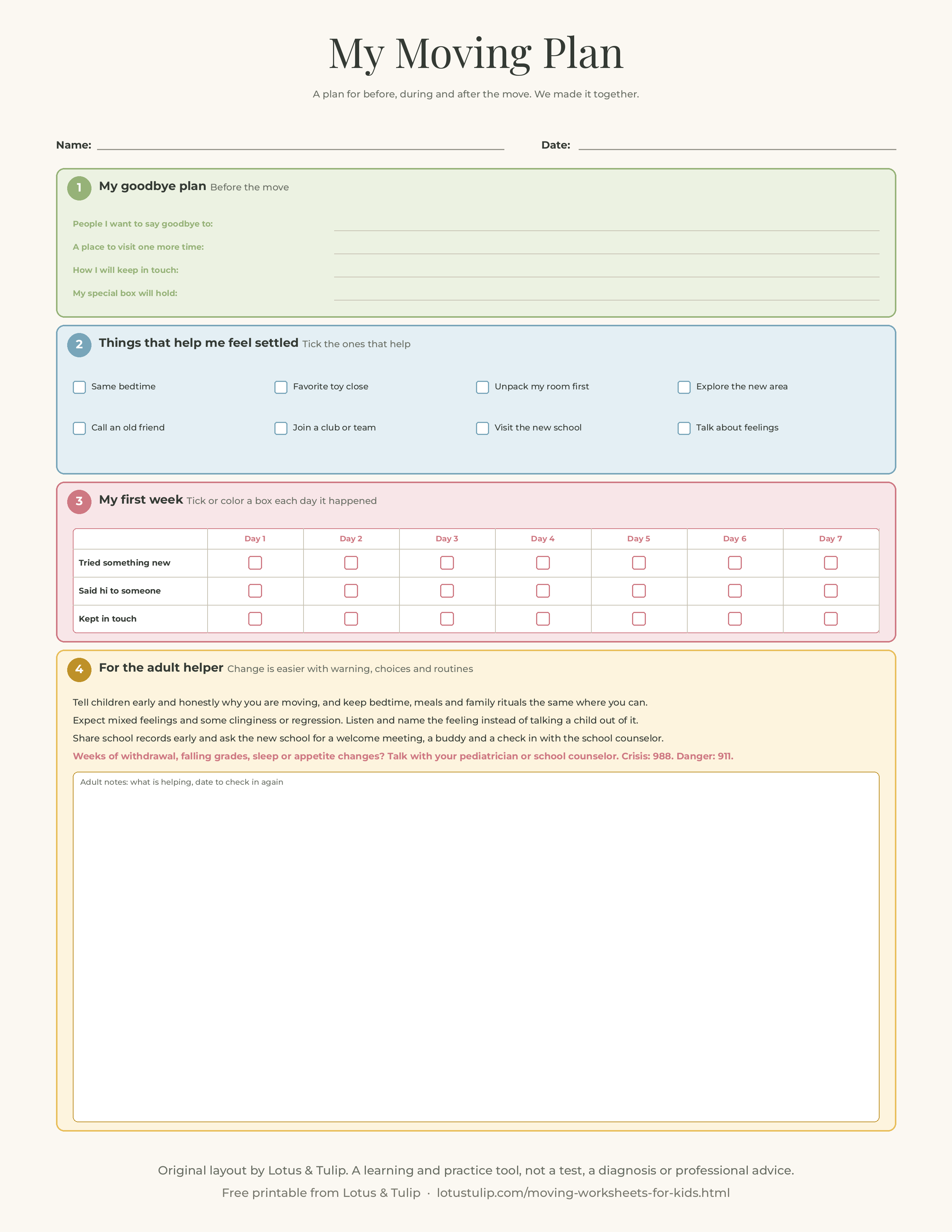
- Goodbye plan. Plan goodbyes on purpose: a last visit to a favorite place, a goodbye card or photo book, a small party or a shared meal. Page 2 of the printable has a goodbye plan.
- Keep in touch tools. Write down addresses, phone numbers or video call times for old friends and relatives, or start a pen pal letter. Staying connected to old friends while making new ones is part of nearly every expert tip list.
- First week tracker and settling in. Track small brave steps each day in the new home: trying something new, saying hi to someone, keeping in touch. Praise the effort, not only the outcome.
How to help your child cope with a move, step by step
- Tell them early and explain why. AACAP recommends explaining clearly why the move is necessary. Give as much notice as you can, in simple, honest words that fit your child's age, and repeat it as often as they need.
- Listen to every feeling. Expect excitement, sadness, anger and worry, sometimes all in one evening. Name the feeling ("You're really sad about leaving Maya") instead of rushing to cheer your child up. Page 1 of the printable helps children check off their feelings.
- Answer their questions. Use the question list to find out what your child is actually worried about, and answer honestly. If you don't know yet, say so and tell them when you will find out.
- Show them the new place. Look at maps and photos of the new home, neighborhood and school together, point out things your child will enjoy, and visit ahead of time if you can.
- Give them real choices. Let your child pack a special box of favorite things that travels with them, help choose how their room is set up, and choose one or two things to look forward to.
- Plan the goodbyes. Fill in the goodbye plan together: the people to see, the places to visit one more time and how you will keep in touch.
- Keep routines steady. On moving day and in the first weeks, keep bedtime, meals and family rituals as close to normal as possible. Set up your child's bed and comfort items first, so the first night feels familiar.
- Help them connect in the new place. Meet the teacher and school counselor early, ask about a buddy, and look for clubs, sports, faith communities, libraries or recreation centers where your child can meet other children.
- Check in and review. Use the first week tracker, then check in every week or two for the first couple of months. If your child is still very unhappy, withdrawn or struggling after a few weeks, talk with your pediatrician or the school counselor.
How to adapt it by age and need
- Ages 4 to 5: keep it concrete and close in time. Use picture books about moving, play "moving day" with toy boxes, and count down with a simple calendar. Expect some regression, such as clinginess, toilet accidents or sleep trouble, and respond with extra closeness and patience.
- Ages 6 to 8: children can use the feelings checklist and question list with help. Give them jobs, like packing their own box or choosing paint for their room, and plan a visit to the new school if you can.
- Ages 9 to 12: friends matter most now. Take their protests seriously, give them a say where you can, and help them keep in touch with old friends by phone or video. Help them find one club or activity in the new place quickly. AACAP notes that some older children do not talk about their distress, so watch for withdrawal, irritability or a drop in grades.
- Autistic children and children who need predictability: use visual schedules, photos of the new home and school, and social stories. Move familiar items in the same arrangement where possible, and keep the first days in the new home as predictable as you can.
- Children with ADHD or learning differences: share records and any 504 plan or IEP with the new school before the first day. A move often means new teachers who do not yet know what works for your child.
- Anxious children: more information, given calmly, usually helps more than less. Practice the new routes, rehearse introductions ("Hi, I'm new, I'm Sam") and break the move into small steps.
- Military families and frequent movers: build rituals that travel with you, such as a goodbye tradition and a first night tradition. Ask whether the new school is a Purple Star School or has a military family liaison, and use the school counselor early.
- After a loss of home, a disaster or a family breakup: safety, stability and connection come first. Children may need more time and more support; talk with the school counselor or a child therapist.
Moving and the new school: notes for teachers and counselors
- Welcome on purpose. A short meeting with the student and family before or on the first day, a tour and a trained buddy can make the first week much easier.
- Get records moving. Ask for transcripts, assessments and any IEP or 504 plan as soon as possible. Under the federal special education law, when a child with an IEP transfers, the new district must provide services comparable to those in the previous IEP until it adopts the old one or develops a new one.
- Check in early and often. A brief check in during the first weeks, and again after a month, catches children who are quietly struggling. A new student group or lunch bunch can help children meet each other.
- Know the McKinney-Vento Act. Children whose families have lost housing, including families staying with others because they have nowhere else to go, have the right to stay in their school of origin when it is in their best interest, or to enroll right away in the local school even without the usual records. Every district has a homeless education liaison who can help.
- Look at the whole child. Falling grades, withdrawal, aggression or school avoidance after a move can reflect stress at home, not only adjustment. Involve the family and the school team, and consider an evaluation if problems persist.
- Mandated reporting. Frequent moves are sometimes linked to family hardship or adverse experiences. If you suspect abuse or neglect, follow your district policy and your duties as a mandated reporter.
Common mistakes
- Telling children too late. Finding out a week before the truck arrives leaves no time to say goodbye or ask questions.
- Only selling the positives. "You'll love it" can feel like a child's sadness is not allowed. Name both the good parts and the hard parts.
- Changing everything at once. A new home, new school, new bedtime and new rules in the same week is a lot. Keep what you can the same.
- Cutting off old friendships. Old friends are a source of comfort while new friendships form. Help children stay in touch.
- Missing the quiet signs. Some children seem fine and then struggle weeks later. Keep checking in after the boxes are unpacked.
- Forgetting the adults. Children read their parents' stress. Look after yourself, and keep adult worries and arguments about the move away from children.
Examples
- Noah, 5: started wetting the bed and wanted to sleep in his parents' room after they told him about the move. His parents read a picture book about moving, let him pack a special box with his stuffed fox, and set up his bed first in the new home with the same night light. Within a few weeks he was sleeping in his own room again.
- Priya, 8: cried every night that she would never see her best friend again. Together with her mom she filled in the miss and keep list, made a photo book for her friend and set up a video call every Sunday. At the new school, the counselor paired her with a buddy, and she ticked "said hi to someone" four days in her first week.
- Jordan, 11: moved for his dad's military assignment, his third move in five years. He said he did not care, but his grades dropped and he stopped playing basketball. His parents talked with the school counselor, who set up regular check ins and connected him with a club for military connected students. He joined the school team after a month.
Free printable: moving worksheets for kids
This printable is an original Lotus & Tulip layout. It is not an assessment and gives no score. Page 1, My Moving Map, has a checklist of feelings about moving, questions to ask a grown up, a miss and keep list (something and someone I will miss, something coming with me, a way to keep in touch), new place prompts (three things I want to find out, something I am looking forward to, one thing I want in my new room) and a box to draw the new room or home. Page 2, My Moving Plan, has a goodbye plan, things that help me feel settled, a first week tracker for trying something new, saying hi to someone and keeping in touch, and notes for the adult helper, including when to get help.
Download the free moving worksheets for kids (PDF, 2 pages, US Letter)
Prefer single images? Page 1: My Moving Map (PNG) · Page 2: My Moving Plan (PNG)
Related resources
- Military deployment worksheets for kids: when a move comes with a parent's deployment, with a free deployment plan
- Divorce worksheets for kids: when a move comes with parents separating
- Separation anxiety worksheet for kids: for clinginess and hard goodbyes after a move
- Friendship worksheets for kids: how to join in and make new friends at a new school
- Grief activities for kids: when a move comes with a loss
- Middle school transition activities: for students starting a new school
- Adoption and foster care worksheets for kids: when a move means a new foster, kinship or adoptive home, with a free belonging plan
- All counseling resources for kids and teens
FAQ
How do I tell my child we are moving?
Tell them as early as you can, in simple, honest words that fit their age, and explain why the move is happening. Share what will stay the same (family, pets, favorite things) and what will change, invite questions, and expect to repeat the conversation several times. The free moving map on this page gives children a place to tick their feelings and questions.
How long does it take a child to adjust to a move?
Most children settle within a few weeks to a few months, especially once they have a routine and a friend or two. Some take longer, particularly older children and those dealing with other changes at the same time. If your child is still very upset, withdrawn or struggling at school after a few weeks, talk with your pediatrician or the school counselor.
Is moving bad for kids?
A single, well prepared move is something most children manage well, and it can build confidence and social skills. Research links frequent moves to more school and behavior problems, but part of that link comes from the stresses that often come with moving, such as family breakups or money problems. Preparation, steady routines, kept friendships and support from the new school all help.
What age is hardest for a child to move?
There is no single worst age. AACAP notes that children starting kindergarten or first grade can be particularly vulnerable because they are still learning to separate from parents, and that moves tend to get harder with age as friends become more important. A large Danish study found that several moves in a single year during early and mid adolescence were linked to especially high risks later in life.
How can I help my child make friends after moving?
Ask the new school about a buddy or a new student group, sign your child up for one club, sport or activity quickly, invite a classmate over, and practice simple introductions at home. Keeping in touch with old friends helps too, because it gives children comfort while new friendships grow.
Should I change my child's school in the middle of the year?
If you have a choice, many families time moves for the summer or a natural break, and AACAP suggests that a high school senior might stay with a trusted family to finish the year. If a mid year move cannot be avoided, share records early, ask for a welcome meeting and a buddy, and check in often during the first weeks. Families who have lost housing may have the right to keep their child in the school of origin under the McKinney-Vento Act.
What age are these moving worksheets for?
They are designed for children about 4 to 12. Younger children can point, color and talk through the pages with an adult reading aloud. Children 7 to 12 can fill in most of the moving map and moving plan themselves. Parents, teachers, school counselors and therapists can use them at home, in class or in sessions.
Sources
- American Academy of Child and Adolescent Psychiatry (2017). Moving: helping children cope. Facts for Families No. 14.
- Coley, R. L., and Kull, M. (2016). Cumulative, timing-specific, and interactive models of residential mobility and children's cognitive and psychosocial skills. Child Development, 87(4), 1204 to 1220.
- Dong, M., Anda, R. F., Felitti, V. J., Williamson, D. F., Dube, S. R., Brown, D. W., and Giles, W. H. (2005). Childhood residential mobility and multiple health risks during adolescence and adulthood: the hidden role of adverse childhood experiences. Archives of Pediatrics and Adolescent Medicine, 159(12), 1104 to 1110.
- Jelleyman, T., and Spencer, N. (2008). Residential mobility in childhood and health outcomes: a systematic review. Journal of Epidemiology and Community Health, 62(7), 584 to 592.
- Military Child Education Coalition. Facts about military connected children.
- National Center for Homeless Education. Enrolling children and youth experiencing homelessness in school (McKinney-Vento Act).
- Simpson, G. A., and Fowler, M. G. (1994). Geographic mobility and children's emotional/behavioral adjustment and school functioning. Pediatrics, 93(2), 303 to 309.
- U.S. Census Bureau. Current Population Survey Annual Social and Economic Supplement, geographic mobility releases for 2021 and 2022.
- Vernberg, E. M. (1990). Experiences with peers following relocation during early adolescence. American Journal of Orthopsychiatry, 60(3), 466 to 472.
- Webb, R. T., Pedersen, C. B., and Mok, P. L. (2016). Adverse outcomes to early middle age linked with childhood residential mobility. American Journal of Preventive Medicine, 51(3), 291 to 300.
- Wood, D., Halfon, N., Scarlata, D., Newacheck, P., and Nessim, S. (1993). Impact of family relocation on children's growth, development, school function, and behavior. JAMA, 270(11), 1334 to 1338.
Lotus & Tulip is not affiliated with the researchers, programs, agencies or organizations named on this page. Names in the examples are invented. This page is educational and does not replace professional advice, diagnosis or treatment.