
Special education and visual supports · Updated 2026-11-03
Social story template: how to write a social story for kids, with a free printable
Ready-made printable: Visual Schedule and Behavior Supports Holiday 20% off: about $6.44, was $8 (EUR 7) · instant digital download
Buy on Etsy
A social story is a short, simple story that explains a situation to a child before it happens: what will happen, who will be there, what it may feel like and one thing the child can try. "Sometimes the plan changes. Many kids feel unsure at first, and that is okay." Read on a calm day, a story like this can make a haircut, a fire drill, a new sibling or a substitute teacher far less of a shock. This guide is for parents, special education teachers, school counselors, speech and occupational therapists, ABA therapists and RBTs. It covers what a social story is, where the idea comes from, what the research says, how to write one step by step, examples of good topics, how to read it with a child, and the most common mistakes. It ends with a free printable: a blank six page story template, a finished sample story called "When My Day Changes", and a story planner.
Jump to the free social story template
What a social story is
A social story describes one situation, skill or idea in a calm, literal, reassuring way, usually with one short sentence or two per page and a picture on each page. It is written for one child, often in their own voice ("I", "my"), and it answers the questions the child might not be able to ask: where and when does this happen, who is there, what happens first, why do people do this, and what usually happens next.
The key word is describe. A good social story mostly explains what is going on and how other people may think or feel. It may include one gentle suggestion, such as "I can take a slow breath", but it is not a list of rules or a warning. Children learn the situation first, and the right response becomes easier once the situation makes sense.
Where social stories come from
Social Stories were developed by Carol Gray, a teacher and consultant in Michigan, who started writing guidelines for them in 1991. "Social Story" is Carol Gray's trademarked term for stories that meet her published criteria, which she has revised over the years; the current version is called Social Stories 10.2. Many teachers and therapists use "social story" loosely for any short story that explains a situation, and researchers often use the wider term social narrative. The template on this page is a general social narrative template inspired by those ideas. It is not affiliated with Carol Gray, and if you want to write stories that meet her criteria in full, her own books and training are the place to go.
A few of her ideas are useful for anyone writing a story at home or in class:
- Describe more than you direct. Her criteria include a formula: a story should have at least twice as many describing sentences as coaching sentences (sentences that suggest what to do). Many good stories have only one coaching sentence, or none.
- Answer the wh questions. Where, when, who, what, how and why. The planner page in the free printable is built around those six questions.
- Title, beginning, middle and end. A title that names the topic, an introduction, a body with detail, and an ending that sums it up.
- Patient, positive and literally true. Words like "usually", "sometimes" and "may" keep the story true even when things go differently, which matters for children who take words literally.
- Celebrate, not only correct. Gray recommends that a good share of stories praise something the child already does well. A story about "How I helped my friend today" is as valid as one about a dentist visit.
What the research says
Social narratives are one of the evidence-based practices for autistic children and youth identified by the National Clearinghouse on Autism Evidence and Practice (Steinbrenner et al., 2020), which reviewed intervention research published from 1990 to 2017. NCAEP defines social narratives as interventions that describe social situations in order to highlight relevant features of a target behavior or skill and offer examples of appropriate responding. In that review, social narratives met the evidence-based criteria with 20 single case design studies and one group design study, covering learners from about age 3 to 18.
Two honest caveats. First, most of the research is with autistic learners, and results vary from child to child; social stories tend to work best when they are short, individualized, read regularly, and combined with other supports such as a visual schedule and praise when the child uses the skill. Second, a story is one support, not a full plan. If a situation leads to unsafe behavior or a lot of distress, the child's team (a BCBA, school psychologist, counselor or therapist) should look at the whole picture.
Who social stories help
- Autistic children who do better when they know exactly what will happen and why.
- Children with anxiety who worry about new or unpredictable situations.
- Young children preparing for a first: the first day of school, a first haircut, a first sleepover.
- Children with ADHD or language delays who miss the unspoken rules of a situation.
- Any child facing a change: a move, a new baby, a new teacher, a hospital visit or a family change.
How to write a social story, step by step
- Pick one situation. Choose one specific event or skill, not a general problem. "Fire drills at school" works better than "being scared". Start with something that is coming up soon or that keeps going wrong.
- Find out what the child experiences. Watch the situation, or ask the child and the adults around them. What does the child see, hear and feel? What part is confusing or hard? A fire drill story is often about the loud noise, so that is what the story should explain.
- Answer the six questions. Where and when does it happen, who is there, what happens and what are the cues, how does it usually go, and why does it happen. Write a short answer to each on the planner page before you write the story.
- Write mostly describing sentences. Facts ("The fire alarm is very loud"), what other people think or feel ("My teacher wants everyone to be safe"), and reassurance ("Fire drills are practice. They end after a few minutes"). Keep sentences short and literal.
- Add at most one or two gentle coaching sentences. Phrase them as something the child can try, not a command: "I can cover my ears and walk with my class." Count your sentences: describe at least twice as much as you coach.
- Use the child's voice and words. Write in first person for younger children, or with the child's name. Use the words the child uses for places and people. Avoid "always" and "never", and choose "usually", "sometimes" and "may" so the story stays true.
- Add one picture per page. Photos of the real place and people work best for many children. Simple drawings or picture cards work too. Keep one idea and one picture on each page.
- Read it before the situation, when the child is calm. Read it together once a day for a few days before the event, and again just before. Let the child hold it, turn the pages and read parts aloud.
- Review and fade. Praise the child when they use the idea from the story. If the situation goes well a few times, read the story less often. If it does not help, rewrite it: often the story is explaining the wrong part.
Social story examples: topics that work well
| Situation | What the story explains | One coaching idea |
|---|---|---|
| When my day changes | Schedules usually stay the same, sometimes plans change, feeling unsure is okay, the rest of the day is still there | I can look at my schedule and take a slow breath |
| Fire drill at school | The alarm is loud, it is practice, everyone walks outside, it ends after a few minutes | I can cover my ears and walk with my class |
| Going to the dentist | The waiting room, the big chair, the light, the dentist counts teeth, it usually takes a short time | I can hold my toy while I wait |
| Getting a haircut | The cape, the sound of the clippers, small hairs may tickle, the haircut is done when the cape comes off | I can watch the timer |
| Losing a game | Games have winners and losers, everyone loses sometimes, friends like playing again | I can say "good game" |
| A substitute teacher | Teachers are sometimes away, a substitute follows the same schedule, my teacher comes back | I can show the substitute my schedule |
| A new baby at home | Babies cry and sleep a lot, grown ups are busy, they still love me, there is special time for me | I can ask for a hug |
Notice that each row has one coaching idea and several facts. That balance is what makes a story feel kind rather than bossy.
A sample social story: "When My Day Changes"
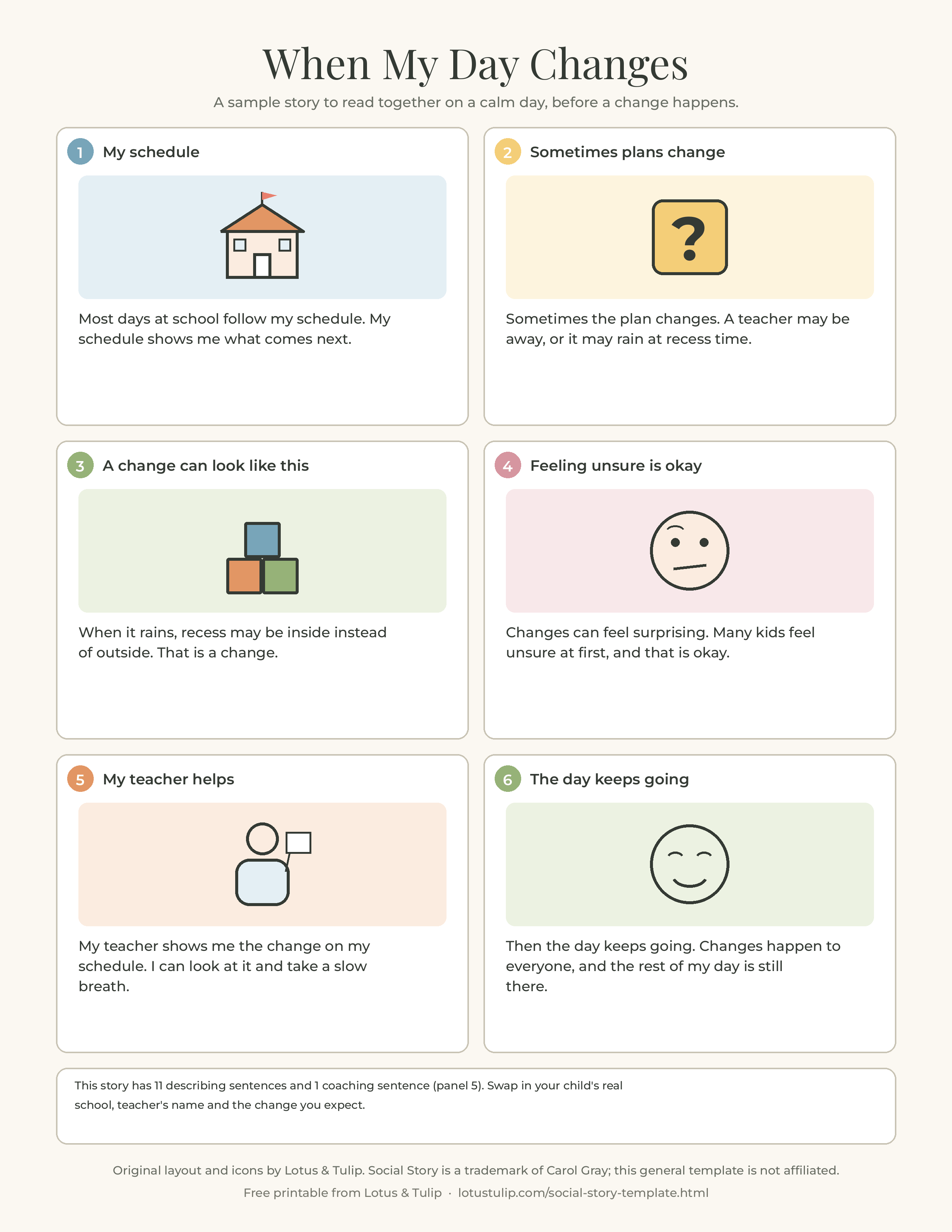
Page 2 of the free printable is this finished six page story. You can use it as it is or change the details to match your child's school.
- My schedule. Most days at school follow my schedule. My schedule shows me what comes next.
- Sometimes plans change. Sometimes the plan changes. A teacher may be away, or it may rain at recess time.
- A change can look like this. When it rains, recess may be inside instead of outside. That is a change.
- Feeling unsure is okay. Changes can feel surprising. Many kids feel unsure at first, and that is okay.
- My teacher helps. My teacher shows me the change on my schedule. I can look at it and take a slow breath.
- The day keeps going. Then the day keeps going. Changes happen to everyone, and the rest of my day is still there.
The story has eleven describing sentences and one coaching sentence. It pairs well with the change card on a visual schedule, so the story explains changes and the schedule shows them.
How to read a social story with a child
- Choose a calm time. A story read in the middle of a meltdown is just more words. Read it at a quiet moment, such as after a snack or at bedtime.
- Read it the same way each time. Repetition is the point. Many children like to read it themselves after a few days.
- Keep it short. Five to ten pages is plenty for most young children. Older children may prefer a one page version with a short paragraph.
- Connect it to real life. Before the situation, say "Remember our story?" and show the matching page. Afterward, praise what went well: "You covered your ears and walked with your class, just like in the story."
- Keep it where the child can find it. In their backpack, a binder, by the calm down corner, or as photos on a tablet.
Common mistakes
- Writing rules instead of a story. "I will not scream. I will sit still. I will listen." is a rule list. Children tune it out, and it can feel like a punishment.
- Using absolutes. "The dentist will not hurt" or "The bus is always on time" can backfire the first time it is not true. Use "usually" and "sometimes".
- Explaining the wrong part. If the hard part is the noise, a story about walking in a line will not help. Find out what the child finds hard first.
- Making it too long. One idea per page and one sentence or two per page is enough for most young children.
- Only reading it after problems. Then the story becomes a consequence. Read it ahead of time, and write some stories about things the child does well.
- Stopping too soon. One reading rarely changes much. Read it daily for at least a week before deciding it does not work.
Free social story template (printable PDF)
This free printable is an original Lotus & Tulip design, sized for US Letter paper. It has three pages:
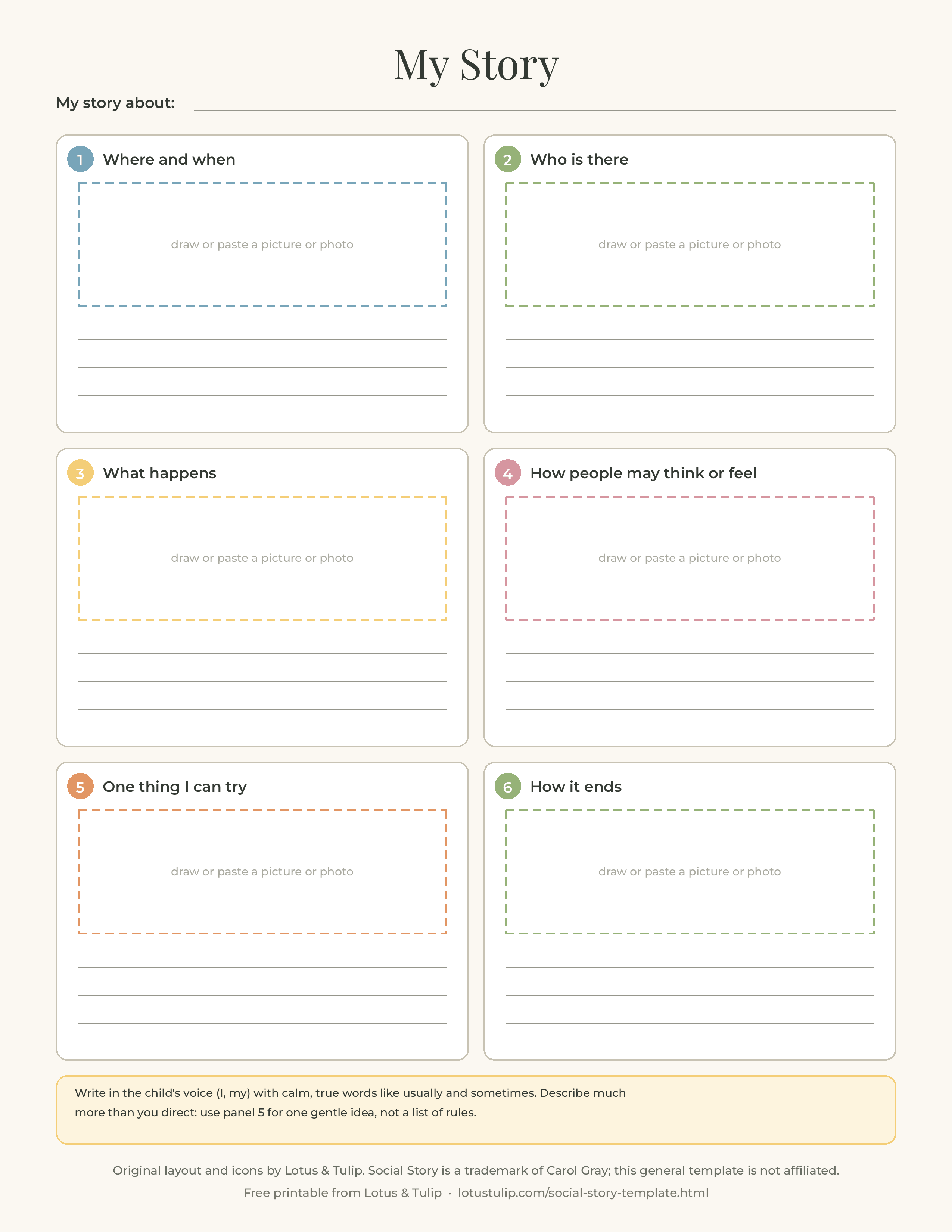
- Page 1: blank story template. A title line and six panels, each with a picture box and writing lines, prompted with where and when, who is there, what happens, how people may think or feel, one thing I can try, and how it ends.
- Page 2: sample story, "When My Day Changes". A finished six panel story with pictures, eleven describing sentences and one coaching sentence.
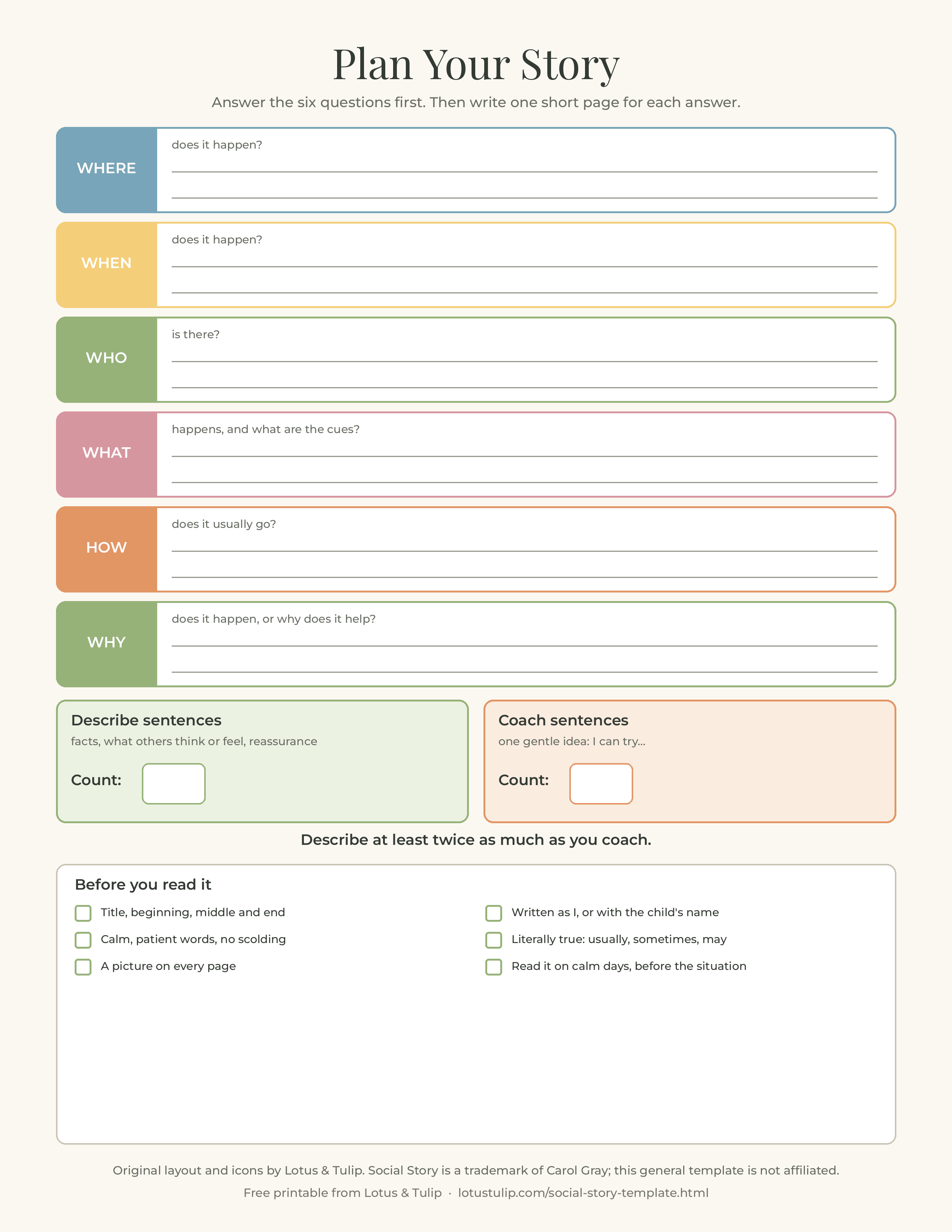
- Page 3: story planner. The six questions (where, when, who, what, how, why), a sentence counter for describing and coaching sentences, and a short checklist to use before you read the story.
Download the free social story template (PDF, 3 pages, US Letter)
Prefer single images? Page 1: blank six panel story template (PNG) · Page 2: sample story, When My Day Changes (PNG) · Page 3: story planner and checklist (PNG)
Free to print for use with your own students, clients or children. Please link to this page rather than re-uploading the file. A general support, not a substitute for an individual plan from your child's team. Social Story is a trademark of Carol Gray; this template is not affiliated with or endorsed by her.
Related resources
- Personal space worksheet (free printable): the space bubble, the arm's length check and three zones
- Free visual schedule printable (picture cards and All done pocket)
- First then board printable (free picture cards)
- Token board printable (free 3, 5 and 10 token boards)
- Calm down corner ideas (free calm down steps printable)
- Coping skills list for kids (free printable)
FAQ
What is a social story?
A social story is a short, individualized story that describes a situation, skill or idea in a calm and literal way, usually with a picture on each page. It explains what happens, who is there, how people may feel and why, and may suggest one thing the child can try. The term Social Story was coined by Carol Gray, who trademarked it for stories that meet her criteria.
How do you write a social story?
Pick one situation, find out what the child finds hard about it, answer where, when, who, what, how and why, then write short, literal, mostly describing sentences in the child's voice with one picture per page. Add at most one or two gentle coaching sentences, and read the story on calm days before the situation.
Do social stories work?
Social narratives are an evidence-based practice for autistic children and youth according to the National Clearinghouse on Autism Evidence and Practice (Steinbrenner et al., 2020), with support from 20 single case studies and one group design study. Results vary by child, and stories work best when they are individualized, read regularly and paired with other supports.
What age are social stories for?
The research covers learners from preschool through high school. Young children usually need short stories with one sentence and one picture per page. Older children and teens often prefer a short written version without cartoon pictures, sometimes called a social article.
How long should a social story be?
For most young children, five to ten short pages with one idea per page is enough. The free template on this page has six panels, which covers a beginning, middle and end without losing attention.
How often should you read a social story?
Read it once a day for several days before the situation and again just before it happens, always when the child is calm. Once the situation goes well a few times, read it less often.
Is this social story template free?
Yes. It is free to print for use with your own students, clients or children. Please link to this page rather than re-uploading the file.