
Social skills · Kids, school counselors and special education · Updated 2026-11-12
Personal space worksheet: how to teach kids about personal space and the space bubble (free printable)
Social skills group: Social Skills Small Group Curriculum, Grades 2 to 5, 8 sessions with lesson plans and student pages Holiday 20% off: about $11.04, was $14 (EUR 12) · instant digital download
Buy on EtsyAges 5 to 11: Kids Feelings and Social Skills Worksheets, incl. conflict solving steps, I-statements and stop, think, choose, try Holiday 20% off: about $11.04, was $14 (EUR 12) · fillable PDF, instant digital download
Buy on EtsyTry it free first: download a fillable sample (feelings thermometer and calm-down plan, PDF, 240 KB). Type into it on screen, then get the full pack. No email needed.
Visual supports: Visual Schedule and Behavior Supports, 23 pages with token boards, a reward menu, first then boards and 136 picture cards Holiday 20% off: about $6.44, was $8 (EUR 7) · instant digital download
Buy on EtsySome children hug every classmate, stand nose to nose to talk, or lean on whoever is next to them on the carpet. They are rarely being rude. Personal space is an unwritten rule, and unwritten rules are hard to learn when nobody spells them out. A personal space lesson makes the rule visible: everyone carries an invisible bubble, the bubble changes size depending on who you are with, and other people show you when you are too close.
This guide is for school counselors, special education teachers, speech and occupational therapists, child therapists and parents. It covers what personal space is, what research shows about how it develops, why some children (including many autistic children) find it harder, how to teach it step by step, how to respond in the moment, and common mistakes. It ends with a free 2 page printable: a My Space Bubble worksheet and a Personal Space Plan with a practice tracker.
Download the free personal space worksheet (PDF, 2 pages, US Letter)
Direct download, no email or sign up. See the pages first.
What personal space is
Personal space is the area people keep around their bodies. When someone comes inside it without an invitation, most of us feel uncomfortable and step back, lean away or turn. Psychologists call the distance people keep from each other interpersonal distance, and the study of it is called proxemics, a term from anthropologist Edward T. Hall.
In his 1966 book The Hidden Dimension, Hall described four rough zones that Americans in his observations used: intimate distance (touching to about 18 inches), personal distance (about 18 inches to 4 feet), social distance (about 4 to 12 feet) and public distance (12 feet and beyond). These are descriptions of typical behavior, not rules, but they explain something children notice without words: we stand closer to people we know well and farther from people we do not.
For kids, the simplest version is the space bubble: an invisible bubble around each person, about one arm's length for most people at school. You keep your body outside other people's bubbles unless they invite you in, and they keep out of yours.
What research shows
- Personal space grows with age. John Aiello and Tyra De Carlo Aiello (1974) observed pairs of children aged 6 to 16 and found that children used more space as they got older, with adult like distances by about age 12. Young children standing close is developmentally normal; what we teach is how to read the situation.
- Distance depends on the relationship. A study of 8,943 people in 42 countries (Sorokowska and colleagues, 2017) asked how close another person could come during a conversation. On average people wanted about 135 cm (roughly 4.4 feet) from a stranger, about 92 cm (3 feet) from an acquaintance and about 32 cm (1 foot) from a close person. Preferences also varied a lot by country, age and gender.
- Culture and family shape the bubble. In that same study, average stranger distance ranged from about 80 cm in Argentina to about 140 cm in Romania. A child who stands close may simply be following the norms of their family or community. Teach the school expectation without treating home norms as wrong.
- The feeling of "too close" has a brain basis. Daniel Kennedy and colleagues (2009) studied a woman with damage to both amygdalae who had no sense of personal space: she was comfortable even nose to nose. In healthy adults, the amygdala responded more when an experimenter was close. The discomfort of a crowded bubble is an automatic emotional signal, which is why children who do not feel it need the rule taught explicitly.
- Autistic children often find it harder. Using parent reports on 766 autistic children and teens and 766 of their siblings, Kennedy and Adolphs (2014) found that autistic young people more often stood too close to others. In a small adult lab study, a few autistic participants had no sense of personal space at all. Later research has found mixed patterns, including autistic people who prefer more distance, so watch the individual child rather than assuming.
One honest caveat: there is little controlled research on personal space lessons specifically. The teaching steps below follow general good practice for social skills instruction (explain, model, practice, give feedback, practice in real settings) rather than a single tested program.
Signs someone needs more space
Kids do not need to learn proxemics. They need to notice a few body clues and know what to do next. Teach these signs that a person wants more room:
- They step back, lean back or turn their body away.
- They cross their arms or put a hand up.
- They look away, look uncomfortable or stop smiling.
- They say "stop", "move over", "you are squishing me" or "too close".
The response is the same every time: take one step back, check that you are about an arm's length away, and keep talking or playing. No big apology is needed.
How to teach personal space, step by step
- Name the idea. Explain that everyone has an invisible space bubble around their body and that people feel more comfortable when others stay outside it unless invited.
- Make the bubble visible. Use a hula hoop, a circle of tape on the floor or arms stretched out to show about one arm's length. Let children stand in their bubble and notice the space.
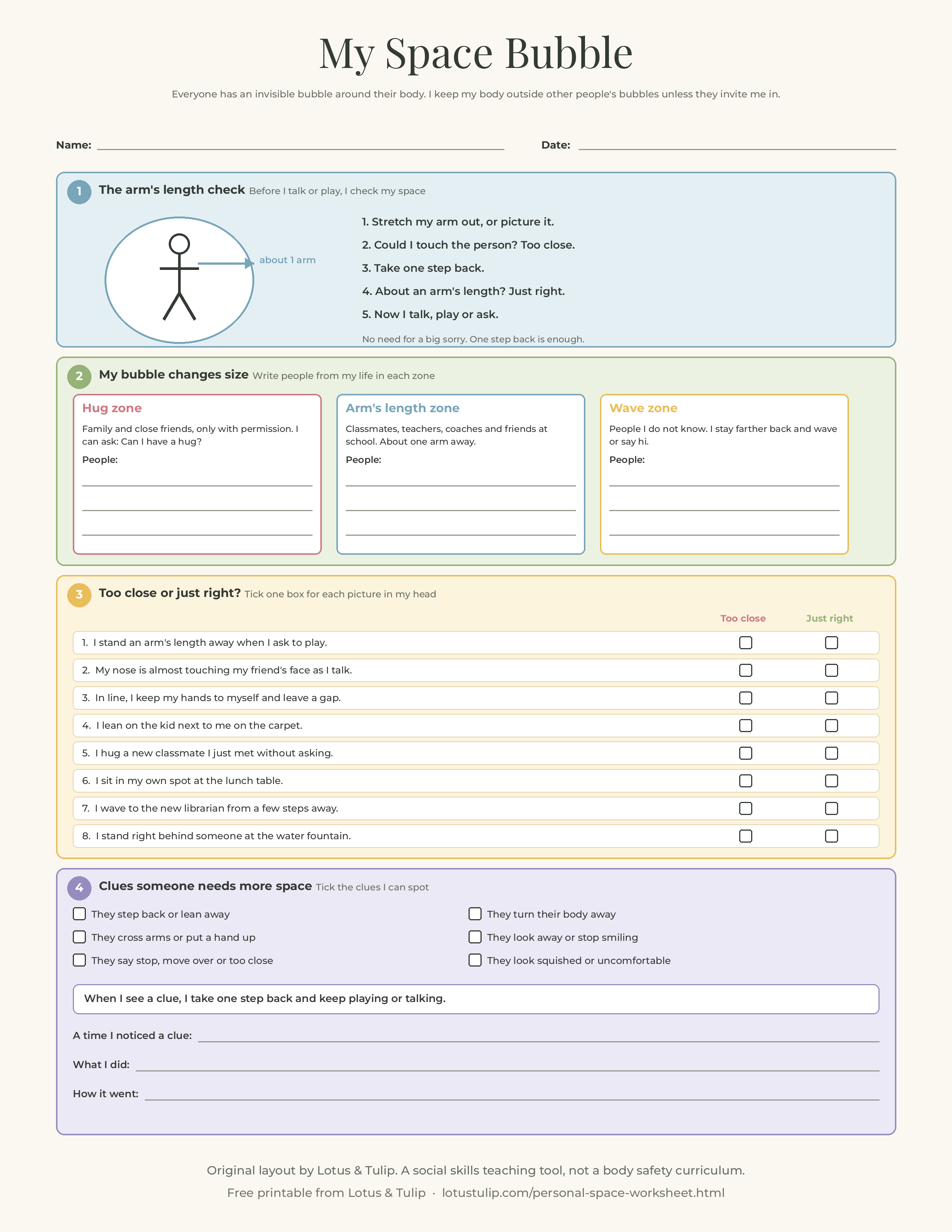
- Teach the arm's length check. Before talking to someone, stretch an arm out (or imagine doing it). If you could touch the person, take a step back. This gives a concrete rule for children who cannot judge distance by feel.
- Show that bubbles change. Use three simple zones: a hug zone for family and close friends with permission, an arm's length zone for classmates, teachers and friends at school, and a wave zone for people we do not know. Sort people from the child's own life into the zones.
- Teach the signs. Act out stepping back, leaning away and saying "too close". Ask children to spot the sign and show the fix: one step back.
- Model too close and just right. Role play the same conversation twice, once too close and once at arm's length, and ask which felt better and why. Adults playing the "too close" role usually gets a laugh and makes the point.
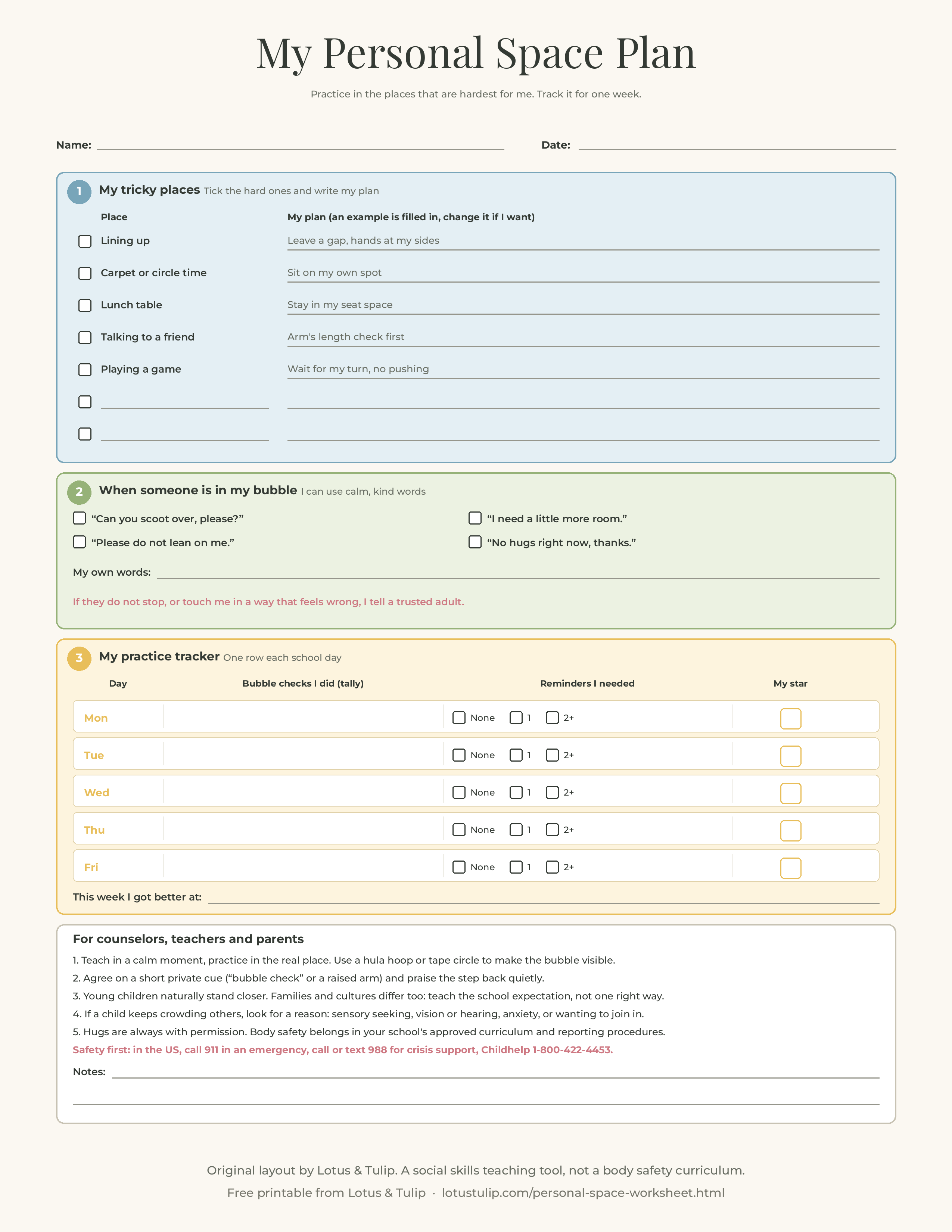
- Practice in real places. Lining up, sitting on the carpet, at a lunch table, in a group game and at the drinking fountain each have their own space rules. Practice the hardest one for this child first.
- Teach what to say when someone is in your bubble. Children also need words for their own space: "Can you scoot over, please?" or "I need a little more room." Practice saying it calmly.
- Reinforce and fade. Give specific praise when you see good spacing ("You stood an arm's length away from Maya when you asked to play"), track a few practice moments for a week or two, then use quick reminders only when needed.
How to respond in the moment
- Use a short, neutral cue. "Bubble check" or a raised arm works better than a lecture in front of peers. Agree on the cue in advance.
- Prompt the fix, not the feeling. "One step back" is clearer than "you are making her uncomfortable."
- Praise the correction. When the child steps back, acknowledge it quietly. The goal is a habit, not shame.
- Look for the reason. A child who always crowds others may be seeking sensory input, may not see well, may be anxious, or may be trying hard to connect. An occupational therapist can help with sensory seeking, and a child who crowds to make friends may need joining in skills too.
Adapting it by age and need
- Pre-K and kindergarten. Keep it physical: hula hoops, carpet spots, a "bubble" song or picture cue. Expect frequent reminders, since young children naturally stand closer.
- Grades 1 to 3. Use the three zones and the arm's length check, sorting real people into zones, and role plays with "too close" and "just right".
- Grades 4 to 6. Add body language reading, cultural differences and situations like crowded hallways, sports and buses, where the rule bends.
- Autistic children and children with ADHD. Use explicit rules, visuals and a social story, and practice in the actual setting. For children who prefer a lot of space, teach that their need is valid and give them words to ask for room.
Personal space and body safety
Personal space lessons overlap with body safety, but they are not the same thing. The hug zone is always with permission, and children should learn that they can say no to touch, even from people they know, and tell a trusted adult if someone touches them in a way that feels wrong or asks them to keep it a secret. Many schools teach body safety with a separate, approved curriculum. Use this worksheet for everyday social spacing and follow your school's body safety program and reporting duties for anything more.
Common mistakes
- Only saying "give people space." It is too abstract. Give a measurable rule (one arm's length) and a visual.
- Correcting in public with a long explanation. It embarrasses the child and rarely changes the habit. Use a short cue and teach in a calm moment.
- Treating one distance as right for everyone. Families and cultures differ. Teach the school expectation and the skill of watching others.
- Forgetting the child's own bubble. Children who are crowded need permission and words to ask for space too.
- Teaching once. Spacing is a habit. Plan practice across settings and a few weeks of quick reminders.
Free personal space worksheet
This free printable is an original Lotus & Tulip layout on US Letter. Page 1, My Space Bubble, has an arm's length check, the three zones (hug zone with permission, arm's length zone and wave zone) with space to write people from the child's life, 8 situations to sort into "too close" or "just right", and a body clue checklist for spotting when someone needs more space. Page 2, My Personal Space Plan, has the child's tricky places with a plan for each, words to use when someone is in their bubble, a 5 day practice tracker, and a guide for adults with crisis lines.
Download the free personal space worksheet (PDF, 2 pages, US Letter)
Prefer single images? Page 1: my space bubble (PNG) · Page 2: my personal space plan (PNG)
Free to print for use with your own students, clients or children. Please link to this page rather than re-uploading the file. A teaching tool, not a body safety curriculum or a diagnosis. In an emergency in the US, call 911. For crisis support for any age, call or text 988. The Childhelp National Child Abuse Hotline (1-800-422-4453) offers support and guidance.
Related resources
- Expected vs unexpected behavior worksheet (free printable): the same action can fit one place and not another
- Whole body listening worksheet (free printable): a flexible my listening body plan for kids
- Social story template (free printable): write a short personal space story for one child
- Social skills worksheets for kids: conversation, joining in and taking turns
- Tattling vs telling worksheet (free printable): when to tell an adult
- Puberty worksheets for kids (free printable): body changes, body safety and trusted adults
- Friendship worksheets for kids: how to teach friendship skills
- Social skills small group activities: games and lesson ideas for groups
- Self-monitoring checklist for students (free printable): help a child track their own spacing
FAQ
How do you explain personal space to a child?
Tell them everyone has an invisible space bubble around their body, about as big as one arm's length. Show it with a hula hoop or outstretched arms, and teach a simple check: if you could touch the person with your arm out, take a step back.
How much personal space is normal?
It depends on the relationship and the culture. A 42 country study found people wanted about 4.4 feet from a stranger, 3 feet from an acquaintance and 1 foot from a close person on average. For kids at school, about one arm's length is a good working rule.
At what age do children understand personal space?
It develops gradually. Observational research found that children use more space as they grow and reach adult like distances by about age 12, so young children standing close is normal. Explicit teaching helps at any age.
Why does my child stand too close to people?
Common reasons are age, family or cultural habits, eagerness to connect, sensory seeking, vision or hearing difficulties, and differences in social processing, which are more common in autistic children. Teach the rule visually, and ask a school counselor, occupational therapist or pediatrician if it continues or comes with other concerns.
Is personal space the same as body safety?
No. Personal space is about everyday social distance. Body safety teaches children that they can say no to touch and should tell a trusted adult about unsafe touch or secrets. The two support each other, but body safety should follow your school's approved curriculum.
Is this personal space worksheet free?
Yes. It is free to print for use with your own students, clients or children. Please link to this page rather than re-uploading the file.
Sources
- Aiello, J. R., and De Carlo Aiello, T. (1974). The development of personal space: proxemic behavior of children 6 through 16. Human Ecology, 2(3), 177 to 189. doi:10.1007/BF01531420
- Hall, E. T. (1966). The Hidden Dimension. New York: Doubleday.
- Kennedy, D. P., and Adolphs, R. (2014). Violations of personal space by individuals with autism spectrum disorder. PLoS ONE, 9(8), e103369. doi:10.1371/journal.pone.0103369
- Kennedy, D. P., Gläscher, J., Tyszka, J. M., and Adolphs, R. (2009). Personal space regulation by the human amygdala. Nature Neuroscience, 12(10), 1226 to 1227. doi:10.1038/nn.2381
- Sorokowska, A., Sorokowski, P., Hilpert, P., and colleagues (2017). Preferred interpersonal distances: a global comparison. Journal of Cross-Cultural Psychology. doi:10.1177/0022022117698039