
Therapist worksheets · Updated 2026-11-03
ACT values worksheet: how to help clients clarify values and take committed action (free printable)
Ready-made printable: ACT Worksheets for Therapists Fillable PDF: type into the values compass and values in my own words, plus defusion record, choice point and committed action plan (20 pages)
Holiday 20% off: about $9.20, was $12 (EUR 10) · instant digital download
Try it free first: download a fillable sample (values compass and unhooking from thoughts, PDF, 259 KB). Type into it on screen, then get the full pack. No email needed.

Values work is the part of Acceptance and Commitment Therapy (ACT) that gives everything else a direction. Defusion and acceptance make room for hard thoughts and feelings; values answer the question "room for what?" This guide gives therapists, counselors and other helpers a practical way to run values clarification: what ACT means by a value, how values differ from goals, the life areas most values exercises use, a step by step session plan, prompts and scripts for adults and teens, adaptations, common mistakes and an FAQ. It ends with a free one page ACT values worksheet on US Letter paper.
This is educational information for therapists, school counselors and other helpers, not a substitute for clinical training, supervision or a treatment plan. In the US, anyone in crisis can call or text 988, the Suicide and Crisis Lifeline, or call 911 in an emergency.
Jump to the free ACT values worksheet
What a value is in ACT
ACT was described in book length by Steven Hayes, Kirk Strosahl and Kelly Wilson in Acceptance and Commitment Therapy: An Experiential Approach to Behavior Change (Guilford Press, 1999). In ACT, a value is a freely chosen quality of action: how a person wants to behave, what they want to stand for, the kind of partner, parent, friend or worker they want to be. Values are usually written as verbs or adverbs, such as "being a patient, present parent" or "learning with curiosity", rather than as things to get.
Three features help clients tell a value apart from a rule or a wish:
- Chosen, not imposed. A value is not what the client "should" care about because a parent, culture or therapist expects it. A useful check is "Would this still matter to you if nobody ever knew?"
- Ongoing, never finished. You cannot complete "being a caring friend" the way you complete a task. There is always a next step.
- Available right now. A client can act on a value today, even in pain, even while anxious, even before anything in their life changes.
Values vs goals
Most clients arrive with goals: lose weight, get a promotion, stop panicking, fix the marriage. Goals matter, but they can be achieved and then they are gone, and many are partly outside the client's control. A common metaphor is a compass: a value is a direction like "west", and goals are the towns you pass on the way. You never arrive at west, but you always know whether you are heading toward it.
| Value (direction) | Goal (a stop on the way) |
|---|---|
| Being a loving, involved parent | Read with my daughter three nights this week |
| Caring for my body | Walk 20 minutes after lunch on weekdays |
| Being honest and open with my partner | Tell him on Sunday what I have been worried about |
| Learning and growing at work | Ask my manager for feedback on the report |
The life areas most values exercises use
Two well known ACT measures give a structure for exploring values across a whole life:
- The Valued Living Questionnaire (VLQ) by Kelly Wilson, Emily Sandoz and colleagues (The Psychological Record, 2010) asks people to rate how important ten life areas are and how consistently they have lived by them recently. The gap between importance and action is often the most useful thing on the page.
- The Bull's-Eye Values Survey by Tobias Lundgren, Jason Luoma, JoAnne Dahl, Kirk Strosahl and Lennart Melin (Cognitive and Behavioral Practice, 2012) uses a dartboard image. Clients mark how close their recent actions have been to the center of their values, which makes the values-action gap visible at a glance, and also note barriers that get in the way.
For everyday session use, a shorter set of areas works well: relationships (partner, family, friends), work or school, health and self care, growth and learning, fun and leisure, and community or spirituality. The free worksheet below uses six areas like these.
How to run a values session, step by step
- Start with what hurts. In ACT, pain and values are linked: we hurt where we care. Ask "What does this struggle tell you about what matters to you?" A client who is devastated by a friendship ending may value connection and loyalty.
- Explore one life area at a time. Use open prompts (below) and write the client's own words. Avoid suggesting values for them.
- Turn answers into qualities of action. "I want people to respect me" is about others' behavior. Ask "If they did respect you, how would you act? What kind of person would you be?" Often the answer is a value such as "speaking up honestly".
- Rate importance and consistency. For each area, ask how important it is (0 to 10) and how closely the client has lived by it this past week (0 to 10). Notice the biggest gaps, without judgment.
- Choose one small committed action. Pick one area with a gap and one specific, doable step for the coming week: what, when and where. Small is the point; the action only has to move in the chosen direction.
- Name the barriers in advance. Ask which thoughts, feelings or urges are likely to show up when the client tries the step ("I'll look stupid", dread, the urge to cancel). This links values work to defusion and acceptance skills.
- Review next session with curiosity. If the action did not happen, explore what got in the way rather than treating it as failure. Then choose the next step.
Values prompts and scripts
Prompts for adults:
- "Imagine it is your 80th birthday and someone you love gives a short speech about you. What would you most want them to be able to say about how you lived?"
- "If anxiety were not making the decision, what would you do with this week?"
- "Think of someone you admire. What qualities in how they act do you admire?"
- "When have you felt most like yourself? What were you doing, and how were you doing it?"
Prompts for teens:
- "What do you want your friends to say about what kind of friend you are?"
- "If you could design the kind of person you are becoming, what three words would you pick?"
- "What is something you care about that adults usually do not ask you about?"
A script for introducing values: "A lot of our work has been about the hard stuff, the worry and the thoughts that show up. Today I want to look at the other side: what you want your life to be about. Not what you think you should want, and not what other people want for you. These are called values, and they are more like a direction than a destination. We will pick one small step in that direction for this week."
Adaptations
- Teens: Values can feel abstract. Card sorts, picking words from a list, or starting with heroes, characters and songs often works better than open questions. Respect values that differ from what parents want.
- Depression: Values pair naturally with behavioral activation: choose activities because they connect to a value, not only because they might lift mood.
- Anxiety: Values give exposure work a reason. "I am doing this hard thing because I care about being there for my kids" is more motivating than "I am doing this to get less anxious".
- Groups: Have each member share one value and one small action, then check in the following week. Hearing others' values often helps members find their own words.
- Couples: Each partner completes the relationship area separately, then shares how they want to act in the relationship, not what they want the other person to change.
Common mistakes
- Writing feelings as values. "Being happy" or "feeling calm" are feelings, not values. Ask what the client would do if they felt that way.
- Accepting "shoulds". If a value sounds like duty or guilt, check whether it is truly chosen.
- Making the action too big. "Rebuild my relationship with my dad" is a goal for months. "Text him a photo on Saturday" is a committed action.
- Using values as a stick. A big gap between importance and action is information, not a verdict. Hold it with compassion.
- Doing values once. Values work is most useful when it is revisited, linked to each week's actions and to the barriers that show up.
Free ACT values worksheet
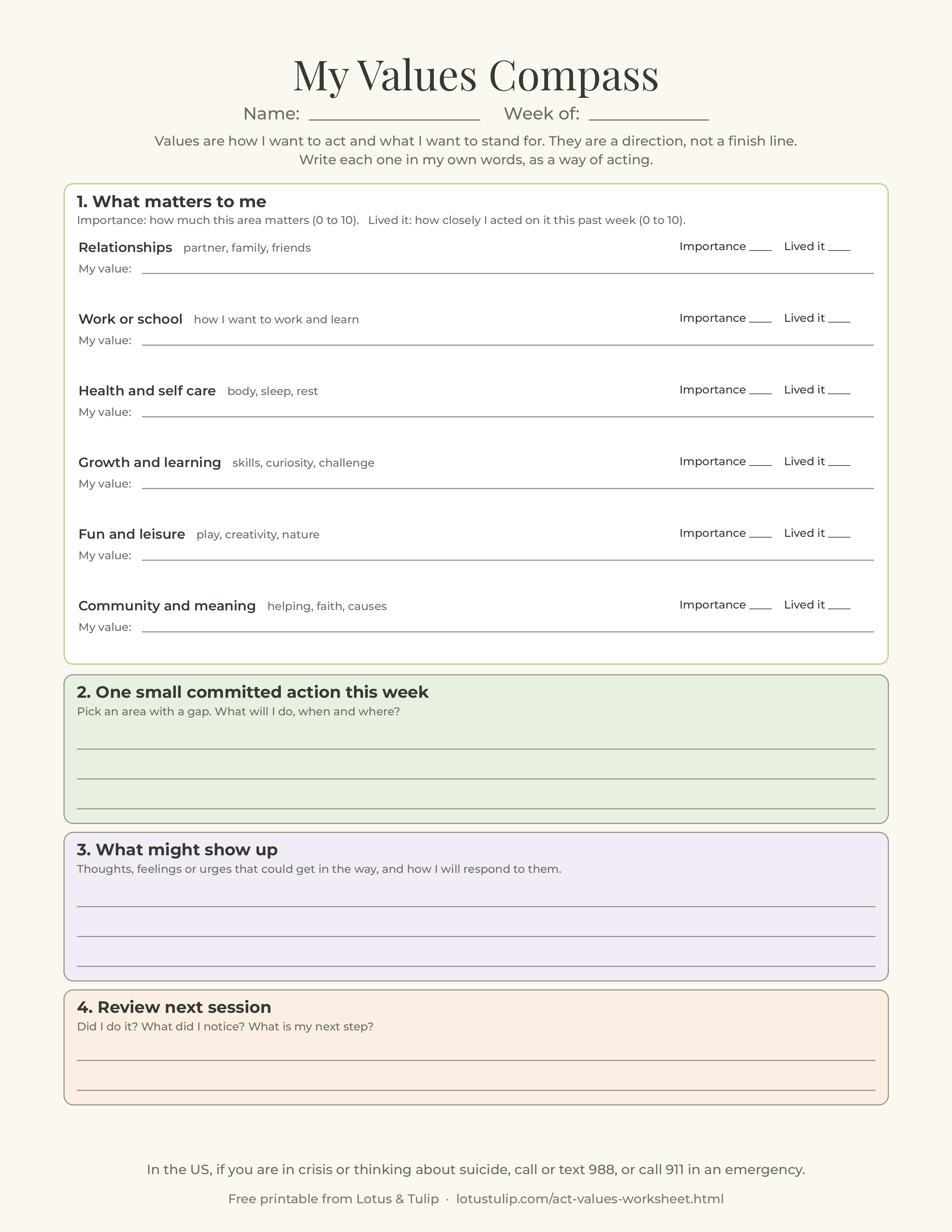
This one page "My Values Compass" worksheet is an original Lotus & Tulip design. The top section lists six life areas, each with a line for the client's own value in their own words and two 0 to 10 ratings: how important it is and how closely they lived by it this past week. The middle section picks one area with a gap and plans one small committed action with what, when and where. The bottom section names the thoughts, feelings and urges likely to show up and how the client wants to respond, plus a short review for next session. The footer includes the 988 line. It prints on US Letter.
Download the free ACT values worksheet (PNG, US Letter)
Free to print for use with your own clients, students or yourself. Please link to this page rather than re-uploading the file. This worksheet is an independent tool and is not affiliated with or endorsed by the authors or publishers of ACT texts or of the VLQ or Bull's-Eye Values Survey.
Related resources
- Wheel of life worksheet (free printable): rate 8 life areas, then move one up by a point
- Goal setting worksheet for adults (free printable): turn a value into a specific goal with if-then plans
- Character strengths worksheet (free printable): the strengths you can bring to valued action
- Behavioral activation worksheet (free printable)
- Cognitive distortions worksheet (free printable)
- Healthy boundaries worksheet (free printable)
- Window of tolerance worksheet (free printable)
- All therapist worksheets: CBT, DBT and ACT
FAQ
What is a values worksheet in ACT?
It is a structured page that helps a client name what matters to them in different life areas, notice how closely they are living by those values, and choose a small committed action in that direction.
What is the difference between values and goals?
A value is an ongoing direction, such as being a caring friend, that is never finished. A goal is a specific outcome that can be completed, such as calling a friend on Friday. Goals are steps in the direction of a value.
What life areas are used in ACT values work?
Common sets include relationships, family, parenting, friendship, work, education, leisure, health, spirituality and community. The Valued Living Questionnaire (Wilson and colleagues, 2010) uses ten areas; the Bull's-Eye Values Survey (Lundgren and colleagues, 2012) uses a smaller set.
What is committed action in ACT?
Committed action means taking concrete steps guided by your values, even when difficult thoughts and feelings show up, and returning to those steps after setbacks.
Can values worksheets be used with teens?
Yes, with simpler language, examples and choices such as word lists or card sorts. Teens often engage more when asked about the kind of friend or person they want to be.
Is this ACT values worksheet free?
Yes. It is free to print for use with your own clients, students or yourself. Please link to this page rather than re-uploading the file.