
Therapist worksheets · Life balance · Updated 2026-11-14
Wheel of life worksheet: how to use a life balance wheel, what it can and cannot tell you, and a step by step plan (free printable)
Turn the wheel into values and action: ACT Worksheets for Therapists, values, defusion and committed action pages Holiday 20% off: about $9.20, was $12 (EUR 10) · fillable PDF, instant digital download
Buy on EtsyTry it free first: download a fillable sample (values compass and unhooking from thoughts, PDF, 259 KB). Type into it on screen, then get the full pack. No email needed.
When the low areas come with harsh thoughts: CBT Worksheets for Therapists, 20 pages including thought records and core beliefs Holiday 20% off: about $11.04, was $14 (EUR 12) · fillable PDF, instant digital download
Buy on EtsyTry it free first: download a fillable sample (thought record and evidence for and against, PDF, 105 KB). Type into it on screen, then get the full pack. No email needed.
A full caseload: Therapist Worksheets Mega Bundle (8 packs incl. DBT, CBT, ACT, anxiety, grief and ADHD) Holiday 20% off: about $35.88, was $45 (EUR 39) · fillable PDFs for all 8 packs plus 160 printable pages, instant digital download
Buy on EtsyA wheel of life worksheet asks a simple question about each part of your life: how satisfied am I with this, right now, from 0 to 10? You shade each slice of a circle to match, and the shape tells you something a list cannot. A lopsided wheel shows at a glance which areas are thriving and which are being squeezed. Used well, it is one of the quickest ways to start a conversation about what to change. Used badly, it becomes one more scorecard to feel bad about.
This guide is for adults who feel stretched, stuck or out of balance and for therapists, counselors and coaches who use a life balance wheel with clients. It covers where the wheel comes from, what research on life satisfaction and balance actually says, the limits of rating your own life, nine steps to use the worksheet, common mistakes and three short examples. It ends with a free 2 page printable: My Life Balance Wheel, an 8 area wheel with a rating table, and My Life Balance Plan, for moving one or two areas up by a single point and checking in at 4, 8 and 12 weeks.
Download the free wheel of life worksheet (PDF, 2 pages, US Letter)
Direct download, no email or sign up. See the pages first. Ready to set a goal for one area? See our goal setting worksheet for adults.
What a wheel of life is, and where it comes from
A wheel of life is a circle divided into slices, one for each major area of life, such as health, work, money, relationships, friends, fun, growth and home. The center of the circle is 0 and the outer edge is 10. You rate your satisfaction with each area, shade or mark that level in its slice and join the marks. The result is a picture of your life right now: some slices full, some barely started.
The tool is generally credited to Paul J. Meyer, who founded the Success Motivation Institute in Waco, Texas, in 1960 and used a wheel of life among the goal setting tools in its programs. From there it spread into coaching, mentoring and counseling, where it is now a common first session exercise. Versions use anywhere from 6 to 12 areas with different names, and there is no single correct list.
"Wheel of Life" is a registered trademark of Success Motivation International, Inc. This page is not affiliated with or endorsed by SMI. Our free printable is an original life balance wheel with our own areas, layout and wording.
It is worth being clear about what the wheel is not. It was built as a practical training aid, not as a research instrument. It has not been validated as a psychological measure the way questionnaires such as the 5 item Satisfaction With Life Scale (Diener, Emmons, Larsen and Griffin, 1985) have been. That does not make it useless. It makes it a reflection tool: a way to notice and talk, not a score that says how well you are doing.
What research says about balance and life satisfaction
There is no trial of the wheel itself, but several lines of research explain why looking at your life area by area can help, and where it can mislead.
- Balance matters, not only the total. In four studies, Kennon Sheldon and Christopher Niemiec (2006, Journal of Personality and Social Psychology) looked at how satisfied people were in three basic psychological needs: autonomy, competence and relatedness. People whose needs were met in a more balanced way reported higher well-being than people with the same total but a more uneven profile. The finding held across different designs, including a daily diary study and a three month follow up, and was independent of neuroticism. A lopsided wheel is worth taking seriously, even when some slices are full.
- Time alone is not the answer. Jens Gröpel and Julius Kuhl (2009, British Journal of Psychology) studied work life balance, defined as feeling there is enough time for both work and social life, in a sample of students and a sample of employees. Having enough time predicted well-being largely because it let people meet their personal needs. In practice: freeing up an evening helps only if you spend it on something that actually matters to you.
- The area you focus on looks bigger than it is. David Schkade and Daniel Kahneman (1998, Psychological Science) asked large samples of students in the Midwest and Southern California about their life satisfaction. Both groups were equally satisfied, yet both expected Californians to be happier, because climate was easy to picture. They called this the focusing illusion: whatever you are thinking about seems more important to your overall happiness than it really is. On a wheel, the slice that is bothering you today can feel like the whole picture.
- Mood colors the ratings, a little. In a classic experiment, Norbert Schwarz and Gerald Clore (1983, Journal of Personality and Social Psychology) found that people phoned on sunny days rated their life satisfaction higher than people phoned on rainy days, unless their attention was drawn to the weather. A much larger later study by Richard Lucas and Nicole Lawless (2013), with over a million Americans, found weather effects on life satisfaction to be mostly absent or very small. The honest takeaway: your mood on the day can nudge your numbers, so treat a single wheel as a snapshot and rate again on another day before making big decisions.
Two other findings explain why the worksheet does not stop at the wheel. Writing an if-then plan ("if this situation comes up, then I will do that") had a medium to large effect on reaching goals in a meta-analysis of 94 tests with 8,461 participants (Gollwitzer and Sheeran, 2006, d = 0.65). And interventions that got people to monitor their progress improved goal attainment in 138 randomized studies with 19,951 participants (Harkin and colleagues, 2016, d = 0.40), more so when progress was written down. That is why page 2 asks for a concrete first step, an if-then plan and three re-rating dates.
The wheel is also widely used in coaching, and coaching as a whole has research support: a meta-analysis of 18 workplace coaching studies with 3,103 people (Theeboom, Beersma and van Vianen, 2014, Journal of Positive Psychology) found positive effects on well-being (g = 0.46), coping (g = 0.43) and goal-directed self-regulation (g = 0.74). Those results are for coaching overall, with large differences between studies, not for the wheel specifically.
What a wheel of life can and cannot tell you
- It can show where your satisfaction is uneven, start an honest conversation, help you choose one area to work on and track change over weeks.
- It cannot tell you whether you are depressed, burned out or anxious, or measure how "good" your life is. A low slice is information, not a verdict.
- Importance matters. A 3 in an area you care little about may be fine. A 6 in the area that matters most to you may be the real priority. That is why the table on page 1 asks how much each area matters, not just how satisfied you are.
- A perfect circle is not the goal. Life has seasons. During a new baby, a degree or a caregiving year, some slices will shrink on purpose. The useful question is whether the shape fits what you value right now.
How to use a wheel of life worksheet, step by step
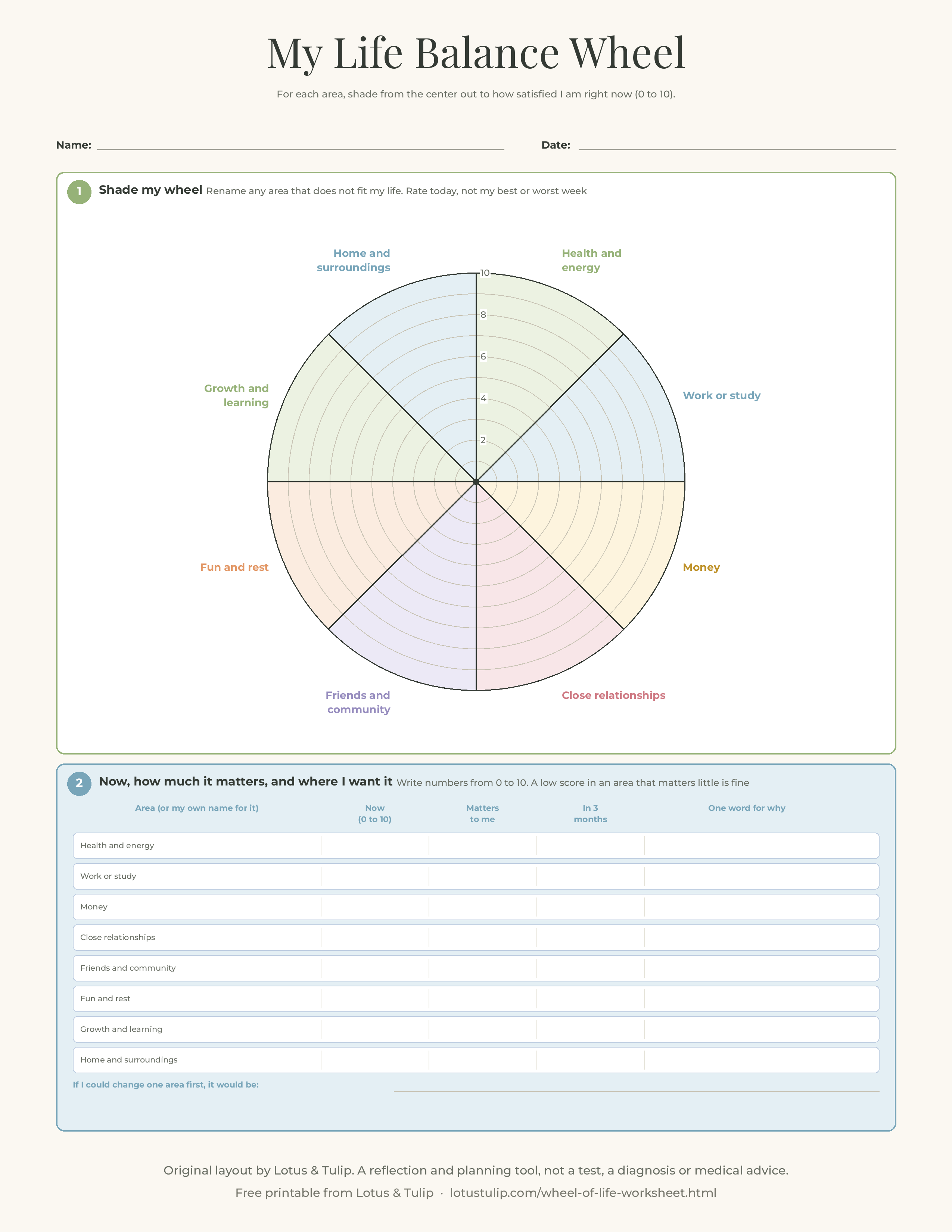
- Choose your areas. The printable lists eight common areas: health and energy, work or study, money, close relationships, friends and community, fun and rest, growth and learning, and home and surroundings. Cross out and rename any that do not fit your life, for example "faith" or "caregiving" or "creative work".
- Rate each area for today. For each slice, ask "How satisfied am I with this area right now, from 0 to 10?" Rate the last couple of weeks, not your best or worst day. Go with your first honest answer.
- Shade the wheel. Shade each slice from the center out to your number, or draw an arc across it and join the arcs. Then step back and look at the shape for a full minute before deciding anything.
- Add how much each area matters. In the table on page 1, write how important each area is to you right now, also from 0 to 10, and one word for why. Areas that matter a lot but score low are your likely starting points.
- Write where you want each area in three months. Be realistic. Moving from 4 to 6 in three months is a big change. Some areas you may simply want to keep where they are.
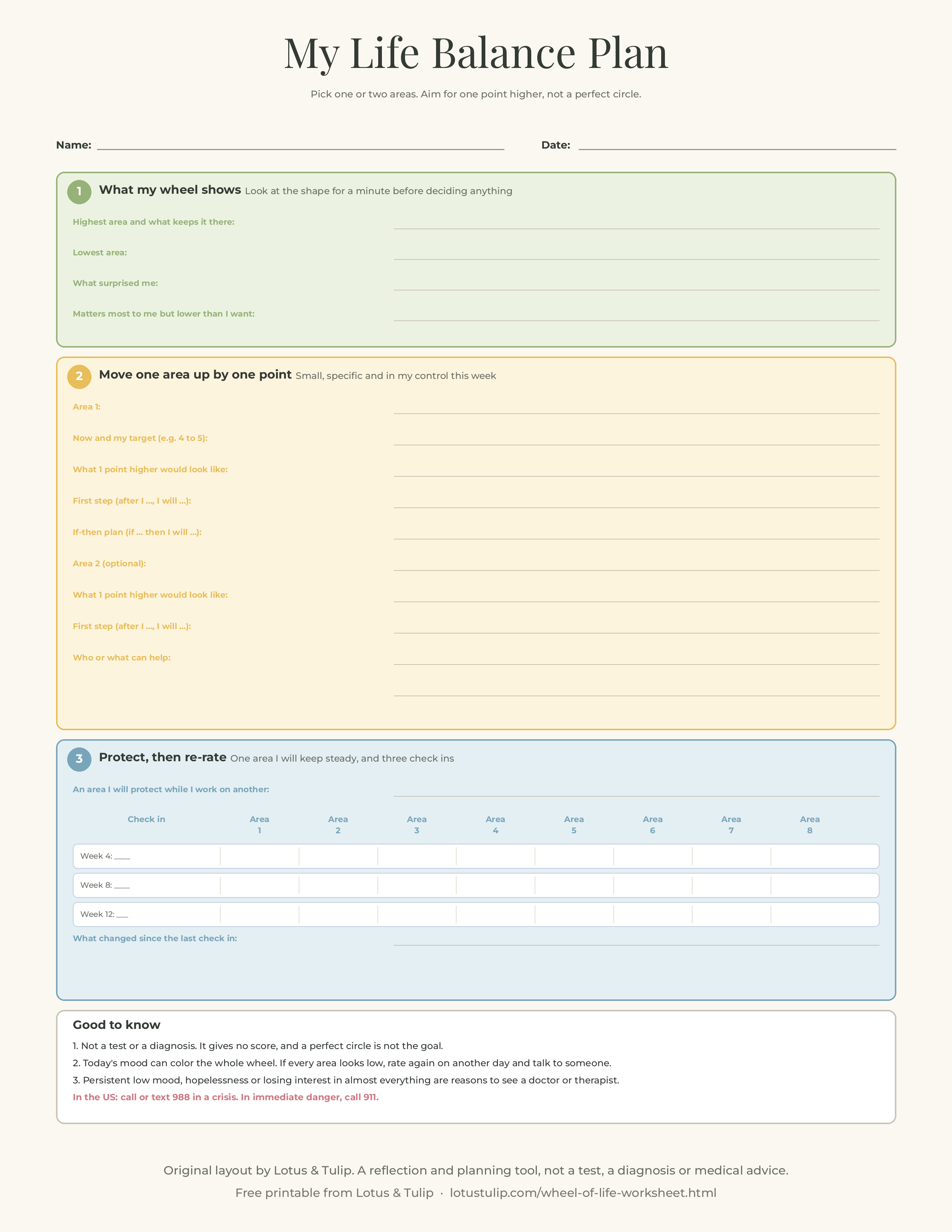
- Note what the wheel shows. On page 2, write your highest area and what keeps it there, your lowest area, what surprised you and the area that matters most but is lower than you want. Ask: is today's mood or one recent event coloring the whole wheel?
- Pick one or two areas and aim for one point higher. Describe what one point higher would look like in daily life: "I go to bed by 11 most nights" rather than "better health". Then write a first step as "After I..., I will..." and an if-then plan for your most likely obstacle.
- Protect one area. Working on one slice often drains another. Name one area you will keep steady, such as sleep or time with your partner, while you work on the others.
- Re-rate at 4, 8 and 12 weeks. Use the check in grid on page 2. Look for small shifts, write what changed and adjust your step. If every area stays low, or low mood, hopelessness or loss of interest last for weeks, talk to a doctor or therapist, and in the US call or text 988, or call 911 in an emergency.
Common mistakes
- Trying to fix every slice at once. Eight goals compete for the same time and energy. One or two areas, one point each, is plenty.
- Rating on a terrible day. A bad morning can drag every number down. If the whole wheel looks bleak, rate again on another day.
- Chasing a perfect circle. Balance means a shape that fits your values and season of life, not all 10s.
- Using someone else's areas. If "career" means nothing to a retired client, rename it. The wheel works only when the areas are yours.
- Stopping at insight. Seeing a low slice is not the same as changing it. Write the first step and the if-then plan.
- Comparing wheels. Your 7 and a friend's 7 are not the same thing. Compare your wheel only with your own earlier wheels.
Examples
- A busy parent: A 38 year old accountant shaded work at 7 and close relationships at 6, but fun and rest at 2 and health and energy at 3. Both mattered a 9 to her. She chose fun and rest and aimed for 2 to 3: "After the kids are in bed on Wednesday, I take 45 minutes for my sketchbook, phone in the kitchen." Her if-then plan: "If work email pulls me in, then I set a 10 minute timer and close the laptop when it rings." At week 8 fun and rest was a 4, and to her surprise health and energy had moved to 4 as well.
- After a move: A man in his late twenties moved to a new city for a job. Work was an 8, friends and community a 1. Rather than a vague "make friends", one point higher meant "one planned social thing a week". His first step: "After I get home on Thursday, I go to the climbing gym's beginner night." His 12 week grid showed friends and community at 3, and he used our guide to making friends as an adult for the next step.
- A therapy client and values work: A client recovering from burnout rated work at 2 and wanted to "fix work". The importance column showed work at 5 and close relationships and health at 9. With her therapist she worked on health first while keeping work steady, and later used ACT values pages to decide what she wanted from work at all. For the wider picture, see our burnout worksheet and ACT values worksheet.
Free printable: wheel of life worksheet
This free printable is an original Lotus & Tulip life balance wheel on US Letter, in our own wording. It is not the SMI Wheel of Life assessment, the Satisfaction With Life Scale or any published questionnaire, and it gives no score. Page 1, My Life Balance Wheel, is a large 8 area wheel with rings from 0 to 10 that you can shade, plus a table for each area: satisfaction now, how much it matters, where you want it in three months and one word for why. Page 2, My Life Balance Plan, covers what the wheel shows, moving one or two areas up by one point with a first step and an if-then plan, one area to protect, a re-rating grid for weeks 4, 8 and 12, and notes with US crisis lines.
Download the free wheel of life worksheet (PDF, 2 pages, US Letter)
Prefer single images? Page 1: life balance wheel (PNG) · Page 2: life balance plan (PNG)
Free to print for yourself or for use with your own clients or groups. Please link to this page rather than re-uploading the file. A reflection and planning tool, not a test, a diagnosis or a substitute for therapy. In the US, call or text 988 in a mental health crisis. In immediate danger, call 911.
Buy the ACT worksheets on Etsy
Related resources
- Goal setting worksheet for adults: turn the area you chose into a clear goal and action plan
- Habit tracker worksheet for adults: make your "one point higher" step a daily habit
- ACT values worksheet: find out what matters most in each area
- Character strengths worksheet: use what you are good at to lift a low area
- Burnout worksheet: when the work slice is draining all the others
- Self care plan template: protect the basics while you make changes
- All therapist worksheets: CBT, DBT, ACT and more
FAQ
What is a wheel of life worksheet?
A wheel of life worksheet is a circle divided into life areas, such as health, work, money and relationships, where you rate your satisfaction with each from 0 to 10 and shade the slices to see how balanced your life feels right now. The free 2 page printable on this page adds a table for how much each area matters, a plan to move one or two areas up by one point and a re-rating grid. It is an original tool and gives no score.
What are the 8 areas of the wheel of life?
There is no official list. Common versions use 6 to 12 areas. Our printable uses eight: health and energy, work or study, money, close relationships, friends and community, fun and rest, growth and learning, and home and surroundings. Rename any area that does not fit your life, such as faith, caregiving or creative work.
Who created the wheel of life?
It is generally credited to Paul J. Meyer, who founded the Success Motivation Institute in 1960 and used a wheel of life in its goal setting programs. "Wheel of Life" is a registered trademark of Success Motivation International, Inc. The free printable on this page is an original life balance wheel and is not affiliated with SMI.
Is the wheel of life evidence based?
The wheel itself has not been validated as a psychological measure, so treat it as a reflection tool, not a test. Related research supports the idea behind it: balanced need satisfaction predicted higher well-being than the same total with an uneven profile (Sheldon and Niemiec, 2006), and writing if-then plans and tracking progress both help people reach goals.
How often should I do a wheel of life?
A full wheel every three months works well for most people, with quick re-ratings of your chosen areas every four weeks in between. Avoid redoing it daily: small day to day swings in mood can make the shape jump around without meaning much.
What if every area on my wheel is low?
Rate again on another day, because mood can pull every number down. If the whole wheel stays low for weeks, or you notice persistent sadness, hopelessness or loss of interest in almost everything, that is a reason to talk to a doctor or therapist rather than a sign you need more goals. In the US, call or text 988 in a crisis, or call 911 in an emergency.
Can therapists and coaches use this worksheet with clients?
Yes. It is free to print for use with your own clients or groups. Please link to this page rather than re-uploading the file. It works as a first session exercise, as homework before goal setting and alongside values work or behavioral activation. For clients in acute distress, focus on safety and support first.
Sources
- Diener, E., Emmons, R. A., Larsen, R. J., and Griffin, S. (1985). The Satisfaction With Life Scale. Journal of Personality Assessment, 49(1), 71 to 75.
- Gollwitzer, P. M., and Sheeran, P. (2006). Implementation intentions and goal achievement: A meta-analysis of effects and processes. Advances in Experimental Social Psychology, 38, 69 to 119.
- Gröpel, P., and Kuhl, J. (2009). Work life balance and subjective well-being: The mediating role of need fulfilment. British Journal of Psychology, 100(2), 365 to 375.
- Harkin, B., Webb, T. L., Chang, B. P. I., and others (2016). Does monitoring goal progress promote goal attainment? A meta-analysis of the experimental evidence. Psychological Bulletin, 142(2), 198 to 229.
- Lucas, R. E., and Lawless, N. M. (2013). Does life seem better on a sunny day? Examining the association between daily weather conditions and life satisfaction judgments. Journal of Personality and Social Psychology, 104(5), 872 to 884.
- Schkade, D. A., and Kahneman, D. (1998). Does living in California make people happy? A focusing illusion in judgments of life satisfaction. Psychological Science, 9(5), 340 to 346.
- Schwarz, N., and Clore, G. L. (1983). Mood, misattribution, and judgments of well-being: Informative and directive functions of affective states. Journal of Personality and Social Psychology, 45(3), 513 to 523.
- Sheldon, K. M., and Niemiec, C. P. (2006). It's not just the amount that counts: Balanced need satisfaction also affects well-being. Journal of Personality and Social Psychology, 91(2), 331 to 341.
- Theeboom, T., Beersma, B., and van Vianen, A. E. M. (2014). Does coaching work? A meta-analysis on the effects of coaching on individual level outcomes in an organizational context. The Journal of Positive Psychology, 9(1), 1 to 18.
- Success Motivation Institute history: Paul J. Meyer legacy site, "Industry Pioneer" (pauljmeyer.com).