
Therapist worksheets · Goal setting · Updated 2026-11-14
Goal setting worksheet for adults: what research shows about goals that stick, and a step by step plan (free printable)
Goals built on values, plus committed action pages: ACT Worksheets for Therapists, values, defusion and committed action pages Holiday 20% off: about $9.20, was $12 (EUR 10) · fillable PDF, instant digital download
Buy on EtsyTry it free first: download a fillable sample (values compass and unhooking from thoughts, PDF, 259 KB). Type into it on screen, then get the full pack. No email needed.
When "I always give up" thinking blocks the plan: CBT Worksheets for Therapists, 20 pages including thought records and core beliefs Holiday 20% off: about $11.04, was $14 (EUR 12) · fillable PDF, instant digital download
Buy on EtsyTry it free first: download a fillable sample (thought record and evidence for and against, PDF, 105 KB). Type into it on screen, then get the full pack. No email needed.
A full caseload: Therapist Worksheets Mega Bundle (8 packs incl. DBT, CBT, ACT, anxiety, grief and ADHD) Holiday 20% off: about $35.88, was $45 (EUR 39) · fillable PDFs for all 8 packs plus 160 printable pages, instant digital download
Buy on EtsyMost adults know how to set a goal. The hard part is week three, when the first rush of motivation has gone, work is busy and the old habit is right there. Writing "get fit" or "save more" on a list does very little on its own. What helps is a goal you actually care about, a clear picture of what gets in the way, and a plan for the exact moments you usually slip.
This guide is for adults who want a goal to last past January, and for therapists, counselors and coaches who set goals with adult clients. It covers what goal setting research shows, what SMART really stands for, why picturing success can backfire, how if-then plans work, nine steps to use a goal setting worksheet, common mistakes and three short examples. It ends with a free 2 page printable: My Goal Map, for choosing and sharpening one goal, and My Goal Action Plan, for if-then plans, an eight week tracker and a review.
Download the free goal setting worksheet for adults (PDF, 2 pages, US Letter)
Direct download, no email or sign up. See the pages first. Working with students instead? See our goal setting worksheet for students.
What goal setting research shows
Specific, challenging goals tend to beat vague ones, but only when you are committed to them, get feedback and have a workable strategy. That is the short version of goal setting theory, built over decades by Edwin Locke and Gary Latham and summarized in their 2002 American Psychologist review. A few points from that work are worth knowing:
- "Do your best" is not a goal. Across the studies they reviewed, specific, difficult goals led to higher performance than telling people to do their best. Their explanation: "do your best" has no clear target, so almost any result can count as success.
- Harder goals, up to a point. Performance rose with goal difficulty until people hit the limits of their ability or stopped being committed to a goal that felt out of reach.
- Four ways goals work. Goals direct attention toward what matters, raise effort, increase persistence and push people to find better strategies.
- What makes them work better or worse. Commitment (the goal matters to you and you believe you can do it), feedback on progress and task complexity. On complex, new tasks, a learning goal ("find three ways to...") can work better than a hard outcome target.
A 2017 meta-analysis by Epton, Currie and Armitage in the Journal of Consulting and Clinical Psychology looked at goal setting as a behavior change technique on its own. Across 141 papers, 384 effect sizes and 16,523 participants from randomized trials, setting goals had a small but reliable effect on behavior (d = 0.34). Effects were larger when goals were difficult, set publicly or set as a group goal.
What SMART actually means
SMART goals are everywhere, but the acronym is not a research finding. It comes from a one page 1981 article in Management Review by George T. Doran, written for managers. His original letters were Specific, Measurable, Assignable (who will do it), Realistic and Time-related. Later versions swapped in words like achievable, relevant and time-bound. Doran himself noted that not every objective needs to be fully measurable.
SMART is a useful checklist for making a goal clear. It says nothing about whether the goal is worth wanting or what to do when motivation dips. That is why our worksheet starts with why the goal matters and ends with if-then plans and tracking.
Why your reasons matter
Kennon Sheldon and Andrew Elliot (1999, Journal of Personality and Social Psychology) studied what they called self-concordant goals: goals that fit your own interests and core values, rather than goals you pursue out of guilt or because someone else wants them. Across three longitudinal studies, people with more self-concordant goals put in more sustained effort and were more likely to attain them, and reaching those goals brought larger gains in well-being.
Page 1 of the worksheet has a quick reasons check. If most of your reasons are "someone else wants it for me" or "I would feel guilty if I did not", it is worth looking for your own reason, or a different goal. Values work, such as an ACT values worksheet, can help you find goals that are really yours.
Why only picturing success can backfire
Popular advice says to visualize your goal as already achieved. Research by Gabriele Oettingen and colleagues suggests that positive fantasies on their own can drain motivation. In four experiments, Kappes and Oettingen (2011) found that people who were led to imagine an idealized future felt less energized, measured both by blood pressure and by self-report, than people in comparison conditions.
The alternative is mental contrasting: picture the outcome you want, then picture the main obstacle inside you that stands in the way, such as a habit, a feeling or a belief. Oettingen's research team teaches a version of this as WOOP (wish, outcome, obstacle, plan). Page 1 of our worksheet uses the same idea in our own wording.
If-then plans: the most studied tool here
An implementation intention, a term from psychologist Peter Gollwitzer, is a plan in the form "If situation X happens, then I will do Y." Instead of "I will exercise more", you write "If it is 7 am on a weekday, then I put on my shoes and walk for 20 minutes." The situation becomes a cue, so you decide once instead of every day.
- Medium to large effects. Gollwitzer and Sheeran (2006) pooled 94 independent tests with 8,461 participants. Forming if-then plans had a medium to large effect on goal attainment (d = 0.65). If-then plans helped people get started, stay on track despite distractions and step back from failing courses of action.
- Combined with mental contrasting. A 2021 meta-analysis by Wang, Wang and Gai in Frontiers in Psychology pooled 21 studies (24 effect sizes, 15,907 participants) of mental contrasting with implementation intentions. The effect on goal attainment was small to medium (g = 0.34), larger when delivered by a person than through written materials, and the authors note some publication bias, so the true effect may be smaller.
Tracking progress: write it down
Harkin and colleagues (2016, Psychological Bulletin) analyzed 138 randomized studies with 19,951 participants. Interventions that got people to monitor their progress more often improved goal attainment (d = 0.40), and the effect was larger when progress was physically recorded or reported to others. That is why page 2 has an eight week tracker and a line for who you will share progress with.
A myth to skip
You may have read about a Yale or Harvard study in which the 3 percent of graduates with written goals later earned more than the other 97 percent combined. No such study has been found. Fast Company reported in 1996 that Yale had no record of it, and Harvard Library's research staff describe it as an urban legend. The real evidence for writing goals and plans down is more modest, and more useful: the studies above.
The takeaway: goal setting helps a little on its own. It helps more when the goal is yours, specific and challenging but reachable, when you plan for the obstacle with if-then plans and when you write your progress down. A worksheet is a tool for this, not a treatment for depression, anxiety or ADHD.
How to use a goal setting worksheet, step by step
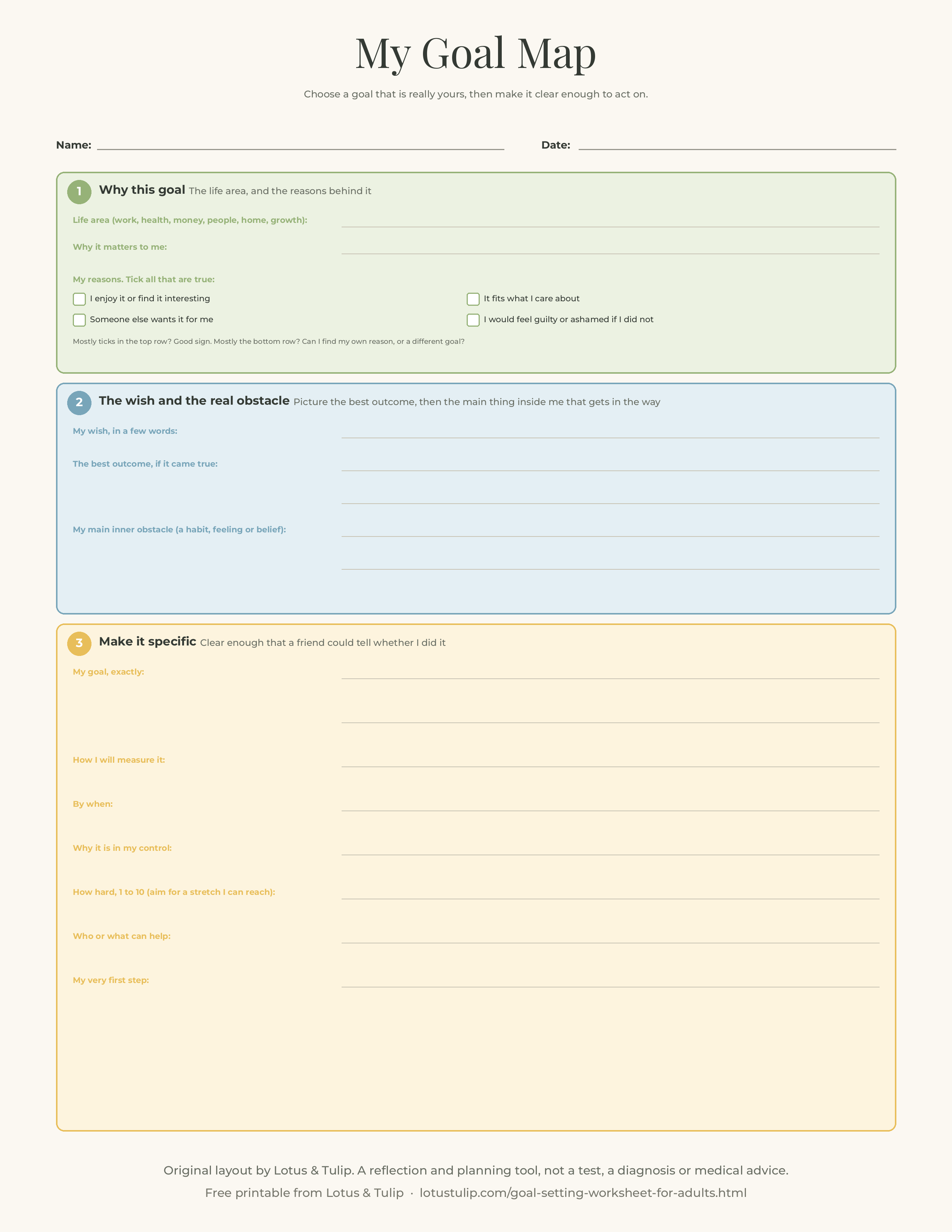
- Pick one life area and one goal. On page 1, choose an area such as work, health, money, people, home or growth, and one goal for the next two to three months. One goal you work on beats five you think about.
- Check your reasons. Write why it matters and tick your reasons. If most ticks are "someone else wants it" or "I would feel guilty", find your own reason or choose a goal that fits your values better.
- Name the wish and the best outcome. Write the wish in a few words, then the best thing about reaching it. Make it vivid, but do not stop here.
- Name the real obstacle. Ask what inside you is most likely to get in the way: a habit, a feeling, a belief like "I never stick with things". Name the main one, not a list of outside excuses.
- Make it specific. Write the goal so a friend could tell whether you did it. Add how you will measure it, a date and why it is in your control. "Walk 20 minutes on five weekdays a week for eight weeks" beats "get fit".
- Set the difficulty on purpose. Rate how hard it is from 1 to 10. Aim for a stretch you can reach, often around 6 or 7. If it is a 9 or 10, break it into a first milestone. If it is new and complex, try a learning goal first.
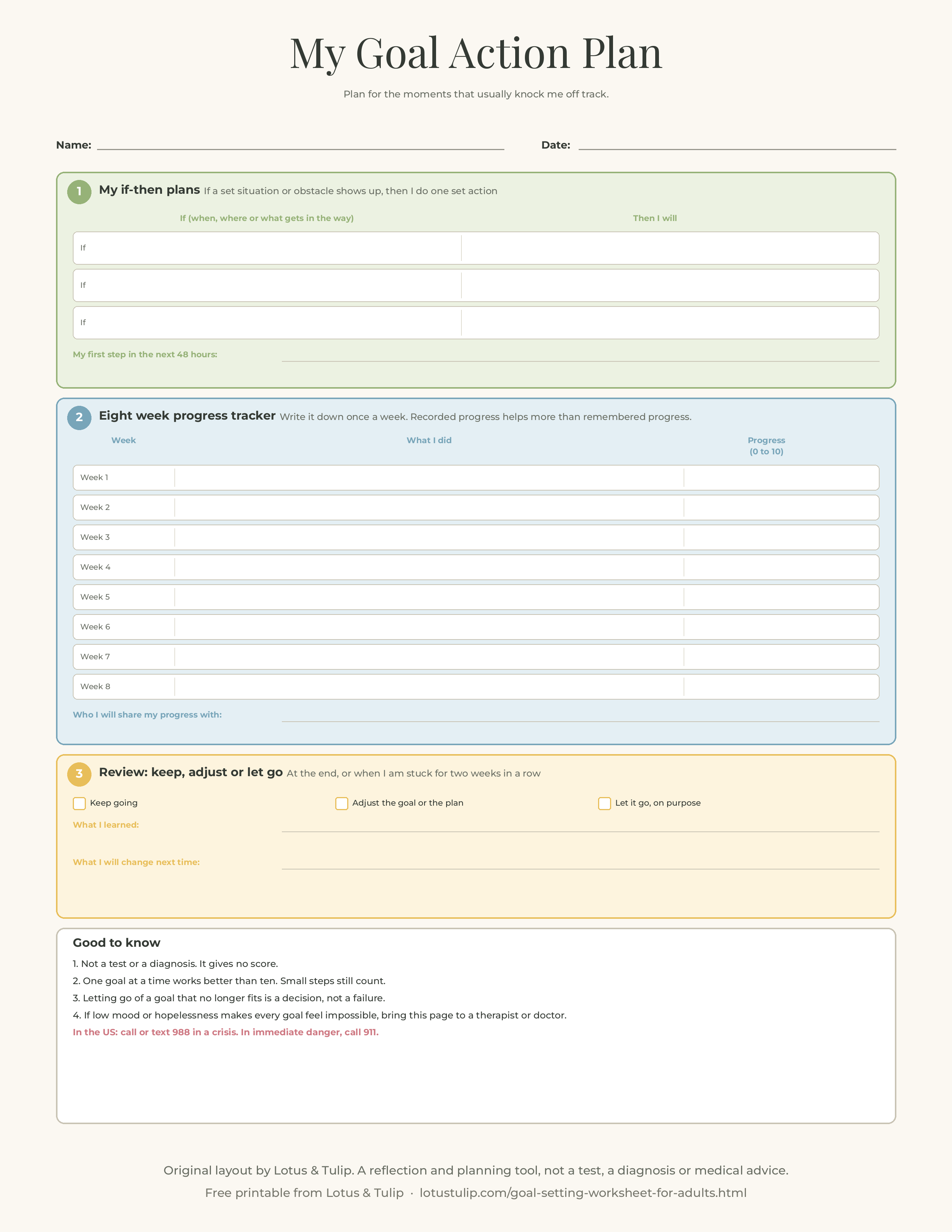
- Write three if-then plans. On page 2, write one plan for when and where you will act, and two for your likely obstacles: "If I get home tired and want to skip it, then I walk for ten minutes instead of twenty."
- Take the first step within 48 hours, then track weekly. Write a first step you can do in the next two days. Each week, write what you did and rate your progress from 0 to 10. Share it with one person if that helps you stay honest.
- Review: keep, adjust or let go. At the end, or after two stuck weeks in a row, tick keep going, adjust or let it go on purpose, and write what you learned. If low mood, hopelessness or thoughts of self harm make every goal feel impossible, a worksheet is not enough: talk to a professional, and in the US call or text 988, or call 911 in an emergency.
Common mistakes
- Too many goals at once. A list of ten New Year's resolutions spreads effort thin. Start with one, and add the next once the first is a habit.
- Outcome only, no behavior. "Lose 20 pounds" or "get promoted" depends partly on things you do not control. Pair the outcome with a behavior you do control, like a daily walk or one skill a month.
- Fantasizing instead of planning. Vision boards and daydreams feel good, but research suggests positive fantasies alone can sap energy. Always add the obstacle and a plan.
- A goal that belongs to someone else. Goals set out of guilt or pressure are harder to keep. If a goal is someone else's, say so, and look for what part of it you want for yourself.
- No tracking. Memory is kind to us and bad at numbers. A weekly line on paper keeps the goal visible and shows real progress.
- All or nothing. Missing a day does not cancel the goal. The if-then plan for "I missed a day" is often the most useful one you will write.
Examples
- Health, with an honest obstacle: A 38 year old office manager wanted to "get in shape". Her reasons check showed this was her goal, not her doctor's: she wanted energy to play with her kids. Her inner obstacle was "after work I tell myself I deserve to rest". Her goal: walk 25 minutes on four weekdays a week for eight weeks. If-then: "If I sit down on the couch after work, then I put my shoes on before I check my phone." By week six her tracker showed four walks in most weeks and two weeks with three.
- Money, adjusted on purpose: A man in his fifties set a goal to save $500 a month. He rated it a 9 out of 10, and after three weeks his tracker showed it was not happening. At review he ticked "adjust": $200 a month by automatic transfer on payday, plus one if-then plan for impulse buys over $50 ("If I want it, then I wait 48 hours"). He kept the new goal for the rest of the eight weeks.
- A therapy client with a learning goal: A client who wanted to "make friends" after a move rated the goal as complex and new. With her therapist she changed it into a learning goal: try three different group activities in six weeks and note which ones felt easiest. Her if-then plan for anxiety: "If I feel like canceling, then I go for 20 minutes and allow myself to leave." She found a weekly running club she wanted to keep. For more on this goal, see how to make friends as an adult.
Free printable: goal setting worksheet for adults
This free printable is an original Lotus & Tulip layout on US Letter, in our own wording. It is not the official WOOP materials or any published questionnaire, and it gives no score. Page 1, My Goal Map, covers the life area and why it matters, a reasons check, the wish and the best outcome, your main inner obstacle, and a box to make the goal specific (what exactly, how you will measure it, by when, why it is in your control, how hard from 1 to 10, who can help and your very first step). Page 2, My Goal Action Plan, covers three if-then plans, a first step in the next 48 hours, an eight week progress tracker, who you will share progress with and a keep, adjust or let go review, plus notes with US crisis lines.
Download the free goal setting worksheet for adults (PDF, 2 pages, US Letter)
Prefer single images? Page 1: goal map (PNG) · Page 2: goal action plan (PNG)
Free to print for yourself or for use with your own clients or groups. Please link to this page rather than re-uploading the file. A reflection and planning tool, not a test, a diagnosis or a substitute for therapy. In the US, call or text 988 in a mental health crisis. In immediate danger, call 911.
Related resources
- Wheel of life worksheet: rate 8 life areas first to choose where a goal matters most
- Habit tracker worksheet for adults: turn the goal into one small daily habit with a cue and an 84 day tracker
- ACT values worksheet: find what matters first, then set goals that fit
- Character strengths worksheet: the strengths you can bring to a goal
- Procrastination worksheet: when the goal is clear but starting is the problem
- Time management worksheet: make room in the week for your goal
- Behavioral activation worksheet: small steps when low mood drains motivation
- Goal setting worksheet for students: SMART goals shaped for school
- All therapist worksheets: CBT, DBT, ACT and more
FAQ
What is a goal setting worksheet for adults?
A goal setting worksheet is a structured page that helps you choose a goal, make it specific and plan how you will reach it. The free 2 page printable on this page covers why the goal matters to you, the main obstacle, a specific version of the goal, if-then plans, an eight week tracker and a review. It is an original tool and gives no score.
What does SMART stand for in goal setting?
In George Doran's original 1981 article, SMART stood for Specific, Measurable, Assignable, Realistic and Time-related. Common later versions use Specific, Measurable, Achievable, Relevant and Time-bound. SMART is a checklist for clarity, not a research based method on its own.
Does writing down goals really work?
Writing goals and plans down helps, but less dramatically than the famous Yale or Harvard goals study suggests, because that study has never been found. Real research shows that goal setting has a small effect on behavior on its own, that if-then plans have a medium to large effect, and that physically recording progress improves goal attainment.
What is an if-then plan?
An if-then plan, or implementation intention, links a specific situation to a specific action: "If it is 7 am on a weekday, then I walk for 20 minutes." A 2006 meta-analysis of 94 tests with 8,461 participants found a medium to large effect on goal attainment (d = 0.65).
What is WOOP?
WOOP stands for wish, outcome, obstacle, plan. It is a version of mental contrasting with implementation intentions developed by Gabriele Oettingen and colleagues: you picture what you want, then the main inner obstacle, then make an if-then plan for it. A 2021 meta-analysis of 21 studies found a small to medium effect on goal attainment (g = 0.34). Our worksheet uses the same idea in its own wording.
How many goals should I work on at once?
Start with one. Research on goals does not set a magic number, but one clear goal with a plan and a tracker is easier to keep than several vague ones. Add the next goal once the first has become routine.
Can therapists use this worksheet with clients?
Yes. It is free to print for use with your own clients or groups. Please link to this page rather than re-uploading the file. It works in session and as homework, alongside values work, behavioral activation or motivational interviewing. For clients in acute distress, focus on safety and support first; in the US, call or text 988 in a crisis, or call 911 in an emergency.
Sources
- Doran, G. T. (1981). There's a S.M.A.R.T. way to write management's goals and objectives. Management Review, 70(11), 35 to 36.
- Epton, T., Currie, S., and Armitage, C. J. (2017). Unique effects of setting goals on behavior change: Systematic review and meta-analysis. Journal of Consulting and Clinical Psychology, 85(12), 1182 to 1198.
- Gollwitzer, P. M., and Sheeran, P. (2006). Implementation intentions and goal achievement: A meta-analysis of effects and processes. Advances in Experimental Social Psychology, 38, 69 to 119.
- Harkin, B., Webb, T. L., Chang, B. P. I., and others (2016). Does monitoring goal progress promote goal attainment? A meta-analysis of the experimental evidence. Psychological Bulletin, 142(2), 198 to 229.
- Harvard Library, Ask a Librarian. Answer on the "Harvard goals study" (describes it as an urban legend). ask.library.harvard.edu.
- Kappes, H. B., and Oettingen, G. (2011). Positive fantasies about idealized futures sap energy. Journal of Experimental Social Psychology, 47(4), 719 to 729.
- Locke, E. A., and Latham, G. P. (2002). Building a practically useful theory of goal setting and task motivation: A 35-year odyssey. American Psychologist, 57(9), 705 to 717.
- Sheldon, K. M., and Elliot, A. J. (1999). Goal striving, need satisfaction, and longitudinal well-being: The self-concordance model. Journal of Personality and Social Psychology, 76(3), 482 to 497.
- Tabak, L. (1996). If your goal is success, don't consult these gurus. Fast Company.
- Wang, G., Wang, Y., and Gai, X. (2021). A meta-analysis of the effects of mental contrasting with implementation intentions on goal attainment. Frontiers in Psychology, 12, 565202.