
Therapist worksheets · Character strengths · Updated 2026-11-14
Character strengths worksheet: the 24 VIA strengths, signature strengths and how to use them step by step (free printable)
Turn strengths into values based action: ACT Worksheets for Therapists, values, defusion and committed action pages Holiday 20% off: about $9.20, was $12 (EUR 10) · fillable PDF, instant digital download
Buy on EtsyTry it free first: download a fillable sample (values compass and unhooking from thoughts, PDF, 259 KB). Type into it on screen, then get the full pack. No email needed.
For the inner critic that cannot see any strengths: CBT Worksheets for Therapists, 20 pages including thought records and core beliefs Holiday 20% off: about $11.04, was $14 (EUR 12) · fillable PDF, instant digital download
Buy on EtsyTry it free first: download a fillable sample (thought record and evidence for and against, PDF, 105 KB). Type into it on screen, then get the full pack. No email needed.
A full caseload: Therapist Worksheets Mega Bundle (8 packs incl. DBT, CBT, ACT, anxiety, grief and ADHD) Holiday 20% off: about $35.88, was $45 (EUR 39) · fillable PDFs for all 8 packs plus 160 printable pages, instant digital download
Buy on EtsyAsk most adults what is wrong with them and the list comes fast. Ask what is right with them and many go quiet, or offer a job title. Yet the qualities that make you good at your life, such as curiosity, kindness, persistence or a sense of humor, are just as real as your flaws, and they can be named, noticed and put to work on purpose.
That is the idea behind character strengths work in positive psychology. This guide is for therapists, counselors, coaches and teachers who use strengths with adult clients, and for adults who want to try it on their own. It explains the VIA classification of 24 character strengths, what signature strengths are, what the research honestly shows, nine practical steps to use a character strengths worksheet, common mistakes and three short examples. It ends with a free 2 page printable: My Strengths Map, for spotting your top strengths from your own stories, and My Strengths in Action Plan, for using one of them in a new way this week.
Download the free character strengths worksheet (PDF, 2 pages, US Letter)
Direct download, no email or sign up. See the pages first.
What character strengths are
Character strengths are positive traits that show up in how you think, feel and act, and that are valued in their own right, not only for what they get you. In 2004, Christopher Peterson and Martin Seligman published Character Strengths and Virtues: A Handbook and Classification (American Psychological Association and Oxford University Press), the result of a multi year project to build a shared language for good character, in the way diagnostic manuals give a shared language for problems.
The handbook groups 24 character strengths under six broad virtues. The idea is not that some people have strengths and others do not. Everyone has all 24 to different degrees, so each person has their own profile.
Character strengths are different from talents (like perfect pitch), skills (like coding) and interests (like hiking). A talent or skill is about what you can do. A character strength is about who you are when you do it: the persistence you bring to practice, the kindness you bring to a hard conversation.
The 24 character strengths and 6 virtues
Here is the VIA classification in short form. The descriptions are our own plain language summaries.
| Virtue | Character strengths |
|---|---|
| Wisdom | Creativity (new and useful ideas), curiosity (interest in new things), judgment (thinking things through, open to other views), love of learning (building knowledge and skills), perspective (seeing the big picture, giving wise advice) |
| Courage | Bravery (acting on what is right despite fear), perseverance (finishing what you start), honesty (being genuine and truthful), zest (energy and enthusiasm) |
| Humanity | Love (close, warm relationships), kindness (helping others without expecting a return), social intelligence (reading your own and others' feelings) |
| Justice | Teamwork (doing your share for a group), fairness (treating people equally), leadership (organizing a group toward a goal while keeping relations good) |
| Temperance | Forgiveness (letting go of resentment), humility (letting your actions speak), prudence (careful choices, thinking ahead), self-regulation (managing feelings and impulses) |
| Transcendence | Appreciation of beauty and excellence (noticing beauty and skill), gratitude (noticing and thanking), hope (expecting the best and working for it), humor (playfulness, bringing lightness), spirituality (a sense of meaning and purpose) |
The best known measure of these strengths is the VIA Inventory of Strengths. The original version has 240 items. The VIA Institute revised it in 2017, and the free VIA Survey on its website is the 96 item VIA-IS-P, which takes about 10 to 15 minutes. It is a copyrighted questionnaire, so we describe it here and do not reproduce its items. Our worksheet is not the VIA Survey and gives no score or ranking. If you want a ranked profile, take the official survey and bring the results to page 1.
What signature strengths are
Your signature strengths are the few character strengths that feel most like you. Peterson and Seligman described them as strengths a person owns, celebrates and frequently uses, and reported that in interviews adults could usually name a handful, typically between three and seven. The VIA Institute today treats the top five on the survey as signature strengths by convention, while noting that some people have fewer and many have more.
Peterson and Seligman proposed possible signs of a signature strength. Among them:
- A sense of ownership and authenticity: "this is the real me"
- Excitement when using it, especially at first, and a fast learning curve
- Feeling energized rather than drained after using it
- A yearning to use it, and a sense that you cannot help but use it
- Keeping finding new ways to use it, and building projects around it
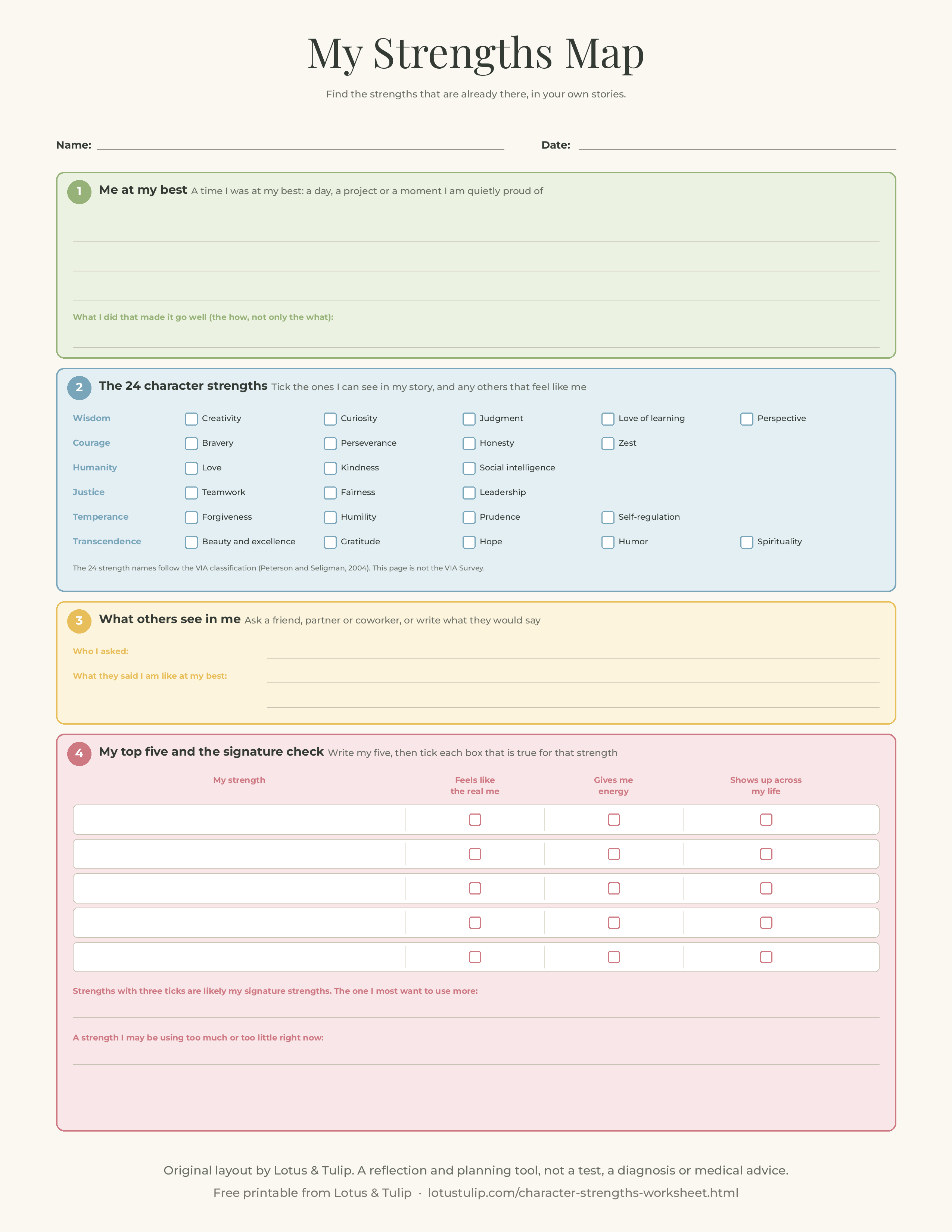
Page 1 of our worksheet uses questions in this spirit: which strengths feel like the real you, which give you energy and which come up again and again in your best moments.
Overuse and underuse
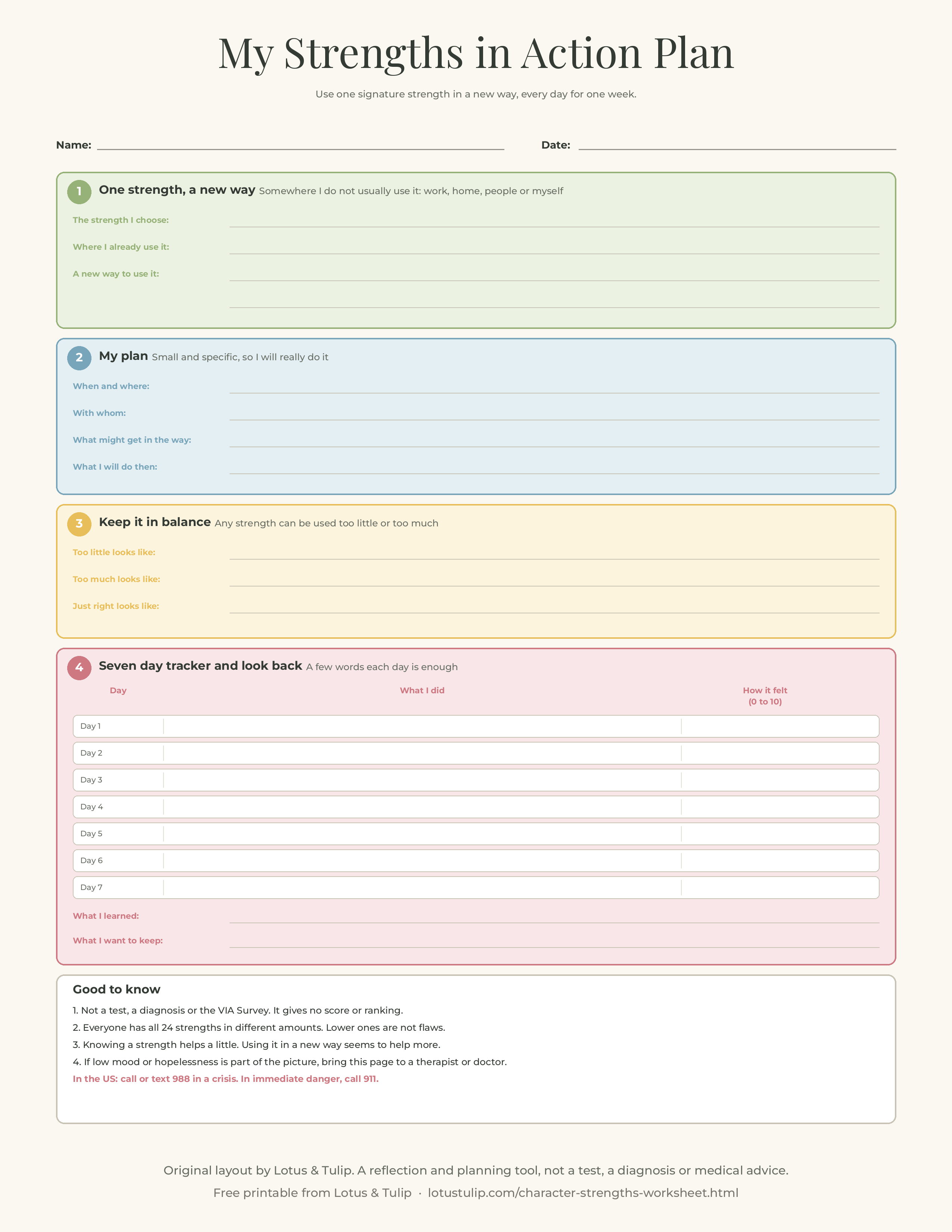
More is not always better. Ryan Niemiec of the VIA Institute has written about overuse, underuse and optimal use of character strengths (2019): the aim is the right strength, to the right degree, in the right situation. Honesty overused can turn into bluntness that hurts, prudence into rigidity, humor into making light of things that matter. Underused, a strength sits idle when you need it, like bravery in a meeting where you stay silent. Page 2 includes a box for how your strength could tip over, and what the balanced version looks like.
What the research says
- The classic study. In 2005, Seligman, Steen, Park and Peterson ran a randomized, placebo controlled internet study with 577 adults, published in American Psychologist. Each person did one exercise for one week. "Using signature strengths in a new way" (taking the strengths survey, then using one top strength in a new way every day for a week) and "three good things" increased happiness and reduced depressive symptoms for six months, compared with a placebo exercise of writing about early memories. Identifying strengths without using them in new ways had only short lived effects. The sample was mostly white, well educated visitors to a positive psychology website, which limits how far the results generalize.
- A replication found a smaller picture. Mongrain and Anselmo-Matthews (2012) repeated the study with a better control condition and a "positive placebo" (writing about positive early memories). The exercises led to lasting increases in happiness, but so did the positive placebo, and the exercises did not beat the control for depression. The authors suggest that part of the benefit may come simply from bringing positive information about yourself to mind.
- Meta-analysis: small to moderate effects. Schutte and Malouff (2019) pooled 29 effect sizes from 14 articles on signature strengths interventions compared with control conditions. The interventions increased positive affect or happiness (Hedges' g = 0.32, 9 studies) and life satisfaction (g = 0.42, 7 samples), and reduced depression (g = 0.21, 7 studies). Use of signature strengths also went up (g = 0.55), though that was based on only two studies.
- Beyond happiness. Ghielen, van Woerkom and Meyers (2018) reviewed 18 experimental and quasi experimental studies of strengths interventions published from 2011 to 2016. All types of strengths interventions were linked with positive outcomes, including well-being, work engagement, personal growth initiative and team outcomes. Hope, positive affect and authentic self-expression appeared to explain part of the effect.
The takeaway: strengths exercises are low cost and low risk, with small to moderate benefits on average, and stronger evidence for well-being than for depression. Using a strength in a new way seems to matter more than just knowing your strengths. A worksheet supports this practice. It is not a treatment for depression on its own.
How to use a character strengths worksheet, step by step
- Start from a real story, not a list. On page 1, write about a time you were at your best: a day, a project or a moment you are quietly proud of. Two or three sentences are enough. Stories reveal strengths more honestly than ticking boxes.
- Spot the strengths in the story. Read it back and ask which of the 24 strengths show up. Circle them on the strengths list on page 1. Look for the how, not only the what: did you keep going, make people laugh, notice what others missed?
- Ask someone who knows you. Write down what a friend, partner or coworker says you are good at as a person. Others often see strengths we take for granted. If asking feels hard, write what you think they would say.
- Pick your top five. Choose the five strengths that feel most like you. If you took the official VIA Survey, compare your top five with your own picks. Where they differ, trust the ones that feel like "the real me".
- Test each one for the signature feeling. For each of your top five, tick whether it feels like the real you, gives you energy and shows up in different parts of life. Strengths that get all three ticks are likely signature strengths.
- Choose one strength to use in a new way. On page 2, pick one signature strength. Write a new way to use it this week, somewhere you do not usually use it: curiosity in a dull meeting, kindness toward yourself, creativity in how you cook dinner.
- Make it specific. Write when, where and with whom you will do it, every day for seven days if you can. A small, concrete action you will really do beats a big plan you never start.
- Check for overuse. In the balance box, write how this strength could tip over into too much, and what the balanced version looks like. If a strength has been causing friction, the plan may be to dial it down rather than up.
- Look back at the end of the week. Use the seven day tracker to note what you did and how it felt. Then write what you learned and what you want to keep. If low mood, hopelessness or thoughts of self harm are part of the picture, a strengths exercise is not enough: talk to a professional, and in the US call or text 988, or call 911 in an emergency.
Common mistakes
- Stopping at identification. Knowing your top five is interesting, but research suggests the benefit comes mostly from using strengths in new ways. Always end with an action.
- Treating the ranking as fixed. Your bottom strengths are not weaknesses, only less prominent strengths. Profiles can shift with life stage and practice. It is a snapshot, not a verdict.
- Turning it into a performance review. Some clients use a strengths list to grade themselves harder ("I should be braver"). Keep the focus on what is already there.
- Ignoring overuse. A strength used everywhere at full volume can cause the very problems a client brings to therapy. Balance is part of the work.
- Using it to skip the hard stuff. Strengths work complements, rather than replaces, work on trauma, depression or relationship problems. For a harsh inner critic, pair it with a self compassion worksheet or cognitive restructuring.
- Pushing it on someone in acute distress. When a person is in crisis, being asked to list strengths can feel dismissive. Safety and support come first.
Examples
- Curiosity at a job that feels stale: A man in his forties who felt bored at work wrote about a weekend spent figuring out how to fix an old radio. He circled curiosity, love of learning and perseverance. His new way to use curiosity: ask one coworker each day a real question about how they do their part of the job. By Friday he had two ideas for improving a process and felt more interested in work than he had in months.
- Kindness turned inward: A nurse whose top strengths were kindness, teamwork and fairness noticed she used kindness all day for patients and never for herself. Her balance box read: "Overused, kindness means saying yes to every extra shift." Her plan was one kind act for herself each evening, from a short walk to turning her phone off at nine, and saying no to one extra shift that week.
- Humor in a hard season: A woman caring for her mother after a stroke picked humor, love and hope. Her new way to use humor was to share one funny moment from the day with her sister by text each night. She also wrote how humor could tip over: joking to avoid talking about how tired she was. On day seven she wrote that the texts helped, and that she had also told her sister she needed more help.
Free printable: character strengths worksheet
This free printable is an original Lotus & Tulip layout on US Letter, in our own wording. It lists the 24 strength names from the VIA classification, but it is not the VIA Survey or any other published questionnaire, and it gives no score or ranking. Page 1, My Strengths Map, covers a me at my best story, a circle the strengths list grouped by the six virtues, what others see in me, and my top five with a signature check (feels like the real me, gives me energy, shows up across my life). Page 2, My Strengths in Action Plan, covers one strength to use in a new way, a specific plan, a balance box for overuse and underuse, a seven day tracker and a look back, plus notes with US crisis lines.
Download the free character strengths worksheet (PDF, 2 pages, US Letter)
Prefer single images? Page 1: strengths map (PNG) · Page 2: strengths in action plan (PNG)
Free to print for yourself or for use with your own clients or groups. Please link to this page rather than re-uploading the file. A reflection and planning tool, not a test, a diagnosis or a substitute for therapy. In the US, call or text 988 in a mental health crisis. In immediate danger, call 911.
Related resources
- Wheel of life worksheet: find the life area where a strength could help most
- Goal setting worksheet for adults: put a signature strength to work on one real goal
- Self-esteem worksheets for adults: build a fairer view of yourself, with a free printable
- ACT values worksheet: what matters to you, and one step toward it
- Gratitude worksheets for adults: three good things and a journal that does not go stale
- Self compassion worksheet: a kinder voice for the inner critic
- Self esteem activities for teens: strengths and values work shaped for teenagers
- Problem solving worksheet for adults: put your strengths to work on a real problem
- All therapist worksheets: CBT, DBT, ACT and more
FAQ
What is a character strengths worksheet?
A character strengths worksheet is a structured page that helps you identify your strongest positive traits, such as kindness, curiosity or perseverance, and plan how to use them. The free 2 page printable on this page uses the 24 strengths from the VIA classification (Peterson and Seligman, 2004). It is an original tool, not the VIA Survey, and it gives no score.
What are the 24 character strengths?
Grouped by virtue: wisdom (creativity, curiosity, judgment, love of learning, perspective), courage (bravery, perseverance, honesty, zest), humanity (love, kindness, social intelligence), justice (teamwork, fairness, leadership), temperance (forgiveness, humility, prudence, self-regulation) and transcendence (appreciation of beauty and excellence, gratitude, hope, humor, spirituality).
What are signature strengths?
Signature strengths are the character strengths that feel most essential to who you are. People usually feel they are "the real me", get energy from using them and use them across many parts of life. By convention, the top five on the VIA Survey are treated as signature strengths, though some people have fewer and many have more.
What is the "use your signature strengths in a new way" exercise?
You identify your top strengths, then use one of them in a new way every day for a week. In a 2005 randomized study of 577 adults, this exercise increased happiness and reduced depressive symptoms for six months compared with a placebo exercise. A 2012 replication found the happiness gains but similar gains with a positive placebo, and no extra effect on depression.
Do character strengths interventions work?
On average, modestly. A 2019 meta-analysis of 14 articles found small to moderate effects on happiness (g = 0.32) and life satisfaction (g = 0.42), and a small effect on depression (g = 0.21). They are low cost, low risk additions to therapy or coaching, not stand alone treatments for depression.
Is the VIA Survey free?
Yes, the VIA Institute offers the VIA Survey free on its website, with optional paid reports. The current adult version has 96 items and takes about 10 to 15 minutes. You can bring your results to page 1 of our worksheet, or use the worksheet on its own without taking any survey.
Can therapists use this worksheet with clients?
Yes. It is free to print for use with your own clients or groups. Please link to this page rather than re-uploading the file. It works well in session and as homework between sessions. For clients in acute distress, focus on safety and support first; in the US, call or text 988 in a crisis, or call 911 in an emergency.
Sources
- Ghielen, S. T. S., van Woerkom, M., and Meyers, M. C. (2018). Promoting positive outcomes through strengths interventions: A literature review. The Journal of Positive Psychology, 13(6), 573 to 585.
- Mongrain, M., and Anselmo-Matthews, T. (2012). Do positive psychology exercises work? A replication of Seligman et al. (2005). Journal of Clinical Psychology, 68(4), 382 to 389.
- Niemiec, R. M. (2019). Finding the golden mean: The overuse, underuse, and optimal use of character strengths. Counselling Psychology Quarterly, 32(3 and 4), 453 to 471.
- Peterson, C., and Seligman, M. E. P. (2004). Character strengths and virtues: A handbook and classification. American Psychological Association and Oxford University Press.
- Schutte, N. S., and Malouff, J. M. (2019). The impact of signature character strengths interventions: A meta-analysis. Journal of Happiness Studies, 20(4), 1179 to 1196.
- Seligman, M. E. P., Steen, T. A., Park, N., and Peterson, C. (2005). Positive psychology progress: Empirical validation of interventions. American Psychologist, 60(5), 410 to 421.
- VIA Institute on Character. The 24 character strengths, VIA assessments and frequently asked questions. viacharacter.org.