
Kids and teens · Supporting children who are adopted, in foster care or in kinship care, ages 3 to 12 · Updated 2026-11-15
Adoption and foster care worksheets for kids: how to help a child feel safe, talk about their story and belong, what research shows and a free life story map

Ages 5 to 11: Kids Feelings and Social Skills Worksheets, incl. feelings detective, body clues, a feelings thermometer, a coping skills menu and a calm down plan Holiday 20% off: about $11.04, was $14 (EUR 12) · fillable PDF, instant digital download
Buy on EtsyTry it free first: download a fillable sample (feelings thermometer and calm-down plan, PDF, 240 KB). Type into it on screen, then get the full pack. No email needed.
Calm tools for hard days: Coping Skills Cards for Kids and Teens, 96 printable cards plus a coping skills list, toolbox worksheet and tracker Holiday 20% off: about $5.52, was $7 (EUR 6) · instant digital download
Buy on EtsyBest value for families and counselors: Kids and Teens Worksheets Bundle (feelings, anger, self esteem, social anxiety) Holiday 20% off: about $22.08, was $28 (EUR 24) · 80 pages, instant digital download
Buy on EtsyHundreds of thousands of American children live away from the family they were born into. According to the Children's Bureau's AFCARS data (preliminary estimates for federal fiscal year 2025), 331,747 children and young people were in foster care on September 30, 2025, and 501,745 were served by the foster care system during the year. Reunification with their family was the most common plan (45%), and 39% were living with relatives or kin. In the same year 43,380 children were adopted from foster care; 42% were adopted by a foster parent, 33% by a relative and 10% by other kin. Many more children joined their families through private domestic or international adoption.
Behind every number is a child with questions: Where are my people? Is it my fault? Will I have to move again? This guide is for foster parents, adoptive parents, kinship caregivers, teachers, school counselors, therapists and caseworkers supporting children about 3 to 12. It covers what children often feel, what research shows (honestly, including its limits), what worksheets can and cannot do, eight kinds of activities, nine steps to help, visits, birthdays and moves, age and need adaptations, school notes, common mistakes and three short examples. It ends with a free 2 page printable: My Life Story Map and My Belonging Plan.
Professional help comes first: these pages support gentle conversations about feelings and belonging. They are not therapy, not a trauma assessment and not legal or casework advice. Follow the guidance of the child's caseworker, therapist and pediatrician about what to share and when, especially about birth family contact or hard parts of a child's history. If a child talks about wanting to die or hurt themselves, call or text 988 (Suicide and Crisis Lifeline). If anyone is in immediate danger, call 911.
Download the free adoption and foster care worksheets for kids (PDF, 2 pages, US Letter)
Direct download, no email or sign up. See the pages first.
What children in foster care or adoption often feel
Every child's story is different, and many children feel several things at once. A lifebook guide published by Fostering Perspectives lists the questions children in care often carry: Why am I living here? Where are my parents? Where are my brothers and sisters? Why did I leave my other homes? Who is taking care of my pet? Where is my stuff? Common feelings include:
- "Is it my fault?" Young children often believe they caused a move. The American Academy of Pediatrics (AAP) advises explaining clearly that being placed away from birth parents was not their fault.
- "I miss them." A child can love and miss their birth family and love their foster or adoptive family at the same time. Both are real.
- "Will I have to leave again?" HealthyChildren.org notes that children 5 to 7 may think, "Since my first mother left me, maybe my second one might too."
- "Why am I different?" Family tree projects, baby photo days and nosy questions from classmates can make a child feel singled out.
- "Who am I?" Between 7 and 12 many adopted children grow more curious about their background, and in the teen years that interest often grows stronger (HealthyChildren.org).
What the research shows, honestly
Most children who are adopted or in foster care grow up resilient and connected. Research also shows real pressure points worth knowing about, and some things adults can do that seem to help.
Children in foster care face extra health needs, mostly because of what came before. Each year nearly 1% of US children spend time in foster care, and about 6% are placed at least once before age 18. Using the 2011 to 2012 National Survey of Children's Health, researchers found that children in foster care had poorer mental and physical health than other children, including children in economically disadvantaged families, and that nearly all of these differences were explained by children's characteristics and their current home environment (Turney and Wildeman, 2016). The AAP describes children in foster care as children with special health care needs whose problems are often rooted in early adversity and trauma, and recommends more frequent health monitoring (AAP Council on Foster Care, Adoption, and Kinship Care, 2015).
Most adopted children do well. A meta-analysis of studies comparing 25,281 adopted children with 80,260 nonadopted peers found that adoptees showed somewhat more behavior problems, but the differences were small (d 0.16 to 0.24). Adoptees were more often referred to mental health services, a larger difference (d 0.72), and the authors concluded that most international adoptees are well adjusted (Juffer and van IJzendoorn, 2005).
Stability matters. In a national sample of 729 children in out of home care, 52% found a stable placement within 45 days, 19% later and 28% never did over 18 months. Even after accounting for children's starting problems, instability alone was linked with more behavior problems: among lower risk children, 22% of those with early stability had behavior problems compared with 36% of those who stayed unstable (Rubin and colleagues, 2007).
Open, honest talk about adoption is linked with better adjustment. In the long running Minnesota Texas Adoption Research Project, adopted adolescents and young adults who were more satisfied with their birth family contact arrangements showed better adjustment, and adoption related communication predicted identity development (Grotevant and colleagues, 2013). Contact took many shapes: in 190 adoptive families followed over time, 41.6% had no contact, 13.7% stopped contact, 26.3% had limited contact and 18.4% had extended contact (Grotevant and colleagues, 2019). In a study of 100 internationally adopted teens aged 12 to 18, less open communication about their origins was linked with more behavior problems of every type measured (Aramburu Alegret and colleagues, 2020). These studies show links, not proof of cause.
Caregiver warmth can be strengthened. Attachment and Biobehavioral Catch-up (ABC), a 10 session home visiting program for caregivers of young children involved with child protective services, has been tested in randomized trials. In one follow up, foster infants whose caregivers received ABC (24 children) scored higher on receptive vocabulary at 36 months than those in a control program (28 children) (Bernard, Lee and Dozier, 2017). In a randomized trial of 117 young children entering a new foster placement, a structured treatment foster care program for preschoolers increased permanent placements among children with a history of placement instability (Lynch and colleagues, 2014).
No study has tested worksheets like the ones on this page. They are a simple way to put what this research points to, honest words, a child's own story, feelings that are allowed and steady adults, into a child's hands.
What adoption and foster care worksheets can and cannot do
They can help a child name mixed feelings, list the people who matter to them, write down questions to ask later, practice words for nosy questions, notice what helps at bedtime or after visits and give caring adults a calm, regular way to check in.
They cannot treat trauma, replace a trauma informed therapist, decide placement or contact plans, or tell a child what happened in their past. They should never be used to push a child to retell painful events, to quiz them about their birth family, or to compare families as better or worse.
8 kinds of adoption and foster care activities for kids
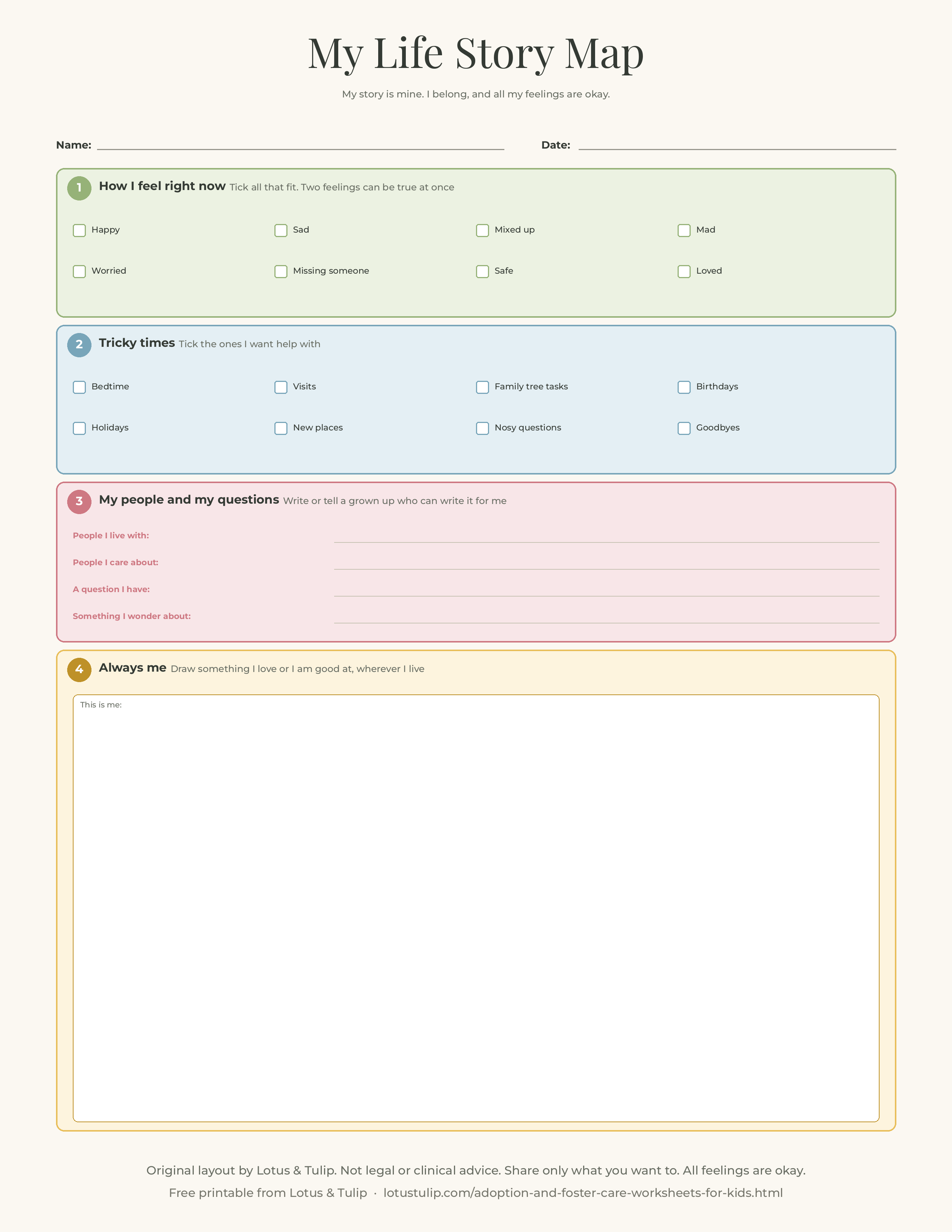
- Feelings check in: a list to tick or color, including happy, sad, mixed up, mad, worried, missing someone, safe and loved, because two feelings can be true at once.
- Tricky times: a checklist of moments that can feel hard, such as bedtime, visits, family tree tasks, birthdays, holidays, new places, nosy questions and goodbyes.
- My people: naming the people the child lives with and the people they care about, wherever those people are, without having to rank or choose.
- My questions: a safe place to write a question or wondering, so the adult can find out the answer with the caseworker or therapist and share it at the child's pace.
- Always me: a drawing box for interests and strengths that stay the same wherever the child lives.
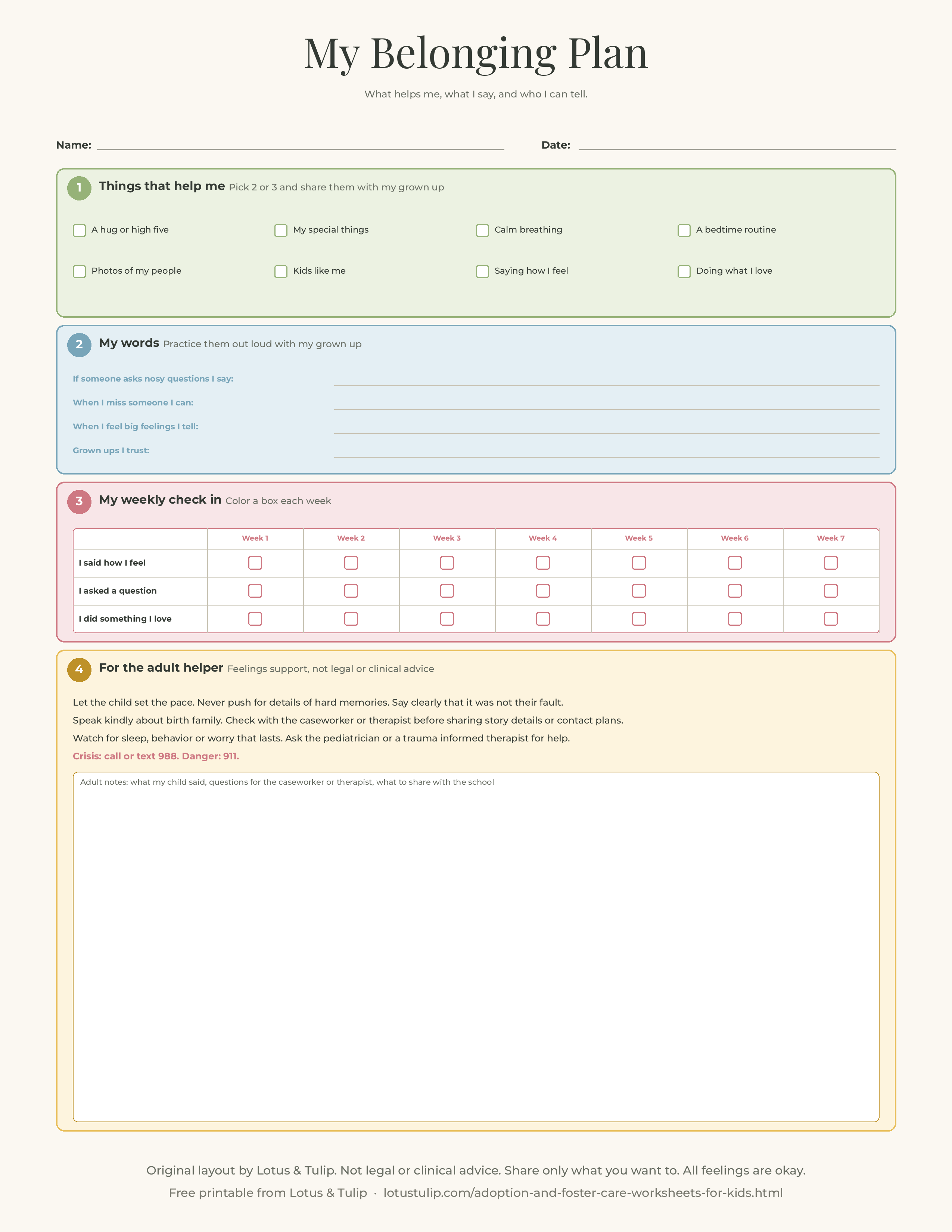
- Things that help me: choosing two or three comforts, such as a hug or high five, special belongings, calm breathing, a bedtime routine or photos of their people.
- My words: practiced phrases for nosy questions, such as "That's private" or "I live with my family," and a plan for what to do when they miss someone.
- Weekly check in: a simple tracker for saying how I feel, asking a question and doing something I love.
How to help a child in foster care or adoption, step by step
- Use honest words early and often. The AAP encourages using words such as adoption, birth family, foster care and kinship care in everyday conversation, and says there is no reason to wait for the "right time." HealthyChildren.org advises that a child know about their adoption by the time they start school.
- Say clearly that it is not their fault. Tell the child plainly that they did nothing to cause the move or the adoption, and that keeping them safe and cared for is the adults' job.
- Speak kindly about the birth family. The AAP suggests saying that birth parents "made an adoption plan" rather than "gave you up," and encourages honest, nonjudgmental language. Children often see part of themselves in their birth family, so harsh words about birth parents can land on the child.
- Follow the child's lead and pace. Answer the question the child actually asked, at their level. Let them set how much they want to talk, and never push for details of hard memories.
- Check with the team before sharing story details. Ask the caseworker or therapist what the child knows, what can be shared and how to explain contact or court changes. The AAP suggests that harder parts of a story, such as abuse, trauma or substance use, are usually discussed in school age years, with care.
- Build a life book together. HealthyChildren.org suggests a life book in a three ring binder so the story can grow over time. Fostering Perspectives notes that the lifebook belongs to the child, the child decides who can look at it, and it goes with them if they move. The printable can be one page in it.
- Keep routines steady and predictable. Stability is linked with fewer behavior problems (Rubin and colleagues, 2007). Regular meals, bedtimes and simple previews of what is coming next can help a child feel safe.
- Plan for tricky times. Before visits, birthdays, holidays or a move, talk through what will happen and what helps. Afterwards, expect big feelings and offer comfort rather than questions.
- Watch for signs a child needs more help. Sleep problems, big behavior changes, worry or sadness that lasts, or play that keeps repeating a frightening event are reasons to talk with the pediatrician, caseworker or a trauma informed therapist.
Visits, birthdays, moves and the rest of the family
Visits and contact. Contact plans are set by the court, the agency or the families involved, not by a worksheet. Children may be excited before a visit and upset after it, and both are normal. Page 1 can help them name feelings, and page 2 can hold their plan for when they miss someone.
Birthdays and holidays. These days can bring up missing and wondering. A simple ritual, such as lighting a candle or making a card the child chooses to keep or send, can make room for those feelings.
Moves and goodbyes. If a child must change homes, keep their belongings, photos and life book together, and say goodbye in a planned way when possible. See our moving worksheets for kids.
Siblings and other children in the home. HealthyChildren.org notes that children who joined a family by birth and by adoption are equal members. Brothers and sisters living elsewhere still matter; ask the caseworker about keeping those connections.
Caregivers need support too. Foster, adoptive and kinship parents carry a lot. Ask your agency about caregiver training, respite and post adoption support, and about programs such as ABC for caregivers of young children.
How to adapt it by age and need
- Ages 3 to 5: keep words short and true ("You grew in another mommy's tummy, and now you live with us"), read picture books about different families and let the child color and point while an adult writes.
- Ages 6 to 8: children start to understand that they have two families and may worry about losing this one. Offer steady reassurance and let them tick feelings and tricky times.
- Ages 9 to 12: curiosity about origins grows. Offer privacy, let them fill in both pages alone if they wish and treat their questions as normal, not as rejection.
- Teens: identity questions often get stronger. HealthyChildren.org notes that a teen's wish to know or find birth parents should not be taken as a rejection of their adoptive family. Our self esteem activities for teens can help.
- Kinship care: children living with grandparents or other relatives may not understand why they cannot live with their parents. Keep explanations simple, honest and kind about everyone in the family.
- Children with a trauma history: focus on safety and present day comfort first. Our trauma worksheets for kids include a calm body plan, and a trauma informed therapist can guide deeper work.
Notes for teachers and school counselors
- Know the school stability rules. Under the Every Student Succeeds Act (ESSA), a child in foster care stays in their school of origin unless it is decided that this is not in their best interest. If they change schools, the new school must enroll them immediately, even without the usual records, and contact the previous school for records. Ask who your district's foster care point of contact is.
- Rethink family assignments. Family trees, baby photo days and "bring a picture of your parents" tasks can be painful. Offer options such as a "people who care about me" map or a choice of any photo.
- Protect the child's story. A child's history is private. Share only what the caregiver and caseworker agree is needed, and never discuss it in front of classmates.
- Expect hard days. Visits, court dates and moves can affect focus and behavior. A quiet space, a trusted adult and a predictable routine can help.
- Use the printable in a counselor check in. With permission from the caregiver and, where needed, the caseworker, the pages can help a student talk about feelings and practice words for nosy questions.
- Know when to refer and report. Refer to the school psychologist, social worker or outside care if a student is struggling over time or talks about suicide. If a student describes being hurt or not cared for, follow your school's procedure and your state's mandated reporting law.
Common mistakes
- Keeping adoption a secret. HealthyChildren.org warns that children who have not been told often sense they are different, and the longer adults wait, the harder it gets.
- Speaking badly of birth parents. Even when the history is hard, harsh words can feel like criticism of the child. Stay honest and kind.
- Pushing for the whole story. Retelling painful events without a therapist's support can overwhelm a child. Let them lead.
- Taking questions as rejection. Curiosity about birth family is normal and is not a sign the child loves you less.
- Treating big behavior as defiance only. Fear and loss can look like anger. Look for what the behavior is saying.
- Using a worksheet instead of professional help. These pages sit alongside casework and therapy, never in place of them.
Examples
- Leo, 5: he was placed with his grandmother and cried every night at bedtime. They made a bedtime routine with a photo of his mom by the bed, and on page 1 he colored "Missing someone" and "Safe."
- Amara, 8: her class was making family trees, and she froze. Her adoptive dad talked with the teacher, who let every student choose a "people who care about me" map instead. Amara practiced "That's private" for nosy questions on page 2.
- Diego, 11: after moving to his third foster home, he asked whether he would ever see his brother. His foster mom wrote the question on page 1 and took it to his caseworker, who set up regular phone calls between the brothers.
Free printable: adoption and foster care worksheets for kids
This printable is an original Lotus & Tulip layout. It is not an assessment, gives no score and contains no legal, casework or clinical advice. It does not ask a child to retell hard events. Page 1, My Life Story Map, has a feelings checklist, tricky times, my people and my questions and an "always me" drawing box. Page 2, My Belonging Plan, has things that help me, my words, a weekly check in tracker and notes for the adult helper, including letting the child set the pace, speaking kindly about birth family, checking with the caseworker or therapist, 988 and 911.
Download the free adoption and foster care worksheets for kids (PDF, 2 pages, US Letter)
Prefer single images? Page 1: My Life Story Map (PNG) · Page 2: My Belonging Plan (PNG)
Related resources
- Trauma worksheets for kids: a calm body plan for children after frightening experiences
- Incarcerated parent worksheets for kids: when a parent is away, with a free staying connected plan
- Blended family worksheets for kids: for new family members and two homes
- Moving worksheets for kids: for changing homes and schools
- Separation anxiety worksheet for kids: when goodbyes are hard
- Coping skills list for kids: 60 ideas for hard days
- All counseling resources for kids and teens
FAQ
How many children are in foster care in the US?
According to preliminary AFCARS estimates from the Children's Bureau, 331,747 children and young people were in foster care on September 30, 2025, and 501,745 were served during federal fiscal year 2025. Reunification with family was the most common plan, and 43,380 children were adopted from foster care that year.
When should I tell my child they are adopted?
Early. The AAP encourages using words like adoption and birth family from the start and says there is no need to wait for the "right time." HealthyChildren.org advises that children know about their adoption by the time they start school, with more detail added as they grow.
How do I talk about birth parents without blaming them?
Use honest, kind and simple words. Say that the birth parents could not take care of a child at that time, that it was not the child's fault, and that the adults made a plan to keep the child safe. Check with the caseworker or therapist before sharing hard details.
What is a life book?
A life book is a binder or album of a child's photos, memories, drawings and important information. HealthyChildren.org suggests a three ring binder so it can grow, and Fostering Perspectives notes that the life book belongs to the child and goes with them if they move.
Do children in foster care need therapy?
Not every child, but many benefit. The AAP describes children in foster care as children with special health care needs and recommends closer health monitoring. If worry, sleep problems or behavior changes last, ask the pediatrician or caseworker about a trauma informed therapist.
Can these worksheets be used in therapy or school counseling?
Yes, as a gentle conversation starter, with permission from the caregiver and where needed the caseworker. They are not an assessment and should not be used to collect details of a child's history.
What age are these adoption and foster care worksheets for?
They are designed for children about 3 to 12. Younger children can color, point and talk through the pages with an adult who writes for them, while children 8 to 12 can fill in most of the map and plan themselves. Foster, adoptive and kinship caregivers, counselors and therapists can all use them.
Sources
- AAP Council on Foster Care, Adoption, and Kinship Care, Committee on Adolescence, and Council on Early Childhood (2015). Health care issues for children and adolescents in foster care and kinship care. Pediatrics, 136(4), e1131 to e1140.
- Aramburu Alegret, I., Pérez-Testor, C., Mercadal Rotger, J., and colleagues (2020). Influence of communicative openness on the psychological adjustment of internationally adopted adolescents. Journal of Research on Adolescence, 30(S1), 226 to 237.
- Bernard, K., Lee, A. H., and Dozier, M. (2017). Effects of the ABC intervention on foster children's receptive vocabulary: follow-up results from a randomized clinical trial. Child Maltreatment, 22(2), 174 to 179.
- Children's Bureau, US Department of Health and Human Services (2026). The AFCARS Dashboard, print version: preliminary FFY 2025 estimates as of February 27, 2026, No. 33.
- Every Student Succeeds Act, ESEA section 1111(g)(1)(E): educational stability of children in foster care.
- Fostering Perspectives (2013). Lifebooks: keeping it together. Vol. 17, No. 2.
- Grotevant, H. D., McRoy, R. G., Wrobel, G. M., and Ayers-Lopez, S. (2013). Contact between adoptive and birth families: perspectives from the Minnesota Texas Adoption Research Project. Child Development Perspectives, 7(3), 193 to 198.
- Grotevant, H. D., Wrobel, G. M., Fiorenzo, L., Lo, A. Y. H., and McRoy, R. G. (2019). Trajectories of birth family contact in domestic adoptions. Journal of Family Psychology, 33(1), 54 to 63.
- HealthyChildren.org (American Academy of Pediatrics). Let's talk about adoption.
- HealthyChildren.org (American Academy of Pediatrics). When to tell your child about adoption.
- HealthyChildren.org (American Academy of Pediatrics). Talking to your teen about being adopted.
- HealthyChildren.org (American Academy of Pediatrics) (2020). How pediatricians can support families of children who are adopted, fostered, or in kinship care.
- Jones, V. F., Schulte, E. E., Waite, D., and AAP Council on Foster Care, Adoption, and Kinship Care (2020). Pediatrician guidance in supporting families of children who are adopted, fostered, or in kinship care. Pediatrics, 146(6), e2020034629.
- Juffer, F., and van IJzendoorn, M. H. (2005). Behavior problems and mental health referrals of international adoptees: a meta-analysis. JAMA, 293(20), 2501 to 2515.
- Lynch, F. L., Dickerson, J. F., Saldana, L., and Fisher, P. A. (2014). Incremental net benefit of early intervention for preschool-aged children with emotional and behavioral problems in foster care. Children and Youth Services Review, 36, 213 to 219.
- Rubin, D. M., O'Reilly, A. L., Luan, X., and Localio, A. R. (2007). The impact of placement stability on behavioral well-being for children in foster care. Pediatrics, 119(2), 336 to 344.
- Turney, K., and Wildeman, C. (2016). Mental and physical health of children in foster care. Pediatrics, 138(5), e20161118.
Lotus & Tulip is not affiliated with the American Academy of Pediatrics, the Children's Bureau, the US Department of Health and Human Services, the US Department of Education, Fostering Perspectives or the researchers or organizations named on this page. Names in the examples are invented. This page is educational and does not replace professional medical, mental health, casework or legal advice.