
Kids and teens · Updated 2026-11-06
Self Esteem Activities for Teens: Practical Exercises with a Free Printable
Ready-made printable: Self Esteem Worksheets for Kids and Teens Holiday 20% off: about $9.20, was $12 (EUR 10) · instant digital download
Buy on Etsy
Self esteem for teens is not a pep talk, a filter, or a permanent personality trait. In plain language, it is a teen's overall sense of worth: how they evaluate themselves as a person across school, friendships, family, skills, and appearance. It rises and falls with context. A teen can feel solid after a hard practice and shaky after a group chat. That swing is normal in adolescence. The work is building skills that make worth less dependent on one grade, one photo, or one friend's mood.
This guide targets the search families, school counselors, and teen therapists actually use: self esteem activities for teens. It is distinct from our younger page, self esteem worksheets for kids, which uses elementary language and simpler strengths menus. Here the tone fits ages about 12 to 18: identity, peers, social media, school pressure, and choice. The free three page US Letter printable at the bottom is an original Lotus and Tulip layout. We are not affiliated with any curriculum brand, textbook publisher, or assessment company, and this is not a copy of any copyrighted worksheet.
You will find honest definitions (self esteem vs confidence vs narcissism vs self compassion), why teens struggle without scare tactics, research with clear caveats, signs framed educationally rather than as a diagnosis, an activity menu with cross links, how counselors and parents can use the activities in groups or one to one, common mistakes, when to escalate, a nine step teaching plan, seven FAQs, and fictional worked examples.
This guide is educational. It is not therapy, not medical advice, and not a diagnosis. If thoughts of ending your life, plans to harm yourself or someone else, or a medical emergency show up, stop the activity and get help now: in the US, call or text 988, text HOME to 741741, or call 911. Our safety plan worksheet is a better first tool in that moment. Related neighbors: self compassion worksheet, positive self talk worksheet, peer pressure worksheets for teens, ACT values worksheet, and growth mindset worksheet.
Jump to the free self esteem activities for teens printable (PDF) · How to teach self esteem activities, step by step · Worked examples · Comparisons
What self esteem means for teens (vs confidence, narcissism, and self compassion)
Self esteem is a global evaluation of the self: "Am I a person of worth?" Morris Rosenberg's classic work on adolescent self image helped shape how researchers measure that evaluation. The Rosenberg Self Esteem Scale (RSES) lineage is still widely used in research. Treat the scale as a research and clinical assessment tool with its own manuals and permissions. This free page does not reproduce scale items and is not a substitute for a validated measure.
Confidence is more task specific. A teen can have strong soccer confidence and shaky social confidence in the same week. Building confidence usually means practice, feedback, and evidence in a domain. Building healthier self esteem usually means a broader pattern: realistic strengths, kinder self talk, values based choices, and less outsourcing of worth to likes or rankings.
Narcissism (in the everyday sense of fragile grandiosity, not a casual insult) is not the same as healthy self regard. Inflated or defensive self esteem can look loud on the outside and brittle on the inside. Research in the Baumeister lineage has long cautioned that "higher self esteem at any cost" is not a simple path to better behavior. Threatened egotism (feeling superior and then feeling that superiority challenged) has been linked in reviews to aggression risk in some contexts. The practical takeaway for helpers: do not teach teens to claim they are better than everyone. Teach them to be fair to themselves and fair to others.
Self compassion (Kristin Neff's framing) emphasizes kindness to oneself in struggle, common humanity, and mindful awareness of pain without over identifying with it. Self compassion and self esteem often move together, but they are not identical. A teen can practice self compassion on a hard day without needing to decide they are "amazing." Cross link: our self compassion worksheet. Many teens respond better to "treat yourself like a decent friend" than to forced affirmations that feel fake.
Core idea for this page: self esteem activities are skills practice. They help teens notice evidence, values, and kinder language. They are not a standalone cure for depression, anxiety, trauma, bullying, or identity distress. Pair activities with counseling or therapy when problems are severe or lasting.
Why teens struggle with self esteem (without scare tactics)
Adolescence is a redesign of identity. Bodies change, brains keep developing, peer status becomes louder, and schools add public grading, tryouts, and college or career talk. None of that means every teen is broken. It does mean comparison is easier than ever.
- Identity work. Teens try on roles: athlete, artist, quiet kid, activist, class clown. Trying on roles can feel unstable. That is development, not failure.
- Peers. Belonging matters. Exclusion, gossip, and friendship churn hit hard. See peer pressure worksheets for teens when the issue is fitting in at a cost.
- Social media. Feeds compress highlight reels. Time online can amplify appearance comparison, status counting, and public mistakes. Hygiene skills (limits, mute, unfollow, reality checks) help more than lectures that teens tune out.
- School pressure. Grades, AP loads, sports, arts, and family expectations stack. Perfectionism can look like "high self esteem" until one B-minus collapses the week. Pair with goal setting worksheet for students and growth mindset worksheet.
- Family climate. Criticism, comparison to siblings, and praise that only lands on outcomes all shape self talk. Warm, specific noticing of effort and character helps.
Stay honest and calm. Fear based talks ("screens will ruin your self esteem forever") rarely build trust. Skills, evidence, and small experiments do.
Self esteem activities vs confidence drills, self compassion, and CBT thought work
| Self esteem activities | Confidence / skills practice | Self compassion | CBT thought work | |
|---|---|---|---|---|
| Main job | Build a fairer overall sense of worth with strengths, values, evidence, and kinder self talk | Improve performance belief in a domain through practice and feedback | Meet struggle with kindness and common humanity | Examine hot thoughts, evidence, and balanced alternatives |
| Best early use | When a teen's worth feels global and fragile ("I am a loser") | When the issue is "I cannot do this skill yet" | When shame or harshness spikes after a setback | When a specific thought is driving mood or avoidance |
| Output | Strengths map, values, evidence log, weekly proud moments | Practice plan and skill gains | Kinder response scripts | Thought record or Socratic notes |
| Cross link | This page | Goal setting · Growth mindset | Self compassion | Positive self talk · CBT for teens |
These tools cooperate. A strengths inventory feeds kinder self talk. Values (see ACT values worksheet) keep goals from becoming perfectionism. Peer and friendship skills protect belonging without people pleasing. Assertiveness and boundaries pages help when worth is tied to never saying no: see assertiveness worksheet and healthy boundaries worksheet.
What the research says (honestly)
Do not claim that three printable pages remake a teen's mental health. Frame activities as practice aids inside counseling, groups, classrooms, or home conversations.
Measurement lineage. Rosenberg's work on adolescent self image and the Rosenberg Self Esteem Scale shaped decades of research. Cite that lineage for definitions and measurement history. Do not treat a free activity sheet as an RSES administration.
Baumeister caveats. Reviews associated with Roy Baumeister and colleagues have argued that simply trying to inflate self esteem is not a reliable fix for outcomes people care about, and that fragile or defensive high self esteem can co-occur with problems when the ego feels threatened. Practical implication: prefer realistic strengths, responsibility, and skills over empty praise and superiority talk.
Orth and Robins longitudinal work. Ulrich Orth, Richard W. Robins, and colleagues have published longitudinal research on how self esteem develops across the lifespan and how it relates to life outcomes. Patterns in that literature generally support treating self esteem as meaningful and somewhat stable yet still changeable over time, not as a fixed destiny. Exact effect sizes vary by study, age band, and outcome. If you need numbers for a paper or grant, go to the primary articles rather than inventing figures from a blog.
Dweck and praise. Carol Dweck's mindset research (and related praise studies) cautions against person praise that freezes identity ("you are so smart") when process praise and strategy focus ("you stuck with that hard problem") better support learning. Empty praise that contradicts a teen's experience often backfires.
Neff self compassion. Self compassion research distinguishes harsh self evaluation from a kinder stance that still tells the truth. For teens who reject affirmations as fake, self compassion language often lands better. See self compassion worksheet.
Honest caveat. School SEL programs, counseling groups, and CBT packages may include self esteem related components. That is not the same as an RCT proving this free printable alone remits diagnoses. Use activities as one tool in a coherent plan. For bullying, trauma, self harm, eating concerns, or severe depression, use setting appropriate care and crisis pathways.
How to teach self esteem activities for teens, step by step
- Check safety and fit. If acute crisis, bullying that needs protection first, or self harm risk appears, pause activities and follow crisis protocol: 988, HOME to 741741, or 911 when needed. Prefer a safety plan in that moment.
- Define the goal in teen words. "Fairer view of yourself," "less crushing after one mistake," or "know what you stand for" beats jargon.
- Normalize the struggle briefly. Identity and comparison are common in the teen years. Validation opens practice. Lectures close it.
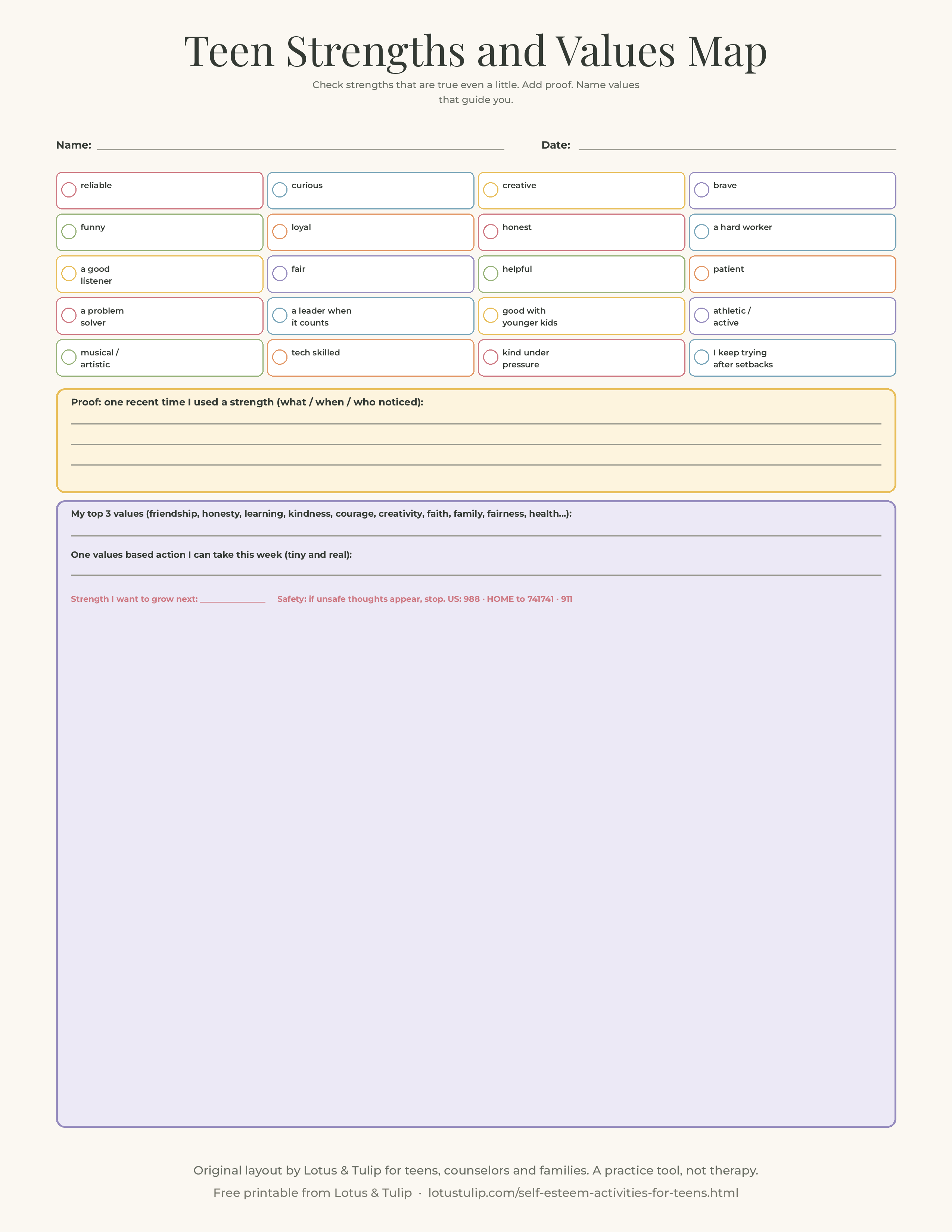
- Start with strengths or values, not with "what is wrong with you." Use page 1 of the free printable (strengths and values map) or a short values check from the ACT values worksheet.
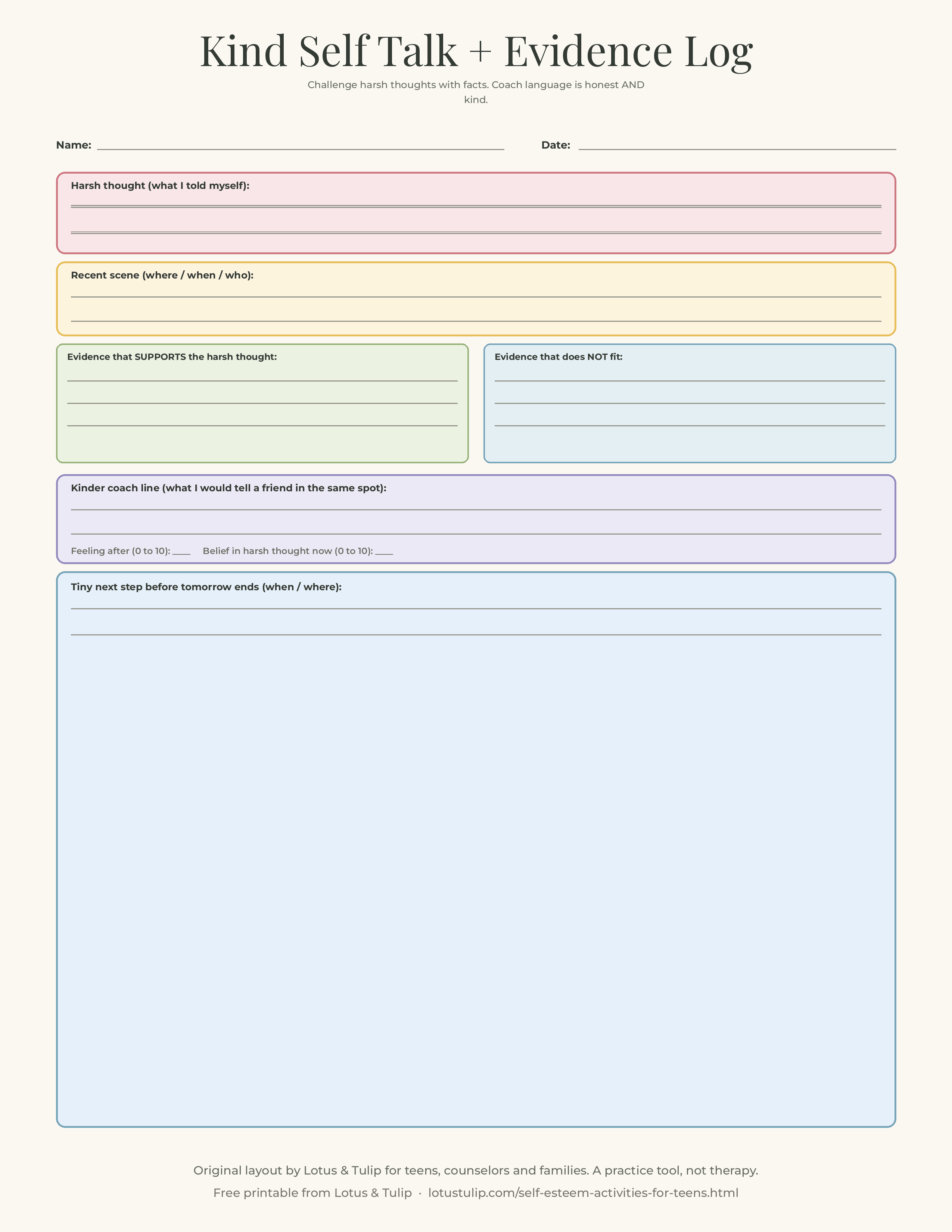
- Add kind self talk with evidence. Challenge harsh thoughts with facts, not toxic positivity. Page 2 of the free printable is built for that. Neighbor: positive self talk worksheet.
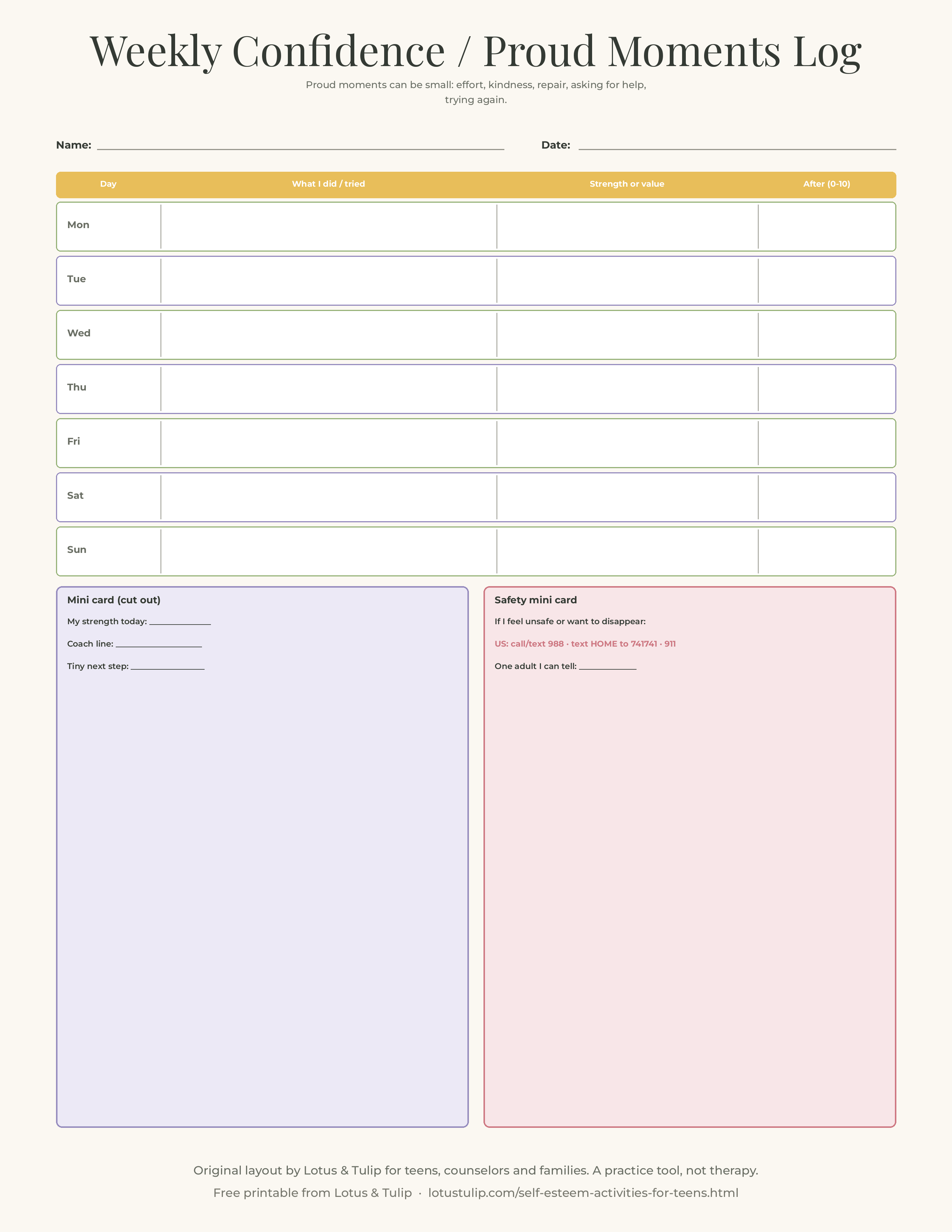
- Collect weekly evidence of effort and character. Proud moments logs beat once a year pep assemblies. Page 3 of the free printable.
- Address peers and media on purpose. Add social media hygiene and friendship skills. Cross link peer pressure worksheets for teens when fitting in costs values.
- Set goals without perfectionism. One small skill goal plus one values based action. Use goal setting and growth mindset pages when useful.
- Review and adjust. What stuck? What felt fake? Shrink homework. Celebrate experiments, not flawless weeks.
Practice in low stakes moments first. Skill grows with repetition and honesty, not with one inspirational speech.
Worked fictional examples
Teen example (fictional): Jordan, age 15, says "I am awkward and nobody wants me around" after eating lunch alone twice. Strengths map: funny with cousins, reliable on the robotics team, kind to younger siblings. Harsh thought: "Two solo lunches mean I have no friends." Evidence that does not fit: group chat still active; one teammate asked for help on code yesterday. Kind self talk: "Solo lunch feels lonely. It does not prove I have zero friends. I can text one person about sitting together Friday." Proud moment that week: stayed after practice to help a freshman. Confidence to try the text: 6/10.
Middle school group example (fictional): In session three of a self esteem group, students complete a five minute strengths inventory, pair share one strength with evidence, and write one kind coach sentence for a made up scenario (failed a quiz). No forced sharing of private family stories. Exit ticket: one proud moment from the past 24 hours.
Parent conversation example (fictional): A parent stops saying "you are the smartest" after every grade and instead says "you planned your study block and stuck with the hard chapter." The teen rolls their eyes, then later uses the proud moments log without being nagged. Small shift, more believable praise.
Activity menu for ages about 12 to 18
Use this as a menu. One or two activities well beats seven half done.
- Strengths inventory. Check strengths that are true even a little, add proof, note one strength to grow. Free printable page 1. Younger sibling page: self esteem worksheets for kids.
- Values map. What kind of friend, student, sibling, or community member do you want to be? Cross link ACT values worksheet. Values protect against people pleasing.
- Kind self talk + evidence log. Inner critic vs inner coach, with facts. Free printable page 2. Neighbor: positive self talk worksheet.
- Proud moments / evidence log. Daily or weekly proof of effort, kindness, courage, repair. Free printable page 3.
- Social media hygiene. Mute accounts that spike shame, set time windows, reality check ("this is a highlight reel"), notice body signals after scrolling. Keep it collaborative, not confiscation theater, unless safety requires adult limits.
- Body image notes with care. Focus on respect, function, and media literacy rather than appearance ranking. If eating restriction, purging, or compulsive exercise appears, escalate to qualified care. Activities are not eating disorder treatment.
- Friendship and peer pressure skills. Belonging without abandoning values. Cross link peer pressure worksheets for teens and friendship group pages.
- Goal setting without perfectionism. One skill goal, one values action, room for mistakes. Cross link goal setting worksheet for students and growth mindset worksheet.
- Assertiveness and boundaries. Saying no, asking for help, ending a chat that turns cruel. Cross link assertiveness worksheet and healthy boundaries worksheet.
How school counselors, therapists, and parents can use these activities
School counselors (group). Keep sessions structured and optional on personal disclosure. Strengths and proud moments work well as warm ups. Use group agreements. Follow district crisis protocol if risk appears. Middle school self esteem curricula (such as Real Me style groups) give an eight session arc when you need more than a one off.
School counselors (1:1). Compress: name the harsh story, one strength with evidence, one kind coach line, one tiny next step. Fifteen minutes can be enough.
Therapists. Fit activities into the formulation. For depression, pair with activation and thought work. For social anxiety, pair with experiments. For trauma, pace carefully. Do not force positive reframes when witnessing is needed first. Progress notes can capture the hot self statement, evidence noticed, and the teen's own conclusion.
Parents and caregivers. Model fair self talk. Notice effort and character. Avoid sibling comparisons. Offer the printable as optional, not as homework punishment. If your teen shuts down, shrink the ask to one proud moment at dinner.
Signs of low vs fragile or defensive high self esteem (educational, not diagnostic)
These are conversation starters for helpers, not a checklist for diagnosing anyone.
- Often linked with low self esteem: global harsh labels after small mistakes, heavy people pleasing, difficulty naming strengths, avoidance of tryouts or new groups for fear of looking stupid, long rumination on criticism.
- Often linked with fragile or defensive high self esteem: needing constant superiority, exploding or shutting down when challenged, putting others down to stay on top, bragging that hides thin skin.
- Healthier direction: can name strengths and limits, repairs after mistakes, accepts compliments without arguing them away, treats others with respect while still advocating for self.
If mood, sleep, appetite, school function, or safety are collapsing, skip DIY and get professional help.
Common mistakes
- Empty praise that the teen does not believe ("you are perfect").
- Comparing to siblings, classmates, or influencer bodies.
- Forcing sharing of private wounds in a group for a grade or a sticker.
- Toxic positivity that bans sad or angry feelings.
- Teaching superiority instead of fair self regard.
- Using activities as the only response to bullying instead of stopping the harm.
- Treating the worksheet as therapy. Paper supports practice. It does not replace a clinician when problems are severe or lasting.
When not to use these activities / when to escalate
- Acute safety risk or medical emergency: stabilize and get help (988, HOME to 741741, 911). Use a safety plan.
- Active bullying or abuse: protection and reporting pathways first; worksheets are not a shield.
- Eating disorder concerns, severe depression, trauma processing needs, or psychosis: refer to qualified care. Do not use strengths worksheets as the main treatment.
- When the teen is flooded and cannot answer even simple prompts: regulate first, return later.
Therapist and counselor tips
- Stay in the teen's language. "Fair to yourself" often beats "self esteem intervention."
- Prefer evidence over slogans. Ask for a recent scene.
- Make practice optional and tiny. One proud moment beats a blank ten page journal.
- Watch for shame in the room. Humor and choice reduce shutdown.
- Coordinate with peers and media themes instead of pretending school is only about grades.
- Measure function. Ask what changed: trying out for something, kinder self talk after a B, less doom scrolling before bed, asking for help once.
Free self esteem activities for teens printable (PDF)
The free self esteem activities for teens printable has three pages in US Letter size:
- Page 1: Teen Strengths and Values Map. Strengths to check, proof boxes, and top values with one values based action.
- Page 2: Kind Self Talk + Evidence Log. Harsh thought, evidence for and against, kinder coach line, and a tiny next step.
- Page 3: Weekly Confidence / Proud Moments Practice Log + mini cards. Seven day rows plus cut out reminders for strengths, coach lines, and safety.
Download the free self esteem activities for teens printable (PDF, 3 pages, US Letter)
Prefer single images? Page 1: Teen Strengths and Values Map (PNG) · Page 2: Kind Self Talk + Evidence Log (PNG) · Page 3: Proud Moments Practice Log (PNG)
Free self esteem starter pack: The free self esteem worksheets starter pack has six more pages from our paid self esteem set for ages about 8 to 17: a strengths finder, inner critic and inner coach, thinking traps about me, believable affirmations, a brave steps ladder and a support and safety page.
Free to print for your own use and for use with your own clients, students, or groups. This is an original layout by Lotus & Tulip for educational self esteem skills practice with teens. It is not affiliated with Rosenberg scale publishers, Dweck mindset programs, Neff self compassion trainings, or any school curriculum brand, and is not a substitute for therapy. Please link to this page rather than re-uploading the file.
Related resources
- Self esteem worksheets for kids: younger strengths and self talk pages.
- Self compassion worksheet: kindness in struggle without fake cheer.
- Positive self talk worksheet: coach language practice.
- Peer pressure worksheets for teens: belonging without abandoning values.
- ACT values worksheet: what matters enough to guide choices.
- Goal setting worksheet for students: goals without perfectionism.
- Growth mindset worksheet: effort and strategy over fixed labels.
- Assertiveness worksheet: clear asks and respectful no.
- Healthy boundaries worksheet: limits that protect worth.
- Coping skills worksheets for teens: tools for hard days.
- Stress management worksheets for teens: school and life load.
- Safety plan worksheet: when the moment is about staying alive.
Sources
- Rosenberg, M. (1965). Society and the Adolescent Self-Image. Princeton University Press. Foundational work on adolescent self image; Rosenberg Self Esteem Scale lineage used widely in research. This page does not reproduce scale items and is not affiliated with scale publishers.
- Baumeister, R. F., Smart, L., and Boden, J. M. (1996). Relation of threatened egotism to violence and aggression: The dark side of high self-esteem. Psychological Review. Plus later Baumeister associated reviews cautioning that inflating self esteem alone is not a simple cure for desired outcomes. Clinical and theoretical caution, not a trial of this printable.
- Orth, U., Robins, R. W., and colleagues. Longitudinal research programs on self esteem development and correlates across the lifespan. Patterns support meaningful, somewhat stable, still changeable self esteem. Consult primary articles for study specific numbers. Not evidence for this printable alone.
- Dweck, C. S., and related mindset / praise research. Process and strategy focused feedback often supports learning better than empty person praise. Educational psychology lineage; not an RCT of this three page PDF.
- Neff, K. Self compassion research and teaching distinguishing self kindness, common humanity, and mindfulness from harsh self evaluation. See also our self compassion worksheet. Not affiliated with any paid self compassion training brand.
- Honest caveat: self esteem activities are skills practice aids. Package level counseling, SEL, or CBT findings are not the same as technique only RCTs, and no study tests this three page Lotus and Tulip printable alone.
Self esteem activities for teens: FAQ
What are self esteem activities for teens?
They are structured exercises that help adolescents practice a fairer sense of worth: naming strengths with evidence, clarifying values, challenging harsh self talk, collecting proud moments, and building peer and media skills. They are educational practice aids, not a diagnosis tool or a standalone therapy.
How is self esteem different from confidence or self compassion?
Self esteem is a global evaluation of worth. Confidence is often task specific. Self compassion is a kinder way of relating to yourself in struggle, even when you are not feeling "high esteem." Many teens need all three skills at different times.
Do self esteem activities really work?
Activities can support skills practice inside counseling, groups, or home routines. Research lineages (Rosenberg measurement, Orth and Robins development work, Dweck praise/mindset, Neff self compassion, Baumeister caveats on empty inflation) inform how we teach. No free printable is a proven cure by itself. Get licensed care for persistent or severe problems.
What age are these activities for?
About 12 to 18. For younger elementary students, use self esteem worksheets for kids and elementary group curricula. Adapt language up or down for your students.
Can school counselors use these in a group?
Yes. Prefer optional sharing, clear group agreements, and low risk prompts first. Follow crisis protocol when risk appears. Ready made multi session groups help when you need an arc beyond a single lesson.
What if my teen rejects affirmations as fake?
Skip forced "I am amazing" lines. Use evidence logs, values, and self compassion language ("this is hard, and I can take one fair next step"). Fake cheer often increases shutdown.
When should we not use self esteem worksheets?
Do not use them as the first move in acute safety risk, medical emergency, active abuse that needs protection, or when the teen is too flooded to engage. Stabilize and get help first when needed: 988, HOME to 741741, or 911. Use a safety plan when staying alive is the job.