
Kids and teens · Helping children adjust to a blended family or stepfamily, ages 3 to 12 · Updated 2026-11-15
Blended family worksheets for kids: how to help children adjust to a stepfamily, what research shows and a free blended family plan

For school counselors: Changing Families Divorce Small Group Curriculum for School Counselors, with sessions on big feelings, kid jobs and grown up jobs, two homes and a circle of support Holiday 20% off: about $11.04, was $14 (EUR 12) · instant digital download
Buy on EtsyAges 5 to 11: Kids Feelings and Social Skills Worksheets, incl. feelings detective, body clues, a feelings thermometer, a coping skills menu and a calm down plan Holiday 20% off: about $11.04, was $14 (EUR 12) · fillable PDF, instant digital download
Buy on EtsyTry it free first: download a fillable sample (feelings thermometer and calm-down plan, PDF, 240 KB). Type into it on screen, then get the full pack. No email needed.
Best value for families and counselors: Kids and Teens Worksheets Bundle (feelings, anger, self esteem, social anxiety) Holiday 20% off: about $22.08, was $28 (EUR 24) · 80 pages, instant digital download
Buy on EtsyBlended families are an ordinary part of American life. A Pew Research Center analysis of Census Bureau data found that about 16% of US children live in a blended family, meaning a household with a stepparent, a stepsibling or a half sibling, a share that has stayed roughly stable since the early 1990s. In a 2010 Pew survey of 2,691 adults, 42% said they have at least one step relative. Ordinary does not mean easy, though. For a child, a new stepparent or new siblings can mean new rules, a new home, less time alone with a parent and confusing feelings about the other parent.
This guide is for parents, stepparents, other caregivers, teachers, school counselors and therapists helping children about 3 to 12 adjust when a parent remarries or moves in with a new partner. It covers what children worry about, what research shows (honestly, including its limits), what worksheets can and cannot do, eight kinds of activities, nine steps to help, how to handle discipline, stepsiblings and two homes, age and need adaptations, notes for schools, common mistakes and three short examples. It ends with a free 2 page printable: My Blended Family Map and My Blended Family Plan.
Professional help comes first when things are hard: these pages support everyday family conversations and do not replace a family therapist, counselor or pediatrician. If a child's sadness, anger or withdrawal lasts or grows, or the adults keep clashing over the children, a counselor who works with stepfamilies can help. If a child says someone at home is hurting them, believe them, keep them safe and contact child protective services or the police. If a child or adult talks about wanting to die or hurt themselves, call or text 988 (Suicide and Crisis Lifeline). If anyone is in immediate danger, call 911.
Download the free blended family worksheets for kids (PDF, 2 pages, US Letter)
Direct download, no email or sign up. See the pages first.
What children worry about in a new blended family
Children's worries depend on their age and history, but family guidance from the American Academy of Pediatrics (AAP) and the American Psychological Association (APA) describes the same themes again and again:
- "If I like my stepparent, am I betraying my mom or dad?" HealthyChildren.org, from the AAP, notes that many children feel that showing love to a new stepparent means disrespecting their other parent, and some worry they will lose that parent's love and attention.
- "Will my parent still have time for me?" The APA notes that young children may feel a sense of abandonment or competition as their parent gives more time and energy to a new partner.
- "Why do I have to follow their rules?" New chores, new routines and a new adult giving instructions are among the most common sources of friction.
- "Where do my things go?" HealthyChildren.org points out that privacy and personal space become important issues, and that even children who share a room should keep their own possessions.
- "Is my family over for good?" The APA notes that a parent's remarriage forces a child to give up the hope that their parents will get back together, which can bring old hurt and anger back up.
What the research shows, honestly
Much stepfamily research compares children in stepfamilies with children in other family types. Newer studies ask a more useful question: what helps children inside stepfamilies do well? Most of it is correlational, uses surveys and focuses on mother and stepfather households, so it shows links rather than proof of cause. Here is what holds up, with its limits.
The stepparent and child relationship matters. A systematic review and meta-analysis by Todd Jensen (2022) pulled together 56 studies and 68 effect sizes. Better stepparent and child relationship quality was linked with better psychological well-being (mean r = .25) and school well-being (mean r = .23) in children, and with fewer psychological problems (mean r = -.23) and behavior problems (mean r = -.19). These are modest, real associations, not guarantees.
The parent and child bond matters too. In a study of 191 stepchildren with an average age of 11.3, a warmer parent and child relationship was linked with fewer emotional and behavior problems at the start, and a warmer stepparent and child relationship predicted decreases in those problems 6 months later. The couple's own relationship was not directly linked to the children's problems in that study (Jensen and colleagues, 2018).
Connection across the whole family helps over time. Using a nationally representative US sample, researchers found that adolescents did best over the long run when relationships were warm across the household, and also when the nonresident parent was included in that warmth, compared with families marked by an unhappy couple or disconnection from both parental figures (Jensen and Lippold, 2018). In another analysis of 758 adolescent stepchildren, better mother and child and stepfather and child relationships were linked with less depression in adolescence (Jensen and Harris, 2017).
Stepparents who build friendship first see less conflict. In a survey of 234 stepfather and mother couples, stepfathers who reported more affinity seeking with a stepchild (efforts to befriend and connect with them) also reported less conflict with that child, better marriages and closer stepfamilies (Ganong and colleagues, 2019). In a study of 291 remarried couples, stepparents did less of this befriending when the parent tightly restricted their role with the children (Ganong and colleagues, 2020).
Parenting support can make a measurable difference. In the Marriage and Parenting in Stepfamilies trial, 110 newly formed mother and stepfather families were studied and 67 were randomly assigned to a parent management training program. The program improved parenting practices and reduced child noncompliance and problem behavior at home and school (Forgatch and colleagues, 2005). A follow up analysis found the better parenting was linked with better couple relationships 24 months later and helped prevent child behavior problems at school from getting worse (Bullard and colleagues, 2010).
It takes time. The APA, drawing on psychologist James Bray's work, says that even under the best conditions a new stepfamily may take two to four years to adjust to living together, and that younger adolescents (about 10 to 14) may have the hardest time.
No study has tested worksheets like the ones on this page. They are a structured way to put the things research and family guidance point to, a warm bond with each parent, a slow and friendly start with the stepparent, shared agreements and room for every feeling, into a child's hands.
What blended family worksheets can and cannot do
They can help a child name mixed feelings, say what is on their mind, notice what changed and what stayed the same, draw the whole family including two homes, choose what helps them, take part in setting family agreements and give adults a calm, regular way to check in.
They cannot fix conflict between the adults, replace family therapy, or settle custody or legal questions. They should never be used to make a child choose between homes, to report on the other household, to rush a child into calling a stepparent "Mom" or "Dad," or to force a child to say they are happy.
8 kinds of blended family activities for kids
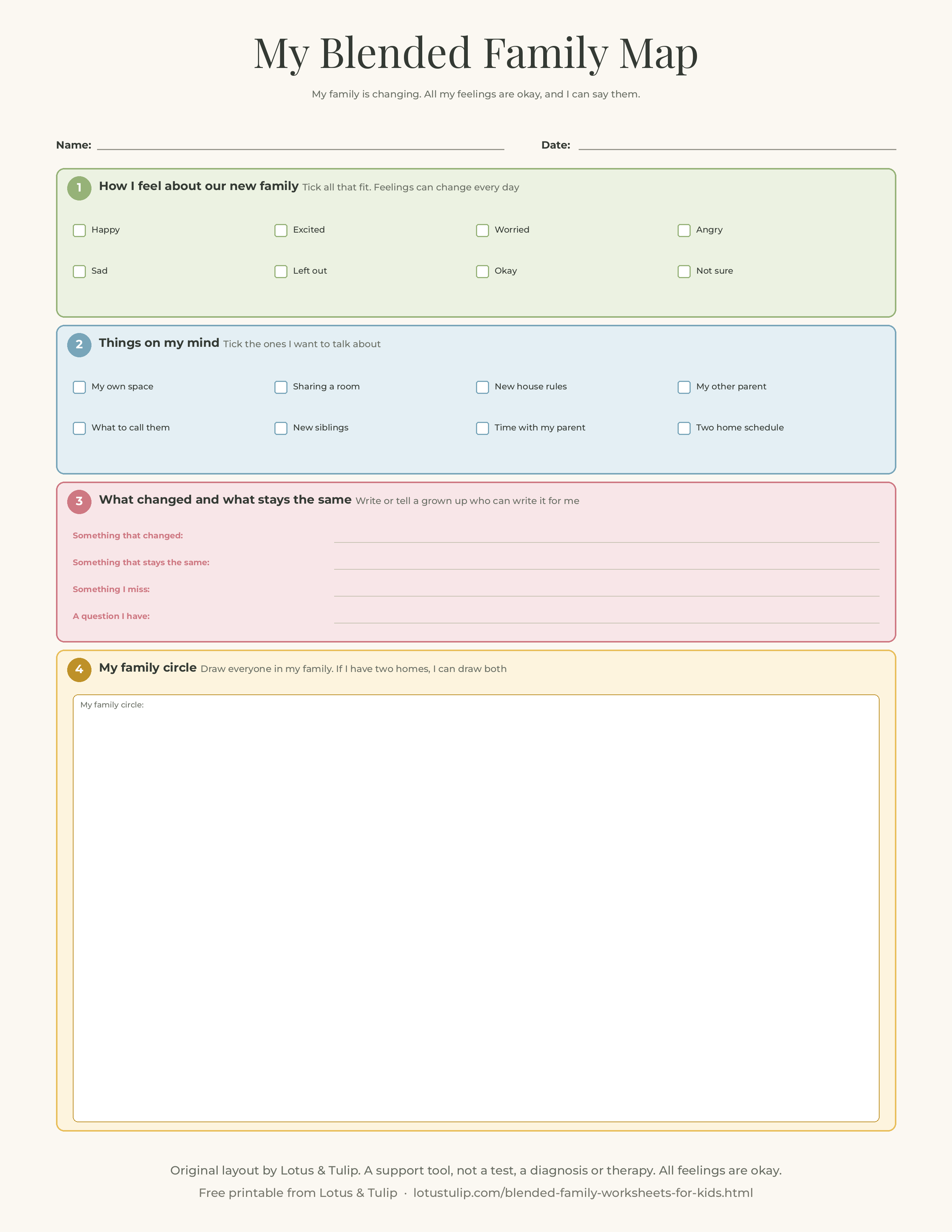
- Feelings check in: a list to tick or color, including happy, excited, worried, angry and left out, so every feeling is allowed, including mixed ones.
- Things on my mind: a checklist of common worries such as my own space, sharing a room, new house rules, my other parent, what to call the stepparent and the schedule between two homes.
- Changed and stayed the same: short sentence starters about what changed, what stays the same, what the child misses and a question they have.
- My family circle: a drawing of everyone in the child's family, in one home or two, with no "right" answer about who belongs.
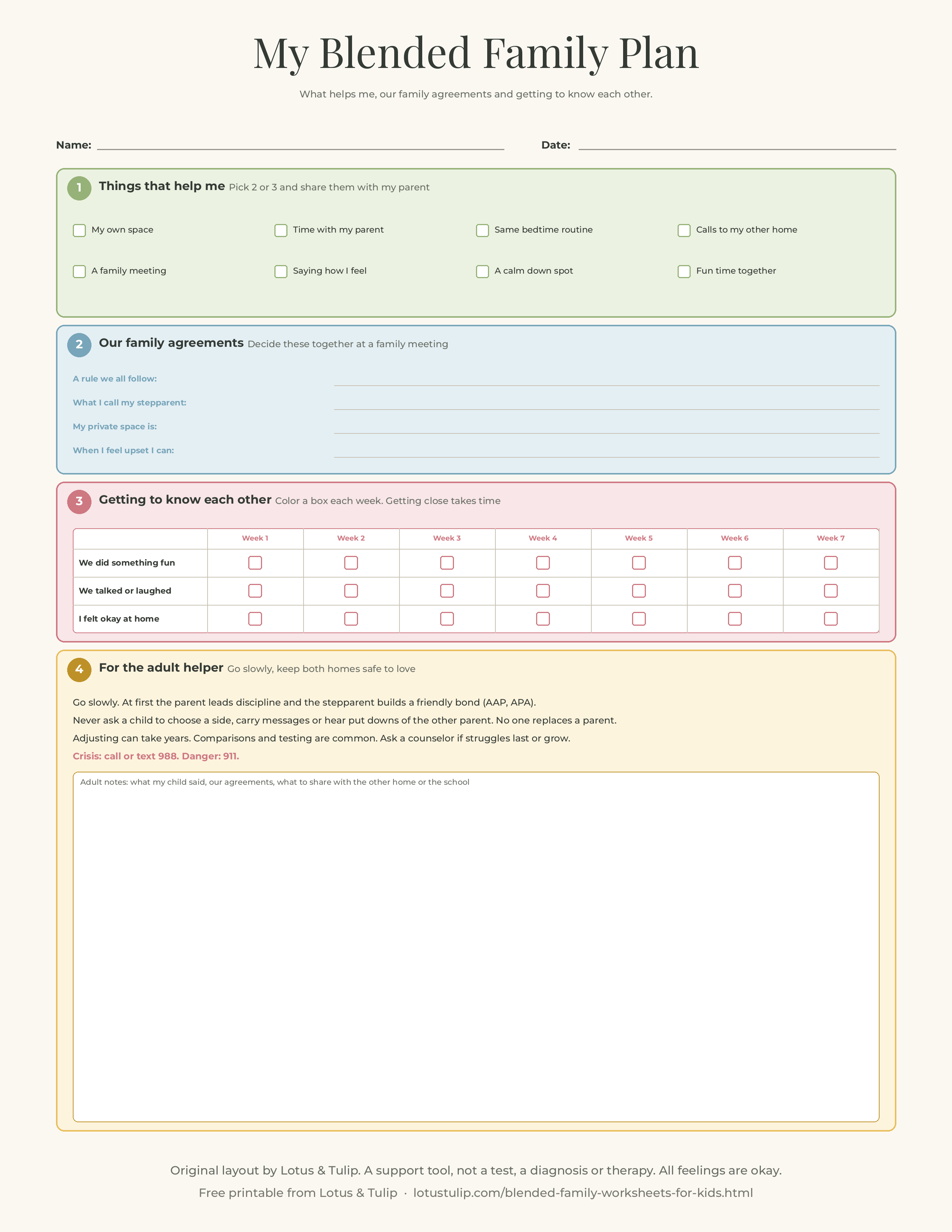
- Things that help me: choosing two or three supports, such as time alone with a parent, a calm down spot or calls to the other home.
- Family agreements: a few shared house rules, what the child calls the stepparent and the child's private space, decided together at a family meeting.
- Getting to know each other: a simple weekly tracker for doing something fun, talking or laughing and feeling okay at home, with no pressure to be close fast.
- Family meeting: a short, regular meeting where everyone, including children, can raise a problem and suggest a fix, as HealthyChildren.org recommends.
How to help a child adjust to a blended family, step by step
- Get the adults on the same page first. The APA advises couples to discuss the role the stepparent will play and any changes in household rules before the families join. Agree on the basics privately, not in front of the children.
- Tell the child honestly and simply. Explain what will change, such as who will live where and when, and what will stay the same. Give time for questions, and answer them again later.
- Make room for every feeling. Use page 1 of the printable to name mixed feelings. Happy and sad, or excited and angry, can be true at the same time. HealthyChildren.org says comparisons such as "You're not as nice as my dad" are normal during the adjustment period.
- Protect the bond with each parent. Keep one on one time between the child and their parent, and support time with the other parent where that is safe. Research links warm parent and child relationships with fewer problems in stepchildren.
- Let the stepparent start as a friend. The APA suggests stepparents first act more like a friend or "camp counselor" than a disciplinarian, and HealthyChildren.org suggests finding shared interests and inviting the child to join. Let the child choose what to call the stepparent.
- Keep the parent in charge of discipline at first. HealthyChildren.org advises that, particularly in the first months, the parent stays the main disciplinarian while the stepparent supports, moving gradually toward shared authority. Avoid sweeping "from now on" announcements.
- Set a few family agreements together. Hold a family meeting and use page 2 to write down a rule everyone follows, the child's private space and what they can do when upset. The APA suggests simple shared rules such as respecting each family member.
- Keep children out of the middle. Never ask a child to carry messages, keep secrets from the other home or listen to put downs of their other parent. The APA warns that criticizing the other parent can undermine a child's self esteem.
- Be patient and check in over months, not days. Use the getting to know each other tracker every week. Expect ups and downs; the APA notes adjustment can take two to four years. If problems last or grow, see a counselor together.
Discipline, stepsiblings and two homes
Discipline. HealthyChildren.org suggests the parent can hand over authority in clear words, such as "While you're with him, you need to mind what he says, or answer to me." If the adults disagree, settle it privately. A child who sees the adults split may start to challenge the stepparent's authority.
Stepsiblings and half siblings. Give each child their own space and belongings where possible, even in a shared room. Do not expect instant friendship, and plan some time for each set of children with their own parent. For everyday squabbles, see our sibling rivalry worksheets for kids; for a new baby in the blended family, see new baby and big sibling worksheets for kids.
Two homes. A visual calendar of the schedule, a bag that travels between homes and a way to call the other parent help children feel secure. HealthyChildren.org suggests that the parent and stepparent of the same role make friendly contact when possible, so the child sees the adults working together. If the separation itself is still raw, start with our divorce worksheets for kids.
How to adapt it by age and need
- Ages 3 to 5: keep words short and concrete, use picture books about families and focus on routines that stay the same. Let the child color and point; an adult can write for them. Younger children are often more accepting of a new adult, according to the APA.
- Ages 6 to 8: children may ask direct questions about fairness and rules. Let them tick their worries, dictate questions and draw the family circle in their own way.
- Ages 9 to 12: loyalty worries and privacy matter more. Let them fill in both pages alone if they prefer and choose which parts to share. The APA notes that children this age and young teens may have the hardest time adjusting.
- Teens: respect privacy and growing independence, and do not expect a close bond with a stepparent quickly. The APA notes that both boys and girls in stepfamilies say they prefer verbal affection, such as praise, to physical affection from a stepparent. See our divorce activities for teens.
- Autism and literal thinkers: a picture schedule of who lives where and when, photos of the new home and clear "first, then" language can help. Introduce changes one at a time where possible.
- ADHD and children who find transitions hard: use checklists for moving between homes and short, active family activities.
- A child who has lost a parent: a stepfamily after a parent's death brings grief as well as change. Keep the parent's memory welcome at home, and see our grief activities for kids.
When a student's family is blending: notes for teachers and school counselors
- Use inclusive language. Say "your grown ups" or "your family" in notes home and class activities, and allow family tree projects to include more than one home.
- Check who to contact. Keep records current on who has legal authority and which adults may pick up the child or receive information, and follow your district's policy.
- Send information to both homes where appropriate, so the child does not have to carry messages.
- Use the printable in a counselor check in. With a caregiver's permission, the pages can help a student sort out feelings about a new stepfamily. A small group on changing families can help students see they are not alone.
- Know when to refer and report. Refer to the school psychologist, social worker or outside care if a student is struggling over time or talks about suicide. If a student describes being hurt or not cared for, follow your school's procedure and your state's mandated reporting law.
Common mistakes
- Rushing the bond. Expecting a child to love a stepparent, or to call them "Mom" or "Dad," on day one often backfires. Friendship first, closeness later.
- A stepparent taking over discipline too soon. Family guidance consistently advises the parent to lead discipline at first.
- Losing one on one time with the child's parent. Children may read less time as less love.
- Putting the child in the middle. Messages, secrets and criticism of the other parent increase loyalty conflicts.
- Taking rejection personally. HealthyChildren.org notes that testing and distance are often the child's way of handling their own feelings about a new adult, and usually ease with time and fairness.
- Expecting it to settle in weeks. Adjustment usually takes years, not months. Patience is part of the plan.
Examples
- Lily, 5: was moving into her mom's partner's house, with his son. She colored "Worried" and "Excited" on page 1 and drew both her houses in the family circle. Her mom kept their Saturday pancake morning, just the two of them, and Lily chose a shelf of toys that was only hers.
- Marcus, 8: was angry that his stepdad made new rules about screen time. At a family meeting the adults agreed his mom would set screen rules for now. Marcus wrote "Mom says the screen rules" in the family agreements box and chose "Coach" as his name for his stepdad, who started shooting hoops with him on Sundays.
- Sofia, 11: worried that liking her stepmom was unfair to her own mom. With her school counselor she filled in page 1 privately, then shared the "Something I miss" line with her dad. Her dad told her she could love everyone without choosing, and her mom said the same on the phone.
Free printable: blended family worksheets for kids
This printable is an original Lotus & Tulip layout. It is not an assessment, gives no score and does not replace professional advice. Page 1, My Blended Family Map, has a feelings checklist, things on my mind, what changed and what stays the same, and a box to draw my family circle. Page 2, My Blended Family Plan, has things that help me, our family agreements, a getting to know each other weekly tracker and notes for the adult helper, including going slowly with discipline, keeping the child out of the middle, how long adjustment can take, 988 and 911.
Download the free blended family worksheets for kids (PDF, 2 pages, US Letter)
Prefer single images? Page 1: My Blended Family Map (PNG) · Page 2: My Blended Family Plan (PNG)
Related resources
- Divorce worksheets for kids: when the separation itself is the main change
- Sibling rivalry worksheets for kids: for squabbles between siblings and stepsiblings
- New baby and big sibling worksheets for kids: when a half sibling is on the way
- Moving worksheets for kids: when blending a family means a new home
- Divorce activities for teens: for older children in changing families
- Adoption and foster care worksheets for kids: when a child joins a family through foster care, kinship care or adoption, with a free life story map
- All counseling resources for kids and teens
FAQ
How long does it take a child to adjust to a blended family?
Often longer than adults expect. The American Psychological Association says that even under the best conditions a new stepfamily may take two to four years to adjust to living together. Ups and downs along the way are normal.
Should a stepparent discipline a stepchild?
Not at first, according to HealthyChildren.org and the APA. The parent stays the main disciplinarian in the early months while the stepparent builds a friendly relationship and supports the house rules. Authority can be shared gradually as trust grows.
What should my child call their stepparent?
Let the child choose, within respectful options such as a first name or a nickname. Pushing "Mom" or "Dad" can feel like a betrayal of the other parent. HealthyChildren.org suggests letting children view the stepparent in whatever way is most comfortable at first.
My child says "You're not my real mom." What do I say?
Stay calm and agree with the true part: "You're right, I'm not your mom, and I'm not trying to replace her. I care about you and I'm here." HealthyChildren.org notes that criticism and comparisons are common early on and usually ease when a stepparent is fair and patient.
When should a blended family see a counselor?
If a child's sadness, anger, withdrawal or school problems last or grow, if conflict between the adults or with the other home keeps escalating, or if the couple cannot agree on parenting. A counselor or family therapist who works with stepfamilies can help, and a parenting program improved parenting and reduced child behavior problems in a stepfamily trial.
What age are these blended family worksheets for?
They are designed for children about 3 to 12. Younger children can color, point and talk through the pages with an adult who writes for them, while children 8 to 12 can fill in most of the map and plan themselves. Parents, stepparents, teachers, school counselors and therapists can all use them.
Sources
- American Psychological Association. Making stepfamilies work (with James Bray, PhD).
- Bullard, L., Wachlarowicz, M., DeLeeuw, J., Snyder, J., Low, S., Forgatch, M., and DeGarmo, D. (2010). Effects of the Oregon model of Parent Management Training (PMTO) on marital adjustment in new stepfamilies: a randomized trial. Journal of Family Psychology, 24(4), 485 to 496.
- Forgatch, M. S., DeGarmo, D. S., and Beldavs, Z. G. (2005). An efficacious theory based intervention for stepfamilies. Behavior Therapy, 36(4), 357 to 365.
- Ganong, L., Jensen, T., Sanner, C., Russell, L., and Coleman, M. (2019). Stepfathers' affinity seeking with stepchildren, stepfather and stepchild relationship quality, marital quality, and stepfamily cohesion among stepfathers and mothers. Journal of Family Psychology, 33(5), 521 to 531.
- Ganong, L., Jensen, T., Sanner, C., Chapman, A., and Coleman, M. (2020). Stepparents' attachment orientation, parental gatekeeping, and stepparents' affinity seeking with stepchildren. Family Process, 59(2), 756 to 771.
- HealthyChildren.org (American Academy of Pediatrics). I am getting remarried. What is the best way to blend our families?
- HealthyChildren.org (American Academy of Pediatrics). Stepsiblings.
- HealthyChildren.org (American Academy of Pediatrics). What your child is experiencing when you remarry.
- Jensen, T. M. (2022). Stepparent and child relationships and child outcomes: a systematic review and meta-analysis. Journal of Family Nursing, 28(4), 321 to 340.
- Jensen, T. M., and Harris, K. M. (2017). Stepfamily relationship quality and stepchildren's depression in adolescence and adulthood. Emerging Adulthood, 5(3), 191 to 203.
- Jensen, T. M., and Lippold, M. A. (2018). Patterns of stepfamily relationship quality and adolescents' short term and long term adjustment. Journal of Family Psychology, 32(8), 1130 to 1141.
- Jensen, T. M., Lippold, M. A., Mills-Koonce, R., and Fosco, G. M. (2018). Stepfamily relationship quality and children's internalizing and externalizing problems. Family Process, 57(2), 477 to 495.
- Pew Research Center (2011). A portrait of stepfamilies.
- Pew Research Center (2015). Parenting in America, chapter 1: The American family today.
Lotus & Tulip is not affiliated with the American Academy of Pediatrics, the American Psychological Association, the Pew Research Center, the researchers or organizations named on this page. Names in the examples are invented. This page is educational and does not replace professional medical, mental health or legal advice.