
Kids and teens · Trauma informed support for children ages 5 to 12 · Updated 2026-11-14
Trauma worksheets for kids: how trauma shows up in children, what research shows and a free calm and safe plan

Ages 5 to 11: Kids Feelings and Social Skills Worksheets, incl. feelings detective, body clues, a feelings thermometer, a coping skills menu and a calm down plan Holiday 20% off: about $11.04, was $14 (EUR 12) · fillable PDF, instant digital download
Buy on EtsyTry it free first: download a fillable sample (feelings thermometer and calm-down plan, PDF, 240 KB). Type into it on screen, then get the full pack. No email needed.
For clinicians: Trauma Worksheets for Therapists, stabilization, grounding and safety pages Holiday 20% off: about $9.20, was $12 (EUR 10) · fillable PDF, instant digital download
Buy on EtsyTry it free first: download a fillable sample (window of tolerance and grounding toolkit, PDF, 189 KB). Type into it on screen, then get the full pack. No email needed.
Kids and teens bundle: Kids and Teens Worksheets Bundle (feelings, anger, self esteem, social anxiety) Holiday 20% off: about $22.08, was $28 (EUR 24) · 80 pages, instant digital download
Buy on EtsyAfter something frightening happens, such as a car crash, a house fire, a medical emergency, violence at home or in the community, abuse, a sudden death or a natural disaster, children often react in ways that confuse the adults around them. A calm child may start having nightmares, a confident child may become clingy, a gentle child may hit, and a child who seemed fine may suddenly fall apart weeks later when something reminds them. These reactions make sense. A child's alarm system is doing its job a little too well.
This guide is for parents, foster and adoptive carers, teachers, school counselors and child therapists supporting children about 5 to 12. It explains what trauma means for a child, common reactions by age, what research shows about recovery and treatment (including its limits), what trauma worksheets for kids can and cannot do, eight kinds of worksheets, nine steps to use them safely, how to adapt them by age, the school side, common mistakes and three short examples. It ends with a free 2 page printable: My Calm and Safe Plan and When Something Reminds Me.
These pages support a trained clinician, they do not replace one. Worksheets for kids after trauma are for safety, calming and connection. They are not a way to get a child to tell the story of what happened. Processing a traumatic memory belongs with a licensed therapist trained in a trauma treatment for children.
Safety first: if a child is in immediate danger, call 911. If you are worried that a child is being abused or neglected, the Childhelp National Child Abuse Hotline (call or text 1-800-422-4453, 24/7) can talk it through and explain how to report to your state's child protective services; it is not itself a reporting line or an emergency service. If a child talks about wanting to die or hurting themselves, call or text 988 (the 988 Suicide and Crisis Lifeline).
Download the free trauma worksheets for kids (PDF, 2 pages, US Letter)
Direct download, no email or sign up. See the pages first. Clinicians working with adults: trauma worksheets for adults and trauma worksheets for therapists.
What trauma means for a child
Clinicians separate the event from the reaction. A potentially traumatic event is something frightening or dangerous that happens to a child or that they witness, such as violence, abuse, a serious accident or injury, a disaster or the sudden loss of someone close. The CDC uses a related term, adverse childhood experiences (ACEs): potentially traumatic events in childhood such as experiencing or witnessing violence, abuse or neglect, or a family member attempting or dying by suicide, plus things that undermine a child's sense of safety and stability, such as a household with substance use or mental health problems, parental separation or a family member in jail or prison.
Whether an event becomes a lasting problem depends on many things: what happened, how often, the child's age and temperament, what came before, and above all how safe, calm and supported the child feels afterward. Many children who live through a frightening event recover with time and steady support from the adults around them. Some develop posttraumatic stress symptoms that need professional care.
Common reactions after trauma, by age
- All ages: fear and worry, startling easily, trouble sleeping, nightmares, avoiding people, places or topics that remind them, irritability, trouble concentrating, stomachaches and headaches, and big reactions to small things.
- Ages 5 to 7: clinging, separation fears, going back to younger behavior such as bedwetting or baby talk, tantrums, and repetitive play that acts out parts of what happened. DSM-5 has separate PTSD criteria for children 6 and younger because young children often show distress through play and behavior rather than words.
- Ages 8 to 10: worries about safety and about it happening again, guilt ("it was my fault"), school problems, telling the story over and over or refusing to talk about it at all, body complaints and anger.
- Ages 11 to 12: withdrawing from family, mood swings, risk taking, shame, feeling different from friends, and harsh beliefs about themselves or the world ("nowhere is safe," "I'm broken").
- Get help the same day if a child talks about wanting to die or hurting themselves, is being harmed now or seems unable to function at all.
Some of these signs overlap with anxiety, depression, ADHD, grief and sleep problems, and children can have several at once. Only a qualified professional can assess what is going on. The lists above are for noticing, not labeling.
What the research shows, honestly
- Frightening events are common, and most children do not develop PTSD. In the Great Smoky Mountains Study (Copeland, Keeler, Angold and Costello, 2007), 1,420 children in North Carolina were followed every year from ages 9, 11 or 13 up to 16. More than two thirds reported at least one traumatic event by 16, and 13.4% of those children developed some posttraumatic stress symptoms. Fewer than 0.5% met full DSM-IV criteria for PTSD. Symptoms were more likely after violent or sexual trauma, multiple traumas, earlier anxiety or family adversity, and the outlook after a first event was generally favorable.
- A significant minority do develop PTSD. A meta-analysis of 43 samples with 3,563 trauma exposed children and adolescents (Alisic and colleagues, 2014, British Journal of Psychiatry) found an overall PTSD rate of 15.9%. The rate was 9.7% after non-interpersonal trauma such as accidents and 25.2% after interpersonal trauma such as violence or abuse, and higher in girls (20.8%) than boys (11.1%).
- Adversity is widespread among US youth. According to the CDC, based on the 2023 Youth Risk Behavior Survey, three in four US high school students reported at least one ACE and one in five reported four or more. Those numbers describe teenagers, not younger children, but they show why trauma informed habits help every classroom.
- Trauma focused CBT has strong trial evidence. TF-CBT, developed by Judith Cohen, Anthony Mannarino and Esther Deblinger, is a short term treatment for children and teens aged 3 to 18 and their caregivers. In a randomized trial with 229 children aged 8 to 14 with PTSD symptoms after sexual abuse (Cohen, Deblinger, Mannarino and Steer, 2004), children in TF-CBT improved significantly more than those in child centered therapy on PTSD, depression, behavior problems, shame and abuse related attributions, and their parents improved more too.
- Younger children benefit, and caregivers matter. In a trial with 210 children aged 4 to 11 (Deblinger and colleagues, 2011), all four versions of TF-CBT (8 or 16 sessions, with or without a trauma narrative) improved symptoms, parenting skills and children's personal safety skills. The 8 session version with a narrative worked best for children's abuse related fear and anxiety, while the 16 session version without a narrative led to the biggest gains in parenting practices and fewer behavior problems. The narrative work was done by trained therapists, step by step, after skills were in place.
- Safety, calm and connection come first. A review of mass trauma research by Hobfoll and colleagues (2007) named five essential elements of early support: a sense of safety, calming, a sense of self and community efficacy, connectedness and hope. These are exactly what home and school can offer, and they shape the free printable below.
The practical message: worksheets do not treat trauma. They give children words for body feelings, practice with calming skills, a list of safe people and a plan for reminders, which are the early skills that therapies such as TF-CBT also build. If symptoms last, are severe or keep a child from school, sleep, friends or play, a trained child trauma therapist is the right next step.
What trauma worksheets for kids can and cannot do
- Can: teach that the body has an alarm, name feelings and body clues, practice calming tools, list safe people and places, plan for reminders, track sleep and build a sense of strength and hope.
- Cannot: diagnose PTSD, replace a forensic interview after suspected abuse, or safely walk a child through the details of a traumatic memory outside therapy. Asking a child to write or draw "what happened" on a worksheet at home or in class can overwhelm them and, where abuse is suspected, can complicate an investigation. Let the child lead, listen if they tell you, and leave the story work to a clinician.
8 kinds of trauma worksheets for kids
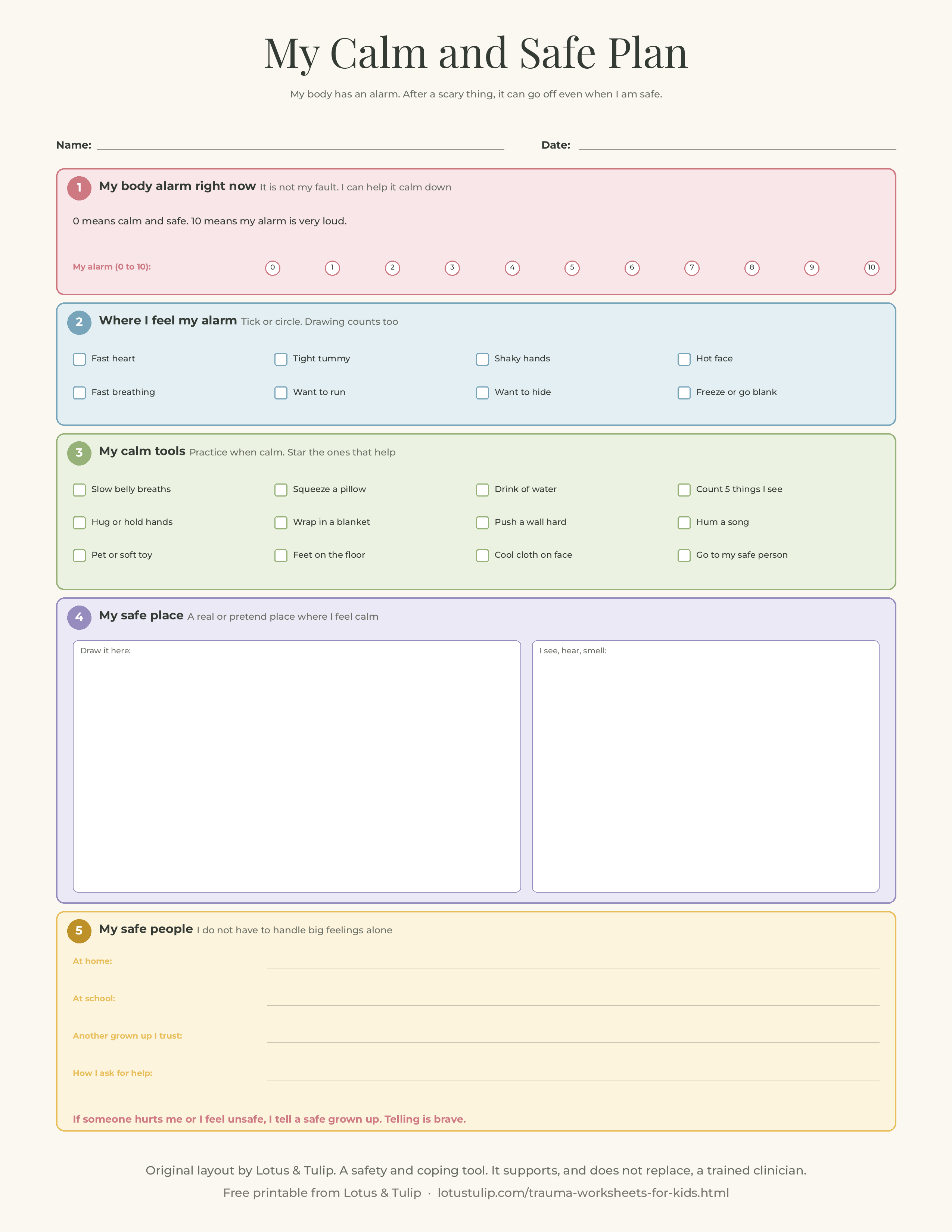
- My body alarm. Explains in kid words that the brain has an alarm that keeps us safe, and that after a scary thing it can go off even when we are safe now. A 0 to 10 alarm meter helps the child rate it.
- Body clues. A tick list of how the alarm feels: fast heart, tight tummy, shaky hands, hot face, wanting to run or hide. Our interoception activities for kids go deeper.
- Calm and safe toolkit. A menu of calming tools to try and rate, such as slow breathing, squeezing a pillow, a drink of water or counting things they can see. See our breathing exercises for kids and 5, 4, 3, 2, 1 grounding worksheet.
- My safe place. A real or imagined place where the child feels calm, drawn and described with the senses, used as a calming picture.
- Safe people and places. Who the child can go to at home, at school and somewhere else, and what to say or do to get help.
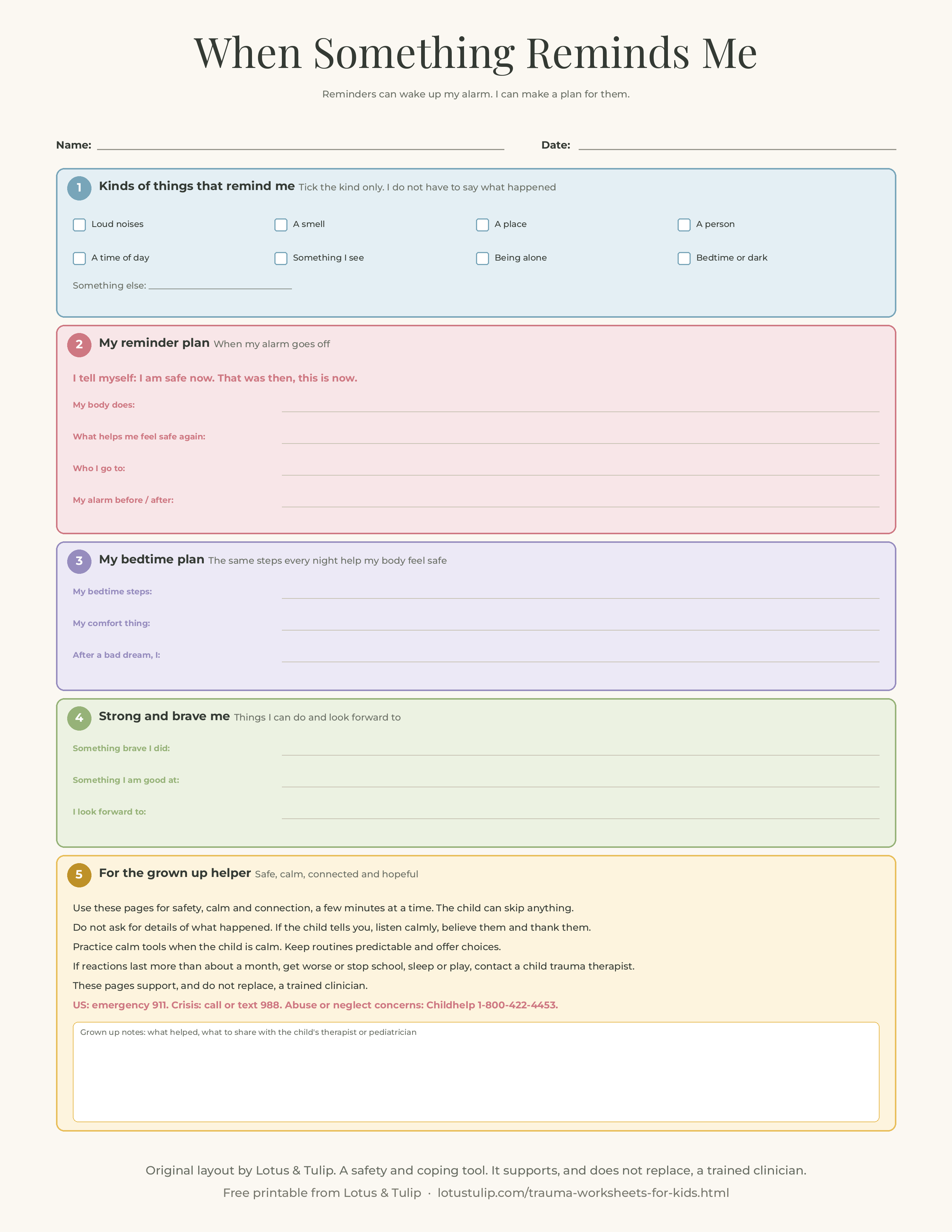
- When something reminds me. A gentle plan for reminders (triggers): what kinds of things bring the alarm back, what my body does, what helps and who helps. It names types of reminders, such as loud noises or a smell, without asking for details of the event.
- Sleep and bedtime plan. A predictable routine, a nightlight or comfort object and a plan for nightmares, since sleep problems are one of the most common reactions.
- Strong and hopeful me. Strengths, things the child is looking forward to and ways they have been brave. Hope is one of the five essential elements, and our resilience activities for kids build it further.
How to use trauma worksheets for kids, step by step
- Make sure the child is safe now. Worksheets come after safety. If a child may still be at risk, act on that first: call 911 in an emergency, and follow your state's reporting process or call Childhelp at 1-800-422-4453 for guidance if abuse or neglect is suspected.
- Choose a calm, predictable time. Sit beside the child, keep it short (10 to 15 minutes), and say that they can stop or skip anything. Choice gives back a sense of control.
- Explain the body alarm. "Your brain has an alarm that keeps you safe. After something scary, it can go off even when you are safe. That is not your fault, and we can help it calm down." Then rate the alarm from 0 to 10 on My Calm and Safe Plan.
- Find the body clues. Tick where the child feels the alarm in their body. Drawing counts as an answer.
- Try calm tools and rate them. Practice two or three tools together when the child is already calm, then rate which helped. Skills learned when calm are easier to use when upset.
- Draw a safe place and list safe people. Fill in helpers at home, at school and one more trusted adult. Agree on a simple signal or words the child can use to ask for help.
- Plan for reminders, without the story. On When Something Reminds Me, tick the kinds of reminders that set off the alarm and what helps afterward. If the child starts to tell you about the event, listen calmly, thank them for telling you and do not push for more details.
- Add sleep and strength. Fill in the bedtime plan and one brave or strong thing the child did this week. Notice effort out loud.
- Review weekly and get help when needed. Look at alarm ratings and which tools helped. If reactions last more than about a month, are getting worse, or stop school, sleep, friends or play, contact the pediatrician, school counselor or a licensed child trauma therapist and bring the sheets with you. In a crisis, call or text 988, or call 911 in an emergency.
How to adapt it by age
- Ages 5 to 7: Use drawing, stuffed animals and play ("Bunny's alarm is going off, what helps Bunny?"). The adult does the writing. One calm tool, one safe person and a bedtime routine are plenty. Repetitive play about the event is common; stay calm and gently add safety and comfort to the play, and mention it to the child's clinician.
- Ages 8 to 10: Most children can fill in both pages with support. The 0 to 10 alarm meter and rating calm tools work well. Watch for self blame and correct it clearly: "It was not your fault."
- Ages 11 to 12: Explain the brain alarm in more detail and let the child lead the plan. Respect privacy, and agree in advance what you will need to share with other adults, such as any safety concern. Our coping skills worksheets for teens may fit mature 12 year olds.
- After a death or family change: Grief and trauma can overlap, especially after a sudden or violent death. See our grief activities for kids and divorce worksheets for kids.
Using these worksheets in school
School counselors can use My Calm and Safe Plan as a brief individual check in and share the calm tools and safe people with the child's teachers, so the plan works in class too. Trauma informed classroom habits help every child: predictable routines, warnings before changes, a calm corner, choices instead of power struggles, and responding to big reactions with "What happened to you?" curiosity rather than only consequences. School staff are mandated reporters of suspected child abuse and neglect under state law, so follow your district's reporting policy, and never use a worksheet to investigate. In groups, keep the focus on body alarms and coping skills and never ask children to share what happened to them.
Common mistakes
- Asking for the story. "Draw what happened" is not a safe home or classroom activity. Trauma narrative work belongs in therapy, after skills are in place.
- Waiting for words. Younger children show trauma in play, sleep, behavior and their bodies. Watch for changes.
- Treating every reaction as defiance. Hitting, running or freezing may be the alarm firing. Calm first, then teach and set limits.
- Forcing calm skills in the middle of a meltdown. Practice tools when the child is calm so they are ready when needed.
- Assuming the child is fine because they seem fine. Reactions can show up weeks later, often around reminders or anniversaries.
- Using a worksheet instead of help. If reactions last, worsen or stop daily life, a worksheet supports professional care. It does not replace it.
Examples
- A 6 year old after a car crash: A first grader was not hurt in a minor crash but began screaming when buckled into the car seat and woke from nightmares. Her dad explained the body alarm with her teddy bear, they practiced "balloon breaths" each night, and they made a car plan: favorite song on, holding the bear, Dad saying "We are safe now." The nightmares eased over a few weeks. Her pediatrician agreed to check in again if they returned.
- A 9 year old in foster care: A fourth grader often ran out of class when adults raised their voices. With the school counselor, he ticked "fast heart" and "want to run" as his alarm clues, chose the calm corner and a squeeze ball as his tools, and named two safe adults at school. His teacher agreed on a hand signal for "I need a break." His trauma therapist used the same alarm language in sessions.
- An 11 year old after a house fire: A sixth grader whose family lost their home could not sleep and panicked at the smell of smoke. Her mom used When Something Reminds Me to note "smells" and "sirens" as reminders, with "go to Mom, hold my blanket, slow breaths" as what helps. Because the panic was still strong after a month, the family started TF-CBT with a trained therapist.
Free printable: trauma worksheets for kids
This printable is an original Lotus & Tulip layout. It is not a screening questionnaire or a diagnostic tool, it gives no score, and it never asks a child to describe what happened. Page 1, My Calm and Safe Plan, explains the body alarm in kid words, includes a 0 to 10 alarm meter, body clues to tick, a calm tools menu with a "this helped" rating, a box to draw a safe place and a safe people list with a "how I ask for help" line. Page 2, When Something Reminds Me, helps the child plan for reminders: kinds of reminders to tick (without details), what my body does, what helps me feel safe again, who I go to, a bedtime plan, strong and brave things about me, and notes for the grown up helper with when to get help and US crisis lines.
Download the free trauma worksheets for kids (PDF, 2 pages, US Letter)
Prefer single images? Page 1: My Calm and Safe Plan (PNG) · Page 2: When Something Reminds Me (PNG)
Free to print for your own child, students, clients or groups. Please link to this page rather than re-uploading the file. A safety and coping tool that supports, and does not replace, a trained clinician. In immediate danger, call 911. In a mental health crisis, call or text 988. Concerned about abuse or neglect: Childhelp, 1-800-422-4453.
Buy the kids feelings worksheets on Etsy
Related resources
- Pet loss worksheets for kids: when a pet's death was sudden or upsetting, with a free remembering plan
- Trauma worksheets: grounding, window of tolerance and triggers for adults
- Window of tolerance worksheet: the regulation model explained
- Anxiety worksheets for kids: worry, body clues and brave steps
- Depression worksheets for kids: feelings weather check and little lifts plan
- Resilience activities for kids: a bounce back plan and resilience builder
- Grief activities for kids: helping children cope with loss
- Emotional regulation worksheets for kids: name it and calm it
- Adoption and foster care worksheets for kids: for children in foster care or adoption, with a free life story map and belonging plan
- All counseling resources for kids and teens
FAQ
What are trauma worksheets for kids?
They are printable pages that help children after a frightening event understand their body alarm, name feelings and body clues, practice calming tools, list safe people and plan for reminders. Good trauma worksheets for kids focus on safety, calm and connection and do not ask children to describe what happened. They support, and do not replace, a trained clinician.
What are signs of trauma in a child?
Common signs include nightmares and sleep problems, startling easily, clinging or separation fears, going back to younger behavior, avoiding reminders, irritability or anger, trouble concentrating, stomachaches and headaches, and in younger children repetitive play about the event. Signs can appear right away or weeks later. Only a qualified professional can assess whether a child has PTSD.
Do most children develop PTSD after a traumatic event?
No. In a large US study, more than two thirds of children reported at least one traumatic event by age 16, but fewer than 0.5% met full criteria for PTSD. A meta-analysis found that about 16% of trauma exposed children and adolescents developed PTSD, with higher rates after interpersonal trauma such as violence or abuse. Steady, supportive adults make a real difference.
Should I ask my child to talk or draw about what happened?
Let the child lead. If they want to tell you, listen calmly, believe them and thank them for telling you, without pushing for details. Do not use worksheets to get the story. Talking through a traumatic memory in a structured way is part of treatments such as TF-CBT and is best done with a trained therapist. If abuse is suspected, leave questioning to professionals.
What therapy works for trauma in children?
Trauma focused cognitive behavioral therapy (TF-CBT) has the strongest trial evidence for children and teens aged 3 to 18 with posttraumatic stress symptoms. It involves caregivers and builds skills such as relaxation, feelings and coping before carefully processing the trauma. Randomized trials have found it more effective than child centered therapy for PTSD, depression and behavior problems.
Can teachers use trauma worksheets in class?
Yes, for whole class skills such as understanding the body alarm, calm tools and safe people. Never ask students to share what happened to them in class or in groups. Teachers and school staff are mandated reporters, so any concern about abuse or neglect should follow the district reporting policy. Individual trauma work belongs with the school counselor or a therapist.
When should a child see a professional after trauma?
Contact a pediatrician, school counselor or licensed child trauma therapist if reactions last more than about a month, are getting worse, or stop school, sleep, friends or play, or right away if the child talks about self harm or may still be unsafe. In the US, call 911 in an emergency, call or text 988 in a mental health crisis, and call or text Childhelp at 1-800-422-4453 with concerns about abuse or neglect.
Sources
- Alisic, E., Zalta, A. K., van Wesel, F., Larsen, S. E., Hafstad, G. S., Hassanpour, K., and Smid, G. E. (2014). Rates of post-traumatic stress disorder in trauma-exposed children and adolescents: meta-analysis. British Journal of Psychiatry, 204(5), 335 to 340.
- American Psychiatric Association (2013). Diagnostic and Statistical Manual of Mental Disorders, fifth edition (DSM-5), posttraumatic stress disorder, including criteria for children 6 years and younger.
- Centers for Disease Control and Prevention (2026). About adverse childhood experiences, citing Swedo et al., Youth Risk Behavior Survey, United States, 2023. cdc.gov.
- Childhelp National Child Abuse Hotline. How it works. childhelphotline.org.
- Cohen, J. A., Deblinger, E., Mannarino, A. P., and Steer, R. A. (2004). A multisite, randomized controlled trial for children with sexual abuse-related PTSD symptoms. Journal of the American Academy of Child and Adolescent Psychiatry, 43(4), 393 to 402.
- Copeland, W. E., Keeler, G., Angold, A., and Costello, E. J. (2007). Traumatic events and posttraumatic stress in childhood. Archives of General Psychiatry, 64(5), 577 to 584.
- Deblinger, E., Mannarino, A. P., Cohen, J. A., Runyon, M. K., and Steer, R. A. (2011). Trauma-focused cognitive behavioral therapy for children: impact of the trauma narrative and treatment length. Depression and Anxiety, 28(1), 67 to 75.
- Hobfoll, S. E., Watson, P., Bell, C. C., and colleagues (2007). Five essential elements of immediate and mid-term mass trauma intervention: empirical evidence. Psychiatry, 70(4), 283 to 315.
- National Child Traumatic Stress Network. Trauma-Focused Cognitive Behavioral Therapy (TF-CBT) fact sheet. nctsn.org.
Lotus & Tulip is not affiliated with the researchers, agencies or organizations named on this page. This page is educational and does not replace professional advice, diagnosis or treatment.