
Kids and teens · Bedwetting support for kids 5 to 12 · Updated 2026-11-15
Bedwetting worksheets for kids: how to support a child who wets the bed, what research shows and a free dry night plan

Ages 5 to 11: Kids Feelings and Social Skills Worksheets, incl. feelings detective, body clues, a feelings thermometer, a coping skills menu and a calm down plan Holiday 20% off: about $11.04, was $14 (EUR 12) · fillable PDF, instant digital download
Buy on EtsyTry it free first: download a fillable sample (feelings thermometer and calm-down plan, PDF, 240 KB). Type into it on screen, then get the full pack. No email needed.
Bedtime routines and effort charts: Visual Schedule and Behavior Supports, 23 pages with token boards, a reward menu, first then boards and 136 picture cards Holiday 20% off: about $6.44, was $8 (EUR 7) · instant digital download
Buy on EtsyKids and teens bundle: Kids and Teens Worksheets Bundle (feelings, anger, self esteem, social anxiety) Holiday 20% off: about $22.08, was $28 (EUR 24) · 80 pages, instant digital download
Buy on EtsyIt is 2 a.m., the sheets are wet again, and your child is standing in the doorway, embarrassed and close to tears. Maybe a sleepover invitation is sitting on the fridge and your child has already said "I can't go." Bedwetting is one of the most common things families deal with and one of the least talked about. The American Academy of Pediatrics (AAP) estimates that about 5 million children in the United States wet the bed. It is almost never anyone's fault, and with patience most children grow out of it.
This guide is for parents, caregivers, school nurses, school counselors and therapists supporting children about 5 to 12 who wet the bed. It explains what bedwetting is and why it happens, when to see a doctor first, what research shows (honestly, including its limits), what bedwetting worksheets can and cannot do, eight kinds of supportive activities, nine steps to support your child, age and need adaptations, notes for schools and camps, common mistakes and three short examples. It ends with a free 2 page printable: My Body at Night Map and My Dry Night Plan.
See your child's doctor first: bedwetting is usually a normal part of development, but a health care professional should check your child before you start any program. See the pediatrician soon if your child was dry for 6 months or more and started wetting again; has pain or burning when peeing, cloudy, pink or bloody urine, a weak stream or dribbling, or is wet during the day too; is very thirsty, peeing much more than usual or losing weight; snores loudly or stops breathing in sleep; is constipated; has trouble walking or is always damp; or seems suddenly very different in mood. Get care within 24 hours for signs of a bladder or kidney infection or a fever without a clear cause. If you suspect a child is being hurt, contact your state's child protective services; for confidential support and guidance, call or text the Childhelp National Child Abuse Hotline at 1-800-422-4453. If a child or adult talks about wanting to die or hurting themselves, call or text 988 (the 988 Suicide and Crisis Lifeline). If anyone is in immediate danger, call 911.
Download the free bedwetting worksheets for kids (PDF, 2 pages, US Letter)
Direct download, no email or sign up. See the pages first.
What bedwetting is, and what it is not
Doctors call bedwetting nocturnal enuresis. According to the National Institute of Diabetes and Digestive and Kidney Diseases (NIDDK), children usually gain bladder control somewhere between ages 2 and 4, each in their own time, and by ages 5 or 6 most children are dry at night. There are two groups:
- Primary bedwetting: the child has never been regularly dry at night. This is by far the most common pattern and usually reflects slow development, not illness.
- Secondary bedwetting: wetting that starts again after at least 6 months of dry nights. This deserves a doctor's visit, because it can point to an infection, constipation, diabetes, a sleep problem or stress.
NIDDK lists the usual causes: a nervous system and bladder that are still maturing, deep sleep, a small bladder, a family history of bedwetting, and making too much urine at night because of low levels of a natural hormone (antidiuretic hormone, or ADH). Less often, health problems are involved, such as urinary tract infections, constipation, diabetes, obstructive sleep apnea or problems with the structure of the urinary tract. Children with ADHD are also more likely to wet the bed. Stress, such as a new baby, a move, a new school, a family crisis or abuse, can trigger wetting or make it worse.
What bedwetting is not: NIDDK is clear that loss of urine is almost never due to laziness, a strong will, emotional problems or poor toilet training, and that children almost never wet the bed on purpose. The AAP's first rule for families is "Do not blame your child."
What the research shows, honestly
Bedwetting research comes from many countries and decades, from community surveys, clinic samples and treatment trials of mixed quality. Here is what holds up, with its limits.
It is very common and gets less common every year. NIDDK estimates that about 1 in 6 children wet the bed at age 5, about 1 in 8 at age 6, 1 in 10 at age 7 and only 1 or 2 in 100 at age 15. In the large UK ALSPAC study, parents of 8,151 children answered questions at about 7 and a half years old: 15.5% of the children wet the bed at least sometimes, but most wet once a week or less, and only 2.6% wet at least twice a week. Boys were affected more often than girls.
Many children outgrow it without treatment. In a long term follow up of 1,129 children with bedwetting who were not treated with an alarm, about 14% a year stopped wetting on their own between ages 5 and 9, and about 16% a year between ages 10 and 19; 3% were still wetting after age 20 (Forsythe and Redmond, 1974). This is an old clinic sample, so treat the exact numbers as a rough guide; the message that each year brings more dry children has held up.
It runs in families. NIDDK puts a child's chances of wetting the bed at about 1 in 3 when one parent wet the bed as a child, and about 7 in 10 when both parents did. Researchers have found genes linked to bedwetting.
It can hurt self esteem, and that can improve. In a Swedish study, 66 children with bedwetting or daytime wetting had clearly lower self esteem than 64 children from the same town without wetting before treatment. After 6 months of treatment their self esteem was at the same level as the comparison group, and children who had become completely dry did best (Hägglöf and colleagues, 1997 and 1998). The study is small, but it supports treating wetting as worth addressing kindly rather than waiting in silence.
Punishment is common and harmful. In a Brazilian clinic study of 149 children and teens aged 6 to 18 with bedwetting, 89% had been punished for wet nights, all with verbal punishment and about half with physical punishment (Sapi and colleagues, 2009). One clinic in one country cannot tell us how common this is in the United States, but it shows why pediatric guidance repeats that wetting is not the child's fault. NIDDK states that taking back rewards, shaming, penalties and punishments do not work.
Treatments help, with honest limits.
- Bedwetting alarms: a 2020 Cochrane review pooled 74 trials with 5,983 children aged 5 to 16. Alarms may reduce wet nights and help more children reach 14 dry nights in a row than no treatment, and more children stayed dry after treatment ended, but the review rated much of the evidence as low quality. The AAP says alarms succeed 50% to 75% of the time, work best for deep sleepers who have some bladder control, and need regular use; NIDDK says families should expect 3 to 4 months.
- Simple behavior steps such as reward charts, waking and bladder training: a 2013 Cochrane review of 16 trials with 1,643 children found they may work better than no active treatment but less well than alarms, so they are a reasonable first step before an alarm or medicine.
- Medicine: desmopressin reduces wet nights while children take it, but wetting often returns when it stops. The AAP notes that medicines rarely cure bedwetting but can help for sleepovers and camp, for children 6 and older, with a doctor's guidance.
- Treating constipation: in a US study of 234 children treated for chronic constipation, nighttime wetting went away in 63% of those whose constipation was successfully relieved (Loening-Baucke, 1997). Constipation is easy to miss, which is one more reason to see a doctor first.
What this means for you. No study has tested worksheets like the ones on this page. The research does not support blame, punishment or "cures" sold online; the AAP warns that many products make false claims. What it does support is a medical check, patience, a calm routine, rewarding effort, and, when your child is ready and the doctor agrees, an alarm or medicine.
What bedwetting worksheets can and cannot do
Bedwetting worksheets help children understand what is happening in their bodies, name the feelings that come with wet nights, and take an active part in a plan they helped make. NIDDK suggests involving children age 4 and older in finding solutions, because it gives them a sense of control, and recommends tracking effort with something like a sticker calendar. A written plan also keeps every adult in the house using the same calm approach.
They cannot diagnose a cause, replace a medical exam, or make a child's body mature faster. If wetting continues after 3 to 6 months of a home routine, NIDDK advises talking with your child's health care professional about other treatments. If your child seems very ashamed, anxious or low, or the box above applies, bring the pages to the pediatrician, the school counselor or a child therapist.
8 kinds of bedwetting activities for kids
- Body at night explainer. A simple picture of how the bladder sends a "full" message to the brain, and how a sleepy brain can miss it. Children who understand their bodies feel less broken.
- Feelings check in. Embarrassed, worried, frustrated, sad, fine about it: a feelings checklist (page 1 of the free printable) lets children say how they feel without having to talk about wet sheets out loud.
- "Lots of kids" facts. Hearing that about 1 in 10 seven year olds wet the bed, and that it often runs in families, lifts a lot of shame. If a parent wet the bed as a child, saying so can be powerful.
- Questions for my doctor. Children write or tick their own questions before the appointment, so the visit feels like teamwork.
- Bedtime routine steps. Pee before bed, pee again just before lights out, dry pajamas and a towel laid out, a nightlight on the path to the bathroom.
- Effort tracker. A weekly chart that rewards things the child can control, such as following the bedtime steps or helping with sheets calmly, not only dry nights. NIDDK recommends rewarding effort because a child often cannot control wetting.
- Morning reset plan. A short, practiced, no fuss routine for wet mornings: sheets in the hamper, a shower or bath, clean clothes. It gives the child control and privacy and keeps mornings calm.
- Sleepover and camp plan. A private plan made with the child, such as dark colored pajama pants, a discreet sleeping bag liner, a quiet word with the host adult, or asking the doctor about medicine for that night.
How to support a child who wets the bed, step by step
- See the doctor first. Book a visit with your child's pediatrician before starting any program, and sooner if any warning sign in the box above applies. Bring a week of notes on wet nights, drinks, daytime bathroom trips and bowel movements; the AAP lists questions the doctor may ask about family history, daytime habits and changes at home.
- Tell your child it is not their fault. Explain in simple words that their bladder and brain are still learning to talk at night, that lots of kids wet the bed, and that most grow out of it. If you or another relative wet the bed as a child, consider sharing that.
- Set a no teasing rule. The AAP advises not letting family members, especially siblings, tease a child about wetting. Keep wet nights private and talk about them only with the people who need to know.
- Protect the bed and plan for easy clean up. Use a waterproof mattress cover, and consider layering a waterproof pad and a fitted sheet twice so a wet layer can be pulled off at night. Leave out dry pajamas and a towel. A nightlight helps on the way to the bathroom.
- Build a calm bedtime routine. Following NIDDK, encourage most drinks in the morning and early afternoon, regular bathroom trips during the day (about every 2 to 3 hours), peeing just before bed and again about half an hour later, and fewer drinks with caffeine or bubbles, citrus juices and sports drinks. Do not cut fluids so much that your child is thirsty during the day.
- Reward effort, not dryness. Use page 2 of the printable to tick the bedtime steps and calm morning resets. Small, quick rewards for effort work better than prizes only for dry nights. Never take rewards back, shame or punish; NIDDK says those approaches do not work.
- Involve your child in the morning reset. Children can help strip the bed and put sheets in the hamper, as long as it is never a punishment. A daily shower or bath washes away the smell and protects them at school.
- Look at stress and constipation. If wetting started after a move, a new baby, a family change or a hard event, support your child through that change too. Watch for hard or infrequent bowel movements and tell the doctor; treating constipation can help.
- Review after 3 to 6 months and ask about next steps. If wetting is not improving, talk with the doctor about a bedwetting alarm (if your child is motivated and you can help at night for several months) or medicine for special nights. Expect setbacks, celebrate progress such as smaller wet spots, and remember that each year more children become dry on their own.
How to adapt it by age and need
- Ages 5 to 6: keep it light. Nighttime wetting is still common at this age, so focus on the body explainer, a cozy routine and no blame. Use pictures and stickers rather than writing. Talk with the pediatrician about whether any treatment is needed yet.
- Ages 7 to 9: children start to notice that friends are dry and may avoid sleepovers. Let them fill in more of the map and plan themselves, choose their own effort rewards and write questions for the doctor.
- Ages 10 to 12 and teens: privacy matters most. Let your child run the morning reset alone, keep the chart in their room, and include them fully in decisions about alarms or medicine. Older children who still wet the bed should have a medical review; NIDDK notes untreated bedwetting can last into the teen years.
- ADHD: bedwetting is more common in children with ADHD. Visual checklists on the bathroom door, very short routines and frequent encouragement help. Mention bedwetting to the doctor managing ADHD.
- Autism and sensory differences: use a visual schedule for bedtime and morning steps, choose bedding and protective pads with textures your child tolerates, and practice the morning reset in a calm moment first.
- After a stressful change or trauma: wetting that comes back after a long dry spell needs a doctor's visit first. Then focus on safety, routine and comfort, and consider a counselor if your child seems anxious or withdrawn. See our trauma worksheets for kids for more support.
- Siblings sharing a room: agree on privacy rules, keep spare sheets nearby and enforce the no teasing rule firmly.
- Foster, adoptive and kinship care: a child may have been punished for wetting before. Be extra gentle, say early and clearly that wet beds are never punished in your home, and share any history with the child's doctor.
Bedwetting, school and camp: notes for teachers, nurses and counselors
- Overnight trips: offer families a private conversation before any overnight field trip, sleepaway camp or retreat. Simple plans, such as a discreet wake up for the bathroom, a sleeping bag liner, a private place to change and a trusted adult who knows, let children take part.
- Medicine at camp: if the child's doctor has prescribed medicine for special nights, follow the camp or school's medication policy and keep it confidential.
- Daytime wetting: NIDDK suggests easy on and off clothes and a vibrating watch reminder for children with daytime accidents. Easy bathroom access, a change of clothes kept with the school nurse and, where needed, a written health plan or 504 plan can help. Talk with the family.
- Bullying and teasing: treat teasing about wetting as bullying, and protect the child's privacy with classmates.
- Counselor support: a few sessions on feelings, worry and self esteem can help a child who is ashamed or avoiding friends. The free printable can be used in a session with a parent's permission.
- Mandated reporting: if a child mentions being hit, shamed or harshly punished for wetting, or there are other signs of abuse, follow your school's reporting procedure and your state's mandated reporting law.
Common mistakes
- Blaming or punishing. Children almost never wet on purpose. Punishment adds shame and does not work.
- Skipping the doctor. Constipation, infections, diabetes and sleep apnea can all play a part. Check first, especially if wetting is new.
- Rewarding only dry nights. A child cannot fully control them. Reward the steps they can control.
- Cutting fluids too hard. Shift drinks earlier in the day instead of leaving your child thirsty.
- Buying a "cure". The AAP warns that many bedwetting programs and devices make false claims and can be expensive. Ask your pediatrician before buying anything.
- Giving up after a setback. Wet nights during an alarm program or a stressful week are normal. Look at the trend over weeks, not one night.
Examples
- Leo, 6: had never been dry at night. His mom felt pressure from relatives to "get tough." The pediatrician found no medical cause and explained that this is common at 6. Leo colored the body at night page, chose stickers for peeing twice before bed, and his dad told him he wet the bed until he was 8. The family stopped talking about it at breakfast, and Leo stopped hiding wet pajamas.
- Sofia, 8: started wetting again a few months after her parents separated, and also complained of tummy aches. The doctor found she was constipated, and treating it helped. With her mom she filled in the feelings check in, ticking "worried" and "embarrassed," and they set up a morning reset she could do on her own. The school counselor checked in with her weekly about the changes at home.
- Jayden, 10: refused every sleepover. After a medical check, he and his parents decided to try a bedwetting alarm. The first weeks were hard and his dad helped him wake. They tracked effort on the dry night plan, celebrated smaller wet spots and, for a school camp, the doctor prescribed medicine for those nights. Jayden went to camp, and after a few months of the alarm his wet nights became rare.
Free printable: bedwetting worksheets for kids
This printable is an original Lotus & Tulip layout. It is not an assessment, gives no score and does not replace your child's doctor. Page 1, My Body at Night Map, has a feelings checklist, true facts about bedwetting, questions for my doctor and a box to draw my calm bedtime. Page 2, My Dry Night Plan, has my bedtime steps, my morning reset, a weekly effort tracker that rewards steps, not dry nights, and notes for the adult helper, including when to see a doctor and 988 and 911.

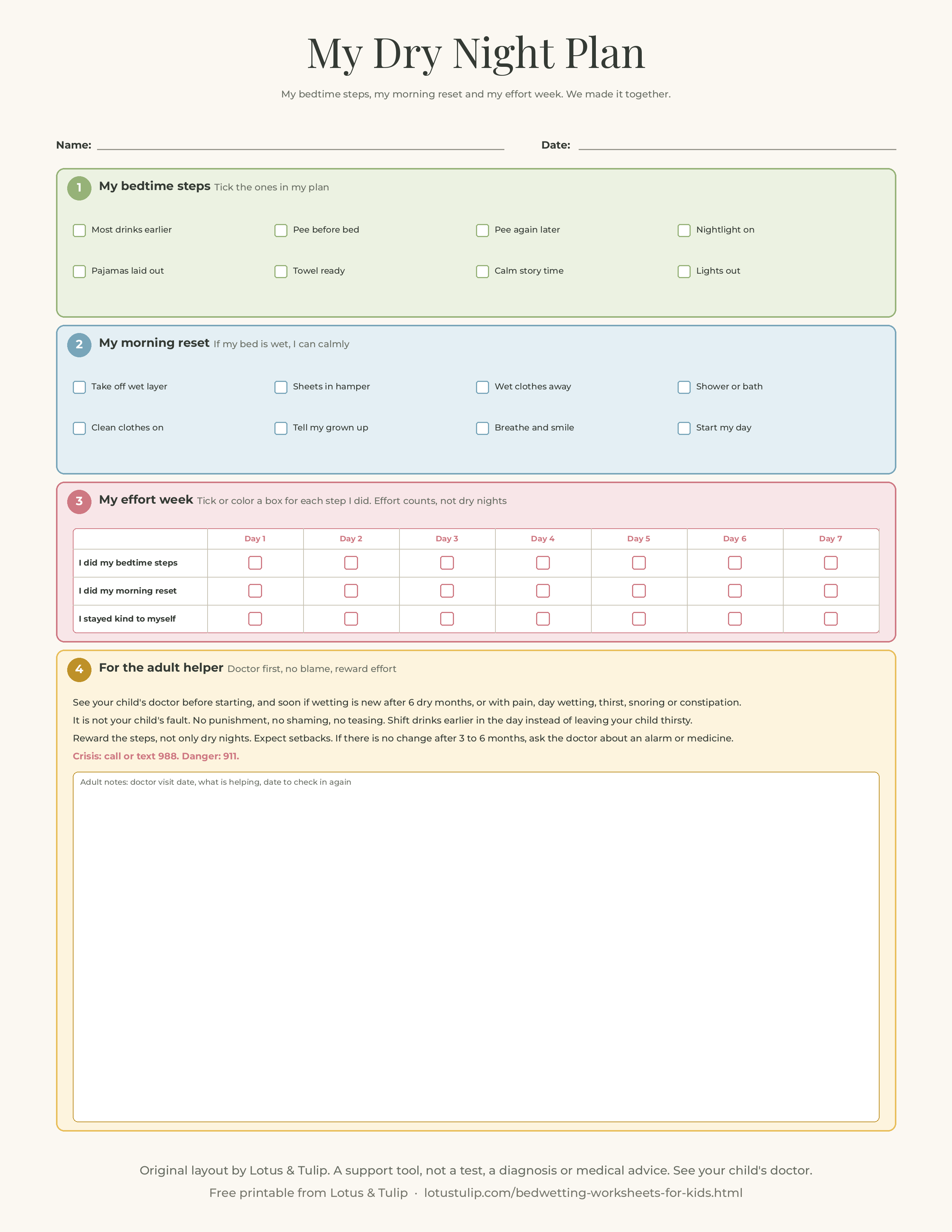
Download the free bedwetting worksheets for kids (PDF, 2 pages, US Letter)
Prefer single images? Page 1: My Body at Night Map (PNG) · Page 2: My Dry Night Plan (PNG)
Related resources
- Nightmare worksheets for kids: bedtime worries and a calm bedtime plan
- Interoception activities for kids: helping children notice body signals, including a full bladder
- Self esteem worksheets for kids: when embarrassment starts to dent confidence
- New baby and big sibling worksheets for kids: when wetting returns after a new baby arrives
- Sleep hygiene worksheet: a one week sleep plan for better habits
- All counseling resources for kids and teens
FAQ
Is bedwetting normal at age 7?
Yes, it is common. NIDDK estimates that about 1 in 10 children wet the bed at age 7, and in a large UK study 15.5% of children about 7 and a half years old wet the bed at least sometimes, though only 2.6% wet twice a week or more. It is still worth mentioning to your child's doctor, especially if it bothers your child.
When should I take my child to the doctor for bedwetting?
See a doctor before starting any program, and soon if your child was dry for 6 months and started wetting again, has pain, burning, cloudy or pink urine, wets during the day, is very thirsty or losing weight, snores loudly, is constipated, or seems suddenly different in mood. Get care within 24 hours for signs of a bladder or kidney infection or a fever without a clear cause.
What causes bedwetting in children?
Usually a mix of a bladder and nervous system that are still maturing, deep sleep, a family history of bedwetting and making too much urine at night. Less often, constipation, infections, diabetes, sleep apnea or stress play a part. Children almost never wet the bed on purpose.
Do bedwetting reward charts work?
They can help as a first step, especially when they reward effort, such as peeing before bed and helping with the morning reset, rather than only dry nights. A Cochrane review found simple steps like rewards may work better than no treatment but less well than an alarm. Never take rewards back or punish wet nights.
Do bedwetting alarms work?
For many children, yes. The AAP says alarms succeed 50% to 75% of the time, and a 2020 Cochrane review found they may help more children become and stay dry than no treatment, although much of the evidence is low quality. They need regular use for 3 to 4 months and an adult who can help at night. Ask your child's doctor first.
Should I wake my child at night to pee?
NIDDK advises against making a habit of it because researchers do not think it helps children learn to stay dry. Some small trials found waking reduced wet nights, so ask your child's doctor what fits your family. Peeing twice before bed and a nightlight on the way to the bathroom are simple places to start.
What age are these bedwetting worksheets for?
They are designed for children about 5 to 12. Younger children can color, point and talk through the pages with an adult. Children 7 to 12 can fill in most of the map and plan themselves. Parents, school nurses, school counselors and therapists can use them, alongside the child's doctor.
Sources
- American Academy of Pediatrics, HealthyChildren.org. Bedwetting: 3 common reasons and what families can do.
- Butler, R. J., Golding, J., Northstone, K., and the ALSPAC Study Team (2005). Nocturnal enuresis at 7.5 years old: prevalence and analysis of clinical signs. BJU International, 96(3), 404 to 410.
- Caldwell, P. H., Codarini, M., Stewart, F., Hahn, D., and Sureshkumar, P. (2020). Alarm interventions for nocturnal enuresis in children. Cochrane Database of Systematic Reviews, CD002911.
- Caldwell, P. H., Nankivell, G., and Sureshkumar, P. (2013). Simple behavioural interventions for nocturnal enuresis in children. Cochrane Database of Systematic Reviews, CD003637.
- Forsythe, W. I., and Redmond, A. (1974). Enuresis and spontaneous cure rate: study of 1129 enuretics. Archives of Disease in Childhood, 49(4), 259 to 263.
- Glazener, C. M., Evans, J. H., and Peto, R. E. (2004). Treating nocturnal enuresis in children: review of evidence. Journal of Wound, Ostomy and Continence Nursing, 31(4), 223 to 234.
- Hägglöf, B., Andrén, O., Bergström, E., Marklund, L., and Wendelius, M. (1998). Self-esteem in children with nocturnal enuresis and urinary incontinence: improvement of self-esteem after treatment. European Urology, 33(Suppl 3), 16 to 19.
- Loening-Baucke, V. (1997). Urinary incontinence and urinary tract infection and their resolution with treatment of chronic constipation of childhood. Pediatrics, 100(2), 228 to 232.
- National Institute of Diabetes and Digestive and Kidney Diseases (NIDDK). Bladder control problems and bedwetting in children: definition and facts; symptoms and causes; treatment.
- Sapi, M. C., Vasconcelos, J. S., Silva, F. G., Damião, R., and Silva, E. A. (2009). Assessment of domestic violence against children and adolescents with enuresis. Jornal de Pediatria, 85(5), 433 to 437.
Lotus & Tulip is not affiliated with the American Academy of Pediatrics, NIDDK, Childhelp, the researchers, programs, agencies or organizations named on this page, and does not sell or recommend any bedwetting device or medicine. Names in the examples are invented. This page is educational and does not replace professional medical advice, diagnosis or treatment.