
Kids and teens · Nightmares and bedtime worries for kids 4 to 12 · Updated 2026-11-15
Nightmare worksheets for kids: bad dreams, bedtime worries, what research shows and a free calm bedtime plan

Ages 5 to 11: Kids Feelings and Social Skills Worksheets, incl. feelings detective, body clues, a feelings thermometer, a coping skills menu and a calm down plan Holiday 20% off: about $11.04, was $14 (EUR 12) · fillable PDF, instant digital download
Buy on EtsyTry it free first: download a fillable sample (feelings thermometer and calm-down plan, PDF, 240 KB). Type into it on screen, then get the full pack. No email needed.
For the sleep side: Sleep and Insomnia Worksheets, incl. a sleep diary, wind down routines and worry before bed pages Holiday 20% off: about $9.20, was $12 (EUR 10) · instant digital download
Buy on EtsyKids and teens bundle: Kids and Teens Worksheets Bundle (feelings, anger, self esteem, social anxiety) Holiday 20% off: about $22.08, was $28 (EUR 24) · 80 pages, instant digital download
Buy on EtsyIt is 2am and a small voice is at your bedroom door: "I had a bad dream." Or bedtime itself has become a nightly negotiation, with one more drink, one more hug, the hallway light on and a child who is sure something is under the bed. Nighttime fears and bad dreams are among the most common worries of childhood. They are usually a normal part of growing up, and they also respond well to a few simple, practical skills that children can learn.
This guide is for parents, school counselors, teachers and therapists supporting children about 4 to 12. It explains the difference between nightmares, night terrors and bedtime worries, what research shows, why the most common responses can keep fears going, what worksheets can and cannot do, eight kinds of nightmare and bedtime worries worksheets, nine steps to use them, age adaptations, the school side, common mistakes and three short examples. It ends with a free 2 page printable: My Bedtime Worries Map and My Calm Bedtime Plan.
When to get help instead of (or as well as) a worksheet: talk with your child's doctor if bad dreams happen most weeks for a month or more, started after something frightening or traumatic, keep your child from sleeping or leave them afraid during the day, or come with loud snoring, pauses in breathing, injuries during sleep or sleepwalking out of the house. A child who has been through a trauma should be supported by a licensed therapist, not asked to retell or redraw the event at home. If a child talks about wanting to die or hurting themselves, call or text 988 (the 988 Suicide and Crisis Lifeline). If anyone is in immediate danger, call 911.
Download the free nightmare and bedtime worries worksheets for kids (PDF, 2 pages, US Letter)
Direct download, no email or sign up. See the pages first. Worries that show up all day, not just at night? See anxiety worksheets for kids. Child will not sleep without you? See the separation anxiety worksheet for kids.
Nightmares, night terrors and bedtime worries, in plain words
These three get mixed up all the time, and they need different responses.
- Nightmares are scary dreams that wake a child up. They usually happen in the second half of the night, when dreaming is most intense. The child is awake afterward, upset, can often tell you what happened and may not want to go back to sleep alone.
- Night terrors (sleep terrors) happen in deep sleep, usually in the first few hours of the night. The child may scream, sit up, thrash or look terrified with open eyes, but is not really awake, does not respond normally and usually remembers nothing in the morning. They are most common in toddlers and preschoolers and most children outgrow them.
- Bedtime worries and nighttime fears happen while the child is still awake: fear of the dark, monsters, noises, burglars, being alone or of having a bad dream. They show up as stalling, calling out, needing a parent to stay or moving into the parent's bed.
The worksheets on this page are for nightmares and bedtime worries. Night terrors are handled differently: stay calm, do not try to wake the child, keep them safe and let the episode pass. Talk to your doctor if terrors are frequent, cause injuries or come with breathing problems.
Why kids get bad dreams and bedtime fears
- A growing imagination. Children between about 4 and 10 can picture vivid dangers but are still learning what is real and what is pretend.
- Scary information. A frightening show, a news story, a video an older child shared or a playground ghost story can fuel fears for weeks.
- Daytime stress. A new school, a move, a new baby, family conflict, an illness or a loss often show up first at night, when the house goes quiet.
- Too little sleep. Overtired children often have a harder time settling and more disturbed sleep.
- Temperament and anxiety. Some children are simply more sensitive and cautious, and anxious children tend to have more bad dreams.
- Family patterns. Frequent nightmares and night terrors both tend to run in families.
- Something frightening that really happened. Repeated nightmares can be a sign of trauma, which needs professional support.
What the research shows, honestly
Nighttime fears are the norm, not the exception. In a Dutch interview study of 176 children aged 4 to 12, 73.3% reported nighttime fears. They were common at 4 to 6, even more frequent at 7 to 9 and stayed fairly stable at 10 to 12. Almost 80% of children linked their fear to scary information they had seen or heard, and in about 10% the fears were part of a diagnosable anxiety disorder (Muris and colleagues, 2001). In an Australian school study of 511 young people aged 8 to 16, 64.2% reported nighttime fears, most often of intruders. They were more common in girls (72.9%) than boys (54.6%) and in children (79.4%) than in teens (48.8%) (Gordon and colleagues, 2007).
Parents often underestimate them. In the Dutch study, parents markedly underestimated how often their children had nighttime fears (Muris and colleagues, 2001). In a German study of 4,531 children aged 8 to 11 and 4,834 parents, parents also underestimated how often their children had nightmares, and the researchers advised asking children directly (Schredl and colleagues, 2009). That is one reason a worksheet the child fills in can be so useful: it gives you their version.
Frequent nightmares are less common, and they tend to stick around. Cross sectional studies put the peak of childhood nightmares between about 5 and 10 years. In a longitudinal German sample of 851 ten year olds, nightmares happened "often" for 2.5% (parent report) to 3.5% (child report), nightmares one year predicted nightmares the next, and children with ongoing nightmares had more emotional and behavioral symptoms (Schredl and colleagues, 2009). In a Hong Kong study of 6,359 children (average age about 9), 5.2% had nightmares at least once a week. Frequent nightmares were linked to hyperactivity (odds ratio 1.68), temper outbursts or mood problems (1.76) and poorer school performance (1.62), and about 20% of these children also had frequent insomnia (Li and colleagues, 2011). These are associations, not proof that nightmares cause the problems, but they are a good reason not to ignore weekly bad dreams.
Anxiety matters more than "bad habits." In a Quebec study following 987 children from infancy, bad dreams in the preschool years were predicted by the child's anxiety and by early sleep difficulties, more than by parent bedtime habits (Simard and colleagues, 2008). In other words, bad dreams are rarely a parenting failure. They are a sign to help a child with worry.
Night terrors are very common in toddlers and usually fade. In 1,940 Quebec children followed to age 13, sleep terrors peaked at 34.4% at 18 months, sleepwalking peaked at 13.4% at age 10, about a third of children with early terrors went on to sleepwalk, and both ran strongly in families (Petit and colleagues, 2015).
Changing the dream can help. Imagery rehearsal therapy asks a person to rewrite a recurring nightmare with a new ending and to rehearse the new version while awake. For adults, the American Academy of Sleep Medicine recommends it for nightmare disorder (Morgenthaler and colleagues, 2018). The child studies are small but encouraging. In a randomized study of 20 children aged 9 to 11 with weekly nightmares (and no PTSD), imagery rehearsal reduced nightmare frequency compared with a waiting list, and the gain held at 9 months, although nightmare distress did not drop significantly (St-Onge and colleagues, 2009). In a study of 10 children aged 6 to 11 and their mothers, keeping a dream log and learning about nightmares were linked to fewer unpleasant dreams and less distress, and drawing a changed version of the nightmare for a month brought further drops in distress and anxiety (Simard and Nielsen, 2009).
Simple, playful tools reduce bedtime fears. In a randomized study of 104 children aged 4 to 6 with significant nighttime fears, giving the child a puppy doll to look after (or presenting the same doll as a protector) reduced fears more than a waiting list after one month, cut sleep problems and parents' fear managing behaviors, and the gains held at 6 months (Kushnir and Sadeh, 2012). In a small US study of 9 children aged 5 to 7 with a specific phobia diagnosis and persistent nighttime fears, parents reading a story based treatment book with activities over 4 weeks led to clinically meaningful improvement in 8 of the 9 children and more nights in their own bed (Lewis and colleagues, 2015).
Routines and enough sleep help. In a survey of mothers of 10,085 children from birth to 5 years in 13 countries and regions, a consistent bedtime routine was linked to earlier bedtimes, falling asleep faster, fewer night wakings and longer sleep, and more nights with a routine meant better sleep (Mindell and colleagues, 2015). The American Academy of Sleep Medicine recommends 10 to 13 hours in 24 hours (including naps) for children 3 to 5 and 9 to 12 hours for children 6 to 12 (Paruthi and colleagues, 2016).
What we do not know. The treatment studies are small, and researchers have called for larger, modern randomized trials of treatments for children's nighttime fears (Gordon and colleagues, 2007). No study has tested nightmare worksheets on their own. Worksheets are best seen as a practical way to put the tested ideas (naming fears, a steady routine, coping tools, a brave buddy and changing the dream) into everyday family life.
Why the usual responses can keep fears going
- Checking for monsters every night. A kind gesture, but a nightly search can quietly confirm that there might be something to find. One cheerful check, then a calm "All safe, goodnight" works better than a long inspection.
- "There's nothing to be scared of." The fear feels real to the child. Dismissing it makes them less likely to tell you next time. Name the feeling first: "That dream was really scary."
- Long talks about the dream at 2am. Going over every detail in the middle of the night keeps the child wide awake and the dream fresh. Comfort briefly now and talk it through tomorrow, in daylight.
- Always moving into your bed or staying until they sleep. It solves tonight, but it can teach that their own bed is not safe and that they cannot cope without you. Fade your help step by step instead.
- Scary shows and screens right before bed. Most children in the Dutch study traced their fears to frightening information. Calm, predictable evenings help.
- Worry talk at lights out. Bedtime becomes the only quiet moment to unload the day, so worries pile up exactly when the child needs to wind down. Move the talking to earlier in the evening.
- Teasing or shaming. "Big kids aren't scared of the dark" adds embarrassment to fear and makes children hide it.
What nightmare worksheets can and cannot do
Worksheets give children words and pictures for scary feelings, turn vague dread into a list you can work on, and give the child a sense of control: they plan their own brave tools and even their own new dream ending. They also give tired parents a calm script to follow, and give school counselors and therapists a gentle way to talk about sleep and worry.
Worksheets cannot treat trauma, PTSD, an anxiety disorder, sleep apnea or night terrors, and they will not work in the middle of the night when a child is frightened. Use them in the daytime or early evening, and get professional help when the signs in the box above apply.
8 kinds of nightmare and bedtime worries worksheets for kids
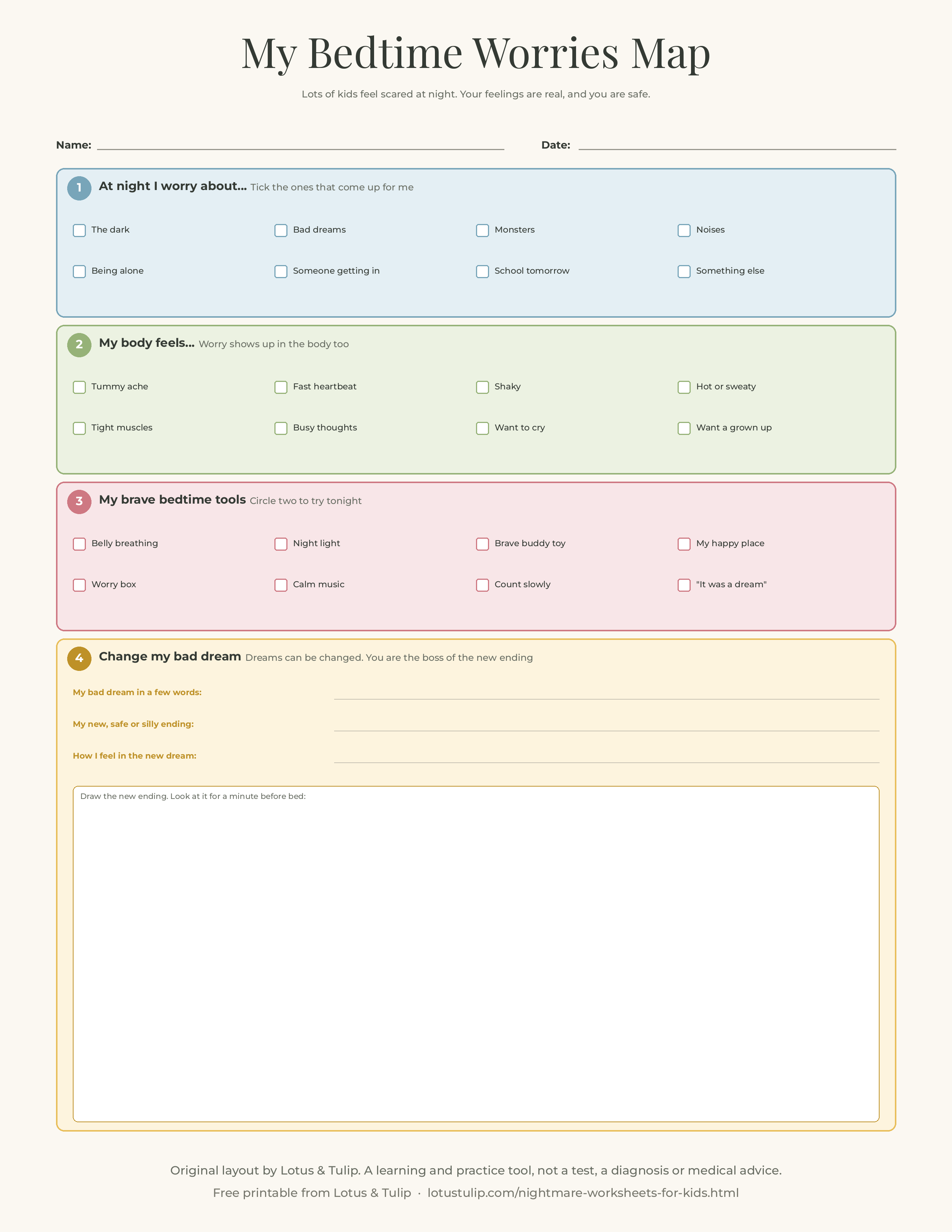
- Bedtime worries map. What I worry about at night (the dark, monsters, noises, bad dreams, someone getting in) so fears are named instead of guessed.
- Body clues page. Where worry shows up in my body at night: tummy ache, fast heartbeat, busy thoughts, wanting a grown up.
- Brave bedtime toolbox. A short menu of what I can do myself: belly breathing, a night light, a brave buddy toy, a happy place picture, counting slowly.
- Change my bad dream. Write or draw a recurring bad dream with a new safe, strong or silly ending, then look at the new version for a minute before bed.
- Worry time page. A set time in the early evening to write or draw worries and put them in a worry box, so they do not wait for lights out.
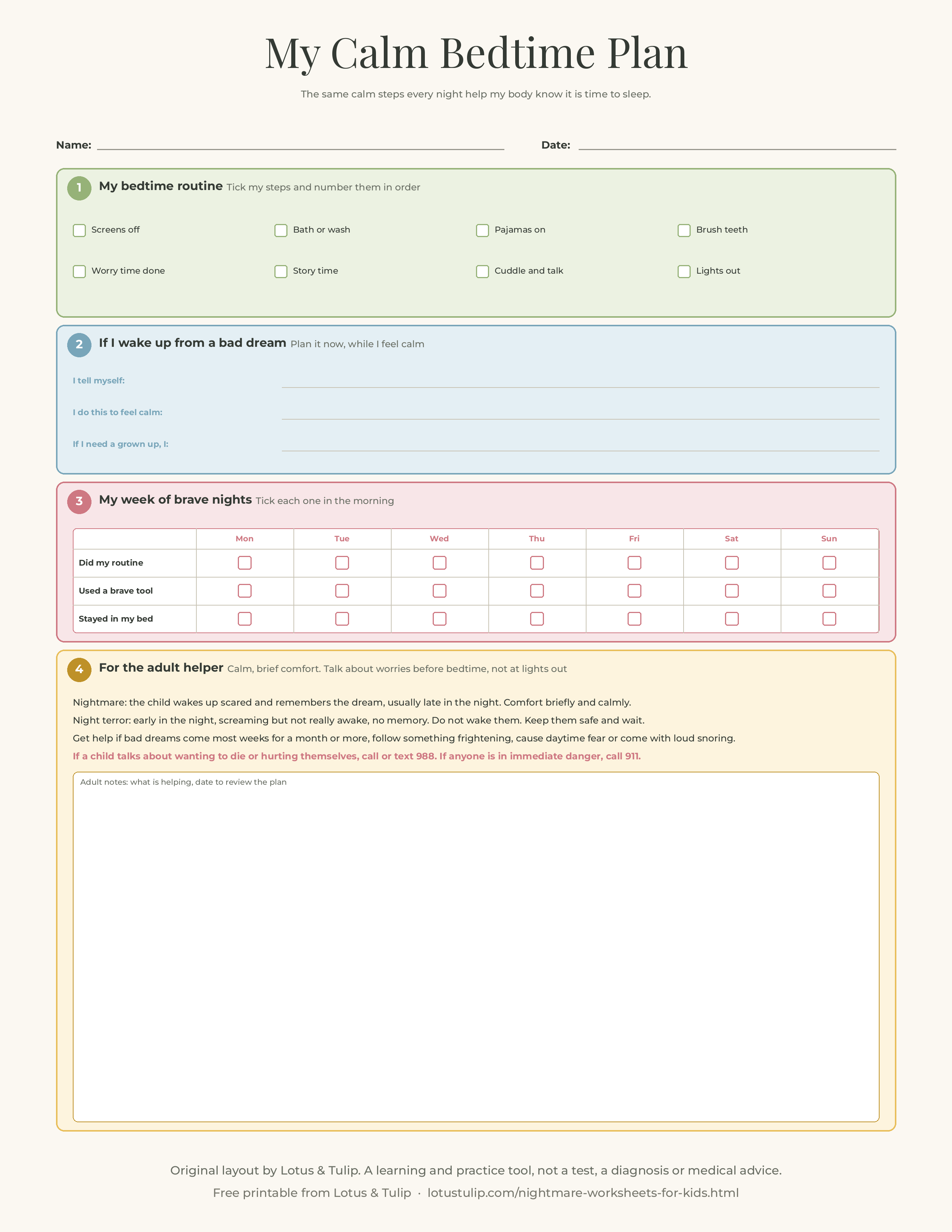
- Calm bedtime routine chart. The same steps in the same order every night, chosen and numbered by the child.
- If I wake up plan. What I tell myself, what I do to feel calm and how I get a grown up if I need one, planned while calm.
- Brave nights tracker. A weekly chart to tick routine done, brave tool used and stayed in my own bed, with praise for effort.
How to use nightmare worksheets for kids, step by step
- Pick a calm daytime moment. Never start at bedtime or after a bad night. Try after school or on a weekend morning: "Lots of kids have scary dreams or worries at night. Want to make a plan so nights feel better?"
- Fill in the Bedtime Worries Map together. Let your child tick their night worries and body clues. Listen without arguing or correcting. Children often reveal worries parents had no idea about, so simply say: "Thanks for telling me. That makes sense."
- Explain dreams in simple words. "Dreams are stories your brain tells while you sleep. They can feel very real, but they are not real and they cannot hurt you. And dreams can be changed." Learning about nightmares was itself linked to less distress in one child study.
- Build a calm routine. Use My Calm Bedtime Plan to choose and number the routine steps. Keep the same order every night, put screens away well before bed and keep bedtimes regular, even on weekends, so your child gets enough sleep for their age.
- Move worries earlier in the evening. Set a short worry time after dinner. Your child can tell, write or draw the worry and put it in a worry box. At bedtime, if a worry pops up, say: "Let's save that for worry time tomorrow."
- Practice brave tools in the daytime. Have your child circle two tools, then practice them when calm: belly breathing with a toy on their tummy, imagining a happy place in detail, or giving a stuffed animal the job of brave buddy who keeps them company.
- Change the bad dream. If one bad dream keeps coming back (and it is not about something that really happened), ask your child to tell it briefly, then invent a new ending: the monster turns out to be friendly, shrinks to the size of a mouse or gets a funny hat. Draw the new ending and look at it for a minute before bed for a week or two.
- Plan the 2am response. Fill in "If I wake up from a bad dream" together. Agree on what you will do too: come quickly, comfort briefly and calmly, remind them it was a dream, help them use one tool and leave while they are still a bit awake. Save the story for tomorrow.
- Track effort and fade your help. Tick the tracker each morning and praise specific effort ("You used your breathing and went back to sleep!"). If your child relies on you staying, fade it slowly: sit by the bed, then by the door, then check in briefly. Review the plan every week or two.
How to adapt it by age
- Ages 4 to 6: keep it playful and visual. Read the choices aloud and let children point or color. A brave buddy toy, a night light and a short picture routine chart work well. Expect fantasy fears (monsters, the dark) and answer them simply and confidently. Night terrors are most common at this age, so check which one you are dealing with.
- Ages 7 to 9: nighttime fears are often at their most frequent. Children can fill in most of the map themselves, invent detailed new dream endings and run their own worry time. Fears may shift toward burglars, news events and things they heard at school, so watch what they are seeing and hearing.
- Ages 10 to 12: respect privacy. Many preteens are embarrassed to admit fears of the dark, so normalize it ("Lots of kids your age feel this way"). Let them write rather than draw, use a journal for worry time, and support independent tools such as a relaxation recording. Watch for later bedtimes and phones in the bedroom.
- After a frightening event: keep routines steady, offer extra comfort and predictability, and do not push the change my dream page. If nightmares about the event continue, or your child seems on edge, avoids reminders or has trouble in the daytime, see a licensed therapist trained in trauma focused care.
- Autism, ADHD or sensory differences: sleep problems are common. Visual schedules, a very predictable routine, attention to noise, light and fabric, and extra practice of tools in the daytime help. Ask your child's doctor about sleep if problems persist.
Nightmares, sleep and school: notes for counselors and teachers
A child who slept badly is a child who struggles at school: more irritability, more trouble focusing, more tears. In the Hong Kong study, frequent nightmares were linked to poorer school performance and hyperactivity (Li and colleagues, 2011). A tired or jumpy student is worth a gentle question about sleep.
- Use the worries map in individual sessions or a small worry group. Children are often relieved to learn that most kids their age have nighttime fears.
- Be thoughtful about scary content. Ghost stories, frightening videos and intense news topics can feed fears in sensitive children. Give a heads up before scary content in class and a choice to opt out where you can.
- Share practical tips with families. Send home the free printable with a short note rather than a long list of what parents should change.
- Notice patterns. Nightmares, sleep problems and new fears that appear together with changes in behavior can be a sign that something difficult is happening at home or in the child's life.
- Know when to refer and report. Refer to a school psychologist, social worker, pediatrician or outside therapist when sleep problems are persistent or the child seems anxious or depressed. If you suspect abuse or neglect, follow your district's mandated reporting procedures.
Buy the kids feelings worksheets on Etsy
Common mistakes
- Starting the plan at bedtime. A tired, scared child cannot learn new skills. Plan in daylight, use at night.
- Confusing night terrors with nightmares. Waking a child mid terror usually makes it longer and more confusing. Keep them safe and wait.
- Using the change my dream page for trauma. Rewriting dreams about something that really happened belongs with a trained therapist.
- Removing all comfort at once. Going from staying all night to "You're on your own" usually backfires. Fade step by step.
- Expecting no bad dreams ever. Everyone has bad dreams sometimes. The goal is fewer, shorter, less scary nights and a child who knows what to do.
- Forgetting the basics. Too little sleep, an irregular schedule, late screens, caffeine in sodas or iced tea and loud snoring can all make nights harder. Check them first.
Examples
- Maya, 5: came into her parents' bed every night, sure a monster lived in her closet. Her mom gave her a stuffed bear with the job of brave buddy, did one cheerful closet check and a three step picture routine. Maya circled belly breathing and her night light. Over three weeks her mom moved from sitting on the bed to the doorway, and Maya slept in her own bed most nights.
- Ethan, 8: had the same dream about falling off a cliff two or three times a week. In daylight he drew a new ending where he grew wings and flew to his grandma's house, and looked at the drawing before bed. He also ticked "busy thoughts" and started a worry time after dinner. Within a few weeks the cliff dream came back only now and then, and when it did he said it ended "the flying way."
- Sofia, 11: was falling asleep in class. The school counselor used the worries map and Sofia ticked "someone getting in" after a break in nearby. She was lying awake for hours and reading news on her phone in bed. The counselor talked with her parents, who showed her the new door locks, moved the phone charger to the kitchen and added worry time. When her sleep did not improve after a few weeks, the family saw her pediatrician, who referred her to a therapist for anxiety.
Free printable: nightmare and bedtime worries worksheets for kids
This printable is an original Lotus & Tulip layout. It is not a test or a clinical tool and gives no score. Page 1, My Bedtime Worries Map, has ticks for what I worry about at night, how my body feels and my brave bedtime tools, plus a change my bad dream section with lines for a new ending and a drawing box. Page 2, My Calm Bedtime Plan, has bedtime routine steps to choose and number, an if I wake up from a bad dream plan, a 7 night tracker for routine done, brave tool used and stayed in my bed, and notes for the adult helper, including the difference between nightmares and night terrors, when to get help and the 988 and 911 numbers.
Download the free nightmare and bedtime worries worksheets for kids (PDF, 2 pages, US Letter)
Prefer single images? Page 1: My Bedtime Worries Map (PNG) · Page 2: My Calm Bedtime Plan (PNG)
Related resources
- Bedwetting worksheets for kids: for wet nights alongside bedtime worries, with a free dry night plan
- Anxiety worksheets for kids: when worries show up in the daytime too
- Separation anxiety worksheet for kids: a goodbye plan and a brave apart ladder
- Worry worksheet for kids: a worry box and worry time ideas
- Sleep hygiene worksheet: a one week sleep plan for better habits
- Breathing exercises for kids: calm body tools to practice before bed
- All counseling resources for kids and teens
FAQ
Are nightmares normal for kids?
Yes. Occasional bad dreams are a normal part of childhood, and nighttime fears are even more common: in one study 73.3% of children aged 4 to 12 reported them. Nightmares are most common between about 5 and 10. Frequent nightmares, such as most weeks for a month or more, are less common and worth discussing with your child's doctor.
What is the difference between a nightmare and a night terror?
A nightmare is a scary dream that wakes a child up, usually in the second half of the night, and the child often remembers it. A night terror happens in deep sleep early in the night: the child may scream or thrash but is not really awake and usually remembers nothing. Comfort a child after a nightmare. During a night terror, do not try to wake them, keep them safe and wait for it to pass.
What should I do when my child wakes up from a nightmare?
Go to them calmly, name the feeling ("That was a scary dream"), remind them it was a dream and they are safe, help them use one calming tool such as belly breathing or their brave buddy, and keep the visit short. Save talking about the dream for the next day, when you can also draw a new ending together.
How do I help my child change a recurring bad dream?
In the daytime, ask your child to tell the dream briefly, then invent a new ending that is safe, strong or silly. Have them draw or write it and look at the new version for a minute before bed for a week or two. This idea comes from imagery rehearsal therapy, which has shown promise in small studies with children. Do not use it for dreams about real traumatic events without a therapist.
Should I let my child sleep in my bed after a bad dream?
Occasional comfort is fine. If it becomes an every night habit, it can teach a child that they cannot cope in their own bed. Comfort them in their own room, help them use a tool and gradually reduce how long you stay, for example from sitting on the bed to sitting by the door to a brief check in.
When should I worry about my child's nightmares?
Talk with your child's doctor if nightmares happen most weeks for a month or more, began after a frightening or traumatic event, cause daytime fear, sleepiness or behavior changes, or come with loud snoring, breathing pauses, injuries or sleepwalking. If your child talks about wanting to die or hurting themselves, call or text 988, and in an emergency call 911.
What age are these nightmare worksheets for?
They are designed for children about 4 to 12. Children 4 to 6 can point, color and draw with an adult reading aloud. Children 7 to 12 can fill in most of the pages themselves and invent their own new dream endings. School counselors and therapists can use them in individual sessions or small worry groups.
Sources
- American Academy of Pediatrics. Sleep problems in children. Pediatric Patient Education.
- Gordon, J., King, N., Gullone, E., Muris, P., and Ollendick, T. H. (2007). Nighttime fears of children and adolescents: frequency, content, severity, harm expectations, disclosure, and coping behaviours. Behaviour Research and Therapy, 45(10), 2464 to 2472.
- Gordon, J., King, N. J., Gullone, E., Muris, P., and Ollendick, T. H. (2007). Treatment of children's nighttime fears: the need for a modern randomised controlled trial. Clinical Psychology Review, 27(1), 98 to 113.
- Kushnir, J., and Sadeh, A. (2012). Assessment of brief interventions for nighttime fears in preschool children. European Journal of Pediatrics, 171(1), 67 to 75.
- Lewis, K. M., Amatya, K., Coffman, M. F., and Ollendick, T. H. (2015). Treating nighttime fears in young children with bibliotherapy: evaluating anxiety symptoms and monitoring behavior change. Journal of Anxiety Disorders, 30, 103 to 112.
- Li, S. X., Yu, M. W., Lam, S. P., Zhang, J., and colleagues (2011). Frequent nightmares in children: familial aggregation and associations with parent-reported behavioral and mood problems. Sleep, 34(4), 487 to 493.
- MedlinePlus. Night terrors in children. US National Library of Medicine.
- Mindell, J. A., Li, A. M., Sadeh, A., Kwon, R., and Goh, D. Y. (2015). Bedtime routines for young children: a dose-dependent association with sleep outcomes. Sleep, 38(5), 717 to 722.
- Morgenthaler, T. I., Auerbach, S., Casey, K. R., Kristo, D., and colleagues (2018). Position paper for the treatment of nightmare disorder in adults: an American Academy of Sleep Medicine position paper. Journal of Clinical Sleep Medicine, 14(6), 1041 to 1055.
- Muris, P., Merckelbach, H., Ollendick, T. H., King, N. J., and Bogie, N. (2001). Children's nighttime fears: parent-child ratings of frequency, content, origins, coping behaviors and severity. Behaviour Research and Therapy, 39(1), 13 to 28.
- Paruthi, S., Brooks, L. J., D'Ambrosio, C., Hall, W. A., and colleagues (2016). Recommended amount of sleep for pediatric populations: a consensus statement of the American Academy of Sleep Medicine. Journal of Clinical Sleep Medicine, 12(6), 785 to 786.
- Petit, D., Pennestri, M. H., Paquet, J., Desautels, A., and colleagues (2015). Childhood sleepwalking and sleep terrors: a longitudinal study of prevalence and familial aggregation. JAMA Pediatrics, 169(7), 653 to 658.
- Schredl, M., Fricke-Oerkermann, L., Mitschke, A., Wiater, A., and Lehmkuhl, G. (2009). Factors affecting nightmares in children: parents' vs. children's ratings. European Child and Adolescent Psychiatry, 18(1), 20 to 25.
- Schredl, M., Fricke-Oerkermann, L., Mitschke, A., Wiater, A., and Lehmkuhl, G. (2009). Longitudinal study of nightmares in children: stability and effect of emotional symptoms. Child Psychiatry and Human Development, 40(3), 439 to 449.
- Simard, V., and Nielsen, T. (2009). Adaptation of imagery rehearsal therapy for nightmares in children: a brief report. Psychotherapy: Theory, Research, Practice, Training, 46(4), 492 to 497.
- Simard, V., Nielsen, T. A., Tremblay, R. E., Boivin, M., and Montplaisir, J. Y. (2008). Longitudinal study of preschool sleep disturbance: the predictive role of maladaptive parental behaviors, early sleep problems, and child/mother psychological factors. Archives of Pediatrics and Adolescent Medicine, 162(4), 360 to 367.
- St-Onge, M., Mercier, P., and De Koninck, J. (2009). Imagery rehearsal therapy for frequent nightmares in children. Behavioral Sleep Medicine, 7(2), 81 to 98.
Lotus & Tulip is not affiliated with the researchers, programs, agencies or organizations named on this page. Names in the examples are invented. This page is educational and does not replace professional advice, diagnosis or treatment.