
Therapist worksheets · Updated 2026-11-03
Sleep hygiene worksheet: a practical checklist for adults, teens and kids, and what the research says (free printable)
Ready-made printable: Sleep and Insomnia Worksheets for Therapists Holiday 20% off: about $9.20, was $12 (EUR 10) · instant digital download
Buy on Etsy
Sleep comes up in almost every counseling caseload. Anxious clients lie awake replaying the day, depressed clients sleep too much or too little, teens scroll until 1am, and parents of young kids ask why bedtime turns into a battle. A sleep hygiene worksheet is often the first tool a therapist, school counselor or parent reaches for. This guide explains what sleep hygiene is, what the research actually says about it (including where it falls short), a checklist you can use in session, a simple one week plan, adaptations for kids and teens, common mistakes and an FAQ. It ends with a free one page "My Sleep Plan" worksheet on US Letter paper.
This is educational information for therapists, counselors, parents and other helpers. It is not medical advice and not a substitute for evaluation by a qualified health professional. Loud snoring, pauses in breathing, very strong daytime sleepiness, or insomnia that lasts for months are reasons to see a doctor or sleep specialist. In the US, anyone in crisis can call or text 988, the Suicide and Crisis Lifeline, or call 911 in an emergency.
Jump to the free sleep hygiene worksheet
What sleep hygiene means
Sleep hygiene is a set of everyday habits and bedroom conditions that make good sleep more likely. It usually covers five areas:
- Timing: a regular wake up time, a regular bedtime and a wind down period before bed.
- Substances: caffeine, nicotine and alcohol, and when they are used.
- Screens and light: phones, tablets, gaming and bright light late in the evening, and daylight in the morning.
- The bedroom: dark, quiet, cool enough and comfortable, and used mainly for sleep.
- The day: physical activity, meals, naps and how stress is handled before bedtime.
What the research says (and why it matters for your session)
Two facts are worth knowing before you hand anyone a sleep hygiene checklist.
How much sleep people need. The American Academy of Sleep Medicine (AASM) and the Sleep Research Society recommend that adults sleep 7 or more hours per night on a regular basis (Watson and colleagues, Journal of Clinical Sleep Medicine, 2015). For young people, the AASM pediatric consensus recommends 9 to 12 hours per 24 hours for children aged 6 to 12 and 8 to 10 hours for teenagers aged 13 to 18 (Paruthi and colleagues, Journal of Clinical Sleep Medicine, 2016). Individual needs vary, so treat these ranges as a guide, not a test.
Sleep hygiene alone is not a treatment for chronic insomnia. The 2021 AASM clinical practice guideline on behavioral and psychological treatments for chronic insomnia in adults (Edinger and colleagues, Journal of Clinical Sleep Medicine, 2021) strongly recommends multicomponent cognitive behavioral therapy for insomnia (CBT-I). It conditionally suggests stimulus control, sleep restriction therapy and relaxation therapy as single components, and it suggests that clinicians not use sleep hygiene as a single-component therapy. Sleep hygiene can still be part of a multicomponent plan.
In practice, that means a sleep hygiene worksheet is a good starting point for ordinary sleep problems, for psychoeducation and for building a routine. For someone with insomnia that has lasted for months, it should not be the whole plan. Refer to, or train in, CBT-I.
Sleep hygiene checklist
Use this as a conversation guide rather than a list of rules. Ask the client to tick what they already do, then pick one or two items to change this week.
| Area | Helpful habit | Question to ask |
|---|---|---|
| Wake time | Get up at about the same time every day, including weekends | "What time could you get up on most days, even after a bad night?" |
| Wind down | A calm 30 to 60 minute routine before bed: dim lights, shower, reading, stretching | "What does the last hour before bed look like right now?" |
| Screens | Put the phone away or out of the bedroom before lights out; avoid gaming or work in bed | "Where does your phone sleep?" |
| Caffeine | Keep coffee, tea, energy drinks and cola to the morning or early afternoon | "When is your last caffeinated drink of the day?" |
| Alcohol and nicotine | Avoid them close to bedtime; alcohol can make sleep lighter and more broken later in the night | "Do you use anything to help you fall asleep?" |
| Light | Get daylight soon after waking; keep the evening dim | "When do you first go outside or sit near a window?" |
| Bedroom | Dark, quiet, comfortable and not too warm; use the bed mainly for sleep | "What do you do in bed besides sleep?" |
| Naps | If you nap, keep it short and earlier in the day | "How long and how late are your naps?" |
| Activity | Move during the day; finish hard exercise a little before bedtime if it keeps you wired | "How active are your days?" |
| Worry | Write worries and tomorrow's to do list down earlier in the evening, not in bed | "What does your mind do when the lights go off?" |
| Can't sleep | If you lie awake and get frustrated, get up, do something calm in dim light and return when sleepy | "What do you do when you can't fall asleep?" |
The last row is the core instruction of stimulus control, one of the techniques the AASM guideline supports: the bed is for sleep, and lying awake in it for a long time teaches the brain the opposite. Most versions suggest getting up if sleep has not come after roughly 15 to 20 minutes, judged by feel rather than by watching the clock.
A simple one week sleep plan
- Track first. Before changing anything, keep a short sleep diary for 3 to 7 days: bedtime, rough time to fall asleep, wake ups, final wake time, naps, caffeine and how rested you felt. This gives you and the client real data instead of guesses.
- Pick one anchor. Set a fixed wake up time. It is usually easier to control than bedtime, and it steadies the body clock.
- Choose two habits. From the checklist, choose two changes the client actually believes they can keep, such as "phone charges in the kitchen" and "no energy drinks after lunch".
- Build a wind down. Write the routine as three or four steps in order, for example "shower, pajamas, 10 minutes of reading, lights out".
- Plan for a bad night. Decide in advance what to do if sleep does not come: get up, sit somewhere dim, do something calm, go back when sleepy. Keep the same wake time the next morning.
- Review after a week. Compare the diary with the first week. Keep what helped, adjust one thing, and decide whether more help is needed.
Adapting it for kids and teens
- Young children: a picture bedtime routine (bath, pajamas, teeth, story, lights out) works better than a checklist. Keep the same order every night and keep it short. A visual schedule is ideal.
- School age kids: let the child tick the routine steps and pick a calm activity, such as a book or a breathing exercise. Talk with parents about screens in the bedroom and consistent bedtimes on school nights.
- Teens: teens naturally drift later, and lecturing rarely works. Use curiosity: "How do you feel on days after a late night?" Let them choose their own two changes. Phone outside the bedroom is often the single biggest lever, so negotiate it rather than impose it.
- Anxious kids and adults: add a "worry time" earlier in the evening where worries go on paper, and a calming skill for bedtime, such as slow breathing or a body scan.
- Depression: sleeping in and long naps can deepen low mood. A steady wake time plus a morning activity works well alongside behavioral activation.
Common mistakes
- Handing over the whole list. Eleven rules at once feels like failure by Wednesday. Pick one anchor and two habits.
- Treating sleep hygiene as the cure for insomnia. The research says it is not enough on its own for chronic insomnia. Use it as a foundation and refer for CBT-I when needed.
- Chasing an early bedtime. Going to bed much earlier than you feel sleepy often means more time lying awake. A fixed wake time does more.
- Clock watching. Checking the time at night raises frustration. Turn the clock away.
- Skipping medical red flags. Loud snoring, gasping, restless legs, or strong daytime sleepiness need a medical check, not just new habits.
Free sleep hygiene worksheet
This one page "My Sleep Plan" worksheet is an original Lotus & Tulip design. It starts with a sleep goal and a fixed wake up time, then a checklist of ten sleep habits with a "doing it" and "want to try" box for each. Below, a wind down routine box lists your steps in order, a "If I can't sleep, I will" box plans for a bad night, and a 7 day tracker records bedtime, wake time and how rested you felt from 1 to 5. The footer includes the 988 line. It prints on US Letter.
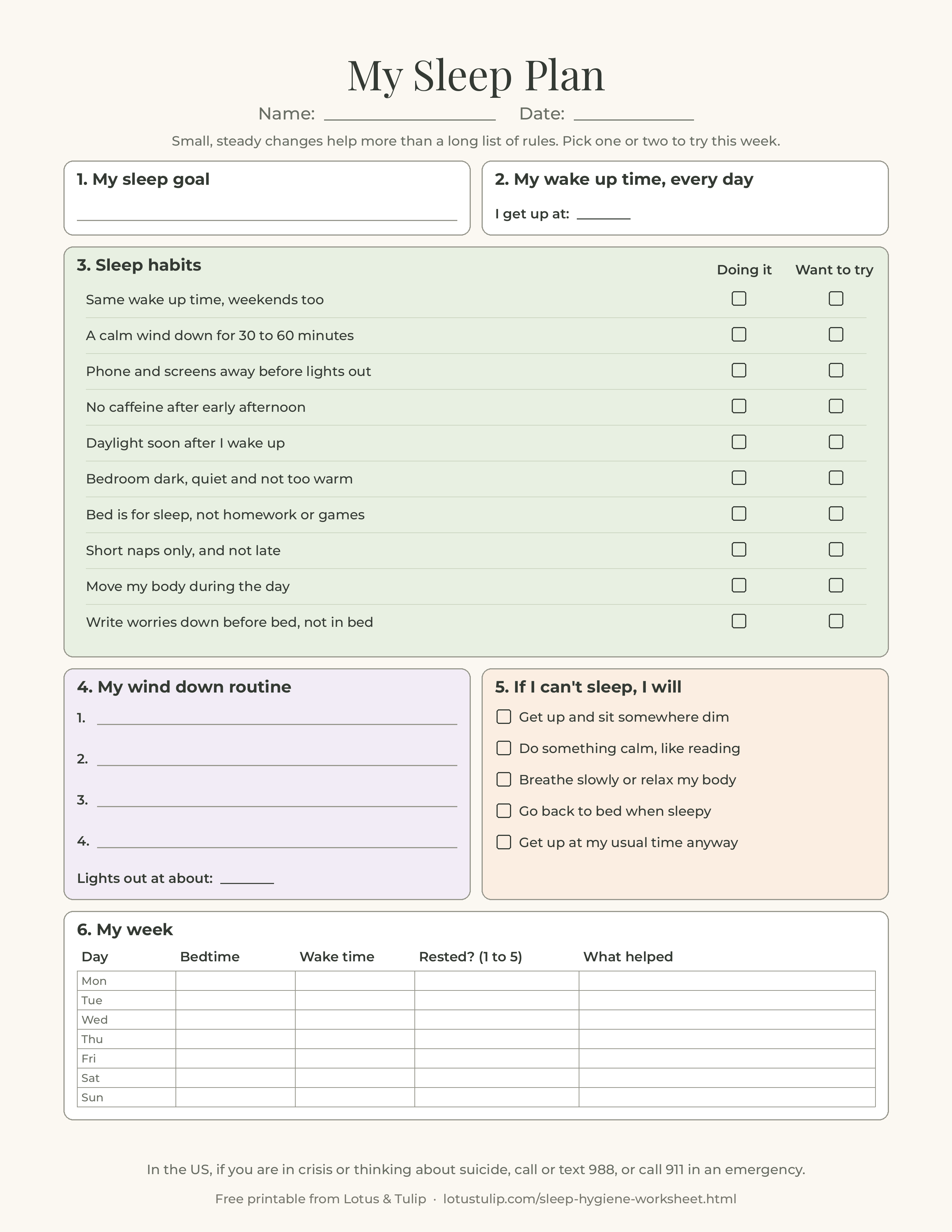
Download the free sleep hygiene worksheet (PNG, US Letter)
Free to print for use with your own clients, students, children or yourself. Please link to this page rather than re-uploading the file.
Related resources
- Nightmare worksheets for kids: bad dreams, bedtime worries and night terrors in children, free calm bedtime plan
- Habit tracker worksheet for adults (free printable): build one bedtime habit at a time
- Behavioral activation worksheet (free printable)
- 5 4 3 2 1 grounding worksheet (free printable)
- CBT thought record worksheet (free printable)
- Circle of control worksheet (free printable)
- Coping skills list for kids (free printable)
FAQ
What is a sleep hygiene worksheet?
It is a page that helps someone review their sleep habits, such as wake time, screens, caffeine and bedtime routine, choose one or two changes, and track how sleep goes over a week.
How many hours of sleep do people need?
The American Academy of Sleep Medicine recommends 7 or more hours a night for adults, 9 to 12 hours per 24 hours for children aged 6 to 12, and 8 to 10 hours for teens aged 13 to 18. Individual needs vary.
Does sleep hygiene work for insomnia?
Good habits help many people sleep better, but the 2021 AASM guideline suggests clinicians not use sleep hygiene as a single-component therapy for chronic insomnia in adults. Cognitive behavioral therapy for insomnia (CBT-I) is the recommended first approach.
What is the most important sleep hygiene tip?
For many people it is a fixed wake up time every day, including weekends, combined with keeping the phone out of bed. Choose the change that fits the person rather than one rule for everyone.
How do you teach sleep hygiene to kids?
Use a short picture or checklist bedtime routine in the same order every night, keep screens out of the bedroom at night, and let the child choose a calm activity such as a story or slow breathing.
Is this sleep hygiene worksheet free?
Yes. It is free to print for use with your own clients, students, children or yourself. Please link to this page rather than re-uploading the file.