
Body awareness · Kids, school counselors, OTs and special education · Updated 2026-11-12
Interoception activities for kids: how to teach body clues, step by step (free printable)
Body scans and calm scripts: Mindfulness Worksheets for Kids and Teens, ages 5 to 18, with read aloud scripts, breathing cards, body scans and an eight session plan Holiday 20% off: about $9.20, was $12 (EUR 10) · instant digital download
Buy on EtsyAges 5 to 11: Kids Feelings and Social Skills Worksheets, incl. naming feelings, body signals and calming down Holiday 20% off: about $11.04, was $14 (EUR 12) · fillable PDF, instant digital download
Buy on EtsyTry it free first: download a fillable sample (feelings thermometer and calm-down plan, PDF, 240 KB). Type into it on screen, then get the full pack. No email needed.
What to do next: Coping Skills Cards for Kids and Teens, 96 printable cards plus a coping skills list, toolbox worksheet and tracker Holiday 20% off: about $5.52, was $7 (EUR 6) · instant digital download
Buy on EtsySome children do not notice they are hungry until they are melting down, run to the bathroom at the last second, or say "I'm fine" while their fists are clenched and their face is red. Often the missing piece is not willpower. It is noticing the signals coming from inside the body early enough to do something about them. That skill has a name: interoception.
This guide is for school counselors, occupational therapists, special education teachers, child therapists and parents. It explains what interoception is, what the research does and does not show, how to teach it with short, playful body clue experiments, and how to link body clues to feelings and to actions. It ends with a free 2 page printable: a My Body Clues worksheet and a Body Check-In Plan with 8 experiments and a weekly tracker.
Download the free interoception worksheet (PDF, 2 pages, US Letter)
Direct download, no email or sign up. See the pages first.
What interoception is
Interoception is the sense of what is happening inside the body: heartbeat, breathing, hunger and fullness, thirst, temperature, muscle tension, needing the bathroom, tiredness and the "butterflies" of nerves. Neuroscientist A. D. (Bud) Craig's influential 2002 review defined it as "the sense of the physiological condition of the body". Occupational therapists sometimes call it the eighth sense, alongside sight, hearing, touch, taste, smell, the vestibular sense (balance) and proprioception (body position).
Interoception matters for emotions because feelings show up in the body first. A fast heart and hot face can be a clue for anger or excitement; a fluttery stomach can mean nerves. A child who cannot feel those clues, or cannot make sense of them, often only notices a feeling when it is already huge.
Researchers also separate different parts of the skill. Garfinkel and colleagues (2015) distinguished interoceptive accuracy (how well someone actually detects a signal, such as counting their own heartbeats), interoceptive sensibility (how good they believe they are at it) and interoceptive awareness (how well their confidence matches their real accuracy). The three do not always line up, which is a good reason to treat a child's own report with curiosity rather than as the full picture.
What research shows (and what it does not)
- Interoception is linked to mental health. A 2018 roadmap paper by Sahib Khalsa and a large group of interoception researchers describes differences in interoception across anxiety, depression, eating disorders, addiction and other conditions, and calls for better measurement and treatment research. The links are real but complex; differences can run in either direction.
- It develops across childhood. A review by Murphy and colleagues (2017) found that interoceptive ability varies across development, that childhood research is still limited, and that low interoceptive sensitivity is associated with alexithymia, a difficulty identifying one's own emotions.
- Autistic people often process it differently. A 2016 review by DuBois and colleagues found repeated differences between autistic and non-autistic groups, with a slight tendency toward reduced awareness of internal signals, but the size and direction of the difference vary a lot from person to person. Some autistic children under-notice signals and others feel them intensely.
- Early intervention studies are promising but small. In a pilot study, eight autistic students aged 6 to 13 improved on an interoception measure after an 8 week program based on The Interoception Curriculum (Hample, Mahler and Amspacher, 2020). A 25 week school study with 14 autistic students aged 9 to 19 found significant gains in interoceptive awareness and emotion regulation (Mahler and colleagues, 2022), and a 7 week study with 9 middle school students in a special education classroom found similar improvements (Mahler and colleagues, 2024).
An honest caveat: those intervention studies were small, had no control group, and were led by the author of the curriculum being tested. They suggest that teaching body awareness is feasible in schools and may help emotion regulation, but they do not prove it works better than other approaches. Treat interoception activities as a low cost, low risk part of a wider plan, and watch how each child responds.
Signs a child may need help with body clues
- Frequent bathroom accidents or always rushing at the last minute (once medical causes are ruled out).
- Not noticing hunger, thirst or fullness, or eating until uncomfortable.
- Not seeming to notice being too hot, too cold, hurt or ill.
- Going from "fine" to a meltdown with no warning signs the child can name.
- Answering "I don't know" or "fine" to every feelings question.
- Feeling body signals very strongly and finding them scary, such as panicking at a fast heartbeat.
These signs have many possible causes. Toileting, eating, pain and growth concerns should go to a pediatrician first. An occupational therapist can assess sensory processing, including interoception.
How to teach interoception, step by step
- Start with the body, not the feeling. Begin with neutral signals like heartbeat, breathing and muscle tension before asking about emotions. "What do you notice in your hands?" is easier than "How do you feel?"
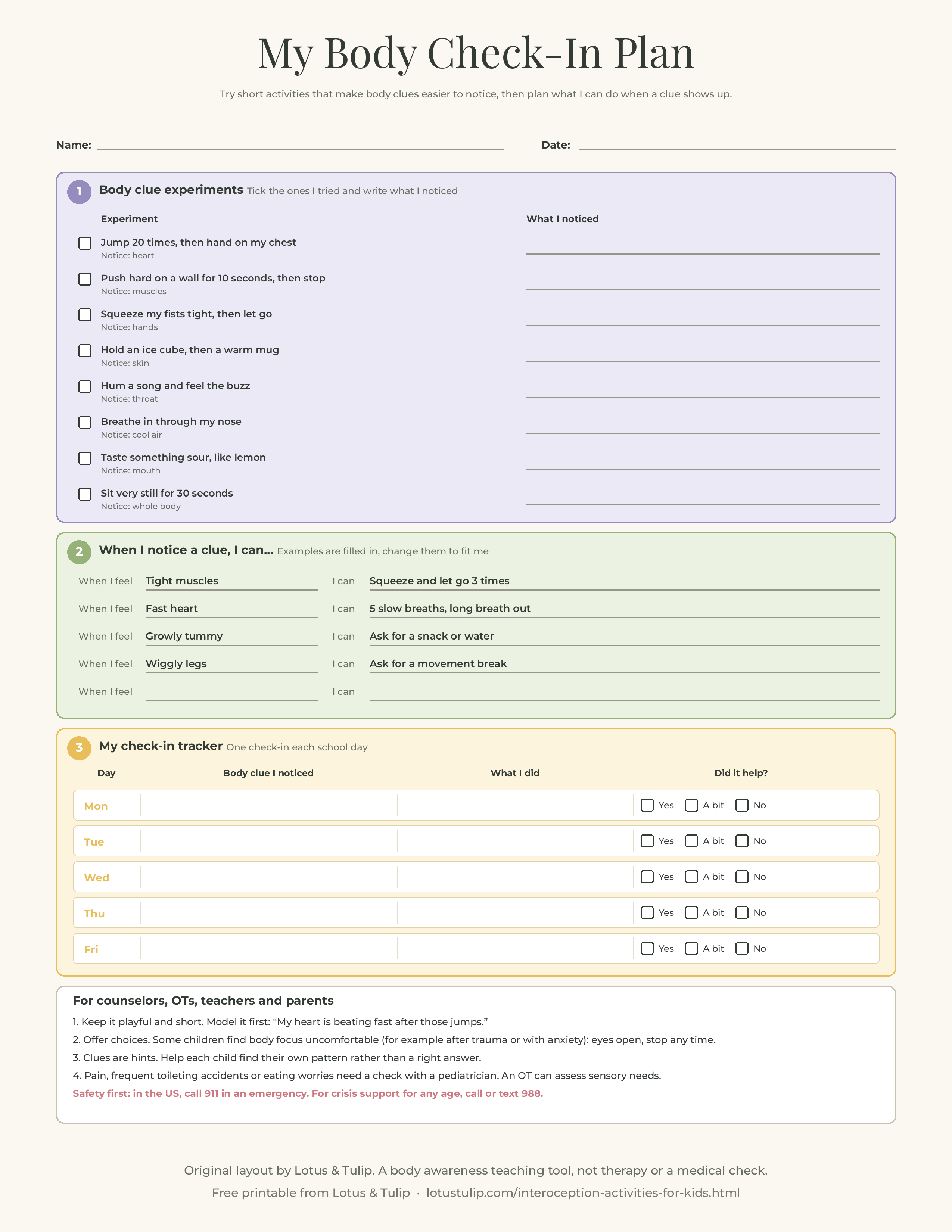
- Make a signal bigger, then notice it. Short experiments make clues easier to feel: 20 jumping jacks then a hand on the chest, a wall push for 10 seconds then letting go, an ice cube then a warm mug.
- Give words for sensations. Offer a menu: fast, slow, tight, loose, hot, cold, heavy, light, fluttery, growly, buzzy. Many children have the sensation but not the word.
- Model out loud. Narrate your own clues: "My stomach is growling. I think I am hungry." Children learn the habit from hearing it.
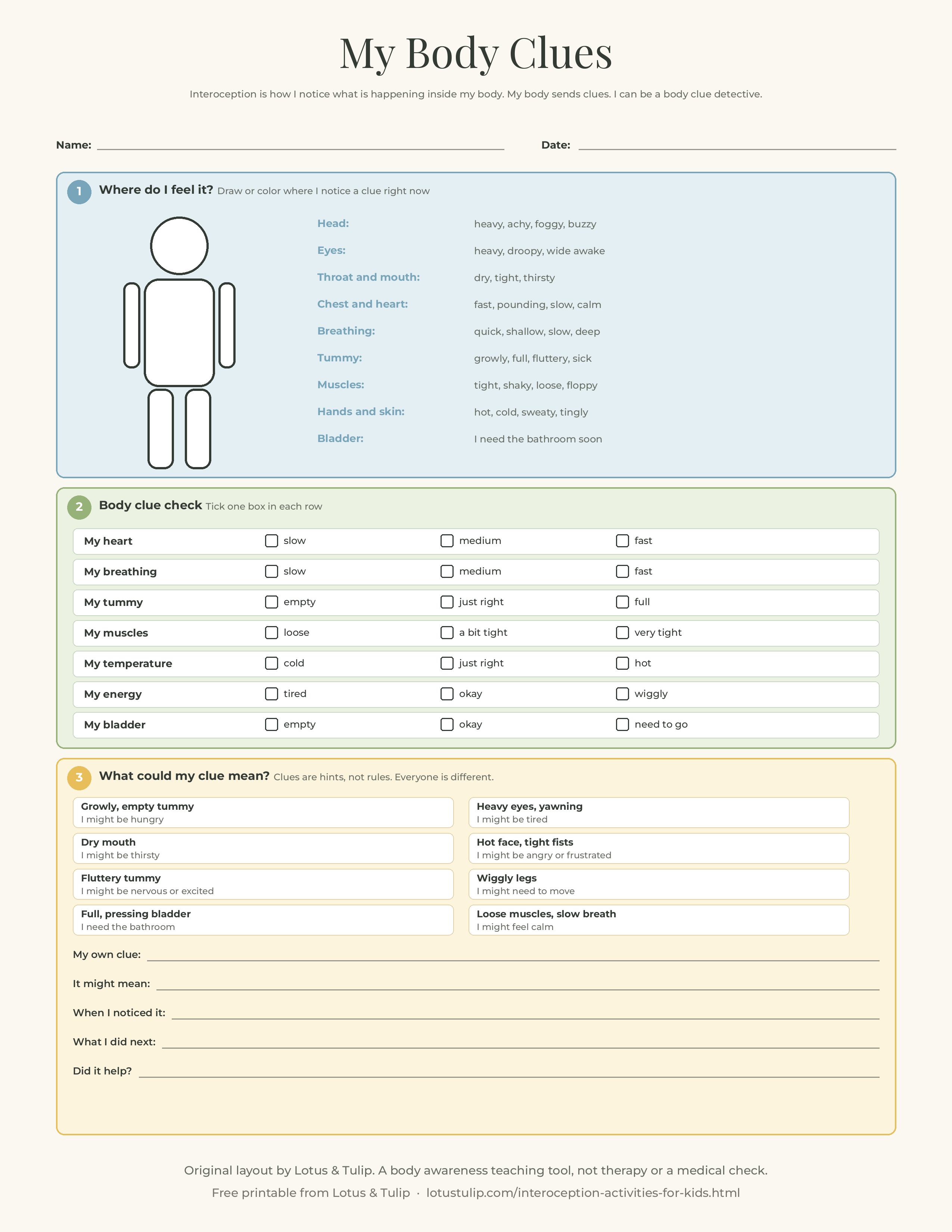
- Map where it happens. Use a body outline and let the child color or mark where they notice something. There are no wrong answers.
- Connect clues to meaning. Once a child can notice a signal, explore what it might mean: a growly tummy might mean hungry, heavy eyes might mean tired, a hot face and tight fists might mean angry. Keep it tentative, because each child's pattern is different.
- Connect meaning to action. Pair each clue with something to do: tight muscles, squeeze and let go; fast heart, slow breaths with a long breath out; wiggly legs, ask for a movement break.
- Check in at set times. A quick body check-in at the start of the day, after recess and before a hard task builds the habit. Short and regular beats long and rare.
- Practice when calm, use it when upset. Teach and rehearse in calm moments. During a meltdown, keep words minimal and help the child regulate first; talk about clues later.
12 interoception activities for kids
- Heartbeat detective: feel your heartbeat at rest, do 20 jumps, feel it again. What changed?
- Wall push: push hard against a wall for 10 seconds, then stop and notice your arms.
- Squeeze and let go: squeeze fists, shoulders or toes tight, then release. Tight vs loose.
- Hot and cold: hold something cool, then something warm, and describe the difference.
- Hum and buzz: hum a song with a hand on your throat or chest and feel the vibration.
- Nose breathing: breathe in through your nose and notice the cool air, then out slowly through your mouth.
- Balloon belly: lie down with a toy on your tummy and watch it rise and fall.
- Sour and sweet: taste something sour, like lemon, then something mild, and notice your mouth.
- Statue freeze: sit very still for 30 seconds and notice anything that wants to move.
- Puffer cheeks: fill your cheeks with air, hold, then let it out. Notice your face muscles.
- Snack check: before and after a snack, rate your tummy from empty to full.
- Short body scan: move attention slowly from toes to head. See our body scan script for wording.
Check allergies and food rules before taste activities, and keep any activity optional.
Adapting it by age and need
- Pre-K and kindergarten. Keep it physical and silly: animal moves, then "how does your heart feel?" Use pictures for body parts and two choices (fast or slow).
- Grades 1 to 3. Use the body outline, the body clue check and simple clue to feeling links. Practice daily for a few minutes.
- Grades 4 to 8. Add a body clue journal, link clues to stress before tests or games, and let students design their own experiments.
- Autistic children. Use concrete language, visuals and predictable routines. Respect sensory preferences, and remember some children feel signals too strongly rather than too weakly.
- Children with trauma or anxiety. Focusing inward can feel unsafe or set off panic. Keep eyes open, offer outside anchors (feet on floor, holding an object), let the child stop at any time, and work with their therapist.
Common mistakes
- Jumping straight to feelings. If a child cannot yet notice body signals, feelings charts alone may not help.
- Telling a child what they feel. "You're not hungry, you just ate" teaches them to ignore their body. Ask and explore instead.
- Treating clues as fixed rules. A fast heart can mean anger, fear, excitement or just running. Teach clues as hints.
- Practicing only during meltdowns. New skills are learned when calm.
- Ignoring medical causes. Toileting, eating and pain concerns need a medical check before they are treated as awareness problems.
Free interoception worksheet
This free printable is an original Lotus & Tulip layout on US Letter. Page 1, My Body Clues, has a body outline to color where a clue is felt with word ideas for each body part, a body clue check (heart, breathing, tummy, muscles, temperature, energy and bladder, three choices each), and a "what could my clue mean?" list with lines for the child's own clue. Page 2, My Body Check-In Plan, has 8 body clue experiments with space to write what the child noticed, a "when I notice a clue, I can" plan with examples, a 5 day check-in tracker, and a guide for adults.
Download the free interoception worksheet (PDF, 2 pages, US Letter)
Prefer single images? Page 1: my body clues (PNG) · Page 2: my body check-in plan (PNG)
Free to print for use with your own students, clients or children. Please link to this page rather than re-uploading the file. A teaching tool, not therapy, an occupational therapy assessment or medical advice. In an emergency in the US, call 911. For crisis support for any age, call or text 988.
Related resources
- Bedwetting worksheets for kids: when a child sleeps through the full bladder signal at night, with a free dry night plan
- Sensory processing activities for kids: too much, too little and seeking, with a free sensory map and day plan
- Whole body listening worksheet (free printable): find what helps each child's body listen
- Emotional regulation worksheets for kids: the next step after noticing body clues
- Body scan meditation script: guided wording, with caveats for anxiety
- Feelings thermometer printable: rate how big a feeling is
- Breathing exercises for kids (free printable): actions for a fast heart
- Calm down corner ideas: a place to use body clue actions
- Coping skills list for kids (free printable): 60 ideas to pair with clues
- Picky eating activities for kids: what is normal, what research shows and a free food explorer plan
FAQ
What is interoception in simple terms?
Interoception is the sense that tells you what is happening inside your body, such as hunger, thirst, a fast heartbeat, tight muscles, feeling hot or cold, or needing the bathroom. For kids, you can call it noticing body clues.
What are examples of interoception activities for kids?
Short experiments that make a body signal stronger and then ask the child to notice it: jumping then feeling the heartbeat, pushing a wall then letting go, squeezing and releasing fists, holding something cold then warm, humming to feel the vibration, and rating hunger before and after a snack.
How is interoception linked to emotional regulation?
Feelings show up as body changes, such as a fast heart or tight muscles. Noticing those clues early gives a child a chance to use a calming strategy before a feeling gets too big. Small school studies have found that interoception lessons were followed by better emotion regulation, but they had no control groups, so more research is needed.
Do autistic children have trouble with interoception?
Many autistic people process internal signals differently, but not in one direction. Some notice signals less, others feel them very strongly. Watch the individual child and ask an occupational therapist for an assessment if you have concerns.
Who can help a child with interoception?
Occupational therapists are the professionals most often trained to assess and support interoception. School counselors, teachers, therapists and parents can practice everyday body clue activities, and a pediatrician should check toileting, eating or pain concerns.
Is this interoception worksheet free?
Yes. It is free to print for use with your own students, clients or children. Please link to this page rather than re-uploading the file.
Sources
- Craig, A. D. (2002). How do you feel? Interoception: the sense of the physiological condition of the body. Nature Reviews Neuroscience, 3(8), 655 to 666. doi:10.1038/nrn894
- DuBois, D., Ameis, S. H., Lai, M.-C., Casanova, M. F., and Desarkar, P. (2016). Interoception in autism spectrum disorder: a review. International Journal of Developmental Neuroscience, 52, 104 to 111. doi:10.1016/j.ijdevneu.2016.05.001
- Garfinkel, S. N., Seth, A. K., Barrett, A. B., Suzuki, K., and Critchley, H. D. (2015). Knowing your own heart: distinguishing interoceptive accuracy from interoceptive awareness. Biological Psychology, 104, 65 to 74. doi:10.1016/j.biopsycho.2014.11.004
- Hample, K., Mahler, K., and Amspacher, A. (2020). An interoception-based intervention for children with autism spectrum disorder: a pilot study. Journal of Occupational Therapy, Schools, and Early Intervention, 13(4), 339 to 352. doi:10.1080/19411243.2020.1743221
- Khalsa, S. S., Adolphs, R., Cameron, O. G., Critchley, H. D., Davenport, P. W., Feinstein, J. S., and colleagues (2018). Interoception and mental health: a roadmap. Biological Psychiatry: Cognitive Neuroscience and Neuroimaging, 3(6), 501 to 513. doi:10.1016/j.bpsc.2017.12.004
- Mahler, K., Hample, K., Jones, C., Sensenig, J., Thomasco, P., and Hilton, C. (2022). Impact of an interoception-based program on emotion regulation in autistic children. Occupational Therapy International, 2022, 9328967. doi:10.1155/2022/9328967
- Mahler, K., Hample, K., Ensor, C., Ludwig, M., Palanzo-Sholly, L., Stang, A., Trevisan, D., and Hilton, C. (2024). An interoception-based intervention for improving emotional regulation in children in a special education classroom: feasibility study. Occupational Therapy in Health Care, 38(3), 636 to 650. doi:10.1080/07380577.2024.2313527
- Murphy, J., Brewer, R., Catmur, C., and Bird, G. (2017). Interoception and psychopathology: a developmental neuroscience perspective. Developmental Cognitive Neuroscience, 23, 45 to 56. doi:10.1016/j.dcn.2016.12.006