
Kids and teens · Updated 2026-11-06
Divorce Activities for Teens (with Free Printable)
Ready-made printable: Changing Families Divorce Small Group Curriculum for School Counselors Holiday 20% off: about $11.04, was $14 (EUR 12) · instant digital download
Buy on Etsy
Divorce activities for teens are practice tools that help middle and high school students name what is changing in the family, sort loyalty binds from healthy loyalty, plan two-home logistics without becoming a messenger or confidant for adult problems, keep school and sports and arts plans workable, talk about dating models and college questions with adults, notice pseudo-maturity and withdrawal, log what helps, and know when to pause for safety. Teen divorce and separation work is not a longer version of divorce worksheets for kids. Identity, peer status, dating models, sports and arts logistics, college talk, loyalty binds, and the temptation to parent a parent raise the stakes. Belonging still matters. So does honesty that conflict and parenting quality often matter more than the legal status of the parents alone.
This Lotus and Tulip page is a teen-focused divorce and changing families guide with an original free three page US Letter printable. It targets searches families and helpers actually use: divorce activities for teens, divorce worksheets for teenagers, coping with parents divorce high school, changing families activities for teens, and teen divorce counseling worksheets. It is distinct from our divorce worksheets for kids (younger two-home pages, adult-coached language about fault and visits), from grief activities for teens (bereavement and continuing bonds when death or pet loss is primary), from emotional regulation activities for teens, from friendship activities for teens, from conflict resolution activities for teens, from peer pressure worksheets for teens, from self esteem activities for teens, from assertiveness worksheet, from coping skills worksheets for teens, from healthy boundaries worksheet, and from safety plan worksheet. Those neighbors help. This page centers adolescent family change: separation, divorce, two homes, loyalty binds, and the teen jobs of staying a kid in the family system while building an adult-ish life plan.
We credit research lineages associated with Joan Kelly and Robert Emery (2003 and related reviews of children and divorce), Paul Amato and colleagues on average effects and conflict, Buchanan, Maccoby, and Dornbusch on feeling caught between parents, and protective-factor summaries that emphasize parenting quality and low conflict. We credit those lineages with clear non-affiliation. We are not affiliated with those authors, any scale publisher, or any branded divorce curriculum. This printable is an original educational layout, not a copy of any copyrighted worksheet and not a diagnosis or treatment.
This guide is educational. It is not therapy, not medical advice, and not a diagnosis. If thoughts of ending your life, plans to harm yourself or someone else, or a medical emergency show up, stop the worksheet and get help now: in the US, call or text 988, text HOME to 741741, or call 911. Our safety plan worksheet is a better first tool in that moment. Nearby tools: divorce for kids, grief for teens, emotion regulation for teens, friendship for teens, conflict for teens, assertiveness, and healthy boundaries.
Jump to the free divorce activities printable (PDF) · How to use divorce activities for teens, step by step · Worked examples · Comparisons
What teen divorce and separation work is (and how it differs from kids divorce pages)
Kids divorce pages often teach that the split is not the child's fault, map two homes with simple visit calendars, and coach adults to answer concrete questions about pets, bedrooms, and who picks up from school. Teen divorce activities keep those bones and add autonomy, identity, peer status, dating models learned from parents, sports and arts logistics across two households, college and money talk, loyalty binds, pseudo-maturity (looking fine while carrying adult loads), and withdrawal that adults sometimes misread as "attitude."
Teen divorce response skills include:
- Safety sort first when crisis risk, self-harm talk, violence at home, or acute danger is present.
- Naming what is changing without forcing fake cheer or forced "closure."
- Sorting loyalty binds from healthy loyalty: you can love both parents without carrying messages, secrets, or adult problems.
- Two-home logistics that protect school, sleep, sports, arts, and friendships.
- Not being a messenger or confidant for adult conflict, money fights, or dating news that belongs to parents.
- Identity and dating models: noticing what you are learning about relationships without becoming a referee.
- College and future talk with adults who stay in the adult seat.
- Knowing when not to force talk: optional practice, never forced public disclosure in class.
Teens also weigh sports teams, arts rehearsals, jobs, group chats, and college applications. A skill that worked with a younger child (color two houses and circle feelings) may feel babyish when the teen needs a calendar that survives two addresses, a script for "I will not carry that message," and adult backup without becoming the family therapist.
Loyalty binds, two homes, and not being a messenger
Loyalty binds show up when a teen feels pressure to side with one parent, hide information, report on the other home, or keep adult secrets. Feeling caught between parents has been linked with poorer adjustment in classic adolescent research (Buchanan, Maccoby, and Dornbusch lineage, credited with non-affiliation). Educational takeaway: protect the teen from the middle seat. Healthy loyalty is "I care about both of you." Unhealthy bind is "I must spy, choose, or soothe adult pain."
Two-home logistics are not busywork. Missed practices, lost textbooks, and sleep chaos amplify stress. Teens need a workable plan for backpacks, meds, devices, rides, and which adult handles school emails. Adults own the co-parenting system. Teens practice asking for clarity, not mediating adult fights.
Messenger and confidant traps. Do not ask teens to deliver money messages, schedule changes laced with blame, or adult dating news. Do not use them as the late-night listening ear for adult loneliness. Pair with healthy boundaries and assertiveness when a teen needs words for "I want to stay out of adult problems."
How to use divorce activities for teens, step by step
- Safety sort. If acute crisis, self-harm plans, violence, or imminent harm, pause. Use crisis pathways first: 988, HOME to 741741, or 911 when needed. Prefer a safety plan in that moment. Do not force public family talk.
- Name what is changing. Write what changed (homes, schedule, adults, pets, school) in one or two fair sentences on the free plan page. Keep it specific. Avoid forcing "I am fine" language.
- Sort feelings and body cues. Sad, angry, relieved, guilty, numb, mixed. Note sleep, appetite, focus. Pair with emotion regulation for teens when flooded.
- Loyalty bind check. Am I carrying messages, secrets, or adult problems? Circle healthy loyalty vs bind. Practice one boundary line with assertiveness or boundaries tools.
- Two-home logistics map. Bag, devices, meds, rides, sports and arts, school contacts. List what adults will own. List what the teen can reasonably track.
- Support map. People, school adults, places, and digital spaces that help versus drain. Circle at least two safe adults who are not in the middle of the fight.
- School and activity plan. Who to tell at school if needed, hard-day options, practice and rehearsal rides, homework drop spots. Protect sleep.
- Future talk without adultifying. College, money basics, dating models: ask adults for clarity. Do not take the parent seat. If grief-like waves dominate after a secondary loss of family form, bridge to grief activities for teens.
- Log and bridge. Record practice on the log page. Bridge to safety plan, coping skills for teens, friendship for teens, conflict for teens, self esteem for teens, peer pressure for teens, or divorce for kids when a younger sibling needs the kids page.
Practice naming and logistics on lower-stakes weeks first when possible, then rely on the full sequence when loyalty binds spike. Skill grows with reps and with adults who keep teens out of the middle.
Protective factors research (honest caveats)
Kelly and Emery lineage (2003 and related). Reviews commonly note that divorce raises risk on average, most children and teens do not develop lasting clinical problems, and what happens around the divorce (conflict, parenting quality, stability) matters a great deal. Credit with clear non-affiliation. This is a map for helpers, not proof that this three page sheet remits distress.
Amato and related average-effects work. Meta-analytic traditions associated with Amato report small average differences across adjustment domains between youth with divorced parents and those in continuously married families, with lots of overlap. Conflict and related stresses often matter as much as or more than legal marital status alone. Credit with non-affiliation. Not a claim that every teen is fine or that every divorce is harmful.
Feeling caught. Adolescent research associated with Buchanan, Maccoby, and Dornbusch links feeling caught between parents with poorer adjustment and with hostile co-parenting. Educational takeaway: keep teens out of messenger and spy roles.
Honest limits. These reviews are not technique-only RCTs of this printable. Adult support, school policy, sleep, safety, and clinical care when indicated matter. No study tests this three page Lotus and Tulip printable alone. Do not claim it remits depression, anxiety, PTSD, or any diagnosis.
Pseudo-maturity, withdrawal, dating models, and college talk
Pseudo-maturity looks like a teen who cooks dinner, calms a younger sibling, and tells adults "I got this" while sleep and grades quietly crash. Looking capable is not the same as having adult support. Helpers should praise real responsibility and still put adults back in the adult seat for money, legal, and dating decisions.
Withdrawal can look like silence, "whatever," canceled plans, or disappearing into games and group chats. It is sometimes protection, sometimes depression risk, sometimes both. Educational sorting helps choose tools. It does not diagnose. Pair flat mood lasting weeks with adult follow-up, and prefer a safety plan if hopelessness or self-harm talk appears.
Dating models. Teens watch how parents fight, repair, date, and talk about ex-partners. Without turning the teen into a confidant, adults can answer short questions about respect and consent and keep adult dating details private. Bridge to healthy boundaries and friendship for teens when peer relationship patterns are the load.
College and money talk. Silence creates rumor. Dump trucks create panic. Steady adult-led clarity about applications, FAFSA roles, and who pays for what belongs to parents and counselors, not to a teen mediating a money fight. Keep the teen informed without making them the broker.
What helps vs common myths
What often helps: honest naming, low conflict in front of teens, warm consistent parenting in each home, predictable logistics, optional counseling, sleep and food basics, peer support that does not force performance, school flexibility on hard days, and skill printables used as practice aids.
Myths to drop:
- "Teens do not care because they shrug." Pseudo-maturity and withdrawal are common. Shrug can be armor.
- "If they take a side, they are choosing love." Siding under pressure can be a bind, not free choice.
- "Using the teen as messenger is efficient." It loads the teen with adult conflict.
- "Divorce always ruins teens." Average risks rise; most teens adapt when conflict is managed and parenting stays warm.
- "Divorce never hurts if parents are polite." Loss of family form, routines, and identity still deserve naming.
- "College talk can wait forever or dump everything tonight." Steady adult-led clarity beats silence or dump trucks.
Worked fictional examples
Teen example, two-home sports logistics (fictional): Maya, age 15, splits weeks between two apartments. Cue: missed volleyball practice twice because rides fell through. Safety sort: no crisis. Name: "Homes changed and practice rides are chaotic." Loyalty check: Mom asked her to tell Dad he is "being selfish" about the schedule. Boundary: "Please text each other about rides. I will not carry that." Logistics map: backpack checklist, shared calendar adults own, one backup ride adult. School plan: tell the counselor once so absences get context. Plan written on the free changing family plan page.
Teen example, loyalty bind and dating models (fictional): Theo, age 16, hears late-night details about a parent's new dating life. Cue: stomach drop, then overhelping younger sibling. Safety sort: no self-harm. Name the bind. Script: "I love you. Adult dating details are too much for me." Bridge to boundaries and self esteem for teens when worth dipped after feeling responsible for a parent's loneliness.
Teen example, withdrawal after separation (fictional): Riley, age 14, says "whatever" and stops texting friends. Cue: grades slip, sleep late. Safety sort: check for hopelessness; no plan to die, but mood is flat. Name: family form changed, friends feel far. Skills: support map plus friendship for teens for one low-stakes reconnect, and emotion regulation for teens when flooded before bed. Adult follow-up if flat mood lasts.
School counselor note (fictional): In a twelve minute meeting, a counselor helps a student fill what changed, feelings and body cues, loyalty bind check, two-home logistics, support map, school next step, and one boundary line. Optional practice, never forced public sharing. Follow district crisis protocols if risk appears. For multi-session groups, pair with a changing families divorce group curriculum rather than stacking every worksheet in one period.
Teen divorce vs kids divorce, grief teens, conflict teens, and friendship teens
| Teen divorce (this page) | Kids divorce | Grief teens | Conflict teens | Friendship teens | |
|---|---|---|---|---|---|
| Main job | Name change, loyalty binds, two-home logistics, not messenger, school and future plan | Younger two-home pages and fault myths | Name loss, continuing bonds, dual process | Cool body, speak, listen, fair options | Healthy vs unhealthy peer bonds |
| Best early use | When teens face separation or divorce with adult support | Younger kids with adult coaching | When bereavement or pet loss is primary | When peer or sibling fights are the scene | When friendship quality is the load |
| Output | Change name, feelings, bind check, logistics, support, school next step, practice log | Two homes and support for kids | Loss name, bond, oscillation plan | Conflict plan and repair | Friendship plan and scripts |
| Cross link | This page | Kids divorce | Grief teens | Conflict teens | Friendship teens |
These tools cooperate. Teen divorce builds the name-bind-logistics-support loop. Kids divorce keeps younger language. Grief teens cover bereavement. Conflict teens cover fair fights. Friendship teens cover peer bonds. Teach one tool clearly before stacking four on day one.
School counselor, therapist, and parent tips
Teens. Prefer concrete scenes over lectures about "family systems theory." Let them reject babyish cartoons. "Name it, drop the messenger job, fix logistics, map support" often lands better than a long theory talk. Keep experiments within their real control. Pair with emotion regulation for teens when flooded, and with self esteem for teens when worth collapsed after feeling responsible for adult pain.
School counselors. Short meetings favor a compressed sequence: safety sort, what changed, feelings and body cues, loyalty bind check, logistics, support map, school next step. Groups can practice optional boundary lines with low-stakes prompts. Never force public disclosure. Follow district crisis protocols if risk appears. Avoid shaming "drama"; target the skill gap and the load (sleep, ADHD supports, trauma, identity-based harm, secondary losses), not the teen's worth. Whole-school flexibility and adult follow-through matter more than any single worksheet.
Therapist tips:
- Stay in the client's language. Reflect their scenes and values. Do not overwrite with your favorite divorce model label on day one.
- Separate loyalty binds, grief-like waves, and trauma load out loud, repeatedly, without diagnosing from a printable.
- Protect before perform. Do not require public sharing as proof of coping.
- Treat logistics as clinical. Rides, sleep, and school access belong in the plan.
- Bridge to neighbors. Safety plan for acute risk, emotion regulation for flooding, coping skills for the menu, assertiveness and boundaries for messenger traps, grief teens when bereavement-like yearning dominates, kids divorce when a sibling needs younger tools.
- Measure function. Ask what changed: fewer messages carried, clearer logistics, earlier adult asks, sleep slightly better, less self-blame.
Parents. Keep conflict away from teens. Do not use them as messengers or confidants. Model calm logistics. Do not force teens to attend every adult conversation to look polite. After a separation, prioritize safety and adult presence, then skill practice when everyone is regulated. Do not turn the plan into a new weapon ("fill this out or else") that makes the worksheet feel like punishment. Ask the school what flexibility exists on hard days, and follow up. For parent-side skill practice, see parenting worksheets calm and connected.
Common mistakes
- Using the teen as messenger or spy so loyalty binds never get named.
- Calling shrug "not caring" when withdrawal or pseudo-maturity is the real pattern.
- Forcing public sharing in class or on social media.
- Ignoring logistics while only talking feelings.
- Ignoring sleep, ADHD supports, trauma load, or identity-based harm while blaming "attitude" alone.
- Using conflict or bullying tools as the first response when the load is family form change and loyalty binds.
- Using it in acute crisis instead of safety first.
- Treating the worksheet as therapy. Paper supports practice. It does not replace a clinician, school policy, or crisis care when problems are severe or lasting.
When not to use this worksheet
Good early uses: a teen who can name what is changing, mild to moderate family change stress with adult support available, homework between counseling sessions, school counseling check-ins, and building a name-bind-logistics-support sequence.
Prefer another tool first when:
- Acute safety risk or medical emergency: stabilize and get help (988, HOME to 741741, 911). Prefer a safety plan.
- Active violence or unsafe contact with a parent: prioritize safety planning, supervision, and emergency protocols over logistics worksheets.
- When younger language fits better: use divorce worksheets for kids.
- When the teen is too flooded to engage: co-regulate first, then return to plan work. See emotion regulation for teens.
- When bereavement is the primary load: use grief activities for teens alongside, not instead of, clinical care when needed.
What the research says (honestly)
Divorce activities and worksheets are a skill practice aid, not a standalone RCT treatment. Do not claim this free printable remits divorce-related distress, depression, anxiety, or any diagnosis.
Kelly and Emery and protective factors. Counselor and family education often credit Kelly and Emery style reviews: raised average risk, substantial resilience, and strong roles for conflict, parenting quality, and stability. Credit with clear non-affiliation.
Amato average effects and conflict. Meta-analytic traditions associated with Amato report small average differences and highlight conflict and related stresses. Credit with non-affiliation. Not technique-only RCTs of this sheet.
Feeling caught between parents. Adolescent research associated with Buchanan, Maccoby, and Dornbusch supports keeping teens out of the middle. Educational credit only.
Honest caveat. Adult support, school policy, sleep, and clinical care when indicated matter. A skill printable is not a standalone RCT treatment and is not a substitute for crisis care. For severe depression, trauma, psychosis, or acute risk, use disorder-appropriate care and crisis pathways. No study tests this three page Lotus and Tulip printable alone.
Free divorce activities printable for teens (PDF)
The free divorce activities printable has three pages in US Letter size:
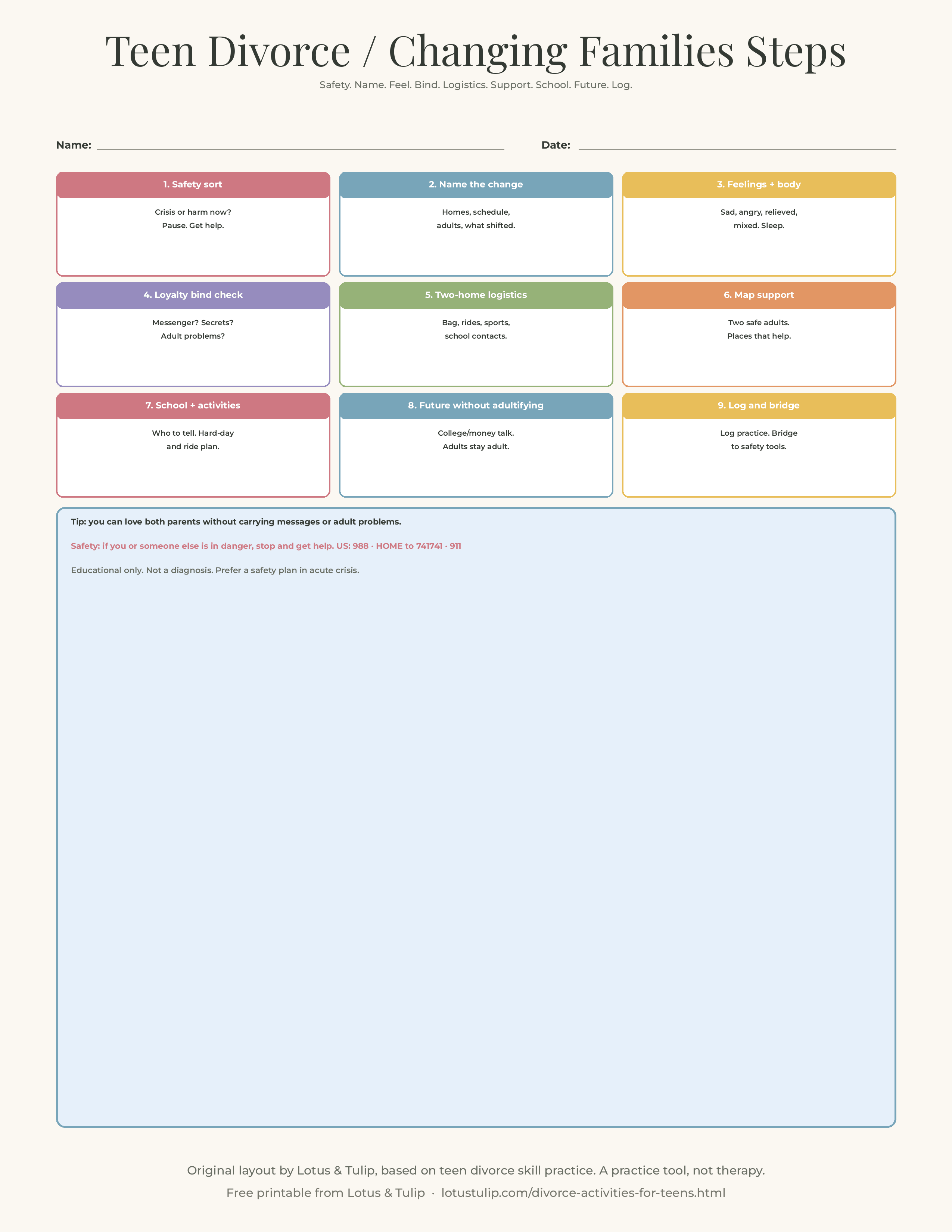
- Page 1: Teen Divorce / Changing Families Steps card. Sequence matching the HowTo: safety sort, name what is changing, sort feelings and body cues, loyalty bind check, two-home logistics, support map, school and activity plan, future talk without adultifying, log and bridge, plus safety reminders.
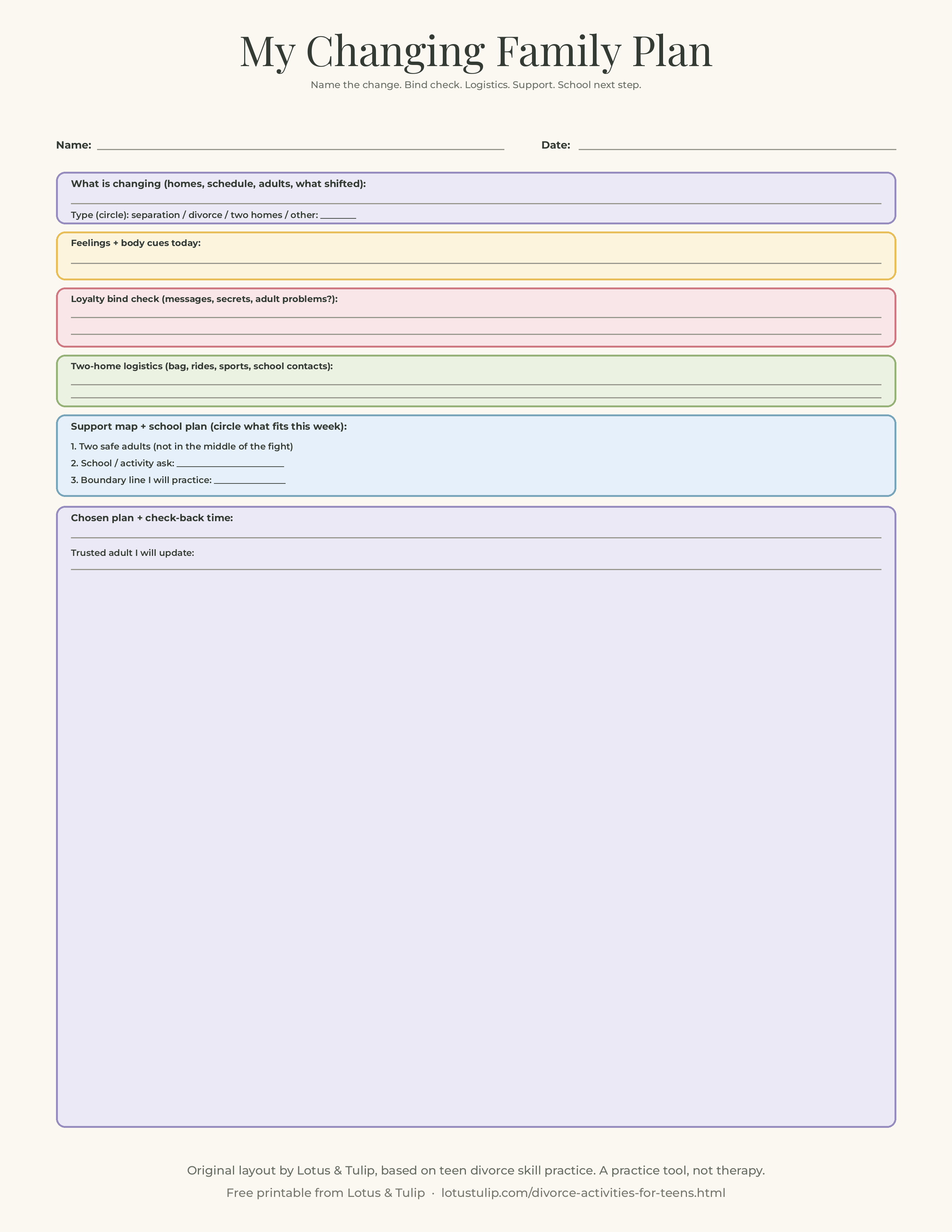
- Page 2: My Changing Family Plan. Fill in what changed, feelings, loyalty bind check, logistics, support people, and school next step.
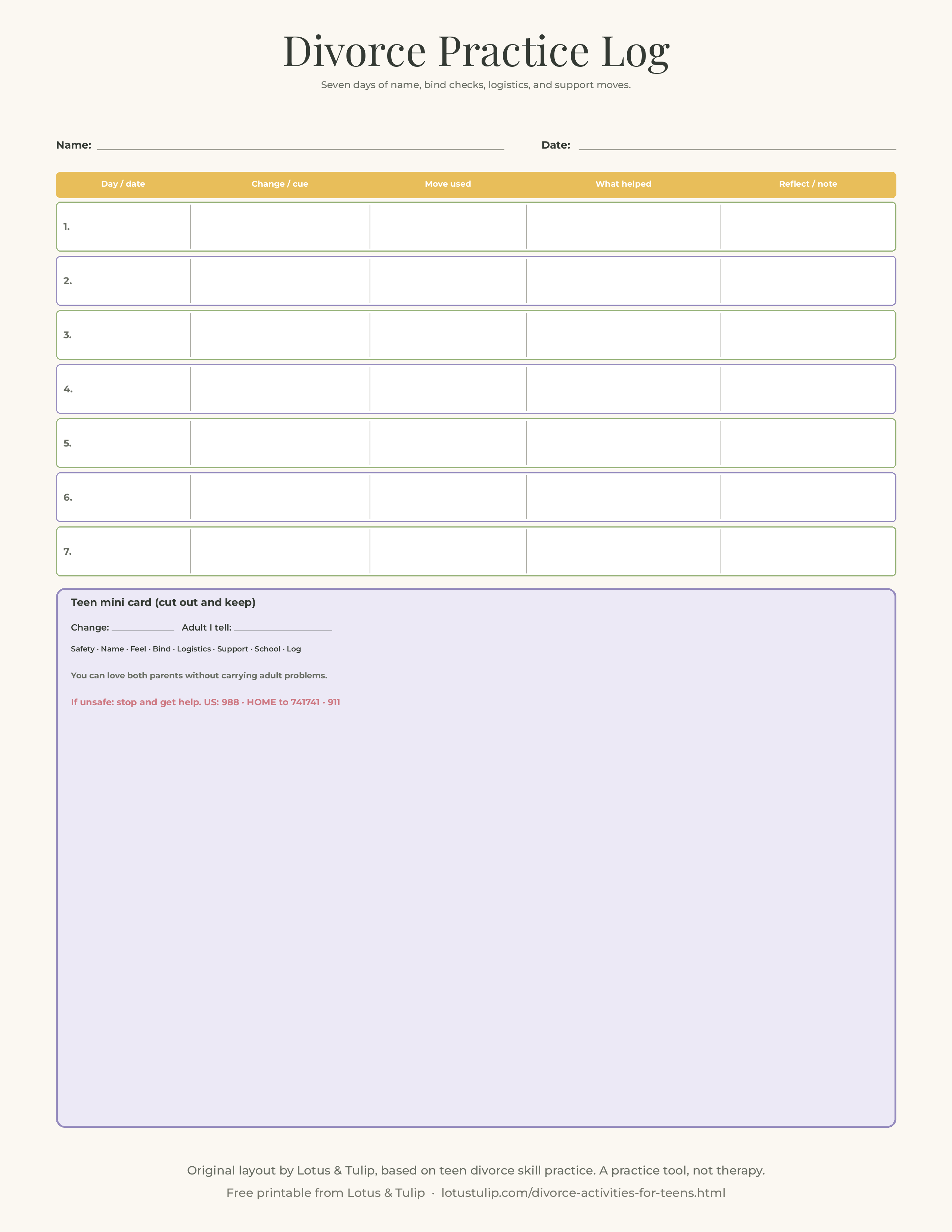
- Page 3: Practice Log + teen mini card. Seven day rows plus a cut out reminder for safety, name, bind, logistics, support, school, log.
Download the free divorce activities printable for teens (PDF, 3 pages, US Letter)
Prefer single images? Page 1: Teen Divorce / Changing Families Steps (PNG) · Page 2: My Changing Family Plan (PNG) · Page 3: Practice Log (PNG)
Free to print for your own use and for use with your own clients, students, or groups. This is an original layout by Lotus & Tulip, based on teen divorce and changing families skill practice associated with Kelly and Emery protective factor neighbors, Amato average-effects context, and feeling-caught research neighbors, with clear non-affiliation. It is not affiliated with those authors, any scale publisher, or any specific treatment or curriculum package, and is not a substitute for therapy. Please link to this page rather than re-uploading the file.
Related resources
- Blended family worksheets for kids: younger stepfamily pages for remarriage and new stepsiblings.
- Divorce worksheets for kids: younger two-home pages and fault myths.
- Grief activities for teens: when bereavement or pet loss is primary.
- Emotional regulation activities for teens: cool body then choose.
- Friendship activities for teens: peer bonds during family change.
- Conflict resolution activities for teens: fair fights outside the family middle seat.
- Peer pressure worksheets for teens: group pressure neighbors.
- Self esteem activities for teens: worth after feeling responsible for adult pain.
- Assertiveness worksheet: words for dropping the messenger job.
- Coping skills worksheets for teens: broad coping menu.
- Healthy boundaries worksheet: limits with adults and peers.
- Safety plan worksheet: when the moment is about staying safe and alive.
Sources
- Kelly, J. B., and Emery, R. E. (2003 and related). Children's adjustment following divorce reviews emphasizing risk, resilience, conflict, and parenting quality. Educational credit with clear non-affiliation. Not a claim that this printable remits distress or diagnoses anything.
- Amato, P. R., and related meta-analytic traditions on average effects of parental divorce and the role of conflict. Educational credit with clear non-affiliation.
- Buchanan, C. M., Maccoby, E. E., and Dornbusch, S. M. Feeling caught between parents in adolescence. Educational credit with clear non-affiliation.
- Honest caveat: teen divorce drills are a skill practice aid. Reviews are not the same as RCTs of this Lotus and Tulip printable. Adult support and clinical care when indicated matter.
Divorce activities for teens: FAQ
What are divorce activities for teens?
They are practice tools for naming family change, sorting loyalty binds, planning two-home logistics, staying out of messenger roles, mapping support, handling school and activity scenes, and logging what helps. They are educational skill aids, not therapy.
Is this the same as the kids divorce page?
No. The kids page uses younger language and two-home pages. This teens page centers adolescent divorce with identity, loyalty binds, dating models, sports and arts logistics, college talk, pseudo-maturity, and withdrawal.
What is a loyalty bind?
A loyalty bind is pressure to side with one parent, carry messages, keep adult secrets, or soothe adult pain. Healthy loyalty is caring about both parents without taking the middle seat. This page does not diagnose. Use safety pathways when risk is high.
Can school counselors use it with teens?
Yes, often in short meetings with safety sort, what changed, loyalty bind check, logistics, support map, and school next steps. Keep practice optional and school safe. Follow crisis protocols when risk appears. Do not use the page as a diagnosis.
How does this relate to grief activities for teens?
Divorce can feel like a secondary loss of family form. Use this page for logistics and loyalty binds. Use the grief teens page when bereavement-like yearning, death, or pet loss is primary.
When should I not use this worksheet?
Do not use it as the first move in acute safety risk, medical emergency, active violence, or when the teen is too flooded to engage. Stabilize and get help when needed: 988, HOME to 741741, or 911. Prefer a safety plan in crisis.
Is this affiliated with Kelly and Emery or Amato?
No. This is an original Lotus and Tulip educational layout. We credit research lineages with clear non-affiliation and do not reproduce copyrighted manual worksheets.