
Special education and behavior support · School counseling · Updated 2026-11-12
Behavior contract for students: how to write one that works (free template and tracker)
Behavior supports kit: Visual Schedule and Behavior Supports, 23 pages with token boards, a reward menu, first then boards and 136 picture cards Holiday 20% off: about $6.44, was $8 (EUR 7) · instant digital download
Buy on EtsyFor home: Parenting Worksheets: Calm and Connected, 30 pages on labeled praise, clear directions, calm consequences and routine charts Holiday 20% off: about $9.20, was $12 (EUR 10) · instant digital download
Buy on EtsyGrades 4 to 8: Executive Function Group Curriculum: Plan It, Do It, a small group on planning, starting, remembering and checking work Holiday 20% off: about $11.04, was $14 (EUR 12) · instant digital download
Buy on EtsyTry it free first: download session 1 free (group at a glance, lesson plan and student page, PDF, 69 KB). Run it with your group, then get all 8 sessions. No email needed.
A behavior contract is a short written agreement between a student and the adults around them. It names one clear goal, the help the adults will give, and what the student earns when they reach it. Done well, it turns "you need to behave" into something a child can actually see, track and win at. Done badly, it becomes one more piece of paper that reminds a struggling student how often they fail.
This guide is for teachers, special education staff, school counselors, school psychologists and parents of children and teens. It covers what a behavior contract is, what the research shows, when a contract is a good fit, how to write one step by step, how to track it and fade it, examples for different ages, and the mistakes that make contracts stop working. It ends with a free 2 page printable: a behavior contract template and a weekly point tracker.
Download the free behavior contract (PDF, 2 pages, US Letter)
Direct download, no email or sign up. See the pages first.
What a behavior contract is
A behavior contract (also called a contingency contract) is a written agreement that spells out three things: the behavior the student will show, the reward for showing it, and what happens when the goal is not met. Everyone involved helps write it and signs it, and progress is checked on a short, regular schedule, usually every class period or every day.
A contract is different from a classroom rule chart because it is built for one student and one or two goals. It is different from a punishment plan because the focus is on what the student will do and what they earn, not on what they lose. And it is usually lighter than a full behavior intervention plan (BIP), although a contract can be one part of a BIP.
What the research says about behavior contracts
Behavior contracts have been studied in applied behavior analysis for more than 50 years. The most useful summary for schools is a meta-analysis by Lisa Bowman-Perrott, Mack Burke and colleagues at Texas A&M University ("A meta-analysis of single-case research on behavior contracts: effects on behavioral and academic outcomes among children and youth", Behavior Modification, 2015). They pooled 18 single-case studies with 58 children and youth aged 5 to 21 and found a moderate overall effect (Tau-U 0.57), with results ranging from small to very large across studies.
Three findings matter for practice:
- Contracts helped students of all ages and both genders, with and without disabilities. Grade level, gender and disability status did not change whether contracts worked.
- They were better at reducing problem behavior than at building new behavior. A contract can motivate a student to use a skill they already have. If the student does not yet have the skill, such as asking for help or starting a task, you need to teach it as well.
- Academic outcomes improved too. When students spent less time in problem behavior, work completion and accuracy tended to rise.
Do contracts need a penalty for missed goals? An earlier study by Teresa Kidd and Richard Saudargas (Education and Treatment of Children, 1988) compared contract versions with two elementary students who rarely finished their daily arithmetic. A contract with the positive part alone was enough to keep completion and accuracy high; adding a negative consequence was not needed. That is one reason the free template below uses a calm fresh start plan instead of penalties.
The same paper by Bowman-Perrott and colleagues notes that contracts have been used with students with emotional and behavioral disorders, ADHD, autism, intellectual disabilities and traumatic brain injury, and in classrooms, homes and clinics. Keep the limits in mind: single-case studies involve small numbers of students, and a contract is one tool, not a full plan for serious or dangerous behavior.
When a behavior contract is a good fit, and when it is not
A contract works best when:
- The student can do the behavior some of the time, for example raising a hand, staying in the work area or handing in homework, but does not do it consistently.
- The student is old enough to understand a simple "if I do this, I earn that" agreement. For most children that is from about age 6 or 7. Younger children and many students with significant disabilities do better with a token board or a first then board, which are more visual and more immediate.
- Adults can check the behavior often and keep their part of the deal every day.
A contract is a poor fit when the behavior is dangerous, when it happens because the student is trying to escape work that is too hard, or when nobody knows why it happens. In those cases, talk to your school psychologist, BCBA or the student's team about a functional behavior assessment (FBA) first. If a student has an IEP and their behavior gets in the way of their learning or other students' learning, the IEP team is required under IDEA to consider positive behavioral interventions and supports, and a contract may be written into the BIP rather than used on its own.
The parts of a good behavior contract
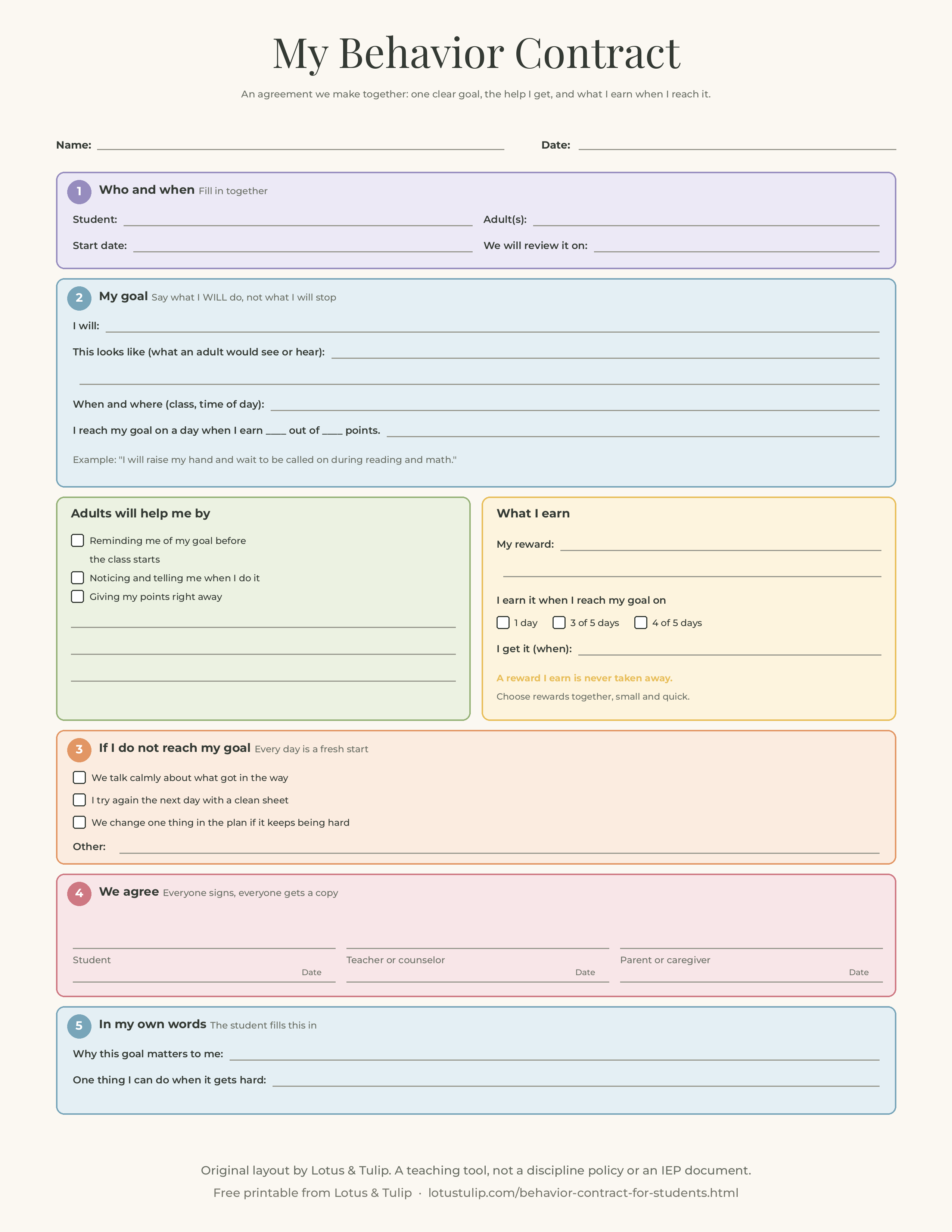
- One or two goals, written as what the student will do. "I will stay in my seat during independent work" is clearer than "no wandering".
- What it looks like. Describe the behavior so that any adult walking into the room would score it the same way.
- When and where. Which classes, times or routines the contract covers.
- A clear success criterion. For example, 9 out of 12 points in a day, or 4 out of 5 days in a week.
- What the adults will do. Reminders before the hard part of the day, quick praise, immediate points, a check-in. A contract is a two sided agreement.
- The reward and when it is delivered. Chosen with the student, small, quick and realistic for the school or family.
- A fresh start plan. What happens on a day the goal is not met. Keep it calm and short: talk about what got in the way, start again tomorrow.
- A review date and signatures from the student, the teacher or counselor and, ideally, a parent or caregiver.
How to write a behavior contract, step by step
- Pick one target behavior. Choose the behavior that causes the most trouble for learning, then flip it into a positive goal. Calling out becomes "I will raise my hand and wait to be called on". Two goals is the limit for a first contract.
- Define it so anyone can score it. Write what an adult would see or hear. "Respectful" is too vague; "I use a calm voice and ask before I take materials" is clear.
- Get a baseline. Track the behavior for 3 to 5 days without the contract. If the student currently meets the goal in 3 of 6 periods, start there.
- Set a goal the student can reach on day one. Begin slightly above the baseline, for example 4 or 5 of 6 periods. Early success is what makes a contract work. You can raise the bar later.
- Choose the reward together. Ask the student what they would work for, and offer a short menu: extra computer time, a lunch with a favorite adult, a class job, free drawing, a note or call home with good news. Avoid big, expensive or far off rewards.
- Write down what the adults will do. Name the reminders, the praise and the check-ins. This is the part most contracts leave out, and it is often the part that makes the difference.
- Meet, read it aloud and sign it. Go through the contract with the student, ask them to explain it back in their own words, and have everyone sign. Give a copy to the student, the family and each adult who scores it.
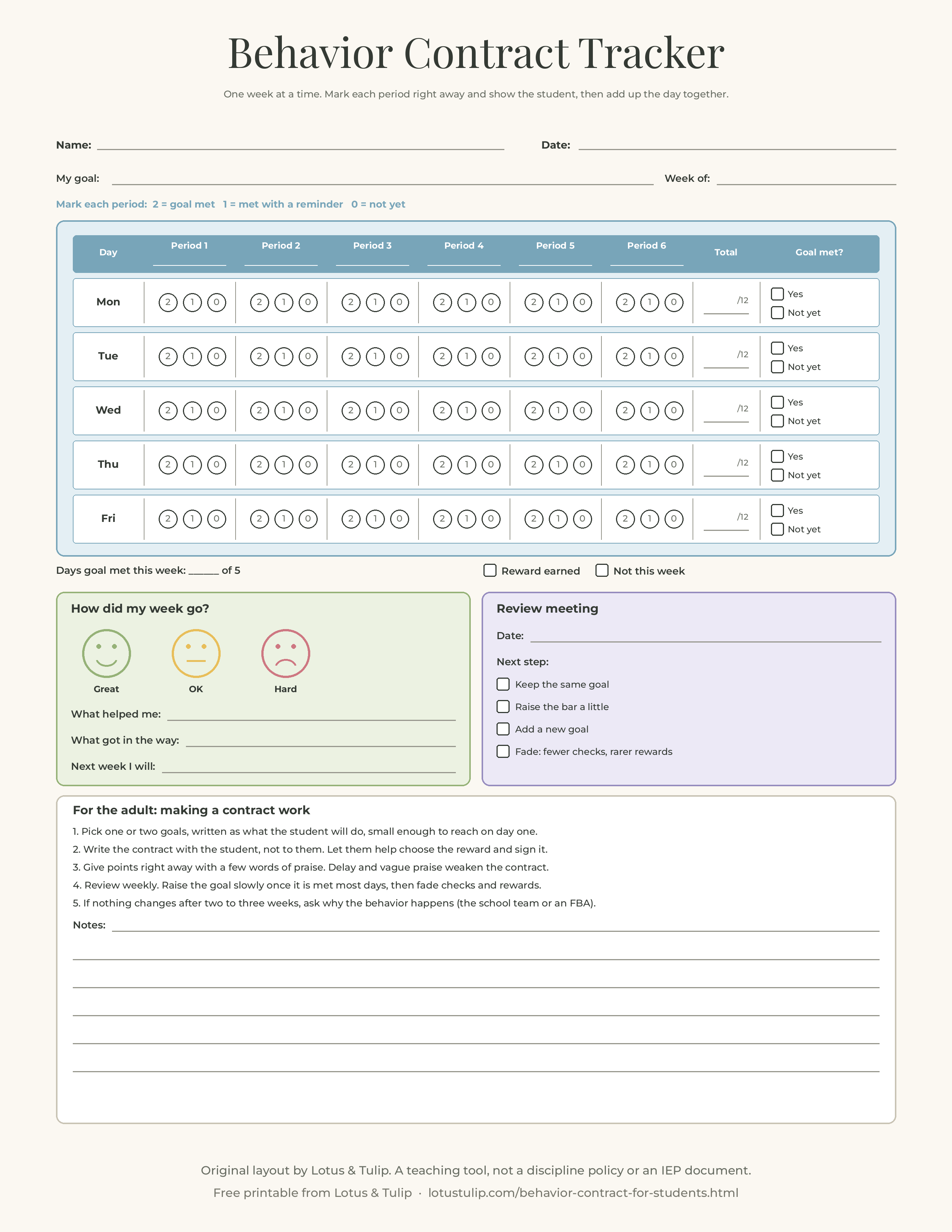
- Track every period and give feedback right away. Mark the tracker at the end of each period, show the student, and add a few words of specific praise when they earn their points. Add up the day together.
- Review weekly, then raise the goal or fade. When the student meets the goal most days for one to two weeks, raise the criterion a little or move from daily rewards to weekly ones. Over time, check less often until the contract is no longer needed.
How to track a behavior contract
The free tracker uses a simple 0 to 2 scale for each of six periods: 2 means the goal was met, 1 means it was met after a reminder and 0 means not yet. That gives 12 points a day, so a daily goal can be written as "9 out of 12". The reminder column matters: it rewards a student for recovering, which keeps them motivated on a hard day.
If your school already uses Check-In Check-Out (CICO) as a Tier 2 support, a contract fits well alongside it: the CICO point card is the tracker and the contract adds the student's own goal, the agreed reward and signatures. Keep the data. A simple graph of daily points over three or four weeks will tell you, and the student's team, whether the contract is working.
Behavior contract examples by age
- Grades 1 to 3: "I will keep my hands and feet to myself in line and on the carpet." Six check points, goal 8 of 12, reward of choosing a class job or 5 minutes of a favorite activity at the end of the day. Use pictures on the contract and very short reviews.
- Grades 4 to 6: "I will start my independent work within 2 minutes of the directions." Goal 9 of 12 points on 4 of 5 days, reward of lunch with a chosen adult on Friday. Pair it with a simple task starter checklist.
- Middle school: "I will bring my planner and complete materials to every class and write down the homework." Teachers initial each period. Goal 4 of 5 days, reward agreed with the family at home, such as extra screen time or a later bedtime on Friday.
- High school: "I will attend first period on time." Teen chooses the reward, often privileges or a work related incentive. Keep the language adult to adult and let the student set part of the goal.
- Home: "I will finish my homework before screen time on school nights." One check per evening, goal 4 of 5 nights. Pair it with calm, clear directions and labeled praise rather than reminders and threats.
Common mistakes
- Too many goals. A list of six rules is a rule chart, not a contract. Start with one.
- Goals written as "don't". "Don't call out" tells the student what to stop but not what to do instead.
- A first goal that is too hard. If the student fails the first three days, the contract is dead. Set the bar so they win early.
- Rewards that are too far away. A pizza party at the end of the month is too distant for most children. Daily or weekly works better.
- Taking earned rewards away. Once earned, a reward stays earned. Losing it for an unrelated behavior teaches the student the contract cannot be trusted.
- Adults forgetting their side. Missed check-ins and late points weaken the contract quickly. If a substitute or a specials teacher is involved, give them a copy.
- Never fading it. A contract is a bridge. Plan from the start how you will move to fewer checks and less frequent rewards.
Free behavior contract template and tracker
This free printable is an original Lotus & Tulip layout on US Letter. Page 1, My Behavior Contract, has who and when (student, adults, start and review dates), a positively worded goal with what it looks like, when and where and a points criterion, what adults will do to help, what I earn and when (1 day, 3 of 5 or 4 of 5 days), a fresh start plan for days the goal is not met, signature lines for the student, the teacher or counselor and a parent or caregiver, and an "in my own words" box. Page 2, Behavior Contract Tracker, is a weekly point sheet with six periods a day scored 2, 1 or 0, daily totals out of 12, a goal met check, a weekly total, a student self rating with what helped and what got in the way, a review meeting box (keep, raise the bar, add a goal or fade) and a short guide for adults.
Download the free behavior contract (PDF, 2 pages, US Letter)
Prefer single images? Page 1: behavior contract template (PNG) · Page 2: weekly tracker (PNG)
Free to print for use with your own students, clients or children. Please link to this page rather than re-uploading the file. A teaching tool, not a discipline policy, an IEP or a behavior intervention plan. For dangerous or frequent behavior, work with your school team on a functional behavior assessment.
Related resources
- Self-monitoring checklist for students: teach the student to check their own behavior, with a free self-check sheet and graph
- Token board printable: a more visual option for younger students
- First then board printable: the simplest "if, then" support
- Break card printable: when behavior is about escaping hard tasks
- Daily check in for students
- Impulse control worksheets for kids: teach the skill behind the goal
- Goal setting worksheet for students
FAQ
What is a behavior contract for students?
A behavior contract is a short written agreement between a student and the adults who support them. It names one or two goals written as what the student will do, how the adults will help, what the student earns for reaching the goal and when progress will be reviewed. Everyone signs it.
Do behavior contracts work?
Research suggests they do for many students. A 2015 meta-analysis of 18 single-case studies with 58 children and youth aged 5 to 21 found a moderate overall effect, with benefits across grade levels, genders and disability status. Contracts were stronger at reducing problem behavior than at building new skills, and academic outcomes also improved.
What should be included in a behavior contract?
Include one or two positively worded goals, a description of what the behavior looks like, when and where it applies, a clear success criterion, what adults will do to help, the reward and when it is delivered, what happens if the goal is not met, a review date and signatures from the student, the teacher or counselor and a parent.
What age are behavior contracts for?
Written contracts usually work from about age 6 or 7 through high school, as long as the student understands the agreement. Younger children and students who need more visual support often do better with a token board or a first then board.
How long should a behavior contract last?
Review it every week. Once the student meets the goal most days for one to two weeks, raise the goal a little or fade the contract by checking less often and moving to weekly rewards. If nothing has improved after two to three weeks, rethink the goal, the reward or the reason for the behavior.
Is this behavior contract template free?
Yes. It is free to print for use with your own students, clients or children. Please link to this page rather than re-uploading the file.
Sources
- Bowman-Perrott, L., Burke, M. D., de Marin, S., Zhang, N., and Davis, H. (2015). A meta-analysis of single-case research on behavior contracts: effects on behavioral and academic outcomes among children and youth. Behavior Modification, 39(2), 247 to 269.
- Kidd, T. A., and Saudargas, R. A. (1988). Positive and negative consequences in contingency contracts: their relative effectiveness on arithmetic performance. Education and Treatment of Children, 11(2), 118 to 126.
- Individuals with Disabilities Education Act regulations, 34 CFR 300.324(a)(2)(i): consideration of positive behavioral interventions and supports.