
Therapists and counselors · Updated 2026-11-07
CBT-I Worksheets: Sleep Diary, Stimulus Control, and Free Printable
Ready-made printable: Sleep and Insomnia Worksheets for Therapists Holiday 20% off: about $9.20, was $12 (EUR 10) · instant digital download
Buy on Etsy
CBT-I worksheets give therapists and counselors a structured way to track sleep, teach stimulus control, plan a clinician guided sleep window, build a wind down, park worries earlier in the day, and challenge catastrophic beliefs about sleep. This guide is written for US clinicians working with adult clients who have chronic insomnia symptoms. Adults who struggle with sleep can use the free printable too, ideally with a trained clinician beside them, because sleep restriction and related schedule changes need clinical judgment.
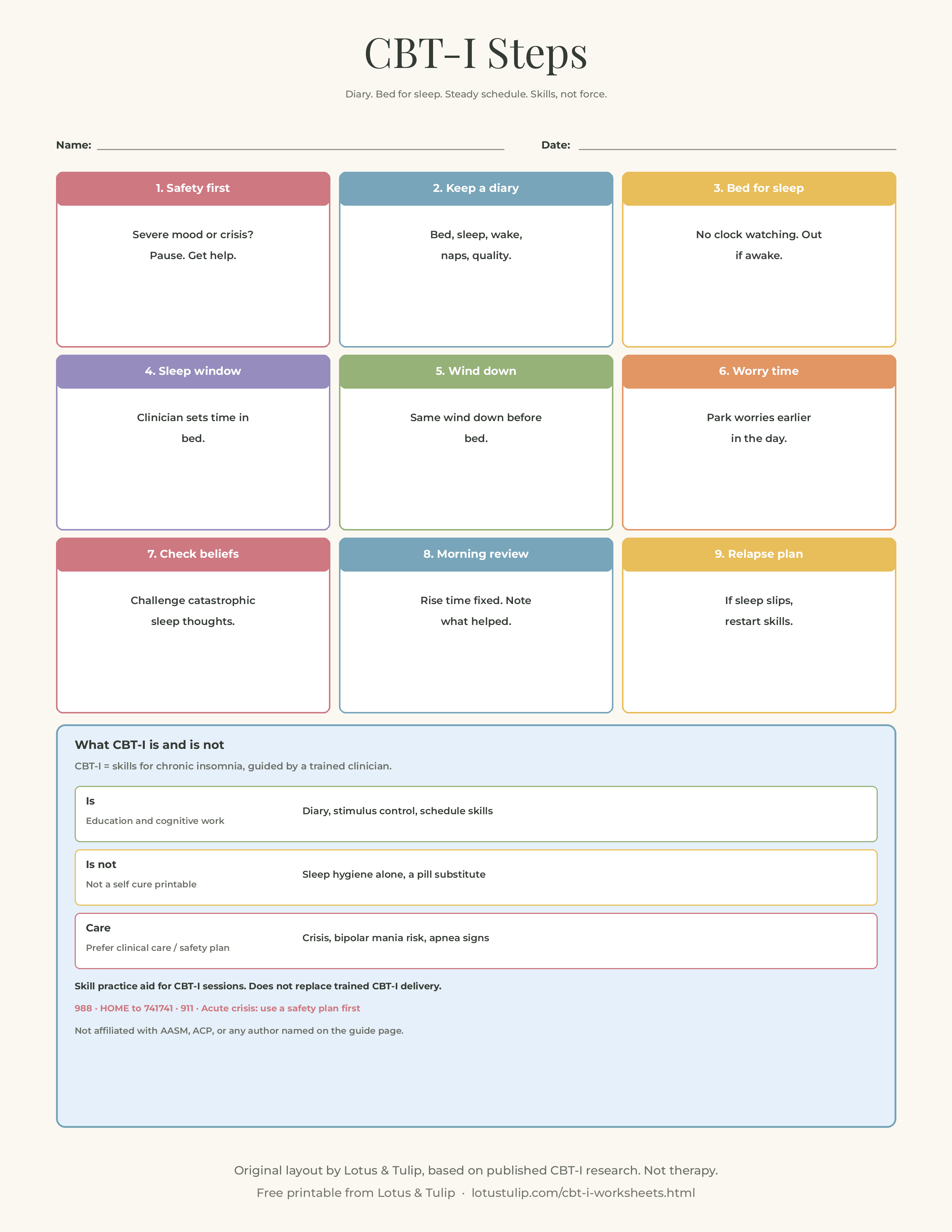
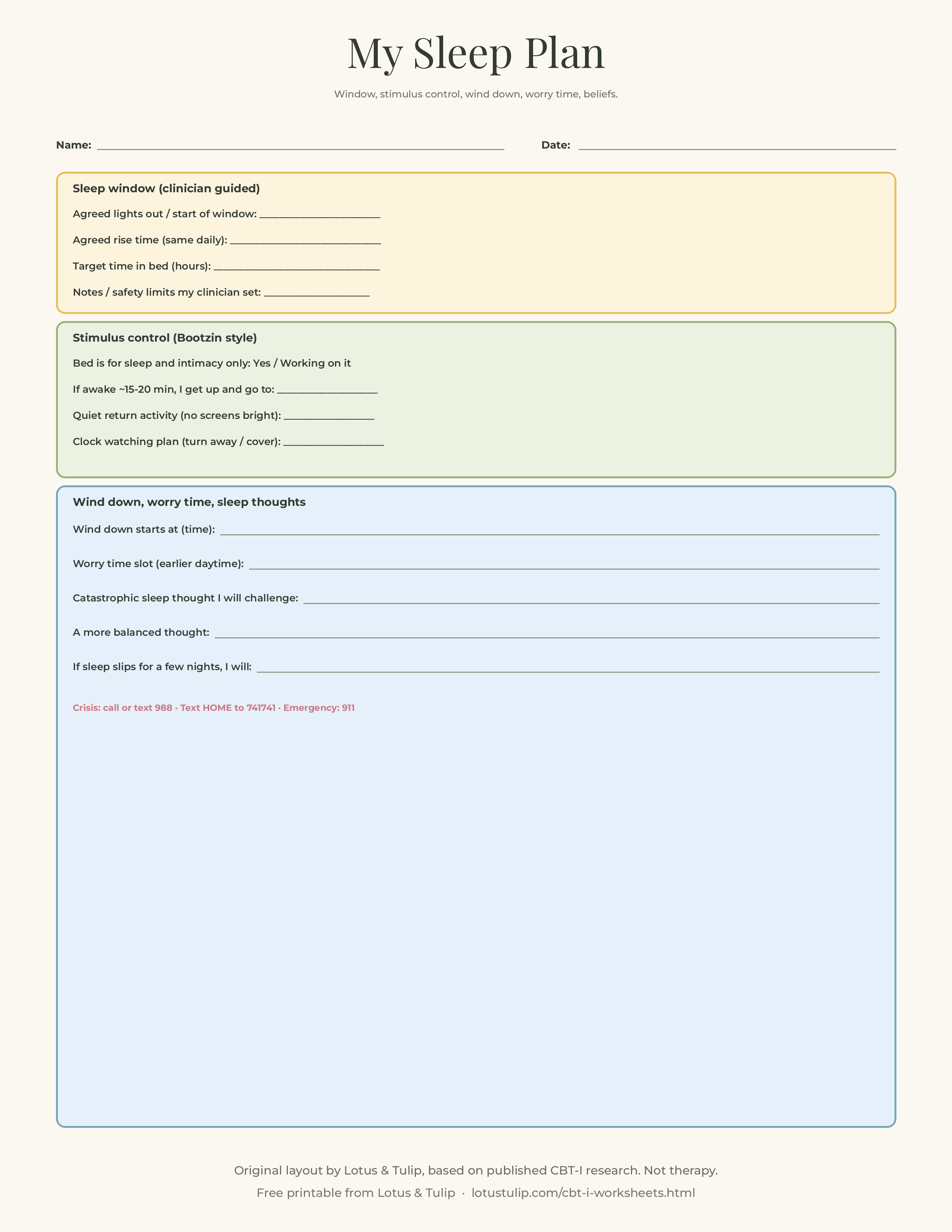
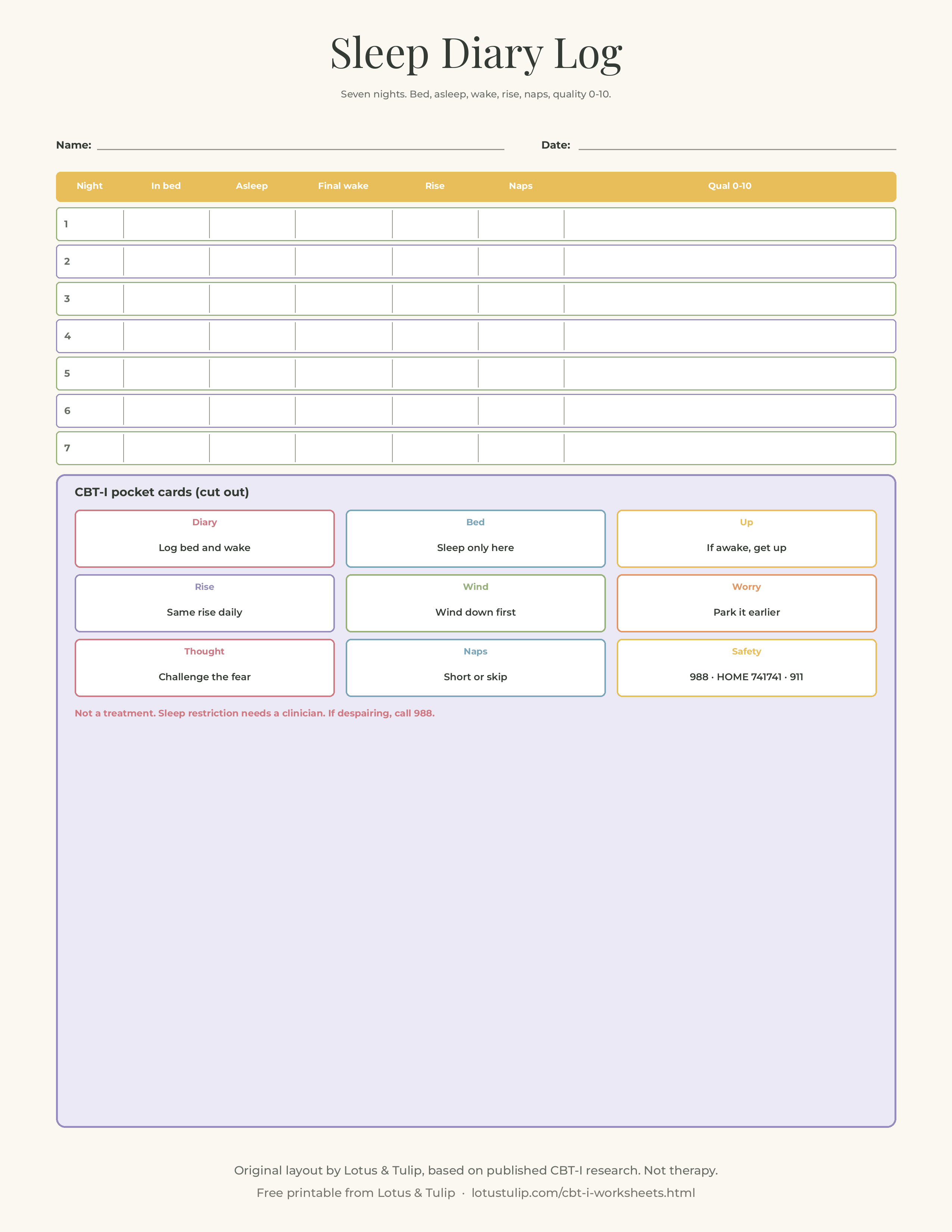
You will get twelve worksheet backed practices with timing and debrief questions, a six session starter plan, adaptations for common clinical situations, honest notes on what the research does and does not show, three fictional examples, seven FAQs, a nine step HowTo and a free three page US Letter printable: CBT-I Steps, My Sleep Plan, and a Sleep Diary Log with nine pocket cards.
This page is distinct from our short sleep hygiene worksheet, which covers basic hygiene tips only. It is also distinct from behavioral activation, urge surfing, anxiety and depression worksheet guides, grief worksheets for adults and ERP worksheets for OCD. Those pages serve other goals. This one is for CBT for insomnia style skill practice with adult clients.
We draw on published insomnia research and clinical guidelines without claiming any affiliation or endorsement: Bootzin stimulus control (1972); Spielman, Saskin and Thorpy sleep restriction (1987); CBT-I work associated with Morin and colleagues; the Trauer and colleagues (2015) Annals of Internal Medicine meta-analysis; the American College of Physicians 2016 guideline recommending CBT-I as initial treatment for chronic insomnia in adults; and the American Academy of Sleep Medicine 2021 strong recommendation for multicomponent CBT-I. The printable is an original Lotus and Tulip layout.
This guide is educational. Worksheets do not treat insomnia by themselves and do not replace CBT-I delivered by a trained clinician. Sleep restriction can increase short term sleepiness and is not appropriate for every client. If you or someone you support is thinking about suicide, call or text 988 (Suicide and Crisis Lifeline) or text HOME to 741741 (Crisis Text Line). For immediate danger, call 911. For a written plan for a crisis moment, see our safety plan worksheet.
What CBT-I worksheets are (and are not)
CBT-I stands for cognitive behavioral therapy for insomnia. In clinical practice it usually combines a sleep diary, stimulus control, a carefully prescribed sleep window (often called sleep restriction or sleep compression), sleep education, wind down routines, and cognitive work on unhelpful beliefs about sleep. Worksheets are the paper trail: they help clients notice patterns, practice skills between sessions and review progress with the clinician.
What they are not.
- Not sleep hygiene alone. The AASM 2021 guideline suggests clinicians not use sleep hygiene as a single component therapy for chronic insomnia. Hygiene tips can support a fuller plan, but a checklist of caffeine and screens is not CBT-I.
- Not a self cure printable. These pages are skill practice aids. They do not diagnose insomnia, rule out apnea or restless legs, or replace a clinician who can adjust a sleep window safely.
- Not forced early bedtimes. Many people with insomnia already spend too long in bed trying to force sleep. CBT-I often shortens time in bed first, then expands it when sleep consolidates. That decision belongs with a trained clinician.
- Not a pill substitute slogan. Some clients use medication and CBT-I together. Others prefer skills first. Shared decision making matters. Worksheets do not tell anyone to stop a prescribed medicine.
- Not a treatment claim for printables alone. Strong evidence supports clinician delivered CBT-I. A free three page PDF is a support tool inside that work, not a standalone course of therapy.
Good CBT-I worksheets leave room for clinical judgment. A diary row is not a moral score. A missed rise time is data, not failure. The tone of the page matters because many adults with insomnia already feel ashamed of "failing at something everyone else does." Your prompts should sound like a collaborative experiment: notice, adjust, practice, review.
It also helps to separate assessment from intervention on paper. Early pages capture what is happening now. Later pages introduce stimulus control and a sleep window only after you have enough diary nights and a clear safety picture. Mixing those steps on one crowded sheet often tempts people to change everything on night one.
How CBT-I tends to work: ideas that shape good worksheets
1. The bed becomes a cue for sleep, not for worry. Bootzin (1972) described stimulus control for insomnia: lie down when sleepy, keep the bed for sleep and intimacy, get up if sleep does not come, keep a steady rise time, and avoid using the bed for incompatible activities. Worksheets turn those rules into a concrete plan the client can review each night.
2. Extra time in bed can perpetuate insomnia. Spielman, Saskin and Thorpy (1987, Sleep) treated 35 adults by restricting time in bed to roughly their reported sleep time, then extending time in bed as sleep efficiency improved. Over eight weeks, sleep latency, wake time, efficiency and subjective insomnia improved, with gains still present at follow up in those assessed. The method is powerful and also demanding. Worksheets should frame sleep window changes as clinician guided, with safety checks for daytime sleepiness, driving and mood.
3. Multicomponent CBT-I has a strong evidence base for chronic insomnia in adults. Trauer, Qian, Doyle, Rajaratnam and Cunnington (2015, Annals of Internal Medicine) meta-analyzed 20 randomized trials (1,162 adults) of face to face, multimodal CBT-I versus inactive controls in uncomplicated chronic insomnia. At posttreatment, sleep onset latency improved by about 19 minutes, wake after sleep onset by about 26 minutes, and sleep efficiency by about 9.9 percentage points. Total sleep time rose by about 7.6 minutes and that change was not statistically significant. Benefits appeared sustained at later time points in the synthesis. The review excluded comorbid medical, sleep and psychiatric insomnia samples, so results do not automatically generalize to every clinic case.
4. Major guidelines name CBT-I as first line for chronic insomnia in adults. The American College of Physicians (Qaseem and colleagues, 2016) strongly recommends CBT-I as the initial treatment for chronic insomnia disorder in adults. The American Academy of Sleep Medicine (2021) strongly recommends multicomponent CBT-I for chronic insomnia disorder in adults, with conditional suggestions for brief therapies, stimulus control alone, sleep restriction alone and relaxation alone, and a conditional suggestion against sleep hygiene alone.
5. Thoughts about sleep matter. Catastrophic predictions ("If I do not sleep eight hours I will fail tomorrow") raise arousal at bedtime. Cognitive worksheets help clients catch those thoughts, test them and write more balanced alternatives. That cognitive strand sits beside the behavioral work, not instead of it. Clinical manuals associated with Morin, Perlis, Espie and others describe this combination in detail; this page is not affiliated with those authors.
When you explain these ideas to clients, keep the story simple. Insomnia is often maintained by extended time in bed, conditioned arousal in the bedroom, irregular schedules and anxious effort to force sleep. CBT-I aims to reverse those maintaining factors. Predisposing traits and precipitating stress still matter, which is why Spielman's broader 3P framing (predisposing, precipitating, perpetuating) is a useful teaching neighbor even when your worksheet set focuses on perpetuating habits.
Be honest about timelines. Many people feel worse before they feel better when time in bed is shortened, because sleepiness rises before consolidation arrives. Prepare clients for that dip. Write it into the plan so a rough first week is expected data rather than proof that the method "is not for me."
Twelve worksheet backed CBT-I practices
Use these in session and as optional homework. Times are approximate. Always screen for safety, bipolar spectrum risk with sleep loss, untreated sleep apnea signs and severe depression before aggressive schedule changes.
1. Baseline sleep diary (one to two weeks)
Time: 5 minutes each morning. When: before changing the schedule.
Record lights out, estimated sleep onset, night awakenings, final wake, rise time, naps and sleep quality (0 to 10). Estimate total sleep and time in bed so the clinician can calculate sleep efficiency. Page three of the free printable is a seven night diary. A longer diary lives in the full sleep pack.
Debrief: "Looking at the week, where did time in bed stretch far past actual sleep?"
2. Stimulus control plan sheet
Time: 15 minutes. When: after a few nights of diary data.
Write Bootzin style rules in the client's words: bed for sleep and intimacy only; get up after about 15 to 20 minutes awake; quiet low light activity in another room; return when sleepy; same rise time daily; no clock watching. Name the return activity in advance so 3 a.m. decisions are easier.
Debrief: "What will you do in the other room that is dull enough not to wake you further?"
3. Sleep window education worksheet (clinician guided)
Time: 20 minutes. When: once baseline sleep time is clear and medical red flags are addressed.
Explain that the clinician, not the printable, sets the initial time in bed, often near average reported sleep with a floor for safety. Track sleep efficiency and plan how and when the window may widen. Note daytime sleepiness, driving limits and mood. Do not hand a client a blank "cut your sleep to five hours" form without clinical oversight.
Debrief: "What feels hardest about the proposed window, and what safety limits should we write down?"
4. Wind down routine planner
Time: 10 to 15 minutes. When: early, and revise as needed.
Pick a start time 30 to 60 minutes before the sleep window. List screens off or dimmed, lights lowered, a short stretch or shower, a paper book or audio that is not activating, and a place for the phone outside the bed. Keep it boring on purpose.
Debrief: "Which one step of the wind down is most likely to slip, and what cue will protect it?"
5. Constructive worry / worry time
Time: 15 minutes to set up; 10 to 20 minutes daily practice. When: when bedtime becomes a worry conference.
Schedule a daytime worry slot. Write worries and one next step for each. At night, if worries return, note "parked until tomorrow's slot" and return to the wind down. Pair with stimulus control so the bed is not the place those lists get written.
Debrief: "Did any worry actually need a 2 a.m. decision, or could it wait for the daytime slot?"
6. Dysfunctional beliefs about sleep worksheet
Time: 15 to 25 minutes. When: when clients treat one short night as a catastrophe.
List beliefs such as "I must get eight hours or tomorrow is ruined," "I have lost the ability to sleep," or "I should stay in bed longer to catch up." For each, write evidence for, evidence against and a balanced alternative. Keep language respectful; these beliefs often grew from real exhaustion.
Debrief: "Which belief raises your body arousal the most when you climb into bed?"
7. Morning review and rise time log
Time: 5 minutes each morning. When: throughout CBT-I.
Log actual rise time, whether the alarm won, caffeine timing, mood (0 to 10) and one thing that helped the night before. Consistency of rise time is often as important as bedtime for consolidating sleep.
Debrief: "On the mornings you rose on time, how did the next night look?"
8. Sleep efficiency calculation sheet
Time: 10 minutes in session. When: weekly review.
Sleep efficiency is roughly total sleep time divided by time in bed. Clinicians use this to decide whether to hold, widen or tighten the window. Clients can learn the idea without becoming perfectionistic about every minute. Avoid obsessive night by night recalculation that feeds clock watching.
Debrief: "What does this week's efficiency suggest about our next schedule step?"
9. Daytime sleepiness and nap decision card
Time: 10 minutes. When: when naps or nodding off threaten the plan.
Rate sleepiness, note risky activities (driving, childcare, machinery) and decide with the clinician whether a brief early nap is allowed. Write a hard stop time. Never trade safety for a pure protocol.
Debrief: "Where do we put safety ahead of the schedule this week?"
10. Catastrophic sleep thought record
Time: 15 minutes. When: mid protocol, after some behavioral wins.
A short CBT thought record focused on sleep: situation (lying awake), thought, emotion and body cues, evidence, alternative thought, and planned behavior (get up if needed, no clock check). Link to the stimulus control plan so cognitive work does not become another reason to stay in bed arguing with thoughts.
Debrief: "What did your body do when the thought softened even a little?"
11. Relapse and setback plan
Time: 15 to 20 minutes. When: before ending active CBT-I skills work.
Define a setback (for example, three rough nights). List early skills to restart: diary for a week, stimulus control, protect rise time, shorten wind down distractions. Include when to contact the clinician and crisis lines if despair appears. Insomnia often returns under stress; a written restart plan reduces panic.
Debrief: "If next month is hard, what is the first page you will pull out?"
12. Weekly CBT-I review sheet
Time: 15 minutes. When: each session.
Summarize diary averages, adherence to stimulus control and rise time, sleepiness and mood, belief work done, and one goal for the next week. Celebrate small consolidations. Adjust only one major schedule lever at a time when possible.
Debrief: "What is the single skill that helped most this week?"
Across all twelve practices, keep language concrete. Prefer "get out of bed after about 15 to 20 minutes awake" over vague advice like "only sleep when sleepy" without a plan. Prefer "rise at 6:30 even after a short night" over "try to keep a routine." Prefer "write the worry at 5 p.m." over "do not worry in bed" with no alternative. Worksheets work when they turn principles into next actions.
Also plan for literacy, vision and language needs. Large print, fewer columns and oral completion in session help. If English is a second language, simplify clock labels and avoid idioms. If a client cannot safely leave the bed at night because of mobility or caregiving duties, adapt stimulus control with the clinician rather than forcing a rule that creates new harm.
Core CBT-I components your worksheets should cover
Most clinician delivered CBT-I packages combine several parts. Your worksheet set does not need a separate page for every lecture slide, but the free printable and the fuller sleep pack should make each component visible.
Sleep diary. Without measurement, schedule changes are guesswork. Morning completion beats night completion. Teach clients to estimate rather than stare at the clock all night.
Stimulus control. Rebuild the bed as a cue for sleep. The rules are old, simple and still central. Worksheets fail when they list the rules without a personalized "where I go" and "what I do" plan.
Sleep restriction or compression. Match time in bed more closely to actual sleep, then expand. Compression uses smaller steps and may fit older adults or fragile clients better. Either way, the clinician owns the number.
Cognitive therapy for sleep. Target beliefs and nighttime mental habits that keep arousal high. Pair with behavioral rules so clients do not debate thoughts for an hour under the covers.
Relaxation and wind down. Progressive muscle relaxation, breathing or a simple wind down can help some people. They are helpers, not a replacement for schedule and stimulus work when insomnia is chronic.
Relapse prevention. Skills fade under stress travel illness and deadlines. A one page restart plan is worth more than a perfect discharge summary that nobody rereads.
Sleep hygiene education can appear as a short supporting list: light, caffeine timing, alcohol, environment. Keep it short so it does not swallow the session. Clients have usually heard the hygiene lecture. What they have not practiced is getting out of bed when sleep will not come, protecting rise time and changing the sleep window with guidance.
Making the sleep diary usable
A diary that is too complex will be abandoned by night three. Aim for columns the client can finish in under five minutes with coffee in hand. If your clinic uses total sleep time and sleep efficiency, calculate those in session at first rather than demanding perfect home math.
Watch for perfectionism. Some clients restart a night's row five times or annotate every awakening to the minute. That habit feeds insomnia. Give permission for rounded estimates. Say out loud that the goal is pattern detection, not courtroom evidence.
Partners sometimes fill diaries for the sleeper. That can help when memory is poor, and it can also create conflict. Agree who writes what. The sleeper's subjective experience still matters, even when a partner insists "you were asleep."
A six session starter plan for CBT-I style work
Real CBT-I length varies. Many protocols run roughly six to eight sessions. This table is a starter structure for individual therapy, not a rigid protocol. Medical screening and safety come first.
| Session | Focus | Optional take home page |
|---|---|---|
| 1 | History, safety and red flags, introduce diary, basic education on why time in bed can backfire | Sleep diary (practice 1) |
| 2 | Review diary, teach stimulus control, begin wind down plan | Stimulus control plan and wind down (practices 2 and 4) |
| 3 | Set clinician guided sleep window if appropriate, sleepiness and safety plan | Sleep window education and nap decision (practices 3 and 9) |
| 4 | Worry time, beliefs about sleep, clock watching | Worry time and beliefs pages (practices 5 and 6) |
| 5 | Thought record for catastrophic sleep thoughts, morning review habits | Thought record and morning review (practices 7 and 10) |
| 6 | Efficiency review, adjust window carefully, relapse plan, next steps | Weekly review and relapse plan (practices 8, 11 and 12) |
If six sessions are too few, extend diary and stimulus control weeks before you touch the sleep window. If eight or more sessions are available, keep a fuller cognitive module and a longer relapse rehearsal. Group CBT-I is common in some clinics; the same worksheet sequence can run in group with shared teaching and private diary review.
Document informed consent for sleep restriction style work: expected short term sleepiness, driving caution, mood monitoring and the right to pause. A one paragraph consent note in the chart protects the client and the clinician.
How to use CBT-I worksheets, step by step
- Screen first. Ask about suicidal thoughts, severe depression, mania or hypomania history, loud snoring or gasping, restless legs, alcohol and sedating medicines, pregnancy and shift work. Pause aggressive schedule change when risk is high. Use a safety plan if crisis risk is present.
- Start the diary before big changes. One to two weeks of honest morning logging beats guessing.
- Teach stimulus control in plain language. Write the rules together. Rehearse the "get up and return" loop.
- Build a wind down that is boring on purpose. Protect it from email and bright screens.
- Set a sleep window only with clinical judgment. Explain why, write safety limits and plan how you will widen time in bed later.
- Add worry time earlier in the day. Keep lists out of the bed.
- Challenge catastrophic sleep beliefs. One or two thoughts at a time is enough.
- Review weekly with numbers and compassion. Adjust one major lever at a time when you can.
- Write a relapse plan before discharge. Insomnia often returns under stress. Skills restart faster than panic.
Print the free three page set once and keep a blank stack in your office. Clients who struggle with phone diaries often do better with paper beside the bed (filled in the morning, not during the night). If you use a digital diary app in your clinic, still keep the printable plan page so stimulus control and wind down rules stay visible on the fridge or nightstand.
Adaptations
- Older adults: Watch fall risk when getting up at night. Use sleep compression (gentler reductions) when full restriction is too harsh. Protect morning light and daytime activity.
- Comorbid anxiety: Pair CBT-I pages with anxiety tools. Do not let cognitive work become another reason to stay in bed.
- Depression: Low energy can make rise time brutal. Coordinate with behavioral activation. If hopelessness is severe, prioritize mood and safety over sleep experiments. See depression and behavioral activation worksheets.
- Suspected sleep apnea: Refer for evaluation. CBT-I can still help some people with comorbid insomnia, but ignoring apnea signs is unsafe.
- Bipolar spectrum: Sleep loss can destabilize mood. Restrictive schedules need specialist collaboration and often softer targets.
- Shift workers: Standard fixed rise times may not fit. Adapt circadian principles carefully rather than forcing a day worker template.
- Telehealth: Screen share the diary. Mail or email the printable. Confirm the client has a safe place to go when leaving the bed at night.
- Trauma related insomnia: Nighttime may feel unsafe. Titrate stimulus control, add grounding and trauma informed pacing. Consider trauma worksheets when nightmares dominate.
Perinatal clients: Sleep is fragmented by feeding and recovery. Focus on opportunity for sleep, partner shifts and stimulus control for non feeding time in bed, rather than aggressive restriction.
Chronic pain: Getting out of bed may be hard. Collaborate on a safe "out of bed" alternative such as a recliner with low light, and coordinate with pain care so the plan is realistic.
Substance use: Alcohol fragments sleep even when it helps someone fall asleep. Include a non judgmental substance log beside the diary when relevant, and refer for specialty care when use is heavy.
Tips for therapists and counselors
- Lead with the diary. Numbers reduce arguments about "I never sleep."
- Spell out safety for daytime sleepiness, especially driving.
- Expect adherence dips. Problem solve barriers instead of blaming the client.
- Keep sleep hygiene as a support, not the whole treatment.
- Coordinate with prescribers when hypnotics are in play. Do not freelance medication advice from a worksheet page.
- Celebrate consolidated sleep even when total sleep time has not yet risen much. Efficiency often improves before duration.
- Review diaries at the start of session before storytelling takes the hour.
- Graph sleep efficiency for visual learners, then put the graph away so it does not become another obsession.
- Practice the "get up" routine in session with a quick role play. Ambiguity at 3 a.m. kills adherence.
- Ask about partners who complain when the client leaves the bed. A short partner handout reduces conflict.
- Watch for orthosomnia: anxiety about perfect tracker numbers. Sometimes you remove wearable sleep scores for a few weeks.
Common mistakes
- Starting sleep restriction without a diary or medical screen.
- Letting clients invent an extreme sleep window from a blog post.
- Clock watching under the name of "tracking."
- Using the bed for laptop work, then wondering why stimulus control fails.
- Dropping rise time consistency while obsessing over bedtime.
- Treating one bad night as proof that CBT-I failed.
- Skipping relapse planning so the first stressful week undoes the gains.
- Using the diary as a weapon ("See, you slept more than you think") in a shaming tone.
- Changing bedtime, rise time, nap rules and caffeine on the same night.
- Ignoring caregiver realities (infants, night shifts, shared studios with no second room).
- Forgetting to ask about late workouts, nicotine and heavy evening fluids that undermine an otherwise good plan.
Myths about CBT-I and worksheets
- Myth: "Sleep hygiene tips are enough." Reality: AASM 2021 suggests against sleep hygiene as sole therapy for chronic insomnia.
- Myth: "More time in bed fixes short sleep." Reality: Extra time in bed often fragments sleep further for people with insomnia.
- Myth: "If I try hard enough I can force sleep." Reality: Effort and performance pressure raise arousal. Stimulus control and wind down reduce that fight.
- Myth: "A printable replaces a CBT-I clinician." Reality: Evidence is strongest for multicomponent CBT-I delivered with clinical skill. Pages support that work.
- Myth: "CBT-I never helps when depression or anxiety is present." Reality: Many clients have comorbid symptoms. Protocols and referrals need tailoring; comorbidity alone is not an automatic stop.
Three fictional examples
Maya, 42, primary care referred for chronic insomnia. Two weeks of diary showed five and a half hours of sleep spread across eight and a half hours in bed, plus long mid night phone checks. Her clinician taught stimulus control, covered the phone clock and set a carefully limited sleep window with a driving safety rule. By week five her sleep was more solid. Total sleep rose only a little at first, which matched Trauer and colleagues' pattern where efficiency and wake time improved more clearly than total sleep in the pooled trials.
Jordan, 35, anxiety and bedtime catastrophizing. Stimulus control alone was not enough because Jordan stayed in bed arguing with thoughts. Adding daytime worry time and a sleep thought record helped. Anxiety worksheets sat beside the sleep plan so nighttime did not become the only place feelings got attention.
Alex, 58, loud snoring and morning headaches. The clinician paused sleep restriction, referred for apnea evaluation and used only gentle wind down and rise time work until medical results returned. The worksheets were still useful as a diary and wind down plan, but the case shows when not to push schedule restriction.
In each example the worksheets were scaffolding, not the therapy. Maya needed a firm window and clock discipline. Jordan needed cognitive and anxiety tools. Alex needed medical triage. Matching the page to the maintaining factor mattered more than handing every client the full stack on day one.
How this page compares to nearby Lotus and Tulip guides
| Page | Best for | Not the same as CBT-I worksheets |
|---|---|---|
| Sleep hygiene worksheet | Quick hygiene checklist | Not multicomponent CBT-I |
| Behavioral activation | Depression, daytime routine | Not a sleep diary protocol |
| Urge surfing | Riding out urges | Not stimulus control for sleep |
| Anxiety worksheets (product) | Worry and anxiety skills | Complement, not a sleep window plan |
| ERP for OCD | Exposure and response prevention | Different target problem |
| Grief worksheets for adults | Bereavement support | Grief may disturb sleep, different focus |
When not to use these worksheets
- Acute suicidal crisis or inability to keep self safe. Use crisis care and a safety plan first. Call or text 988, text HOME to 741741, or call 911 for immediate danger.
- Active mania or a clear history where sleep loss triggers mania, unless a specialist is guiding care.
- Untreated signs of sleep apnea, narcolepsy or other primary sleep disorders that need medical evaluation first.
- Severe depression with inability to function, until mood and safety are stabilized enough for schedule experiments.
- As a DIY extreme sleep cut without clinical oversight.
Free 3 page CBT-I printable (US Letter)
Download the free printable, print on US Letter and use in session or as homework.
- Page 1: CBT-I Steps. Nine steps that match the HowTo above, what CBT-I is and is not, and crisis resources.
- Page 2: My Sleep Plan. Clinician guided sleep window, stimulus control, wind down, worry time and belief prompts.
- Page 3: Sleep Diary Log. Seven nights of bed, asleep, wake, rise, naps and quality, plus nine pocket cards.
Download free PDF · Page 1 PNG · Page 2 PNG · Page 3 PNG
Research notes (verified, with caveats)
- Bootzin RR. Stimulus control treatment for insomnia. Proceedings of the 80th Annual Convention of the American Psychological Association. 1972;7:395-396.
- Spielman AJ, Saskin P, Thorpy MJ. Treatment of chronic insomnia by restriction of time in bed. Sleep. 1987;10(1):45-56. Thirty five adults; eight week program; improvements in sleep parameters with follow up gains in those assessed.
- Trauer JM, Qian MY, Doyle JS, Rajaratnam SMW, Cunnington D. Cognitive behavioral therapy for chronic insomnia: a systematic review and meta-analysis. Ann Intern Med. 2015;163(3):191-204. Twenty trials, 1,162 adults; SOL about -19 min; WASO about -26 min; SE about +9.9%; TST about +7.6 min (not significant); uncomplicated chronic insomnia samples.
- Qaseem A, Kansagara D, Forciea MA, Cooke M, Denberg TD; Clinical Guidelines Committee of the American College of Physicians. Management of chronic insomnia disorder in adults: a clinical practice guideline from the American College of Physicians. Ann Intern Med. 2016. Strong recommendation for CBT-I as initial treatment.
- Edinger JD and colleagues for the American Academy of Sleep Medicine. Behavioral and psychological treatments for chronic insomnia disorder in adults: an AASM clinical practice guideline. Journal of Clinical Sleep Medicine. 2021. Strong recommendation for multicomponent CBT-I; conditional suggestion against sleep hygiene as sole therapy.
- Clinical manuals and reviews associated with Morin, Perlis, Espie and others describe CBT-I components in depth. This page is not affiliated with those authors or organizations.
We do not invent effect sizes beyond what these sources report. Clinic cases with comorbidity may differ from Trauer and colleagues' inclusion criteria.
Trauer and colleagues limited inclusion to uncomplicated chronic insomnia and face to face multimodal CBT-I versus inactive controls. That design strengthens internal clarity and limits claims about comorbid populations, digital only programs and head to head drug comparisons. ACP 2016 and AASM 2021 still place CBT-I first for chronic insomnia in adults based on broader evidence reviews, including older adults in parts of the ACP synthesis. When you cite these sources to clients, say what they measured and what they did not.
Single component findings also matter for worksheet design. AASM 2021 offers conditional suggestions for stimulus control alone and sleep restriction alone, and a conditional suggestion against sleep hygiene alone. That is why this free set leads with diary, stimulus control and a clinician guided window, and treats hygiene as supporting detail rather than the main event.
CBT-I worksheets: FAQ
What are CBT-I worksheets?
They are structured pages that support cognitive behavioral therapy for insomnia: sleep diaries, stimulus control plans, clinician guided sleep window education, wind down and worry time, belief work, morning review and relapse planning. Therapists use them in session and as homework.
Do CBT-I worksheets treat insomnia by themselves?
No. Evidence is strongest for multicomponent CBT-I delivered with clinical skill. Printables are practice aids inside that care, not a standalone cure.
Is sleep hygiene the same as CBT-I?
No. Sleep hygiene is education about habits that may support sleep. AASM 2021 suggests clinicians not rely on sleep hygiene alone for chronic insomnia. CBT-I adds diary based behavioral and cognitive components.
Is sleep restriction safe?
It can help consolidate sleep when guided carefully, and it can also increase short term sleepiness. It is not appropriate for every client. A clinician should set the window, watch mood and daytime safety, and know when to pause.
Can I use the free printable without a therapist?
You can use the diary, wind down and gentle stimulus control ideas, but do not invent an extreme sleep cut on your own. If sleep problems come with despair, snoring with gasping, or mood swings, seek clinical care. For crisis, call or text 988 or text HOME to 741741.
How is this different from your sleep hygiene worksheet?
The hygiene page is a short checklist. This CBT-I page covers diary work, stimulus control, schedule education, cognitive skills and a fuller free three page printable mapped to a therapist sleep pack.
What if insomnia comes with severe depression or suicidal thoughts?
Prioritize safety and mood treatment. Use a safety plan, contact a clinician, and call or text 988 or text HOME to 741741. Call 911 for immediate danger. Sleep experiments can wait until it is safe to run them.