
Therapist worksheets · Updated 2026-11-06
Urge Surfing Worksheet: How to Ride Cravings Like a Wave, with a Free Printable
Ready-made printable: Relapse Prevention Worksheets Holiday 20% off: about $9.20, was $12 (EUR 10) · instant digital download
Buy on Etsy
Urge surfing is a mindfulness skill for riding a craving or impulse the way a surfer rides a wave: notice it, stay with the body sensations, breathe through the peak, and let the urge fall without fighting it or acting on it. G. Alan Marlatt described the method inside cognitive behavioral relapse prevention. Later Mindfulness-Based Relapse Prevention (MBRP) programs, especially the work of Sarah Bowen and colleagues, made urge surfing a core practice for people at risk of returning to substance use. The same wave metaphor now shows up in DBT style distress tolerance work, ACT style willingness work, and school or clinic work with teens who feel "send the text," binge, check, or lash out urges.
This guide explains what urge surfing is, when to use it and when not to, how to practice step by step, self talk scripts, adult and teen examples, a worked fictional example, how it compares with TIPP, opposite action, radical acceptance, cognitive defusion, and ACCEPTS distraction, tips for therapists and school counselors, common mistakes, and what the research honestly shows. You also get a free three page US Letter printable: an Urge Surf Steps card, an Urge Surfing Worksheet with an intensity timeline, and a seven day Urge Practice Log with a short teen mini card.
This guide is educational. It is not therapy, not detox advice, and not a diagnosis. If thoughts of ending your life, plans to harm yourself or someone else, or a medical emergency show up, stop the worksheet and get help now: in the US, call or text 988, text HOME to 741741, or call 911. Our safety plan worksheet is a better first tool in that moment. For a broader aftercare plan, see the relapse prevention plan worksheet.
Jump to the free urge surfing worksheet (PDF) · How to practice urge surfing, step by step · Worked example · Adult and teen examples
What urge surfing is (Marlatt and MBRP lineage)
An urge is a strong desire or impulse to do something right now. Substance cravings are the classic teaching case. The method also applies to binge eating urges, compulsive checking, the urge to send an angry message, the urge to skip a med, or the urge to leave a hard conversation. The key claim of urge surfing is simple: many urges rise, peak, and fall on their own if you do not feed them by fighting, ruminating, or acting. Clinicians often teach that substance urges commonly last on the order of about 15 to 30 minutes when you do not reinforce them. That figure is a teaching estimate, not a universal law. Some waves are shorter. Some stack. Some return later the same day. The point of the metaphor is impermanence and skillful contact, not a stopwatch guarantee.
Marlatt and Gordon's relapse prevention model (1985), summarized for clinicians by Larimer, Palmer, and Marlatt (1999), treated high risk situations, coping, self efficacy, outcome expectancies, and the abstinence violation effect as central. Urge surfing grew out of that tradition as a way to stay with craving without using. Witkiewitz and Marlatt (2004) later described relapse as a dynamic process rather than a single failure event. Bowen and colleagues integrated urge surfing into Mindfulness-Based Relapse Prevention, an eight session aftercare approach that blends mindfulness practices with cognitive behavioral relapse prevention skills. In MBRP, participants practice noticing body sensations, thoughts, and emotions around craving, then use the breath as a "surfboard" through the peak.
Urge surfing is not white knuckling. White knuckling means holding on until you break. Surfing means staying curious, describing sensations in plain language, and letting the wave move without needing to erase it. It is also not the same as distraction. Distraction (for example DBT ACCEPTS) turns attention elsewhere until the intensity drops. Surfing keeps gentle attention on the urge itself while you refrain from the target behavior.
This free printable is an original Lotus and Tulip layout. It is not affiliated with the University of Washington, Guilford Press, or any MBRP institute, and it is not a substitute for treatment.
When to use urge surfing (and when not to)
Good fits:
- Substance craving after a trigger (smell, payday, argument, lonely evening) when you have already decided not to use in this moment.
- Binge or purge urges, late night snacking spirals, or "just one more scroll then food" loops, inside a broader eating related care plan.
- Checking, reassurance seeking, or "I must open the app" impulses in OCD or health anxiety work, when response prevention is the goal.
- Anger send-the-text / send-the-email urges when the emotion is hot and a short pause would protect a relationship or a job.
- Teen peer pressure moments where the urge is to say yes, leave with the group, or post something they will regret.
Do not use urge surfing as the first move when:
- There is acute safety risk: suicidal ideation with plan or intent, self harm in progress, violence risk, or overdose risk. Protect first. Call 988, text HOME to 741741, or call 911.
- There is a medical emergency (chest pain, severe withdrawal, seizure risk, inability to stay hydrated). Seek medical care.
- The situation requires action, not observation: leaving a dangerous place, locking up means, calling a sponsor who asked you to call, taking a prescribed as-needed medication your clinician already planned with you.
- The person is too activated to track breath or body without panicking. Stabilize with a TIPP style downshift or grounding first, then surf a milder wave later.
- Urges are constant and untreated withdrawal is driving them. Mindfulness is not detox.
In short: urge surfing is a coping skill for rideable waves. It is not a replacement for crisis response, medical care, or a full relapse prevention plan.
How to practice urge surfing, step by step
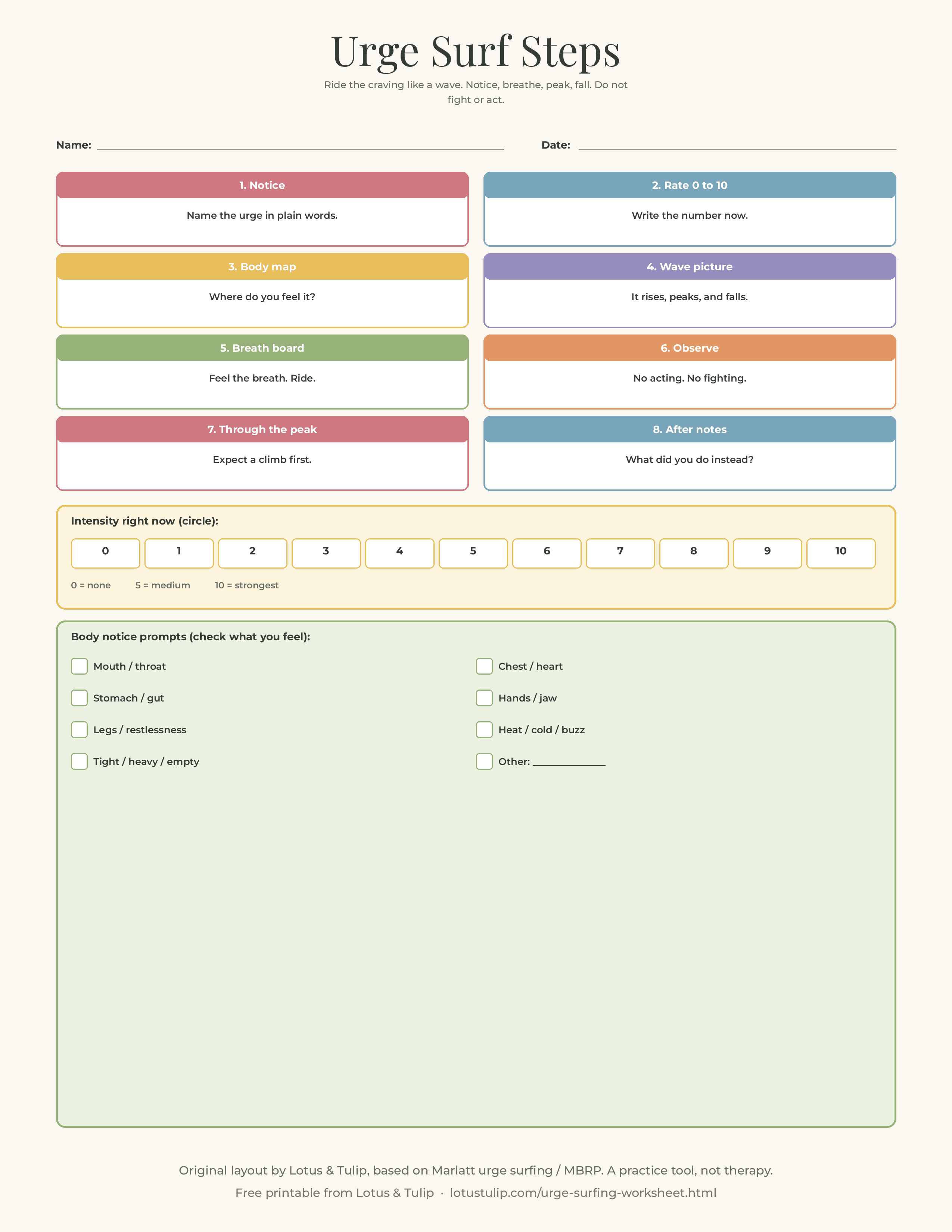
- Notice that an urge is here. Name it plainly: "This is a craving to drink," "This is the send-the-text urge," "This is the check-the-phone urge." Naming creates a little space between you and the impulse.
- Rate intensity 0 to 10. Zero is none. Ten is the strongest you can imagine. Write the number. Rating turns a fog into data and makes the later fall visible.
- Map where it lives in the body. Scan mouth, throat, chest, gut, hands, jaw, legs. Note heat, tightness, buzzing, emptiness, salivation, restlessness. Stay descriptive. Skip the story for a minute.
- Picture the urge as a wave. Waves start smaller, build, peak, and break. You do not have to push the ocean down. You only have to stay on the board.
- Use the breath as the surfboard. Feel air at the nostrils or the rise and fall of the belly. When the mind hooks a thought ("I cannot stand this"), notice the thought, then return to breath and body.
- Observe without acting and without fighting. Fighting sounds like "Make it stop now." Acting is the target behavior. Surfing is willing contact: "I can feel this and still choose not to use / send / binge / check."
- Ride through the peak. Intensity often climbs before it falls. Expect that. Keep rating every few minutes if it helps. Many people are surprised when a 8 becomes a 5 without them "winning an argument" with the urge.
- Note what you did instead. After the peak softens, write one line: walked, texted a support person, sipped water, sat with feet on the floor, used a planned skill from your distress tolerance menu.
- Record the after notes and one learning. Final intensity, how long the wave lasted this time, what triggered it, and one sentence of learning. Then decide whether a longer plan piece is needed (trigger list, refusal script, or a decisional balance sheet filled when calm).
Practice on milder urges first (a 3 or 4), the same way MBRP often invites a moderate scenario before the hardest trigger. Skill grows with reps, not with heroics.
Self talk scripts while you surf
- "This is a wave. Waves peak and fall."
- "I can feel this in my chest and still not drink."
- "Urges are allowed. Acting on them is a choice."
- "Breath is the board. Sensation is the water."
- "I do not have to like this. I only have to ride it."
- "Checking would feed the urge. I can wait ten breaths."
- "Send later if I still want to when I am at a 3."
- "A craving is not a command."
If self talk turns into argument ("I am weak," "I always fail"), switch to bare description: "Tight jaw. Warm face. Thought: just once. Breath in. Breath out." Description is usually safer than debate in the peak.
A worked adult example (fictional)
Alex, 34, is 11 weeks without alcohol. After a tense call with a parent at 8:40 p.m., Alex rates an urge to drive to the corner store at 7/10. Body map: dry mouth, flutter in the stomach, restless legs, a mental movie of the first cold sip.
- Notice and name: "This is a drink urge after conflict, not a need for water."
- Surf: Sit on the couch, feet on the floor, eyes soft. Breath at the belly. Silent labels: "heat in chest," "thought: just one," "urge climbing." At minute 4 the urge hits 8. Alex stays. No fighting speech. No "you are pathetic" story.
- Instead of driving: Text a support person the prewritten line "Urge 8 after call, surfing." Sip sparkling water. Keep rating.
- After: At about minute 18 the urge is 4. At minute 25 it is 2. Learning: "Conflict spike peaks fast. The movie of the sip is not proof I must go. Texting support did not erase the urge, but it kept me off the road."
- Next plan piece: Add "parent call after 8 p.m." to the high risk list on the relapse prevention plan, and practice a shorter surf the next calm day so the skill is warm.
Notice that Alex did not wait to feel zero before choosing not to drive. Zero is rare in early recovery. Rideable is enough.
Adult and teen examples
Adults:
- Substance: Smell of smoke outside a bar. Urge 6. Surf for 10 minutes in the car with windows up, then leave the block.
- Binge eating: Alone with delivery apps after a shame spiral. Urge 7. Surf with hand on stomach, rate every 3 minutes, delay ordering for one full wave, then rechoose from a planned meal list.
- Checking: "Did I lock the door?" Urge to return to check a fourth time. Urge 5. Surf at the end of the driveway: name the doubt, feel the chest flutter, drive to the appointment anyway as planned with the clinician.
- Anger send-the-text: Draft open. Urge 8 to hit send. Surf: phone face down, three minutes of breath, rewrite when intensity is under 4 or talk in person tomorrow.
Teens:
- Vape or drink at a party: Friend holds one out. Urge 6 plus social pressure. Surf in the bathroom for two minutes, then use a refusal line from your peer pressure plan.
- Send the snap: Embarrassed, wants to fire back. Urge 7. Surf: leave the chat, walk, rate down to 3, then decide.
- Skip the quiz by "getting sick": Anxiety urge to avoid. Surf the stomach drop for five minutes, then take the first easy question (pair with opposite action if anxiety does not fit the facts).
Keep teen practice private. Do not post filled worksheets. Follow school or clinic safety rules if risk shows up. Pair with mindfulness activities for younger clients who need shorter, more concrete body noticing.
Urge surfing vs TIPP, opposite action, radical acceptance, defusion, and ACCEPTS
People searching "urge surfing technique" often land next to nearby skills. Use this table to choose.
| Urge surfing | TIPP | Opposite action | Radical acceptance / defusion / ACCEPTS | |
|---|---|---|---|---|
| Main job | Stay with the urge as a wave until it peaks and falls, without acting | Quickly change body chemistry when emotion is extreme (cold, intense exercise, paced breathing, paired muscle relaxation) | Act opposite to an emotion urge when the emotion does not fit the facts or the intensity is too high for the facts | Radical acceptance: stop fighting reality. Defusion: unhook from thoughts. ACCEPTS: distract until you can cope |
| Attention | On the urge and body sensations | On physiological downshift | On doing the opposite behavior | Acceptance on reality; defusion on thoughts; ACCEPTS away from the urge |
| Best early use | Craving or impulse you can safely ride for several minutes | Emotion is too hot to think or surf yet | Emotion driven urge that is unjustified or overblown | Acceptance when fighting reality fuels pain; defusion when the hook is a thought; ACCEPTS when surfing would flood you |
| Cross link | This page | DBT TIPP skills worksheet | Opposite action worksheet | Radical acceptance · Cognitive defusion · Distress tolerance (ACCEPTS) |
They stack. Many people TIPP first, surf the leftover wave, then use decisional balance or refusal skills once intensity is lower. Window of tolerance ideas also help: if you are outside the window, stabilize before you surf. See the window of tolerance worksheet.
Tips for therapists and school counselors
- Teach the metaphor with a drawing. A simple wave sketch beats a lecture. Have the client mark "me on the board" at rising, peak, and falling.
- Practice in session on a mild urge first. Imaginal cue of a 3/10 craving builds confidence before Friday night.
- Separate urge from action every time. "You already surfed successfully if you did not act, even if the number stayed high for a while."
- Link to a written plan. Put urge surfing on the if-then line of a relapse prevention plan next to supports and 988.
- Watch for white knuckling dressed up as mindfulness. If the client is bracing and self attacking, slow down and return to curious description.
- In schools, keep it skills based and private. Use non substance examples (send the text, walk out of class, pick a fight) unless your role and consent cover substance talk. Follow district crisis protocol.
- Bridge tools deliberately. Pair with distress tolerance, TIPP, opposite action, defusion, and decisional balance filled when calm.
Common mistakes
- Expecting the urge to vanish in sixty seconds. Peaks take time. Leave room for a 15 to 30 minute teaching window without treating it as a promise.
- Fighting the wave. "I must not feel this" often lengthens the ride.
- Surfing while acting. Half using / half "mindful" is not surfing.
- Only practicing at a 10. Learn the skill at a 3.
- Skipping the after notes. Without a learning line, the next wave feels brand new.
- Using surfing instead of getting safe. Crisis first. Skill second.
- Treating a worksheet as treatment. Persistent substance use disorder, eating disorders, OCD, trauma symptoms, or depression need licensed care. A printable is homework inside a broader plan.
What the research says (honestly)
Urge surfing is a component skill inside relapse prevention and mindfulness based packages. It is rarely tested as a standalone worksheet in large trials. Be careful with claims.
Relapse prevention roots. Marlatt and Gordon (1985) laid out a cognitive behavioral model of relapse. Larimer, Palmer, and Marlatt (1999) summarized that model for clinicians, including high risk situations, coping and self efficacy, and lifestyle balance. Urge surfing sits in that coping skill family: stay with craving without using.
Dynamic model. Witkiewitz and Marlatt (2004) argued that relapse is better seen as a dynamic, unfolding process than as a single broken rule. That framing supports practicing skills across many waves rather than treating one lapse as total failure. See also our relapse prevention plan page for lapse vs relapse language.
MBRP. Bowen, Witkiewitz, Clifasefi, Grow, Chawla, and colleagues (2014) reported a randomized clinical trial in JAMA Psychiatry with 286 adults in aftercare after substance use treatment, comparing Mindfulness-Based Relapse Prevention, standard cognitive behavioral relapse prevention, and treatment as usual over 12 months. Relative to treatment as usual, both MBRP and standard RP were associated with lower relapse risk to substance use and heavy drinking at 6 months among key outcomes reported. At 12 months, MBRP participants reported significantly fewer days of substance use and less heavy drinking compared with RP and treatment as usual in that trial. Urge surfing is one practice inside MBRP, not the whole program, so those outcomes cannot be credited to urge surfing alone.
Brief urge surfing instruction. Bowen and Marlatt (2009) tested a brief mindfulness based instruction set based on Marlatt's urge surfing technique with 123 undergraduate smokers in a cue exposure paradigm. Groups did not differ significantly on urge ratings, yet the mindfulness group smoked significantly fewer cigarettes over a 7 day follow-up than the control group. That pattern fits a common clinical teaching point: the skill may change the response to urges before it reliably changes how strong the urge feels.
Honest caveat. No trial has tested this free three page Lotus and Tulip printable on its own. Teaching estimates such as "many urges fall within about 15 to 30 minutes" are common in clinician handouts; they are not a guaranteed duration for every person or every substance. Use the pages as a practice aid inside therapy, mutual help, or a structured program. If use is heavy, withdrawal is dangerous, or safety is in question, get professional and medical care.
Free urge surfing worksheet (PDF)
The free urge surfing worksheet has three pages in US Letter size:
- Page 1: Urge Surf Steps card. Wave steps, a 0 to 10 scale, and body notice prompts you can keep nearby.
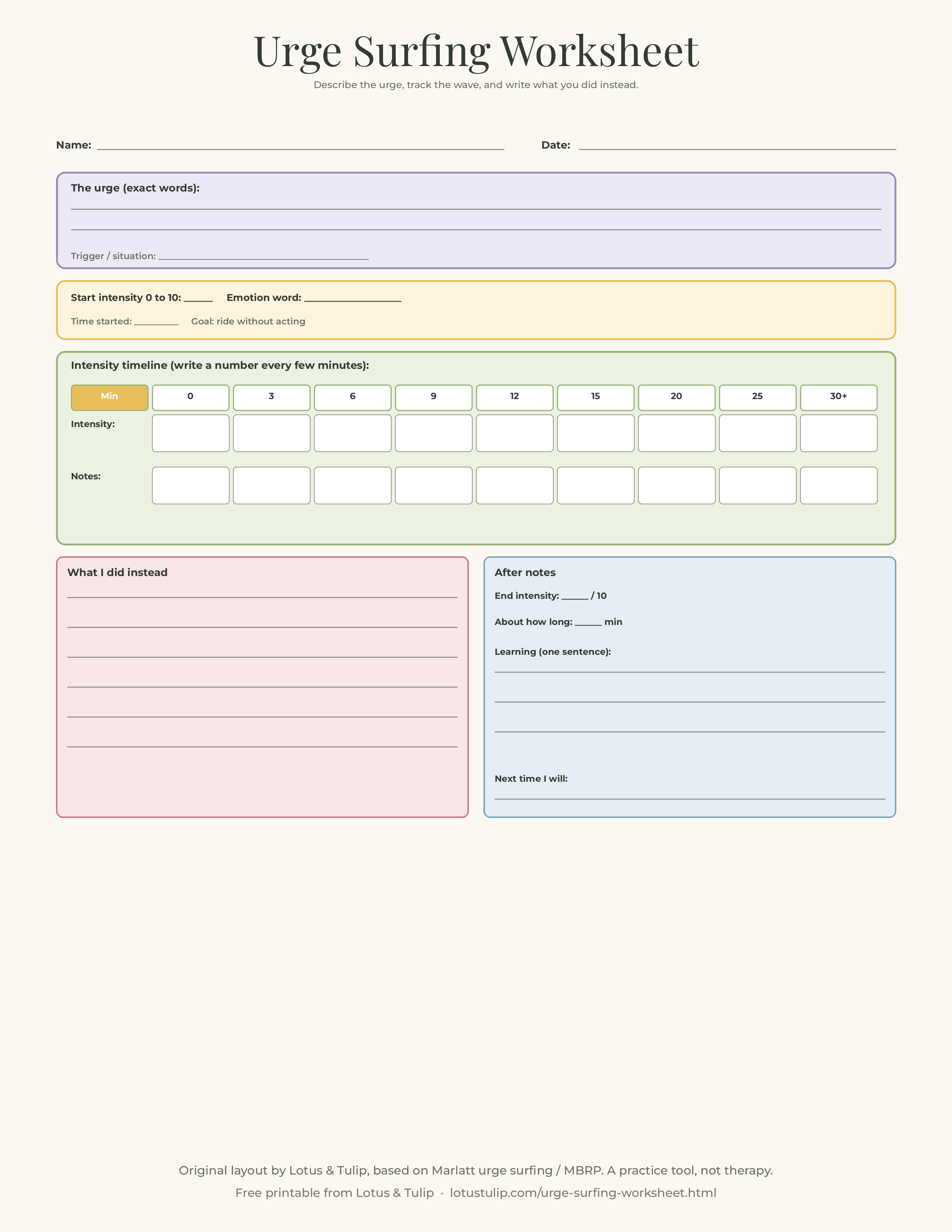
- Page 2: Urge Surfing Worksheet. Urge description, intensity timeline boxes, what I did instead, and after notes.
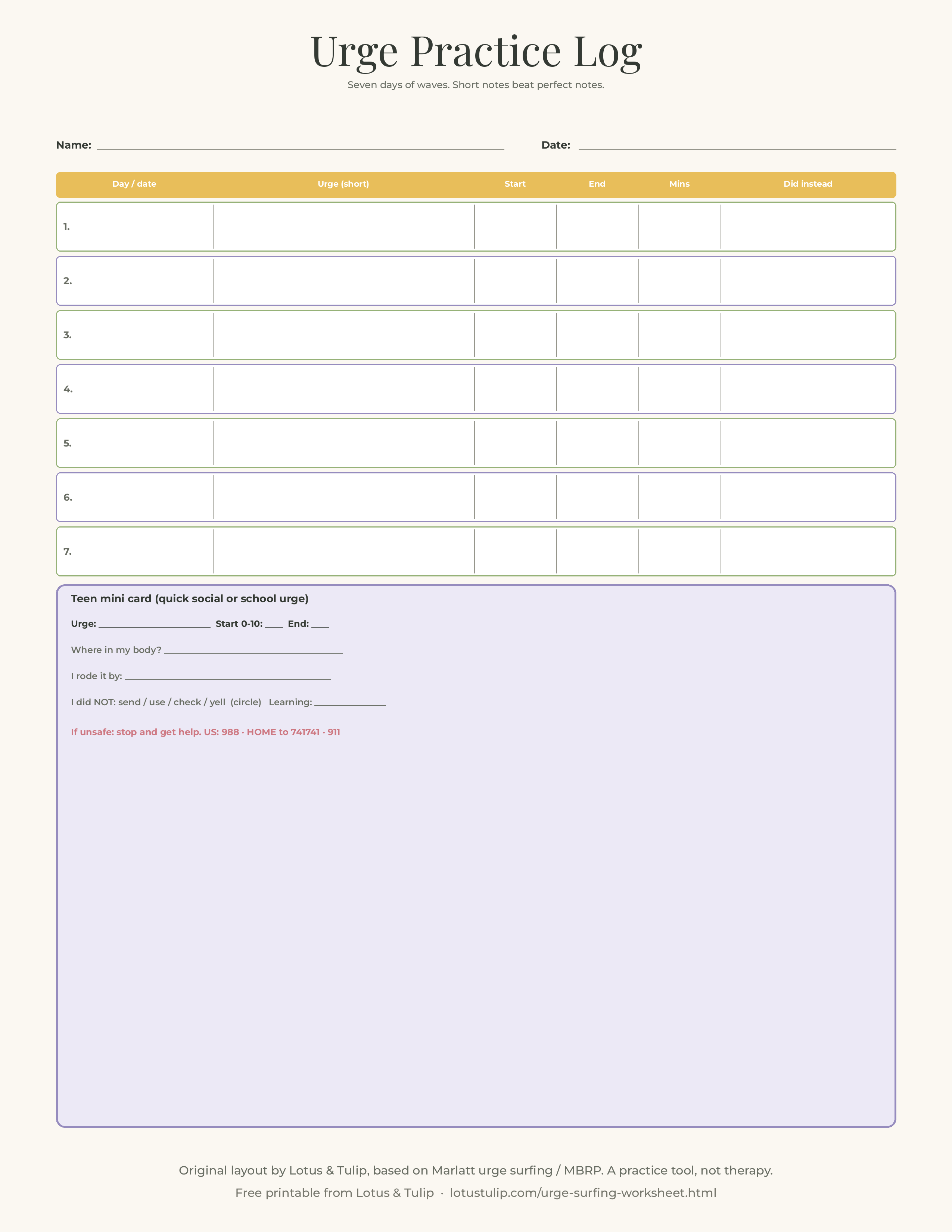
- Page 3: Urge Practice Log. Seven day rows plus a short teen mini card for quick school or social urges.
Download the free urge surfing worksheet (PDF, 3 pages, US Letter)
Prefer single images? Page 1: Urge Surf Steps (PNG) · Page 2: Urge Surfing Worksheet (PNG) · Page 3: Urge Practice Log (PNG)
Free to print for your own use and for use with your own clients, students, or groups. This is an original layout by Lotus & Tulip, based on urge surfing as taught in Marlatt style relapse prevention and Mindfulness-Based Relapse Prevention. It is not affiliated with the University of Washington, Guilford Press, or any MBRP institute, and is not a substitute for therapy. Please link to this page rather than re-uploading the file.
Free OCD and ERP starter pack: Using urge surfing with compulsions? The free OCD and ERP worksheets starter pack includes a riding the urge page with an urge log (start, peak, after 20 minutes), plus the OCD cycle, an exposure ladder, a practice record, a response prevention plan and a support page (8 pages, client use license, no email).
Related resources
- Relapse prevention plan worksheet: triggers, warning signs, if-then coping, lapse plan, support team.
- Distress tolerance worksheets: STOP, pros and cons, TIPP, ACCEPTS, self soothe, IMPROVE.
- DBT TIPP skills worksheet: cold water, intense exercise, paced breathing, paired relaxation.
- Opposite action worksheet: act against an emotion urge when the emotion does not fit.
- Radical acceptance worksheet: stop fighting reality that cannot be changed in this moment.
- Cognitive defusion worksheet: unhook from thoughts that ride along with the craving.
- Decisional balance worksheet: pros and cons of acting on an urge, filled when calm.
- Window of tolerance worksheet: know when you can surf and when you need to stabilize first.
- Mindfulness activities for kids: shorter body noticing practices for younger clients.
- Safety plan worksheet: when the moment is about staying alive, not surfing a craving.
Sources
- Marlatt, G. A., and Gordon, J. R. (Eds.). (1985). Relapse Prevention: Maintenance Strategies in the Treatment of Addictive Behaviors. Guilford Press. Foundational cognitive behavioral relapse prevention model.
- Larimer, M. E., Palmer, R. S., and Marlatt, G. A. (1999). Relapse prevention: An overview of Marlatt's cognitive-behavioral model. Alcohol Research and Health, 23(2), 151 to 160. Clinician oriented summary of high risk situations, coping, self efficacy, and related constructs.
- Witkiewitz, K., and Marlatt, G. A. (2004). Relapse prevention for alcohol and drug problems: That was Zen, this is Tao. American Psychologist, 59(4), 224 to 235. Dynamic model of relapse.
- Bowen, S., Chawla, N., and Marlatt, G. A. (and later editions with colleagues). Mindfulness-Based Relapse Prevention for Addictive Behaviors. Guilford Press. Treatment guide that includes urge surfing as a core practice inside MBRP.
- Bowen, S., Witkiewitz, K., Clifasefi, S. L., Grow, J., Chawla, N., Hsu, S. H., Carroll, H. A., Harrop, E., Collins, S. E., Lustyk, M. K., and Larimer, M. E. (2014). Relative efficacy of mindfulness-based relapse prevention, standard relapse prevention, and treatment as usual for substance use disorders: A randomized clinical trial. JAMA Psychiatry, 71(5), 547 to 556. N = 286 aftercare adults; 12 month follow-up; MBRP and RP vs treatment as usual; urge surfing is a component, not the whole intervention.
- Bowen, S., and Marlatt, G. A. (2009). Surfing the urge: Brief mindfulness-based intervention for college student smokers. Psychology of Addictive Behaviors, 23(4), 666 to 671. N = 123; urge ratings did not differ significantly by group; mindfulness group smoked fewer cigarettes over 7 day follow-up.
- Honest caveat: no study tests this three page Lotus and Tulip printable alone. Duration estimates such as about 15 to 30 minutes are common teaching points, not universal laws.
Urge surfing worksheet: FAQ
What is urge surfing?
Urge surfing is a mindfulness skill for riding a craving or impulse like a wave. You notice the urge, rate it, map body sensations, breathe through the peak, and refrain from acting or fighting until the intensity falls. It comes from Marlatt style relapse prevention and is a core practice in Mindfulness-Based Relapse Prevention (MBRP).
How do you urge surf step by step?
Name the urge, rate 0 to 10, scan the body, picture a wave, use the breath as a surfboard, observe without acting, ride the peak, note what you did instead, and write a short learning. The nine step section above and the free printable walk through the same sequence.
How long do urges last?
Many clinicians teach that substance urges often rise and fall within about 15 to 30 minutes if you do not feed them. That is a common teaching estimate, not a guarantee. Some waves are shorter, some stack, and some return later. Track your own timelines on the practice log.
Is urge surfing the same as distraction or TIPP?
No. Distraction (ACCEPTS) turns attention elsewhere. TIPP changes body chemistry fast when emotion is extreme. Urge surfing keeps gentle attention on the urge itself while you refrain from the target behavior. They can be used in sequence: TIPP or ACCEPTS first if you are flooded, then surf a milder leftover wave.
Can teens use an urge surfing worksheet?
Yes, with concrete examples (send the text, party pressure, check the phone) and privacy. The free printable includes a teen mini card. Follow school or clinic safety rules if a worksheet reveals risk. Substance specific work needs appropriate consent and role boundaries.
When should I not use urge surfing?
Do not use it as the first move in acute safety risk, medical emergency, severe untreated withdrawal, or when the situation requires protective action (leaving danger, securing means, calling emergency services). Stabilize and get help first: 988, HOME to 741741, or 911.
Does an urge surfing worksheet work on its own?
A worksheet is a practice aid, not a standalone treatment. MBRP packages that include urge surfing have randomized trial support for aftercare outcomes, and a brief urge surfing instruction study found fewer cigarettes smoked over a week even when urge ratings did not differ. Use the pages inside a broader plan with a clinician when problems are persistent or severe.