
Therapists and clinicians · Updated 2026-11-07
ERP Worksheets for OCD: Exposure Hierarchy, Response Prevention, and Free Printable
Ready-made printable: OCD and ERP Worksheets for Therapists Fillable PDF, 20 pages: exposure ladder with 0 to 100 distress ratings, exposure practice record, response prevention plan and 8 week tracker
Holiday 20% off: about $9.20, was $12 (EUR 10) · instant digital download

ERP worksheets for OCD help clinicians structure Exposure and Response Prevention: map the obsession and ritual loop, build a graded exposure hierarchy, define what not to do (response prevention), track SUDS or distress, record practice, and review learning after each step. This guide is written for US therapists, counselors, psychologists and other clinicians who are learning or delivering ERP for obsessive compulsive disorder (and for careful notes on OCD spectrum presentations). It is a skill practice aid for sessions and homework, not a self help cure page, not a diagnosis tool and not a replacement for trained ERP supervision.
You will get twelve concrete worksheet backed practices, a six session starter sequence, adaptations for contamination, checking, harm OCD, mental rituals, teens and telehealth, honest research with limits, seven FAQs, a nine step HowTo and a free three page US Letter printable. Most practices take 5 to 25 minutes once the model is familiar. The printable is designed for session use and homework, with a crisis line reminder on every page.
If you are new to ERP, use this page as a structured checklist while you seek training and supervision. If you already deliver ERP, use it to tighten response prevention, catch reassurance loopholes and keep learning records consistent across weeks.
This page is distinct from our exposure hierarchy worksheet (fear ladder only), anxiety worksheets for kids, anxiety activities for teens, behavioral experiment worksheet and urge surfing worksheet. Those pages each teach one related skill. This one puts ERP for OCD at the center: exposure plus response prevention across the full treatment arc.
We credit the research and guidelines this approach draws on, without claiming any affiliation or endorsement: Foa and Kozak (1986) on emotional processing of fear; Abramowitz (1996) meta analysis of ERP variants and related quantitative reviews; NICE clinical guideline CG31 on OCD and body dysmorphic disorder; the American Psychiatric Association practice guideline for OCD; and clinician education resources from the International OCD Foundation (IOCDF). The printable is an original Lotus and Tulip layout, not a copy of any program's materials.
This guide is educational. It does not diagnose OCD and does not claim that worksheets alone treat OCD. ERP is a clinical intervention best delivered (or closely supervised) by clinicians trained in the model. If anyone is thinking about suicide or self harm, call or text 988 (Suicide and Crisis Lifeline) or text HOME to 741741 (Crisis Text Line). For immediate danger, call 911. For acute crisis planning, see our safety plan worksheet.
What ERP is (and is not)
Exposure and Response Prevention (ERP) is a structured behavioral treatment for OCD. The person faces obsession related triggers on purpose (exposure) and deliberately refrains from the compulsion or neutralizing behavior that usually follows (response prevention). Over repeated practice, distress often decreases and the predicted catastrophe fails to occur, which updates the fear associations that keep OCD going.
Two ideas sit underneath most ERP protocols. First, obsessions (intrusive thoughts, images, urges or doubts) create distress. Second, compulsions and neutralizing (overt rituals, mental reviewing, reassurance seeking, avoidance) reduce that distress in the short term and maintain the OCD loop in the long term. ERP interrupts the second part while the person stays with the first part long enough to learn something new.
What ERP is not.
- Not flooding for its own sake. Classic ERP uses a graded hierarchy. Starting with the hardest item every time is not the same as planned, consented, clinician guided practice. Intensity should be tolerable and collaborative.
- Not thought stopping. Suppressing or arguing with an intrusion often becomes another ritual. ERP usually teaches willingness to have the thought without neutralizing it.
- Not reassurance. "Tell me I'm not a bad person" or "check Google one more time" is often a compulsion. ERP plans usually limit reassurance from self, others and search engines.
- Not a trick. Clients deserve a clear rationale: why we expose, why we block rituals, what learning we expect, and how safety is handled.
- Not a cure all printable. Worksheets organize practice. They do not replace assessment, risk management, medication decisions when indicated, or supervision for complex OCD.
The OCD loop (educationally)
A simple educational map helps clients see why rituals feel helpful and why they keep the problem stuck:
- Obsession / intrusion: an unwanted thought, image, urge or doubt (contamination, harm, blasphemy, "did I lock it?", symmetry, and many others).
- Distress: anxiety, guilt, disgust, or a "not just right" feeling, often rated with SUDS (Subjective Units of Distress Scale, 0 to 10 or 0 to 100).
- Compulsion or neutralizing: washing, checking, ordering, mental reviewing, confessing, seeking reassurance, avoiding triggers, or covert rituals.
- Short term relief: distress drops for a while, which rewards the ritual.
- Long term maintenance: the brain never learns that the obsession can be survived without the ritual, so the loop strengthens.
OCD vs GAD worry and casual perfectionism. Generalized anxiety often involves broad, future oriented worry that can shift topics and is less tied to a specific neutralizing ritual. OCD is typically more ego dystonic (the thought feels intrusive and unwanted) and more tightly linked to rituals or avoidance that reduce distress. Perfectionism can look like OCD when "not just right" checking and correcting take hours, but everyday high standards without impairing rituals are not OCD. Diagnosis belongs to a qualified clinician; worksheets on this page assume assessment is already underway or complete.
Why worksheets help in ERP sessions
ERP fails most often when the plan is vague ("try not to wash"), when homework is not recorded, or when response prevention is partial without anyone noticing. Worksheets help because they:
- Make the hierarchy visible and agreed.
- Force a concrete definition of the ritual to block (including mental rituals).
- Track SUDS before, peak and after so habituation or inhibitory learning is observable.
- Separate "what we predicted" from "what happened."
- Support adherence between sessions with a shared homework record.
Caveats. A worksheet can become a new ritual if a client fills it out compulsively for reassurance. Keep forms brief, time limited and reviewed in session. For harm OCD and other high risk themes, worksheets never replace risk assessment and clinical judgment about what exposures are ethical and safe. If a client spends more time perfecting the log than doing the exposure, simplify the form to three lines: what I faced, what I did not do, what I learned.
Worksheets also help supervisors. A trainee can bring a filled hierarchy and practice log to consultation, which makes feedback concrete instead of vague ("be more structured"). That is one reason Abramowitz (1996) findings about therapist supervised exposure still matter for how we train and document ERP.
12 ERP worksheet backed practices
Each practice below can be a session segment or a homework page. Use the free printable for the core steps, plan and log; use the full OCD and ERP pack when you need the complete set of clinical pages.
1. Psychoeducation map (obsession, compulsion, function)
Time: 15 to 20 minutes. When: early in treatment.
On one page, write the main obsession, the distress it creates, the compulsion or neutralizing behavior, the short term payoff and the long term cost. Ask: "What is this ritual trying to accomplish?" Naming the function (reduce doubt, undo a thought, feel clean enough) makes response prevention less arbitrary.
Debrief: "If the ritual works in the short term, why are we asking you to stop it?"
2. Trigger and intrusion log
Time: 5 minutes a day for one week. When: assessment and hierarchy building.
Log situations, thoughts, images or urges that spike OCD, with time of day and rough SUDS. Include internal triggers (a memory, a feeling of doubt) and external ones (a sink, a news headline, a locked door). This becomes raw material for the hierarchy.
Debrief: "Which triggers show up most? Which are avoided entirely?"
3. SUDS / distress rating
Time: built into every exposure. When: throughout.
Agree on a 0 to 10 scale with anchors the client understands (0 = calm baseline, 10 = worst OCD distress they can recall). Rate before starting, at peak and after. Do not require distress to hit zero; look for a meaningful drop or for new learning even if distress stays moderate.
Debrief: "What did your peak number teach us about what you can tolerate?"
4. Exposure hierarchy / fear ladder builder
Time: 20 to 40 minutes. When: after psychoeducation.
List items from easier to harder for one OCD theme. Each item should be specific ("touch kitchen faucet then prepare a snack without washing" rather than "be less clean"). For a dedicated free ladder builder, practice record and weekly tracker, see our exposure hierarchy worksheet. This ERP page assumes you will build or refine a hierarchy as one step inside a fuller response prevention plan, not rehash the whole free ladder page.
Debrief: "Is item 3 truly harder than item 2, or are we guessing?"
5. Response prevention plan (what NOT to do, competing response, delay)
Time: 15 to 25 minutes. When: before the first planned exposure.
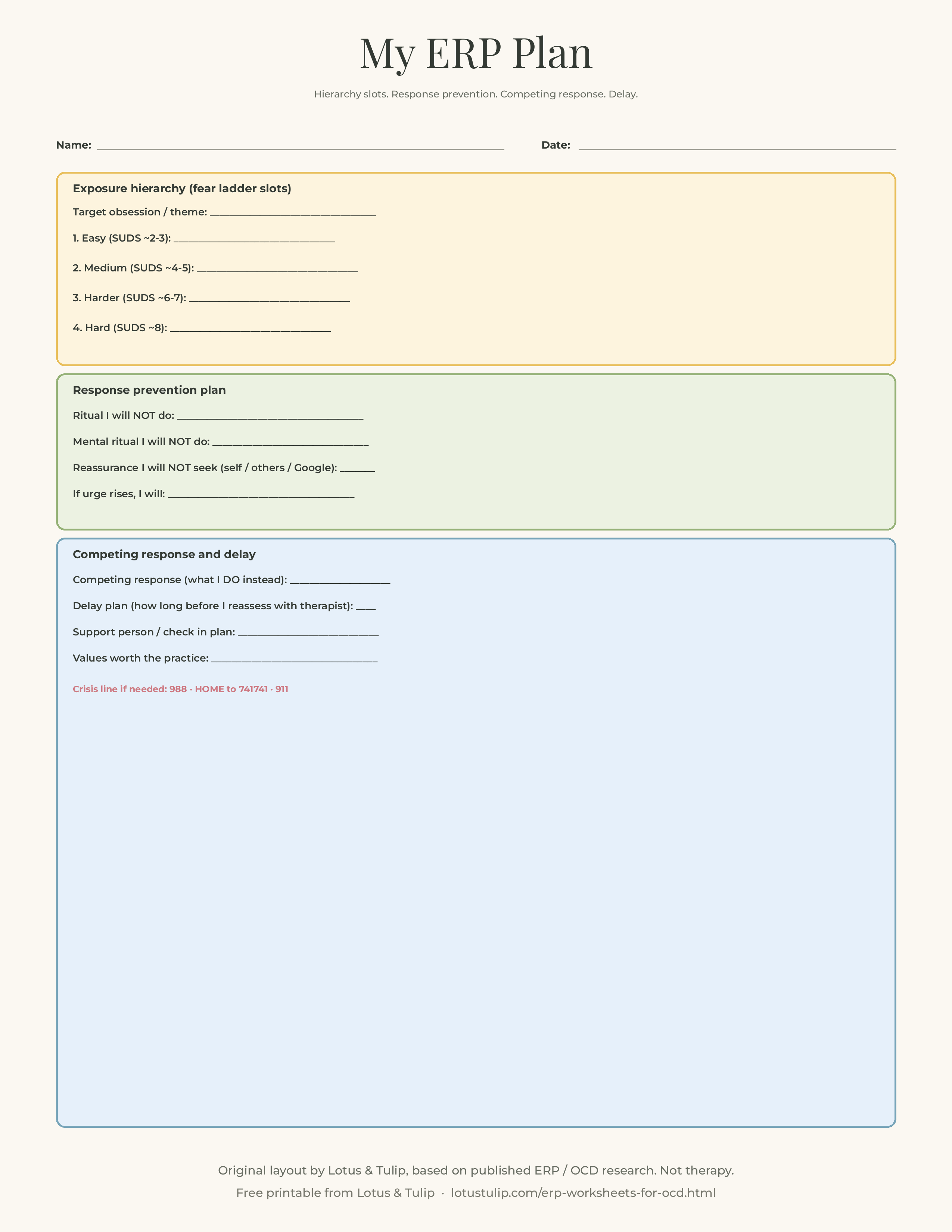
Write the exact ritual to block: overt (washing, checking, rearranging), mental (reviewing, praying a set number of times, neutralizing images) and interpersonal (asking a partner "are you sure?"). Add a competing response (something to do with hands or attention that is not a ritual) and a delay plan (urge first, wait an agreed time, then reassess with the therapist's rules). Page two of the free printable is built for this.
Debrief: "Which part of the ritual is hardest to give up, and why?"
6. In vivo exposure practice record
Time: during and after each practice. When: homework and in session exposures.
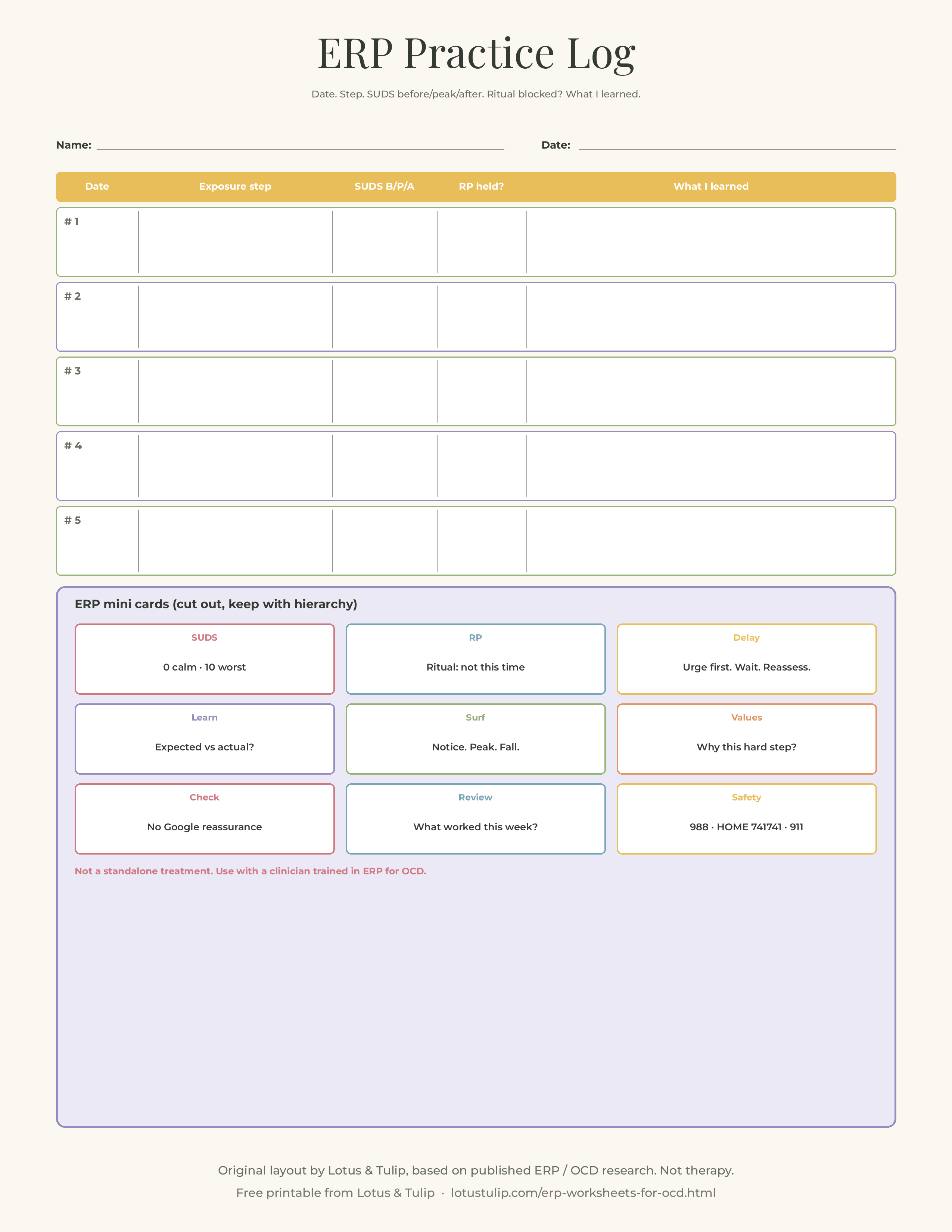
Record date, hierarchy step, SUDS before / peak / after, whether response prevention held, any slips and what was learned. Keep the form short so it does not become busywork.
Debrief: "Did the feared outcome happen? What did you do instead of the ritual?"
7. Imaginal exposure script outline (clinician led)
Time: 20 to 40 minutes to draft; repeated practice. When: for harm, catastrophic or hard to recreate in vivo themes, under clinician guidance.
Draft a first person script of the feared scenario without neutralizing endings. The client reads or listens while allowing distress and without mental undoing. Imaginal work needs careful consent, pacing and risk review. It is not a homework assignment to invent alone for violent or suicidal content.
Debrief: "What urge to neutralize showed up while reading, and how did you handle it?"
8. Ritual delay / urge surf for urges to neutralize
Time: 5 to 15 minutes per urge. When: when the compulsion urge spikes.
Teach the client to notice the urge, rate it, breathe and watch it rise and fall without acting. Pair with our urge surfing worksheet carefully: urge surfing supports response prevention; it is not a substitute for planned exposures on the hierarchy.
Debrief: "How long until the urge peaked? Did it fall without the ritual?"
9. Reassurance seeking audit (self, others, Google)
Time: 10 minutes to set up; ongoing tally. When: when doubt OCD or checking is central.
List every reassurance channel: asking partners, confessing to clergy or friends, mental self talk ("you're fine"), and online searching. Agree on limits (for example: no OCD related Google for the week; partner answers with a planned script once, then redirects). Count urges and slips without shame.
Debrief: "Which reassurance source is the biggest loophole?"
10. Post exposure learning record (expected vs actual)
Time: 5 minutes after each exposure. When: every practice.
Before: "What do I fear will happen?" After: "What actually happened? What did I learn about the obsession, my ability to cope and the need for the ritual?" This supports inhibitory learning, not only waiting for anxiety to drop to zero.
Debrief: "What belief shifted by even 10 percent?"
11. Weekly ERP review
Time: 10 to 15 minutes at the start of session. When: weekly.
Review completed steps, slips, SUDS trends, avoidance that crept back and the next hierarchy item. Celebrate blocked rituals as much as completed exposures.
Debrief: "What helped most this week: the plan, the delay, or the values reminder?"
12. Relapse / setback plan
Time: 15 to 20 minutes near the end of acute treatment. When: booster and discharge planning.
List early warning signs (sleep loss, stress, new theme, ritual creep), the first three hierarchy items to restart, who to contact and how to tell a slip from a full relapse. Pair with our relapse prevention plan worksheet if you want a broader recovery page.
Debrief: "If OCD gets louder during a hard month, what is your day one plan?"
How to use these tools in session + a 6 session starter sequence
Keep sessions collaborative. Explain the rationale, agree on one hierarchy theme, define response prevention before the first exposure and review learning every time. Homework should be specific, timed and written.
| Session | Focus | Homework |
|---|---|---|
| 1 | Assessment refresh, psychoeducation map, SUDS anchors, safety / crisis check | Trigger and intrusion log |
| 2 | Build hierarchy, draft response prevention plan, pick first easy item | One easy in vivo step with practice record |
| 3 | Review learning, tighten RP (including mental rituals), second item | Two practices; start reassurance audit if needed |
| 4 | Medium items; teach urge surf / delay; imaginal outline only if indicated | Medium step + urge surf log |
| 5 | Harder item with strong RP; expected vs actual learning record | Harder step; weekly review sheet |
| 6 | Consolidate, setback plan, plan next month of practice | Continue agreed steps; booster date |
Six sessions is a starter arc for milder or already well assessed cases, or for clinicians building skill with supervision. Many clients need a longer course. NICE CG31 describes intensity partly in therapist hours; do not treat this table as a protocol ceiling.
Between sessions, ask clients to schedule practice like an appointment, not a maybe. Morning practices often beat late night ones when fatigue fuels rituals. If a week goes poorly, treat it as data: which loophole opened, which step was too hard, and what support would make the next attempt clearer?
In group or intensive formats, the same worksheets scale: shared psychoeducation maps, individual hierarchies and a common weekly review structure. Keep personal hierarchy content private unless the client consents to sharing themes at a high level.
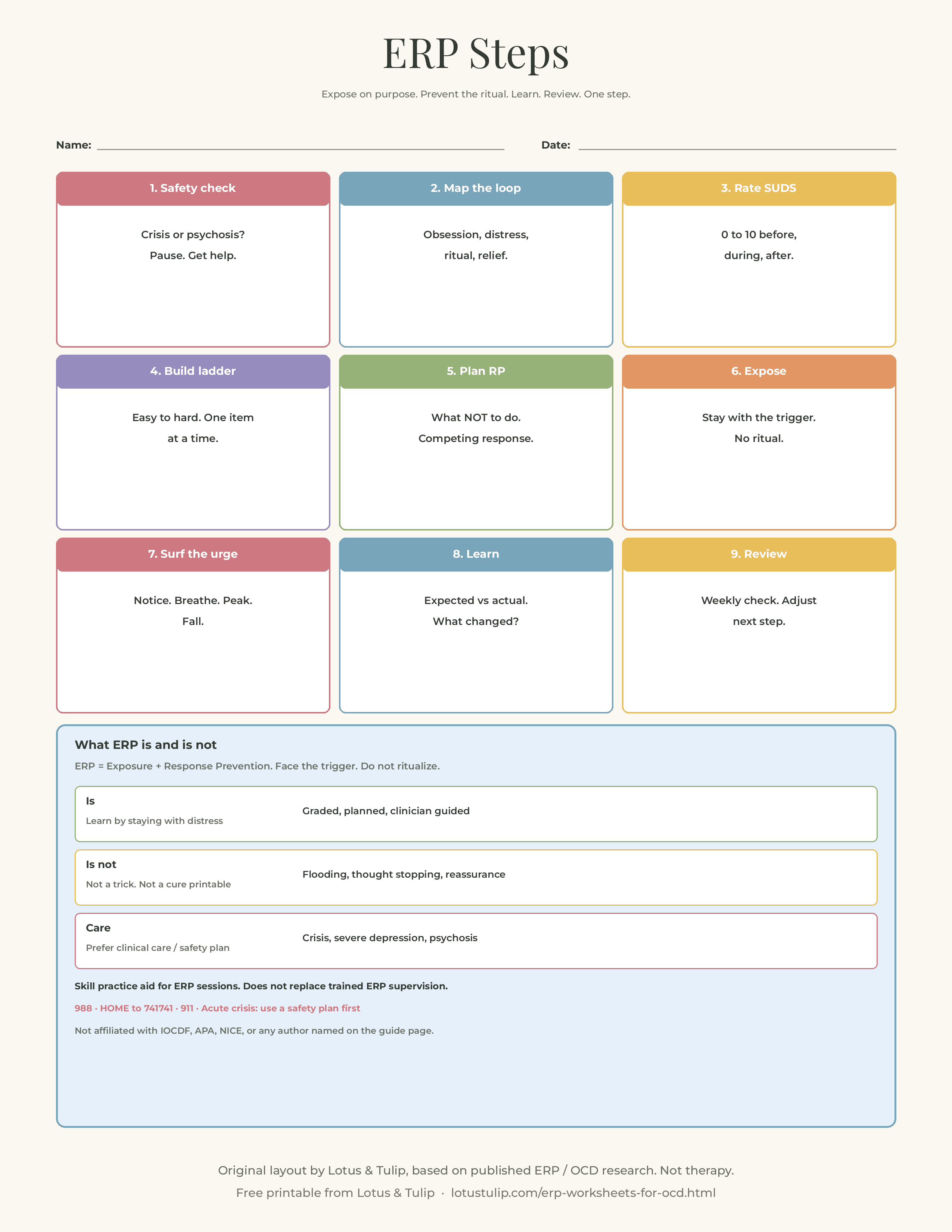
How to use ERP worksheets for OCD, step by step
- Safety check. Screen for acute crisis, active suicidal or homicidal risk, untreated psychosis and severe depression that would block engagement. If acute crisis is present, pause ERP worksheets and use a safety plan, 988, HOME to 741741 or 911 as needed.
- Map the loop. Complete the psychoeducation map: obsession, distress, compulsion, short term relief, long term cost.
- Agree SUDS anchors. Define 0 to 10 with concrete examples from the client's life.
- Build a graded hierarchy. List specific steps from easier to harder for one theme (see also exposure hierarchy worksheet).
- Write the response prevention plan. Name overt, mental and reassurance rituals to block, plus a competing response and delay rule.
- Run a planned exposure. Start with an agreed item. Stay with the trigger. Do not ritualize.
- Surf or delay the urge. Notice the urge to neutralize, rate it and let it peak and fall without the ritual (see urge surfing as a support skill).
- Record learning. Write expected vs actual outcome and what changed in the belief or coping confidence.
- Review weekly and adjust. Update the hierarchy, tighten loopholes and plan the next step or a setback plan.
Adaptations
- Contamination OCD. Hierarchy often moves from cleaner to dirtier contact, with clear rules about washing windows (for example: no wash for 30 minutes after a planned touch). Watch for "mental cleaning," changing clothes as a ritual and reassurance about illness. Cost benefit of gloves or sanitizer as temporary scaffolding should be planned and faded, not left as a permanent loophole.
- Checking OCD. Limit re checks with written rules (one check, then leave the room). Photo evidence and video doorbells can become new rituals; use carefully or not at all. Doubt often spikes in the car after leaving; practice driving a short distance without returning.
- Harm OCD. Extra care and risk assessment are required. Distinguish ego dystonic intrusive harm thoughts from intent, planning and preparatory behavior. Exposures must be ethically designed with supervision; never assign dangerous acts. Imaginal scripts and hierarchy items that reduce avoidance without creating real risk need experienced clinical judgment. Document risk reasoning in the chart.
- Pure O / mental rituals. Response prevention targets reviewing, neutralizing prayers, mental undoing, silent counting and reassurance. Exposures may include allowing uncertainty, writing the feared sentence once without undoing, and imaginal work. Clients often need help spotting that "figuring it out" is the ritual.
- Teens. Shorten forms, involve caregivers as coaches (not reassurance machines), and adapt language. Family accommodation (parents answering reassurance or helping rituals) often needs its own plan. School staff may need a brief note about not providing repetitive reassurance during the school day.
- Telehealth. Share the printable on screen, coach SUDS live, and assign in vivo homework in the client's real environment with clear safety rules. Confirm privacy so a roommate cannot become a reassurance source mid session.
- When to refer / when worksheets are not enough. Refer or step up care for treatment refractory OCD, severe functional impairment, complex comorbidity, medication questions outside your scope, or when you lack ERP training and supervision. Worksheets support care; they do not replace specialty OCD treatment when it is needed.
Across adaptations, keep the same backbone: a clear hierarchy, a written response prevention plan, SUDS tracking and a learning record. Change the content of the steps, not the logic of ERP.
Therapist tips, common mistakes and myths
Tips. Explain the model in plain language before the first hard exposure. Get consent for discomfort and revisit it when the hierarchy climbs. Define success as blocked rituals and new learning, not zero anxiety. Hunt for subtle rituals every week. Involve family in reducing accommodation without blaming them. Schedule consultation for harm themes and complex cases. Keep forms short so homework stays doable on a tired evening.
Common mistakes. Starting too hard without buy in. Exposing without response prevention. Allowing "just one" reassurance search. Turning the worksheet into a compulsion (rewriting the log until it feels perfect). Debating the content of every obsession instead of changing the relationship to it. Skipping risk assessment in harm OCD. Praising only low SUDS instead of courageous blocked rituals.
Myths. "ERP means forcing people into panic." (It should be graded and collaborative.) "If anxiety does not fully habituate, ERP failed." (Learning can occur with moderate distress.) "Mental rituals do not count." (They do.) "Worksheets alone cure OCD." (They do not.) "Imaginal exposure is always unsafe." (It can be appropriate for some themes under trained care; it is not a homework free for all.)
When stuck, return to the loop map: what is the obsession, what is the ritual, what is the short term payoff, and which loophole is still open?
Worked fictional examples
Maya, adult with contamination OCD. Her hierarchy started with touching a "clean enough" doorknob and preparing tea without washing, while blocking a 20 minute handwashing ritual. SUDS started at 6, peaked at 7 and fell to 4. Expected outcome: "I will get sick and it will be my fault." Actual: she drank the tea, felt uneasy and did not get sick that week. Learning record: "I can feel dirty and still not wash for the planned window."
Jordan, adult with checking and Google reassurance. Response prevention banned lock re checks beyond one look and banned OCD related searching. Competing response: leave the house with keys in a bowl photo taken once at the door for the first week only, then faded. Weekly review showed urges stayed high for three days, then dropped when reassurance was blocked.
A case where worksheets alone were not enough. A client with severe harm OCD, sleep deprivation and passive suicidal ideation needed safety planning, psychiatric consultation and specialty ERP supervision before hierarchy homework. The clinician paused exposure worksheets, completed a safety plan and arranged a higher level of care.
These examples are fictional composites for teaching purposes, not real clients.
ERP worksheets vs related guides
| Guide | Best when the main need is | Overlap |
|---|---|---|
| ERP worksheets for OCD (this page) | Full ERP arc for OCD: hierarchy + response prevention + practice learning | All twelve practices |
| Exposure hierarchy worksheet | Building and tracking a fear ladder | Practice 4 |
| Anxiety worksheets for therapists | Broader anxiety session tools | Worry, grounding, exposure planning |
| Behavioral experiment worksheet | Testing a hot thought with a planned experiment | Learning records; not full RP for OCD |
| Urge surfing worksheet | Riding out an urge without acting | Practice 8 |
| CBT worksheets for therapists | Thought records and cognitive skills | Co occurring patterns |
| CBT thought record | One situation, thought, feeling, alternative | Limited; not ERP |
When not to use these worksheets
- Acute crisis. Suicidal or homicidal crisis, or inability to stay safe: use a safety plan, 988, HOME to 741741 or 911. Do not run ERP homework in the middle of an acute safety emergency.
- Untreated severe depression or psychosis. Prefer stabilizing clinical care first or alongside; ERP engagement may be poor or unsafe without that support.
- No OCD assessment. Do not treat every intrusive thought as OCD. Assessment first.
- Harm themes without training or supervision. Get consultation; do not invent risky exposures from a printable.
- As a standalone self help cure. These pages do not claim to treat OCD by themselves.
What the research says (honestly)
Emotional processing theory. Foa and Kozak (1986), in Psychological Bulletin, proposed that fear is stored as a memory structure linking stimuli, responses and meanings, and that exposure works when the structure is activated and corrective information is provided (for example, the feared outcome does not occur and rituals are not required). This is a theoretical framework that shaped later ERP practice. It is not itself a clinical trial of our printable.
ERP variants. Abramowitz (1996) meta analyzed 38 trials from 24 controlled and uncontrolled studies of ERP variants for OCD. Therapist supervised exposure outperformed self controlled exposure; complete response prevention outperformed partial or no response prevention; and combining in vivo with imaginal exposure was associated with greater anxiety reduction than in vivo alone. Effect sizes in that paper were within group pre to post changes, a method the author noted likely inflated estimates compared with traditional controlled comparisons. Treat the directional findings as useful, not as a guarantee of a specific effect size for every client.
Broader quantitative reviews. Abramowitz (1997) reviewed psychological and pharmacological treatments for OCD and reported that exposure with response prevention was highly effective in reducing OCD symptoms in the controlled outcome literature of that period, with cognitive approaches also appearing efficacious and overlapping procedures likely sharing mechanisms. We do not invent newer pooled effect sizes here.
Guidelines (neighbors, not affiliation). NICE clinical guideline CG31 (Obsessive compulsive disorder and body dysmorphic disorder: treatment) recommends CBT that includes ERP among initial treatment options for adults and for children and young people, with intensity stepped by functional impairment and with SSRI options in the pathway. The American Psychiatric Association practice guideline for OCD recommends CBT that relies primarily on ERP, and/or serotonin reuptake inhibitors, as safe and effective first line approaches, with choice individualized by severity, comorbidity, preference and availability. Lotus and Tulip is not affiliated with NICE or the APA.
Clinician resources. The International OCD Foundation (IOCDF) provides clinician and public education on OCD and evidence based treatment. Mention here is for navigation only; we are not affiliated with or endorsed by IOCDF.
Ost / Hofmann style meta analytic neighbors. Broader anxiety and OCD psychotherapy meta analyses in the tradition of large quantitative reviews (including work associated with researchers such as Ost and Hofmann in the anxiety treatment literature) are often cited alongside OCD specific ERP reviews. We do not quote pooled effect sizes from those neighboring literatures here unless verified line by line for this page. The practical takeaway that matters for clinicians using worksheets is consistent with the OCD specific sources above: structured exposure with response prevention is a first line psychosocial approach, and quality of delivery (supervision, complete RP, clear hierarchy) matters.
Bottom line. ERP is a well supported treatment approach for OCD in guidelines and reviews. Worksheets are skill practice aids that help structure hierarchy, response prevention and homework. They are not a standalone randomized trial and not a substitute for trained care. Use them to make sessions clearer, homework more specific and learning more visible.
Free ERP worksheets for OCD printable (PDF)
The free printable has three pages in US Letter size:
- Page 1: ERP Steps. Nine steps that match the HowTo above, plus what ERP is and is not, and crisis resources.
- Page 2: My ERP Plan. Hierarchy slots, response prevention lines, competing response and delay plan.
- Page 3: ERP Practice Log + mini cards. Five practice rows (date, step, SUDS before/peak/after, RP held, learning) plus nine cut out cards (SUDS, RP, delay, learn, surf, values, check, review, safety).
Download the free ERP worksheets for OCD printable (PDF, 3 pages, US Letter)
Prefer single images? Page 1: ERP Steps (PNG) · Page 2: My ERP Plan (PNG) · Page 3: Practice Log (PNG)
Free to print for your own use and for use with your own clients. This is an original layout by Lotus & Tulip, drawing on published ERP and OCD research and guidelines (Foa and Kozak 1986; Abramowitz 1996; Abramowitz 1997; NICE CG31; APA OCD practice guideline). It is not affiliated with or endorsed by any author, institute, guideline body or organization named on this page, does not diagnose or treat any condition, and is not a substitute for therapy or ERP supervision. Please link to this page rather than re-uploading the file.
Free OCD and ERP starter pack: Want more real pages? The free OCD and ERP worksheets for therapists starter pack adds six pages from our paid OCD and ERP set: the OCD cycle, an exposure ladder with 0 to 100 distress ratings (SUDS), an exposure practice record, a response prevention plan, riding the urge and a support and contacts page (8 pages, client use license, no email).
Related resources
- OCD worksheets for kids: the child version, name OCD, rate fear and a boss back ladder for ages 5 to 12
- Intrusive thoughts worksheet: normalize unwanted thoughts, spot thought-action fusion and drop neutralizing, free printable
- Therapist worksheets: CBT, DBT, ACT and more: all worksheet sets in one place.
- Exposure hierarchy worksheet: dedicated fear ladder builder.
- Urge surfing worksheet: riding out urges to ritualize.
- Behavioral experiment worksheet: testing predictions in CBT.
- Cognitive defusion worksheet: watching thoughts without buying them.
- Safety plan worksheet: when the moment is about staying safe.
- Relapse prevention plan worksheet: broader setback planning.
Sources
- Abramowitz, J. S. (1996). Variants of exposure and response prevention in the treatment of obsessive compulsive disorder: A meta analysis. Behavior Therapy, 27, 583 to 600.
- Abramowitz, J. S. (1997). Effectiveness of psychological and pharmacological treatments for obsessive compulsive disorder: A quantitative review. Journal of Consulting and Clinical Psychology, 65(1), 44 to 52.
- American Psychiatric Association. Practice guideline for the treatment of patients with obsessive compulsive disorder. psychiatryonline.org.
- Foa, E. B., and Kozak, M. J. (1986). Emotional processing of fear: Exposure to corrective information. Psychological Bulletin, 99(1), 20 to 35.
- International OCD Foundation. Clinician and public education resources. iocdf.org.
- National Institute for Health and Care Excellence. (2005). Obsessive compulsive disorder and body dysmorphic disorder: treatment (CG31). nice.org.uk/guidance/cg31.
ERP worksheets for OCD: FAQ
What are ERP worksheets for OCD?
They are structured pages that help clinicians and clients map the OCD loop, build an exposure hierarchy, define response prevention, rate distress (SUDS), record in vivo or imaginal practice and review what was learned. They organize ERP; they do not replace trained ERP treatment.
How is this different from an exposure hierarchy worksheet?
A hierarchy worksheet focuses on the fear ladder. This page covers the full ERP arc for OCD, including response prevention plans, reassurance audits, learning records, weekly review and relapse planning, with the hierarchy as one of twelve practices.
Can worksheets alone treat OCD?
No. Guidelines support CBT with ERP delivered as clinical care, sometimes with medication. A printable is a practice aid, not a standalone treatment or RCT.
What is response prevention?
It means deliberately not doing the compulsion or neutralizing behavior after an exposure or urge: no washing, checking, mental reviewing, confessing or reassurance seeking that is part of the OCD loop, for the agreed period.
Is ERP the same as flooding?
No. ERP is usually graded and collaborative. Flooding (starting with the hardest item) is one historical variant, not the definition of good ERP and not required for every client.
When should I not use ERP worksheets?
During acute crisis (use a safety plan, 988, HOME to 741741 or 911), when severe depression or psychosis is untreated and blocks safe engagement, when OCD has not been assessed, or when harm themes require specialty supervision you do not have.
Do I need special training to use ERP?
Yes, competent ERP for OCD typically requires training and supervision. These worksheets support clinicians who are learning or delivering ERP; they are not a license to practice beyond your competence. IOCDF and specialty trainings are common next steps for clinicians (we are not affiliated with IOCDF).