
Therapist worksheets · Boundaries, relationships and self-worth · Updated 2026-11-13
Codependency worksheet: what codependency is (and is not), what the research shows, and how to care without losing yourself (free printable)
Limits that hold: Boundaries Worksheets for Therapists, saying no, script builder and handling pushback Holiday 20% off: about $9.20, was $12 (EUR 10) · instant digital download
Buy on EtsyCouples work: Couples Therapy Worksheets, 15 pages on communication, conflict cycle, repair and rebuilding trust Holiday 20% off: about $9.20, was $12 (EUR 10) · instant digital download
Buy on EtsyThe beliefs underneath: CBT Worksheets for Therapists, 20 pages including thought records and core beliefs Holiday 20% off: about $11.04, was $14 (EUR 12) · fillable PDF, instant digital download
Buy on EtsyTry it free first: download a fillable sample (thought record and evidence for and against, PDF, 105 KB). Type into it on screen, then get the full pack. No email needed.
Your partner drinks too much, so you call in sick for them, hide the bottles and plan your evening around their mood. A friend is in crisis again, so you cancel your own plans for the third time this month. You feel needed, exhausted and a little invisible. Many people now call this pattern codependency: caring for someone in a way that slowly costs you your own needs, feelings and life.
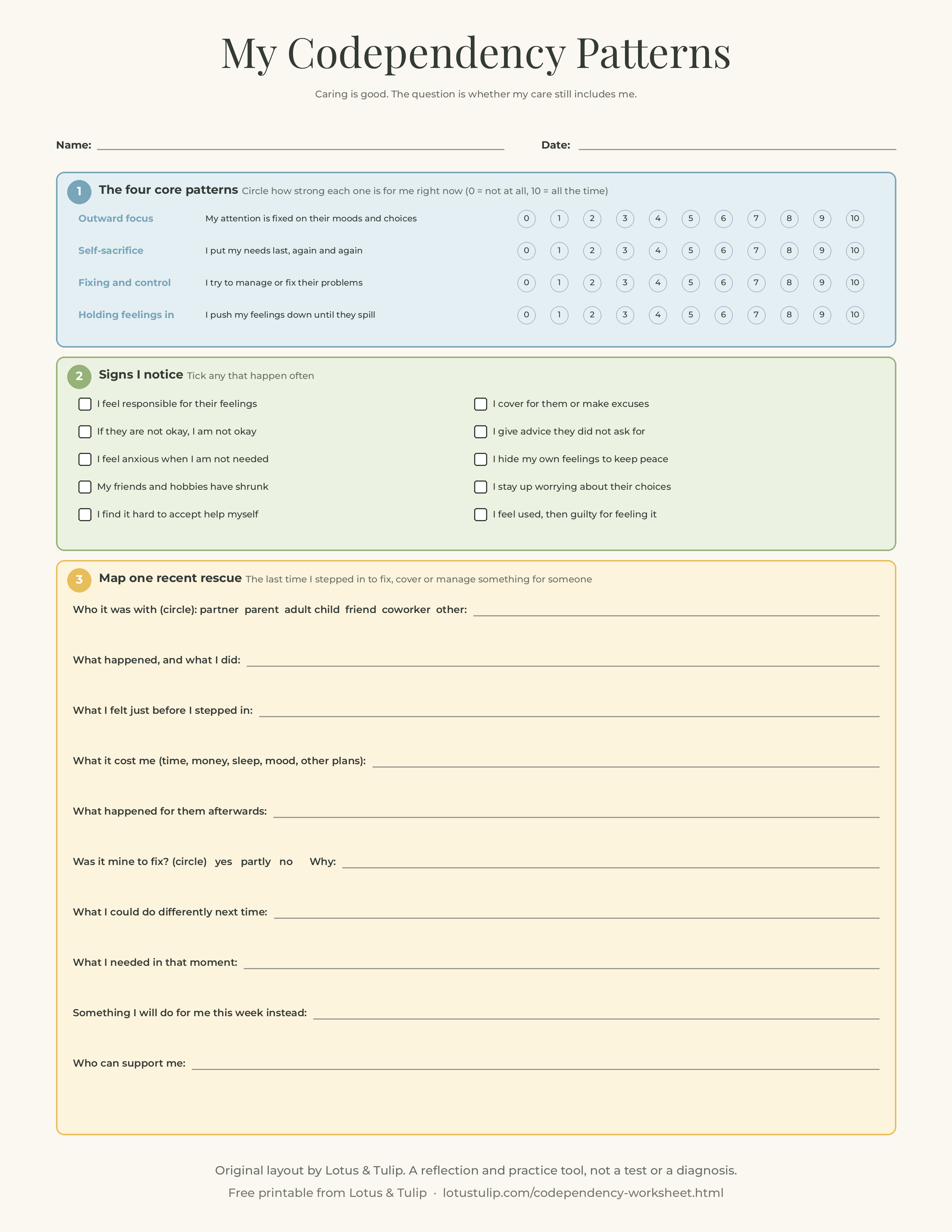
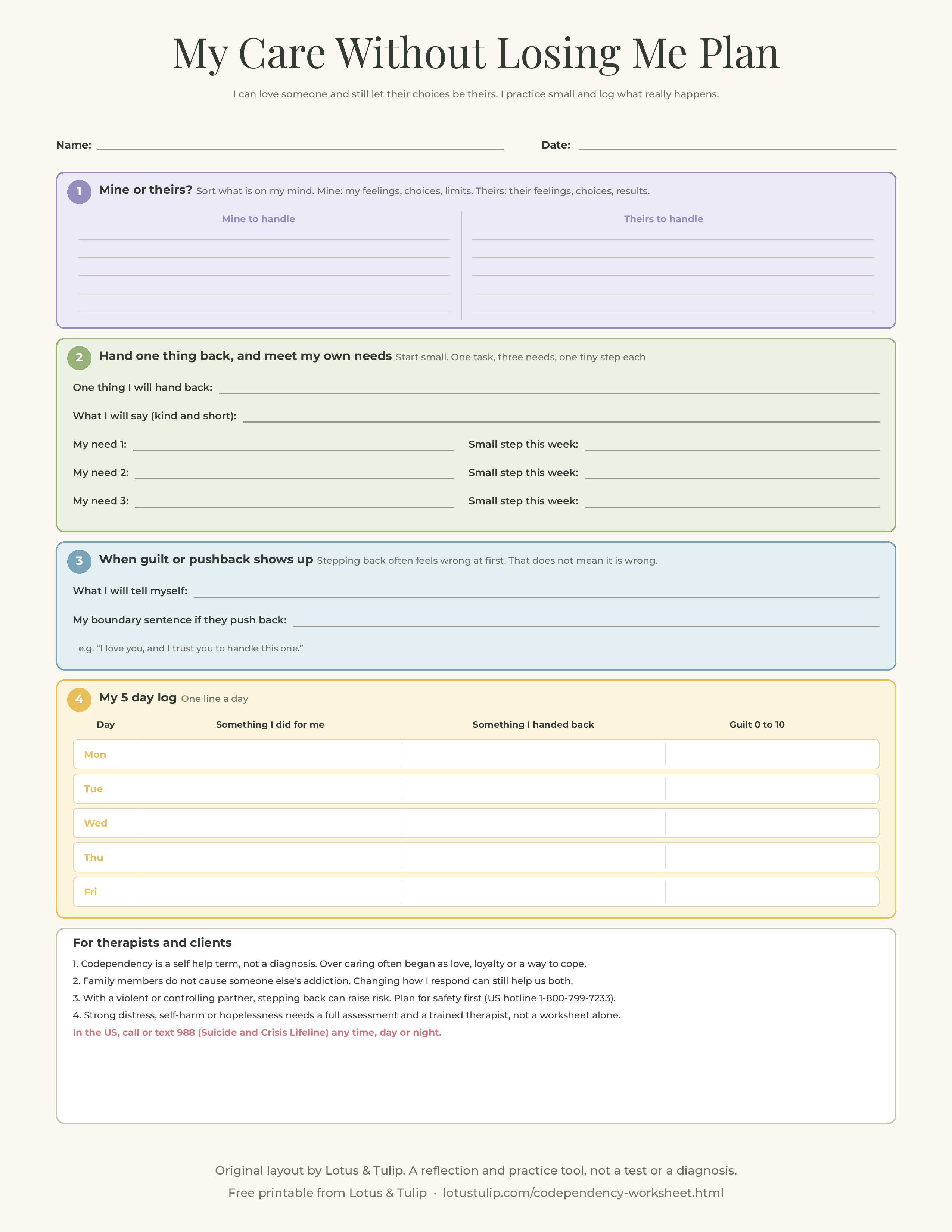
This guide is for therapists, counselors and anyone who recognizes the pattern. It covers where the word comes from, what it is and is not, what research actually supports, the fair criticism, nine practical steps and common mistakes. It ends with a free 2 page printable: My Codependency Patterns, which maps the four core patterns and where my care turns into rescuing, and My Care Without Losing Me Plan, which sorts what is mine and what is theirs and builds a small daily self care and boundary practice.
Download the free codependency worksheet (PDF, 2 pages, US Letter)
Direct download, no email or sign up. See the pages first.
What codependency is, and what it is not
It is not a diagnosis. Codependency is not in the DSM-5-TR. In 1986 psychiatrist Timmen Cermak proposed diagnostic criteria for a "codependent personality disorder", but they were never adopted. Today it is best used as a description of a pattern, not a label for a person.
It is not the same as caring. Caring for a sick parent, supporting a partner in recovery or showing up for a friend is healthy and often admirable. The concern is care that has become compulsive and one sided: where your mood depends on theirs, you keep trying to fix or control their choices, and your own needs, feelings and relationships keep shrinking.
It can overlap with other problems. The pattern often travels with anxiety, depression, low self-worth, trauma or a relationship with someone who is abusive or has an addiction. A worksheet cannot sort these out. If the pattern is severe, or there is any abuse, a full assessment and safety planning come first.
Where the idea comes from
- Addiction treatment, late 1970s. Clinicians working with alcohol problems first spoke of "co-alcoholics", the partners and family members whose lives became organized around someone else's drinking. "Co-dependent" grew out of that language, and Al-Anon family groups had already been supporting relatives of drinkers since the 1950s.
- Self help, 1980s. Melody Beattie's Codependent No More (1986) brought the term to a mass audience, and Co-Dependents Anonymous (CoDA), a 12 step fellowship, was founded in Phoenix, Arizona in 1986. The meaning widened from families of drinkers to anyone who over focuses on others.
- The research definition. Because definitions varied so much, Greg Dear, Clare Roberts and Lois Lange (2004) analyzed 11 widely published definitions and found four shared core elements: external focusing (attention fixed on other people's behavior, opinions and expectations), self-sacrifice (neglecting your own needs to meet theirs), interpersonal control (a firm belief that you can and should fix other people's problems and behavior) and emotional suppression (pushing feelings down until they overflow). The free worksheet is built around these four.
What the research shows
The pattern can be measured, and it travels with distress. Marks, Blore, Hine and Dear (2012) developed the 19 item Composite Codependency Scale with 301 adults from the general population and 49 members of CoDA. Three factors held up: self-sacrifice, interpersonal control and emotional suppression. Higher scores were linked with more depression, anxiety and stress, more family dysfunction and lower self-esteem, and the scale separated CoDA members from the general sample. That is correlational evidence: it shows the pattern is real and painful, not what causes it.
For families facing addiction, skills beat confrontation. In a randomized trial with 130 concerned family members of people refusing treatment for alcohol problems, Miller, Meyers and Tonigan (1999) compared three 12 hour approaches. Community Reinforcement and Family Training (CRAFT), which teaches positive communication, rewarding sober behavior and letting natural consequences happen when safe, got 64% of the drinkers into treatment, compared with 30% for the confrontational Johnson Institute intervention and 13% for Al-Anon facilitation. All three approaches brought similar improvement in the family members' own functioning. The lesson for codependency work: stepping back from rescuing does not mean giving up on the person.
The fair criticism. Psychologist Janice Haaken (1990) and other writers argued that "codependency" stretched to cover almost any caring behavior, and that it risks pathologizing caretaking roles that fall mostly on women. It can also blame family members for someone else's addiction or abuse. Those points are worth keeping in the room. The goal is never "stop caring"; it is care that includes yourself.
The honest caveat. There is no trial of a codependency worksheet. Use it to structure work that has better support, such as boundary and assertiveness practice, CBT work on beliefs like "I am only lovable when I am needed", and for families affected by addiction, approaches like CRAFT or peer support such as Al-Anon.
Codependency or healthy care? A quick check
- Helping: I offer support they asked for, and I can still rest when I help. Rescuing: I step in before they ask, and I feel anxious when I do not.
- Helping: I let them face the results of their choices. Rescuing: I cover, excuse or clean up so they never have to.
- Helping: My mood can stay steady when they are upset. Rescuing: If they are not okay, I cannot be okay.
- Helping: I still have my own friends, interests and plans. Rescuing: My life has shrunk to their needs and crises.
How to use a codependency worksheet, step by step
- Start with compassion. Over caring usually began as love, loyalty or a way to survive a chaotic home. Name that out loud. The aim is balance, not blame.
- Rate the four patterns. On page 1, rate external focusing, self-sacrifice, control and holding feelings in from 0 to 10. Most people have one or two that stand out.
- Find the relationship. Note who the pattern is strongest with: a partner, a parent, an adult child, a friend. It is rarely the same everywhere.
- Map one rescue. Write down the last time you stepped in: what you did, what it cost you, and what happened for the other person. Rescues often bring short relief and long resentment.
- Sort mine and theirs. On page 2, sort current worries into what is mine to handle (my feelings, my choices, my limits) and what is theirs (their feelings, choices and consequences).
- Choose one thing to hand back. Pick one small task or problem that belongs to them and decide how you will step back kindly, for example "I trust you to sort out your work schedule."
- Name your own needs. Write three needs you have been ignoring, such as sleep, time with friends or a hobby, and one small way to meet each this week.
- Plan for the guilt and the pushback. Stepping back often brings guilt and sometimes anger from the other person. Write the line you will say to yourself and the boundary sentence you will use.
- Log and review. Use the 5 day log to note what you did for you, what you handed back and how it went. Review it in session and choose the next step.
For scripts that keep a limit warm and clear, see the people pleasing worksheet and the DEAR MAN worksheet.
Common mistakes
- Treating it as a label. "You are a codependent" can feel like an accusation. Talk about patterns and moments instead.
- Swinging to cold detachment. The aim is not to stop caring or cut people off. Warm limits and continued love can go together.
- Blaming the family for the addiction. Family members do not cause someone else's drinking or drug use. Changing how you respond can help, but the choice to use is theirs.
- Starting with the hardest change. Handing back a small task first builds confidence before bigger steps such as refusing to cover for someone at work.
- Ignoring safety. With a violent or controlling partner, stepping back or setting limits can raise risk. Safety planning comes first, with support from a domestic violence service.
Examples
- Partner with a drinking problem: Pattern: calling in sick for him. Handed back: "I am not going to call your work for you anymore." What I did for me: dinner with a friend on Thursday. Guilt before 9 out of 10, after 5.
- Adult child: Pattern: paying a 26 year old's phone bill every month while my own savings run down. Handed back: a clear date when the bill moves to his name. Need named: saving for my own retirement.
- Friend in repeated crisis: Pattern: answering texts at 2 a.m. most nights. Plan: "I care about you. I am turning my phone off at 11. If you are in danger, call or text 988." Logged: slept through the night three times.
Free codependency worksheet
This free printable is an original Lotus & Tulip layout on US Letter, in our own wording. Page 1, My Codependency Patterns, rates the four core patterns from the research definition (external focusing, self-sacrifice, control and holding feelings in), lists ten everyday signs to tick, and maps one recent rescue: what I did, what it cost me and what happened for them. Page 2, My Care Without Losing Me Plan, has a mine or theirs sort, one thing to hand back, three needs of my own with a small step for each, a guilt and pushback plan, a 5 day log and notes for therapists and clients, including the US 988 crisis line.
Download the free codependency worksheet (PDF, 2 pages, US Letter)
Prefer single images? Page 1: my codependency patterns (PNG) · Page 2: my care without losing me plan (PNG)
Free to print for use with your own clients or for yourself. Please link to this page rather than re-uploading the file. A reflection tool, not a test, a diagnosis or a substitute for therapy. In the US, call or text 988 in a crisis, or call the National Domestic Violence Hotline at 1-800-799-7233.
Related resources
- People pleasing worksheet: noticing the automatic yes, with a free kind no practice plan
- Healthy boundaries worksheet: types of boundaries and how to set them
- Attachment styles worksheet: fear of abandonment and secure moves
- Shame vs guilt worksheet: guilt after stepping back, and what to do with it
- Core beliefs worksheet: working with "I am only lovable when I am needed"
FAQ
What is codependency?
Codependency is an everyday and self help term for a pattern of focusing on another person's needs, moods and problems so much that your own needs, feelings and life get lost. Researchers describe four core parts: external focusing, self-sacrifice, trying to control others and suppressing your own emotions. It is not a formal diagnosis.
Is codependency a mental illness?
No. It is not in the DSM-5-TR. A diagnosis was proposed in 1986 but never adopted. The pattern can still cause real distress and is linked in studies with depression, anxiety and stress, so it is worth working on.
What are signs of codependency?
Common signs include feeling responsible for someone else's feelings or choices, covering for them, struggling to say no, feeling anxious when you are not needed, hiding your own feelings and letting your friendships and interests shrink. The free worksheet has a 10 sign checklist.
Is codependency the same as people pleasing?
They overlap. People pleasing is mostly about avoiding disapproval in general. Codependency usually centers on one close relationship and includes trying to fix or control the other person. The people pleasing worksheet pairs well with this one.
How do I stop being codependent?
Start small: notice where you rescue, sort what is yours and what is theirs, hand back one small task, and meet one of your own needs each day. Expect guilt at first. Therapy, boundary skills and, for families affected by addiction, approaches like CRAFT or groups like Al-Anon can help.
Is this codependency worksheet free?
Yes. It is free to print for use with your own clients or for yourself. Please link to this page rather than re-uploading the file.
Sources
- American Psychiatric Association. (2022). Diagnostic and Statistical Manual of Mental Disorders (5th ed., text rev.).
- Beattie, M. (1986). Codependent No More. Hazelden.
- Cermak, T. L. (1986). Diagnostic criteria for codependency. Journal of Psychoactive Drugs, 18(1), 15 to 20.
- Dear, G. E., Roberts, C. M., and Lange, L. (2004). Defining codependency: A thematic analysis of published definitions. In S. Shohov (Ed.), Advances in Psychology Research (Vol. 34, pp. 189 to 205). Nova Science.
- Haaken, J. (1990). A critical analysis of the co-dependence construct. Psychiatry, 53(4), 396 to 406.
- Marks, A. D. G., Blore, R. L., Hine, D. W., and Dear, G. E. (2012). Development and validation of a revised measure of codependency. Australian Journal of Psychology, 64(3), 119 to 127.
- Miller, W. R., Meyers, R. J., and Tonigan, J. S. (1999). Engaging the unmotivated in treatment for alcohol problems: A comparison of three strategies for intervention through family members. Journal of Consulting and Clinical Psychology, 67(5), 688 to 697.