
Therapist worksheets · Couples, individual therapy and self-help · Updated 2026-11-12
Attachment styles worksheet: what the research really says, and how to use it without labeling anyone (free printable)
Couples work: Couples Therapy Worksheets, 15 pages on communication, conflict cycle, repair and rebuilding trust Holiday 20% off: about $9.20, was $12 (EUR 10) · instant digital download
Buy on EtsyAsking for needs: Boundaries Worksheets for Therapists, saying no, script builder and handling pushback Holiday 20% off: about $9.20, was $12 (EUR 10) · instant digital download
Buy on EtsyBig emotions: DBT Worksheets for Therapists, diary card, check the facts, opposite action and validation Holiday 20% off: about $11.04, was $14 (EUR 12) · fillable PDF, instant digital download
Buy on EtsyTry it free first: download a fillable sample (weekly diary card and checking the facts, PDF, 234 KB). Type into it on screen, then get the full pack. No email needed.
Attachment styles are everywhere right now: in therapy rooms, on social media and in dating advice. Clients often arrive already sure they are "anxiously attached" or that their partner is "an avoidant". The research behind attachment is real and useful, but it is more careful than the internet version. It describes patterns on a range, shaped by relationships, and able to change.
This guide is for therapists, counselors, coaches and anyone curious about their own patterns. It covers where attachment styles come from, the four patterns adults are usually sorted into, why researchers now prefer two dimensions to four boxes, whether attachment can change, how to use a worksheet in individual and couples sessions, and common mistakes. It ends with a free 2 page printable: a My Attachment Patterns reflection page and a My Secure Moves Plan with a practice log.
Download the free attachment styles worksheet (PDF, 2 pages, US Letter)
Direct download, no email or sign up. See the pages first.
Where attachment styles come from
Attachment theory began with British psychiatrist John Bowlby, who argued in Attachment and Loss (volume 1, 1969) that infants have a built in drive to stay close to a caregiver who can protect them, and that early experiences shape "internal working models": expectations about whether others will be there and whether we are worth caring for.
Mary Ainsworth and colleagues turned the idea into research. In Patterns of Attachment (1978) they described the Strange Situation, a short lab sequence of separations and reunions between a baby and a parent. They saw three main patterns: secure babies were upset but easily comforted, avoidant babies seemed to ignore the parent on return, and anxious resistant (also called ambivalent) babies were hard to settle and mixed seeking comfort with anger. Main and Solomon (1990) later added a fourth infant category, disorganized, for babies with no consistent strategy.
From babies to adult relationships
In 1987 Cindy Hazan and Phillip Shaver asked whether romantic love works as an attachment process too. They published a "love quiz" in a local newspaper and asked readers to choose which of three short descriptions fit them best. Of the 620 people who replied, 56% chose the secure description, 25% avoidant and 19% anxious ambivalent, proportions similar to the infant studies of the time. People in each group described their most important love relationship in different ways: secure respondents as happy, friendly and trusting, avoidant respondents with fear of closeness, and anxious ambivalent respondents with jealousy, emotional highs and lows and a strong desire for the other person to feel the same.
Kim Bartholomew and Leonard Horowitz (1991) then proposed four adult patterns built from two ideas: a person's view of themselves (am I worthy of love?) and their view of others (can I count on people?).
| Pattern | View of self and others | What it can look like in a relationship |
|---|---|---|
| Secure | Positive self, positive others | Comfortable with closeness and with time apart; can ask for what they need and handle conflict without panic. |
| Preoccupied (often called anxious) | Negative self, positive others | Worries about being left or not loved enough; seeks reassurance; very alert to signs of distance. |
| Dismissing (often called avoidant) | Positive self, negative others | Values independence; uncomfortable depending on others or sharing feelings; pulls back when things get close or tense. |
| Fearful (sometimes called fearful avoidant) | Negative self, negative others | Wants closeness and fears it at the same time; may move toward and away in quick turns. |
Two dimensions, not four boxes
The research has moved on from types. Brennan, Clark and Shaver (1998) pooled the adult attachment questionnaires of the time and found that they boil down to two underlying dimensions: attachment anxiety (fear of rejection and abandonment) and attachment avoidance (discomfort with closeness and depending on others). Their Experiences in Close Relationships scale, and the revised version by Fraley, Waller and Brennan (2000), measure people on both dimensions rather than putting them in one category.
Fraley, Hudson, Heffernan and Segal (2015) tested the question directly with taxometric analyses in two samples. Their results were more consistent with a dimensional model than a categorical one, both for attachment in general and for attachment with specific people such as parents and peers. In plain language: people are not "an anxious" or "an avoidant". Everyone sits somewhere on two sliding scales, and the spot can differ from one relationship to another.
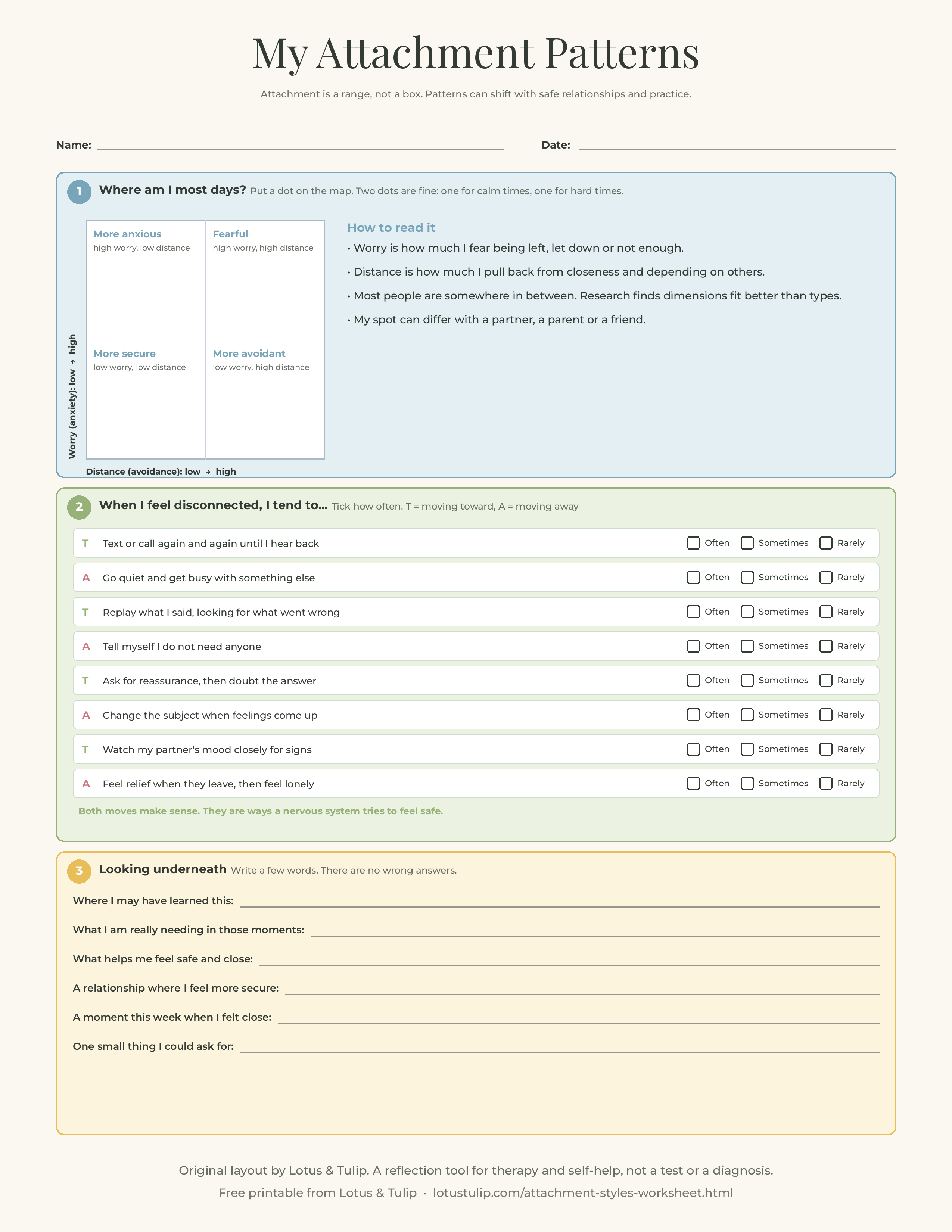
This is why our free worksheet uses a map with two axes instead of a quiz with a result. The four patterns are useful shorthand for the corners of the map, nothing more.
Can attachment style change?
Yes, to a degree. Attachment patterns are fairly stable, but they are not fixed. Fraley's (2002) meta-analysis found only moderate stability in attachment security from infancy into early adulthood, and adult attachment responds to new relationship experiences.
Therapy can help too. Burgess Moser and colleagues (2016) followed 32 couples through emotionally focused couple therapy (EFT), an approach built on attachment theory. Couples became less avoidant in their relationship over the course of therapy, and couples who completed a key change event in EFT called blamer softening also became less anxious after it. As anxiety and avoidance went down, relationship satisfaction went up. It was a small study without a control group, so it shows that change happens in therapy, not that this exact path is guaranteed for everyone.
What an attachment styles worksheet can and cannot do
- It can help someone notice their own moves when they feel disconnected, link them to old learning without blame, and plan one or two different moves.
- It can give couples a shared, non blaming language: "When I feel far from you, I chase. When you feel pressured, you go quiet."
- It cannot diagnose anything or give anyone a style. Attachment is not a diagnosis, and free online quizzes are not validated research measures.
- It cannot replace a validated questionnaire when you need one for research or formal assessment. Our worksheet uses our own wording and is not a version of the ECR, the ECR-R or any published scale.
How to use an attachment styles worksheet, step by step
- Start with the idea of a range. Explain that attachment describes patterns on two sliding scales, worry and distance, and that most people sit somewhere in the middle.
- Frame patterns as protection. Present chasing and withdrawing as strategies that once made sense for staying connected or staying safe, not as flaws.
- Place a dot on the map. Ask the client to mark where they are most days with one person. Two dots, one for calm times and one for stressful times, often tell the more useful story.
- Tick the disconnection reactions. Go through the moving toward and moving away reactions on page 1. Most people tick some of both.
- Look underneath. Use the reflection lines to explore where the pattern may have been learned and what the person is really needing in those moments.
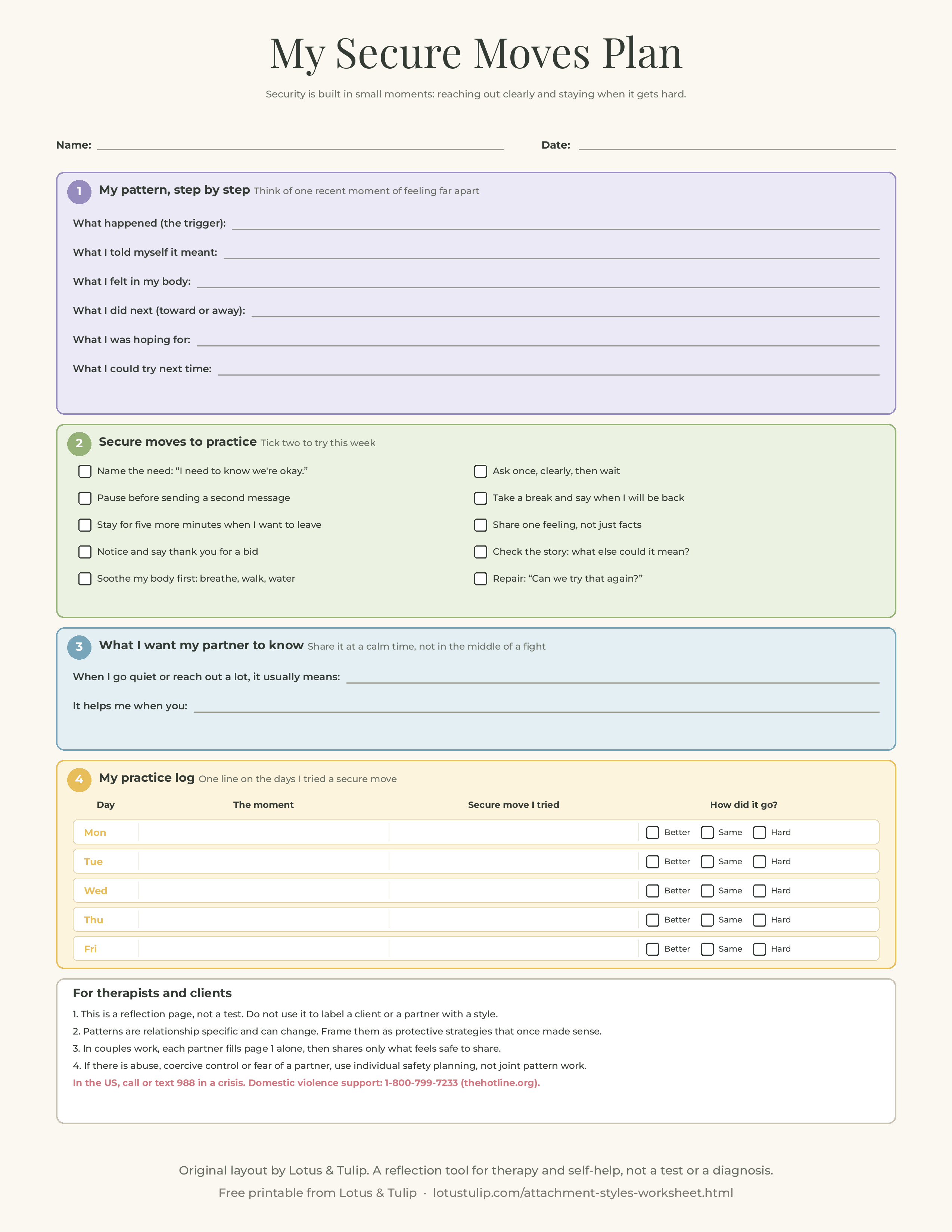
- Map one real moment. On page 2, walk through a recent moment of feeling far apart: trigger, the story about what it meant, body signals, what they did and what they hoped for.
- Choose two secure moves. Pick two small behaviors from the list, such as naming the need or taking a break with a clear return time, and rehearse the words in session.
- Share safely in couples work. Each partner fills page 1 alone. In session, each shares only what feels safe, using the "what I want my partner to know" lines.
- Track and review. Use the practice log for a week and review it next session. Notice what was different, not only what went wrong.
Common mistakes
- Using styles as labels or weapons. "You're just avoidant" ends conversations. Talk about moves in moments instead.
- Treating a quiz result as fact. One self-report on one bad week is a snapshot, not a personality.
- Ignoring relationship context. Someone can feel secure with a friend and anxious with a partner. Ask "with whom?"
- Pathologizing normal needs. Wanting a reply or wanting time alone are both ordinary. The question is how rigid and painful the pattern is.
- Doing joint pattern work when there is abuse. If one partner is afraid of the other, attachment language can be twisted to excuse control. Switch to individual work and safety planning.
- Skipping the body. Attachment alarms are felt in the body. Pair the worksheet with grounding or a window of tolerance check.
Examples of secure moves
- Toward leaning (anxious): "I'm feeling a bit wobbly since we argued. Can we have five minutes tonight to check we're okay?" Then wait for the reply instead of sending three more messages.
- Away leaning (avoidant): "I need about 30 minutes to cool down. I'm not leaving the conversation. Let's talk at 8." Then come back at 8.
- Fearful: "Part of me wants to be close and part of me wants to run. I'm going to stay and tell you one thing I'm feeling."
- Any pattern: notice a small bid for connection, such as a shared joke or a question about your day, and respond to it. Small, repeated moments of being answered are what security is built from.
Free attachment styles worksheet
This free printable is an original Lotus & Tulip layout on US Letter. Page 1, My Attachment Patterns, has a two dimension map of worry (anxiety) and distance (avoidance) with the four patterns at the corners, eight moving toward and moving away reactions to tick by how often they happen, and reflection lines on roots, needs and what helps. Page 2, My Secure Moves Plan, walks through one moment of feeling far apart, offers ten secure moves to practice, has a short "what I want my partner to know" section, a 5 day practice log and notes for therapists with US crisis lines.
Download the free attachment styles worksheet (PDF, 2 pages, US Letter)
Prefer single images? Page 1: my attachment patterns (PNG) · Page 2: my secure moves plan (PNG)
Free to print for use with your own clients or for yourself. Please link to this page rather than re-uploading the file. A reflection tool, not a test, a diagnosis or a substitute for therapy.
Related resources
- Jealousy worksheet for adults: fear of losing someone, urges to check, and a free jealousy and envy plan
- Emotional neglect worksheet: early unmet emotional needs and how they show up now, with a free practice plan
- Codependency worksheet: rescuing, control and a free care without losing me plan
- Inner child worksheet: noticing old feelings and needs, with a free reparenting plan
- Communication exercises for couples: 12 structured exercises with a free printable
- I statements worksheet: saying what you feel and need without blame
- Healthy boundaries worksheet: noticing and setting limits
- Core beliefs worksheet: working with "I'm not enough" and "people leave"
- Window of tolerance worksheet: noticing when the body is in alarm
- DBT validation worksheet: responding to a partner's feelings
FAQ
What are the 4 attachment styles?
The four adult patterns most often named are secure, anxious (preoccupied), avoidant (dismissing) and fearful (fearful avoidant), from Bartholomew and Horowitz (1991). Research now treats them as corners of two dimensions, attachment anxiety and attachment avoidance, rather than separate types.
Is attachment style permanent?
No. Attachment patterns are fairly stable but can change with new relationship experiences and with therapy. A study of emotionally focused couple therapy found couples became less avoidant over therapy, and some became less anxious too.
Is this worksheet an attachment style test?
No. It is a reflection tool with our own wording, not a scored or validated questionnaire. For research or formal assessment, use a validated measure such as the Experiences in Close Relationships Revised (ECR-R) under its own terms.
Can I use this attachment worksheet in couples therapy?
Yes. Have each partner complete page 1 on their own, then share only what feels safe in session. Do not use joint attachment work when there is abuse, coercive control or fear of a partner; use individual safety planning instead.
What is the difference between anxious and avoidant attachment?
Attachment anxiety is fear of being rejected or left, which often shows up as seeking closeness and reassurance. Attachment avoidance is discomfort with closeness and depending on others, which often shows up as pulling away. A person can be high, low or in between on each.
Is this attachment styles worksheet free?
Yes. It is free to print for use with your own clients or for yourself. Please link to this page rather than re-uploading the file.
Sources
- Ainsworth, M. D. S., Blehar, M. C., Waters, E., and Wall, S. (1978). Patterns of Attachment: A Psychological Study of the Strange Situation. Lawrence Erlbaum.
- Bartholomew, K., and Horowitz, L. M. (1991). Attachment styles among young adults: a test of a four-category model. Journal of Personality and Social Psychology, 61(2), 226 to 244.
- Bowlby, J. (1969). Attachment and Loss, Vol. 1: Attachment. Basic Books.
- Brennan, K. A., Clark, C. L., and Shaver, P. R. (1998). Self-report measurement of adult attachment: an integrative overview. In J. A. Simpson and W. S. Rholes (Eds.), Attachment Theory and Close Relationships (pp. 46 to 76). Guilford Press.
- Burgess Moser, M., Johnson, S. M., Dalgleish, T. L., Lafontaine, M.-F., Wiebe, S. A., and Tasca, G. A. (2016). Changes in relationship-specific attachment in emotionally focused couple therapy. Journal of Marital and Family Therapy, 42(2), 231 to 245. doi:10.1111/jmft.12139
- Fraley, R. C. (2002). Attachment stability from infancy to adulthood: meta-analysis and dynamic modeling of developmental mechanisms. Personality and Social Psychology Review, 6(2), 123 to 151.
- Fraley, R. C., Hudson, N. W., Heffernan, M. E., and Segal, N. (2015). Are adult attachment styles categorical or dimensional? A taxometric analysis of general and relationship-specific attachment orientations. Journal of Personality and Social Psychology, 109(2), 354 to 368. doi:10.1037/pspp0000027
- Fraley, R. C., Waller, N. G., and Brennan, K. A. (2000). An item response theory analysis of self-report measures of adult attachment. Journal of Personality and Social Psychology, 78(2), 350 to 365.
- Hazan, C., and Shaver, P. (1987). Romantic love conceptualized as an attachment process. Journal of Personality and Social Psychology, 52(3), 511 to 524.
- Main, M., and Solomon, J. (1990). Procedures for identifying infants as disorganized/disoriented during the Ainsworth Strange Situation. In M. T. Greenberg, D. Cicchetti and E. M. Cummings (Eds.), Attachment in the Preschool Years (pp. 121 to 160). University of Chicago Press.