
Therapist worksheets · CBT, DBT and self-compassion work · Updated 2026-11-12
Shame vs guilt worksheet: how to tell them apart, why it matters, and what helps each one (free printable)
Check the facts and opposite action: DBT Worksheets for Therapists, diary card, check the facts, opposite action and validation Holiday 20% off: about $11.04, was $14 (EUR 12) · fillable PDF, instant digital download
Buy on EtsyTry it free first: download a fillable sample (weekly diary card and checking the facts, PDF, 234 KB). Type into it on screen, then get the full pack. No email needed.
Self-critical thoughts: CBT Worksheets for Therapists, 20 pages including thought records and core beliefs Holiday 20% off: about $11.04, was $14 (EUR 12) · fillable PDF, instant digital download
Buy on EtsyTry it free first: download a fillable sample (thought record and evidence for and against, PDF, 105 KB). Type into it on screen, then get the full pack. No email needed.
Low mood and withdrawal: Depression and Behavioral Activation Worksheets for Therapists Holiday 20% off: about $9.20, was $12 (EUR 10) · instant digital download
Buy on EtsyClients often use "guilty" and "ashamed" as if they were the same word. They are not the same feeling, and they do not respond to the same help. Guilt is about something I did. Shame is about who I am. One tends to lead toward repair; the other tends to lead toward hiding, or toward blaming someone else.
This guide is for therapists, counselors and anyone working on harsh self-judgment. It covers where the distinction comes from, what the research shows about each emotion, how to check whether the feeling fits the facts, step by step use in session, and common mistakes. It ends with a free 2 page printable: a Shame or Guilt? sort with a check the facts section, and a My Repair and Self-Compassion Plan with a practice log.
Download the free shame vs guilt worksheet (PDF, 2 pages, US Letter)
Direct download, no email or sign up. See the pages first.
The core difference: the act or the self
The modern distinction goes back to psychoanalyst and researcher Helen Block Lewis. In Shame and Guilt in Neurosis (1971) she argued that in shame the whole self is the focus of the negative evaluation, while in guilt the focus is the thing that was done. June Tangney and colleagues then tested the idea in decades of research, summarized in Shame and Guilt (Tangney and Dearing, 2002).
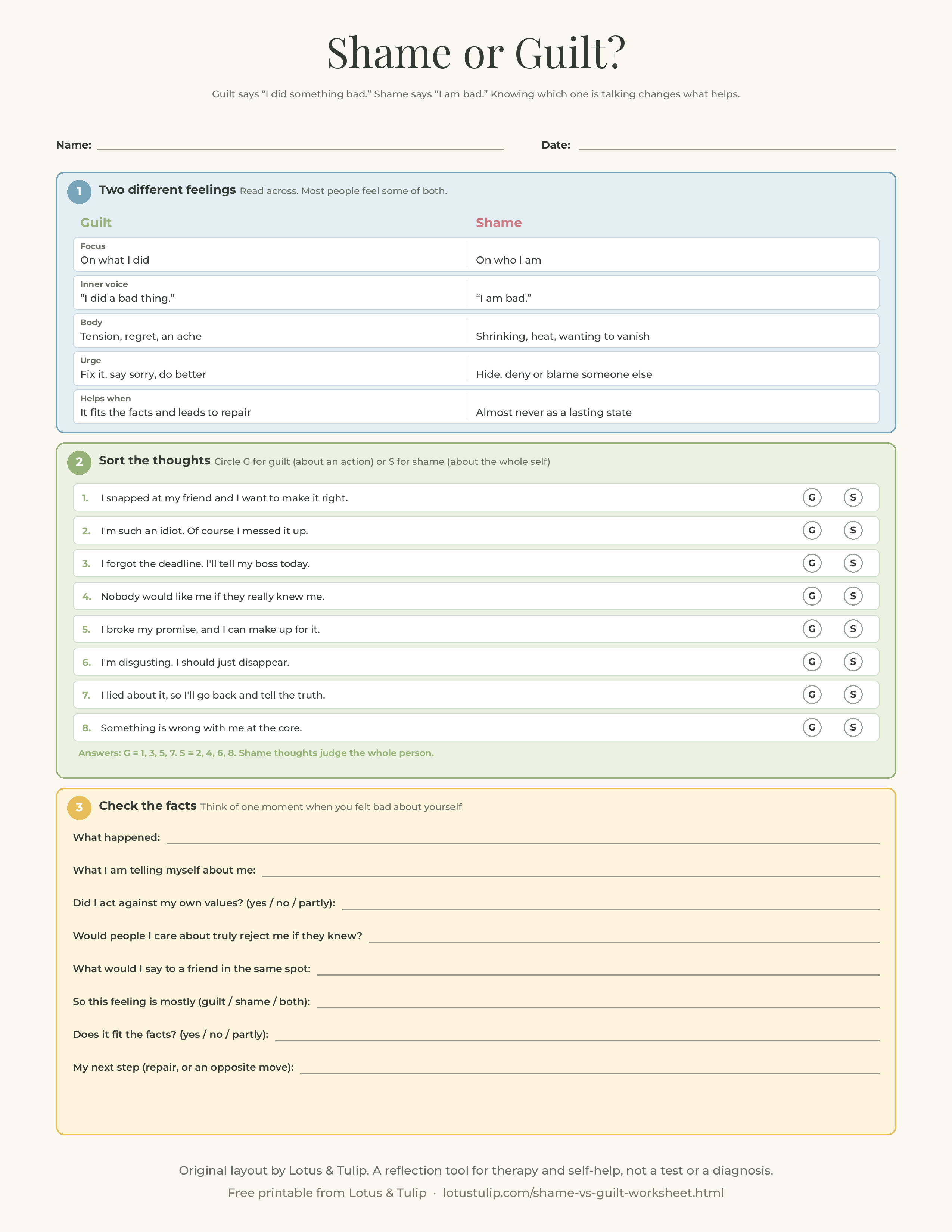
| Guilt | Shame | |
|---|---|---|
| Focus | A specific behavior: "I did a bad thing." | The whole self: "I am bad." |
| Felt as | Tension, remorse, regret | Shrinking, feeling small, exposed or worthless |
| Typical urge | Confess, apologize, repair | Hide, escape, deny, or shift the blame |
| Attention goes to | The other person and the harm done | Oneself and how one looks |
Both are called self-conscious emotions, and the same event can trigger either one. Forgetting a friend's birthday can bring "I forgot, I'll call her" (guilt) or "I'm a terrible friend, everyone would be better off without me" (shame). Most people feel a mix.
What the research shows
Shame is linked more strongly to depression. Kim, Thibodeau and Jorgensen (2011) pooled 108 studies with 22,411 participants. Shame was more strongly associated with depressive symptoms (r = .43) than guilt (r = .28). Two kinds of guilt were the exception: guilt about things a person could not control, and "free floating" guilt with no specific event behind it were linked to depression about as strongly as shame. External shame, feeling judged as bad in the eyes of others, had the strongest link of all (r = .56). These are correlations, so they do not show that shame causes depression, but they make shame worth asking about.
Shame can turn into blame and anger. Tangney and colleagues (1992) found that shame-prone people were more likely to feel anger and to blame others, while guilt-prone people were not. When the self feels attacked, pushing the blame outward can feel like protection.
Guilt tends to predict better behavior; shame is more complicated. In a longitudinal study of 476 jail inmates, Tangney, Stuewig and Martinez (2014) found that guilt proneness directly predicted less reoffending in the first year after release. Shame proneness did not predict reoffending on its own. It raised the risk indirectly, through its link to blaming others, but when shame did not turn into blame, it was linked to less reoffending. The authors describe shame as having "two faces": one destructive, one with constructive potential.
The honest caveat. Most of this research uses self-report scales such as Tangney's Test of Self-Conscious Affect (TOSCA), and much of it is cross-sectional. Guilt is also not always healthy: excessive guilt over things outside a person's control is a common feature of depression and of trauma. The goal is not to remove guilt, but to help it fit the facts.
Does the feeling fit the facts?
Dialectical behavior therapy (DBT) offers a practical test. In Linehan's skills manual (2015), guilt is treated as justified when your own behavior goes against your values or moral code, and shame is treated as justified when you would really be rejected by a person or group you care about if a characteristic or behavior of yours became known. When the emotion fits, the skill is problem solving: for guilt, repair the harm, apologize, accept the consequences and commit to doing it differently. When it does not fit, the skill is opposite action: instead of hiding, share it with people who will not reject you, keep your head up and stay present.
This is why the free worksheet asks two separate questions: "Did I act against my own values?" and "Would people I care about truly reject me if they knew?" A client who yelled at their child may answer yes to the first and no to the second. That points to repair, not to hiding.
Where self-compassion fits
Compassion focused therapy (CFT), developed by Paul Gilbert, was built for people with high shame and self-criticism. Gilbert and Procter (2006) described a group approach called compassionate mind training and reported promising results in a small pilot study. The idea is simple to say and hard to do: learn to meet your own mistakes with the warmth you would offer a friend. Self-compassion does not mean letting yourself off the hook. It often makes it easier to look at what you did, because you are not also fighting the feeling that you are worthless.
How to use a shame vs guilt worksheet, step by step
- Normalize both feelings. Explain that guilt and shame are universal human emotions and that feeling them does not make someone a bad person.
- Teach the one line difference. Guilt says "I did something bad." Shame says "I am bad." Use the table on page 1 to compare focus, body feelings and urges.
- Practice the sort. Have the client circle G or S for the eight sample thoughts. The answers are printed at the bottom, so it also works as homework.
- Bring a real moment. Ask for one recent time they felt bad about themselves, and write what happened and what they told themselves about who they are.
- Check the facts. Ask the two questions: did I act against my own values, and would people I care about truly reject me if they knew?
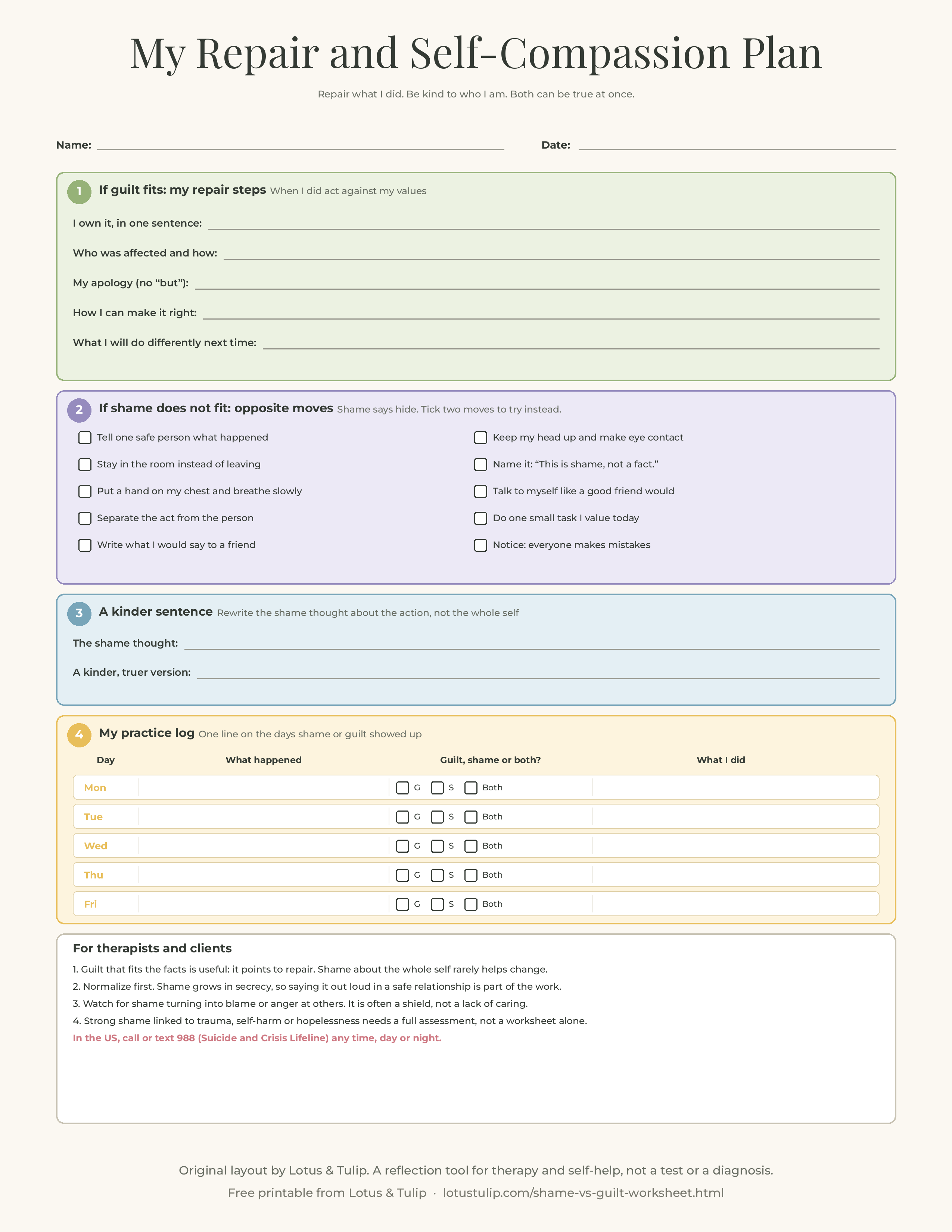
- If guilt fits, plan repair. Use page 2 to own it in one sentence, name who was affected, write an apology without "but" and decide how to make it right.
- If shame does not fit, choose opposite moves. Pick two moves from the list, such as telling one safe person or staying in the room, and rehearse them in session.
- Rewrite one shame thought. Turn "I'm such an idiot" into a sentence about the action: "I made a mistake on that report, and I can fix it."
- Track for a week. Use the practice log to note when shame or guilt showed up and what the client did. Review it together next session.
Common mistakes
- Trying to talk someone out of guilt that fits. If a client really hurt someone, reassurance alone can block repair. Validate the guilt and help them act on it.
- Treating shame as a lack of caring. Defensiveness and blame can be shame in disguise. Lower the threat first, then talk about responsibility.
- Using shame to motivate change. Lectures that attack the person ("What is wrong with you?") tend to push people toward hiding, not change.
- Skipping safety. Intense shame can come with self-harm or suicidal thoughts. Ask directly, and use the worksheet alongside a full assessment.
- Ignoring trauma. Survivors often carry shame for what was done to them. Here the facts are clear: the shame does not fit, and repair is not theirs to make.
Examples
- Adult client: "I missed my sister's recital. I'm a selfish person." Sort: shame. Check: did I act against my values? Partly, family matters to me. Would she reject me? No. Plan: call her, apologize and ask to see a video; kinder sentence: "I made a scheduling mistake that hurt her, and I can show up next time."
- Teen: "Everyone saw me fail the presentation. I'm such a loser." Sort: shame. Check: values? No, freezing is not a moral failing. Rejection? Unlikely. Opposite move: go to lunch with friends as usual instead of hiding.
- Parent: "I yelled at my son this morning." Sort: guilt. Check: values? Yes. Plan: repair after school: "I'm sorry I yelled. That wasn't fair to you. Next time I'll take a break before I talk."
Free shame vs guilt worksheet
This free printable is an original Lotus & Tulip layout on US Letter, with our own wording rather than items from any published scale. Page 1, Shame or Guilt?, compares the two feelings by focus, inner voice, body, urge and when each helps, then has eight thoughts to sort with an answer key and a check the facts section with eight prompts. Page 2, My Repair and Self-Compassion Plan, has repair steps for when guilt fits, ten opposite moves for when shame does not fit, a kinder sentence rewrite, a 5 day practice log and notes for therapists with the US 988 crisis line.
Download the free shame vs guilt worksheet (PDF, 2 pages, US Letter)
Prefer single images? Page 1: shame or guilt sort (PNG) · Page 2: repair and self-compassion plan (PNG)
Free to print for use with your own clients or for yourself. Please link to this page rather than re-uploading the file. A reflection tool, not a test, a diagnosis or a substitute for therapy. In the US, call or text 988 in a crisis.
Related resources
- Body image worksheet for adults: for body shame, checking and avoiding, with a free map and plan
- Forgiveness worksheet for adults: working through a hurt someone else caused, with a free map and plan
- Self-esteem worksheets for adults: testing the harsh bottom line belief, with a free practice plan
- Inner child worksheet: noticing old feelings and needs, with a free reparenting plan
- Core beliefs worksheet: working with "I'm not enough" and other deep beliefs
- Rumination worksheet: getting out of replay loops after a mistake
- DBT validation worksheet: responding to feelings without judgment
- Attachment styles worksheet: fear of rejection in close relationships
- Window of tolerance worksheet: when shame floods the body
FAQ
What is the difference between shame and guilt?
Guilt is a feeling about a specific action: "I did something bad." Shame is a feeling about the whole self: "I am bad." Guilt usually leads toward repair, while shame usually leads toward hiding, denial or blaming others.
Is guilt healthy?
Guilt that fits the facts can be healthy because it motivates apology and repair. Guilt that is excessive, about things you could not control, or not tied to any event is linked to depression and is worth working on in therapy.
Is shame always bad?
Not always. Research on jail inmates found that shame which did not turn into blaming others was linked to less reoffending. But chronic shame about the whole self is strongly linked to depression and rarely helps people change.
How do you know if shame fits the facts?
In DBT, shame fits when you would really be rejected by people you care about if something about you became known. If the people who matter would not reject you, the shame does not fit and opposite action, such as sharing with a safe person, is the skill to use.
Can kids and teens use this worksheet?
Teens can usually use it as is with some support. For younger children, use the simple line "Did I do a bad thing, or am I a bad kid?" and focus on repair: saying sorry and fixing what can be fixed.
Is this shame vs guilt worksheet free?
Yes. It is free to print for use with your own clients or for yourself. Please link to this page rather than re-uploading the file.
Sources
- Gilbert, P., and Procter, S. (2006). Compassionate mind training for people with high shame and self-criticism: overview and pilot study of a group therapy approach. Clinical Psychology and Psychotherapy, 13(6), 353 to 379.
- Kim, S., Thibodeau, R., and Jorgensen, R. S. (2011). Shame, guilt, and depressive symptoms: a meta-analytic review. Psychological Bulletin, 137(1), 68 to 96. doi:10.1037/a0021466
- Lewis, H. B. (1971). Shame and Guilt in Neurosis. International Universities Press.
- Linehan, M. M. (2015). DBT Skills Training Manual (2nd ed.). Guilford Press.
- Tangney, J. P., and Dearing, R. L. (2002). Shame and Guilt. Guilford Press.
- Tangney, J. P., Stuewig, J., and Martinez, A. G. (2014). Two faces of shame: the roles of shame and guilt in predicting recidivism. Psychological Science, 25(3), 799 to 805. doi:10.1177/0956797613508790
- Tangney, J. P., Wagner, P., Fletcher, C., and Gramzow, R. (1992). Shamed into anger? The relation of shame and guilt to anger and self-reported aggression. Journal of Personality and Social Psychology, 62(4), 669 to 675.