
Therapist worksheets · Boundaries, assertiveness and self-worth · Updated 2026-11-13
People pleasing worksheet: why saying yes feels safer, what the research shows, and how to practice a kind no (free printable)
Saying no with confidence: Boundaries Worksheets for Therapists, saying no, script builder and handling pushback Holiday 20% off: about $9.20, was $12 (EUR 10) · instant digital download
Buy on EtsyAsking without apologizing: DBT Worksheets for Therapists, diary card, check the facts, opposite action and validation Holiday 20% off: about $11.04, was $14 (EUR 12) · fillable PDF, instant digital download
Buy on EtsyTry it free first: download a fillable sample (weekly diary card and checking the facts, PDF, 234 KB). Type into it on screen, then get the full pack. No email needed.
The beliefs underneath: CBT Worksheets for Therapists, 20 pages including thought records and core beliefs Holiday 20% off: about $11.04, was $14 (EUR 12) · fillable PDF, instant digital download
Buy on EtsyTry it free first: download a fillable sample (thought record and evidence for and against, PDF, 105 KB). Type into it on screen, then get the full pack. No email needed.
A coworker asks you to cover their shift and you hear yourself say "Sure, no problem" before you have even checked your calendar. Later you feel tired, a little resentful and annoyed with yourself. That is people pleasing: saying yes, agreeing or staying quiet mainly to avoid someone's disappointment, not because you actually want to.
This guide is for therapists, counselors and anyone who wants to work on it. It covers what people pleasing is and is not, what research says about why it happens, the difference between kindness and pleasing, nine practical steps and common mistakes. It ends with a free 2 page printable: My People Pleasing Patterns, which maps where and why you say yes, and My Kind No Practice Plan, with scripts, a small steps ladder and a 5 day log.
Download the free people pleasing worksheet (PDF, 2 pages, US Letter)
Direct download, no email or sign up. See the pages first.
What people pleasing is, and what it is not
It is not a diagnosis. "People pleaser" is an everyday phrase, not a term in the DSM-5-TR. It describes a pattern: putting other people's wishes ahead of your own needs, often automatically, because conflict, disappointment or disapproval feels unbearable.
It is not the same as being kind. Kindness is a choice you make freely and could also decline. Pleasing feels like there is no real choice. A quick test: if saying no is not actually an option for you, it is probably pleasing rather than generosity.
It can overlap with other problems. Strong, lifelong fear of disagreeing with others can be part of anxiety, depression, trauma or, at the far end, dependent personality disorder, where one of the DSM criteria is difficulty expressing disagreement because of fear of losing support or approval. A worksheet is not a way to diagnose any of these. If the pattern is severe, a full assessment comes first.
Where the idea comes from in psychology
- Sociotropy. Aaron Beck (1983) described two personality styles that can make people vulnerable to depression: autonomy and sociotropy. Sociotropy is a strong investment in being accepted and liked, with fear of rejection and a habit of putting others first. Researchers still use the word "sociotropy" for what most people call people pleasing.
- Unmitigated communion. Vicki Helgeson and Heidi Fritz (1998) separated healthy caring for others (communion) from "unmitigated communion", a focus on others to the exclusion of the self. In their research, it was unmitigated communion, not caring itself, that was linked to psychological distress, including depressive symptoms.
- The fawn response. Therapist Pete Walker, in Complex PTSD: From Surviving to Thriving (2013), added "fawn" to fight, flight and freeze: appeasing and pleasing a threatening person to stay safe. It is a useful clinical idea, especially for clients who grew up around unpredictable adults, but it is a description from clinical experience, not a tested research category.
What the research shows
Pleasing changes real behavior, not only feelings. In two studies with undergraduates, Exline and colleagues (2012) found that people high in sociotropy took more candy, but only when they believed a peer wanted them to eat. They also reported trying to match the peer and eating to make the peer comfortable. When participants thought the peer did not care, sociotropy did not predict how much they ate. The pull was about the other person, not the candy.
We overestimate how costly a no is, in both directions. Flynn and Lake (2008) found that people asking for help underestimated, by as much as 50%, how many strangers would say yes. The reason: they focused on the effort of helping and missed how socially awkward it feels to say no. That awkwardness is real for almost everyone. For a people pleaser it can feel like an emergency. Knowing that the discomfort is normal, and passes, helps make room for practice.
Wording can make refusals feel stronger. Patrick and Hagtvedt (2012) found that framing a refusal as "I don't" (for example, "I don't skip workouts") rather than "I can't" led people to feel more empowered and to stick with their own goals more often. Their studies were about resisting temptation, not refusing other people, so treat this as a helpful idea for self-talk rather than proof about conversations.
The honest caveat. There is no trial of a people pleasing worksheet. The approaches with the most support for this kind of pattern are structured skills work inside therapy, such as assertiveness practice, CBT work on beliefs about rejection and the DBT interpersonal effectiveness skills. Use this worksheet as a guide for that practice, not as a treatment by itself.
Common beliefs behind people pleasing
- "If I say no, they will be angry or leave."
- "My needs matter less than other people's."
- "If someone is upset, it is my job to fix it."
- "I am only worth something when I am useful."
- "Conflict means the relationship is in trouble."
These are beliefs to test, not facts. The free worksheet asks you to write the fear, predict what will happen, then write down what actually happened after a small no. Over a week or two, the gap between the prediction and the result is often the most persuasive evidence.
How to use a people pleasing worksheet, step by step
- Name it without shame. Pleasing usually started as a smart strategy for keeping the peace or staying safe. Say so. The goal is more choice, not a personality overhaul.
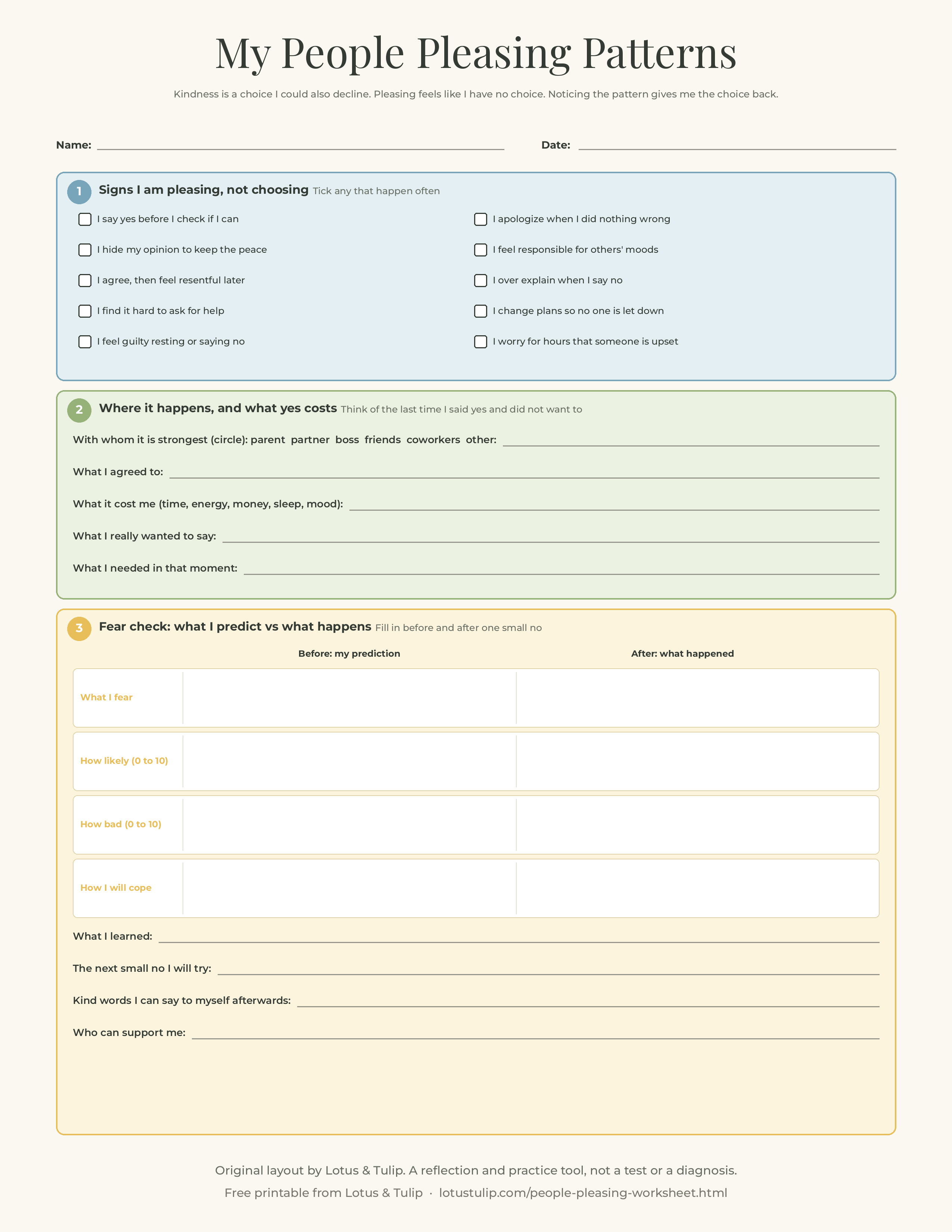
- Spot the signs. Use the checklist on page 1: saying yes before thinking, over apologizing, hiding opinions, feeling responsible for other people's moods.
- Map where it happens. Note the people and places where it is strongest, such as a parent, a boss or a partner. Pleasing is rarely the same everywhere.
- Count the cost of yes. Write what the last automatic yes cost in time, energy, money or resentment. This builds the reason to change.
- Find the fear. Ask what you were afraid would happen if you said no, and how likely that really was.
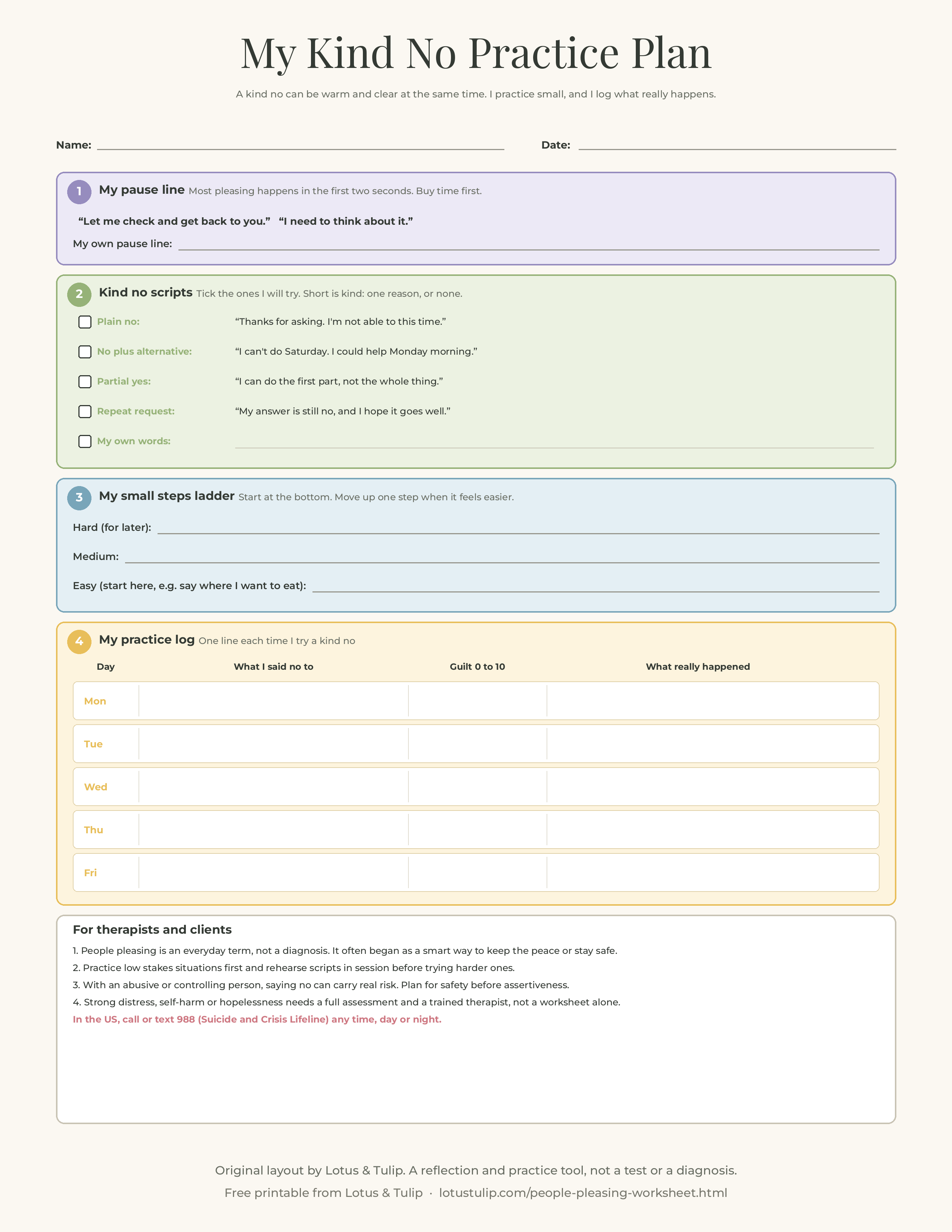
- Use the pause. Practice one buying time line, such as "Let me check and get back to you." Most pleasing happens in the first two seconds.
- Pick a script. On page 2, choose a kind no that fits: a plain no, a no with an alternative, a partial yes or a no to a repeat request.
- Climb a small ladder. Start with low stakes, like stating a restaurant preference, before harder ones, like declining extra work. Rehearse in session first.
- Log the result. Record what you feared and what really happened. Review it together next session and pick the next rung.
For the full DBT approach to asking and refusing, the DEAR MAN skill (Describe, Express, Assert, Reinforce, stay Mindful, Appear confident, Negotiate) and the FAST skill for self-respect (be Fair, no unneeded Apologies, Stick to values, be Truthful) from Linehan's DBT Skills Training Manual (2015) fit well alongside this page.
Common mistakes
- Starting with the hardest relationship. A first no to a critical parent is a big step. Build skill on easy situations first.
- Over explaining. Long reasons invite debate. One short reason, or none, is enough.
- Swinging to harshness. The aim is a kind, clear no, not a cold one. Warm tone and firm content can go together.
- Expecting no discomfort. Guilt after a fair no is common at first. It is a sign of change, not proof you did something wrong.
- Ignoring safety. With an abusive or controlling person, saying no can carry real risk. Safety planning comes before assertiveness practice there.
Examples
- At work: A manager asks for weekend help again. Fear: "They will think I am not a team player." Script: "I'm not available this weekend. I can help Monday morning." Result logged: the manager said "No worries" and asked someone else.
- With family: A sibling expects hosting every holiday. Script with an alternative: "I am not hosting this year. I am happy to bring dessert." Fear rating before 8 out of 10, after 4.
- With friends: Always picking the friend's choice of movie. Small ladder step: "I'd really like to see the comedy tonight." The friend agreed straight away.
Free people pleasing worksheet
This free printable is an original Lotus & Tulip layout on US Letter, in our own wording. Page 1, My People Pleasing Patterns, has ten signs of people pleasing, a map of where and with whom it happens, prompts on the cost of the last automatic yes, and a fear check that compares what I predict with what actually happens. Page 2, My Kind No Practice Plan, has a pause line, five kind no scripts, a small steps ladder from easy to hard, a 5 day practice log and notes for therapists and clients, including the US 988 crisis line.
Download the free people pleasing worksheet (PDF, 2 pages, US Letter)
Prefer single images? Page 1: my people pleasing patterns (PNG) · Page 2: my kind no practice plan (PNG)
Free to print for use with your own clients or for yourself. Please link to this page rather than re-uploading the file. A reflection tool, not a test, a diagnosis or a substitute for therapy. In the US, call or text 988 in a crisis.
Related resources
- Codependency worksheet: when care for one person crowds out your own needs, with a free plan
- Healthy boundaries worksheet: types of boundaries and how to set them
- Assertiveness worksheet: passive, aggressive and assertive styles with scripts
- Inner child worksheet: when an old fear of upsetting people shows up
- Shame vs guilt worksheet: guilt after a fair no, and what to do with it
- Attachment styles worksheet: fear of abandonment and secure moves
FAQ
What is people pleasing?
People pleasing is a pattern of saying yes, agreeing or staying quiet mainly to avoid other people's disappointment or disapproval, often at the expense of your own needs. It is an everyday term, not a diagnosis.
What causes people pleasing?
There is rarely one cause. Common threads include fear of rejection, beliefs like "my needs matter less", growing up where keeping others calm felt necessary for safety, and simple habit. Researchers study related traits under names like sociotropy and unmitigated communion.
Is people pleasing a trauma response?
Sometimes. Pete Walker's "fawn" idea describes pleasing a threatening person to stay safe, and some people who grew up with unpredictable adults recognize it. But many people pleasers have no trauma history, so it is worth exploring rather than assuming.
How do I stop people pleasing?
Start small: notice your automatic yes, use a pause line like "Let me check and get back to you", then practice kind, short refusals in low stakes situations. Write down what you feared and what actually happened. Skills work in therapy, such as assertiveness practice and DBT interpersonal effectiveness, can help.
Why do I feel guilty after saying no?
Saying no feels socially costly for most people, and more so if you are used to keeping everyone happy. Guilt after a fair, kind no is common at first and usually fades with practice. It does not mean you did something wrong.
Is this people pleasing worksheet free?
Yes. It is free to print for use with your own clients or for yourself. Please link to this page rather than re-uploading the file.
Sources
- American Psychiatric Association. (2022). Diagnostic and Statistical Manual of Mental Disorders (5th ed., text rev.).
- Beck, A. T. (1983). Cognitive therapy of depression: New perspectives. In P. J. Clayton and J. E. Barrett (Eds.), Treatment of Depression: Old Controversies and New Approaches (pp. 265 to 290). Raven Press.
- Exline, J. J., Zell, A. L., Bratslavsky, E., Hamilton, M., and Swenson, A. (2012). People-pleasing through eating: Sociotropy predicts greater eating in response to perceived social pressure. Journal of Social and Clinical Psychology, 31(2), 169 to 193. doi:10.1521/jscp.2012.31.2.169
- Flynn, F. J., and Lake, V. K. B. (2008). If you need help, just ask: Underestimating compliance with direct requests for help. Journal of Personality and Social Psychology, 95(1), 128 to 143.
- Helgeson, V. S., and Fritz, H. L. (1998). A theory of unmitigated communion. Personality and Social Psychology Review, 2(3), 173 to 183.
- Linehan, M. M. (2015). DBT Skills Training Manual (2nd ed.). Guilford Press.
- Patrick, V. M., and Hagtvedt, H. (2012). "I don't" versus "I can't": When empowered refusal motivates goal-directed behavior. Journal of Consumer Research, 39(2), 371 to 381.
- Walker, P. (2013). Complex PTSD: From Surviving to Thriving. Azure Coyote.