
Therapist worksheets · CBT core beliefs · Updated 2026-11-05
Core beliefs worksheet: how to identify and change core beliefs in CBT, with examples and a free printable
Ready-made printable: CBT Worksheets for Therapists Fillable PDF, 20 pages: thought record, exposure ladder, activity logs, coping cards and 0 to 10 rating scales
Holiday 20% off: about $11.04, was $14 (EUR 12) · instant digital download
Try it free first: download a fillable sample (thought record and evidence for and against, PDF, 105 KB). Type into it on screen, then get the full pack. No email needed.

Some thoughts come and go. Others keep coming back in different clothes. "They didn't text back, they must be annoyed." "My boss wants a word, I'm in trouble." "I got a B, I'm going to fail." When you follow thoughts like these far enough down, they often land on the same short, harsh sentence: I'm not good enough. I'm unlovable. I can't cope. In cognitive behavioral therapy (CBT) that sentence is called a core belief, and it shapes how a person reads almost everything that happens to them.
This guide is for therapists, counselors, school based clinicians and people working through CBT on their own. It explains what core beliefs are in the cognitive model, how they differ from automatic thoughts and intermediate beliefs, a list of common negative core beliefs with examples, how to find a core belief with the downward arrow technique, the main ways CBT works to loosen an old belief and build a new one, how to adapt the work for teens, common mistakes, and what the research does and does not show. At the end there is a free three page core beliefs worksheet: a Downward Arrow Worksheet, a Core Belief Examiner and a Positive Data Log.
Jump to the free core beliefs worksheet · Jump to core belief examples
What core beliefs are in CBT
Core beliefs are a person's most basic understandings of themselves, other people, the world and the future. In the cognitive model developed by psychiatrist Aaron Beck and taught in Judith Beck's textbook Cognitive Behavior Therapy: Basics and Beyond, they sit at the deepest of three levels of thinking:
- Automatic thoughts. The quick words or images that pop up in a specific situation: "She thinks I'm boring." They are close to the surface and usually easy to catch once you know to look. A CBT thought record works at this level.
- Intermediate beliefs. The rules, attitudes and assumptions that connect the surface to the core: "If I don't keep people entertained, they will leave." "I should never ask for help." "It's terrible to make a mistake." They are often phrased as if/then statements or shoulds.
- Core beliefs. The global, absolute conclusions underneath: "I am boring." "I am weak." "People will leave me." They are usually short, feel like plain facts rather than opinions, and are rarely put into words until someone asks.
In CBT these layers are treated as hypotheses, not diagnoses. A core belief is not a truth about a person. It is a learned conclusion that made sense of earlier experiences, which is why it can feel completely true and still be inaccurate or out of date.
How core beliefs form and why they stick
Core beliefs usually develop early. A child with a particular temperament meets a particular set of experiences, such as a critical parent, frequent moves, bullying, illness, loss, or simply being the one who struggled in a family of high achievers, and draws a conclusion that helps make sense of it. "I'm stupid" can be a reasonable summary for a seven year old with an undiagnosed learning difference who keeps getting things wrong. The problem is that the conclusion stays in place long after the circumstances change.
Once a belief is in place, it tends to protect itself. Christine Padesky, writing about schema change in 1994, compared a negative core belief to a prejudice: evidence that fits is noticed and remembered, while evidence that does not fit is discounted, distorted, not noticed or treated as an exception. Someone who believes "I'm unlikable" may barely register a friend's invitation ("she was just being polite") while replaying one awkward silence for days. That information processing bias is the reason core beliefs rarely change from insight alone and why CBT uses structured tools such as continua and data logs to help new information get through.
Beliefs also stick because of what people do. Coping strategies built around a belief, such as never asking for help to avoid looking incompetent, or pleasing everyone to avoid rejection, prevent the person from ever finding out that the belief might be wrong. CBT calls these safety behaviors or compensatory strategies, and changing them is part of changing the belief.
Common negative core beliefs, with examples
Judith Beck groups negative core beliefs about the self into three broad categories: helplessness, unlovability and worthlessness. A person can hold beliefs in one, two or all three. Core beliefs can also be about other people and the world. The lists below are examples, not a checklist to diagnose anyone. People usually recognize their own belief when they see it, often with a small jolt.
| Category | Example core beliefs | How it can show up day to day |
|---|---|---|
| Helpless (incompetent, weak, vulnerable, inferior) | I'm incompetent. I'm a failure. I'm weak. I can't cope. I'm trapped. I'm not as good as other people. | Avoiding challenges, perfectionism, over preparing, giving up early, relying on others to decide. |
| Unlovable (unlikable, unwanted, different, bound to be rejected) | I'm unlovable. I'm unlikable. I'm unwanted. I'm different, I don't fit in. I'm bound to be abandoned. | People pleasing, avoiding closeness, checking for signs of rejection, staying in poor relationships. |
| Worthless (bad, defective, a burden) | I'm worthless. I'm bad. I'm a burden. I don't deserve good things. Something is wrong with me. | Harsh self criticism, not accepting help or kindness, self punishment, hiding. |
| About others | People can't be trusted. Others will hurt me. People only care about themselves. | Guardedness, testing people, keeping secrets, expecting betrayal. |
| About the world and future | The world is dangerous. Nothing ever works out. Things will always be this way. | Worry, constant scanning for threat, low effort because "what's the point." |
Real world data line up with these themes. In a study of 1,813 people using the online CBT program Beating the Blues, Millings and Carnelley (2015) coded the core beliefs participants found with the downward arrow technique into ten categories. The most common were global self evaluation (for example, "I am useless"), attachment (fear of rejection or being alone) and competence. People who reported anxiety more often named beliefs about power and control.
A note on positive core beliefs: most people also hold balanced or positive beliefs ("I'm capable in some things," "Some people can be trusted"). Beck's model treats these as active most of the time, with negative core beliefs switching on mainly under stress or low mood. That is useful to tell clients. The goal is not to invent a belief from nothing, but to strengthen one that is already partly there.
Core beliefs vs automatic thoughts vs intermediate beliefs
Many people mix up the levels, and it matters because each level calls for a different tool. A quick way to tell them apart:
| Level | Example | Clues | Main tool |
|---|---|---|---|
| Automatic thought | "He's going to say my report is bad." | Specific to one situation, quick, often a prediction or guess. | Thought record, cognitive distortions check. |
| Intermediate belief | "If my work isn't perfect, people will see I'm a fraud." "I must never make mistakes." | If/then, should, must, rules for living. | Advantages and disadvantages, behavioral experiments, rewriting the rule. |
| Core belief | "I'm incompetent." | Short, global, absolute, about who you are, feels like a fact. | Downward arrow, continuum, positive data log, historical review. |
How to find a core belief: the downward arrow technique
The most common way to uncover a core belief is the downward arrow. Psychiatrist David Burns introduced it in Feeling Good (1980) as the vertical arrow technique, and it is now a standard part of CBT training. The idea is simple: instead of challenging an upsetting thought, you temporarily assume it is true and ask what it would mean.
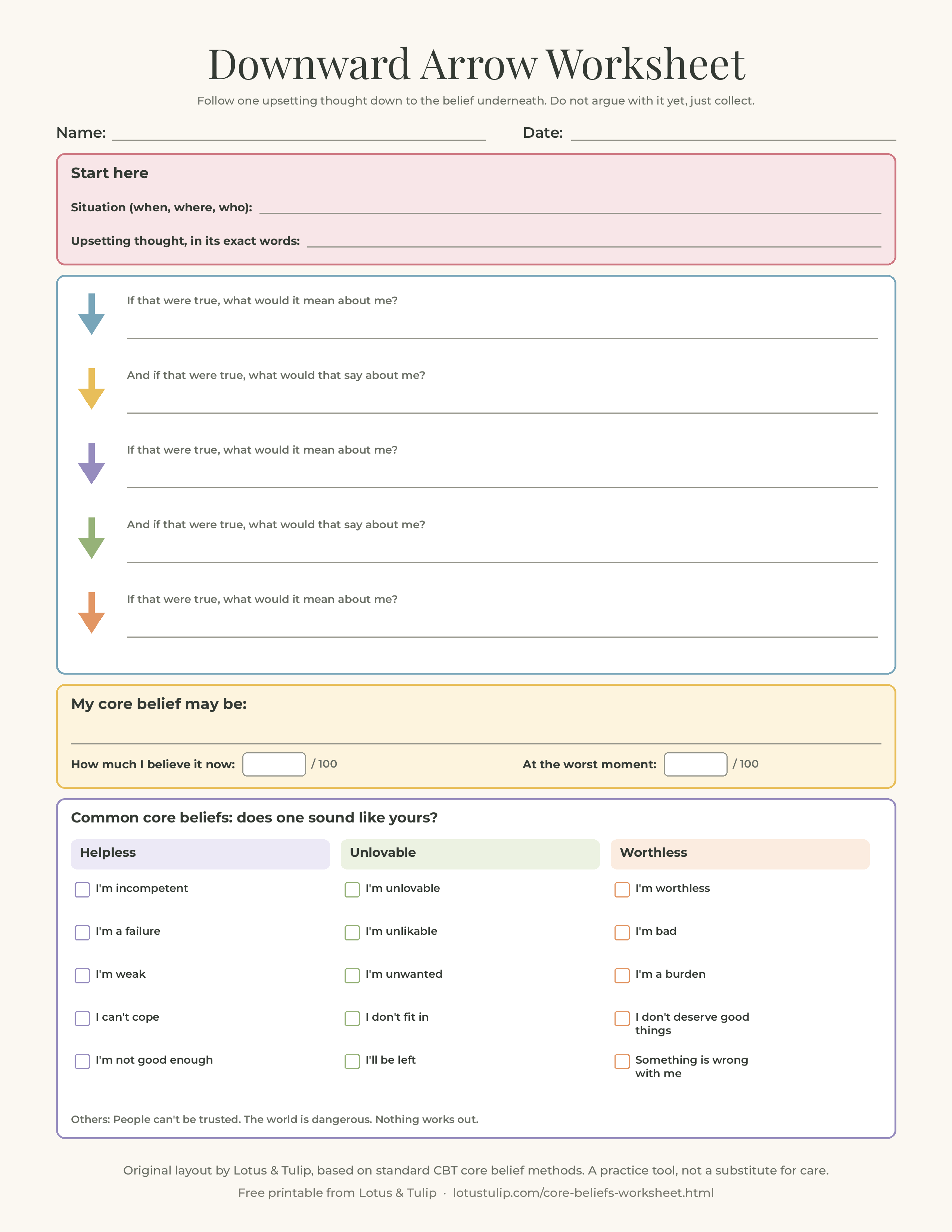
- Write an upsetting automatic thought from a recent, specific situation at the top of the page, in the exact words it came in.
- Draw an arrow underneath and ask: If that were true, what would it mean to me? Why would it be so upsetting?
- Write the answer under the arrow, then ask the same question about that answer.
- Keep going until the answer stops changing, sounds global and absolute ("I'm a failure"), or comes with a strong drop in mood. That is likely the core belief.
Here is an example with a college student who did not get an internship:
- Thought: "They chose someone else."
- If that's true, what would it mean? "I wasn't good enough for them."
- And if that's true? "I'll never get a good job."
- And what would that say about you? "Everyone else is moving ahead and I'm stuck."
- And what does that mean about you? "I'm a failure."
Some practical tips for the arrow:
- Use the meaning question, not just "why." "Why?" invites explanations of the situation. "What would that mean about you?" moves toward the belief.
- Do not argue on the way down. Challenging each line stops the descent. Collect first, examine later.
- Watch for loops. If answers start repeating, you are probably at the bottom.
- Look for a belief, not a feeling. "I'd feel awful" is a feeling. Ask what the awful feeling would say about you.
- Repeat with different situations. If arrows from a work event, a friendship and a family argument all end at "I'm not good enough," that is strong evidence you have found a central belief.
Other ways to spot core beliefs include noticing themes across many thought records, listening for global "I am..." statements in session, sentence completion ("I am...," "People are...," "The world is..."), and looking at which situations trigger the strongest reactions.
How CBT works to change a core belief
Core belief work is slower than catching automatic thoughts. Padesky noted that a thought record can shift an automatic thought within a single session, while continuum work changes schemas only when used persistently over weeks or months. Most clinicians use several of the following methods together.
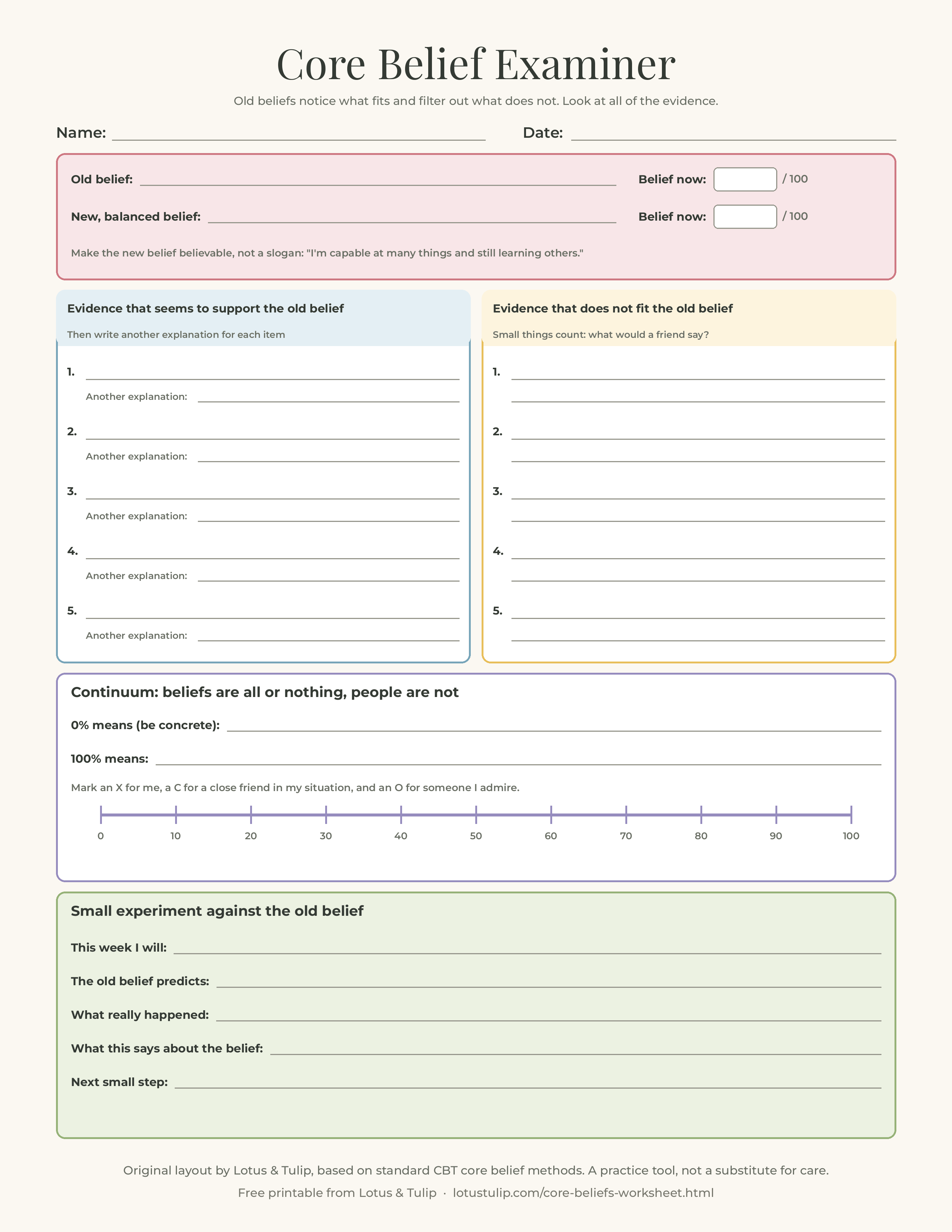
- Name the old belief and a new one. Rate how strongly you believe the old belief right now (0 to 100) and how strongly you believe a more balanced alternative. The new belief should be believable, not a slogan: "I'm competent at many things and still learning others" rather than "I'm brilliant at everything."
- Look at the evidence, including the evidence that has been filtered out. List experiences that seem to support the old belief and look for another explanation for each. Then list experiences that do not fit it. The second list is often empty at first, which is part of the point.
- Use a continuum. Core beliefs are all or nothing ("I'm a failure"). Draw a line from 0 to 100 percent, define what the extremes really look like with concrete criteria, then place yourself and other people on it. Most people discover they sit well away from the extreme, and that they would never rate a friend in their position as a total failure.
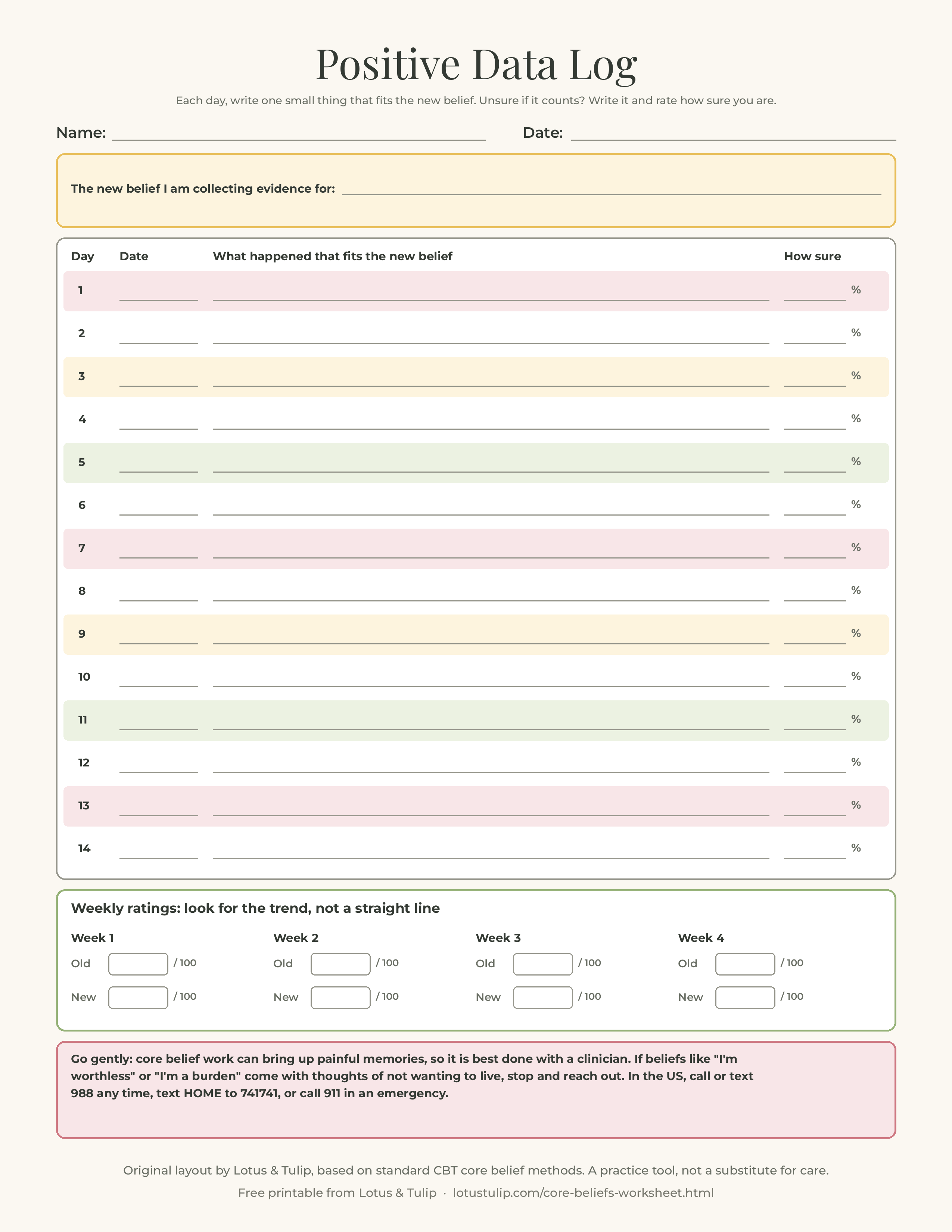
- Keep a positive data log. Each day, write down small pieces of evidence that fit the new belief, even tiny ones, with an optional confidence rating ("a coworker asked my opinion, 30 percent sure this counts"). Padesky described the positive data log as central to schema change and recommended that therapists actively help clients notice data in session, because the old belief will make it hard to see.
- Review the belief's history. Go through life in stages and ask what happened that seemed to support the belief, what happened that did not, and how an adult who cares about you would explain the supporting events now. This often reveals that the belief was a child's reasonable conclusion about an unreasonable situation.
- Run behavioral experiments. Act against the belief in small, planned ways and see what happens. Someone who believes "if I ask for help, people will think I'm useless" might ask a colleague one question and record the response. Bennett-Levy and colleagues' Oxford Guide to Behavioural Experiments in Cognitive Therapy (2004) covers this approach in depth.
- Drop safety behaviors gradually. Over preparing, over apologizing and avoiding are ways the belief protects itself. Reducing them lets new evidence in.
- Act as if the new belief were true. Ask, "What would someone who believed 'I'm acceptable as I am' do this week?" and try one of those things.
- Practice a kinder inner voice. Harsh self talk keeps worthlessness beliefs alive. Our positive self talk worksheet has realistic swaps that pair well with core belief work.
How to identify and change a core belief, step by step
- Pick a recent upsetting moment. Choose a specific situation with a strong emotion, and write down the automatic thought in the words it came in.
- Use the downward arrow. Ask "If that were true, what would it mean about me?" again and again until you reach a short, global statement. Write it as the old core belief.
- Rate the old belief. Note how much you believe it right now, from 0 to 100, and how much you believed it at the worst moment.
- Check for a pattern. Repeat the arrow with two or three other situations. If the same belief keeps appearing, you have found an important one.
- Write a balanced new belief. Make it believable and specific, and rate how much you believe it now, even if it is only 10 or 20.
- Examine the evidence. List what seems to support the old belief and find another explanation for each item. Then list what does not fit the old belief.
- Place yourself on a continuum. Define the two ends with concrete criteria and mark where you really are, and where you would place a friend in the same situation.
- Collect daily data for the new belief. Use the Positive Data Log for at least two weeks, writing down small examples every day, with a confidence rating if that helps.
- Test it in action and re-rate. Plan one small behavioral experiment that goes against the old belief, then re-rate both beliefs each week and look at the trend.
A worked example, start to finish
Maya, 34, came to therapy for anxiety at work. Her thought records kept showing predictions like "My manager thinks I'm not up to this."
- Downward arrow: "My manager rewrote my email" led to "She thinks I can't do my job," then "I'll be found out," then "I'm incompetent." Belief in "I'm incompetent": 85 out of 100.
- Pattern: Arrows from a family conversation about money and from a hard gym class ended in the same place.
- New belief: "I'm a capable person who is still learning some parts of this job." Belief: 20.
- Evidence review: The rewritten email turned out to be a style preference her manager applies to everyone. Evidence that does not fit "incompetent": she was promoted last year, trains new staff and runs her household budget.
- Continuum: Maya defined 0 percent competent as "can't do any part of the job, no one relies on them." She placed herself at 70 and a struggling colleague she likes at 55, whom she would never call incompetent.
- Positive data log: Over three weeks she logged things like "answered a client question without checking," "my sister asked me to look over her lease," with confidence ratings that started at 20 to 30 percent and rose.
- Experiment: She sent an email without rereading it four times. Nothing bad happened.
- After four weeks: "I'm incompetent" 45, "I'm capable and still learning" 60.
The numbers rarely move in a straight line. A hard week can push the old belief back up. What matters is the trend across weeks, which is why the free printable includes weekly ratings.
Using core belief work with teens
Teenagers are building their sense of who they are, and beliefs like "I'm stupid," "I'm ugly" or "Nobody really likes me" are common, especially around school pressure, social media and friendship changes. Core belief work can be powerful with teens, with some adjustments:
- Keep the arrow short. Three or four steps is usually enough. Ask "And if that were true, what would it say about you?" rather than using CBT language.
- Use their own examples. Group chats, grades, being left out of plans, a coach's comment. Abstract examples lose them.
- Make the data log easy. A note on their phone with one line a day works better than a form they forget. They can copy entries onto the printable in session.
- Pair it with self esteem and coping work. Our free self esteem worksheets and coping skills worksheets for teens give younger clients concrete ways to notice strengths.
- Watch for global self rejection. In Millings and Carnelley's study, people who reported recent thoughts of suicide were more likely to name global self evaluation beliefs such as "I am useless." If a teen's arrow ends in "I'm worthless" or "Everyone would be better off without me," pause the exercise and check on safety directly.
For younger children, full core belief work is usually too abstract. Simpler tools such as catching and swapping unhelpful thoughts work better, and our guide to CBT worksheets for teens shows teen friendly versions of thought work.
Common mistakes with core beliefs
- Going for the core belief too early. Core belief work is easier once a client is comfortable catching automatic thoughts and trusts the therapist. Starting in the first session can feel exposing.
- Arguing with the belief. Telling someone "you're not a failure" rarely helps and can feel dismissive. Guided questions and collected evidence work better than debate.
- Writing a new belief that is too positive. "I'm amazing" will be rejected. A modest, believable belief has a chance to grow.
- Stopping after the evidence review. One worksheet does not undo a belief built over decades. The daily data log and repeated experiments are where change happens.
- Ignoring the history. Some beliefs come from real mistreatment. Validating that the belief made sense at the time is part of the work.
- Expecting a straight line. Old beliefs return under stress. Treat that as information, not failure.
- Using it with someone in crisis. When a person is highly distressed or unsafe, stabilization and safety come first.
What the research says (honestly)
Core belief work is a standard part of CBT, but it is worth being clear about what has been tested directly.
- CBT as a whole has a strong evidence base. Hofmann and colleagues (2012) identified 269 meta-analyses of CBT and reviewed 106 of them. They found the strongest support for anxiety disorders, somatoform disorders, bulimia, anger control problems and general stress, and concluded that the evidence base for CBT is very strong overall. Those trials tested CBT packages, not core belief techniques on their own.
- Core belief content can be measured. Osmo and colleagues (2018) developed the Negative Core Beliefs Inventory, a self report questionnaire built on Beck's categories, and reported good psychometric properties. Tools like this let researchers and clinicians track whether beliefs change during treatment.
- What people find with the downward arrow is consistent. The Millings and Carnelley (2015) study of 1,813 online CBT users showed that self evaluation, attachment and competence themes are the most common, which supports the categories clinicians use.
- Specific techniques are mostly clinically derived. The continuum method and the positive data log come from clinical writing, especially Padesky (1994), rather than from large trials comparing them to alternatives. They make good sense and are widely taught, but there is less direct trial evidence for each tool on its own than for CBT as a whole.
- Schema therapy is a related but different treatment. Jeffrey Young's schema therapy, described in Schema Therapy: A Practitioner's Guide (Young, Klosko and Weishaar, 2003), works with 18 early maladaptive schemas using additional experiential and relationship methods. It is often used for long standing personality related difficulties. The worksheet on this page is standard CBT core belief work, not schema therapy.
The fair summary: identifying and testing core beliefs is a central, well reasoned part of a treatment with strong evidence, but individual techniques have less direct research behind them. Use them as part of a broader plan and track your own data, which the weekly ratings on the printable help you do.
Safety notes and when to get more help
- Core belief work can stir up painful memories. If the history review brings up trauma, slow down and work with a trained clinician.
- Beliefs like "I'm worthless" or "I'm a burden" deserve attention. If they come with thoughts of not wanting to be alive, stop the worksheet and reach out for support.
- Persistent low mood, anxiety or self criticism that gets in the way of work, school or relationships deserves an assessment from a licensed mental health professional.
- This page is educational. It is not a substitute for therapy, diagnosis or treatment.
In the US, if you or someone you are supporting is thinking about suicide or self harm, call or text 988 (the 988 Suicide and Crisis Lifeline) any time, day or night. You can also text HOME to 741741 to reach the Crisis Text Line. If someone is in immediate danger, call 911.
Tips for therapists
- Introduce core beliefs with a metaphor. Padesky's prejudice comparison works well, as does "glasses that tint everything one color."
- Build a simple case conceptualization with the client: early experiences, core belief, rules for living, coping strategies, and how they show up in current situations.
- Review the positive data log at the start of each session, and add items you hear in session ("Did you notice what you just told me about your neighbor? That might go in the log.").
- Use confidence ratings when clients discount evidence. Writing "30 percent sure" is easier than writing something they don't fully accept.
- Connect beliefs to values. Our ACT values worksheet can help clients choose actions that build a new belief from the outside in.
- For low mood, combine belief work with getting active. The behavioral activation worksheet creates new experiences for the data log.
Free core beliefs worksheet (PDF)
The free core beliefs worksheet has three pages in US Letter size, written for teens and adults:
- Page 1: Downward Arrow Worksheet. A situation and automatic thought box, five arrow steps with the "what would that mean about me?" prompt, a box for the core belief with a 0 to 100 rating, and a quick reference of common core beliefs in the helpless, unlovable and worthless categories.
- Page 2: Core Belief Examiner. Old belief and new balanced belief with ratings, evidence that seems to support the old belief with space for another explanation, evidence that does not fit it, a 0 to 100 continuum with space to define both ends, and a small experiment plan.
- Page 3: Positive Data Log. Fourteen days of entries with a confidence rating for each, weekly belief ratings for four weeks, and a safety note with 988.
Download the free core beliefs worksheet (PDF, 3 pages, US Letter)
Prefer single images? Page 1: Downward Arrow Worksheet (PNG) · Page 2: Core Belief Examiner (PNG) · Page 3: Positive Data Log (PNG)
Free to print for your own use and for use with your own clients. This is an original layout by Lotus & Tulip, not a copy of any published handout. Please link to this page rather than re-uploading the file.
Related resources
- Self-esteem worksheets for adults: the bottom line, rules for living and a free fairer view practice plan
- Shame vs guilt worksheet: a thought sort, check the facts and a repair and self-compassion plan
- Attachment styles worksheet: a pattern map of worry and distance and a secure moves plan
- CBT thought record worksheet (free printable)
- Cognitive distortions worksheet (free printable)
- Positive self talk worksheet (free printable)
- Behavioral activation worksheet (free printable)
- Opposite action worksheet (free printable)
- Self esteem worksheets for kids (free printable)
- All therapist worksheets: CBT, DBT, ACT and more
Sources
- Beck, A. T. (1976). Cognitive Therapy and the Emotional Disorders. International Universities Press.
- Beck, J. S. (2020). Cognitive Behavior Therapy: Basics and Beyond, third edition. Guilford Press.
- Burns, D. D. (1980). Feeling Good: The New Mood Therapy. William Morrow.
- Padesky, C. A. (1994). Schema change processes in cognitive therapy. Clinical Psychology and Psychotherapy, 1(5), 267 to 278.
- Millings, A., and Carnelley, K. B. (2015). Core belief content examined in a large sample of patients using online cognitive behaviour therapy. Journal of Affective Disorders, 186, 275 to 283.
- Osmo, F., Duran, V., Wenzel, A., and colleagues (2018). The Negative Core Beliefs Inventory: development and psychometric properties. Journal of Cognitive Psychotherapy, 32(1), 67 to 84.
- Hofmann, S. G., Asnaani, A., Vonk, I. J. J., Sawyer, A. T., and Fang, A. (2012). The efficacy of cognitive behavioral therapy: a review of meta-analyses. Cognitive Therapy and Research, 36(5), 427 to 440.
- Bennett-Levy, J., Butler, G., Fennell, M., and colleagues (2004). Oxford Guide to Behavioural Experiments in Cognitive Therapy. Oxford University Press.
- Young, J. E., Klosko, J. S., and Weishaar, M. E. (2003). Schema Therapy: A Practitioner's Guide. Guilford Press.
- 988 Suicide and Crisis Lifeline, 988lifeline.org. Crisis Text Line, crisistextline.org.
Core beliefs worksheet: FAQ
What are core beliefs in CBT?
Core beliefs are a person's most basic, global beliefs about themselves, other people, the world and the future, such as "I'm not good enough" or "People can't be trusted." In Beck's cognitive model they sit underneath intermediate beliefs (rules and assumptions) and automatic thoughts, and they shape how a person interprets everyday situations.
What are examples of negative core beliefs?
Judith Beck groups negative core beliefs about the self into helplessness ("I'm incompetent," "I'm weak," "I can't cope"), unlovability ("I'm unlovable," "I'm unwanted," "I don't fit in") and worthlessness ("I'm worthless," "I'm bad," "I'm a burden"). There are also core beliefs about others ("People will hurt me") and the world ("The world is dangerous").
How do you identify your core beliefs?
The most common method is the downward arrow technique. Write an upsetting automatic thought, then repeatedly ask "If that were true, what would it mean about me?" until you reach a short, global statement such as "I'm a failure." Repeating this with several situations shows which beliefs come up most often.
Can core beliefs be changed?
Yes, although it usually takes weeks or months of practice rather than one insight. CBT uses methods such as examining evidence, the continuum technique, a positive data log, reviewing the belief's history and behavioral experiments to weaken an old belief and strengthen a more balanced one.
What is the difference between a core belief and an automatic thought?
An automatic thought is specific to a situation ("My boss is annoyed with me"). A core belief is global and absolute ("I'm incompetent") and shows up across many situations. Automatic thoughts can often shift within a session using a thought record, while core beliefs change more slowly.
What is a positive data log?
A positive data log is a daily record of small experiences that fit a new, more balanced belief. Christine Padesky described it as a key schema change method. Because the old belief filters out contradicting evidence, people are encouraged to log even tiny examples, sometimes with a confidence rating.
Is this core beliefs worksheet free?
Yes. The three page core beliefs worksheet (Downward Arrow Worksheet, Core Belief Examiner and Positive Data Log) is free to print for your own use and for use with your own clients. It is an original Lotus & Tulip layout. Please link to this page rather than re-uploading the file.