
Depression and rumination · CBT skills for adults and teens · Updated 2026-11-12
Rumination worksheet: how to stop overthinking loops by switching from why to how (free printable)
Low mood set: Depression and Behavioral Activation Worksheets for Therapists: mood and activity tracking, small valued actions and weekly review Holiday 20% off: about $9.20, was $12 (EUR 10) · instant digital download
Buy on EtsyCBT set: CBT Worksheets for Therapists, 20 pages incl. a 7 column thought record, evidence for and against and an exposure ladder Holiday 20% off: about $11.04, was $14 (EUR 12) · fillable PDF, instant digital download
Buy on EtsyTry it free first: download a fillable sample (thought record and evidence for and against, PDF, 105 KB). Type into it on screen, then get the full pack. No email needed.
Full caseload: Therapist Worksheets Mega Bundle: 8 packs, 160 pages Holiday 20% off: about $35.88, was $45 (EUR 39) · fillable PDFs for all 8 packs plus 160 printable pages, instant digital download
Buy on EtsyRumination is the mental replay that goes round and round: why did I say that, why does this always happen to me, what is wrong with me. It feels like working on the problem. Usually it is not. Research on rumination over the last thirty years points to a practical skill: notice the loop, check whether the thinking is actually helping, and if it is not, switch from vague "why" questions to concrete "how" questions or shift your attention to something absorbing.
This guide is for therapists and counselors, and for adults and teens who overthink. It covers what rumination is and how it differs from useful reflection and from worry, what the research shows, a simple "is it helping?" test, how to switch from why to how step by step, ideas for shifting attention, and common mistakes. It ends with a free 2 page printable: a Rumination Check and a Rumination Log with a weekly review and a therapist guide.
Download the free rumination worksheet (PDF, 2 pages, US Letter)
Direct download, no email or sign up. See the pages first.
What rumination is
Psychologist Susan Nolen-Hoeksema described rumination as a way of responding to low mood: repeatedly and passively focusing on your symptoms and on their possible causes and consequences, instead of doing something to solve the problem or to take your mind off it. Typical ruminative thoughts are abstract and evaluative, such as "Why am I like this?", "Why can't I handle things?" or "What does this say about me?"
Everyone thinks about upsetting events. Rumination is different because it is repetitive (the same ground again and again), abstract (big why and what does it mean questions rather than specifics) and unproductive (no decision, plan or new understanding at the end, and usually a worse mood).
Rumination vs reflection vs worry
| Rumination (brooding) | Reflection | Worry | |
|---|---|---|---|
| Time focus | Mostly the past and the self | Past or present, with a purpose | Mostly the future |
| Typical question | "Why does this always happen to me?" | "What can I learn from this?" | "What if it goes wrong?" |
| Style | Abstract, evaluative, comparing myself to where I should be | Curious, specific, problem solving | Chains of what ifs |
| Result | Lower mood, no plan | Insight or a next step | Anxiety, little action |
| Main link | Depression | Mixed, can be helpful | Anxiety, GAD |
The brooding and reflection split comes from a 2003 analysis of the Ruminative Responses Scale by Treynor, Gonzalez and Nolen-Hoeksema. Brooding (moody pondering about why you are not where you want to be) was the part most tied to depression over time; reflection (turning inward to understand and solve a problem) was not harmful in the same way. For worry, the future focused cousin of rumination, see our worry time worksheet.
What the research says
- Rumination and depression. In her response styles theory (Journal of Abnormal Psychology, 1991), Nolen-Hoeksema proposed that people who ruminate in response to low mood have longer depressions than people who take action or distract themselves, because rumination lets low mood bias thinking and gets in the way of problem solving and action. She reported that laboratory and field studies supported this. A 2008 review, "Rethinking Rumination", summarized later evidence linking rumination with the onset and duration of depression and with other problems such as anxiety, binge eating and drinking.
- Abstract vs concrete thinking. Edward Watkins and Michelle Moulds (Emotion, 2005) tested 40 depressed patients and 40 never depressed controls. When depressed patients were guided to think about their symptoms in a concrete way (how things happened, the specific details) rather than an abstract way (why, what it means), their social problem solving improved. The style of thinking, not just the topic, made the difference.
- Not all repetitive thought is bad. Watkins' 2008 review in Psychological Bulletin concluded that repetitive thinking can be constructive or unconstructive, and that abstract, evaluative thinking about negative topics is the version most tied to harm.
- Treatment that targets rumination. In a small phase II trial (British Journal of Psychiatry, 2011), 42 people with medication resistant residual depression were randomized to usual treatment alone or usual treatment plus up to 12 sessions of rumination-focused CBT. Adding rumination-focused CBT improved residual symptoms and remission rates, and the effect was mediated by change in rumination. The authors note there was no attention control group, so this is promising rather than definitive.
Honest summary: a worksheet will not treat depression on its own. But noticing rumination and practicing a concrete "how" style of thinking is a well supported target, and a simple tool helps clients practice it between sessions.
The "is it helping?" test
Clients often believe rumination will eventually bring insight. Rather than arguing, ask them to check the results. After about 10 minutes of thinking about something, ask three questions:
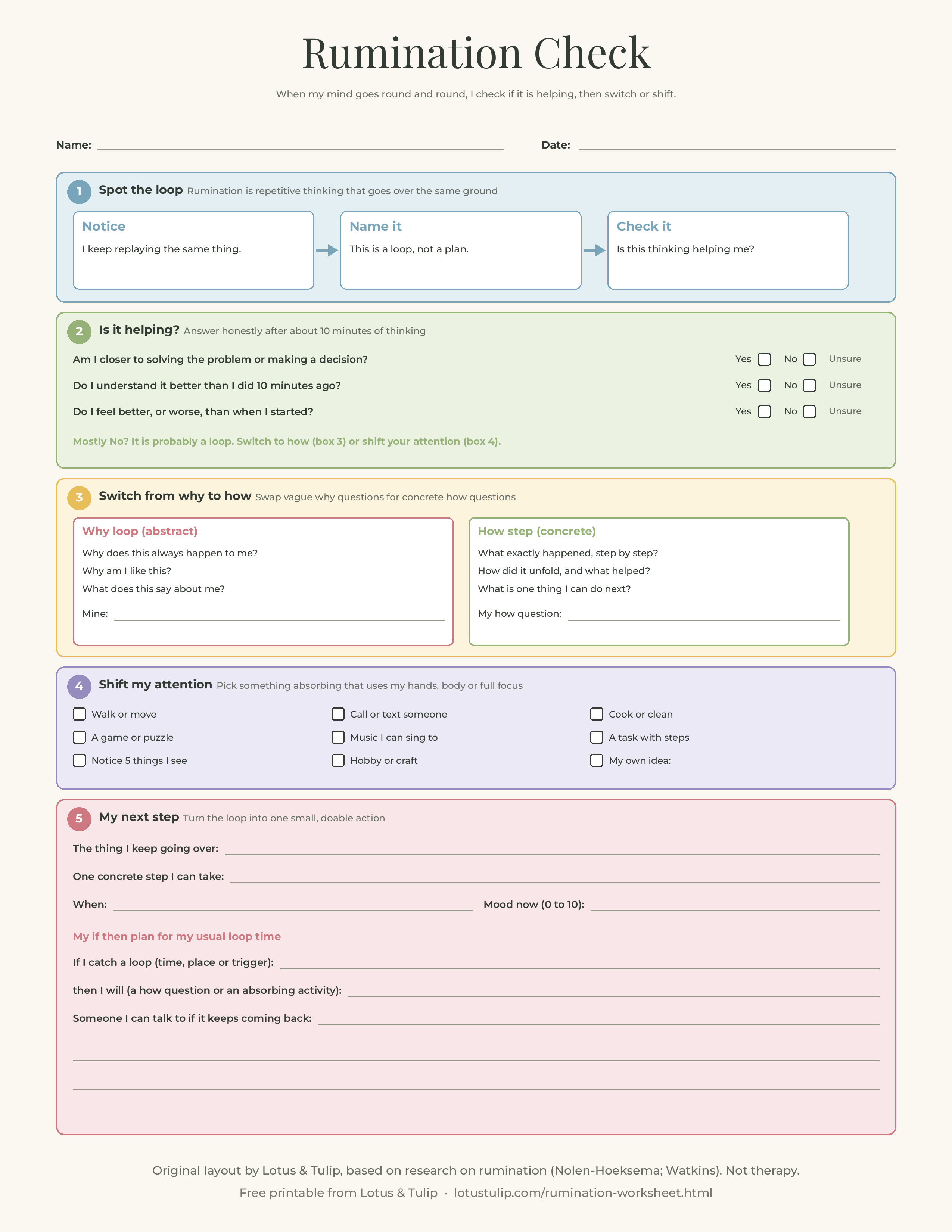
- Am I closer to solving the problem or making a decision?
- Do I understand it better than I did 10 minutes ago?
- Do I feel better, or worse, than when I started?
If the answers are mostly no, the thinking is probably a loop. That is the cue to switch from why to how, or to shift attention. If the answers are yes, it is reflection or problem solving, and it is fine to keep going.
How to switch from why to how, step by step
- Notice the loop. Learn your signs: replaying a conversation, the same question again and again, feeling heavier the longer you think. Many people find their loops cluster at certain times, such as lying in bed, after a social event or when alone in the evening.
- Name it. Say to yourself "This is a loop, not a plan." Naming it creates a little distance from the content.
- Run the three question test. Am I closer to a solution, do I understand it better, do I feel better? Mostly no means switch.
- Write down the why question. For example: "Why did I mess up that meeting? Why am I always like this?"
- Turn it into how questions. "What exactly happened, step by step?", "How did it unfold, and what helped or made it worse?", "How could I handle the next similar moment?"
- Get specific. Answer with concrete details: who, what, where, the sequence of events, what you could see and hear. Specific memories are easier to learn from than global judgments.
- Pick one next step. Choose one small, concrete action and when you will do it: send a short follow up email Monday morning, ask a colleague one question, add an agenda to the next meeting.
- Or shift your attention. If there is nothing to do right now, switch to something absorbing that uses your hands, body or full focus: a walk, a call, cooking, a game, music you can sing along to, a task with steps.
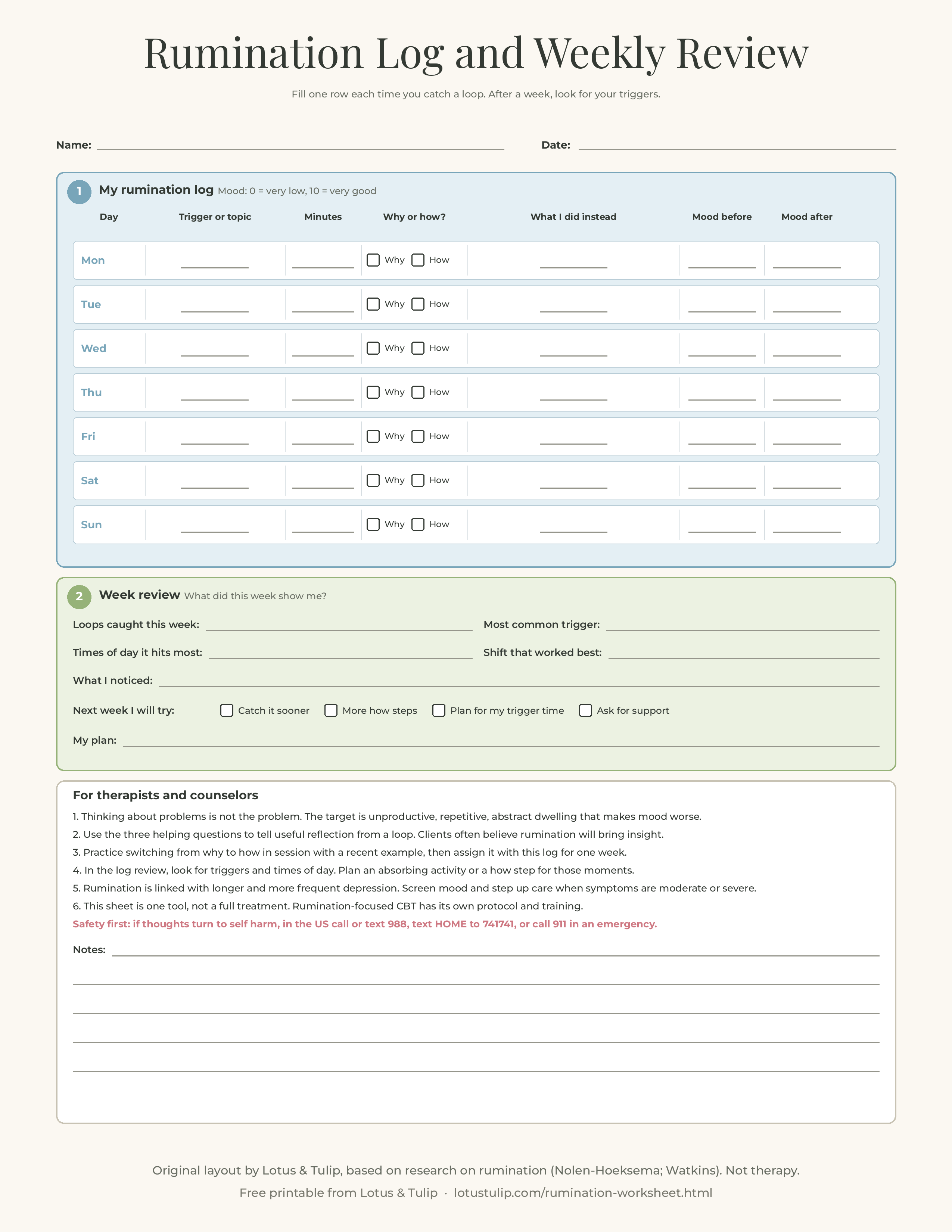
- Log it and plan for your trigger times. Note what triggered the loop, how long it lasted, what you did instead and your mood before and after. After a week, write an if then plan: "If I catch a loop when I get into bed, then I will ask one how question and switch to my audiobook."
Ideas for shifting attention
Shifting attention works best with activities that genuinely absorb you, not ones that leave the mind free to wander. Good options often use movement, the hands or full concentration:
- Walking, stretching or exercise, ideally outside
- Calling or texting a friend about something else
- Cooking, cleaning or tidying one small area
- A puzzle, a game, or a hobby or craft
- Singing along to music, or playing an instrument
- A grounding exercise such as 5 4 3 2 1 grounding
- A small task with clear steps you have been putting off
This is not avoidance of real problems. Problems you can act on get a how question and a next step. Shifting attention is for the repetitive replay that has no next step.
Using this with clients and teens
- Start with curiosity. Ask what the client hopes rumination will do for them. Common beliefs are "if I think it through I will find the answer" or "if I stop, I am not taking it seriously." The three question test lets them see the actual results.
- Practice in session. Take a recent loop and do the why to how switch together before assigning it as homework.
- Pair with action. Rumination-focused CBT grew out of behavioral activation. Pair this sheet with activity scheduling, for example our behavioral activation worksheet.
- Teens. Teens often ruminate about friendships, social media and school performance. Keep the language simple ("stuck thinking" or "replay mode"), use real examples from their week and include social and physical options in the shift list.
- Self-criticism. If the loop is mostly harsh self judgment, add self-compassion work alongside the how questions.
Common mistakes
- Trying to suppress the thought. Telling yourself "stop thinking about it" tends to backfire. The aim is to change how you think about it, or what you do next, not to ban the topic.
- Treating every reflection as rumination. Thinking about a problem with a purpose is healthy. Use the three questions to tell the difference.
- Switching to vague distraction. Scrolling a phone often leaves the mind free to loop. Choose something absorbing.
- A why question in disguise. "How come I always fail?" is still a why question. A how question asks about the specific sequence and the next step.
- Skipping the log. Loops tend to follow patterns. A week of notes usually shows the triggers and times to plan for.
- Using a worksheet instead of care. Persistent rumination with low mood, sleep problems or hopelessness needs a professional assessment.
Safety: if ruminating turns into thoughts of self harm or suicide, get help now. In the US, call or text 988 (Suicide and Crisis Lifeline), text HOME to 741741 (Crisis Text Line), or call 911 in an emergency.
Free rumination worksheet and log
This free printable is an original Lotus & Tulip layout on US Letter. Page 1, Rumination Check, walks through spotting the loop (notice, name it, check it), the three question "is it helping?" test with Yes, No and Unsure boxes, a why loop vs how step comparison with space for your own, a checklist of absorbing activities for shifting attention, and a My next step box with an if then plan for your usual loop time. Page 2, Rumination Log and Weekly Review, has a 7 day log (trigger or topic, minutes, why or how, what I did instead, mood before and after), a week review and a guide for therapists and counselors, with crisis lines.
Download the free rumination worksheet (PDF, 2 pages, US Letter)
Prefer single images? Page 1: Rumination Check (PNG) · Page 2: Rumination Log and Weekly Review (PNG)
Free to print for use with your own clients or yourself. Please link to this page rather than re-uploading the file. A self-help and teaching tool, not therapy or a diagnosis.
Related resources
- Overthinking worksheet for adults: when the loop mixes replaying the past, what ifs and decisions you cannot make
- Anger management worksheets for adults: when replaying it keeps the anger going
- Shame vs guilt worksheet: a thought sort, check the facts and a repair and self-compassion plan
- Worry time worksheet: scheduled worry postponement for future focused worry
- Behavioral activation worksheet
- Cognitive distortions worksheet
- Self-compassion worksheet
- Depression worksheets (free printable)
- Free depression worksheets for therapists
FAQ
What is a rumination worksheet?
It is a short tool for catching and changing repetitive negative thinking. This one helps you spot the loop, check whether the thinking is helping with three questions, switch from abstract why questions to concrete how questions, shift attention to something absorbing and plan one next step, plus a log to track triggers and mood over a week.
What is the difference between rumination and worry?
Both are repetitive negative thinking. Rumination usually dwells on the past, the self and why things happened, and is most linked with depression. Worry looks ahead to what might go wrong and is most linked with anxiety. Many people do both.
How do you stop ruminating?
Trying to force a thought away rarely works. A better approach is to notice the loop, ask whether it is helping (am I closer to a solution, do I understand it better, do I feel better?), and if not, switch to concrete how questions and one next step, or shift attention to an absorbing activity. Tracking triggers helps you plan ahead.
Is rumination always bad?
No. Research separates brooding, the moody why me kind most tied to depression, from reflection, which is purposeful thinking to understand or solve a problem. Thinking about problems is healthy when it leads somewhere.
What is rumination-focused CBT?
It is a form of cognitive behavioral therapy developed by Edward Watkins and colleagues that targets rumination directly, using ideas from behavioral activation and training a more concrete, specific thinking style. A small 2011 randomized trial found it improved residual depression when added to usual care.
Is this rumination worksheet free?
Yes. It is free to print for use with your own clients or yourself. Please link to this page rather than re-uploading the file.
Sources
- Nolen-Hoeksema, S. (1991). Responses to depression and their effects on the duration of depressive episodes. Journal of Abnormal Psychology, 100(4), 569 to 582. doi:10.1037/0021-843X.100.4.569
- Nolen-Hoeksema, S., Wisco, B. E., and Lyubomirsky, S. (2008). Rethinking rumination. Perspectives on Psychological Science, 3(5), 400 to 424. doi:10.1111/j.1745-6924.2008.00088.x
- Treynor, W., Gonzalez, R., and Nolen-Hoeksema, S. (2003). Rumination reconsidered: a psychometric analysis. Cognitive Therapy and Research, 27(3), 247 to 259. doi:10.1023/A:1023910315561
- Watkins, E., and Moulds, M. (2005). Distinct modes of ruminative self-focus: impact of abstract versus concrete rumination on problem solving in depression. Emotion, 5(3), 319 to 328. doi:10.1037/1528-3542.5.3.319
- Watkins, E. R. (2008). Constructive and unconstructive repetitive thought. Psychological Bulletin, 134(2), 163 to 206. doi:10.1037/0033-2909.134.2.163
- Watkins, E. R., Mullan, E., Wingrove, J., Rimes, K., Steiner, H., Bathurst, N., Eastman, R., and Scott, J. (2011). Rumination-focused cognitive-behavioural therapy for residual depression: phase II randomised controlled trial. British Journal of Psychiatry, 199(4), 317 to 322. doi:10.1192/bjp.bp.110.090282