
Special education and behavior support · ADHD and executive function · Updated 2026-11-12
Self-monitoring checklist for students: how to teach self-monitoring that works (free printable)
For ADHD and focus: ADHD Worksheets for Therapists, coaching style pages for starting tasks, planning time, managing impulses and tracking what helps Holiday 20% off: about $11.04, was $14 (EUR 12) · fillable PDF, instant digital download
Buy on EtsyTry it free first: download a fillable sample (break it down and getting unstuck, PDF, 282 KB). Type into it on screen, then get the full pack. No email needed.
Grades 4 to 8: Executive Function Group Curriculum: Plan It, Do It, a small group on planning, starting, remembering and checking work Holiday 20% off: about $11.04, was $14 (EUR 12) · instant digital download
Buy on EtsyTry it free first: download session 1 free (group at a glance, lesson plan and student page, PDF, 69 KB). Run it with your group, then get all 8 sessions. No email needed.
Younger learners: Visual Schedule and Behavior Supports, 23 pages with token boards, a reward menu, first then boards and 136 picture cards Holiday 20% off: about $6.44, was $8 (EUR 7) · instant digital download
Buy on EtsyMost behavior plans depend on an adult noticing, reminding and recording. Self-monitoring flips that. The student learns to stop at set moments, ask one simple question about their own behavior ("Was I working?", "Did I raise my hand?", "Did I finish the steps?") and mark the answer. That small act of checking in with yourself is one of the most studied classroom strategies there is, and it builds the independence that adult reminders alone never will.
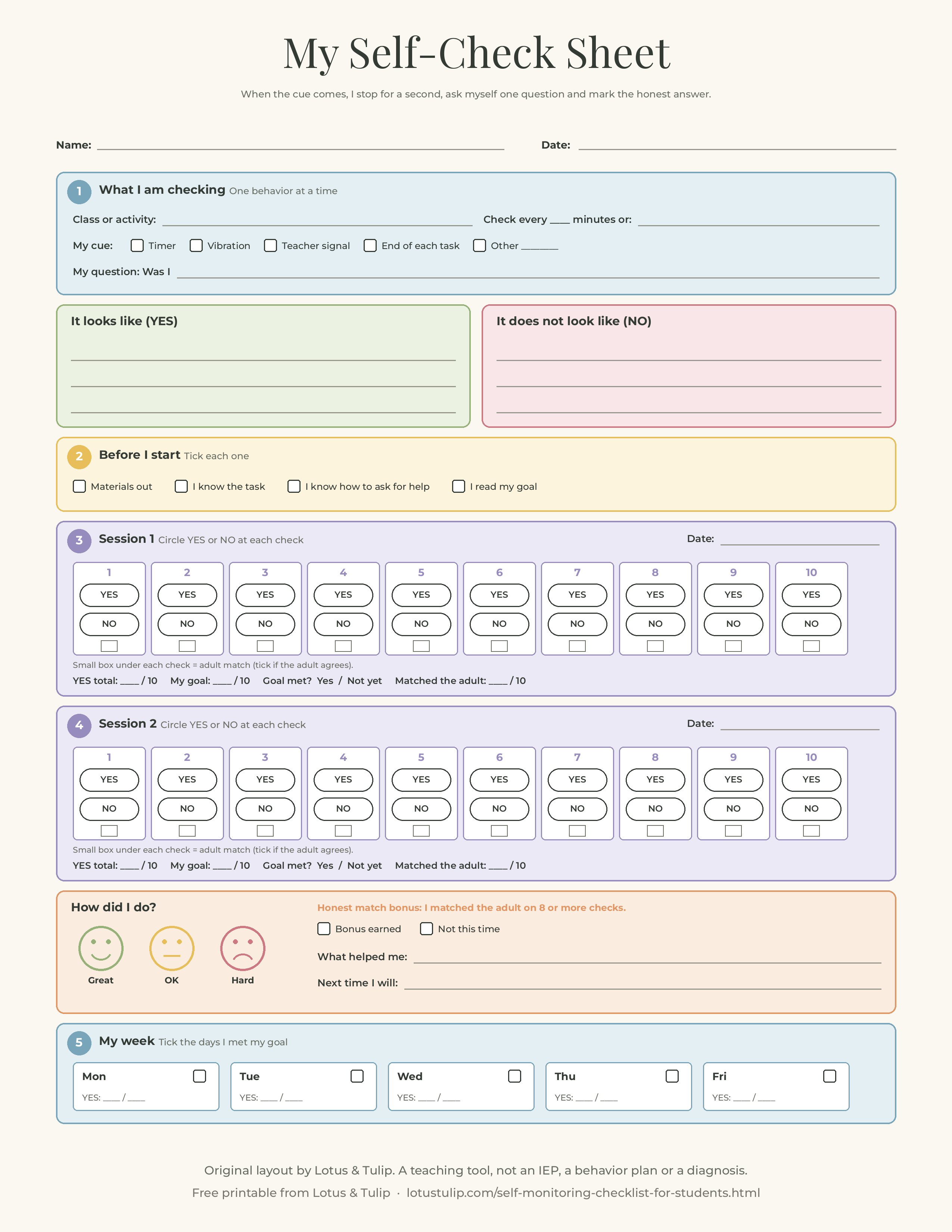
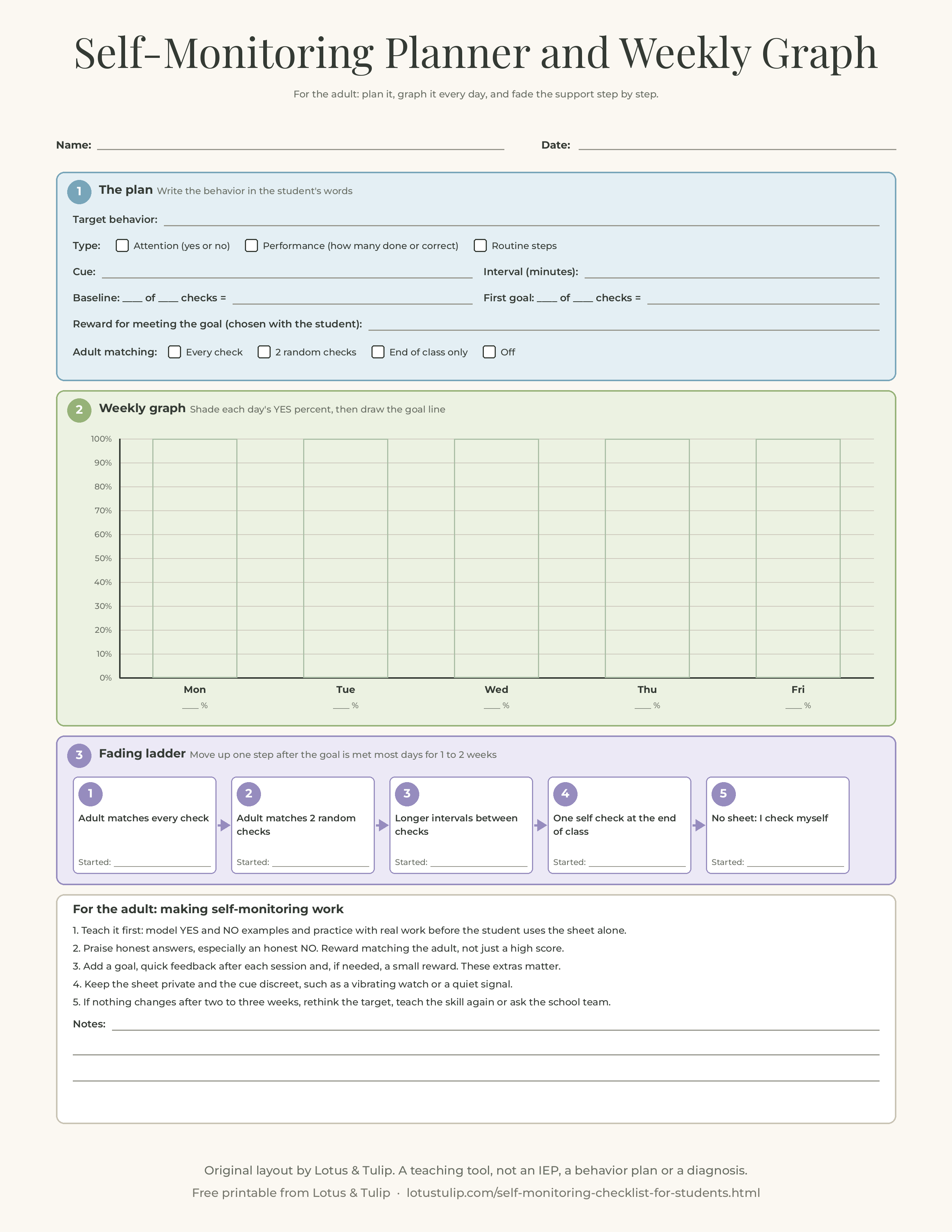
This guide is for teachers, special education staff, school counselors, school psychologists and parents of children and teens, including students with ADHD, autism, learning disabilities and behavior challenges. It covers what self-monitoring is, the main types, what the research shows, when it fits, how to set it up step by step, how to check accuracy and fade it, examples by age and common mistakes. It ends with a free 2 page printable: a student self-monitoring checklist and an adult planner with a weekly graph.
Download the free self-monitoring checklist (PDF, 2 pages, US Letter)
Direct download, no email or sign up. See the pages first.
What self-monitoring is
Self-monitoring means a student watches one of their own behaviors and records it. It has two parts: self-assessment (stopping to ask "Was I doing it?") and self-recording (marking the answer on a sheet, card or app). Karen Harris and colleagues note that self-assessment can be done on its own, but works best for most students when it is paired with recording.
Self-monitoring is the core of a wider family called self-management. In their review of 20 years of school research, Amy Briesch and Sandra Chafouleas found 16 different ways researchers described self-management interventions, but two parts showed up again and again: the student observes a clearly defined behavior and records it. Some versions add a goal, a reward, or comparing the student's ratings with an adult's.
A self-monitoring checklist is simply the tool for that recording: a short sheet with the target behavior, set times to check and a place to mark yes or no.
Three types of self-monitoring
- Self-monitoring of attention. At set moments (a timer, a vibrating watch, a quiet signal) the student asks "Was I paying attention to my work?" and marks yes or no. Best for students who drift off task.
- Self-monitoring of performance. The student counts and records their own output, for example problems attempted, problems correct, words written or spelling words practiced. Best when the student can stay seated but gets little done.
- Routine or step checklists. The student ticks off the steps of a routine, such as unpacking, homework handed in, materials out and agenda written. Best for organization and transitions.
Which type works better depends on the student. Harris and colleagues compared attention and performance monitoring with 6 elementary students with ADHD in a general education classroom. Both improved on task behavior and spelling practice, and on task gains were similar, but attention monitoring produced clearly higher spelling practice for 4 of the 6 students. The authors point out that earlier studies with students with learning disabilities had found the reverse, with performance monitoring often ahead. The practical lesson: pick one, collect a week of data, and switch if it is not working.
What the research says about self-monitoring
Self-monitoring has been studied in classrooms for decades, mostly with single case designs, where a small number of students are measured repeatedly before and during the intervention. The key reviews:
- Bruhn, McDaniel and Kreigh (2015, Behavioral Disorders) reviewed 41 studies published from 2000 to 2012 of self-monitoring with K to 12 students with persistent behavior problems, looking especially at the role of reinforcement, feedback, the function of the behavior and technology.
- Bruhn and colleagues (2022, Journal of Positive Behavior Interventions) went further and reanalyzed the raw data from 66 single case studies on academic engagement and 21 on disruptive behavior, covering 290 students with challenging behavior, 183 of them with a disability. Student age and educational setting changed how well self-monitoring worked, and so did whether the intervention included goal setting, feedback and reinforcement. In other words, the extras matter: a sheet on its own is not the whole intervention.
- The National Clearinghouse on Autism Evidence and Practice (NCAEP, Steinbrenner et al. 2020) lists self-management as one of 28 evidence-based practices for autistic children, youth and young adults, based on 26 studies (25 single case and 1 group design). It defines self-management as teaching learners to tell appropriate from inappropriate behavior, accurately monitor and record their own behavior and reward themselves, with adult support faded over time.
Individual studies show what this can look like. Natalie Amato-Zech, Kathryn Hoff and Karla Doepke (2006) taught 3 elementary students in a special education classroom to check their attention when a small device (the MotivAider) vibrated. Their on task behavior rose from a mean of 55% of observed intervals to more than 90%, and both teachers and students rated the method as highly acceptable. A vibrating cue is private, so classmates do not hear a beep.
Keep the limits in mind. Most studies involve small numbers of students, effects vary from student to student, and self-monitoring works best for behaviors the student already knows how to do. If the student does not yet have the skill, teach the skill first.
When a self-monitoring checklist is a good fit, and when it is not
Self-monitoring works best when:
- The student can do the behavior, such as staying on task, raising a hand or finishing steps, but does it inconsistently.
- The behavior is observable and easy to define in a few words the student understands.
- The student is willing to try and helps choose the goal. Students who care about the outcome tend to do better.
- An adult can check in briefly at first to teach, match ratings and give feedback.
Choose something else first when:
- The behavior is dangerous, such as aggression, running away or self-harm. That needs a team plan, usually based on a functional behavior assessment.
- The student cannot yet tell the target behavior from its opposite, even with examples. Teach the difference with modeling and practice first.
- The sheet would become a public label. Keep it private, on the desk or in a folder.
If a student talks about wanting to hurt themselves or someone else, do not treat it as a behavior chart issue. Tell a school counselor or administrator right away. In the US, call or text 988 (Suicide and Crisis Lifeline), text HOME to 741741 (Crisis Text Line) or call 911 in an emergency.
How to set up a self-monitoring checklist, step by step
- Pick one behavior and define it in student words. Not "be on task" but "eyes on my work, pencil moving or asking for help the right way." Write one example and one non example.
- Choose the type. Attention (yes or no at each check), performance (how many done or correct) or a routine checklist (steps ticked off).
- Collect a short baseline. For 3 to 5 days, have an adult record the behavior the same way, so you know the starting level, for example on task in 5 of 10 checks.
- Pick the cue and the interval. A vibrating watch or timer, a quiet tone, a sticky note that says "Check" or the end of each task. Start with frequent checks (every 3 to 5 minutes for attention) during one class, not the whole day.
- Teach it directly. Model doing the behavior and not doing it, and have the student decide "yes or no" for each example. Then practice with real work while the adult prompts each check.
- Match with an adult at first. The adult rates the same checks quietly. Afterwards, compare. Praise honest ratings, especially an honest "no." Accuracy matters more than a perfect score.
- Add a goal and feedback. Set a reachable goal a little above baseline, for example 7 of 10 yes. Give brief specific feedback after each session.
- Add reinforcement if needed. A small earned privilege for meeting the goal, chosen with the student. Many students need this early on.
- Graph, review weekly and fade. Plot the daily percentage. When the goal is met most days, raise it slowly, then fade: match less often, lengthen the interval, move to a self check at the end of class, and finally drop the sheet.
Checking accuracy: the matching game
Students are not always accurate at first, and that is normal. A classic study by Ginger Rhode, Daniel Morgan and K. Richard Young (1983) worked with six elementary students with behavior problems in a resource room. The students learned to rate their own work and behavior accurately against the teacher, and then a reduced version of the self-evaluation moved with them into their general education classrooms. They kept high levels of appropriate behavior there, and for four of the six students all of the extra training parts could be faded. A simple classroom version of this kind of matching: a student who agrees with the adult on 8 or more of 10 checks earns a bonus point, whether the answers were yes or no. That rewards honesty, not just good behavior.
Examples by age
- Kindergarten to grade 2: a picture checklist for one routine, such as "backpack hung up, folder in the bin, name on the paper, sit on the carpet." The student points and ticks with an adult at first. Pair with a token board if the student needs an extra reason to finish.
- Grades 3 to 5: attention monitoring during independent reading or math. A quiet timer every 4 minutes, 10 checks per session, and a goal of 7 of 10. Teacher matches every check for the first week, then 2 random checks a day.
- Middle school: a class arrival checklist ("on time, materials out, agenda written, started the warm up") on an index card, and a performance count of problems completed in each work block.
- High school: a self check at the end of each class ("Did I write down the homework? Did I ask about anything I missed?") on a phone note or card, with a weekly review with a counselor or case manager.
Common mistakes
- Too many behaviors at once. One target, maybe two. Add more only after the first is going well.
- Vague targets. "Be good" cannot be self-rated. "Hand up and wait to be called on" can.
- Skipping the teaching. Handing over a sheet is not an intervention. Model, practice and prompt.
- Punishing honest "no" answers. If an honest no costs the student, the ratings will quickly turn into all yes.
- No feedback or review. The research points to goals, feedback and reinforcement as part of what makes self-monitoring work.
- Never fading. Plan from the start how the student will move to fewer checks and finally to no sheet.
Free self-monitoring checklist and planner
This free printable is an original Lotus & Tulip layout on US Letter. Page 1, My Self-Check Sheet, is for the student: my goal behavior with what it looks like and what it does not look like, a before I start checklist, two sessions of 10 checks each with yes and no circles and a small adult match box, totals with a goal line, an honest match bonus, a how did I do rating with next time I will, and a my week strip for ticking the days the goal was met. Page 2, Self-Monitoring Planner and Weekly Graph, is for the adult: the target behavior and type, the cue and interval, baseline and goal, the reward and matching plan, a 5 day bar graph with a goal line, a 5 step fading ladder and quick reminders for adults.
Download the free self-monitoring checklist (PDF, 2 pages, US Letter)
Prefer single images? Page 1: student self-check sheet (PNG) · Page 2: adult planner and graph (PNG)
Free to print for use with your own students, clients or children. Please link to this page rather than re-uploading the file. A teaching tool, not an IEP, a behavior intervention plan or a diagnosis.
Related resources
- Behavior contract for students: pair a contract with a self-check sheet, with a free template and tracker
- Executive functioning worksheets for kids: a skills checklist and a free planner
- ADHD worksheets: focus plans and a free printable
- Token board printable: a more visual option for younger students
- Daily check in for students
- Goal setting worksheet for students
FAQ
What is a self-monitoring checklist for students?
It is a short sheet a student uses to watch and record one of their own behaviors. At set times the student asks a simple question, such as "Was I working?", and marks yes or no, or ticks off the steps of a routine. An adult usually checks the ratings at first and the support is faded over time.
Does self-monitoring work?
Self-monitoring is one of the most researched classroom strategies. Reviews of dozens of single case studies with K to 12 students with behavior problems support it, and the National Clearinghouse on Autism Evidence and Practice lists self-management as an evidence-based practice. Results vary by student, and goal setting, feedback and reinforcement are linked to how well it works.
How often should students self-monitor?
Start with frequent checks during one class or activity, for example every 3 to 5 minutes for attention, or after each task for a routine. As the student meets the goal, lengthen the interval, match less often and move to one self check at the end of the class.
Does self-monitoring help students with ADHD?
Studies with students with ADHD have found that both self-monitoring of attention and self-monitoring of performance can improve on task behavior and work completed. One study found attention monitoring led to more spelling practice for most students, so it is worth testing which type works for each child.
What if the student is not honest on the checklist?
Compare the student's ratings with an adult's and reward matching, not just yes answers. Praise an honest "no." If ratings stay inaccurate, reteach with examples and non examples and keep adult matching in place longer.
Is this self-monitoring checklist free?
Yes. It is free to print for use with your own students, clients or children. Please link to this page rather than re-uploading the file.
Sources
- Amato-Zech, N. A., Hoff, K. E., and Doepke, K. J. (2006). Increasing on-task behavior in the classroom: extension of self-monitoring strategies. Psychology in the Schools, 43(2), 211 to 221.
- Briesch, A. M., and Chafouleas, S. M. (2009). Review and analysis of literature on self-management interventions to promote appropriate classroom behaviors (1988 to 2008). School Psychology Quarterly, 24(2), 106 to 118.
- Bruhn, A., McDaniel, S., and Kreigh, C. (2015). Self-monitoring interventions for students with behavior problems: a systematic review of current research. Behavioral Disorders, 40(2), 102 to 121.
- Bruhn, A., Gilmour, A., Rila, A., Van Camp, A., Sheaffer, A., Hancock, E., Fernando, J., and Wehby, J. (2022). Treatment components and participant characteristics associated with outcomes in self-monitoring interventions. Journal of Positive Behavior Interventions, 24(2), 156 to 168.
- Harris, K. R., Friedlander, B. D., Saddler, B., Frizzelle, R., and Graham, S. (2005). Self-monitoring of attention versus self-monitoring of academic performance: effects among students with ADHD in the general education classroom. The Journal of Special Education, 39(3), 145 to 156.
- Rhode, G., Morgan, D. P., and Young, K. R. (1983). Generalization and maintenance of treatment gains of behaviorally handicapped students from resource rooms to regular classrooms using self-evaluation procedures. Journal of Applied Behavior Analysis, 16(2), 171 to 188.
- Steinbrenner, J. R., Hume, K., Odom, S. L., et al. (2020). Evidence-based practices for children, youth, and young adults with autism. University of North Carolina at Chapel Hill, Frank Porter Graham Child Development Institute, National Clearinghouse on Autism Evidence and Practice.